This Week @ MHS

By

At the Society this week, we’ll be talking about capitalists and fishermen, as well as hosting our building tour. Read on for more information. 

– Tuesday, 13 February, 5:15PM : Francis Sargent was a Cape Cod fisherman-turned-public servant. In his positions as Director of Fisheries, head of Public Works, and eventually, governor of Massachusetts, Sargent bridged the gap between working-class fishers and government. The seminar this week comes from the Environmental History series and is called “Governor Francis W. Sargent: Fisheries Manager.” This paper, presented by Benjamin Kochan of Boston University, examines Sargent’s ability to speak directly to fishermen, arguing that his post-1974 disengagement from public life robbed fishermen of an ally who might have soothed tensions created by late-1970s federal regulations. To RSVP: email seminars@masshist.org or call (617) 646-0579.

Seminars are free and open to the public; RSVP requiredSubscribe to receive advance copies of the seminar papers.

– Thursday, 15 February, 6:00PM : Brahmin Capitalism: Frontiers of American Wealth & Populism in America’s First Gilded Age is the title of a recent work authored by Noam Maggor of Queen Mary University, London, and is the subject of this author talk. The work explores how they moneyed elite of Boston mobilized to reinvent the American economy in the aftermath of the Civil War, traveling far and wide in search of new business opportunities following the decline of cotton-based textile manufacturing and the abolition of slavery. They found these opportunities in the mines, railroads, and industries of the Great West, leveraging their wealth to forge transcontinental networks of commodities, labor, and transportation leading the way to the nationally integrated corporate capitalism of the 20th century. 

This talk is open to the public and registration is required with a fee of $10 (no charge for MHS Members and Fellows or EBT cardholders). A pre-talk reception begins at 5:30PM, followed by the speaking program at 6:00PM. 

– Saturday, 17 February, 10:00AM : The History and Collections of the MHS is a 90-minute docent-led tour through the public rooms here at the Society. The tour is free and open to the public with no need for reservations for individuals or small groups. If you would like to bring a larger party (8 or more), please contact Curator of Art Anne Bentley in advance at 617-646-0508 or abentley@masshist.org

While you’re here you will also have the opportunity to view our current exhibition: Yankees in the West

Please note that the Socety is CLOSED on Monday, 19 February, for Presidents’ Day. Normal hours resume on Tuesday, 20 February. 

Fetched from the Stacks : “Every breed of dog known”

By Daniel Tobias Hinchen

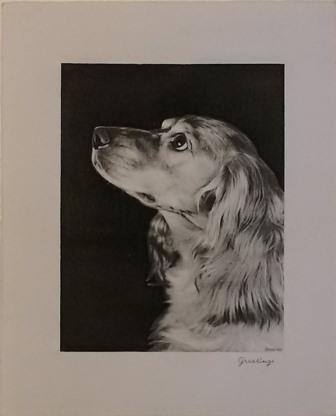
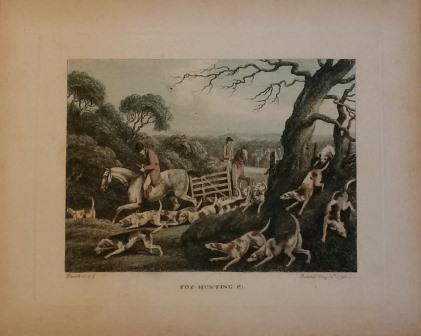
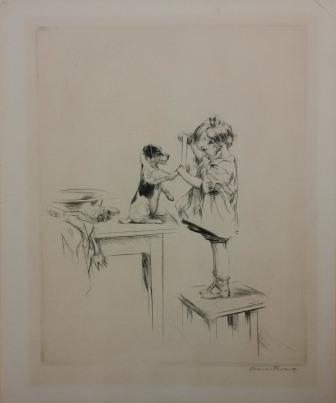
Well, maybe that title is a little bit ambitious. But, in recognition of the 142nd annual Westminster Kennel Club Dog Show – taking place this weekend – today we are looking at collections items featuring canines, particularly images of dogs that are in the stacks here at the MHS (the images, not the dogs). 

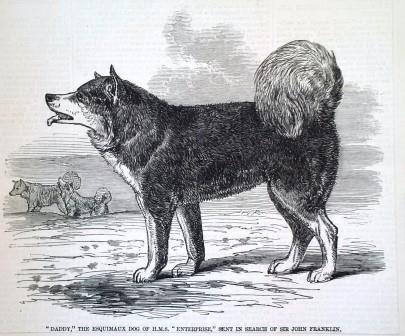
In 1845, Sir John Franklin, English rear admiral and explorer, led an expedition in search of the Northwest Passage. However, his journey met with disaster and, three years later, the remains of he and his crew were found in the Canadian Arctic.1 Of the several search and rescue missions put together to find Franklin and his men, one was carried out by the H.M.S. Enterprise and included some four-legged crew members.

“Daddy,” the Esquimaux dog of H. M. S. “Enterprise,” sent in search of Sir John Franklin.

According to a bit of text that is alongside the above image

The intelligence of the Esquimaux dogs, and their utility, is well known. The portrait of “Daddy” represents a faithful companion of Captain Collinson, who accompanied him 2000 miles, and of whom many anecdotes might be narrated; but one of the most interesting attaches to a dog of Capt. Penny, “Sultan,” who saved the life of one of Sir John Ross’ men who had indulged too freely on a visit to the Felix, when in winter quarters. The man alluded to was found by Sultan floundering in the snow at midnight, and, by his repeated intimations of something having occurred, induced some of the men to leave the ship and follow him to the spot. A few minutes more and life would have been extinct.


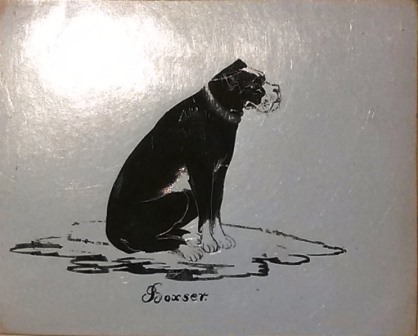
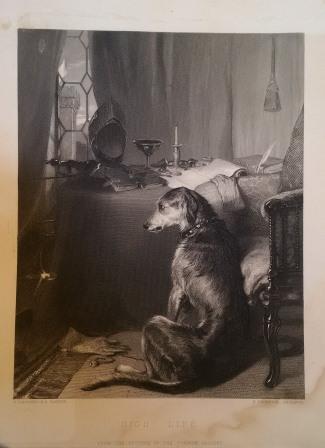
The following images have much less information to go along with them, but you can click on the links to see what we know.

Boxser. [graphic]


High life : from the picture in the Vernon Gallery [graphic] / E. Landseer, R. A. painter ; H. Beckwith engraver


Dog [graphic]


Fox-hunting, p. 1 / [graphic] Howitt in et f.


First aid / [graphic] Diana Thorne


Finally, we can connect all of this to another recent post published here on the Beehive. A few weeks ago we learned a bit about the famed showman P. T. Barnum, his lavish estate called Iranistan, and how he managed to attract the Swedish Nightingale, Jenny Lind, to perform in America. [See: “No Mere Adventurer…”]

Today, we probably associate Barnum most closely with the rise of the traveling circus, but did you know he also dabbled in dog shows? 


Small broadside advertising “A Great National Dog Show.”


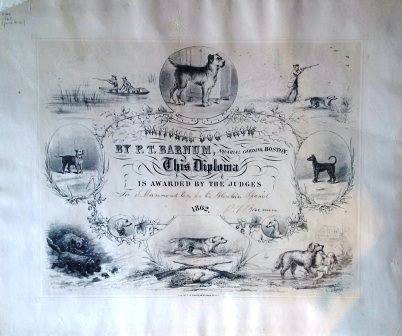
As manager of Boston’s Aquarial Gardens, Barnum arranged for a six-day show, “including every breed of dog known,” with prize money going to the top two or three finishers in each category. Those who did not finish in the top tier were given “elegantly engraved Diplomas” as evidence of the quality of their canines. Among the various breeds and classes to be judged at this event were Newfoundlands, Pointers, Coach Dogs, and Esquimaux Dogs (just like “Daddy”). Below is an example of a prize diploma. 

An elegantly engraved Diploma, “Awarded by the judges to S. Hammond Esq. for his Blenheim Spaniel.”


Based on the information provided in the advertisement above, Mr. Hammond stood to win $10 for his best-specimen spaniel. However, the last page of the three-page ad also lays out some stipulations from Mr. Barnum. To wit: 

Should the Manager desire to retain the Cash Premium Dogs on exhibition from and including June 23rd until and including Saturday June 28th, he shall have the right to do so, he continuing to provide the proper care, food and water for the Dogs FREE, and continuing to admit exhibitors of said dogs free during the time above specified.

Ever the entrepreneur and showman, it makes sense that Barnum would retain the right to attract more viewers for these prize-winning dogs. Cash paid is cash earned, I suppose. 


These are just a few examples of animal illustrations available here at the MHS. Try searching our online catalog, ABIGAIL, to see what else you can find, then consider Visiting the Library to work with material in our reading room!

*****

1. “Sir John Franklin,” Encyclopaedia Britannica, Accessed 2018-02-10 at https://www/britannica.com/biography/John-Franklin


MHS Programs Explore Aspects of African American History

By Gavin Kleespies, Public Programs

This past November, Henry Louis Gates Jr. and Maria Tatar spoke at the MHS about their new book The Annotated African American Folktales. This publication presents nearly 150 African American stories, among them familiar Brer Rabbit classics, but also stories like “The Talking Skull” and “Witches Who Ride,” as well as out-of-print tales from the 1890s’ Southern Workman. Professor Gates’ reflections on how folktales weaved into his own personal history made the power of these stories very real, while professor Tatar helped place these stories in historical context and as a part of the American literary tradition.

Both Gates and Tatar are faculty members at Harvard University. Professor Tatar is the John L. Loeb Professor of Germanic Languages and Literatures. She chairs the Program in Folklore and Mythology, where she teaches courses in German Studies, Folklore, and Children’s Literature. Henry Louis Gates, Jr., is the Alphonse Fletcher University Professor and Director of the Hutchins Center for African and African American Research. He is an Emmy Award-winning filmmaker, a literary scholar, a journalist, a cultural critic, and an Overseer and long term friend to the MHS.

For the audience, it was a captivating opportunity to hear new tales and revisit some familiar stories. These folktales are so full of wisdom, humor, whimsy, and intelligence that anyone who reads or hears them must understand that they should hold a prominent place in the Western literary canon. However, the personal stories of when these tales were first heard or memories of them being shared made the evening truly special.

Kicking off African American History Month, we have made this program available to all on our website. Over the course of the month we are hosting several programs that explore aspects of African American history.


February 8 – 6:00 pm

Thunder at the Gates: The Black Civil War Regiments that Redeemed America with Douglas Edgarton (Le Moyne College)

One of the most treasured objects belonging to the Society’s collection is the battle sword of Robert Gould Shaw, the leader of the courageous 54th Massachusetts infantry, the first black regiment in the north. The prominent Shaw family of Boston and New York had long been involved in reform, from antislavery to feminism, and their son, Robert, took up the mantle of his family’s progressive stances, though perhaps more reluctantly. In this lecture, historian Douglas R. Egerton focuses on the entire Shaw family during the war years and how preceding generations have dealt with their legacy.

$10 (free for MHS members)


February 20 – 6:00 pm

Growing Up with the Country with Kendra Field (Tufts University)

Following the lead of her own ancestors, Kendra Field’s epic family history chronicles the westward migration of freedom’s first generation in the fifty years after emancipation. Field traces their journey out of the South to Indian Territory, where they participated in the development of black towns and settlements. When statehood, oil speculation, and segregation imperiled their lives, some launched a back-to-Africa movement, while others moved on to Canada and Mexico. Interweaving black, white, and Indian histories, Field’s narrative explores how ideas about race and color powerfully shaped the pursuit of freedom.

$10 (free for MHS members)


February 26 – 6:00 pm

Supreme Injustice: Slavery in the Nation’s Highest Court with Paul Finkelman (Gratz College)

The three most important Supreme Court Justices before the Civil War—Chief Justices John Marshall and Roger B. Taney and Associate Justice Joseph Story—upheld the institution of slavery in ruling after ruling. These opinions cast a shadow over the Court and the legacies of these men, but historians have rarely delved deeply into the personal and political ideas and motivations they held. In Supreme Injustice Paul Finkelman establishes an authoritative account of each justice’s proslavery position, the reasoning behind his opposition to black freedom, and the incentives created by his private life.

This Week @ MHS

By

Welcome back to another events round-up! Here is what is happening at the Society in the week ahead:

– Tuesday, 6 February, 5:15PM : Join us for an Early American History seminar with current MHS-NEH Fellow Laurel Daen, and commenter Cornelia Dayton of the University of Connecticut. Between 1790 and 1840, Americans deemed to be cognitively disabled lost the right to vote, marry, immigrate, obtain residency, and live independently. “‘We all agree to exclude…those of unsound mind’: Disability, Doctors, and the Law in the Early Republic” charts these legal developments in Massachusetts as well as how disabled people used the courts to negotiate these contraints. Seminars are free and open to the public; RSVP requiredSubscribe to receive advance copies of the seminar papers. To RSVP: email seminars@masshist.org or call (617) 646-0579.

– Wednesday, 7 February, 12:00PM : This week’s Brown Bag talk is titled “John Winthrop, Benjamin Martin, & Worlds of Scientific Work.” Pierce Williams of Carnegie Mellon University relates how Benjamin Martin was regarded by natural philosophers of his age as a showman and peddler of pseudo-scientific trinkets. At the same time, John Winthrop was working to elevate the North American colonies in the topography of learned culture. This project attempts to understand Winthrop’s puzzling choice of Martin to refurbish Harvard’s scientific instrument collection after the college laboratory burned to the ground in 1764. This talk is free and open to the public. 

– Wednesday, 7 February, 6:00 PM : In “Reconsidering King Philip’s War,” two historians reexamine the narrative of one of colonial America’s most devastating conflicts. Lisa Brooks, Amherst College, recovers a complex picture of war, captivity, and Native resistance during the “First Indian War.” Christine DeLucia, Mount Holyoke College, offers a major reconsideration of the war, providing an alternative to Pilgrim-centric narratives that have dominated the histories of colonial New England. The program will include short presentations by both scholars followed by a conversation. This talk is open to the public, registration required with a fee of $10 (no charge for MHS Members and Fellows, and EBT cardholders). We have exceeded the seating in our main room. Audience members registering on or after February 1st will be seated in overflow seating.

– Thursday, 8 February, 6:00PM : The second author talk this weak features Douglas Egerton, Le Moyne College, and his recent work Thunder at the Gates: The Black Civil War Regiments that Redeemed AmericaOne of the most treasured objects belonging to the Society’s collection is the battle sword of Robert Gould Shaw, the leader of the courageous 54th Massachusetts infantry, the first black regiment in the North. The prominent Shaw family of Boston and New York had long been involved in reform, including antislavery and feminism, and their son, Robert, took up the mantle of his family’s progressive stances, though perhaps more reluctantly. In this lecture, historian Douglas R. Egerton focuses on the entire Shaw family during the war years and how following generations have dealt with their legacy. This talk is open to the public, registration required with a fee of $10 (no charge for MHS Members and Fellows, and EBT cardholders).

– Saturday, 10 February, 10:00AM : The History and Collections of the Massachusetts Historical Society Tour is a 90-minute docent-led walk through our public rooms. The tour is free, open to the public, with no need for reservations. If you would like to bring a larger party (8 or more), please contact Curator of Art Anne Bentley at 617-646-0508 or abentley@masshist.org

While you’re here you will also have the opportunity to view our current exhibition: Yankees in the West.


History by the Numbers: A Gomes Prize Ceremony conversation between 2017 recipient Tamara Thornton and MHS President Catherine Allgor

By Alexis Buckley, Research Department

In 2016, the MHS founded the Peter J. Gomes Memorial Book Prize, awarded annually for the best book on the history of Massachusetts. The prize honors the memory of the Reverend Professor Gomes, a Harvard scholar and a respected and beloved Fellow of the Massachusetts Historical Society for almost thirty-five years. Peter Gomes believed in the transformative power of engaging with the past, and held an especial fondness for the history of his native state. He extolled the role of the imagination in creating a better world.

About two centuries earlier, another Massachusetts native himself set out to create a better world. His name was Nathaniel Bowditch, and above all he believed in the power of numbers. Thus it’s only fitting that the 2017 Gomes Book Prize was awarded to historian Tamara Plakins Thornton for her biography, Nathaniel Bowditch and the Power of Numbers: How a Nineteenth-Century Man of Business, Science, and the Sea Changed American Life. Thornton brings to life the Atlantic-facing maritime world of Bowditch’s hometown, the bustling port of Salem. She also reveals Bowditch’s role in creating the numbered and sorted bureaucratic society familiar to us today, from creating navigational tables, to organizing the collections of Salem’s East India Marine Society—now the Peabody Essex Museum—and the Massachusetts Hospital Life Insurance Company, to introducing a numerical grading system at Harvard. As Thornton demonstrates, Bowditch took his faith in numbers and transformed the world.

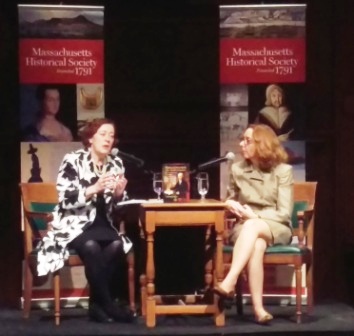
Thornton joined us at the Society on Thursday, Jan. 25, to receive the 2017 prize. Like any good historian, she came in early to spend the day in our reading room, diving into the research for her next project. (Not to mention using collections well numbered and sorted! Our library staff would make Bowditch proud.) Come evening, after Ellis Hall had been transformed for the award ceremony, she received her award check and a certificate beautifully framed and matted with century-old French endpaper. She then took to the stage to commence a conversation on what it means to be a historian and a biographer.

Who better to join Thornton in this conversation than our new president, Catherine Allgor, another historian cum biographer? Allgor’s biography of Dolley Madison followed her work Parlor Politics, on the founding women of the early republic, much as Thornton’s biography of Bowditch followed her monographs on handwriting and the making of country life by the nineteenth-century Boston elite.

Fortunately for those too far away—or too cold!—to attend the program, the conversation was filmed and is now available for you to watch online. Allgor and Thornton spoke about transitioning from writing monographs to writing biographies, and the advantages they had in having already written books that made them familiar with their subject’s world: in Dolley Madison’s case, it was Washington D.C. and all its politicking; for Nathanial Bowditch, it was the surprisingly cosmopolitan city of Salem. More specifically, Bowditch lived in a world of merchants and shipping, where—instead of the Latin and Greek needed for Harvard—young men bound for occupations as clerks and navigators learned math and penmanship. Of course, Thornton and Allgor continued, writing biography also means considering the role of inborn personality and temperament in relation to the influence of the subject’s era.

MHS President Catherine Allgor and Gomes Prize recipient Tamara Thornton, in conversation.


Thornton and Allgor also discussed their efforts to find points of familiarity with their subjects while keeping in mind that the past remains a foreign country. Allgor enjoyed taking a fresh look at Washington politics in its infancy through Dolley Madison, and considering how the politics we know today are contingent on so many nineteenth-century choices that people such as Madison made. Thornton described the uncategorized society that Bowditch transformed, with numbers and forms, into the world we live in today.

And, of course, the two biographers discussed Bowditch’s love of numbers. He was inspired by the rules and regularity of the solar system, and sought to recreate that wherever he could. He saw the world, Thornton said, in “pluses and minuses.” He loved the certainty of numbers. If you were incorrect, inaccurate, immoral, wrong: all of these things were the same to him.

There is more to be heard on the video, about finding sources and excluding them, about Bowditch’s views on the places he sailed to around the world, and about strange and unexpected discoveries in the archives! But I will keep this entry short enough to fit on one of Bowditch’s blank forms, and merely suggest that you watch the video, then pick up Tamara Thornton’s award-winning book and take your own trip to Nathaniel Bowditch’s ordered world.

If you’ve published a book on Massachusetts history copyrighted in 2017, we invite you to submit your work for consideration to receive this year’s Gomes Prize, and we look forward to telling all of you what the 2018 competition brings!


Barbara Hillard Smith’s Diary, January 1918

By Anna Clutterbuck-Cook, Reader Services, and Intern Lindsay Bina

A new year means a new serialized diary here at The Beehive, where for the past three years we have showcased a diary from the collections written one hundred years ago (you can read the 2015, 2016, and 2017 series in our archives!). This year’s diary was transcribed by intern Lindsay Bina.


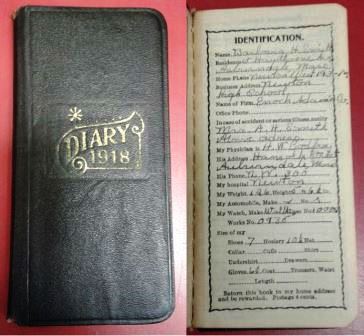
The diary for 2018 is a tiny line-a-day diary kept by teenager Barbara Hillard Smith. Smith was born on 16 July 1903 and was fourteen in January of 1918 when she began keeping her diary. Before she began to record her daily activities, Barbara carefully completed the “Identification” page in the front of the diary, noting that her weight was 126, her height 5 feet, 6 ½ inches, her shoe size a 7, her hosiery 10 ½, and her gloves 6 ¼. Her telephone number was Newton West 193-M and her physician was an H.W. Godfrey. She was a student at Newton High School.

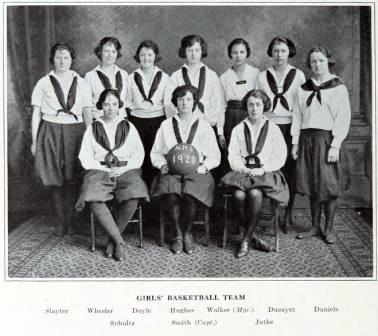
Image from The Newtonian (1920) yearbook. Barbara was captain of her basketball team senior year and is depicted in the center holding a basketball.


Without further ado, we bring you January 1918 through the eyes of a Newton teenager.

* * *

TUES. 1                      JAN., 1918 NEW YEAR’S DAY

Muriel’s. Skating at Bulloughs. Women Club Play


WED. 2

Went over to Aunt Mabels.


THUR. 3      

Mother went to New York. Aunt Mabels.


FRI. 4

Aunt Mabels


SAT. 5

Aunt Mabels


SUN. 6

Came home


MON. 7

School. Took care of the baby.


TUES. 8

School. Basket Ball.


WED. 9

Sick with cold. Peg hurt her back


THUR. 10

Sick with cold. Had Dr. Godfrey.


FRI. 11

Cold Better. Mother came home


SAT. 12

In the house. Down street.


SUN. 13

Church. Sunday School. Service flag unfurled. Skating in back yard. Sick


MON. 14

School. Stayed for algebra. Pegs skating


TUES. 15

School. Stayed for geometry. Pegs.


WED. 16

School. Stayed for French. Skating in front yard.


THUR. 17

School. Skating at Pegs. Concert at the Seminary


FRI. 18

School. Down to Rosa’s. Watched swimming class.


SAT. 19

Shampoo at Miss Mitchells. Sewed on my dress. Down town


SUN. 20

Sunday School. Hung around


MON. 21

School. Took care of the baby.


TUES. 22

School. Basketball. up to Mrs. Reed’s


WED. 23

School. Took care of baby.


THUR. 24

School. Basketball


FRI. 25

School. Camp Fire. Swimming.


SAT. 26

Skating with Mrs. Moody. Pegs. Mother Carey’s Chickens.


SUN. 27

Church. S.S. Skating at Pegs. [Havene] here. Fell down and hurt my back


MON. 28

Home with my back. Felt kind of weak


TUES. 29

Home with my back. Took care of sonny. Father died.


WED. 30

School. Took care of sonny.


THUR. 31

School. Basket Ball. Symphony and Mischa Elman.


* * *

If you are interested in viewing the diary in person in our library or have other questions about the collection, please visit the library or contact a member of the library staff for further assistance.


 *Please note that the diary transcription is a rough-and-ready version, not an authoritative transcript. Researchers wishing to use the diary in the course of their own work should verify the version found here with the manuscript original. The catalog record for the Barbara Hillard Smith collection may be found here.


This Week @ MHS

By

It’s time, once again, to see what public programs are coming in the week ahead here at the MHS:

– Monday, 29 January, 6:00PM : Martha McNamara of Wellesley College and Karan Sheldon of Northeast Historic Film discuss the selection of essays they recently edited titled Amateur Movie Making: Aesthetics of the Everyday in New England Film, 1915-1960, which illustrates how early twentieth-century amateur filmmaking produced irreplaceable records of peoples’ lives and beloved places. In this converation, McNamara and Sheldon highlight three examples: the comedies of landscape architect Sidney N. Shurcliff, depictions of pastoral family life by Elizabeth Woodman Wright, and the chronicles of Anna B. Harris, an African American resident of Manchester, Vermont. This talk is open to the public, though registration is required with a fee of $10 (no charge for MHS Members/Fellows or EBT Cardholders). Pre-talk reception begins at 5:30PM, followed by the speaking program at 6:00PM.

– Tuesday, 30 January, 5:15PM : The seminar this week comes from the Modern American Society and Culture series, and features the work of Anne Gray Fischer of Brown University, with Brandeis University’s Michael Willrich providing comment. “‘Momentum Toward Evil Is Strong’: Poor Women, Moral Panics, and the Rise of Crime-Fighting Policing in Depression-Era America” explores the dramatic shift in public perception of American law enforcement between Prohibition and World War II by studying the changing practices of Depression-era morality policing in boston and Los Angeles — specifically, the police enforcement of moral misdemeanors, including vagrancy, disorderly conduct, lewdness, and prostitution, which disproportionately targeted poor women on city streets. 

Seminars are free and open to the public; RSVP requiredSubscribe to receive advance copies of the seminar papers. To RSVP, e-mail seminars@masshist.org or call (617) 646-0579.

– Wednesday, 31 January, 12:00PM : Stop by at noon for a Brown Bag talk with short-term research fellow Angela Hudson of Texas A&M University. “Indian Doctresses: Race, Labor, and Medicine in the 19th-century United States” focuses on women who worked as Indian doctresses and the clients who sought their care. They study strives to more fully integrate indigeneity into fields of study from which it is often absent, most notably labor history and the history of medicine. This talk is free and open to the public 

– Saturday, 3 February, 10:00AM : The History and Collections of the MHS is a 90-minute, docent-led walk through the public spaces of the Society’s home at 1154 Boylston St. The tour is free and open to the public with no need for reservations for individuals and small groups. Those wishing ot bring a larger party (8 or more), please contact Curator of Art Anne Bentley in advance at (617) 646-0508 or abentley@masshist.org. While you’re here you will also have the opportunity to view our current exhibition: Yankees in the West.


Charles Cornish Pearson and the Great War, Part III

By Susan Martin, Collection Services

This is the third post in a series about the wartime experience of Charles Cornish Pearson. Go back and read Part I and Part II for the full story.

*****

Today we return to the letters of Charles Cornish Pearson, a young man who served during World War I with the 101st Machine Gun Battalion, 26th Division, American Expeditionary Forces. If you want to catch up on the story, see Part I and Part II.

When we left him, Charles had been a soldier for about nine months and had seen his first direct fighting in the trenches of France’s Chemin des Dames sector. On 18 March 1918, his battalion pulled up stakes and began the two-week journey via train and automobile southeast to the Toul sector. The weather was beautiful, the country picturesque, and the troops enjoyed the welcome respite. This part of France was mostly untouched by the war. Charles wrote to his mother en route and described a typical French village.

It is all very peaceful and so different from what we have experienced lately. Here War seems to have affected the village in the lack of men, hardly any being about except those past the age limit, and of course there are a few deserted houses and the others not kept up quite as well as in peace times I imagine. Picture on the other hand a village without any civilian population not a habitable house & even the church in ruins, with the military forces quartered in dugouts or cellars of the ruins of the old houses. It is an awful contrast I can tell you, still you quickly get hardened to it all, and take it all as part of the days work.

The 101st arrived at their destination on 1 April 1918, and Charles’ platoon was stationed at Mandres-aux-Quatre-Tours. He was promoted from corporal to sergeant that same day. The following day, coincidentally, was his 28th birthday.

Charles’ letters, originally chatty and carefree, had become a little more subdued as he experienced the realities of war first-hand. He described bursts of chaotic activity followed by periods of anxious waiting and uncertainty. The battalion never knew when it might be called into action at a moment’s notice. Meanwhile, regular gas alarms and barrages of shells frayed everyone’s nerves. (“They usually tune up about night fall,” Charles wrote to his sister, “so as to disturb our sleep I guess. These Boche certainly have a mean disposition that way, but suppose our gunners treat them the same way.”) Charles also told harrowing stories—for example, the day his detail dragged two dead mules and a wagon out of an exposed road, narrowly avoiding the German bombs dropped on the spot immediately after. All this kept him keyed up most of the time, he admitted.

Philip S. Wainwright, in his History of the 101st Machine Gun Battalion, confirms that Charles’ platoon at Mandres “had its share of shelling every night.” (p. 33) Of course, Charles described things to his parents is his usual wry, understated way.

Up to the present time cann’t [sic] say that it has been especially tranquil. However we have gotten over the newness of it now and can listen to a big gun without shaking too much. […] Even at the present writing the Boche are sending a few shells over, but way over so don’t have to worry much. Funny how you can get to tell pretty well if they are coming near you by their whistle. At times that whistle gets on ones nerves but you can usually figure they are trying to locate a battery and not worrying about small fry such as yours truly.

April 19 was his parents’ anniversary, and he sent a telegram to mark the occasion. The following day, in the early morning hours, the Germans launched a surprise attack, and Charles found himself right in the middle of the Battle of Seicheprey. It was the largest American battle up to that point and certainly the worst fighting Charles had seen, but the Americans (mostly Connecticut men) held their own against the larger and more experienced German army and forced “the Hun” back.

According to Wainwright, “During the intense bombardment of high explosive and gas which preceded the attack,” Charles’ platoon “suffered the first real casualties that occurred in the Battalion.” (p. 34) The first man of the 101st to be killed was Private Giuseppe “Joe” Molinari. Charles wrote to his parents in the aftermath of the battle and, without going into detail, called the past hours “H–l rippers” and “heartbreakers.” After his platoon was relieved, he reflected on his recent experiences in a letter to his brother.

We are supposed to be trained soldiers now so we get our full share of excitement that is going on. It sure is a plenty I can tell you. No use describing things over here as it [is] beyond my power any way. You have a nice explosive gas shell land in the story over your head during a general bombardment in the night and you have to get up half asleep & put on a gas mask and then wonder what your chances are of making a dugout. Take a hike up a road that is called Dead Mans Curve and pull a couple of dead mules off the road and with your detail grab hold of the wagon & pull it back for about ½ mile so it wont impede traffic, wondering all the time when they will harass the road again. You can write these things down but the reader doesn’t get any idea of what one is thinking of when said things are happening.

To his parents that same day, he wrote a letter just two pages long, closing with: “Don’t feel much in the mood for letter writing today, will try to do better next time.”

Hope you’ll join me for the next installment of Charles’ story.

Reference Collection Book Review: Boston’s South End

By Brendan Kieran, Reader Services

In Boston’s South End: The Clash of Ideas in a Historic Neighborhood Shawmut Peninsula Press, 2015), Russ Lopez constructs an engaging historical account of the South End from before the start of its development as a neighborhood in the 1850s through the time of his writing (22). Lopez, who lives in the South End, teaches in the School of Public Health at Boston University and has written books and articles on topics relating to urban environments (285). This background is on display in his writing as he integrates a variety of social developments and changes in the neighborhood over time into a coherent, highly-readable work.

“HEADQUARTERS, 20 Union Park,” from South End House: Longer and Shorter Retrospects 1891-1911 by the South End House ([Boston, 1912]).


Lopez challenges a widely-held narrative of glorious early years, decades of decline and squalor, and later resurgence in the South End, and sheds light on “a much more nuanced history” (xi). He does so utilizing “public records, newspaper articles, older books, published reports, and the personal papers of past and current residents” (ix). Beginning in the Ice Age, Lopez discusses the Indigenous populations of the area, the early settlement of Boston by Europeans, and the development of the neighborhood in the 19th century. He then looks at the various populations that have inhabited and worked in the South End over the years, including Irish and Jewish immigrants; Black, Latino, and gay and lesbian communities; and, more recently, the wealthy white people who have come to dominate the neighborhood.* He also documents the churches, housing, social and cultural organizations, forms of work, customs, and other aspects of life that these residents have created, participated in, and used to shape the neighborhood.

The second half of Lopez’s book largely covers the urban renewal period of the 1950s to 1970s and the developments in the decades that have followed. He explores the actions of city agencies and officials, as well as the drastic displacement and demographic changes that occurred beginning in the mid-20th century. The urban renewal period was very a challenging one in the South End, marked by tensions between the city and residents as well as turmoil along racial lines among residents. Lopez frames the second half of the 20th century to the present as a time of social and economic pressure for low-income people in the neighborhood, with gentrification and rising prices being a near-constant feature of South End life. However, he chronicles the community resistance of these decades, including various organizations that pushed back against economic violence and pursued their own plans, earning some successes such as the creation of the Villa Victoria housing development (168-170).


“WOMEN’S RESIDENCE, 43-47 East Canton Street,” South End House, from South End House: Longer and Shorter Retrospects 1891-1911 by the South End House ([Boston, 1912]).


Lopez in many ways provides an engaging social history of the neighborhood and its connections to the city of Boston as a whole. He successfully charts the developments and changes within the South End’s religious communities, documents the importance of the South End for decades as a center of Boston’s Black community (91-92), and chronicles the many implications of urban renewal on the neighborhood. Lopez not only challenges the established narrative, he redefines it. His emphasis on forms of housing, employment, recreation, and other aspects of life allows him to really explore the social and cultural fabric of the neighborhood over time. Furthermore, by noting the differences in housing types, income levels, and other demographic differences within various sections of the neighborhood, he is able to create an intricate view of the South End over time. His prose is complemented by a variety of photographs throughout the book.

While the depth of Lopez’s research and his emphasis on the geography of the neighborhood are impressive, he occasionally leaves a desire for a closer look at certain social and cultural developments and groups in the city, such as the briefly-mentioned Syrian population in the mid-20th century (69, 144). Additionally, some editorial decisions leave room for potential challenges. For example, while the book includes some maps, more of them could have been helpful for making sense of the close, detailed descriptions of the neighborhood offered by Lopez. In addition, Lopez cites some letters without providing collection or publication information, which could present difficulties for researchers who would like to track down those sources (40-41). Ultimately, these issues do not prevent Lopez from accomplishing his goal of writing a complex and illuminating story of the South End’s existence over time.


 Boston City Hospital, 1880s. Taken by Allen & Rowell. In Photographic Views of Boston, Mass., Box 3, #12.175.


This book may be of interest to historians of Boston’s neighborhoods; urban historians in general; historians of urban geography and the built environment; scholars of urban renewal; historians of race in Boston; and historians of Boston’s Black, Latinx, and LGBTQ communities. There is much in this book for academic researchers and community historians alike; it is also a worthwhile and accessible text for a casual reader who is interested in learning a bit more about Boston’s history.


*In recent years, “Latinx” has gained popularity as a gender-neutral term. I use “Latino” in this paragraph to reflect the language used by the author in the book.


Related Materials

Manuscript Collections

Sarah Pananty Writings and Bibliographies, [193-]-1940.

South Congregational Church Records, 1828-1929.

Robert Treat Paine Papers II, 1733-1965; bulk: 1880-1949.

Henry Lee Shattuck Papers, 1870-1971.

Walter Muir Whitehill Papers, ca. 1941-1978.


Print Materials

Neighbors All: A Settlement Notebook by Esther G. Barrows (Boston: Houghton Mifflin, 1929). 

Chain of Change: Struggles for Black Community Development by Mel King (Boston: South End Press, 1981).

Report to the Massachusetts Legislature, by the Committee on Education : in favor of an appropriation of $5,000, to the Female Medical Education Society, together with the constitution, names of officers and members, and other information respecting the Society, and the Boston Female Medical School” by the Massachusetts General Court Joint Committee on Education (Boston: Female Medical Education Society, 1851).

Life in the Boarding House: Elizabeth Dorr’s Diaries

By Shelby Wolfe, Reader Services

During a recent search in our online catalog, ABIGAIL, I came across two subject headings that caught my attention – “Single women” and “Boardinghouses—Massachusetts.” These struck me as familiar since during my first years in Boston as a single graduate student I lived in something similar to a boarding house just a few minutes’ walk from the MHS. Six floors of 160-square-foot rooms housed over one hundred single women, mainly students and young professionals, with the occasional resident who had lived there for decades. In my circle of friends, the building is commonly referred to as “the convent” – after all, that’s what it once was and retains traces of with its still-used chapel and a scattering of Catholic iconography, figurines, and crucifixes throughout. 

Like you might expect, living in the convent came with its fair share of rules – no visitors allowed beyond the first floor common areas, shared kitchens close at 10:00 PM, shared bathrooms must be kept tidy, no food allowed in certain areas, no alcohol, no candles, quiet hours must be respected, etc. Even with its rules, living in the convent was a privilege – central location, affordable rent, and—perhaps my favorite part of all—a community of fellow residents from a variety of backgrounds who held a range of unique interests and skills.

I was fascinated to read in Elizabeth Dorr’s 1845-55 and 1859 diaries (where the aforementioned subject headings of “Single women” and “Boardinghouses” led me) about the diarist’s day-to-day activities and interactions while living in a 19th-century boarding house. Elizabeth Dorr, who worked as a tutor and never married, first describes her Dorchester lodgings and fellow boarders in a diary entry on Saturday, 3 June 1854:

This day I arrived at Mr. Hiram Shephards, Winter St. to take up my abode for the present. MGL and I having a joint right in a very small bedroom and a not very large parlor with pleasant windows to the North, East, & South – two to each point. The family consists of mine host, his wife, a little son of five years rejoicing in the pretty name of Walter, a little motherless niece of Mrs. Shephard’s just three years old who answers to Alice and calls father & mother with Walter. Our fellow boarders are two German gentlemen named Ansorge. Charles the elder somewhere between thirty and forty. Organist at Mr. Hall’s and director of the music there on Sundays & teacher of German & Music. Alfred the younger brother may be about nineteen. Both speak English intelligently & the former is a man of evident culture & general knowledge which promises an agreeable prospect for our hours of eating – a serious consideration to a dyspeptic this pleasant chat at feeding times.


Elizabeth Dorr, [photograph] [19–]

Copy photograph of a daguerreotype of Elizabeth Dorr. Taken by an unidentified photographer.


While she doesn’t indicate any rules or conditions of occupying her rooms (of course, she wasn’t living in a convent), Elizabeth fills the pages with delicately transcribed accounts of social visits from friends, invitations to tea, and remarks on the weather. Some days are filled with three or four social visits (she could have friends over!) and outings to the Academy or a stop at Thornton’s for soda. Other entries reflect a different pace: Monday, 7 November 1859, “Too entirely exhausted to go to tea at Mrs. Rodman’s”; Sunday, 13 November 1859, “Dull. at home all day.” I learned from her 1854 diary that Friday, 21 July 1854, was “Too warm for action” and the Friday after Thanksgiving in 1859 was “almost summerish.”

The final page stood out from the rest as I read Elizabeth Dorr’s 1859 diary – the latest in the collection. She begins with one of those lines in a diary that transports a reader out of an individual’s personal life and solidly reminds one of the greater context in which this person lived – Friday, 2 December 1859, “Returned by Belleview road, bells ringing at the African church as we returned on account of John Brown’s execution.” The final lines of the diary, written two days later, absorb the reader back into Elizabeth’s daily routine of omnibus excursions and social visits, ending aptly with plans “to see a friend.”

If you are interested in viewing Elizabeth Dorr’s diaries yourself, please visit the library or contact a member of the library staff for assistance.