This Week @ MHS

By

It is a very quiet week here at the Society as we await the thaw following last week’s storm. Here are the calendar notes for the coming days:

The Exhibition Galleries are CLOSED on Monday, 8 January and Tuesday, 9 January. Normal hours resume on Wednesday, 10 January.

– Saturday, 13 January, 10:00AM : The History and Collections of the MHS is a 90-minute docent-led tour of the Society’s public spaces. The tour is free and open to the public with no need for reservations for indivudals or small groups. If you would like to bring a larger party (8 or more), please contact Curator of Art Anne Bentley at 617-646-0508 or abentley@masshist.org

While you’re here you will also have the opportunity to view our current exhibition: Yankees in the West.

A New Year’s Greeting from Merrymount Press, 1918

By Anna J. Clutterbuck-Cook, Reader Services


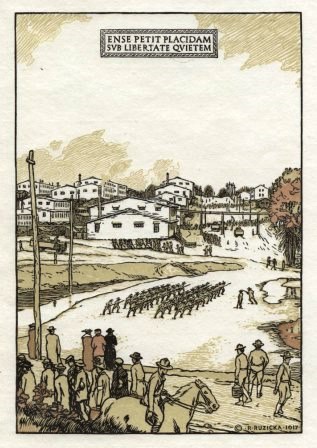
Welcome to the future! In this first week of the new year, I bring you a New Year’s greeting from one hundred years in the past. This illustration by Rudolph Ruzicka (1883-1978) graced the annual greeting to the friends of Merrymount Press, Boston at the dawn of the year 1918. The image is a view of the parade ground at Camp Devens (Ayer, Mass.) and the Latin text at the top of the image is the official motto of the Commonwealth of Massachusetts, “Ense petit placidam sub libertate quietem,” translated into English as “she seeks with the sword a quiet peace under liberty” — a solemn message for the advent of a year under the shadow of World War One.

The Massachusetts Historical Society holds a collection of illustrations by Ruzicka, himself a member of the Society for many years, as well as many titles printed by Merrymount Press. You are welcome to explore our print holdings through our online catalog ABIGAIL and reach out to the library staff with any questions you have about accessing items in our collection.

We look forward to welcoming you to the library in 2018 and beyond!


This Week @ MHS

By

We are back to business this week at the Society, thought it appears that Mother Nature may have other plans for us. Without thinking about the weather, here is what is on the calendar for the first week of the new year:

– Wednesday, 3 January, 12:00PM : Derek O’Leary of the University of California, Berkeley, kicks off the year with the first Brown Bag talk of 2018, “Excavating the Western Indian Mound and Building the American Archive.” Settlers and travelers moving westward in the early republid encountered the myriad Indian mounds scattered along the American frontier. These sundry earthworks furnished ample grist for various projects: frontier infrastructure, literary nationalism, the national historical narrative, and – as this talk explores – the emergence of the American archives. This talk is free and open to the public. 

– Saturday, 6 January, 10:00AM : The History and Collections of the Massachusetts Historical Society Tour is a 90-minute docent-led walk through our public rooms. The tour is free, open to the public, with no need for reservations. If you would like to bring a larger party (8 or more), please contact Curator of Art Anne Bentley at 617-646-0508 or abentley@masshist.org.

While you’re here you will also have the opportunity to view our current exhibition: Yankees in the West.

Throughout the winter, please keep an eye on our main website and online calendar for information about weather-related closings. 

This Week @ MHS

By

The library is CLOSED this week but you can still stop in and view our current exhibition, Yankees in the West. Gallery hours for the week between Christmas and New Year are as follows:

– Monday, 25 December : CLOSED

– Tuesday, 26 December : 10:00AM-4:00PM 

– Wednesday, 27 December : 10:00AM-4:00PM 

– Thursday, 28 December : 10:00AM-4:00PM 

– Friday, 29 December : 10:00AM-4:00PM 

– Saturday, 30 December : 10:00AM-4:00PM. There is also a free building tour on Saturday. Be here at 10:00AM for the History and Collections of the MHS

The Society is CLOSED on Monday, 1 January. Normal hours resume on Tuesday, 2 January. 

Happy Holidays!

Winter in Boston

By Rakashi Chand, Reader Services

Happy Winter Solstice!

I have gathered a few historic winter views of Boston for you to enjoy on this long winter’s night.


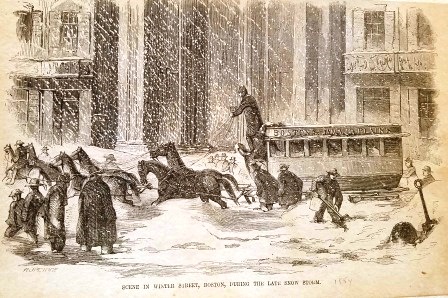
To begin, let’s just say that Bostonians have always been a hardy lot. “Scene in Winter Street, Boston, during the late snow storm” by W. J. Peirce, illustrates the horse-drawn Boston & Jamaica Plains Trolley attempting to get through the storm of 1854. Today we complain about trolley service delays during snow storms, imagine trudging out with a shovel to clear the trolley path through Boston’s congested city streets in 1854. 

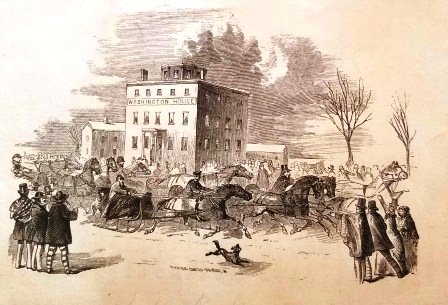
In modern culture we romantically idealize sleigh rides through the snow as a common winter pastime of “yester-year”. Well, apparently that was not enough for Bostonians who clearly craved much more excitement. Lets reimagine that “Currier and Ives” Christmas image and instead think of Sleigh Racing on Boston Neck circa 1850. Sleigh Racing was a popular winter activity at the time and this graphic depicts the crowds milling around applauding the action as men race down Boston Neck (now filled in) with the Washington House in the background. 

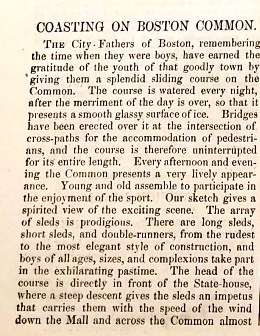
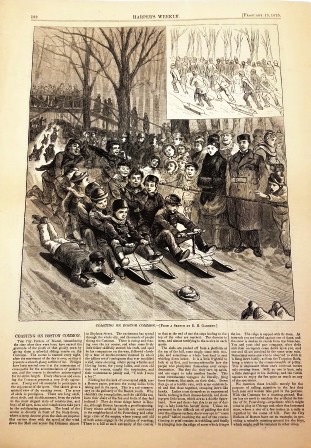
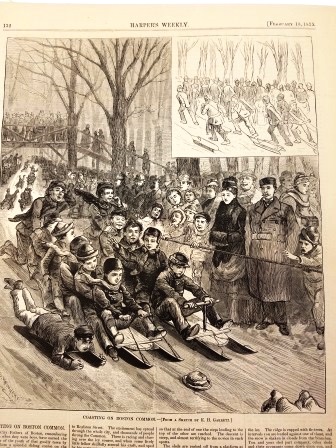
And perhaps the most wonderful of all Winter activities, with an equally delightful description, “Coasting on the Common” seems like the perfect winter thing to do, doesn’t it? For those of you who are not familiar with Boston, the Boston Common is a public park in the middle of the city, directly in front of the Massachusetts State House. Published in Harper’s Weekly, V. 19, no. 946, February 13, 1875 p.132 this graphic “Coasting on Boston Common” from a sketch by Edmund Henry Garrett, depicts boys on sleds on Boston Common racing downhill, while adults in the crowd look on. An insert in the upper righthand corner shows the boys pulling their sleds back up the hill. The city of Boston actually built and maintained the ‘coasting’ course, and even built bridges over the course for spectators to watch the action from overhead. 


The article states “boys of all ages, sizes and complexions take part in this exhilarating pastime.” And that “Nothing but the lack of unoccupied sleds, says a Boston Paper, prevents the young ladies from taking part in the sport. This is a sad commentary on the gallantry of Boston youth. Why shouldn’t the young ladies, and the old folks too, have their share of fun and frolic if they feel inclined?” Although the article does go on to say that “young ladies “come to grief” before reaching the end on the course”, it is still rather liberal for 1875, indicating that ‘Coasting on the Common’ was truly open to all.


If you happen to be in Boston to enjoy the winter holiday, stop into to see our exhibitions, which are free and open to the public.  The exhibitions includes a special display of the “Anti-Christmas laws”- yes! you read that correctly! Curious to learn more? Stop in to see the Anti-Christmas proclamation.During the holiday week, the galleries will be open Tuesday (12/26) through Saturday (12/30) from 10am to 4pm.


This Week @ MHS

By

There is just one event on the calendar for the coming week here at the Society:

– Tuesday, 19 December, 5:30PM : This week’s seminar is part of the History of Women and Gender series. Micki McElya of University of Connecticut leads the discussion and Genevieve A Clutario of Harvard University provides comment. “Miss America’s Politics: Beauty and the Development of the New Right since 1968” examines the centrality of the Miss America pageant, its local networks, and individual contestants to the rise of conservative women and the New Right in the 1960s and 1970s. It analyzes the celebration, power, and political effects of normative beauty, steeped in heterosexual gender norms and white supremacy, and argues for the transformative effect of putting diverse women’s voices at the center of political history and inquiry. 

Seminars are free and open to the public; RSVP requiredSubscribe to receive advance copies of the seminar papers.

Please note that the library closes early on Monday, 18 December, at 3:30PM, and the building closes at 4:00PM. Also, the MHS is CLOSED on Saturday, 23 December. The library remains closed the following week and reopens on Tuesday, 2 January. See the online calendar for more details about holiday closures and gallery hours. 

This Week @ MHS

By

As the end-of-year holidays approach we are slowly applying the brakes to our programming schedule here at the Society. However, we still have a few public events coming in the next couple of weeks. Here are the items on offer in the week ahead:

– Tuesday, 12 December, 5:15PM : Hannah Anderson of University of Pennsylvania leads the discussion in the this week’s Environmental History Seminar. “Lived Botany: Settler Colonialism, Household Knowledge Production, and Natural History in Eighteenth-Century Pennsylvania” examines how colonists developed ways of interpreting their landscapes that simultaneously partook of and deviated from the norms of eighteenth-century natural history. Domestic spaces became sites where colonists created information about the natural world, allowing them to feel secure in the new environments where they claimed dominion. Thomas Wickman of Trinity College is on-hand to provide comment. Seminars are free and open to the public. To RSVP, e-mail seminars@masshist.org or call 617-646-0579. Subscribe to receive advance copies of the seminar papers.

– Wedensday, 13 December, 6:00PM : Come in for an author talk with Manisha Sinha of University of Connecticut, whose most recent work is The Slave’s Cause: A History of Abolition. This book broadens the chronology of abolition beyond the antebellum period, and sets the abolition movement in a transnational context and illustrates how the abolitionist vision ultimately linked the slave’s cause to the struggle to redefine democracy and human rights across the globe. This event is open to the public; registration is required with a fee of $10 (no charge for MHS Members or Fellows). A pre-talk reception begins at 5:30PM, followed by the speaking program at 6:00PM.

– Saturday, 16 December, 10:00AM : The History and Collections of the Massachusetts Historical Society Tour is a 90-minute docent-led walk through our public rooms. The tour is free, open to the public, with no need for reservations. If you would like to bring a larger party (8 or more), please contact Curator of Art Anne Bentley at 617-646-0508 or abentley@masshist.org.

While you’re here you will also have the opportunity to view our current exhibition: Yankees in the West


Charles Cornish Pearson and the Great War, Part I

By Susan Martin, Collections Services

I’d like to introduce Charles Cornish Pearson, a young man who served during World War I in the 101st Machine Gun Battalion, 26th Division, American Expeditionary Forces. The MHS acquired his papers a few months ago, but as I looked at them more closely, I realized there was so much good material that I’m going to stretch his story out over several posts. I hope you’ll enjoy it as much as I have. The collection also came to us with 32 terrific photographs, undated and mostly unidentified, some of which I’ll be using as illustrations.
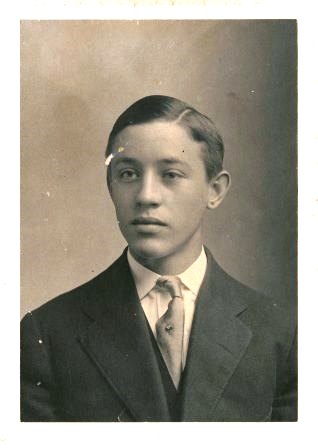
 

Charles C. Pearson was born on 2 April 1890, the son of Charles H. and Gertrude (Cornish) Pearson. He grew up in Arlington, Mass. with his older brother Bill and younger sister Jean. He graduated from Somerville Latin High School in 1908 and Massachusetts Agricultural College in 1912. The MAC yearbook described him like this:

This is little “Napoleon.” When he came here, he hit the studies hard and now he doesn’t have to plug, because the “Profs.” pass him on general principles. He holds the reputation of being one of the really good-looking men in the class who doesn’t fuss. “Connie” had an awful time electing his courses. He wanted to take everything, but of course they wouldn’t let him. We shouldn’t be a bit surprised to see him a member of Phi Kappa Phi.

Charles worked as a salesman after college, specifically as manager of the Hartford, Conn. office of E. Naumburg & Co. The U.S. entered World War I on 6 April 1917, Charles enlisted 12 June, was appointed corporal 1 July, and shipped out to France in early October. His letters at the MHS were written primarily to his mother Gertrude, his father Charles, his aunt Florence, and his brother and sister. He signed his correspondence variously as Charles, Cornish, C.C.P., and most often as “Buster,” but I’ll just call him Charles for simplicity’s sake.

Philip S. Wainwright’s History of the 101st Machine Gun Battalion, published in 1922, is a great resource for all things 101st. I’ll be using Wainwright’s text to add some details, but I want to focus primarily on Charles’ letters, his personal reaction to events, and his evolution over the course of the war.

Spirits were high as the men of the 101st embarked for Europe, and Charles’ first letters home were sent from “a little village in France” in November 1917. He wasn’t allowed to reveal his exact location, but I learned from Wainwright that Charles was stationed in Mont-lès-Neufchâteau in the northeastern part of the country. He was cheerful, except when it came to the weather, which was too wet and muddy for his liking. (A recurring motif.) He urged his family to write often and requested a number of items from home, including clothes, toiletries, cigarettes, and especially reading material. He also reassured them.

Believe me you & Dad and the rest of the family are constantly in my mind, and for your part don’t worry about me, have been in fine health ever since I left Niantic and believe I will keep so, and as regards getting into actual fighting why that is too far off to start worrying about.

Things had been fairly quiet for Charles so far. The training was rigorous, but he suffered few hardships, except monotony. He also liked the locals, despite the language barrier.

The French people here in the village are an interesting lot. Understand practically no English & as most of us are lacking in French, we don’t make much head way. However they all seem only too glad to do what they can for us & jabber away in French just as though we could understand every word they said.
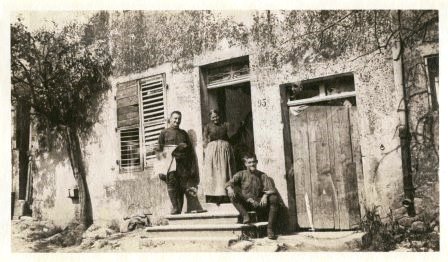
 

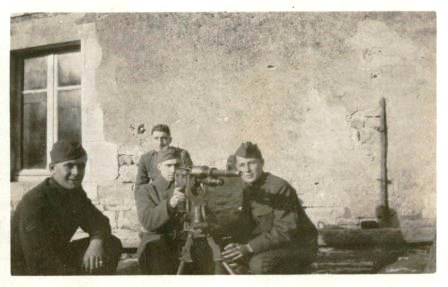
The men of the battalion were “looking forward to when we begin to do our bit” and working hard to master their weapons and other equipment. Two days before Christmas, Charles wrote to his mother about some of this training.

Had my first experience with gas today. Tried out a couple of the masks we have issued to us. We non-coms had the pleasure of going into what they call a gas chamber (which in truth was a well built cattle shed) put on our masks & let them turn the gas on. Nothing very exciting happened if you did things as directed but if not well you would be lucky if you got away with slight sickness. […] However we have to get used to them, learning how to put them on quickly, test for gas etc, so that when we get up against the real thing why we will know what to do.


The 101st Machine Gun Battalion celebrated Christmas 1917 with the French villagers of Mont-lès-Neufchâteau. Many soldiers received care packages from home, and Charles described the meal and entertainment. The holiday was “complete except for being away from our families and believe me you could notice a far away look in the boys faces as they opened their packages and thought of the folks at home.”
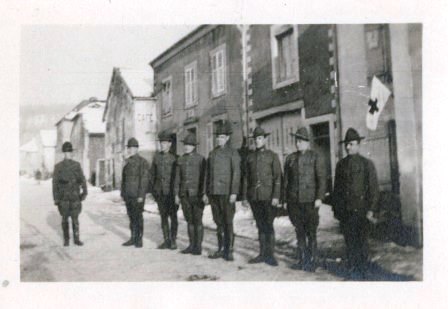
 

Join me in a few weeks when I pick up the story of Charles Cornish Pearson in his new year and ours.

 

Gertrude Codman Carter’s Diary, December 1917

By Anna Clutterbuck-Cook, Reader Services

Today we return to the 1917 diary of Gertrude Codman Carter. You may read the previous entries here:


Introduction | January | February | March | April | May

June | July | August | September | October | November


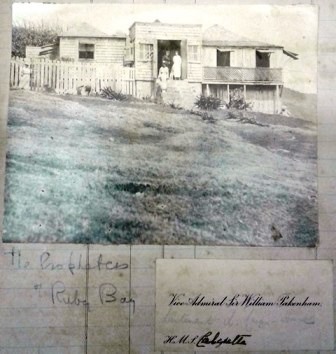
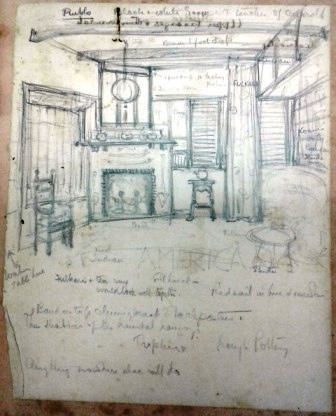
It is the final month of 2017 and 1917 as well; Gertrude Carter left scant record behind as the Carter family’s year ended in news of the death of Gertrude’s grown stepson, Otho, when his ship was torpedoed on November 28th. News reached his father on December 4th, the final page of the diary. The only items left in the journal are pasted in, a photograph, cryptically captioned “the Prophets of Ruby Bay,” and a sketch of a room — “Black & white room” — with Gertrude’s design notations penciled in — “Writing table here” and “Beam 1 foot deep”.

It seems fitting that we let Gertrude’s work as an artist and architect close out our year with her. Thank you for joining us on our journey with Gertrude Codman Carter through 1917! In January we will be introducing our diarist from 1918, a Newton (Mass.) teenager named Barbara Hillard Smith.


* * *

Dec 1.

Tea at the [illegible] Yearwoods.


Dec 2.

A very jolly [illegible] party. The Hancocks, Carpenters, Mrs. Smith [illegible], Laddie, Mr. Fell, Mrs. Da Costa. We sang & danced & had a generally jolly time of it.


Dec 3.

Met Mr. Eustace at L. Challum’s office. The [boots?] departed for the front.


Dec 4.

Poor G. came back from the town with a cable which had been handed him as he passed through. The cable was from Evelyn & said, “Otho lost at sea.” At first we could not grasp it for we had imagined him still in Africa — however when our letters came we found alas~ That he had been invalided home & they were expecting him shortly. G. went to the [illegible] who kindly cabled to the Colonial office & received the official confirmation that the “Apapa” had been torpedoed & sunk with severe loss of life & Otho amongst the lost.


Prophets of Ruby Bay”


 Black and White Room

* * *

As always, if you are interested in viewing the diary or letters yourself, in our library, or have other questions about the collection please visit the library or contact a member of the library staff for further assistance.


This Week @ MHS

By

The calendar is a bit top-heavy this week with a slew of events in the first few days. Here is a look at the programs in the week ahead:

Please note that on Thursday, 7 December, the library opens late at 12:00PM.

– Monday, 4 December, 6:00PM : Join us for a special program presented by a group of undergraduate students from Boston University, called Reforming Boston: Remaking the 19th-Century City. In this presentation and virtual exhibit, Professor Andrew Robichaud and his students present more than twenty rare artifacts and documents from the collection of the Massachusetts Historical Society. From prison and asylum reform, to education and temperance, to women’s rights and abolitionism, this presentation explores many dimensions of reform in Boston. How did Boston reformers understand their changing world, and how did they understand social change and improvement? This program is open to the public at no cost, though registration is required. Light refreshments served after the presentations. 

– Tuesday, 5 December, 5:15PM : This week’s seminar is from the Early American History series and features Adrian C. Weimer of Providence College, with Walter Woodward of University of Connecticut providing comment. “Petitions and the Cry of Sedition” looks at the political upheavals of the early Restoration in which a remarkable number of Massachusetts men and women expressed keen dissatisfaction with the monarch or General Court, leading to trials over seditious speech. The rich theological language in the petitions and feisty curses in the trial records offer an unrivaled glimpse into the significance of religion for the mobilization of local political communities in this tumultuous era. Seminars are free and open to the public. To RSVP, e-mail seminars@masshist.org or call 617-646-0579. Subscribe to receive advance copies of the seminar papers. 

– Wednesday, 6 December, 12:00PM : Chris Pastore of State University of New York at Albany leads this week’s Brown Bag discussion with “Constructing the Ocean’s Edge: Toward an Environmental History of the Atlantic World.” This presentation examines the environmental history and cultural geography of the North Atlantic shore during the Age of Exploration. A closer look at the ways coasts blurred the bounds of natural knowledge, conventions of conduct, and even the distinction between good and evil, may help us write uncertainty into an otherwise linear narrative of human progress, and, by extension, global expansion.

– Wednesday, 6 December, 6:00PM : MHS Fellows and Members are invited to the Society’s annual holiday party. Enjoy an evening of holiday cheer, celebrate the season, and wish a happy retirement to MHS President Emeritus Dennis Fiori. Holiday cocktail attire requested. RSVP by 1 December. Not a Member? Join today!

– Saturday, 9 December, 10:00AM : The History and Collections of the Massachusetts Historical Society Tour is a 90-minute docent-led walk through our public rooms. The tour is free, open to the public, with no need for reservations. If you would like to bring a larger party (8 or more), please contact Curator of Art Anne Bentley at 617-646-0508 or abentley@masshist.org.

While you’re here you will also have the opportunity to view our current exhibition: Yankees in the West.