The “industrious Citizen’s” guide to preparing for cold season

By Alex Bush, Reader Services

With flu season fast approaching and many coworkers and peers already succumbing to illness, the time has come to consider our health and safety for the wintry months ahead. What can we, “the enterprising Mariner—the hardy Soldier—the industrious Citizen,” do to mitigate “the direful consequences of infection?” William Burrell, a late-1700s seller of special medicine chests designed for sailors, collaborated with several physicians to create a pamphlet designed to adapt his sailors’ medicine chests for use by the common citizen. It contains page upon page of useful advice on treating anything from the common cold to gunshot wounds. Note that while William Burrell may not have been an actual doctor, his expertise in preparing medicine chests was definitely enough to qualify him to publish medical advice.


Published in 1798, Medical advice; chiefly for the consideration of seamen: and adapted for the use of travellers, or domestic life can be found within the MHS’ Evans microfiche collection of Early American Imprints. Within this pamphlet Mr. Burrell describes dozens of maladies common during the late 18th century with an eye toward prevention and quick recovery via home remedy. Burrell acknowledges that, shy of “devising and applying means to destroy the Fons et origo mali, (fountain and origin of evil,) and restore the purity of the atmosphere in which the patient breathes,” the best practice for combating illness is to keep the patient clean and comfortable. Most of this is achieved by way of steam, hot water, and a combination of chemicals. Although it is unlikely that Burrell’s medicine chests are still on the market today, the pamphlet fortunately includes a compilation of names and suggested doses for most of the medicines mentioned. Simply visit your local pharmacy for everything listed except, perhaps, tinctures of opium.


In general, Burrell warns that cold climates as well as rapid changes in temperature can predispose one to sickness. The same is true for excessive drinking of beer and spirits, so take care to stay sober during any upcoming holiday parties. Should you find yourself becoming ill, restrict your diet to bland foods such as gruel, pasta, oysters, and boiled meat. Those who remain healthy should bolster their diets with “sallads,” which are “saponaceous, detergent, cooling, and antiseptic,” as well as “opening and diuretic.” However, Burrell warns that salads should be avoided if one feels cold or nervous.

Lithograph showing a phlebotomy, London 1804, Armed Forces Institute of Pathology


In terms of cold symptoms, Burrell’s advice varies according to diagnosis and outside conditions. Most of it, however, involves bloodletting. Bloodletting (or bleeding) was a popular method of treatment for a wide range of ailments from the 1600s into the 1800s, after which it slowly declined in popularity. According to Burrell, bloodletting is an especially necessary step when the climate is cold. For fevers, intersperse repeated bleedings with induced vomiting. For coughs, bleeding and periodic doses of tincture of opium are recommended. In order to prevent malaria while vacationing in warmer areas, remove a pint of blood to account for the change in temperature and allow yourself to sweat freely.

Bear in mind, however, that a footnote to Burrell’s pamphlet warns against the dangers of excessive bloodletting:

it is of the utmost importance not to reduce the system by bleeding or any other evacuation whatever, below the ordinary healthy standard, as a firm constitution and a chearful and fearless mind, most powerfully resist the sedative action of pestilential contagion.


“Life of George Washington: The Christian,” lithograph by Claude Regnier, after Junius Brutus Stearns, 1853. Washington Library, Mount Vernon, VA.


Recall, for instance, the circumstances under which George Washington died. In December of 1799, after spending most of the day supervising his Mount Vernon farm in freezing rain and snow, the former president refused to remove his wet clothing for dinner. Naturally, the next day he developed a sore throat. Spending another full day outside in three inches of snow only made his sore throat worse, and by the following morning he was terribly ill and having trouble breathing. Attended by three physicians and his wife, Washington was given a mixture of molasses, vinegar, and butter to soothe his throat. A firm believer in the healing power of bloodletting, he also asked that half a pint of blood be removed from his arm while refusing other medicines and treatments. “You know I never take anything for a cold,” he said. “Let it go as it came.” As his condition worsened over the next ten hours, an estimated total of two and a half quarts of blood were removed from Washington’s body, amounting to over half of the blood in his body. He passed away at 10 p.m. on Saturday, December 17, 1799. Take care to remember this story while treating your own cold-weather ailments using bloodletting.

Chemicals in the form of gargles, tinctures, and skin treatments are also popular cures in Burrell’s pamphlet. According to Burrell, most oils and tinctures work best when dissolved in plain water or “common nitrous drink,” which can be made by dissolving a few grains of nitre in water. Add citrus juice, molasses, or vinegar to aid in digestion and soothe the throat. Bodily aches and pains caused by influenza or infection can be remedied using a blister, a paste made from mashing a special type of “blister beetle,” to draw toxins to the surface of the skin. The blistering toxin found in blister beetles has been used medically as a vesicant- an agent that causes blistering – as well as an aphrodisiac since the 12th century BC. Use it well, but do not eat it—you will almost definitely die.

With Burrell’s expert and up-to-date advice in mind, venture forth into this year’s cold season without fear!


References

Burrell, William, Medical advice; chiefly for the consideration of seamen: and adapted for the use of travellers, or domestic life, (New York: Printed for the author by R. Wilson, 1798).

“The Death of George Washington,” Mount Vernon Ladies’ Association, 2017, accessed on 30 November 2017, http://www.mountvernon.org/digital-encyclopedia/article/the-death-of-george-washington/

Vadakan, Vibul, MD, FAAP, “The Asphyxiating and Exsanguinating Death of President George Washington,” The Permanente Journal 8, No. 2, Spring 2004, accessed on 30 November 2017, http://www.thepermanentejournal.org/files/Spring2004/time.pdf.

Schmidt, Justin, “Cantharidin and Meloids: a review of classical history, biosynthesis, and function,” 2002, accessed on 30 November 2017, http://archive.li/Srh6y.


Bring Your Students to MHS!

By Kate Melchior, Center for the Teaching of History

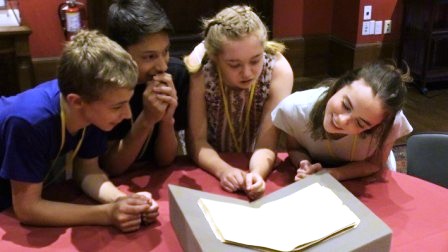
December is knockingon the door which means that the Center for the Teaching of History at the MHS is wrapping-up its inaugural semester of class visits! This fall, the MHS hosted a number of programs for middle school, high school, and college students who want to learn about primary sources and experience the work of historians first-hand.

Students getting up close and personal with MHS documents.


Our collection of Revolutionary War-era material is popular with middle and high school classes who come to MHS to learn about the real people behind Boston’s Freedom Trail. For example, Cohasset-based Chris Luvisi’s AP US History class examined artifacts and documents related to the Boston boycott of British goods in the 1760s and 1770s, including the 1767 “Address to the Ladies” which encouraged Boston women to forgo imported British luxuries in order to appear “Fair, charming, true, lovely, and cleaver” to young men. After taking on identities of Boston craft workers, merchants, shopkeepers, and domestic housewives, students voted on whether to support or ignore the nonimportation agreement. While most students supported the boycott in theory, a number of them admitted that they would likely keep buying their imported tea under the table!

Students were excited to get a close look at a bottle of tea leaves collected from Dorchester Neck the morning after the Boston Tea Party in 1773.


Vincent Bradley’s AP US History class from Catholic Memorial School also engaged with the history of the Revolution, this time through the perspective of John Adams. Students explored how Adams’ views on protest and dissent changed over time by looking at his opinions on the Boston Tea Party, the Boston Massacre, Shay’s Rebellion, and the Alien and Sedition Acts. Bradley’s class also saw historians in action while participating in one of MHS’ Brown Bag Lunches, where they heard Kabria Baumgartner from the University of New Hampshire speak about her current research on Black girlhood and the desegregation of Massachusetts public schools. Catholic Memorial students asked Professor Baumgartner questions about her work and listened as she workshopped her research with other local historians and visitors.

Students deciphered John Adams’s notes from the Boston Massacre trials to learn about his motivation for defending British soldiers. 


As the state coordinators for Massachusetts History Day, the Center for the Teaching of History (CTH) also helps many students learn research strategies for their upcoming projects. Megan Brady’s eighth grade history club from the John F. Kennedy School in Somerville came in on a Saturday so that they could learn about the collections at MHS and practice working with primary sources. Her students, whose National History Day interests range from early Pilgrim-Wampanoag relations to LGBTQ History in the 1920s, posed thoughtful questions to Stephen T. Riley Librarian Peter Drummey while looking at Sarah Gooll Putnam’s Civil War-era childhood diary and a daguerreotype of author and reformer Annie Fields, who lived in a “Boston marriage” with her partner Sarah Orne Jewett for decades. You can learn more about National History Day and find inspiration for your own projects at the Massachusetts History Day website, the National History Day site, or at our own Center webpage.

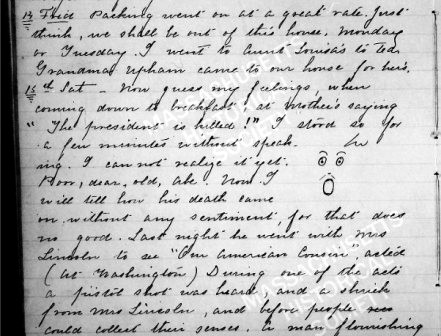
Sarah Gooll Putnam’s diary entry on 14 April 1865. The young artist drew her own expression at hearing of President Lincoln’s asssassination to illustrate how she felt at the news.


The Center sometimes partners with Library Reader Services to help host college visits as well, which gives the perfect excuse to explore more specific and unusual themes in the MHS collections. Erika Boeckeler brought two of her Northeastern University classes this fall to explore Children’s Literature and Shakespeare in America, leading to rediscovery of gems in our stacks such as a homemade morality tale titled “Adventures of a ruffle” that was written by Anne Harrod Adams, John and Abigail’s daughter-in-law! On another day, Cathy McCarron’s class joined us from Middlesex Community College to explore Elizabeth Freeman and Quock Walker’s court petitions for manumission and their leadership in ending slavery in Massachusetts. We discussed the different types of primary sources that illustrate the lives of individuals who previously lacked a voice in traditional historical narratives.

If you would like to bring students to visit us, or have the Center for the Teaching of History come to you, please contact the Center for the Teaching of History at kmelchior@masshist.org. All of our student programs are free of charge, and we would love to work with you to create a memorable program with your class!  For more information on our programming, visit the Center at http://www.masshist.org/teaching-history

This Week @ MHS

By

After a nice long holiday weekend it’s time to put down the turkey legs and get back to the business of history. Here are the programs on-tap in the week ahead:

– Monday, 27 November, 6:00PM : Join us for an author talk with Henry Louis Gates, Jr., and Maria Tatar, both of Harvard University, as they discuss their new book, The Annotated African American Folktales. This new publication presents nearly 150 African American stories, among them familiar Brer Rabbit classics, but also stories like “The Talking Skull” and “Witches Who Ride,” as well as out-of-print tales from the 1890s’ Southern Workman. Arguing for the value of these stories as part of a sophisticated, complex, and heterogeneous cultural heritage, Gates and Tatar show how these stories deserve a place alongside the classic works of African American literature and American literature more broadly. This talk is open to the public. Registration is required with a fee of $10 (no charge for MHS Members or Fellows). The talk begins at 6:00PM and is preceded by a reception at 5:30PM. 

– Tuesday, 28 November, 5:15PM : This week’s seminar is part of the Modern American Society and Culture series. “Volunteerism and Civil Society in the Twentieth Century” is a panel discussion with K. Ian Shin of Bates College, and Chris Staysniak of Boston College, with Timothy Neary of Salve Regina University providing comment. This panel considers volunteerism as sponsored by ethnic and service organizations. Both essays challenge our notions of “belonging” in a civil society, including our understandings of assimilation, activism, and protest. Shin’s paper is “Masons, Scouts, and Legionnaires: Voluntary Associations and the Making of Chinese American Civil Society, 1864-1945.” Staysniak’s essay is “Poverty Warriors, Service Learners, and a Nationwide Movement: Youth Volunteer Service, 1964-1973.” Seminars are free and open to the public. To RSVP: email seminars@masshist.org or call (617) 646-0579. Subscribe to receive advance copies of the seminar papers.

– Thursday, 30 November, 6:00PM : The second author talk of the week features Russell Shorto of the New York Times Magazine who will discuss his recent work Revolution Song: A Story of American Freedom. With America’s founding principles being debated today as never before, Shorto looks back to the era in which those principles were forged. Drawing on new sources, he weaves the lives of six people into a seamless narrative that casts fresh light on the range of experience in colonial America on the cusp of revolution. While some of the protagonists play major roles, others struggle no less valiantly. Through these lives we understand that the Revolution was, indeed, fought over the meaning of individual freedom. This talk is open to the public. Registration is required with a fee of $10 (no charge for MHS Members or Fellows). Pre-talk reception kicks-off at 5:30PM, followed by the speaking program at 6:00PM. 

– Saturday, 2 December, 9:00AM : “The Political Lives of Historical Monuments and Memorials,” is a teacher workshop hosted by the MHS. This workshop is now full. Please join us on March 17, 2018, for another workshop on the topic of Monuments and Historical Memory

There is no tour this Saturday, 2 December, but remember to come in and see the current exhibition, Yankees in the West, open to the public with no charge Monday-Saturday, 10:00AM-4:00PM. 


John Quincy Adams’ Would-be Assassin: George P. Todsen

By Neal Millikan, Adams Papers

On November 30, 1826, President John Quincy Adams learned that Dr. George P. Todsen (Todson) wanted to assassinate him. A native of Denmark, Todsen immigrated to St. Louis in 1817 where he established a medical practice. In 1824 he became an assistant surgeon in the U.S. Army but was cashiered out of service by sentence of a court martial in 1826 for embezzling public stores. Adams had reviewed the sentence and declined renominating Todsen for a military position.

Adams recorded in his diary that Dr. Henry Huntt “came very seriously to put me on my guard against” Todsen, who “had determined to murder me, for revenge.” Col. Thomas Randall, Todsen’s legal counsel, informed Adams that Todsen “had avowed to him his determination to assassinate me; and that he believed it was no idle menace— That the man was desperate, and upon this subject perfectly mad.” The news of Todsen’s hostility did not, however, impact the president’s daily schedule—Adams continued his solitary early morning walks around Washington, D.C.

The following month, on December 16, Todsen himself called at the White House. Adams recorded the visit in detail in his diary, noting that Todsen “demanded that I should nominate him for reappointment.” Adams informed Todsen that “there was no more painful duty within the compass of my service, than that of confirming a sentence of dismission; and it had been peculiarly painful to me in his case— But after the maturest consideration I had deemed it to be my duty, and I had seen no ground upon which I could retract that decision.” Adams stated he “was perfectly willing to consider the threats” of assassination “as the effect of a momentary alienation of mind,” and Todsen then “said he had given up the idea” since Adams “had expressed sentiments of compassion upon his case.”

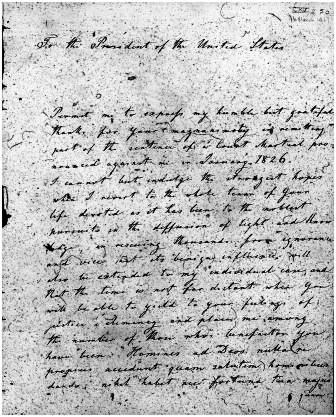
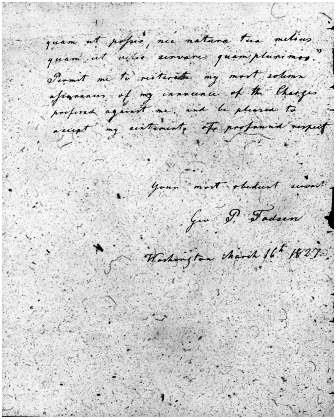
George P. Todsen to John Quincy Adams, March 16, 1827, Adams Family Papers, microfilm edition, 608 reels (Boston: Massachusetts Historical Society) reel 479.


On March 15, 1827, Todsen returned to ask for remission of a $47 payment from his court martial sentence, to which Adams assented; Todsen subsequently wrote Adams a letter of thanks. On June 2, Adams recommended Todsen to serve as doctor on an American vessel, and when Todsen came to thank Adams for the position, the president “observed to him that his future destiny would depend very much upon the propriety of his conduct under this appointment, and that I hoped it would be such as to justify the Government in appointing him, and as entirely to retrieve his character.” Even after Adams left the presidency the two men still kept in touch. As late as January 28, 1845, Todsen, then employed making translations for the U.S. State Department, visited congressman Adams in Washington, D.C.

This Week @ MHS

By

Thanksgiving is nearly upon us, which means a shortened week here at the Society. 

– Monday, 20 November, 6:00PM : Join us for a conversation with author Richard Aldous of Bard College, with Fredrik Logevall of Harvard University, as they discuss Aldous’s recent work Schlesinger: The Imperial Historian. Drawing on oral histories, rarely seen archival documents, and the official Schlesinger papers, this biography crafts an invaluable portrait of a brilliant and controversial historian who framed America’s rise to global empire. Arthur M. Schlesinger, Jr., the architect of John F. Kennedy’s legacy, redefined the art of presidential biography. A Thousand Days, his best selling record of the Kennedy administration, remains immensely influential and cemented his place as one of the nation’s greatest political image makers.This talk is open to the public and registration is required with a fee of $10 (no charge for MHS Members or Fellows). Pre-talk reception begins at 5:30PM, followed by the speaking program at 6:00PM.

The Society closes early at 3:00PM on Wednesday, 22 November.

The Society is CLOSED on Thursday, 23 November, for Thanksgiving.

The Library remains CLOSED on Friday, 24 November and Saturday, 25 November.

The Exhibition Galleries are OPEN on Friday, 24 November and Saturday, 25 November.

– Saturday, 25 November, 10:00AM : The History and Collections of the MHS is a 90-minute docent-led walk through our public rooms. The tour is free, open to the public, with no need for reservations. If you would like to bring a larger party (8 or more), please contact Curator of Art Anne Bentley at 617-646-0508 or abentley@masshist.org.

While you’re here you will also have the opportunity to view our current exhibition: Yankees in the West.

“The Happiest of the Happy”: An Expatriate in Italy

By Susan Martin, Collection Services

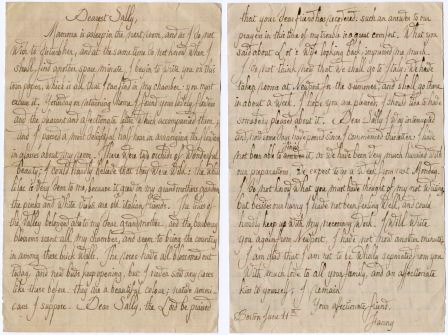
After you’ve processed several collections of papers here at the Massachusetts Historical Society, you start to see familiar names crop up. It’s not just the usual Cabots and Saltonstalls and Lowells, etc., or those famous Boston ministers, merchants, and abolitionists. There’s also Edward Atkinson, who seemed to know just about everybody. I find that reformer Dorothea Dix makes a fairly regular appearance. But there’s one correspondent I’ve come across a few times that intrigued me, not least because of her beautiful handwriting. She was known by various names: Esther Frances Alexander, Francesca Alexander, or just plain Fanny Alexander.


Fanny was an illustrator, author, folklorist, and translator. Her father was portrait painter Francis Alexander, and her mother Lucia (née Swett) was an etcher, author, and philanthropist. Fanny was their only child, born in Boston on 27 February 1837, although she spent most of her life in Italy. Fortunately for us, she kept up a correspondence with friends around the world. Her letters appear in a few different collections at the MHS, including the Bowditch-Codman-Balch and Fay-Mixter family papers. Her most substantial and personal letters here are the five she wrote to her friend Sally Hayward in the Joseph H. Hayward family papers.

Fanny wrote to Sally in great detail about her life in Italy and her artistic work. The letters typically run to at least four densely written pages and cover a variety of subjects. For example, on 28 February 1871, Fanny condoled with Sally on the death of her cousin, congratulated her on the imminent birth of a nephew, and recounted a story she’d read that inspired her latest sketch.

The story comforted me so much, that I could not resist turning it into a picture in pen and ink, which will be the first of my works ever offered for sale in Boston. […] I should like very much to have you see it, as it is a picture which I have put my whole heart into, as I have hardly ever done into any picture in my life.


She also described her painting studio “up under the roof.”

It is a pretty little room, and always full of flowers, so that it looks like a garden. […] I have a few little presents there, almost all from poor people; those which I receive from the rich are disposed of in the room down stairs, but my little painting room is the poor people’s room especially.


A few months later, Fanny wrote about another project she’d begun.

I am busy, among other things, in writing down a curious collection of legends and poetry, which I learnt long ago at Abetone, and which it seems a pity should be forgotten. I think that I shall have it printed some time, but how or where, I have not the least idea.


In 1882, legendary art critic John Ruskin was introduced to Fanny’s work, and he was impressed by her skill and simplicity. He went on to publish volumes of her art and stories and is usually credited with bringing her to the attention of the wider world. But Fanny would be remembered not only for her creative output, which inspired sonnets by James Russell Lowell and John Greenleaf Whittier, but also for her piety, her love of nature, and especially her charity. Many poor Italians considered her a saint.

She also lived in Florence during a time of great change. This passage from her letter of 12 December 1874 is particularly interesting.

Florence is now sadly changed since I first knew it; modern ideas have arrived even here, with the usual modern antipathy to everything venerable and beautiful; they have taken down our grand old walls, that were nearly six hundred years old, and have, for the sake of widening the business streets, and the bridges, destroyed some chapels, and other buildings, of great antiquity and beauty. All these things have grieved me more than I can tell you. […] However, there is no alternative but to die young, or to see changes.


Fanny lived a very sheltered life, with no formal education. In 1885, her eyesight began to fail, and she was all but blind by the end of her life. She had also broken her hip and walked with a crutch or cane. But on 22 August 1910, in a letter to Charles P. Bowditch, her mother Lucia described Fanny as busy and content.

Her room is full of the poor and the rich, who all make friends, and read the Bible, and eat bread and chocolate in company. Half blind and whole lame, she is the happiest of the happy.


Fanny’s father died in 1880. Fanny and Lucia lived together the rest of their lives, devoted to each other. According to Notable American Women, 1607-1950 (p. 35), “After the death of her mother in 1916 at the age of 102, Francesca took to her bed and remained there until her own death, at seventy-nine, the following January.” She is buried with her parents in Florence.


The End of Piracy: Pirates hanged in Boston 300 years ago

By Rakashi Chand, Reader Services


Today marks the 300th anniversary of the execution of the Whydah pirates in Boston, Massachusetts, marched from their Boston jail to the gallows and hanged for their crimes of piracy.

No less a person than Puritan minister Cotton Mather recorded the day of the execution in his diary:

 “15. G. D. There is good this Day to be done, on a very solemn Occasion. Six Pirates were this Day executed. I took a long and sad walk with them, from the Prison, to the Place of Execution. I successively bestowed the best Instructions I could, upon each of them. Arriving to the Tree of Death, I pray’d with them, and with the vast Assembly of Spectators, as pertinently and as profitably as I could.”

*****

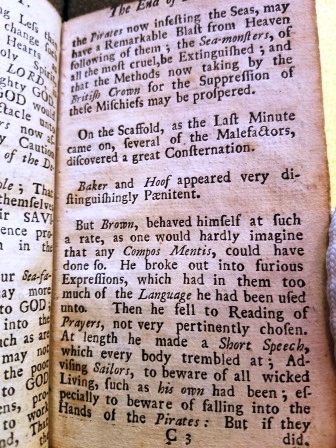
Not much is known about young Samuel Bellamy, also known as Black Bellamy, the captain of the Whydah. Bellamy and his crew captured the three hundred ton merchant slaver Whydah as it left Jamaica on route to London in late February or early March of 1717. The ship originally had 18 guns but the crew mounted an additional ten, making it a formidable sight for any vessel to which it gave chase. According to one of the pirates, John Brown, they had about 20,000 pounds in gold and silver aboard the Whydah from “a-pyrating.” Bellamy brought his fleet to the outer shores of Cape Cod, legend says, to see a beautiful young lady by the name of Maria Hallett, whom he fell in love with on the dunes of Eastham the year before. If Maria truly did exist, we do not have a historical record; but it is more likely that the pirates came north to trade their plunder (desirable illicit goods) with eager merchants in Newport, Connecticut, New York, and Boston.

The Whydah sank off the shore of Cape Cod the night of April 26th, 1717. When the storm rose up that caught the Whydah off the coast of the Cape, the ship was driven onto the shoals and it soon became apparent the Whydah would not survive. Thirty foot waves destroyed the ship and drowned almost all of the pirates and their prisoners. The next morning inhabitants of the nearby towns discovered on the beach the gruesome sight – countless gnarled bodies washed ashore by the tides along with wreckage from the ship – which would haunt them for years. At least 102 bodies washed up on shore.

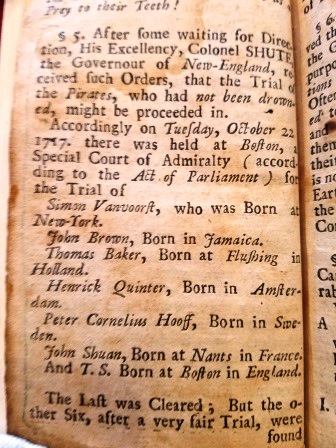
This was the fate of Captain Bellamy and his pirate crew, except for seven survivors who were arrested and sent to Boston for trial. One of the seven, Thomas Davis, was found innocent and released, then disappears from record. The other six men were found guilty of piracy through trial: John Brown, Simon Van Vorst, Hendrick Quintor, Thomas Baker, Peter Hoof and John Shuan.


*****

Cotton Mather went often to visit, study, instruct and ultimately try to provide salvation for the pirates in their Boston jail. It seems the good minister was thoroughly intrigued by these ‘sinners’, and to our great benefit, for without his writings about the fates of the Whydah pirates we would have little record.

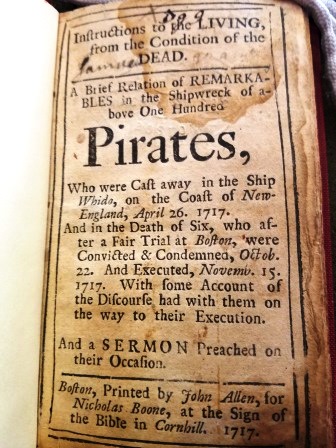
After the execution, Mather wrote Instructions to the living, from the condition of the dead : A brief relation of remarkables in the shipwreck of above one hundred pirates, who were cast away in the ship Whido, on the coast of New-England, April 26. 1717. And in the death of six, who after a fair trial at Boston, were convicted & condemned, Octob. 22. And executed, Novemb. 15. 1717. With some account of the discourse had with them on the way to their execution. And a sermon preached on their occasion. [Boston, Printed by John Allen, for Nicholas Boone, at the sign of the Bible in Cornhill. 1717]


Thanks to this pamphlet – available here in the collection of the Massachusetts Historical Society – we have the conversations and words of the pirates themselves. Mather published his Instructions to the living, from the condition of the dead… a mere month after the execution, perhaps to appease the great curiosity the pirates had caused, while also using the event as an opportunity to teach his flock. Mather again revisited the subject in his sermon “Warnings to Them that Make Haste to be Rich” on 8 December 1717.

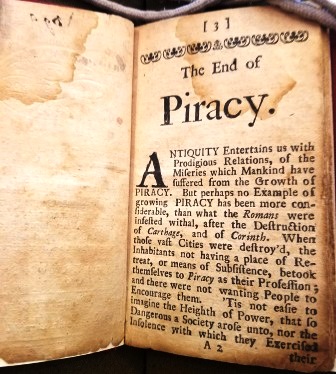
So why did Cotton Mather go to meet with these pirates and why did he put so much thought into their state? He was, for all intents and purposes, interviewing dead men tried, and as Mather clearly stated, “after a fair trial,” convicted and sentenced to death. So here he writes “What may be offere’d, is, A Recollection of Several Passages, which occurred in discourse with the prisoners, while they walked from the prison to the Place of Execution.”


Oh my, can you imagine walking to your execution, your last moments on this earth, while Cotton Mather asks you questions? Perhaps Mather saw this as an opportunity for himself; after all there was nothing more wretched in all the world than a pirate and if he, the great moral ballast of the colonies, could save their souls, well, there would certainly be Puritan brownie points to be earned!

Mather ends his account with “Behold, Reader, the End of Piracy!”

*****

Most Bostonians today would be surprised to learn that a few hundred years ago Boston was known as a “Port Where Pirates Hang.” Even more surprising is how we got that reputation because, indeed, we hanged pirates, and yes, they were an actual problem! So the next time you watch Pirates of the Caribbean or celebrate “Talk like a Pirate Day,” think no further than the streets of Boston!


For more on Cotton Mather materials here at the MHS, start with this online collection guide for the Cotton Mather papers view our collection guide, then consider Visiting the Library!


This Week @ MHS

By

We are back from a long weekend for the only full November week this year. Here are the programs coming in the week ahead:

– Tuesday, 14 November, 5:15PM : The next installment of the Environemental History Seminar series is with Jacqueline Gonzales of Historical Research Associates. “Drafting the Cape Cod Formula” examines how citizens articulated their concerns when the National Park Service wanted to create a federal park on Cape Cod, and how their responses helped the NPS and Senators John F. Kennedy and Leverett Saltonstall to create a new acquisiiton and land management policy that would then be applied to other living landscapes. Steven Moga of Smith College is on-hand to provide comment. To RSVP: email seminars@masshist.org or call 617-646-0579.

Seminars are free and open to the public; RSVP requiredSubscribe to receive advance copies of the seminar papers.

– Wednesday, 15 November, 12:00PM : The Brown Bag talk this week is presented by Adrian Weimer of Providence College and is titled “The Roasting of Hugh Peter: Satire and Politics in Early America.” Accused regicide and former pastor of Salem, Massachusetts, Hugh Peter was the target of colorful satirical ballads and mock-sermons in the mid-seventeenth century. This presentation will explore the ways Royalists attacked Peter as a way of mocking the culture of puritanism, expressing anxieties about the very existence of puritan colonies. This event is free and open to the public. 

– Thursday, 16 November, 6:00PM : Jefferson: Architect of American Liberty is the new work by John Boles of Rice University. This biography does not ignore aspects of Thomas Jefferson that trouble us today but strives to see him in full and understand him amid the sweeping upheaval of his times. From his inspiring defenses of political and religious liberty to his heterodox abridgment of Christian belief, this book explores Jefferson’s expansive intellectual life and the profound impact of his ideas on the world. This author talk is open to the public, registration required with a fee of $10 (no charge for MHS Members or Fellows). Pre-talk reception starts at 5:30PM followed by the speaking program at 6:00PM. 

– Saturday, 18 November, 10:00AM: The History and Collections of the Massachusetts Historical Society Tour is a 90-minute docent-led walk through our public rooms. The tour is free, open to the public, with no need for reservations. If you would like to bring a larger party (8 or more), please contact Curator of Art Anne Bentley at 617-646-0508 or abentley@masshist.org.

While you’re here you will also have the opportunity to view our current exhibition: Yankees in the West.

Gertrude Codman Carter’s Diary, November 1917

By Anna Clutterbuck-Cook, Reader Services

Today we return to the 1917 diary of Gertrude Codman Carter. You may read the previous entries here:

Introduction | January | February | March | April | May

June | July | August | September | November | December


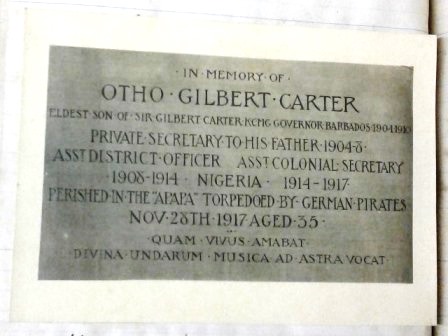
We are nearing the end of Gertrude’s year as a featured diarist at The Beehive. While the month of November 1917 began with “great fun” and a whirl of social activities, it ended under a dark cloud as the Carters found out that one of Sir Gilbert Carter’s sons from his previous marriage was killed on November 28th, 1917 when a German submarine torpedoed a boat, the Apapa, on which he was traveling as a passenger. “Today should have alas had a dark cloud had I known it for the war was to cast yet another shadow on our lives,” writes Gertrude as she gathers her thoughts and fills in her diary pages.

In December, I will be closing out this year of reading alongside Gertrude Codman Carter as she chronicled her life as an upper-class white woman in British colonial Barbados one hundred years ago. Stay tuned for a new diary read-along in January 2018!


* * *

Nov. 1

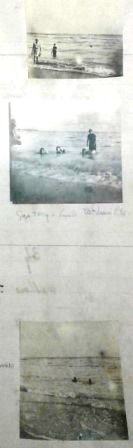
Laddie took me out to Spion Kop to swim. Great fun & as always amusing. We went on to the Charles Sealys afterward & danced. [Illegible] haze of tobacco spoke & little Laurie John on the table as a center piece. “What use is water, when you’re dry – dry – dry -” An appalling but amusing ditty on the gramophone. And Nell Manning being pulled as she swam, by a boatman in a wherry.


Nov. 2

To Sweet Park to Help.


Nov. 3

Great Eastern fete. Huge success.

Lady Probyn gave a big dinner party & I gave a supper party.


Nov. 4


Nov. 5

To Park cleaning up.

To Charlie Hayes to sketch baby.


Nov. 6

Tea at St. Anne’s to meet the new Mrs Hancock.


Nov. 7

1. Help Society

Government House tennis tournament.


Nov. 22

Savannah Club meeting of [illegible].


Nov. 23

Burtons party to meet the Hancocks.


Nov. 24 [numbered but left blank]


[Nov. 25]

Chart of [illegible].


Nov. 26

To swim with L. at the Sealeys.


Today should have alas had a dark cloud had I known it for the war was to cast yet another shadow on our lives.


Nov. 29

[Illegible] all to tea with the [illegible] boat men. Most amusing.


Nov. 30

Church parade at St. Mary’s a depressing one.


* * *

As always, if you are interested in viewing the diary or letters yourself, in our library, or have other questions about the collection please visit the library or contact a member of the library staff for further assistance.


This Week @ MHS

By

It is a short week here at the Society as we approach the Veteran’s Day holiday. But there are still a few opportunities for quenching your thirst for history. Here is what is on the calendar for the week ahead:

– Tuesday, 7 November, 5:30PM : The next installment of the Early American History seminar series is with Craig Gallagher of Boston College, and is titled “British Caledonia: English America and the Scottish Darien Project, 1675-1702.” Beginning in 1695, Scots at home and abroad flocked to support their country’s nascent colony on the Darien isthmus in Panama. This paper argues that Scots’ enthusiasm for the Darien project stemmed not from national impulses, but from a desire to define their status in a liberal, Protestant British Atlantic World alongside their colonial American allies and patrons. Hannah Muller of Brandeis University will be on-hand to provide comment. Seminars are free and open to the public; RSVP required, just click the link or call 617-646-0579. Subscribe to receive advance copies of the seminar papers. Please note that unlike other sessions in this series, this program begins at 5:30PM.

– Wednesday, 8 November, 12:00PM : Pack your lunch and stop by for a Brown Bag talk with Shira Lurie of the University of Virginia. “Politics at the Poles: Liberty Poles and the Popular Struggle for the New Republic” examines conflicts over liberty poles in the 1790s. Liberty poles offered grassroots partisans a tangible symbol through which to channel debates about political participation, popular sovereignty, and dissent under the new Constitution. This event is free and open to the public. 

– Wednesday, 8 November, 6:00PM : The Weeping Angel: Letters and Poems from World War I France is a new work edited by Mary Kelley, and the title of this author talk. Working as a soldier on the railroads in France during World War I, Hubert Williams Kelley found his vocation as a poet and writer through vivid letters to family. In this talk, Mary Kelley describes her efforts to retrace the forgotten history of a perceptive observer of the war’s destruction. Christopher Capozzola of MIT will be on-hand to comment on the letters’ contribution to new historical understandings that have emerged during the war’s centennial. This talk is open to the public, though registration is required with a fee of $10 (no charge for MHS Members and Fellows). A pre-talk reception kicks-off at 5:30PM, followed by the speaking program at 6:00PM. 

Please note that the Society is CLOSED on Friday and Saturday, 10-11 November, for Veteran’s Day. Normal hours resume on Monday, 13 November.