The End of Piracy: Pirates hanged in Boston 300 years ago

By Rakashi Chand, Reader Services

 

Today marks the 300th anniversary of the execution of the Whydah pirates in Boston, Massachusetts, marched from their Boston jail to the gallows and hanged for their crimes of piracy.

No less a person than Puritan minister Cotton Mather recorded the day of the execution in his diary:

 “15. G. D. There is good this Day to be done, on a very solemn Occasion. Six Pirates were this Day executed. I took a long and sad walk with them, from the Prison, to the Place of Execution. I successively bestowed the best Instructions I could, upon each of them. Arriving to the Tree of Death, I pray’d with them, and with the vast Assembly of Spectators, as pertinently and as profitably as I could.”

*****

Not much is known about young Samuel Bellamy, also known as Black Bellamy, the captain of the Whydah. Bellamy and his crew captured the three hundred ton merchant slaver Whydah as it left Jamaica on route to London in late February or early March of 1717. The ship originally had 18 guns but the crew mounted an additional ten, making it a formidable sight for any vessel to which it gave chase. According to one of the pirates, John Brown, they had about 20,000 pounds in gold and silver aboard the Whydah from “a-pyrating.” Bellamy brought his fleet to the outer shores of Cape Cod, legend says, to see a beautiful young lady by the name of Maria Hallett, whom he fell in love with on the dunes of Eastham the year before. If Maria truly did exist, we do not have a historical record; but it is more likely that the pirates came north to trade their plunder (desirable illicit goods) with eager merchants in Newport, Connecticut, New York, and Boston.

The Whydah sank off the shore of Cape Cod the night of April 26th, 1717. When the storm rose up that caught the Whydah off the coast of the Cape, the ship was driven onto the shoals and it soon became apparent the Whydah would not survive. Thirty foot waves destroyed the ship and drowned almost all of the pirates and their prisoners. The next morning inhabitants of the nearby towns discovered on the beach the gruesome sight – countless gnarled bodies washed ashore by the tides along with wreckage from the ship – which would haunt them for years. At least 102 bodies washed up on shore.

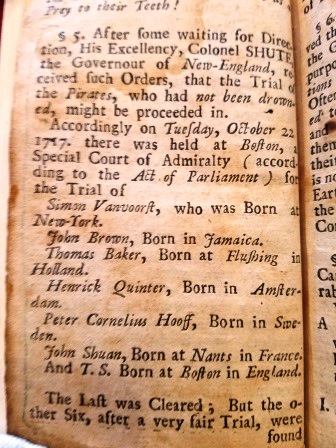
This was the fate of Captain Bellamy and his pirate crew, except for seven survivors who were arrested and sent to Boston for trial. One of the seven, Thomas Davis, was found innocent and released, then disappears from record. The other six men were found guilty of piracy through trial: John Brown, Simon Van Vorst, Hendrick Quintor, Thomas Baker, Peter Hoof and John Shuan.
 

*****

Cotton Mather went often to visit, study, instruct and ultimately try to provide salvation for the pirates in their Boston jail. It seems the good minister was thoroughly intrigued by these ‘sinners’, and to our great benefit, for without his writings about the fates of the Whydah pirates we would have little record.

After the execution, Mather wrote Instructions to the living, from the condition of the dead : A brief relation of remarkables in the shipwreck of above one hundred pirates, who were cast away in the ship Whido, on the coast of New-England, April 26. 1717. And in the death of six, who after a fair trial at Boston, were convicted & condemned, Octob. 22. And executed, Novemb. 15. 1717. With some account of the discourse had with them on the way to their execution. And a sermon preached on their occasion. [Boston, Printed by John Allen, for Nicholas Boone, at the sign of the Bible in Cornhill. 1717]
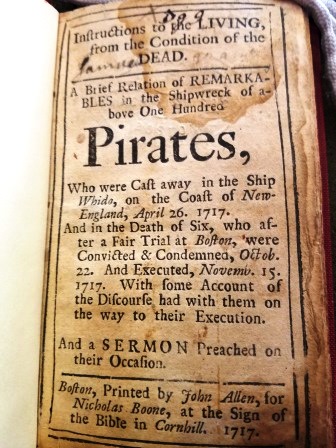
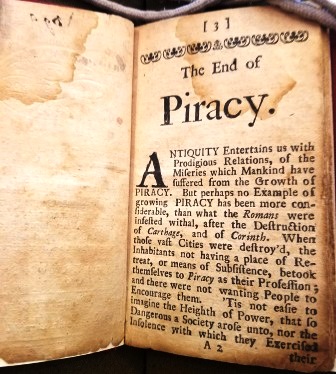
 

Thanks to this pamphlet – available here in the collection of the Massachusetts Historical Society – we have the conversations and words of the pirates themselves. Mather published his Instructions to the living, from the condition of the dead… a mere month after the execution, perhaps to appease the great curiosity the pirates had caused, while also using the event as an opportunity to teach his flock. Mather again revisited the subject in his sermon “Warnings to Them that Make Haste to be Rich” on 8 December 1717.

So why did Cotton Mather go to meet with these pirates and why did he put so much thought into their state? He was, for all intents and purposes, interviewing dead men tried, and as Mather clearly stated, “after a fair trial,” convicted and sentenced to death. So here he writes “What may be offere’d, is, A Recollection of Several Passages, which occurred in discourse with the prisoners, while they walked from the prison to the Place of Execution.”
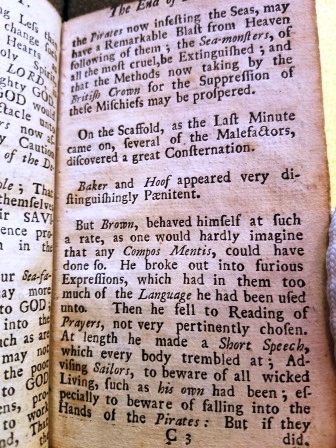
 

Oh my, can you imagine walking to your execution, your last moments on this earth, while Cotton Mather asks you questions? Perhaps Mather saw this as an opportunity for himself; after all there was nothing more wretched in all the world than a pirate and if he, the great moral ballast of the colonies, could save their souls, well, there would certainly be Puritan brownie points to be earned!

Mather ends his account with “Behold, Reader, the End of Piracy!”

*****

Most Bostonians today would be surprised to learn that a few hundred years ago Boston was known as a “Port Where Pirates Hang.” Even more surprising is how we got that reputation because, indeed, we hanged pirates, and yes, they were an actual problem! So the next time you watch Pirates of the Caribbean or celebrate “Talk like a Pirate Day,” think no further than the streets of Boston!


For more on Cotton Mather materials here at the MHS, start with this online collection guide for the Cotton Mather papers view our collection guide, then consider Visiting the Library!

 

This Week @ MHS

By

We are back from a long weekend for the only full November week this year. Here are the programs coming in the week ahead:

– Tuesday, 14 November, 5:15PM : The next installment of the Environemental History Seminar series is with Jacqueline Gonzales of Historical Research Associates. “Drafting the Cape Cod Formula” examines how citizens articulated their concerns when the National Park Service wanted to create a federal park on Cape Cod, and how their responses helped the NPS and Senators John F. Kennedy and Leverett Saltonstall to create a new acquisiiton and land management policy that would then be applied to other living landscapes. Steven Moga of Smith College is on-hand to provide comment. To RSVP: email seminars@masshist.org or call 617-646-0579.

Seminars are free and open to the public; RSVP requiredSubscribe to receive advance copies of the seminar papers.

– Wednesday, 15 November, 12:00PM : The Brown Bag talk this week is presented by Adrian Weimer of Providence College and is titled “The Roasting of Hugh Peter: Satire and Politics in Early America.” Accused regicide and former pastor of Salem, Massachusetts, Hugh Peter was the target of colorful satirical ballads and mock-sermons in the mid-seventeenth century. This presentation will explore the ways Royalists attacked Peter as a way of mocking the culture of puritanism, expressing anxieties about the very existence of puritan colonies. This event is free and open to the public. 

– Thursday, 16 November, 6:00PM : Jefferson: Architect of American Liberty is the new work by John Boles of Rice University. This biography does not ignore aspects of Thomas Jefferson that trouble us today but strives to see him in full and understand him amid the sweeping upheaval of his times. From his inspiring defenses of political and religious liberty to his heterodox abridgment of Christian belief, this book explores Jefferson’s expansive intellectual life and the profound impact of his ideas on the world. This author talk is open to the public, registration required with a fee of $10 (no charge for MHS Members or Fellows). Pre-talk reception starts at 5:30PM followed by the speaking program at 6:00PM. 

– Saturday, 18 November, 10:00AM: The History and Collections of the Massachusetts Historical Society Tour is a 90-minute docent-led walk through our public rooms. The tour is free, open to the public, with no need for reservations. If you would like to bring a larger party (8 or more), please contact Curator of Art Anne Bentley at 617-646-0508 or abentley@masshist.org.

While you’re here you will also have the opportunity to view our current exhibition: Yankees in the West.

Gertrude Codman Carter’s Diary, November 1917

By Anna Clutterbuck-Cook, Reader Services

Today we return to the 1917 diary of Gertrude Codman Carter. You may read the previous entries here:

Introduction | January | February | March | April | May

June | July | August | September | November | December


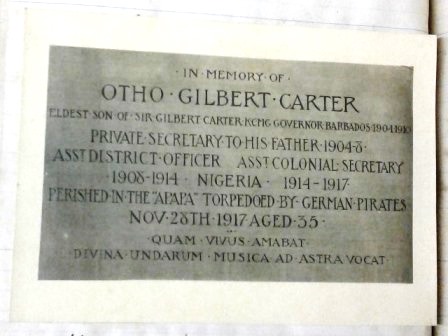
We are nearing the end of Gertrude’s year as a featured diarist at The Beehive. While the month of November 1917 began with “great fun” and a whirl of social activities, it ended under a dark cloud as the Carters found out that one of Sir Gilbert Carter’s sons from his previous marriage was killed on November 28th, 1917 when a German submarine torpedoed a boat, the Apapa, on which he was traveling as a passenger. “Today should have alas had a dark cloud had I known it for the war was to cast yet another shadow on our lives,” writes Gertrude as she gathers her thoughts and fills in her diary pages.

In December, I will be closing out this year of reading alongside Gertrude Codman Carter as she chronicled her life as an upper-class white woman in British colonial Barbados one hundred years ago. Stay tuned for a new diary read-along in January 2018!


* * *

Nov. 1

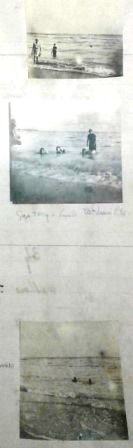
Laddie took me out to Spion Kop to swim. Great fun & as always amusing. We went on to the Charles Sealys afterward & danced. [Illegible] haze of tobacco spoke & little Laurie John on the table as a center piece. “What use is water, when you’re dry – dry – dry -” An appalling but amusing ditty on the gramophone. And Nell Manning being pulled as she swam, by a boatman in a wherry.


Nov. 2

To Sweet Park to Help.


Nov. 3

Great Eastern fete. Huge success.

Lady Probyn gave a big dinner party & I gave a supper party.


Nov. 4


Nov. 5

To Park cleaning up.

To Charlie Hayes to sketch baby.


Nov. 6

Tea at St. Anne’s to meet the new Mrs Hancock.


Nov. 7

1. Help Society

Government House tennis tournament.


Nov. 22

Savannah Club meeting of [illegible].


Nov. 23

Burtons party to meet the Hancocks.


Nov. 24 [numbered but left blank]


[Nov. 25]

Chart of [illegible].


Nov. 26

To swim with L. at the Sealeys.


Today should have alas had a dark cloud had I known it for the war was to cast yet another shadow on our lives.


Nov. 29

[Illegible] all to tea with the [illegible] boat men. Most amusing.


Nov. 30

Church parade at St. Mary’s a depressing one.


* * *

As always, if you are interested in viewing the diary or letters yourself, in our library, or have other questions about the collection please visit the library or contact a member of the library staff for further assistance.


This Week @ MHS

By

It is a short week here at the Society as we approach the Veteran’s Day holiday. But there are still a few opportunities for quenching your thirst for history. Here is what is on the calendar for the week ahead:

– Tuesday, 7 November, 5:30PM : The next installment of the Early American History seminar series is with Craig Gallagher of Boston College, and is titled “British Caledonia: English America and the Scottish Darien Project, 1675-1702.” Beginning in 1695, Scots at home and abroad flocked to support their country’s nascent colony on the Darien isthmus in Panama. This paper argues that Scots’ enthusiasm for the Darien project stemmed not from national impulses, but from a desire to define their status in a liberal, Protestant British Atlantic World alongside their colonial American allies and patrons. Hannah Muller of Brandeis University will be on-hand to provide comment. Seminars are free and open to the public; RSVP required, just click the link or call 617-646-0579. Subscribe to receive advance copies of the seminar papers. Please note that unlike other sessions in this series, this program begins at 5:30PM.

– Wednesday, 8 November, 12:00PM : Pack your lunch and stop by for a Brown Bag talk with Shira Lurie of the University of Virginia. “Politics at the Poles: Liberty Poles and the Popular Struggle for the New Republic” examines conflicts over liberty poles in the 1790s. Liberty poles offered grassroots partisans a tangible symbol through which to channel debates about political participation, popular sovereignty, and dissent under the new Constitution. This event is free and open to the public. 

– Wednesday, 8 November, 6:00PM : The Weeping Angel: Letters and Poems from World War I France is a new work edited by Mary Kelley, and the title of this author talk. Working as a soldier on the railroads in France during World War I, Hubert Williams Kelley found his vocation as a poet and writer through vivid letters to family. In this talk, Mary Kelley describes her efforts to retrace the forgotten history of a perceptive observer of the war’s destruction. Christopher Capozzola of MIT will be on-hand to comment on the letters’ contribution to new historical understandings that have emerged during the war’s centennial. This talk is open to the public, though registration is required with a fee of $10 (no charge for MHS Members and Fellows). A pre-talk reception kicks-off at 5:30PM, followed by the speaking program at 6:00PM. 

Please note that the Society is CLOSED on Friday and Saturday, 10-11 November, for Veteran’s Day. Normal hours resume on Monday, 13 November. 

“…a calm prophetic of, we knew not what.” : Tornadoes in New England

By Daniel Tobias Hinchen, Reader Services

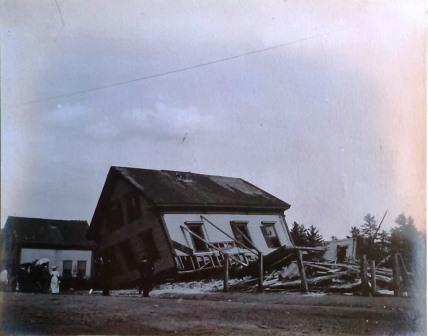
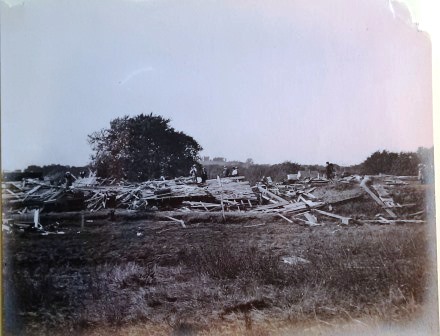
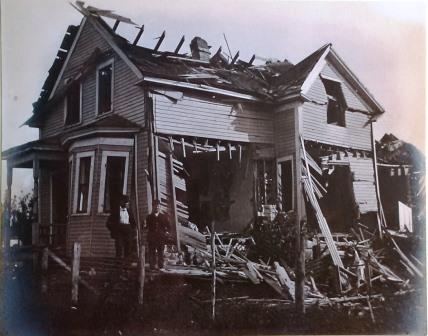
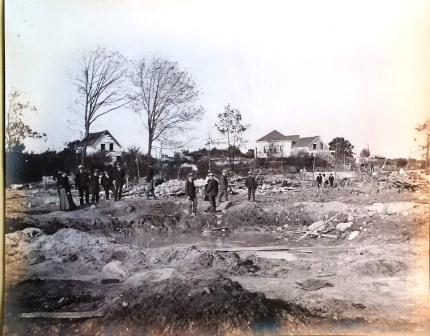
Recently while in the stacks here at the MHS I happened upon a small collection of photographs that were in a folder labeled “Lawrence (Mass) tornado photographs, 1890.” With only enough time to take a brief look, I made a mental note of the title so that I could find out more. 

I grew up in the Midwest – central Illinois, to be more precise – where the idea of a tornado popping-up is not an uncommon thought. In grade school, along with the normal fire drills we also participated in tornado drills; every first Tuesday morning a siren sounded, crescendoed to a wail for several minutes, then slowly subsided – the monthly test of the tornado siren; and we all learned about using roadside ditches and highway overpasses for cover if a twister appeared while traveling. I was never personally affected by a tornado during my years out in the middle, but there were numerous occasions when the white “W” on the TV screen would switch to yellow (from Watch to Warning), and then I and whomever else was in the house would head to the basement to wait for the storm to pass. As a college student in New Hampshire, my parents sent me photographs of the damage done by a tornado that cut a path across our town, even passing through the backyard of my childhood home. Thankfully, they already lived elsewhere, though only a half-mile down the road. 

Back to the present. After I spotted the photos of Lawrence, Mass. damaged by a tornado, I went to our online catalog, ABIGAIL, to see what else we hold that is similar. Below are a few samples of the texts and images I found for some specific events. 


Providence, Rhode Island – 1815

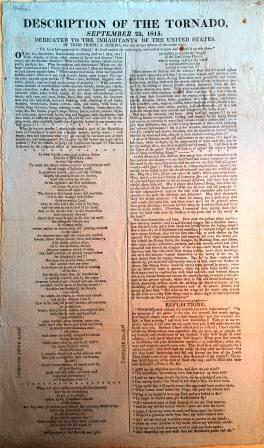
Although referred to as a tornado in the broadside below, the Great September Gale of 1815 seems to have been a hurricane that made landfall in New York and proceeded north through New England. Rhode Island seems to be the area that received the brunt of this storm, though the eye is said to have passed straight through central Massachusetts and into New Hampshire.1

Oh wo, wo, desolation, lamentations, mourning and wo! Alas, alas!

What wrecks of ruins, what scenes of havoc and distress!

(Jenkins, J., “Description of the tornado, September 23, 1815 : dedicated to the inhabitants of the United States.”)


Middlesex County, Massachusetts – 1851

Published in 1852, The Tornado of 1851, in Medford, West Cambridge and Waltham, Middlesex County, Mass. compiled anecdotal accounts to provide a picture of the course, speed, and power of this tornado. Also included are reports produced by various committees that estimated the cost of the damage. If you have ever been in an area where a tornado is imminent, then the description of this mid-19th-century event by Rev. Charles Brooks may seem familiar:

The state of the atmosphere from sunrise to the time of the tornado, on August 22d, was peculiar. Many spoke of a dead closeness, a remarkable want of elasticity in the air. Many complained of lassitude from this cause. Clouds gathered; and there were appearances of wind approaching; but it did not come. For an hour before the tornado, there was here almost a perfect calm; yet it was a calm prophetic of, we knew not what. An old sea-captain told his wife, at 4 o’clock, P.M., that “if he was at sea he should expect a waterspout.” (p.5)


They, who, like us, were in it, and have seen its terrible ravages, need not be told that it exhibited a power in the elements never witnessed by the oldest inhabitant of this region. Houses strongly built were demolished, as if they had been made of paper. Oak and walnut and cedar trees, of the largest growth, were entirely uprooted, some of them snatched out of the ground and carried through long distances…” (p.12)


Lawrence, Massachusetts – 1890

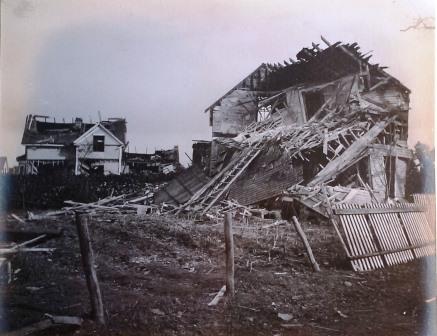
The collection of photographs that prompted this blog post provide visual aid for the words of Charles Brooks. The images below show houses reduced to splinters, some with citizens viewing the damage. The last is a good illustration of the seeming randomness of a tornado, with a large crater in the foreground and yet, nearby in the background, houses standing intact. 


Worcester County, Massachusetts – 1953

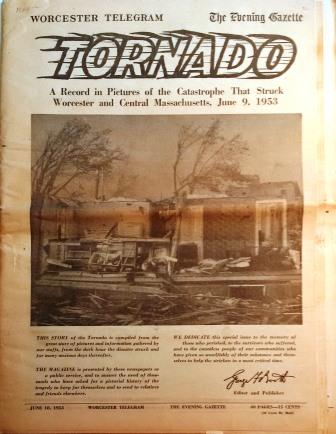
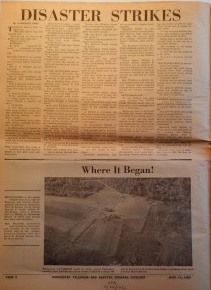
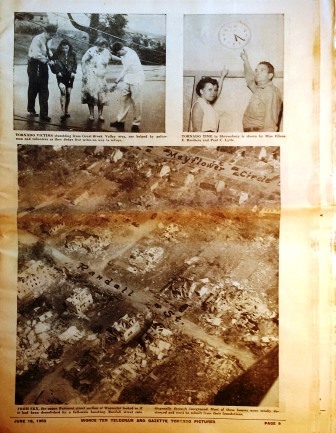
More recently, a tornado swept through Worcester County, Mass. Following that event the Worcester Telegram and the Worcester Evening Gazette produced a special publication to detail the path of the storm, the damage done, and the efforts to clean up in the aftermath, called Tornado: a record in pictures of the catastrophe that struck Worcester and cetral Massachusetts, June 9, 1953


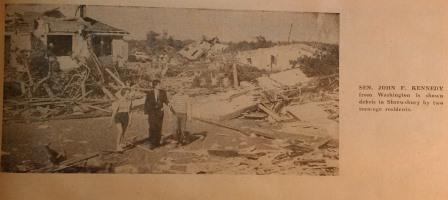
“Sen. John F. Kennedy from Washington is shown debris in Shrewsbury by two teenage residents.”


To find out what else the MHS holds about natural disasters you can search our online catalog, ABIGAIL. If you want to come in and view these items or any others you find in the catalog, take a look at our website to learn more about Visiting the Library


*****

1 “Hurricanes: Science and Society : 1815- the September Gale,” University of Rhode Island, accessed 3 November 2017, http://www.hurricanescience.org/history/storms/pre1900s/SeptemberGale/.


This Week @ MHS

By

Here we are, once again, with the weekly round-up of events to come.

– Monday, 30 October, 6:00PM : Friends Divided: John Adams and Thomas Jefferson is the latest work by Pulitzer Prize-winning author Gordon S. Wood of Brown University, who will speak about his book and the relationship between these two founding fathers. A reception precedes the talk at 5:30PM and the speaking program begins at 6:00PM. THIS TALK IS SOLD OUT!

– Wednesday, 1 November, 12:00PM : Start off the new month right with a lunchtime Brown Bag talk. Join us as Kabria Baumgartner of University of New Hampshire presents “Equal School Rights: Black Girlhood and School Desegregation in Antebellum Massachusetts.” This project looks at some of the integral players in the fight to desegregate public schools in Massachusetts before the Civil War. They authored anti-descrimination pamphlets, helped to organize boycotts, and wrote missives against racial prejudice. As the campaign grew, so did the activist network that bound together African American women, men, and children, as well as their allies across the state. This talk is free and open to the public. 

– Saturday, 4 November, 10:00AM : The History and Collections of the MHS tour is a 90-minute docent-led walk through our public rooms. The tour is free, open to the public, with no need for reservations. If you would like to bring a larger party (8 or more), please contact Curator of Art Anne Bentley at 617-646-0508 or abentley@masshist.org.

While you’re here you will also have the opportunity to view our current exhibition: Yankees in the West.

– Saturday, 4 November, 11:00AM : Experience revolutionary politics “indoors” and “out-of-doors” as it would have happened 250 years ago. Participate in a live reenactment at Faneuil Hall of a Boston town meeting; join the discussion as local citizens argue over whether or not to stop importing British goods; and join a rowdy procession of laboring-class Bostonians from Faneuil Hall to the Old State House as they express their disapproval of British trade policies in a rather colorful and intimidating way. The Devil and the Crown is being offered as a joint program of Boston National Historical Park, Minute Man National Historical Park, The Bostonian Society, and Revolution 250, a program of the MHS. Admission is free to all! For more information, please contact Jim Hollister at 978-318-7829 or jim_hollister@nps.gov

Fornication as Crime in 18th-Century Massachusetts

By Brendan Kieran, Reader Services

While the MHS is not home to a large collection of court records, I recently viewed two items we do hold relating to fornication in 18th-century Massachusetts. These materials concern judicial proceedings that were separated by nearly sixty years, but provide interesting glimpses into the criminalization of sex in colonial Massachusetts. Through further investigation, I learned more about the ways the judicial system addressed sexuality during this period, including the significance of race and gender within the system.


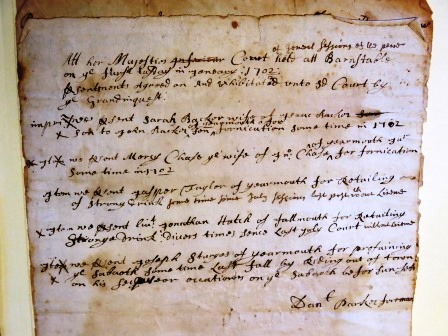
A small collection of Barnstable County (Mass.) legal documents includes one “memorandum of presentments to the Court of General Sessions of the Peace.” This January 1702 document, which bears the signature of foreman Daniel Parker, notes two cases of unlicensed sale of liquor, one case of profaning the Sabbath, and two cases of fornication. The people accused of fornication are Sarah [Backer?] and [Mercy Chase,] both of whom were married at the time; each supposedly engaged in “fornication some time in 1702.”


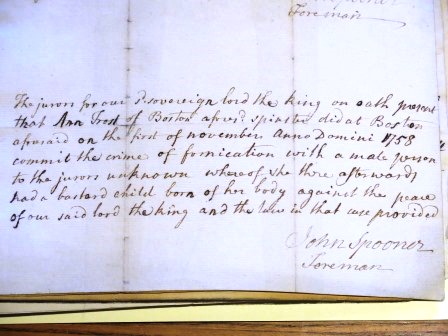
A Grand Jury presentment, 1 January 1760, located in our Miscellaneous Bound Manuscripts collection, notes an accusation against Ann Frost, a Boston resident who supposedly engaged in fornication on 1 November 1758. The man involved was “to the jurors unknown.” Frost had a child out of wedlock, “against the peace of our said lord the king and the laws in that case provided.” This presentment bears the signature of foreman John Spooner and was created for a Court of General Sessions of the Peace for Suffolk County-ordered grand jury.

In Regulating Passion: Sexuality and Patriarchal Rule in Massachusetts, 1700-1830 (Oxford: Oxford University Press, 2014), Kelly A. Ryan (a former Andrew W. Mellon fellow at the MHS) writes that, during the 18th century, white women became the main targets of fornication charges in the Massachusetts judicial system, while punishment of men for fornication dwindled beginning in the mid-17th century as sex outside of marriage came to be seen as a legal issue for women, not men (13-14, 21-23). Additionally, for much of the 17th-century colonial period, “premarital sex” was the main cause of fornication charges; however, in the late 1600s and early 1700s, men increasingly ceased to face judicial consequences for premarital sex (22-23). Also beginning in the late 1600s and extending through the 18th century, “nonmarital sex” became more common among fornication charges against women, as “the court and communities were especially concerned with remedying the problem of disorderly white women” (23-24). These charges were used to justify patriarchal control of white women; however, women accused of fornication did find ways to push back, including by resisting attempts of justices of the peace to elicit names of men involved (13-15, 30-32).

Engagement with the justice system for sex crimes did not look the same for men and women of color as it did for white people, though. According to Ryan, African Americans faced fornication charges in the 17th century, but African Americans and Indians experienced increasingly fewer such prosecutions during the 18th century (74-75, 77). This lack of prosecutions served to uphold white patriarchy by preventing white men from facing consequences for sexual contact with women who were enslaved while denying women of color agency and preventing African American men from being able to seek paternal rights (74, 78, 82). White women faced legal consequences for fornication with African American men, along with social disapproval for sex with Indian men; these actions were intended to enforce the notion that white women should be with white men (78-79, 82). Ultimately, according to Ryan, “[g]overnment prosecutions promoted white men’s sexual authority, partnerships between white women and white men, and the removal of paternal and sexual rights for men and women of color” (82).


Feel free to visit the MHS library if you would be interested in viewing materials in our collections. The library is open Monday through Saturday!


“The pretty little place was burnt to the ground”: The Destruction of Darien, Georgia

By Susan Martin, Collection Services


We feel very badly that you were compelled to take part, through your men, in the destruction of Darien, & fully sympathize in the sentiments you express. I sincerely hope that as Genl Hunter has been relieved, there may be a modification of the policy which caused the perpetration of such a deed, & that you may not be obliged again to participate in anything so repugnant to you.


This excerpt comes from a letter written by Francis G. Shaw to his son Robert Gould Shaw on 23 June 1863, part of the Shaw-Minturn family papers at the MHS. Twelve days earlier, the 54th Massachusetts Infantry, the African-American regiment Robert commanded, had participated with other troops in a raid on the town of Darien in southeast Georgia.

Unfortunately, our collection doesn’t include Robert’s original letter, but Francis was probably replying to the one Robert wrote to his wife Annie the day after the raid, which she sent on to his parents. Robert’s letter to Annie has been printed in Blue-Eyed Child of Fortune (1992) and other publications.

According to his account, when Union troops arrived at Darien, they found the place all but deserted. James Montgomery, colonel of the 2nd South Carolina Infantry (another black regiment) and post commander, had the furniture, livestock, and other movable property confiscated, then smiled “a sweet smile” at Shaw and said, “I shall burn this town.” Shaw explained:

I told him, “I did not want the responsibility of it,” and he was only too happy to take it all on his shoulders; so the pretty little place was burnt to the ground, and not a shed remains standing; Montgomery firing the last buildings with his own hand. One of my companies assisted in it, because he ordered them out, and I had to obey. You must bear in mind, that not a shot had been fired at us from this place, and that there were evidently very few men left in it. All the inhabitants (principally women and children) had fled on our approach, and were no doubt watching the scene from a distance. […]

The reasons he gave me for destroying Darien were, that the Southerners must be made to feel that this was a real war, and that they were to be swept away by the hand of God, like the Jews of old. In theory it may seem all right to some, but when it comes to being made the instrument of the Lord’s vengeance, I myself don’t like it. Then he says, “We are outlawed, and therefore not bound by the rules of regular warfare”; but that makes it none the less revolting to wreak our vengeance on the innocent and defenceless.


Shaw called it a “dirty piece of business” and “as abominable a job as I ever had a share in.” He hated “to degenerate into a plunderer and robber. […] There was not a deed performed, from beginning to end, which required any pluck or courage.” He also feared the raid would damage the reputation of black soldiers. Montgomery’s actions were “barbarous” and gratuitous, he thought, and made him no better than notorious Confederate raider Raphael Semmes. But disobeying orders would have meant a court-martial. Shaw lamented, “after going through the hard campaigning and hard fighting in Virginia, this makes me very much ashamed of myself.”

Luis F. Emilio, another officer of the 54th, wrote about the Darien raid 28 years later in his history of the regiment. Emilio also described the beauty of the town, as well as the looting and destruction carried out by Union troops. But while Shaw’s account was thoughtful and conflicted, Emilio’s was a little more clinical and didn’t address the ethical questions.

Robert Gould Shaw and many other men of the 54th Regiment were killed during the assault on Fort Wagner just a few weeks after the destruction of Darien. Another letter in the Shaw-Minturn collection, written by Rev. Phillips Brooks, summarizes Shaw’s legacy. Brooks wrote to Robert’s mother on 17 Nov. 1892: “Indeed, he belongs to all of us, & to the country, & to history.”


This Week @ MHS

By

It’s another busy week here at the Society with a nice selection of public programs happening. Here’s what is coming up;

– Monday 23 October, 12:00PM : Pack your lunch and stop by for a Brown Bag talk with Laura McCoy of Northwestern University. “‘Let it be your resolution to be happy’: Women’s Emotion Work in the Early Republic” explores the everyday realities of expressing and managing emotions as a foundation of daily labors – emotion work – and helps us understand women’s actions and self-perceptions in the early republic. This talk is free and open to the public. 

– Monday, 23 October, 6:00PM : “Advise & Dissent?” is a conversation that examines the role of public history in modern life. This compelling panel discussion is open to the public and registration is required with a fee of $10 (no charge for MHS Members or Fellows). Pre-talk reception takes place at 5:30PM followed by the speaking program at 6:00PM. 

– Tuesday, 24 October, 5:15PM : Join us for the next installment of the Modern American Society and Culture seminar series. Led by Jennifer Way of the University of North Texas, “Allaying Terror: Domesticating Artisan Refugees in South Vietnam, 1956” explores the publication of photographs of North Vietnam refugee artisans in English-language mass print media. They aimed at resettling and domesticating the refugees while diminishing white American middle-class anxieties about the potential spread of communism in South Vietnam, a place Sen. John F. Kennedy pronounced “the cornerstone of the Free World in Southeast Asia.” Commen is provided by Robert Lee of Brown University. Seminars are free and open to the public; RSVP requiredSubscribe to receive advance copies of the seminar papers. THIS EVENT IS CANCELED DUE TO ILLNESS.

– Wednesday, 25 October, 12:00PM : The second Brown Bag talk this week is given by Nancy Siegel of Towson University, and is called “Political Appetites: Revolution, Taste, and Culinary Activism in the Early Republic.” Culinary activists furthered republican values in the revolutionary era as part of a political and cultural ideology. They developed a culinary vocabulary expressed in words and actions such as the refusal to consume politically charged comestibles, like imported tea, and the celebration of a national horticulture. Through these choices, they established a culinary discourse involving food, political culture, and national identity from the Stamp Act to the early republic. This talk is free and open to the public. 

– Wednesday, 25 October, 6:00PM : “Weird and Worrisome” is a special walking tour of Jamaica Plain. All neigborhoods have secrets but some are stranger than others. In this event, participants will stop at sites of anarchist robberies, stuffed elephants, and a nervine asylum and hear tales of trainwrecks and things that lurk beneath the surfact of Jamaica Pond. The tour is hosted in collaboration with the Emerald Necklace Conservancy and Jamaics Plain Historical Society. THIS TOUR IS SOLD OUT!

– Saturday, 28 October, 10:00AM : The History and Collections of the MHS is a 90-minute, docent-led walk through the public spaces of the Society’s home at 1154 Boylston St. The tour is free and open to the public with no need for reservations for individuals or small groups. If you would like to bring a larger party (8 or more), please contact Curator of Art Anne Bentley at 617-646-0508 or abentley@masshist.org.

While you’re here you will also have the opportunity to view our current exhibition, Yankees in the West

Gertrude Codman Carter’s Diary, October 1917

By Anna Clutterbuck-Cook, Reader Services

Today we return to the 1917 diary of Gertrude Codman Carter. You may read the previous entries here:


Introduction | January | February | March | April | May

June | July | August | September


October 1917 is a lean month in Gertrude’s records, possibly because of Gilbert Carter’s return home from his long absence while Gertrude was relocating the family to Ilaro. After a final, hurried day of preparation on October 1st, Gilbert and Wickham — the household servant who had traveled with him — arrive and are greeted in fine style by a “grand gala festival.”

The sketch of her son, pasted over the entry for October 28th, has a faint inscription that seems to indicate that the drawing was made on the day of the visit to the photographer — an inference supported by the fact that John appears to be wearing the same outfit as he wore in the photograph pasted into the September pages of the diary.


* * *

Oct 1.

Paid servants & rushed on with G’s room. Mickey & I moved books, put up curtains, laid down mats.


Oct 2.

Gilbert (and Wickham) arrived.

Grand gala festival.

Mr. Soelyn came up & witnessed my will.


Oct 3.

Talked.


Sketch of John


Oct 28.

G & I dined with Sir F. & Lady Clarke at the Crane. Festive occasion.


Oct 29.

Tea at the Challums. Laddy drove Mrs Gregg out & me in. 9 the [illegible].

We went to Bleak House.


Oct 30.

4.15 Miss Burton stonework.


Oct 31.

All Hallow’e’en Fete at the MacClaren’s 

Fete in red [illegible.]


* * *

As always, if you are interested in viewing the diary or letters yourself, in our library, or have other questions about the collection please visit the library or contact a member of the library staff for further assistance.