The Lion of the North, caged at the MHS [Updated]

By Daniel Tobias Hinchen, Reader Services

Many years ago as a college student enrolled in a Protestant Theology course, I was required to write a research paper on any topic related to the overall class. I chose to focus on Gustav II Adolf, or King Gustavus Adolphus of Sweden, the Lion of the North. During his reign, Gustavus and chancellor Axel Oxenstierna worked together to suspend the long-standing struggle between the monarch and the nobility which, in turn, allowed for some broad domestic political and social reforms. 

Under Gustav II, Sweden saw the formation of its Supreme Court and the setting of its Treasury and Chancery as permanent administrative boards. In the second decade of his reign, Gustavus professionalized local government in Sweden, placing it under direct control of the crown; he promoted education through the formation of the Gymnasia, an effective provision for secondary education in the country; and he gave generously to the University of Uppsala. Despite all these important political and social reforms, however, Gustavus Adolphus is perhaps best remembered, especially outside of Sweden, as one of the most brilliant military minds in European history.

Through much of his reign, which began in 1611 and ran to 1632, the Thirty Years War (1618-1648) raged in Europe. This long-lasting conflict pitted Catholic forces aligned with the Holy Roman Empire against anti-Imperialist Protestant governments and supporters. By 1630 – as our fair city of Boston was founded – the ordeal was going poorly for German Protestants and their allies. It was around this time that the entry of Lutheran Sweden into the fray helped to turn the tide against the Holy Roman Empire. This reversal of fortunes is directly attributed to Gustavus and the military innovations he brought to the table, such as the first effective iteration of light artillery and the successful combination of infantry and cavalry.**

And you might be thinking to yourself, “But Dan, what does this have to do with the MHS?” I’m glad you asked. 

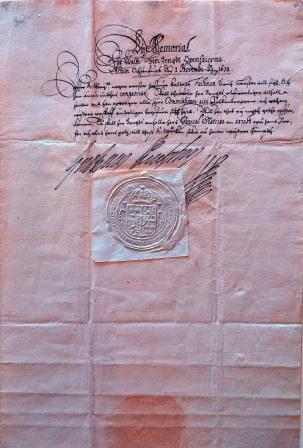
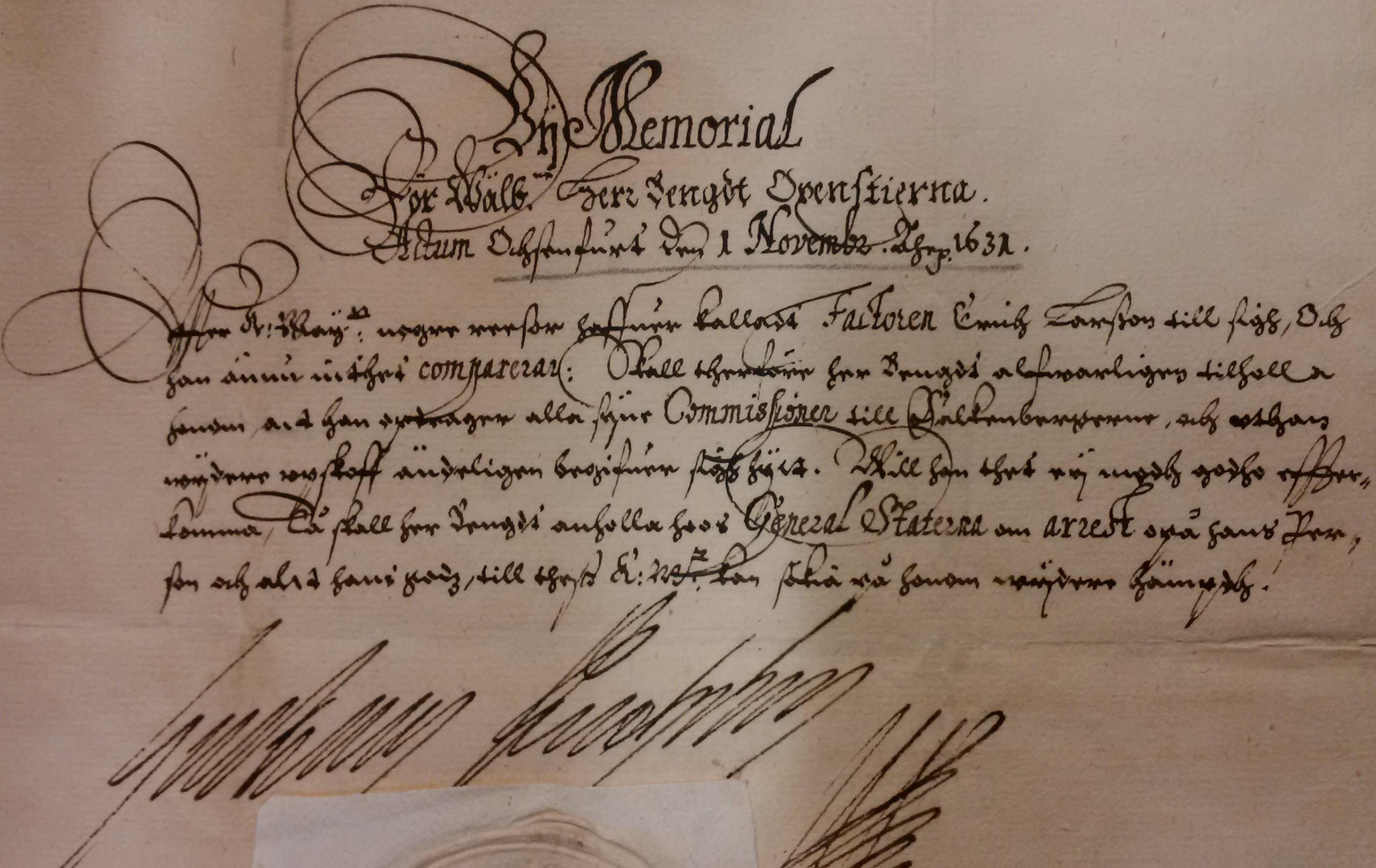
I recently went to the stacks to retrieve a couple of documents from the Curtis Guild autograph collection. As I finger-walked through the folders, I saw one labeled with the name Gustavus Adolphus and was, of course, intrigued. In the folder is a document in fine, albeit small, handwriting. This item, headed with the phrase “In Memorial” and dated 1 November 1632, is signed and sealed by Gustavus Adolphus. Unfortunately, I am not able to make any sense of the text, aside from one or two names that stand out clearly (Oxenstierna being one). 

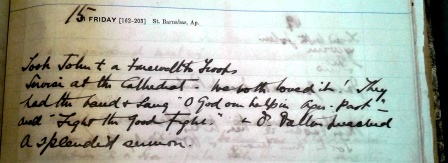
Accompanying the document is another, written much later, which reads:

Gustavus Adolphus

Fine signature & seal

Signed Nov 1 1632

Just 5 days before his death at

the battle of Lutzen –


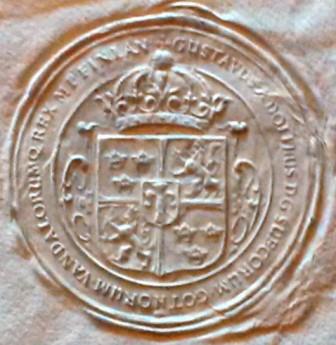
Seal (detail) reading “Gustavus Adolphus D.G. Suecorum Gothorum Vandalorum Q Rex M.P. Finlan”

Regular readers of the Beehive may recall that last year around this time I published a post about a document from the Charles Edward French autograph collection which dates from the 12th century and which I could not make any sense of. Thanks to our readers, within 24 hours we had a transcription, a translation, and contextual information about the quitclaim deed. I am putting up this document in the hope that we can, once again, get help from you out there in the world and learn more about it. 

Are you familiar with 17th century Germanic languages? Can you provide any assistance in transcribing and translating this document? Maybe you know someone who does. If so, please leave a comment below!

_________

**While I wish my memory was so good as to remember all of this, I did use some outside help:

– Roberts, Michael, “Gustav II Adolf,” Encyclopedia Britannica online, https://www.britannica.com/biography/Gustav-II-Adolf (accessed 9 June 2017).


“He plants trees for the benefit of later generations”: John Quincy Adams’s Motto

By Rhonda Barlow, Adams Papers

In the summer of 1830, John Quincy Adams was preoccupied with two projects: planting trees on his properties in Quincy and reading the works of the Roman statesman and philosopher, Cicero, in the original Latin. Just two years earlier, in an 11 May letter to his son Charles Francis, John Quincy had lamented that he had not planted trees in his youth, for if he had, he could now enjoy their fruits and shade. He likewise wished he had read Cicero (106–43 B.C.) in Latin forty years earlier, when it would have been more profitable for his public service. He kept records of his planting and his reading in his Diary, which he had started in 1779, and by his death in 1848, filled 51 volumes.

On 14 August 1830, he started reading Cicero’s Tusculan Disputations, a philosophical treatise that began with “On the Contempt of Death.” In the midst of Cicero’s moralizing and speculation, a quote from the Roman poet Caecilius Statius leapt off the page:

Serit arbores quae alteri seculo prosint

John Quincy, writing in his Diary, made this translation from the Latin:

“He plants trees, says Statius… for the benefit of another century: for what purpose, if the next century were something to him? The diligent husbandman then shall plant trees, upon which his own eyes shall never see a berry? and shall not a great man plant laws, institutions, a Commonwealth?”

Cicero drew a comparison between the farmer and the statesman; but John Quincy was both. In his Diary, JQA followed his translation with this personal reflection:

“I have had my share in planting Laws and Institutions, according to the measure of my ability and opportunities— I would willingly have had more— My leisure is now imposed upon me by the will of higher powers, to which I cheerfully submit, and I plant trees for the benefit of the next age, and of which my own eyes will never behold a berry— To raise forest trees requires the concurrence of two Generations, and even of my lately planted nuts seeds and Stones, I may never taste the fruit— Sero arbores quae alteri seculo prosint.” Here John Quincy altered the Latin significantly, from Caecilius Statius’ “He plants” to “I plant.”

Having lost the 1828 presidential election to Andrew Jackson, John Quincy faced an early retirement from public life. He had passed from planting a republic to planting a garden. He could not forget the brief quote from Caecilius Statius. “Seculo prosint” kept appearing in his Diary as he cared for his trees. But within three months, he was elected to serve in the U. S. House of Representatives, and given a fresh chance to continue to plant laws for another century, another age, another generation.

In June 1833, President Andrew Jackson, was in Boston inspecting the local troops. While listening to the roar of the cannons in the distance, John Quincy, alone with his seedlings, proclaimed alteri seculo as his motto. The Latin phrase was a shout of triumph in the midst of defeat. His grandson, Henry Adams, recorded that JQA designed a seal, featuring an acorn and two oak leaves, and began using it to seal his letters. He even made a fob for his watch, and carried it everywhere (Catalogue of the Books of John Quincy Adams, Boston, 1938, p. 144–145).

This seal now adorns every volume of The Adams Papers, and appears on the website for the digital edition.


Announcing 2017-2018 Research Fellowships

By Dan Hinchen, Reader Services

Each year, the MHS sponsors various fellowship programs which bring a wide variety of researchers working on a full range of topics into the MHS library. The Reader Services staff enjoys getting to know the fellows, many of whom become career-long friends of the Society, returning to our reading room year after year. 

The Society is excited to receive the list of the incoming research fellows for the 2017-2018 cycle. If any of the research topics below are particularly interesting to you, keep an eye on our events calendar over the course of the upcoming year, as all research fellows present their reearch at Brown Bag lunch programs as part of their commitment to the MHS. 

For more information about the different fellowship types, click the headings below. 

*****

Suzanne and Caleb Loring Fellows on the Civil War, Its Origins, and Consequences

Kathleen Hilliard

Iowa State University

Bonds Burst Asunder: The Revolutionary Politics of Getting By in Civil War and Emancipation, 1860-1867


MHS Short-term Fellowships

Judith Harford

University College Dublin

The Power of Social and Professional Networks to Promote Agency and Negotiate Access: The Role of the Women’s Educational Association, Boston, in Advancing the Cause of Women’s Admission to Harvard


African-American Studies Fellow


Natalie Joy

Northern Illinois University

Abolitionists and Indians in the Antebellum Era


Andrew Oliver Fellow

Susan Eberhard

University of California – Berkeley

Artisanal Currencies: Silver Circulations of the US-China Trade, 1784-1876


Andrew W. Mellon Fellows

Daniel Burge

University of Alabama

A Struggle Against Fate: The Opponents of Manifest Destiny and the Collapse of the Continental Dream, 1846-1871


Angela Hudson

Texas A&M University

The Rise and Fall of the Indian Doctress: Race, Labor, and Medicine in the 19th-century United States


Lindsay Keiter

Colonial Williamsburg Foundation

Uniting Interests: Love, Wealth, and the Law in American Marriage, 1750-1860


Kimberly Killion

University of California – Berkeley

From Farms to Kitchens to “the Body Laboratory”: Nutritional Science and the Politics of Food in the United States


Sunmin Kim

University of California – Berkeley

A Laboratory for the American National Identity: The Re-Invention of Whiteness in the Dillingham Commission (1907-1911)


Aaron Moulton

University of Arkansas

Caribbean Blood Pact: Dictators, Exiles, and the CIA in the Caribbean Basin, 1944-1955


Heather Sanford

Brown University

Palatable Slavery


Jaclyn Schultz

University of California – Santa Cruz

Learning the Value of a Dollar: Children and Commerce in the U.S., 1830-1900


Christopher Pastore

University at Albany

American Beach: Law, Culture, and Ecology along the Ocean’s Edge


Benjamin F. Stevens Fellow

Gretchen Murphy

University of Texas – Austin

Disestablishing Virtue: Federalism, Religion, and New England Women Writers


Louis Leonard Tucker Alumni Fellows

Alexandra Montgomery

University of Pennsylvania

Projecting Power in the Dawnland: Colonization Schemes, Imperial Failure and Competing Visions of the Gulf of Maine World, 1710-1800


Ittai Orr

Yale University

Intellectual Power: Print Culture and Intelligence in the United States, 1781-1908


Michael Williams

Carnegie Mellon University

Impolite Science: Print and Performance in the Eighteenth-Century Atlantic


Malcolm and Mildred Freiberg Fellow

Derek O’Leary

University of California – Berkeley

Building the American Archives


Marc Friedlaender Fellow

Nina Sankovitch

Independent Scholar

The Rebels of Braintree: Exploring Collaboration, Conflict, and Conciliation Between Colonial Families Prior to the American Revolution


Massachusetts Society of the Cincinnati Fellow

John McCurdy

Eastern Michigan University

Quarters: Billets, Barracks, and Place in Revolutionary America


Ruth R. & Alyson R. Miller Fellows

Kabria Baumgartner

University of New Hampshire

A Right to Learn: African American Women and Educational Activism in Early America


Caylin Carbonell

The College of William and Mary

Women and Household Authority in Colonial New England


W. B. H. Dowse Fellows

David Ciepley

University of Denver

The Tug-of-War between Trust and Corporation as Models for Colonial New England Government


George O’Brien

University of South Carolina

“What an expecting and troublesome being a New England Refugee is”: The Struggles of Early New England Emigrants in Nova Scotia, 1755-1783


MHS-NEH Long-term Fellowships

Kimberly Blockett

Penn State University – Brandywine

Race, Religion, and Rebellion: Recovering the Antebellum Writing and Itinerant Ministry of Zilpha Elaw


Laurel Daen

The College of William and Mary

The Constitution of Disability in the Early United States


Adrian Weimer

Providence College

Godly Petitions: Puritanism and the Crisis of the Restoration in America


New England Regional Fellowship Consortium Fellows

Christopher Babits

University of Texas – Austin

To Cure a Sinful Nation: A Cultural History of Conversion Therapy and the Making of Modern America, 1930 to the Present Day


Renzo Baldasso

Arizona State University

The Emergence of the Visuality of the Printed Page from Gutenberg to Ratdolt: Case Studies in the Collections of the New England Consortium of Libraries


Kathrinne Duffy (MHS)

Brown University

Doctrine of the Skull: Phrenology, Public Culture, and the Self in Antebellum America


Craig Gallagher

Boston College

Covenants and Commerce: Religious Refugees and the Making  of the British Atlantic World


J. Ritchie Garrison (MHS)

University of Delaware

Matter and Mind in the Early Modern Atlantic World


Karen Harker

University of Birmingham

Shakespeare’s 19th-Century Soundscape: Reconstructing, Reconsidering, and Preserving Shakespearean Incidental Music written for Victorian and Edwardian Theatres


Hina Hirayama

Independent Scholar

Edward Sylvester Morse (1838-1925): his American Life & Times


Alexander Jacobs

Vanderbilt University

Pessimism and Progress: Left Conservatism in Modern American Political Thought


Shira Lurie (MHS)

University of Virginia

Politics at the Poles: Liberty Poles and the Popular Struggle for the New Republic


Jen Manion

Amherst College

Born in the Wrong Time: Transgender Archives and the History of Possibility, 1750-1900


Laura McCoy (MHS)

Northwestern University

In Distress: Family and a Marketplace of Feeling in the Early American Republic


Brianna Nofil

Columbia University

Gender, Community Policing, and Crime Control in the Late 20th C.


Heather Sanford

Brown University

Palatable Slavery


Nancy Siegel (MHS)

Towson University

Political Appetites: Revolution, Taste, and Culinary Activism in the Early Republic


Daniel Soucier

University of Maine

Navigating Wilderness and Borderland: Environment and Culture in the Northeastern Americas during the American Revolution, 1775-1779


Tyler Sperrazza (MHS)

Penn State University

Defiant: African American Cultural Responses to Northern White Supremacy, 1865-1915


Amy Voorhees

Independent Scholar

Christian Science Identity and New England Cultures, 1820-1920


Peter Walker

McNeil Center – University of Pennsylvania

The Church Militant: Anglicanism, Loyalism, and Counterrevolution in the British Empire, 1720-1820


Donald Yacovone (MHS)

Harvard University

The Liberator’s Legacy: Memory, Abolitionism, and the Struggle for Civil Rights, 1865-1965


Colonial Society of Massachusetts Fellowship

Hannah Anderson (MHS)

University of Pennsylvania

Lived Botany: Households, Ecological Adaptation and the Origins of Settler Colonialism in Early British North America


This Week @ MHS

By Dan Hinchen

Coming up this week, we have programs featuring ice cream, the “other” speaker at Gettysburg, and interstate trade during the Civil War. Here are the specifics:

– Tuesday, 6 June, 6:00PM : Ice Kings is the next installment in our Cooking Boston series or public programs. In this panel discussion, Gus Rancatore, Jeri Quinzio, and Judy Herrell discuss Boston’s unusual obsession with ice cream. Moderated by Kathleen Fitzgerald, the talk will look at where this devotion to ice cream comes from and how institutions like Bailey’s ice cream parlor and innovators like Steve’s have changed the country’s taste for frozen treats. Samples of ice cream from Toscanini’s and Herrell’s are available at the reception. This talk is open to the public and registration is required with a fee of $20 (no charge for MHS Members or Fellows). Pre-talk reception begins at 5:30PM followed by the speaking progam at 6:00PM. 

– Wedensday, 7 June, 12:00PM : This week’s Brown Bag talk is put on by research fellow David Montejano of University of California, Berkeley. “From Southern Plantation to Northern Mill: Traveling the Cotton Trail During the Civil War” looks at the vigorous cotton trade between the north and south that re-emerged through the neutral port of Matamoros, Mexico. Montejano looks at how the politics of war were trumped by the “invisible hand” of the market by following the cotton stream from Texas to Massachusetts and making visible the many hands involved in this suspect wartime commerce. This talk is free and open to the public. 

– Thursday, 8 June, 6:00PM : Join us for a talk with Matthew Mason of Brigham Young University, author fo Apostle of Union: A Political Biography of Edward Everett. Everett’s distinguished career, from the 1820s through the Civil War, reveals a complex man who shifting political opinions illuminate the nuances of Northern Unionism. Everett’s political and cultural efforts to preserve the Union, and the response to his work from citizens and politicians, help us see the complexity of the coming of the Civil War. This talk is open to the public, registration required with a fee of $10 (No charge for MHS Members or Fellows; no charge for Members of the Union Club of Boston). Reception begins at 5:30PM, followed by the talk at 6:00PM. 

– Saturday, 10 June, 10:00AM : The History and Collections of the MHS is a 90-minute docent-led walk through our public rooms. The tour is free, open to the public, with no need for reservations. If you would like to bring a larger party (8 or more), please contact Curator of Art Anne Bentley at 617-646-0508 or abentley@masshist.org.

While you’re here you will also have the opportunity to view our current exhibition: The Irish Atlantic: A Story of Famine Migration and Opportunity.

The Significance of Strawberries

By Rakashi Chand, Reader Services

In New England, the arrival of summer is synonymous with strawberries. Strawberry plants (fields) can be found throughout the region, and the strawberry harvest in late May and early June goes hand-in-hand with the most beautiful part of the year. The lovely, fragrant evenings and the final sigh of relief as New Englanders pack their coats away for the summer inevitably lead to the sudden desire to celebrate the arrival of the long-awaited warm months of summer. So, naturally, spring fetes were often “Strawberry Festivals.” The delicious berry was a welcome addition to the kitchen after months of cooking and consuming dried fruit. Every dish on the table was augmented, filled, or garnished with the beautiful, vibrant, and sweet berry.

In the nineteenth century Strawberry Festivals or parties were very popular. The strawberry was the first crop of the summer, and the region was dotted with strawberry farms. Strawberry festivals were popular events celebrated in many New England towns. Here at the Historical Society we have a few examples of broadside advertisements for local strawberry festivals from the late nineteenth century.


Harvard’s Hasty Pudding Club (yes, they were up to the same silliness all those years ago!) produced an annual show called “Strawberry Night” in June. 


But for us at the Massachusetts Historical Society, such festivals have a very special significance as our annual strawberry festival may have indeed led to the bequest of our biggest benefactor. According to Robert C. Winthrop, MHS President from 1855-1885, it was the invitation to the Massachusetts Historical Society’s Strawberry Festival that led Thomas Dowse to donate his prized library to the MHS, and to that end, Winthrop says, “the regeneration of our Society may thus be fairly dated.”

“SPECIAL MEETING, JUNE, 1886. A Social Meeting of the Society was held at the house of Mr. Charles Deane, in Cambridge, on Friday, the 18th instant, at five o’clock, P.M.

The Hon. Robert C. Winthrop then spoke as follows :

 “Passing from this topic, let me say how glad I am to find myself at another social meeting of our old society at Cambridge…

…But another of these Cambridge meetings was still more memorable, and can never be forgotten in the history of our Society. I refer, as I need hardly say, to the meeting at good George Livermore’s in 1856, just thirty years ago. From that meeting came the library and large endowment of our great benefactor, Thomas Dowse. Mr. Dowse was a neighbor and friend of Mr. Livermore, and had been specially invited by him to come over to our strawberry festival. Age and infirmities prevented his acceptance of the invitation; but the occasion induced him to inquire into the composition and character of our Society, and he forthwith resolved to place his precious books, the costly collections of a long life, under our guardianship, and to make them our property forever. From that meeting the regeneration of our Society may thus be fairly dated. Cambridge strawberries have ever since had a peculiar flavor for us, – not Hovey’s Seedling, though that too was a Cambridge product, but what I might almost call the Livermore Seedling or the Dowse Graft, which were the immediate fruits of our social meeting at Mr. Livermore’s.”*

Read more about Thomas Dowse and the Dowse Library here! (http://www.masshist.org/database/210)


Ten years ago, The Librarian of the Massachusetts Historical Society, Peter Drummey, suggested the library staff resurrect the age-old tradition; one hundred and fifty years later, a Strawberry Festival was once again held by the Massachusetts Historical Society.

The Library Staff of the Massachusetts Historical Society holds a Strawberry Festival every year in late May or early June for the staff, friends, volunteers, researchers and patrons of the Massachusetts Historical Society. We will be hosting our 2017 Strawberry Festival on Friday, June 2nd.


*Proceedings of the Massachusetts Historical Society, Second Series, Vol. 3, [Vol. 23 of continuous numbering] (1886 – 1887), pp. 53-54


This Week @ MHS

By Dan Hinchen

Returning from a long weekend, this week’s schedule is heavy at the tail-end. Here is what’s coming up in the week ahead:

The MHS is CLOSED on Monday, 29 May, in observance of Memorial Day. Normal hours resume on Tuesday, 30 May. 

– Thursday, 1 June, 6:00PM : The seventh annual Cocktails with Clio takes place at the John F. Kennedy Library and Museum at Columbia Point. We invite you to join us for a festive evening in support of the Center for the Teaching of History at the MHS featuring Jill Lepore in conversation with Robin Young. The evening will begin with cocktails in the pavilion space overlooking the harbor. A seated dinner will follow. Registration is required for this event. 

– Friday, 2 June, 2:00PM : A Description of the New York Central Park by Clarence C. Cook, published in 1869, is recognized as the most important book about the park to apper during its early years. Stop by on Friday for a talk with Maureen Meister, who recently penned the introduction to a re-publication of the work. This talk is free and open to the public. 

The Library closes early on Friday at 2:30PM.

– Saturday, 3 June, 10:00AM : The History and Collections of the MHS is a 90-minute docent-led walk through our public rooms. The tour is free, open to the public, with no need for reservations. If you would like to bring a larger party (8 or more), please contact Curator of Art Anne Bentley at 617-646-0508 or abentley@masshist.org.

While you’re here you will also have the opportunity to view our current exhibition: The Irish Atlantic: A Story of Famine Migration and Opportunity.

– Saturday, 3 June, 1:00PM : Begin at the Beginning – “‘They being stolne’: Conflicting Views of Slavery and Governance in Early Massachusetts.” Holly Brewer of the University of Maryland leads a discussion of primary documents revealing Massachusetts’s contradictory views and practice on slavery.  Compared to other British colonies, where elements of slavery were justified with broad and near-feudal rationales, she argues, Puritan Massachusetts resisted the right of kings and broadened the idea of consent. These ideas helped restrict slavery, even in the face of royal approval and promotion of slavery during the later 17th century and into the eighteenth century. This event is open to the public and registration is required at no cost. 

Origins of Memorial Day, In Brief

By Anna Clutterbuck-Cook, Reader Services

The Massachusetts Historical Society will be closed on Saturday and Monday this weekend in observance of Memorial Day. The origins of Memorial Day are rooted in the Civil War, and the rituals of commemoration that sprung up extemporaneously and then in a more collective, organized fashion in the postwar period and during Reconstruction. Decoration Day, later Memorial Day, celebrations honored the dead, celebrated emancipation, and in the white South kept the memory of the Confederacy alive. It was not until the First World War, in the early twentieth century, that Memorial Day became a national day to remember those who had fallen in all violent conflicts in which the United States had been militarily involved. 


The ribbon above [http://balthazaar.masshist.org/cgi-bin/Pwebrecon.cgi?DB=local&BBID=201361], from 1908, was worn by a participant in the Grand Army of the Republic ceremonies in Washington, D.C. It is one of two ribbons from the day’s celebrations held in the collection of the Massachusetts Historical Society. 

We at the MHS wish you the best on this holiday weekend, and look forward to reopening the library on Tuesday for our summer research season.


Crafting Stories: Families Investigating Family Papers

By Kathleen Barker, Center for the Teaching of History

What is evidence? What can historians do with the evidence they collect and interpret? On May 13, 2017, a dedicated group of middle-school students tackled these very questions as they immersed themselves in the lives of men, women, and children whose papers reside in MHS collections. The Society’s Center for the Teaching of History collaborated with the Johns Hopkins Center for Talented Youth to host 25 students, parents, and grandparents from across the Northeast for a day of family inquiry. In just a few hours, families experienced the thrill of collecting sources, the challenges of interpreting their findings, and the rewards of sharing their discoveries with classmates.   

Adams Papers Editor Sara Georgini and participants discuss the evidence.

The morning began with an exploration of the kinds of sources historians use to tell stories about the past. Families toured our new exhibition “The Irish Atlantic,” analyzing everything from portraits and poems to statistics and a ship’s wheel. While they were asked to look for answers in specific objects, students were also encouraged to ask questions about what they were finding—and not finding—in their sources. This process of questioning sources continued in our next sessions, which focused more specifically on documents and artifacts from the American Revolution and the Civil War. Sara Georgini, Series Editor of the Papers of John Adams, used five items from each period to demonstrate how historians connect diverse types of evidence, created at multiple times by many different makers, to tell a more complex story about a particular event. Librarian Peter Drummey then modeled a different kind of storytelling, using artifacts, photographs, and documents related to John Brown to help students imagine the life of the infamous abolitionist.

By the end of the day participants were ready to use their accumulated discoveries to draft their own piece of historical fiction. CTH director Kathleen Barker led families in a step-by-step writing exercise that led to the creation of several imaginative and evocative stories starring MHS “characters” and collection items. Students shared stories of Massachusetts soldiers caught in slaughter of Antietam and nurses attempting to care for wounded men during the chaos of battle. Other families reimagined the American Revolution from the perspectives of Abigail Adams, John Hancock, and even Paul Revere’s horse! We look forward to adding more of these inter-generation events to the Center’s expanding calendar of events. Do you have suggestions for family activities? Share them with us at education@masshist.org.

This Week @ MHS

By Dan Hinchen

It is a very quiet week ahead as we approach a long holiday weekend, with only one event on the calendar. It is:

– Tuesday, 23 May, 6:00PM : The House of Truth: A Washington Political Salon and the Foundations of American Liberalism is the title of a new book, and this talk, by Brad Snyder of the University of Wisconsin, Madison. Through the lens of a group of ambitious young men disillusioned with the slow pace of change in the Taft Administration, Snyder looks at how ideas shifted from progressivism into what today we refer to as liberalism. This talk is open to the public and registration is required with a fee of $10 (no charge for MHS Members or Fellows). A pre-talk reception begins at 5:30PM followed by the speaking program at 6:00PM. 

Remember that our current exhibit, The Irish Atlantic, is open to the public free of charge, Monday-Saturday, 10:00AM-4:00PM. 

The MHS is CLOSED, Saturday, 27 May-Monday, 29 May, in observance of Memorial Day. Normal hours resume on Tuesday, 30 May. 

Crooked and Narrow Streets: Annie Haven Thwing’s “Old Boston” Scrapbook

By Shelby Wolfe, Reader Services

I recently received a scrapbook from a friend moving away from Boston who needed to weed out her hefty book collection. She texted me a series of pictures of the books she was giving away, which included a Victorian volume with one word, “Scrapbook,” emblazoned in gold on the cover. The book was large (usually a deterrent for me, since I don’t have much room for books in my apartment either) and I didn’t entirely know what I would find inside, but of course I wanted it. I was happy to add this mysterious book to my collection and excited about flipping through its pages to find out what was tucked away between its covers.

I was similarly excited about looking through the Annie Haven Thwing Scrapbooks. It was the printed collection guide that first piqued my interest, the title list of the scrapbooks indicating volumes on ‘Old Boston,’ ‘Portraits,’ and ‘Friendly letters to A.H.T.’ I decided to pull the volume for ‘Old Boston’ and see what treasures it contained. Inside I found maps of Boston, reviews of Thwing’s book The Crooked and Narrow Streets of the Town of Boston, and a number of cut-out sketches and photographs of Boston.

What I found most interesting about these images, seemingly clipped from her own book as well as other publications, was the view they provide not just of Old Boston, but of lost Boston. A compilation of images depicting areas and buildings later demolished or destroyed, as well as maps of the city’s shifting boundaries satisfied some curiosities I had intended to research (What did Louisburg Square look like in the past?), some I didn’t realize I had (Who owned the pasture the State House was built on?), and raised others I have yet to thoroughly investigate: What’s the story behind Smokers’ Circle on Boston Common? The Water Celebration of 1848? The building replaced by the Boston Public Library? Thwing devotes several scrapbook pages to buildings and locations severely impacted by the Great Fire of 1872, highlighting the extent of destruction, damage, and change that such an event can precipitate. I certainly have enjoyed looking into these topics so far and will continue to do so. 


Map of Beacon Hill with preceding land ownership divisions.


Smoker’s Circle on Boston Common.


The Water Celebration of 1848 on Boston Common, commemorating the introduction of water from Lake Cochituate to Boston. 


The Samuel N. Brown House on the corner of Dartmouth and Blagden Streets, where the Boston Public Library now stands.


Artist’s rendering of Boston after the Great Fire of 1872.


 Annie Haven Thwing’s interest in Old Boston, every crooked and narrow street, is captured in her scrapbooks and writings. Other volumes in the scrapbook collection include personal correspondence, letters regarding the publication of her book, obituaries, and portraits of notable American figures, British political figures, Civil War regiments from New England, and newspaper clippings regarding the activities of Justice Oliver Wendell Holmes. Visit the library to view the Annie Haven Thwing Scrapbooks and other collections to see what answers you can find to the questions and curiosities her clippings inspire. For a more detailed history of Old Boston from Thwing herself, read The Crooked and Narrow Streets of the Town of Boston online via the Internet Archive.