A Treasure Rediscovered: The Civil War Sword of Robert Gould Shaw, 54th Regiment

By Daniel Tobias Hinchen, Reader Services

Today, the MHS is happy to unveil a recent acquisition to the collection. On 12 July the Society announced the acquisition of a significant collection of Shaw and Minturn family papers, photographs, art, and artifacts. The most remarkable item in the collection is the officer’s sword carried by Colonel Robert Gould Shaw, 54th Massachusetts Infantry Regiment – the first Northern regiment composed of free black volunteers. One hundred fifty-four years ago, Shaw carried the weapon during the failed assault on Fort Wagner, Morris Island, South Carolina. With sword in-hand, Shaw was shot in the chest while mounting the parapet and was killed. The sword and other personal effects were stolen from his body during the night and presumed lost.

However, the sword survives. Following acquisition of the sword from descendants of the Shaw family, the collections staff here at the MHS had the daunting task of tracing the provenance of this sword in order to ensure that it is the genuine article.

What follows is a brief chronology of Robert Gould Shaw and his sword, as laid out by Curator of Art & Artifacts Anne Bentley, and Senior Cataloger Mary Yacovone, who combed through various sources published, primary, and otherwise. [N.B. – These events are arranged chronologically but, as with much historical research, the pieces fell together in anything but clear order.]

*****

Nov. 1860 – Robert Gould Shaw (RGS) enlists in the 7th NY Militia.

28 May 1861 – RGS commissioned 2nd Lieutenant, Company H, 2nd Massachusetts Infantry.

8 July 1861 – RGS commissioned 1st Lt. in same.

10 Aug 1861 – RGS commissioned Capt. in same.

31 Mar 1863 – RGS commissioned Major, newly-formed 54th Massachusetts Regiment.

17 Apr 1863 – RGS commissioned Colonel, 54th Mass. Regt.

[mid-late April 1863?] – RGS’ uncle, George R. Russell, orders an officer’s sword for Shaw from master English swordsmith Henry Wilkinson.

11 May 1863 – Wilkinson sword no. 12506 proofed on this date, per Henry Wilkinson records.

23 May 1863 – Wilkinson sword no. 12506 etched and mounted on this date. Sold to C. F. Dennett, Esq., per Henry Wilkinson records.

28 June 1863 – RGS wrote to his mother: “Uncle George has sent me an English sword, & a flask, knife, fork, spoon &c. They have not yet come.”1

29 June [1863] – “June 29 – Monday. “Arago” in and mail from the North.”2

1 July 1863 – RGS wrote to his father that “A box of Uncle George’s containing a beautiful English sword came all right.”1

4 July 1863 – RGS wrote to his father that “All the troops, excepting the coloured Regiments, are ordered to Folly Island. … P.S. I sent you a box with some clothes & my old sword. Enclosed is receipt.”1

16 July 1863 – Mass. 54th participated in the Battle of Grimball’s Landing, James Island. RGS probably used his new Wilkinson sword in this action. First experience under fire for the 54th, which stood strong and proved its mettle covering the retreating Union forces.

18 July 1863 – Assault on Fort Wagner. RGS shot in the chest as he stood on the parapet of Ft. Wagner, sword in hand. Overnight his body was robbed of personal effects and arms and stripped to underwear. Sources differ as to the culprits.

19 July 1863 – RGS buried. According to Brig. Gen. George P. Harrison, C.S.A. writing to Luis F. Emilio much later, RGS was placed in the rifle pits below the parapet and 20 of his dead soldiers placed on top of him. Sources here differ also.

Friday 24 [July 1863] – John Ritchie diary: “Packed up Col. Shaw’s effects & expressed them North.” Ritchie later noted that he also sold the colonel’s horse.

3 June 1865 – Letter from Brigadier General Charles Jackson Paine, district commander at New Berne, N. C., to family:

Goldsboro June 3, 1865. I heard the other day of the sword of the late Robt. G. Shaw killed at Fort Wagner, in the possession of a rebel officer about sixty miles from here. I sent out and got it; the scabbard was not with it. I am going to send it on as soon as I have an opportunity.3

28 Jan 1876 – Letter from Lydia Maria Child to John Greenleaf Whittier:

I spent last winter with the parents of Colonel Shaw…The flag of the 54th Regiment was in their hall, and the sword of Colonel Shaw. There is a history about that sword. It is very handsome, being richly damascened with the United States coat-of-arms, and the letters R. G. S. beneath. It was a present from a wealthy uncle in England, and he received it a few days before the attack on Fort Wagner […] When his mother showed me the weapon she said: “This is the sword that Robert waved over his followers, as he urged them to the attack. I am so glad it was never used in battle! Not a drop of blood was ever on it. He had received it but a few days before he died.”4
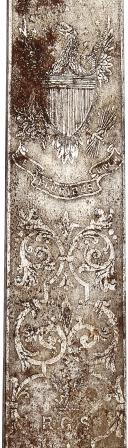
Detail of the sword, showing United States Coat-of-Arms and initials R.G.S.

(Photograph by Stuart E. Mowbray)


1900 – At a meeting of the Military Order of the Loyal Legion of the United States, Commandery of Massachusetts, Brev. Lt. Solon A. Carter, U.S.V., presented a paper titled “Fourteen Months’ Service with Colored Troops,” in which he stated:

In July [1865], upon leaving the service, the late Assistant Adjutant General* was charged by General Paine with the duty of restoring the sword to Colonel Shaw’s father, and upon arrival at this home, opened a correspondence with Mr. Francis George Shaw informing him of its recovery.

The sword in question proved to be the one carried by the gallant colonel and was identified by the initials R.G.S. delicately etched upon the blade. In a postscript to one of his letters, Mr. Shaw wrote, “The sword was a present to my son from his uncle, Mr. George R. Russell, who purchased it in England and caused the etchings to be made there.”

In a subsequent letter acknowledging its receipt he says “I thank you most heartily for all the care and trouble you have taken. So far as such words may be applied to an inanimate thing it is the weapon which has done most for our colored people in this war, and it is to me likewise as well as to you a source of great satisfaction that is was recovered and restored by officers of colored troops.”

*Captain Solon A. Carter, of Leominster, Mass., served as C.J. Paine’s Assistant Adjutant General. Appointed 15 July 1864 and resigned 3 July 1865.

Mar 2017 – The sword was found in the attic of the home of Mary (McCawley) Minturn Haskins.

6 Apr 2017 – In an e-mail to MHS Curator of Art & Artifacts Anne Bentley, one of the donors stated:

Susanna Shaw Minturn is my great-grandmother and apparently was very close to her brother, RGS. Her oldest son, Robert Shaw Minturn, had no children; there were four girls and my grandfather, Hugh Minturn (who died in 1915, before his mother). I can only guess, but presumably my great-grandmother passed the sword on to my father, Robert Bowne Minturn, not her oldest grandson, but the senior by male primogeniture. My father was 15 when his grandmother died in 1926. The sword may have hung on his childhood bedroom wall.

17 Apr 2017 – Shaw sword is given to the Massachusetts Historical Society as part of a larger gift including papers and portraits.

*****

1. Shaw, Robert Gould, Blue-eyed child of fortune: the Civil War letters of Colonel Robert Gould Shaw / edited by Russell Duncan, (Athens : University of Georgia Press, c1992.)

2. Lt. John Ritchie’s diary, Quartermaster of the Massachusetts 54th Volunteer Infantry Regiment, whose diary was used by Luis F. Emilio in A Brave Black Regiment.

3. Paine, Sarah Cushing, Paine ancestry : the family of Robert Treat Paine, signer of the Declaration of Independence, including maternal lines / compiled by Sarah Cushing Paine ; edited by Charles Henry Page, )Boston : Printed for the family [Press of D. Clapp & Son], 1912.

4. Child, Lydia Maria Francis, Letters of Lydia Maria Child / with a biogrpahical introduction by John G. Whittier and an appendix by Wendell Phillips, (Boston: Houghton, Mifflin and Company, 1883).

This Week @ MHS

By

Here we are again with a round-up of events in the week ahead:

– This weeks teacher workshop, “The American Revolution in Art & Artifacts” is SOLD OUT.

– Wednesday, 19 July, 12:00PM : Join us for a Brown Bag lunch talk with Judith Harford of University College Dublin. “Women’s Education Networks” explores the role of the Central Association of Irish Schoolmistresses and the Woman’s Education Association of Boston in advancing the cause of women’s admission to Trinity College Dublin and Harvard University. This talk is free and open to the public. 

– Wednesday, 19 July, 6:00PM : There is no “Boston Historical Society,” but the metro area does have a wealth of history organizations. Boston and surrounding towns are steeped in local history and the inhabitants are proud of their local identity. The MHS is pleased to hold a reception for history buffs and representatives of local organizations to mingle, share recent accomplishments, and talk about the great projects on which they are working. Registration is required at no cost for this Boston Historical Reception. Reception begins at 5:30PM and the formal conversation begins at 6:00PM. 

– Saturday, 22 July, 10:00AM : The History and Collections of the Massachusetts Historical Society Tour is a 90-minute docent-led walk through our public rooms. The tour is free, open to the public, with no need for reservations. If you would like to bring a larger party (8 or more), please contact Curator of Art Anne Bentley at 617-646-0508 or abentley@masshist.org.

While you’re here you will also have the opportunity to view our current exhibition: The Irish Atlantic: A Story of Famine Migration and Opportunity.


“Honest and Faithful” Emerson P. Dibble

By Susan Martin, Collections Services

That word Southwick brings a lot of happy memories to my mind. Can almost see the place now. The old mountain is just beginning to turn color. Chestnut burrs are about half formed and [I] can plainly see the tobacco field with the seed plants standing out like guards. 

This passage is from a letter written by Private Emerson Phelps Dibble on 25 August 1918, about one month after his enlistment in the U.S. Marine Corps. The MHS recently acquired a fascinating collection of Emerson’s papers, primarily letters written during his service in World War I.


Emerson Dibble was born on 24 March 1898, the son of Albert C. and Winifred E. (Phelps) Dibble. As far as I can determine, he was their only child. Emerson’s mother died when he was just three years old, and his father remarried a woman named Millie Holcomb. The Dibbles lived on a farm in Southwick, Mass., where they grew tobacco.

Emerson enlisted in the U.S. Marine Corps on 23 July 1918. Most of the letters in the collection were written to his stepmother Millie, his father Albert, and his girlfriend (later wife) Olive Madeline Jordan. Emerson’s letters are detailed, affectionate, funny, and often very moving. For example, when he wrote the words above, he was in training at Parris Island, S.C., and the pangs of homesickness had set in. Being away made him appreciate his home and family more. Millie wrote that she cared for him as if her were her own son, and he replied, “You can never know how my heart jumped when I read that.” He wrote to his father in the same vein:

When I saw and recognised your hand writing Gee, there was that same big lump came up in my throat and then when I read on and saw your feelings [I] couldn’t keep the tears from my eyes. They were tears of gladness tho’ and [I] can tell you this dad that when this big fight is over and I come back up in a decent country and back to Home there is going to be a closer, dearer feeling between us. I’ve made mistakes in the past that [I] never realized until now. You told me hundreds of times that [I] would see them some day but I in a foolish, boyish passion and anger could not see things the way you did. But [I] can assure you that I see them now, and, oh, so plainly, Dad. When I get back you and I are going to be father and son and not strangers as we have almost been.

Emerson seemed to flourish under the rigorous military discipline. He grew fitter and stronger every day, and even qualified as a sharpshooter. He was proud of the toughness of the Marines: “I wouldn’t want to be a Common Soldier. The U.S. Marine is the only real soldier of [the] United States and is good as any other in the world.” Emerson was also full of interesting anecdotes. He described meeting, in South Carolina, “one old fellow who said he was 92. Don’t know whether he was or not. He looked it tho’. He was a slave when the Civil War broke out and he told us he had seen the battle of Cold Springs and also the evacuation and capture of Richmond by the Yankees.”

In September 1918, the Spanish flu epidemic hit Parris Island, and the camp was temporarily quarantined. Emerson had “a slight attack” and recovered, but he was worried about the folks back home. The following month, he shipped out to Europe.

Letters took longer to reach him across the Atlantic, and when he didn’t hear from Millie, Albert, or Olive for three months, he worried even more. He wanted “to have everyone all O.K. when I come home.” But it was Emerson who would get the worst of it. After another bout with the flu and a fever of 103, he was hospitalized with sub-acute bronchitis. He complained of headaches, weakness in his legs, and a cough, but didn’t feel that bad, he said. It was the monotony he hated.

On 1 May 1919, an ecstatic Emerson wrote to Olive and Millie from the U.S. Naval Hospital in Brooklyn, N.Y. He’d been transferred back to the states and still hoped for a full recovery before leaving the service. One letter revealed a new detail: it was tuberculosis that had killed his mother Winifred eighteen years before, and the family was afraid Emerson would contract it, too. He reassured them that he’d had four sputum tests, and all four had come back negative.

Olive and Emerson were now engaged to be married. Olive was a schoolteacher in Springfield, Mass., and Emerson wrote to tell her how much he missed her:

Oh, Olive dear, if you had only known how I longed for you. Just to see you, to kiss you, to feel you cuddle up close to me as you used to. Gee, dearest girl, I lived over a hundred of those fine times we used to have to-gether. […] You understand, don’t you? Guess I have changed some since a year ago. Maybe in some ways for the worse but principally for the good. […] Oh, dearest girl, if you could only feel my feelings now, Olive, I love you, love you – God help me if I ever stop loving you. […] Hoping and praying to be with you and kiss you (again & again) sometime in the near future.

Emerson was honorably discharged from the U.S. Marine Corps on 29 July 1919 with marks of “excellent” for character, obedience, and sobriety. His service was described as “honest and faithful.” In the fall of 1919, before their marriage, Emerson worked at the General Electric plant in Pittsfield, Mass., and wrote often to Olive in Springfield. They were probably married in 1920.

The next letter, the final letter by Emerson in the collection, is heartbreaking. It’s dated 3 February 1921 and was written on stationery from a ladies’ clothing shop in Holyoke, Mass.—Emerson was apparently boarding there after receiving treatment at a sanatorium. His despair is palpable. At the same time, we learn that Emerson and Olive had become parents.

Today I started to “streak” again so I suppose may expect a hemorrhage any time. Hope this one finishes the bell for [I] am sick and tired of this separation and this recurrence of the trouble. Am afraid that I am going to be a misfit and a dependent for life and thats too much for me. […] Have thought of you often and pray for you and the little girl every night. Can’t go to sleep for hours sometimes just thinking of you dear. […] Maybe I am cowardly and all that but am ready to die tonight and would go happy knowing that [I] had taken a load from the world in general.

Emerson died in July 1922 and is buried at Pine Grove Cemetery in Lynn, Mass. According to his application for a driver’s license, filled out earlier that year, he had contracted pulmonary tuberculosis after all.

I’d love to know what happened to his daughter, Peggy Dibble. She was still alive in 1924, but I can’t find any record of her after that. The collection came to us with a small photograph album, but unfortunately the people in the photographs are unidentified. Another unsolved mystery is the  location of Emerson’s diary, which ended up in the hands of his friend Mike Cronin and was probably returned to Olive after Emerson’s death.

Amazingly, Olive lived to the age of 94 and died in October 1990. She never re-married and is buried in the Lynn cemetery plot with Emerson.


This Week @ MHS

By Dan Hinchen

This week we have just two events on the calendar, featuring JQA and Old Ironsides. Here are the details:

– Wednesday, 12 July, 6:00PM : “The USS Consitution & the Massachusetts Historical Society” is a talk with Margherita Desy, Historian of the USS Constitution, which describes some of the hidden trasures uncovered in the recent restoration of the ship and highlights resources at MHS that help tell the story of the world’s oldest commissioned warship afloat. This talk is open to the public, registration required with a fee of $10 (no charge for MHS Members or Fellows). A reception precedes the talk at 5:30PM followed by the speaking program at 6:00PM. 

– Saturday, 15 July, 10:00AM : Join the Massachusetts Historical Society’s first transcribe-athon! Held in celebration of JQA’s 250th birthday, the purpose of the JQA250 Transcribe-a-thon is to help the Adams Papers editorial project make more of the 15,000-page JQA Diary available online. While the ability to read handwriting is necessary, no transcription experience is required. Bring your laptop or use one of ours. Come for the day or pop in for a little while. All are welcome! Lunch and light refreshments will be provided. Registration is free and open to the public. For more information, or to register, contact Gwen Fries: gfries@masshist.org; 617-646-0556. 

And as always our current exhibition, the Irish Atlantic, is open to the public free of charge, Monday-Saturday, 10:00AM-4:00PM. 

Gertrude Codman Carter’s Diary, July 1917

By Anna Clutterbuck-Cook, Reader Services

Today we return to the 1917 diary of Gertrude Codman Carter. You may read the previous entries here:

Introduction | January | February | March | April | May

June


Only two pages of Gertrude’s diary from June 1917 remain in her diary for that year, the rest having been sliced out at some point before the volume was donated to the Massachusetts Historical Society. Only July 26-31 remain. Still, in even these half-dozen entries we see Gertrude’s life contain everything from a party at the beach to a visit to a former cook who had served the family, now on a pension, to design commissions, to tea with a woman whose son has just enlisted and will soon ship out to war in Europe.

I turn it over Gertrude.

* * *

26 July.

To Lodge school to tea.


27 July.

Mrs South had a bathing party at the [illegible]. Rather fly [illegible] but amusing. Being a Friday & [illegible] day, a number of people [illegible]. So I planted my red sunshade in the sand & Clarence Hayden & I made ourselves into a “Vogue” cover for the amusement of the others. The children had a good time. John frisked about.


28 July.

Went in to see Mrs Plumer the old cook. Her cooking days are over. I am paying for [illegible] & [illegible] has a pension.


To Barton’s after tea


29 July.

John’s [illegible] lesson. “But Mummy, which were the nice people?”

Jacob & Esau

Took John to drive. Lovely sunset at C. Hayden’s.


30 July.

To Ilaro & town.
Called on the Majors.


31 July.

Savannah about green plots.
Inspection of auctions.

11. Dr Gooding dentist. He has invented [illegible] oval playing cards and has asked me to design a cover for them.


Tea at Mrs [illegible]. Her son has gone to enlist and she is very sad at his departure.


* * *

As always, if you are interested in viewing the diary or letters yourself, in our library, or have other questions about the collection please visit the library or contact a member of the library staff for further assistance.


This Week @ MHS

By Dan Hinchen

The Society is CLOSED on Monday, 3 July, and Tuesday, 4 July, for Independence Day.

We return to the Society after a long holiday weekend with a couple of public programs on offer. Here is what’s coming up:

– Wednesday, 5 July, 12:00PM : Come on in for a Brown Bag lunch talk with Lyle Nyberg of the Scituate Historical Society titled “Rivermoor: A Summer Colony in Scituate.” This talk looks at the upper class Bostonians of a century past who spent summers in Rivermoor on Third Cliff in Scituate, including the first American to provide prefabricated houses. Through his Colonial Revival houses, George Welch helps turne what had been farmland since Native American times into a select summer colony. This talk is free and open to the public. 

– Thursday, 6 July, 6:00PM : Stephen Kurkjian is a Pulitzer Prize-winning reporter for the Boston Globe and was the newspaper’s lead reporter on the Gardner art heist. Join us for an author talk with Kurkjian who will discuss his latest book, Master Thieves: The Boston Gangsters Who Pulled off the World’s Greatest Art Heist, share details on the investigation, and offer a possible missing motive. This talk is free and open to the public, though registration is required. A reception will precede the talk, starting at 5:30PM, followed by the program at 6:00PM. 

– Saturday, 8 July : This is your last chance to catch our current short-term exhibit, “Impossible Dreamers: The Pennant-Winning 1967 Red Sox.” View rare photos of the 1967 season taken by retired Boston Globe photographer Frank O’Brien, a collection of 1967 artifacts including Carl Yastrzemski’s jersey. The exhibition is free and open to the public June 24 through July 8th.

While you are here you will also have the opportunity to view our current exhibition: The Irish Atlantic: A Story of Famine Migration and Opportunity.


Guest Post: The Early Revolution, and the Ideas and Identity of the Early Republic

By David “Amby” Tierney, Cohasset High School

This spring I had the pleasure of working with the incredible resources of the Massachusetts Historical Society for use in my research paper. The paper was about the connection between the early events of the American Revolution in Boston and the ideas of the early United States. Perhaps I had hit the right topic, but the Historical Society had a wealth of different sources I could use that were very specific to my topic. In fact, it was somewhat overwhelming. The Historical Society provides an excellent resource, ABIGAIL, which is an online catalog of all of their documents. A simple search will reveal dozens of relevant primary source documents. And these are available in multiple formats. Many of the documents are available online, like John and Abigail Adams’ personal correspondence. Even more are kept at the historical society, in microfilm and microfiche rolls that stack filing cabinets row upon row, top to bottom. Then there are the hard-copy documents from the eighteenth century, which are beyond cool to look at.

Which brings up the personal experience that comes with going in to see the documents. I personally very much enjoyed it. The first time I went in I was rather nervous. I had signed up to Portal1791, the online reservation service, and I assumed that the Massachusetts Historical Society would be a very serious place. I was unsure about what I would need, and I was worried that I hadn’t reserved the right documents. I thought that it was an absolute necessity to reserve documents far in advance. My misgivings were magnified when I realized that I forgot my student ID, which I was informed that I’d need. This turned out to be unfounded. Upon arriving, I signed in and was able to enter with the help of my history teacher, who was my advisor in the project. All of the people at the Massachusetts Historical Society were very friendly and very willing to help. I was impressed with the efficiency of the librarians, who were able to help me find what I needed. When I needed an extra document that I hadn’t reserved, the librarians were able to get it for me without a problem. One librarian was very insightful in teaching me how to use the microfilm reader. Overall, it was an excellent experience and I would recommend using the Massachusetts Historical Society to people doing research.

*****

The MHS has awarded the John Winthrop Student Fellowship since 2013. This fellowship encourages high school students to make use of the nationally significant documents of the Society in a research project of their choosing.


This Week @ MHS

By Dan Hinchen

The final week of June is a fairly quiet one here at the Society. Here is what’s coming up:

– Monday, 26 June, 6:00PM : The Price for their Pound of Flesh: The Value of the Enslaved, from Womb to Grave, in the Building of a Nation is the title of a new publication by past research fellow, Daina Ramey Berry of the University of Texas at Austin. In her work, Berry shows the lengths to which enslavers would go to maximize profits and protect their investments and how enslaved people recalled and responded to being appraised, bartered, and sold throughout the course of their lives. This author talk is open to the public and registration is required with a fee of $10 (no charge for MHS Members or Fellows). Pre-talk reception begins at 5:30PM and the speaking progam begins at 6:00PM. 

– Wednesday, 28 June, 6:00PM : The second author talk of the week features Ann Little of Colorado State University who will discuss her recent book, The Many Captivities of Esther Wheelwright. Little examines the multilingual, multicultural, and border-crossing life of Wheelwright, lived among the three major cultures of colonial North America, and the communites of girls and women around her. The talk is open to the public and registration is required with a fee of $10 (no charge for MHS Members or Fellows). Pre-talk reception begins at 5:30PM and the speaking progam begins at 6:00PM. 

– Saturday, 1 July, 10:00AM : The History and Collections of the MHS is a 90-minute docent-led walk through our public rooms. The tour is free, open to the public, with no need for reservations. If you would like to bring a larger party (8 or more), please contact Curator of Art Anne Bentley at 617-646-0508 or abentley@masshist.org.

While you’re here you will also have the opportunity to view our current exhibition: The Irish Atlantic: A Story of Famine Migration and Opportunity.

Please note that the Society is CLOSED on Monday, 3 July, and Tuesday, 4 July, for Independence Day. Normal hours resume on Wednesday, 5 July. 

A Swing through Lynn Woods around 1910

By Brendan Kieran, Reader Services

The Lynn Woods Reservation is a fun place to spend some time among trees and even take in views of the Boston skyline. It is also notable for various features and structures, such as Stone Tower, Dungeon Rock, and the Wolf Pits, as well as the stories behind them. My dad grew up in Lynn, and I’ve been to the woods myself, so I have some familiarity with these stories. However, I recently had an opportunity to “explore” the woods with two new guides.

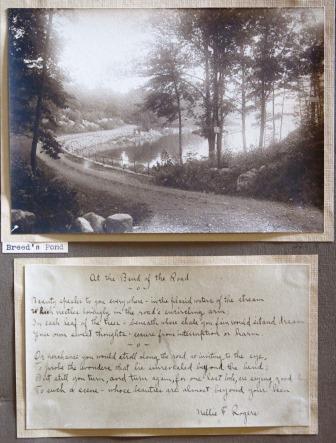
“Breed’s Pond,” photograph by Edward P. Nostrand; “At the Bend of the Road,” poem by Nellie F. Rogers.

The MHS is home to a Lynn Woods photograph album, ca. 1910, consisting of various photographs of Lynn Woods along with explanatory text. The text by Edward P. Nostrand, which includes descriptions of various locations as well as short stories associated with the woods, reads like the transcript of a guided tour. The text interacts nicely with his photographs and Nellie F. Rogers’s poetry to provide an engaging sweep through the Lynn Woods of the early 20th century based on the perspectives of two people who experienced it.

Nostrand prefaces his narrative with a warning that “the legends have been handed down from generation to generation, and as to their truth, the reader must accept them as such.” He starts by briefly describing the early settlement of the Lynn area by Europeans in the seventeenth century. He writes about a supposed pirate encounter in 1656, in which a ship owned by Captain Kid [sic] came up the Saugus River and men from the ship got out and went into the woods. In response to a letter, the townspeople provided shackles and handcuffs to the pirates. According to the story, the men placed treasure in the woods, under Dungeon Rock.

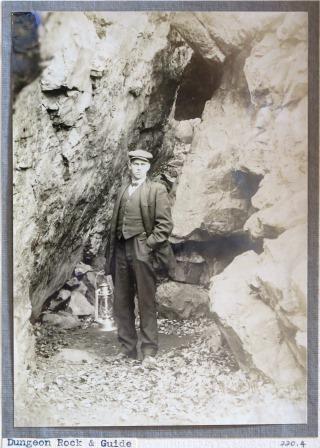
Nostrand also tells the story of Hiram Marble, a man who spent years blasting through the rock in the hopes of finding the treasure; while he never did find what Nostrand calls “treasure which never existed,” the effort has left behind a path in the rock, which is still open for exploration today. 

 “Dungeon Rock & Guide,” photograph by Edward P. Nostrand

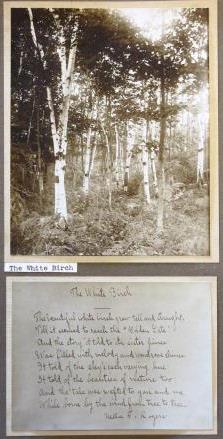
In addition to telling these fascinating stories, Nostrand describes various locations within the woods, as well as some of the flora and fauna there. Among the spots he mentions, and includes photographs of, are “Breed’s Pond,” “Fern Dell,” “Lovers Lane,” and “Forest Castle.” One particular feature that seems to be of particular significance to Nostrand is a group of white birch trees, about which he writes “Oh ye Gods what a sight! There they stand – are they not beautiful?” The previous page includes both a photograph of white birch trees and a poem by Rogers, titled “The White Birch,” which reads as follows:

The beautiful white birch grew tall and straight,

‘Till it seemed to reach the “Golden Gate.”

And the story it told to its sister pines

Was filled with melody and wondrous chimes.

It told of the sky’s each varying hue;

It told of the beauties of nature too;

And the tale was wafted to you and me,

While borne by the wind from tree to tree.


 “The White Birch,” photograph by Edward P. Nostrand; “The White Birch,” poem by Nellie F. Rogers

This Lynn Woods photograph album offers an exciting glimpse into the Lynn Woods of the 1910 period, as seen and documented by Nostrand and Rogers. Nostrand’s narrative should not serve as a transcript for a 2017 walking tour – he uses some language that is offensive today, and, based on my knowledge of the woods and my viewing of his photographs, the area does not look exactly the same now as did over a century ago. However, if you would like to engage with the woods as Nostrand and Rogers would have in the early 20th century, feel free to view the album here in the MHS library.

Additionally, if you are interested in the stories around Dungeon Rock, N. S. Emerson’s The History of Dungeon Rock: Completed Sept. 17th, 1856 (Boston: Adams, 1856) and Dungeon Rock; or The Pirate’s Cave at Lynn (Boston: C.M.A. Twitchell, 1885) are print items held by the MHS that may be of interest. Copies of an 1859 edition of The History of Dungeon Rock (Bela Marsh), which the MHS also holds, as well as the 1885 Dungeon Rock book are available electronically through Internet Archive.

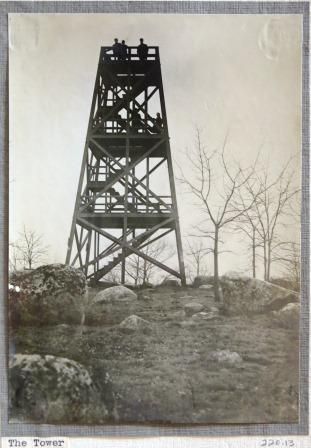
“The Tower,” photograph by Edward P. Nostrand

Photographs at the MHS

By Susan Martin, Collections Services

Having spent the last few weeks immersed in a very interesting collection of 19th- and early 20th-century photographs (more on that in a later post), I thought I’d take this opportunity to write about processing photographs here at the MHS and what goes into making these terrific collections available to researchers. 

The MHS is primarily a manuscript repository, but most of our manuscript collections come to us with at least a few photographs mixed in. Because of their special storage and preservation needs, the photographs are removed and stored separately. Unfortunately we don’t have the resources to process all of our photograph collections, but we have cataloged many of them in our catalog ABIGAIL, and over fifty are described in more detailed online guides.

Describing a photograph collection is challenging, and not just because of the technical knowledge required. For one thing, unlike manuscript collections, which are arranged into groups of related material (correspondence, diaries, financial papers, etc.), photographs are described at the item level. Every photograph is listed individually, and each listing includes most of the following information: subject, date, photographer, location, type, size, and condition, as well as any label or caption.


Just the subject and date can be tricky! The collection I’m currently processing, for example, contains hundreds of photographs and came to us completely unorganized. Many of the photographs include no identifying information at all. Since the collection encompasses five generations of a very large family, as well as families related by marriage, I had to do a lot of genealogical research. As I sorted through the photographs, I started to recognize familiar faces (“Hey, it’s Frank!”). My colleague Sabina Beauchard described the fun of making these connections in an earlier Beehive post.

Dates of photographs can be determined—or at least estimated—based on various factors. Here it helps to know something about the history of photography, and fortunately for me (not even close to an expert) our library has some great resources on the subject. If I know when a particular photographic process was invented and when it was most popular, I can make an educated guess about a photograph’s date, even if I can’t identify the subject. I often use “circa” dates and date ranges to hedge my bets.

The earliest photographic processes were metal- or glass-based, and the types I’ve seen most are daguerreotypes, ambrotypes, and tintypes. Each has distinctive characteristics. Daguerreotypes and ambrotypes both come in cases or enclosures, but a daguerreotype has a mirrored surface, and you have to hold it at a slight angle to see the image. This isn’t true for ambrotypes. And the tintype is the only one of the three that’s magnetic.

Starting in the 1860s, these types of photographs were gradually replaced by paper-based cartes de visite and, later, cabinet cards. These come in standard sizes: cartes de visite are about the size of baseball cards (2.5” x 4”), and cabinet cards are larger (4.25” x 6.5”).

I may be able to use contextual clues to determine the date of a photograph—clothes, hairstyle, etc. If I have multiple photographs of the same person, I can try to guess their age, but this is more of an art than a science! Biographical details are useful: when did they take that trip to Philadelphia? When did they get married? If a photographer printed his or her name and address on a photograph, I can research when the studio was located there. There may even be something in the manuscript collection to help, like a letter the photograph was enclosed in.

Our digital team sometimes comes along behind us and digitizes part or all of a photograph collection, and we link to that content from the guide. Several of our Civil War photograph collections are accessible this way, as are our Portraits of American Abolitionists. Or to find photographs related to a particular person or subject, you can always just search our website. If you can identify anybody we missed, don’t hesitate to let us know!