“Free Soil, Free Speech, Free Labor, Free Men”: Charles Sumner and the Massachusetts Free Soil Party

By Susan Martin, Collection Services

It was the summer of 1850, and the Massachusetts Free Soil Party needed a standard-bearer. The party was just two years old and struggled to make headway against the two-party juggernaut of Democrats and Whigs. Free Soilers had seated only a handful of their candidates in Congress so far, but with the upcoming U.S. Senate election, they saw a chance to cement their influence on public policy.

Founded in 1848 by disillusioned anti-slavery Democrats and Whigs, the party’s primary issue was opposition to slavery in new territories acquired by the United States. Thus its slogan: “Free Soil, Free Speech, Free Labor, Free Men.” To be a Free Soiler was not necessarily to be an abolitionist; the party platform didn’t call for an end to slavery, merely opposed its extension into new American land.

The Free Soilers’ sense of urgency was warranted. On 2 February 1848, with the Treaty of Guadalupe Hidalgo that ended the Mexican-American War, the U.S. had annexed a massive amount of land, including Texas, California, and most of the American Southwest. The debate was raging: Would slavery be the law of the land in this new territory?

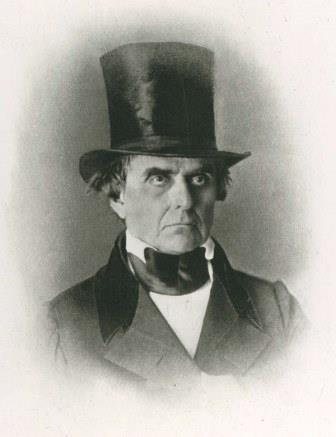
Daniel Webster

Then, on 7 March 1850, “the great Massachusetts Statesman” Daniel Webster gave a fateful speech. In his Seventh of March Speech, as it came to be known, Senator Webster argued in favor of the Compromise of 1850, including the abhorrent Fugitive Slave Law, as necessary to preserve the Union. Anti-slavery partisans in Massachusetts, where opposition to the compromise was strongest, were shocked and angry. Even more so when Webster was appointed Secretary of State by President Millard Fillmore in July.

To make matters worse, the nominee chosen by the Massachusetts Whig Party, Samuel A. Eliot, came out in support of Webster’s speech. The Whigs were the dominant party in the state, but Free Soilers could not, in good conscience, back Eliot’s candidacy. Tired of concessions to “the great Slave Power,” they met on 8 August to choose their own nominee.

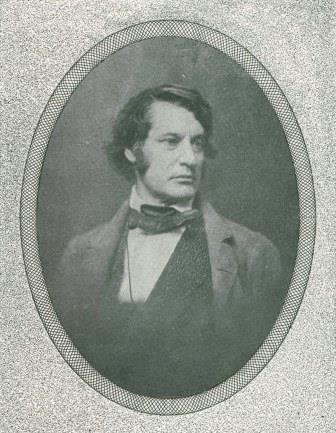
Charles Sumner


They settled on Boston lawyer Charles Sumner, a staunch “anti-extensionist” and former “Conscience” (anti-slavery) Whig. The 39-year-old Sumner was an impressive orator notorious for delivering a controversial anti-war speech at Boston’s official Independence Day celebration five years earlier. He’d also recently argued against racial segregation in public schools in the landmark case of Roberts v. Boston, alongside African-American lawyer Robert Morris. And although he’d run for a Congressional seat once before and lost, Sumner was a logical choice, and Free Soilers were hopeful.


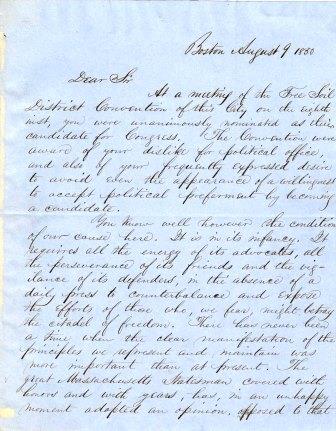
On 9 August 1850, Chairman William Bates and Secretary James W. Stone of the Massachusetts Free Soil Party wrote a letter to Sumner offering him the nomination. The letter, recently acquired by the MHS, reads in part:

You know well however the condition of our cause here. It is in its infancy. It requires all the energy of its advocates, all the perseverance of its friends and the vigilance of its defenders, in the absence of a daily press to counterbalance and expose the efforts of those who, we fear, might betray the citadel of freedom. There has never been a time when the clear manifestation of the principles we represent and maintain was more important than at present.

Sumner initially demurred. Then Congress passed the Compromise of 1850, and Sumner accepted the nomination.

He was a divisive candidate, to say the least. It took four months of repeated and contentious voting in Congress for Sumner to win the absolute majority necessary to take the seat, which he finally did in April 1851. It was the start of a long and illustrious career. Sumner would go on to serve in the Senate for almost 23 years, as a Free Soiler and then a Republican, until his death in 1874. Probably most famous as the victim of an assault by fellow Congressman Preston Brooks in 1856, Sumner is widely acknowledged as one of the most influential U.S. legislators during the Civil War and Reconstruction eras.


Sources:

Blue, Frederick J. Charles Sumner and the Conscience of the North. Arlington Heights, Ill.: Harlan Davidson, 1994.

Blue, Frederick J. The Free Soilers: Third Party Politics, 1848-54. Urbana, Ill.: University of Illinois Press, 1973.

Taylor, Anne-Marie. Young Charles Sumner and the Legacy of the American Enlightenment, 1811-1851. Amherst, Mass.: University of Massachusetts Press, 2001.

This Week @ MHS

By Daniel Hinchen, Reader Services

It’s a pretty busy week ahead for programs at the Society. Here is what’s on tap:

– Monday, 23 January, 12:00PM : Come on in at lunchtime for a Brown Bag talk. “‘Faraway Women’ and the Atlantic Monthly” discusses Ellery Sedgwick, editor of the Atlantic Monthly from 1908-1938, and the “Faraway Women” who were viewed as a defining feature of his career: women who published in the Atlantic accounts of unusual life experiences in Europe, Asia, the American South, and, most especially, the American West. The talk is presented by Cathryn Halverson of the University of Groningen. This talk is free and open to the public. 

– Tuesday, 24 January, 5:15PM : This week’s seminar is from the Modern American Society and Culture series and is a panel discussion. “Urban History on the Digital Frontier” features Vivek Bald of MIT, Jack A. Dougherty of Trinity College, and Marilynn S. Johnson of Boston College. Bald is working on a transmedia project that includes a digital oral history website; Dougherty and his students are writing an open-access book which features interactive maps and oral history videos; Johnson’s Global Boston is a public history website combining student research, oral history, and a curated selection of digitized primary sources, images and maps documenting the local immigrant experience. The discussion is moderated by Douglas O’Reagan of MIT. Seminars are free and open to the public; RSVP requiredSubscribe to receive advance copies of the seminar papers.

– Thursday, 26 January, 6:00PM : Please join us for a special author talk which will feature a discussion between Stephen Kinzer of the Boston Globe, and Emmy Award-winning host of Here and Now, Robin Young. The discussion focuses on Kinzer’s latest book, The True Flag: Theodore Roosevelt, Mark Twain, and the Birth of American Empire. In asking how the United States should act in the world, Kinzer reveals a piece of forgotten history and transports us to the dawn of the 20th century, when the United States first found itself with the chance to dominate faraway lands. This talk is open to the public, registration required with a fee of $20 (No charge for MHS Fellows or Members). There is a pre-talk reception at 5:30PM and the program begins at 6:00PM. 

– Saturday, 28 January, 10:00AM : The History and Collections of the MHS is a 90-minute docent-led walk through the public rooms of the Society’s home on Boylston Street. The tour is free and open to the public with no reservations needed for individuals or small groups. Larger parties (8 or more), please contact Curator of Art Anne Bentley in advance at 617-646-0508 or abentley@masshist.org. While you’re here you will also have the opportunity to view our current exhibition: Turning Points in American History.

– Saturday, 28 January, 1:00PM : The next installment of our Begin at the Beginning series looks at Medical and Surgical Care in Puritan New England. From bloodletting to powders made from roasted toads, medical care in early New England was of uncertain value to the patient. In this discussion of primary documents led by Sid Levitsky of Harvard Medical School, we’ll explore the foundations of 17th century English medicine and surgery and the practice of medicine in New England. Please RSVP. This event is done in cooperation with the Partnership of Historic Bostons. 

Gertrude Codman Carter’s Diary, January 1917

By Anna Clutterbuck-Cook, Reader Services

In late December, I introduced readers to Lady Gertrude Codman Carter, whose diary we will be exploring month-by-month through 2017. While a fairly regular diarist, Gertrude Carter’s journal skips from the end of December 1916 to February 8, 1917 without clear explanation. Thus, our January installment of this series will be slightly atypical as I introduce you to Carter’s diary through the look, feel, and format of the volume itself.


Unlike last year’s diary, which contained line-a-day entries with little or no elaboration, the Carter diary is a wealth of variation. While physically designed in a pre-printed format much like the line-a-day-diaries of Margaret Russell, Carter’s diary is a large format of 11.5 x 7 inches, three days per page. As you can see, Codman uses the design of the pages as only a loose guide; to begin with, she has repurposed a pre-printed volume meant for 1915 for her record of two years later. This thrift, perhaps caused by wartime shortages, requires her to correct the numerical date for each entry as well as the year printed next to the month on each page.


The page above, with which the diary opens, is preceded by the rough edge of several torn pages. Were the pages removed because they were unused, or was their information within them the diarist or descendent did not wish to be seen by future eyes? Impossible to tell from the volume itself.

It is also clear from Carter’s entries that, in some cases at least, the details were added in retrospect. “Another engagement,” she writes under February 10, a Saturday, “(doesn’t say what – so I imagine it was a life…)” … any suggestions for what that final word may be? To what other record is she referring, the record in which she failed to record her engagements? Another mystery.


An artist, Carter’s record incorporates the visual. The photo affixed to the February page above is pasted on the date without remark, appearing to be an image of a construction site of some kind — perhaps work being done on Ilaro, the residence Carter was designing for her family. On other pages, we will encounter fanciful sketches and brilliant paintings, such as this tiny island sketched in an otherwise dense page of writing and the “Study of Captain Silver’’s Parrot,” both found in the volume for 1916.


In February, we will delve into the stories shared in the diary itself, including a long narrative recording about a what Carter deems a “real case of telepathy,” and the long, deathly shadow of the ongoing war.

Do you have specific questions about Codman’s life or diaries? Leave a comment below! Throughout the year, I will be exploring Codman’s biography and context, and will be happy to take requests.

If you are interested in viewing the diary yourself, in our library, or have other questions about the collection please visit the library or contact a member of the library staff for further assistance.

Teacher and Student Fellowships at MHS

By Kathleen Barker, Public Programs & Education

Are you an educator looking for a relaxing and rewarding summer professional development opportunity? Consider applying for a Swensrud Teacher Fellowship! Perhaps you don’t have much time to devote to research this summer, but you have a student (or a few) who would love to do some original research. We have a fellowship for them, too!

New England School by Charles Frederick Bosworth (c.1852). Massachusetts Historical Society

Each year the MHS offers at least three fellowships to K-12 educators. Applications are welcome from any candidate (living anywhere in the United States) who is interested in developing an engaging series of lessons using documents and artifacts from the Society’s collections. Each fellow receives a $4,000 stipend in exchange for approximately 4 weeks of research and writing. Our 2016 teacher fellows investigated topics including the coming of the American Revolution in Boston, Bostonians’ experiences in World War I, and the Transcendentalist movement and the creation of Brook Farm. Other fellows explored the role of women in the abolitionist movement and how Boston’s abolitionist movement influenced ideas about Black identity and racial equality. Throughout 2017, we will be adding these (and more) curriculum units to our website, so visit our education pages frequently. (http://www.masshist.org/2012/education/lessonplans)

Our Winthrop Student Fellowship encourages budding historians to engage with primary sources to write a paper, create a website, or design an exhibit … whatever piques the student’s interest. Prior to applying, a student should consult with his or her teacher to agree upon an appropriate topic and product. This year’s Winthrop Fellows were a group of students from Stoneham (Mass.) High School. They created an exhibition for National History Day on the Boston Post Road, and described their research experiences in a recent blog post. (http://www.masshist.org/blog/index.php?series=46) Both the teacher and the student(s) receive a stipend upon completion of the fellowship, as well as an opportunity to attend a behind-the-scenes tour of MHS.

Applications for teacher and students fellowships must be postmarked no later than February 16, 2017. Learn more about application requirements, suggested topics, and other guidelines on our website (http://www.masshist.org/education/fellowships), or contact education staff members for more information (education@masshist.org). 

This Week @ MHS

By Dan Hinchen

The Society is CLOSED on Monday, 16 January, in observance of Martin Luther King, Jr. Day

Here are the events on the schedule this week:

– Wednesday, 18 January, 12:00PM : “The Fight for Women’s Equality in the Anti-Slavery Movement, 1833-1840” is a Brown Bag talk with Louis Knight, author of Jane Addams: Spirit in Action. The talk examines ow some early feminist abolitionists sought to integrate women into the American Antislavery Society beginning in 1833 and finally succeeding in 1840, illustrating how these women were inspired by a groundbreaking feminist vision for a genderblind democracy. This talk is free and open to the public. 

– Wednesday, 18 January, 6:00PM : Loom, a new book of poetry by Kevin Gallagher, explores the difficult relations between the northern textile mills and the cotton produced by the southern slave economy. This author talk is open to the public and registration is required with a fee of $10 (no charge for MHS Members or Fellows). There is a pre-talk reception at 5:30 with light refreshments, and the program begins at 6:00PM. 

– Thursday, 19 January, 5:30PM : “Publishing Lives: How It’s Done, and Who Does It” is part of the New England Biography Seminar series. Deanne Urmy, Senior Executive Editor at Houghton Mifflin Harcourt, and Jill Kneerim of the Kneerim & Williams literary agency, both of whom are actively engaged in publishing biography, will be joined by Laura Claridge, author of the just-published The Lady with the Borzoi: Blanche Knopf, Literary Tastemaker Extraordinaire. Their conversation will widen out from biography itself to the workings of the literary marketplace, then and now. The discussion is moderated by Megan Marshall. Seminars are free and open to the public; RSVP requiredSubscribe to receive advance copies of the seminar papers.

– Saturday, 21 January, 10:00AM : The History and Collections of the Massachusetts Historical Society Tour is a 90-minute docent-led walk through our public rooms. The tour is free, open to the public, with no need for reservations. If you would like to bring a larger party (8 or more), please contact Curator of Art Anne Bentley at 617-646-0508 or abentley@masshist.org.

While you’re here you will also have the opportunity to view our current exhibition: Turning Points in American History.

This Week @ MHS

By Dan Hinchen

We’re back to business here at the MHS, heading into year 226! Our programs begin in earnest this week with a seminar, a brown bag, and a tour. Here’s the rundown:

– Tuesday, 10 January, 5:15PM : The first seminar of the year is part of the Environmental History series and is called “Sex in the Reeds: Disciplining Nature and Cultivating Virtue in the Back Bay Fens.” Zachary Nowak of Harvard University presents this essay on “invasive exotic species” as one reason for the removal of reeds planted along the Muddy River, and that label as a social construct, not a biological fact. Improving the Fens through planting and weeding has for more than a century really been a project to improve people. Independent Scholar Phyllis Andersen provides comment. Seminars are free and open to the public; RSVP requiredSubscribe to receive advance copies of the seminar papers.

– Wednesday, 11 January, 12:00PM : Stop by at lunch time for a Brown Bag talk with John Garcia of Boston University. “The Early American Bookseller: A Network History” explains how financial records, correspondence, and writing by booksellers can help to reconstruct print networks and geographies of books and reading. Garcia argues that the many instances of economic failure in American bookselling reveal various attempts to connect authors, readers, and publics in the face of geographic and infrastructural obstacles. This talk is free and open to the public. 

– Saturday, 14 January, 10:00AM : The History and Collections of the Massachusetts Historical Society Tour is a 90-minute docent-led walk through our public rooms. The tour is free, open to the public, with no need for reservations. If you would like to bring a larger party (8 or more), please contact Curator of Art Anne Bentley at 617-646-0508 or abentley@masshist.org.

While you’re here you will also have the opportunity to view our current exhibition: Turning Points in American History.


Please note that the Society is CLOSED on Monday, 16 January, in observance of Martin Luther King Day. Normal hours resume on Tuesday, 17 January. 

Book Review: “Not A Catholic Nation”

By Wesley Fiorentino, Reader Services alumnus


New England is perhaps not the first region in which twenty-first century readers place the Ku Klux Klan.  Yet, in Not A Catholic Nation: The Ku Klux Klan Confronts New England in the 1920s, Mark Paul Richard thoroughly dispels the notion that the infamous secret society had no substantial presence in New England or the northeast.  Richard, Professor of History and Canadian Studies at the State University of New York at Plattsburgh, focuses on the tensions between the KKK and Catholic immigrant populations throughout New England in the 1920s.  Of particular interest to Richard is the resistance to KKK influence by Franco-American populations in the northeast borderlands regions.  French-speaking Catholic groups in all six New England states were at the forefront of anti-Klan activity in the 1920s.

Richard closely examines the rise and fall of the 1920s Klan in New England using newspapers, state government records, and court proceedings as his source material.  Through this research Richard sheds considerable light on the sentiments both for and against the Klan during the 1920s.  Formally re-founded in 1915, the second iteration of the Ku Klux Klan spread well beyond the southern states where the original Klan had operated.  Building on a structured hierarchy, the Klan of the 1920s functioned as something like a fraternal and civic organization, espousing the need for Anglo-American Protestants to unite in the face of waves of Catholic immigrants in addition to Jews, African-Americans, and other minorities.  Espousing Nativist ideals, the Klan sought to disenfranchise entire groups of Catholic immigrants from politics and business.  While Klan-affiliated groups in New England remained in agreement with the national Klan with regards to their views on minorities including Jews and African-Americans, Catholic immigrants generally made up much larger portions of the population in New England states and were thus seen as a more immediate threat to be dealt with.  Among their biggest targets were the Franco-American populations in New England.  In the 1920s, Franco-Americans made up a huge portion of both the immigrant and the Catholic populations of New England states.  They would clash with the Klan in their newspapers, in the streets of New England cities and towns, and in the halls of state government.

Richard’s book showcases the efforts of ethnic Catholic groups to dispel the Klan’s exclusionary notions of Americanism.  Furthermore, Richard demonstrates that Franco-Americans in particular acted as their own agents in their ideological struggles with the Klan.  Although Irish-American politicians in New England such as James Michael Curley railed against the KKK, Franco-Americans resisted the influence of the KKK largely through their own efforts.  Richard examines the use of French-language newspapers in Massachusetts, Rhode Island, and elsewhere in exposing the contradictions and hypocrisy inherent in KKK ideology. 

In addition to earlier scholarship focusing on the struggles of Irish-American politicians against the Klan,  Richard shows that Franco-Americans were often a favorite target of Klan members and Nativist sympathizers and that they effectively discredited the Klan in New England through their own avenues including French-language newspapers and open protest.  Richard’s book is an excellent read for students of immigration issues in the early twentieth century, as well as of the struggles of Catholic populations against Nativist bigotry.  Scholars of the Franco-American experience in the northeast in the twentieth century will find Richard’s book to be an invaluable tool. 

Below are some materials relating to issues of immigration, race, religion, and civil liberties in Massachusetts from our collections:

– Ursuline Convent Trial Notes, 1834.  Call Number: Ms. N-1698.  Shaw, Lemuel, 1781-1861.  Massachusetts Historical Society.

– John E. Gilman Scrapbooks, 1885-1890.  Call Number: Scrapbooks 051.  Gilman, John E., 1844-1921.  Massachusetts Historical Society.

– Massachusetts Public Interests League records, 1919-1929.  Call Number: Ms. N-514.  Massachusetts Public Interests League.  Massachusetts Historical Society.

– American Civil Liberties Union of Massachusetts records, 1920-2005.  Call Number: Ms. N-2257.  American Civil Liberties Union of Massachusetts.  Massachusetts Historical Society.

Gertrude Carter’s Diary: An Introduction

By Anna Clutterbuck-Cook, Reader Services

Gertrude Carter with her husband Gilbert and son John, 1916

(Library of Congress, Public Domain)

Following the serialization of the 1915 travel diary of an anonymous Boston woman who journeyed down the Nile, and the 1916 line-a-day-diary kept by upper-class Bostonian Mrs. Margaret Pelham Russell, I am continuing to explore the personal narratives contained in the MHS collections in 2017 with the 1917 illustrated diary of Boston-born artist Gertrude Codman Carter.

Born in 1875 to Frank Parker and Mary Codman, Gertrude grew up in a comfortably upper-middle class family that had made its wealth in the textile industry before and during the Civil War [1]. Encouraged in artistic pursuits, young Gertrude was an accomplished artist and studied at the Boston Museum School of Fine Arts during the 1890s and traveled abroad to Italy and France to refine her work as a painter and illustrator [2]. In her late twenties she became the second wife of Sir Gilbert Thomas Carter, a British colonial officer who served as Governor in The Bahamas and Barbados and, briefly, in Trinidad and Tobago.

Gertrude and Gilbert began the year 1917 living in Barbados at Ilaro Court, a residence that Carter had designed herself, with their young son John (pictured above with his parents). Though an ocean away from Europe, the long shadow of WWI hangs over the household even as the activities of white British Colonial society carries on. Beginning in January 2017 we will be following Carter through her year to learn what her diaries can tell (and show) us about the life of a female artist, mother, and white British colonial was like one hundred years ago.

Do you have specific questions about Codman’s life or diaries? Leave a comment below! Throughout the year, I will be exploring Codman’s biography and context, and will be happy to take requests.

If you are interested in viewing the diary yourself, in our library, or have other questions about the collection please visit the library or contact a member of the library staff for further assistance.

The Bostonian and the Bard

By Dan Hinchen, Reader Services

The Shakespeare Birthplace Trust is an organization in Stratford-upon-Avon, Warwickshire, England which oversees the historic home in which the William Shakespeare was born. Through the centuries, millions have visited this 16th century abode in order to pay their respects to the Immortal Bard. 

A few weeks ago, I was greeted one morning with a reference question from the staff of the Shakespeare Birthplace Trust. The question focused on the oldest guestbook that the Trust holds in their archives. The item dates to the year 1812 and the first recorded visitors are a TH Perkins of Boston, and Joseph Curwen of Philadelphia.

DR185/1 Shakespeare’s Birthplace Visitors’ books, Stratford-upon-Avon, Shakespeare Birthplace Trust


The question coming from Stratford was whether this TH Perkins is Thomas Handasyd Perkins, a prominent Boston businessman and successful merchant of the China trade. Here at the MHS we hold the Thomas Handasyd Perkins papers, 1764-1854 and the folks at the Shakespeare Birthplace were looking for confirmation that these were the same person. So, I started digging to see what I could find about Mr. Perkins’ travels in the early 19th century.

Within the collection is a “Journal of Reminiscences of England and Wales, 1 July 1812,” which seemed promising for answering this question. I scrolled through the microfilm looking for keywords that would jump out at me and, sure enough, about thirty frames in I saw mention of Stratford, so I slowed down and started paying attention. As I read, more and more pieces slid into place.

Altho’ I had before visited Stratford, yet it gave me great pleasure to have an opportunity of passing a few more hours here…

When here before, I went to the house, and into the room where the Poet was born, but as Mr. Curwen had not visited this place before, I passed thro’ the town with him and visited, both the house and the church with him…

Perkins then goes into some detail about the people residing in the house

It is now occupied by a Butcher, who hangs up his mutton at the windows of the front room, and whose wife who is a very loquacious sort of a woman, shows you all the Relics which are said to have been the property of the bard.

He continues to describe some of the rooms in the house, making special mention of some walls which were whitewashed and then covered over in the penciled scrawling of visitors, signing their names and leaving messages to show their passage through.

When I was here before, I asked the woman why she did not keep a Book, in which persons who came to visit the house might subscribe their names, as the walls were full. She said she had frequently thought of getting one, and had been often asked if she had one, but that she had no one to prepare it for her; at that time I was much hurried, but determined that if I ever again passed thro’ Stratford I would purchase one and give it to the woman. I now put my resolution into execution by buying a quarto blank Book containing about four quires of paper, and giving to be applied to his purpose I ruled it, making a column for the date, another for the name and a third for the Residence__and having written in the beginning of it “Tribute of Repsect to the Memory of the Bard of Avon” and furnished the woman with an ink stand and some pens, I subscribed my name, and wished her to deliver the Book when filled to the Librarian of the town, who is to deposit it in the Library, and furnish another blank Book in its stead.


When taking on this reference question I was fairly confident that the “TH Perkins” in the guestbook would be the same as the man whose papers we hold. However, I was tickled when I read this passage and learned that our Perkins was actually the person who purchased and inscribed the guestbook, even going so far as to provide instructions for its preservation. Perhaps in another life this businessman will make a good librarian.

An Anxious Christmas

By Amanda M. Norton, Adams Papers

Christmas 1798 was an anxious one for the Adams family. President John Adams faced a new congressional session and the continued threat of war with France, a presidential cabinet of unknown loyalty, and a fiercely partisan Congress. The situation in his personal life was scarcely more cheery—John marked the day alone in Philadelphia as his dearest friend, Abigail, recuperated from a life-threatening illness in Quincy, and winter weather making her joining him unsafe. Moreover his youngest son, Thomas Boylston, was overdue to arrive in a winter voyage across the Atlantic home to the United States after over four years in Germany.

John had already written to Abigail once on Christmas morning, but picked up his pen a second time later in the day. While the upcoming volume of Adams Family Correspondence will include the first of these letters as it is more detailed and substantial, this second letter will be omitted. In his brief second letter, he told her about the ride he took through what he describes as a picturesque winter wonderland around Philadelphia on a sunny day. He also tried to reassure Abigail from afar that there was no need to worry if no news of their son’s arrival had yet reached her:

I have rode in the Coaches with Mr [William Smith] shaw over Grays Ferry and round by Hamiltons Woodlands over the Upper Ferry home, about ten miles [James] Kiggin says. more beautifull Slaying never was seen. The snow not as with you excessively deep, but enough to cover all the Earth and deep enough to afford a very smooth path and beautifully white as Innocence itself. Yet the sun melts the snow and it runs from the Roofs and fills the air with a Chilly Vapour which destroys the Comforts as well as beauty of Winter in this place.— How soon a warm rain and thorough Thaw may happen to break all up & make the Roads impossible, none can tell.

Christmas is arrived but I dont hear of T. B. Adams’s Arrival at Newbury Port. I hope you have before this: but if you have not dont be anxious—long Passages very long are very frequent at this season.

Although the Adamses did not celebrate Christmas the way it is commonly celebrated today, it was still a day that brought a short respite from work if not from worry with an eye toward an approaching new year.