Six Degrees of Paul Revere

By Susan Martin, Collections Services

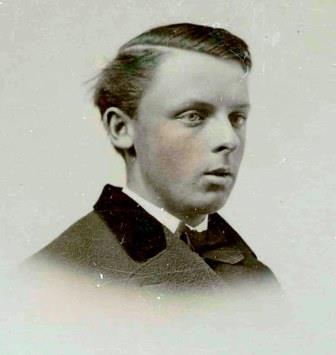
While processing the Fay-Mixter family photographs, I came across this small tintype.


A note on the back of the photograph, probably written by a relative, identifies the subject as “Joseph W. Revere / about 18 yrs old.” I wondered if he was one of the Reveres, so I did a little genealogical research.

The Fay-Mixter photograph collection contains 277 photographs depicting members of several interrelated families, including Fays, Mixters, Spooners, Galloupes, Torreys, and others. (The MHS also holds a collection of Fay-Mixter family papers.) After building multiple family trees and tracing the intersections, I finally hit on a Revere.

There have been several Joseph W. Reveres, but this particular one is Joseph Warren Revere (1848-1932) of Boston and Canton, Mass. He was connected to the Fays, etc. through his mother, Susan Tilden (Torrey) Revere, who was the first cousin of Elizabeth Elliot (Torrey) Spooner. Elizabeth’s daughter married Henry Howard Fay.

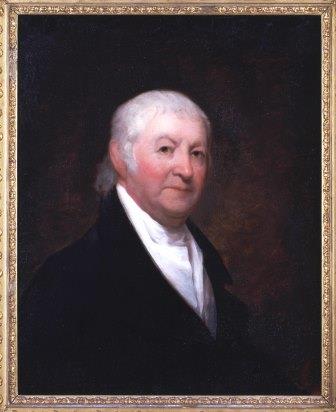
And yes, Joseph was a direct descendant—a great-grandson—of the legendary Paul Revere. The MHS holds a portrait of Paul Revere, painted ca. 1823 by Chester Harding after a Gilbert Stuart original.


What I find remarkable is not the connection itself (eleven of Paul Revere’s sixteen children survived to adulthood, so he’s bound to have descendants far and wide), but that the connection is so recent. Joseph was the grandson and namesake of Paul’s eleventh child, Joseph Warren Revere (1777-1868). Two centuries but only four generations separate Paul’s birth in 1735 and Joseph’s death in 1932. Paul was born 20 years before the French and Indian War, and his great-grandson died in the midst of the Great Depression.

Tintype photographs were first introduced in the 1850s, soon after daguerreotypes and ambrotypes, and reached the height of their popularity in the 1860s-70s. If Joseph Warren Revere was 18 years old when he sat for this portrait, it was taken around 1866. The tintype measures 9 cm x 6 cm, although the image above is cropped. If you look closely, you’ll see that some color has been added to his cheeks.

Joseph became a mining engineer and worked with the Dominion Coal Company in Glace Bay, Nova Scotia. He married Anna Peterson in 1893, and the couple had four children, the last of whom died in 1988 at the age of 92.


This Week @ MHS

By Dan Hinchen

It is a very short holiday week for us here at the Society. On Monday, 21 November, there is a public conversation with Jonathan Holloway of Yale and Adriane Lentz-Smith of Duke: “A Most Peculiar Institution: Slavery, Jim Crow, and the American University Today.” This talk looks at the the complicated legacies of American universities founded ante bellum and their relationship to slavery, and how they served as intellectual homes of defenders of slavery and advocates of the inferiority of non-white peoples while also promoting the development of important arguments about the blessings of democracy. This talk is open to the public, registration required at a fee of $20 (no charge for MHS Members or Fellows). Pre-talk reception begins at 5:30PM followed by the program at 6:00PM. 

The Society is CLOSED on Thursday, 24 November, for Thanksgiving. The library remains closed on Friday and Saturday, though the exhibition galleries are open those two days, 10:00AM-3:00PM.

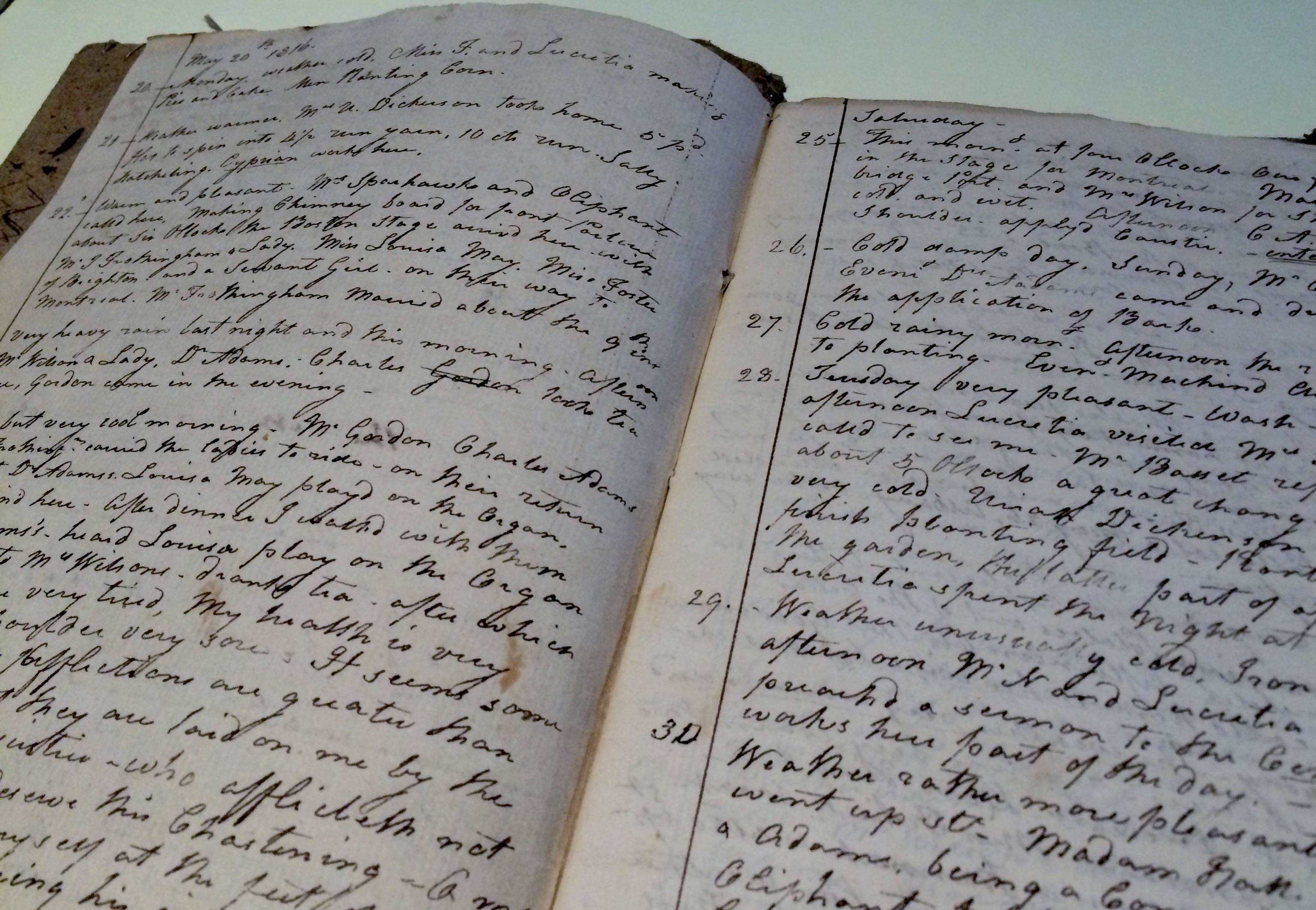
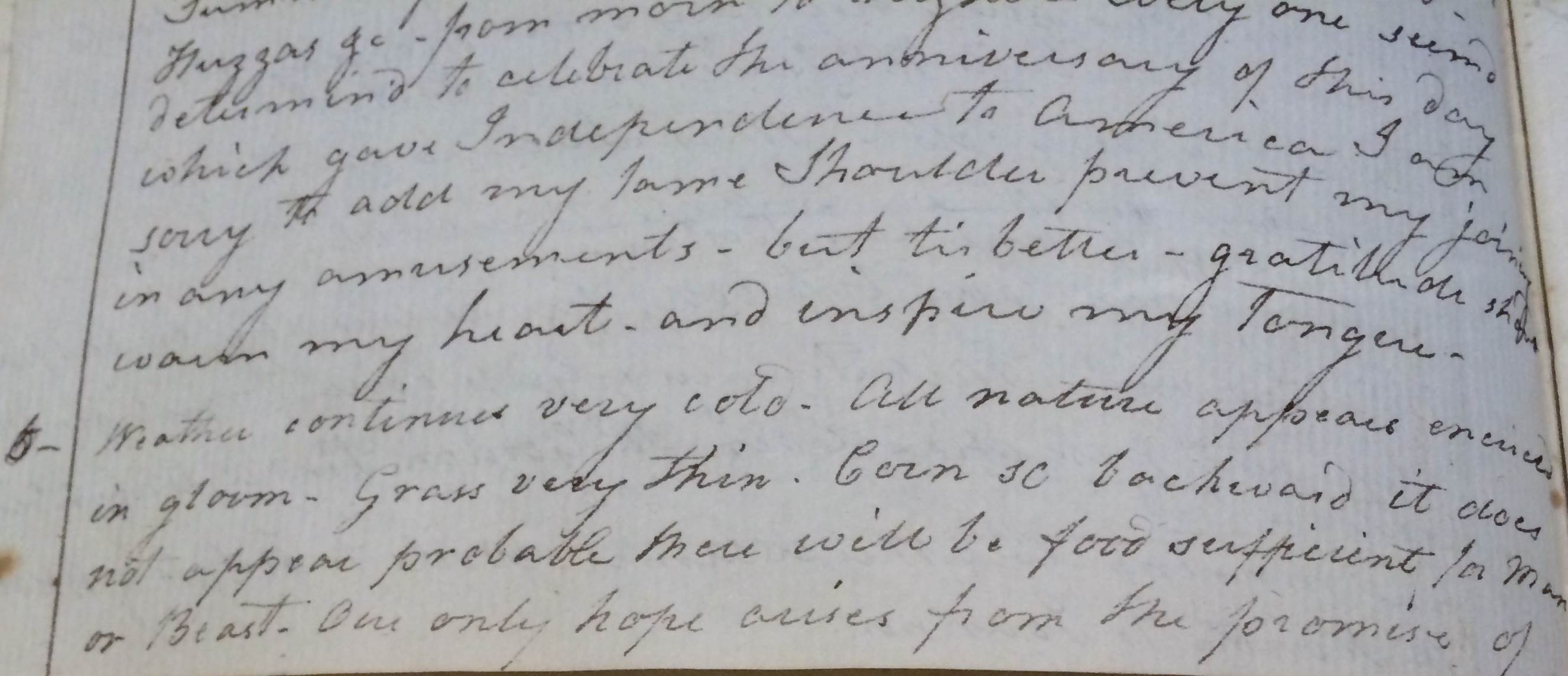
Margaret Russell’s Diary, November 1916

By Anna J. Clutterbuck Cook, Reader Services

Today, we return to the line-a-day diary of Margaret Russell. You can read previous installments here:

January | February | March | April | May | June | July | August | September | October

As winter approaches, Margaret Russell’s activities shift from the north shore back to Boston, where she attends lectures and concerts on a regular basis as well as noting a regular round of visits to family and friends.

On November 8th she notes that she spent time packing in the morning and then left for New York City on the five o’clock train. Her destination was ultimately Hot Springs, North Carolina where she found “pleasant rooms” waiting for her, “lovely weather,” and “very pleasant people.” She stayed for almost two weeks enjoying the balmy weather and sunshine before returning to the “bitter cold” of Boston via New York. On the 29th she attended the theatre, seeing the romantic comedy The Great Lover which had had its run on Broadway from November 1915 to June 2016. “Very amusing” our diarist notes.

As we round out this year in the life of Margaret Russell, I have begun exploring my options for a 1917 diary to transcribe; stay tuned for a December blog post introducing our 2017 diarist and diary before we see what the year 1917 brings for our chosen Bostonian.

In the meantime, without further ado, here’s Margaret in her own words.

 * * *

November 1916*

1 Nov. Wednesday – All Saint’s Service. Mrs. Ward’s opening talk. First Holman meeting at Mrs. Allen’s. Ward reception for Perkins girl.

2 Nov. Thursday – Shopping. Went to Swampscott. Dined at Mrs. Bell’s.

3 Nov. Friday – Went to Milton & called at Sarah Hughes & Hester Cunningham. Dined at S. Bradley with Mr & Mrs Locke.

4 Nov. Saturday – Errands. To see Aunt Emma, Stephen Wild’s [sic] & Mrs. Walcott. Country still very beautiful.

5 Nov. Sunday – Church – Lunched at H.G.C’s.

6 Nov. Monday – Mary. Lunched with Marian.

7 Nov. Tuesday.

8 Nov. Wednesday – Packing. Went H. Cushing’s memorial exhibition. Left for N.Y. on five o’ck. Went to Colony Club.

9 Nov. Shopping – Lunched at Mary Amory’s. Met Mrs. [illegible] on five oc to Hot Springs.

10 Nov. Arrived 9.30 (hour late) Pleasant rooms. Have cold so kept quiet. Mrs. S. busy with baths – Movies in the evening.

11 Nov. Saturday – Lovely weather keep out as much as possible. Very pleasant people.

12 Nov. Rainy – Went to church. Most of P.M. in my room.

13 Nov. Monday – Walked up Delafield Path. Warm & lovely. Took beautiful drive round mountain.

14 Nov. Tuesday- Cloudy & cold. Wrote letters & rested. Walked with Mr. Chapin to dairy.

15 Nov. Wednesday – We walked to Boone Cabin & lunched […] sun on ground. Feeling better.

16 Nov. Thursday. Still very cold. Took long walk. We drove to Flag Rock in P.M. but it was too hazy to see far.

17 Nov. Friday – Warmer. Took walk in the morning. Drove to Dunn’s Gap.

18 Nov. Saturday. Drove to Healing Springs & walked through Cascades, home to lunch. Sat out in the sun.

19 Nov. Sunday – Church & then walked to Tall Gate. Took the jungle drive. Concert in the evening.

20 Nov. Monday – Walked up Sunset Hill. Sat in piazza in the sun with pleasant people.

21 Nov. Tuesday – Drove to [illegible] for lunch, took Miss Newell.

22 Nov. Wednesday – Took a long walk in morn. After lunch sat in sun. Movies in the evening. Like early autumn.

23 Nov. Packing. Heavy showers so did not go out. Tea at five with Mrs. Berwind & all our friends. Left at 6.30 for N. Y.

24 Nov. Friday – Arrived in N. Y. 9.30. Mrs. Sibley drove me to Colony Club but had no room. Took walk & left on 1 oc for home.

25 Nov. Saturday – Shopping & doing errands. Drove to Swampscott, bitter cold. Lovely concert in the evening.

26 Nov. Sunday – Church. Lunched at HGC. Short walk still cold. Family to dine.

27 Nov. Monday – Mary, lunch with Marian. Went out to see Aunt Emma & leave flowers for Mrs. J. M. Cadman.

28 Nov. Tuesday – Errands on foot & meeting at E&E. Took long drive & dined at C’s. Meeting of new opera co.

29 Nov. Wednesday – Went to see the Great Lover with the Parkmans. Very amusing.

30 Nov. Thursday. Church then to dine at Sallie A’s. Raining so drove back with Marian. Dined at HGC’s. Four Neilsons came.


* * *

If you are interested in viewing the diary in person in our library or have other questions about the collection, please visit the library or contact a member of the library staff for further assistance.


*Please note that the diary transcription is a rough-and-ready version, not an authoritative transcript. Researchers wishing to use the diary in the course of their own work should verify the version found here with the manuscript original.

 

This Week @ MHS

By Dan Hinchen

The events schedule is full this week. Without further ado, here’s a look at what’s coming up.

– Monday, 14 November, 6:00PM : Kicking off the week is an author talk featuring Wendy Warren of Princeton University. She will be speaking about her recent book, New England Bound : Slavery and Colonization in Early America, a work that reclaims the lives of long-forgotten enslaved Africans and Native Americans in the seventeenth century. This talk is open to the public with a fee of $10 (no charge for MHS Members or Fellows), RSVP required. A pre-talk reception begins at 5:30PM followed by the program at 6:00PM.

– Tuesday, 15 November, 5:15PM : This week’s Environmental History seminar takes the form of a panel discussion. “Native Peoples, Livestock, and the Environment” features Katrina Lacher of Unversity of Central Oklahoma and Strother Roberts of Bowdoin College, with Nancy Shoemaker of UConn providing comment. Seminars are free and open to the public; RSVP requiredSubscribe to receive advance copies of the seminar papers.

– Wednesday, 16 November, 6:00PM : In the second author talk of the week, Riachard Alan Ryerson discusses his book John Adams’s Republic: The One, the Few, and the ManyThis talk is open to the public with a fee of $10 (no charge for MHS Members or Fellows), RSVP required. A pre-talk reception begins at 5:30PM followed by the program at 6:00PM.

Please note that the library is closed on Thursday, 17 November.

– Thursday, 17 November, 6:00PM : Join us for Revolutionary Portraits from the Collections of the MHS, a fun and festive evening that spotlights portraits of Revolutionary-era figures from the Society’s collection. Enjoy a reception, view terrific works of art, and learn about the artists and the people they portrayed. Erica Hirshler, MFA, Boston, will present Copley’s John Hancock and David Dearinger, Boston Athenæum, will present Lafayette: Before & After

Reservations are required; please call the Development Office at 617-646-0543 to register for this event.

– Friday, 18 November, 2:00PM : Stop by on Friday for an afternoon gallery talk with past MHS Director, WIlliam Fowler, Jr., of Northeastern University. In this talk, Mr. Fowler will discuss George Washington’s Newburgh Address as a turning point in American History, ensuring civilian control of the government. This even is free and open to the public. 

– Saturday, 19 November, 10:00AM : The History and Collections of the Massachusetts Historical Society Tour is a 90-minute docent-led walk through our public rooms. The tour is free, open to the public, with no need for reservations. If you would like to bring a larger party (8 or more), please contact Curator of Art Anne Bentley at 617-646-0508 or abentley@masshist.org.

While you’re here you will also have the opportunity to view our current exhibition: Turning Points in American History.

Clearing the Seas with Fire and Steam

By Rhonda Barlow, Adams Papers

In the spring of 1787, two men wrote to America’s representative in London recommending naval inventions that they thought would help the United States fight the Barbary pirates in the Mediterranean. One of those writers was Andrew Quin, a gunner aboard the Dutch warship, Batavier; the other was Patrick Miller, a Scottish banker and inventor who experimented with cannons, water wheels, and steam power. The American representative just happened to be John Adams, then serving as American minister to Britain.

In his 30 May letter, Andrew Quin recommended that American warships use “burning shot” as effective ammunition against the Barbary pirates, and offered his assistance:

“Sir I am of oppinion if any force was sent out to protect the trade I could be of great service to them. by making a burning shot That whould disstroy them or put them to the flight.”

“Burning shot,” more commonly known as “red-hot shot,” or simply “hot shot,” refers to cannonballs that were heated in a furnace before being loaded into the cannons and fired. These cannonballs not only damaged a ship, but threatened to set it on fire.

Quin also told Adams about his two sons, his financial troubles, and the challenge of emigrating to America. He wrote with a legible hand, and although the words do not rhyme and the sentences flow across the page, he imitated the poetic convention of capitalizing the first letter in each line.


Adams was familiar with the Batavier and with her former captain, Wolter Bentick, who died from the wounds he sustained during the 1781 Battle of the Dogger Bank between the Dutch and British navies. But he had probably never heard of Quin, and this letter appears to be the only letter Quin wrote to John Adams. We have no reply from Adams, and found no evidence that Adams took any action beyond retaining the letter.

In contrast, there are two letters to John Adams from Patrick Miller, who was experimenting with steam propulsion for navigation. With his 14 April 1787 letter, Miller included an essay on naval architecture: Elevation, Section, Plan, and Views of a Triple Vessel (Edinburgh, 1787); and on 30 April, Adams wrote a short note to him:

“I have received the elegant volume you did me the honor to address to me, and shall take the first favorable opportunity to transmit it to Congress at New York, in conformity to your desire.”

Adams took action, forwarding the essay to Congress. On 19 Nov. 1787 Miller wrote to Adams again, and included a report describing his experiment in the Firth of Forth, near Edinburgh, Scotland, on 2 June, when a ship reached speeds of over four miles per hour as five men operated a winch connected to his water wheel. In further experiments, Miller employed a steam engine and achieved speeds of 8 miles per hour.

Miller had already made improvements to a light and effective cannon, the carronade, and wrote that ships outfitted with paddle wheels, and thus capable of propulsion regardless of the lack of wind, were America’s answer to the Barbary pirates:

“Five or six such Ships would clear the Seas of all the African Cruizers.— In Calms or light Winds, very frequent in the Mediterranean Sea during the Summer Months, they would be superiour to any number of Ships of the present Construction of whatever force—”

Adams forwarded Miller’s report to Congress too. Based on Adams’ interactions, Miller’s letters will appear in the Papers of John Adams, volume 19 (Belknap Press, HUP, 2018), and Andrew Quin’s will not. But omitting the letter does not mean that we discard it. Andrew Quin’s original letter remains in the Adams Family Papers archive. You can view the manuscript on the Adams Papers microfilm, reel 370. A rough transcription is freely available on Founders Online.

A Brief Look at 19th-Century Children’s Stories at the MHS

By Brendan Kieran, Reader Services

I initially came across The Carrier Pigeon and Other Tales: Illustrating the Rewards of Virtue and the Punishment of Vice, selected by Mrs. Pamela Chandler Colman (Worcester, 1849), in an effort to find materials relating to pigeons at the MHS. However, I ended up utilizing this collection of children’s stories as a jumping point into a look at children’s literature and children in the 19th-century United States. Through my reading, I began to gain some insight into the roles of children and themes represented in literature during this period.

The titular story of this book is set in the German countryside, seemingly in the medieval or early-modern period. A girl named Agnes comes into contact with a dove, which she decides to take in. Through the advisement of her mother, Othilia, Agnes turns the actions of the dove into lessons for her behavior, becoming a more obedient, hygienic, and organized girl in the process.

One day, a woman named Rosalind and her daughter, Emma, show up at the castle of Sir Theobald (Agnes’s father) looking for help; using her care for the dove as an example, Agnes encourages Theobald to take in the visitors. Later, once Rosalind and Emma have returned to their castle, two men show up at their house; unbeknownst to them, but later discovered by a servant named Leonardo, the men are robbers looking to steal from and murder Theobald and his family. Emma comes up with the idea of flying the dove with a note attached to it to warn Theobald and the family of the motivations of the robbers. Ultimately, it is successful, and the plan is thwarted.

The second story, “Ingratitude,” is about a young girl named Helen and Mrs. Everhold, a woman who takes care of Helen. When Helen’s mother dies, Mrs. Everhold is given responsibility for raising Helen. Everhold tries to teach her skills and a strong work ethic, but Helen decides to act out, eventually turning to working for a baroness and not being there for Everhold when she becomes ill and unable to work. Helen eventually marries a violent and abusive man, and when he dies in an accident, she goes to Mrs. Everhold for help. Helen apologizes for her past actions; going forward, she is good to Mrs. Everhold, who ends up living a long life.

The final story is “The Good Son,” attributed to Rev. E. Mangin. After the death of her husband, a woman and son go to live with another family. The son, after displaying artistic ability, begins to train with a nearby mason. Ultimately, he receives awards for his work, providing new financial stability for himself and his mother. After becoming successful and notable as a sculptor, he continues to be good to his mother, the man who discovered him, and the family with whom he had lived.

All three of these stories have similarities that live up to the subtitle of the book. In “The Carrier Pigeon,” the dove serves as a symbol of virtue, imbued with overt religious connotations; to be like the dove is to be pure and respectful of God. The dove even serves as the means by which Rosalind and Emma are able to save lives. In “Ingratitude,” while Helen is disrespectful for much of the book, she ultimately turns to “proper” behavior toward a woman who took care of her, with suggested positive results for Everhold’s longevity. In “The Good Son,” the boy demonstrates hard work, creativity, and respect for the people who fostered his success. All of the children serve as lessons, indeed, on “the rewards of virtue and the punishment of vice.”

However, the stories do have some notable differences that raise questions regarding the audience of the book and the roles of class, gender, and race in 19th-century children’s literature. For example, the families in “The Carrier Pigeon” seem to be quite wealthy and of the nobility; however, the subjects of the other stories struggle with financial insecurity. There also seems to be an implication that girls are especially in need of lessons regarding proper morality. While the girls in “The Carrier Pigeon” learn lessons through the dove, and Helen in “Ingratitude” only learns good behavior after misfortune hits her, the boy in “The Good Son” seems to be good and respectful all along. It is men (the robbers) who exhibit most of the immorality in “The Carrier Pigeon,” and Helen’s abusive husband in “Ingratitude” is not a model of good behavior, but the process of learning lessons and correcting behavior seems to be more apparent in the women and girls in this book than in the men and boys. Racialized language seems to be a factor in “The Carrier Pigeon,” with the whiteness of both Agnes’s dresses and the dove deployed to represent good morality and cleanliness. This analysis is brief and tentative, but it hopefully notes the potential significance of this resource to scholars of race, class, and gender in 19th-century United States children’s literature. 

I consulted our copy of Karen Sánchez-Eppler’s Dependent States: The Child’s Part in Nineteenth-Century American Culture (University of Chicago Press, 2005) in the hopes of learning a bit more about children’s literature in the 19th-century. Sánchez-Eppler offers some conclusions about children and literature of the period. The author notes the role “of teaching morals and forming character” in primers of the period, and notes the “variation on the basis of class, region, gender, and race” in conceptions of childhood in the 19th century, including the connection between leisure and a middle-class living. Sánchez-Eppler also notes the desirability of “submissiveness” for girls in 19th-century temperance literature of the period; the literature suggested – often using references to incest – that these qualities in girls would help their fathers overcome alcoholism and become better people. This literature has class connotations, as well, with children representing middle-class norms in some temperance works. Later, the author draws connections between race and the proper, domesticated behavior of children in 19th-century Sunday School works; these themes served as components of imperialist and colonialist projects. There is much more to Dependent States than what I’ve included here, and Sánchez-Eppler’s scope of analysis is broader than strictly children’s literature, but these ideas offer some insight into the complex roles constructed for children in literature of the period.

The MHS library is open for anyone who would like to view any of our available print materials. In addition, an 1851 copy of this book is available electronically through Internet Archive.


This Week @ MHS

By Dan Hinchen

It is a little bit quieter at the Society this week but we still have three public programs on offer. Here is what is happening:

– Monday, 7 November, 12:00PM : “The Church Militant: The American Loyalist Clergy and the Making of the British Counterrevolution, 1701-92” is a Brown Bag talk presented by Peter Walker of Columbia University. This project is a study of the loyalist Church of England clergy in the American Revolution, focusing on the New England and Mid-Atlantic colonies. Walker attempts to shine light on the relationship between church and empire, the role of religious pluralism and toleration in the American Revolution, and the dynamics of loyalist politics. This program is open to the public free of charge. Pack up a lunch and come on in!

– Thursday, 10 November, 5:30PM : Join us for a Conversation with Fredrik Logevall, part of our Biography Seminar series. Caroly Bundy will moderate the discussion in which Logevall, Harvard University, talks about his current book project, a biography of John F. Kennedy. Seminars are free and open to the public; RSVP requiredSubscribe to receive advance copies of the seminar papers.

– Saturday, 12 November, 10:00AM : The History and Collections of the Massachusetts Historical Society Tour is a 90-minute docent-led walk through our public rooms. The tour is free, open to the public, with no need for reservations. If you would like to bring a larger party (8 or more), please contact Curator of Art Anne Bentley at 617-646-0508 or abentley@masshist.org.

While you’re here you will also have the opportunity to view our current exhibition: Turning Points in American History.

N.B.: The MHS is CLOSED on Friday, 11 November, in observance of Veteran’s Day.

Bringing Willa Home: A Child Displaced by Civil War

By Susan Martin, Collection Services

I’ve written a few times here at the Beehive about manuscripts from the Fay-Mixter family papers, and I’d like to dive into that collection again this week. I was intrigued by four letters from December 1861, so I dug a little deeper and uncovered the story of a family separated by war and a Southern child taken in by Northern friends.

The four letters were written by Edwin Parsons to Joseph Story Fay. Fay, originally from Cambridge, Mass., moved to Savannah, Ga. in 1838 and became a prosperous cotton merchant. He was an enslaver, but opposed secession, and before the Civil War broke out he returned to his home state of Massachusetts. When these letters were written he lived in Boston with his wife, their three children, and a child unrelated to them, the young daughter of a Mr. Sims.

This passage in Parsons’ first letter to Fay, dated 10 December 1861, was the first thing that caught my eye: “I will advise you in time so that you can send Mr Sims little daughter on.” Parsons continued:

It seems to me however to be a heartless piece of business on Sims part to send for her in such times. With her mother dead & father in Fort Pulaski where he may soon reap the folly of his disloyalty, it will be a sad day for the little girl to exchange the kind care of Mrs Fay, for such a home as awaits her in Georgia.

Fort Pulaski was the vital clue. Among the soldiers stationed at this Savannah garrison in December 1861 was one Capt. (later Col.) Frederick William Sims of the 1st Georgia Infantry. Other details of his biography lined up: his wife Catherine (Sullivan) Sims had died in 1858, followed by one of their two children in 1859, leaving Sims and his nine-year-old daughter Willa. Willa must have been taken in by the Fays in Boston while her father fought for the Confederacy—the disloyalty Parsons alluded to.

Sims wanted his daughter brought back to the South, presumably to live with extended family while he finished out his military service. But Parsons, who apparently acted as a kind of agent for Sims, thought it was a terrible idea. Savannah was like a ghost town after the Battle of Port Royal, and many felt the war would continue for some time. And the possibility of “some hard fighting” in Kentucky after its admission to the Confederacy would make travel difficult, if not impossible. However, on 26 December 1861, when Parsons wrote his fourth and last letter on the subject, the matter was still unresolved.

The last piece of the puzzle was a letter I’d originally passed over, not recognizing the signature. On 14 November 1861, Frederick W. Sims scrawled this short note to Joseph Story Fay on fragile onion-skin paper:

The bearer of this note Mr Briggs will bring Willa home with him. Will you add one more to the many favors already vouchsafed me by fitting her out for the journey. Mr B. has funds[?] to bring her out.

As this may be the last communication which will pass for some time between us I beg you to accept my heartfelt thanks for the Kindness of yourself and Mrs Fay and believe me when I wish you a long life and prosperity.

Fort Pulaski was captured by Union forces in April 1862, and Sims became a POW, later paroled. After the war, he worked as a merchant and insurance executive in Savannah and served as one of the city’s alderman from 1867-1869. He had at least six more children with his second wife, Sarah (Munroe) Sims, but most of them died young. According to newspapers, in 1875, suffering under severe financial difficulties, Sims died by suicide with a morphine overdose. The coroner’s report lists the belongings he left behind: $20.90 in coin, a gold watch and chain, clothing, and a revolver.

Unfortunately, I couldn’t find out what happened to Willa after 1861. No other papers in the Fay-Mixter collection refer to her. The obituary of Sarah (Munroe) Sims, who died in 1904, identifies only two surviving children, Emily and Elizabeth.

Happy Halloween, 1874: Sketches Here and There

By Rakashi Chand, Reader Services

I love Halloween, so when I saw these lovely India ink sketches in our Graphics collection I was thrilled! Sketches Here and There by Franklin B. Gardner portray the fun and frolic of Halloween almost 150 years ago.  Amazingly, this is exactly what I had hoped and envisioned Halloween would have been like in the past; almost a ‘Dicken’s-like’ visual representation of what could be ‘A Halloween story’. Young people frolicking and enjoying a lovely morning in a cornfield followed by festive evening party, where guests clad in costumes have gathered to celebrate.

Although Halloween was celebrated elsewhere in various ways, modern Halloween is a distinctly American capstone holiday, whose traditions and celebration have permeated throughout the rest of the world. These images portray the holiday as a joyous occasion, celebrating autumn, the most beautiful season in New England. And what could be more idyllic than Halloween in the corn fields of New England in 1874?

In the Cornfield, on the Morning of Halloween


In the Cornfield, on the Morning of Halloween, detail.


As the Halloween season is upon us, these visions of Halloween past are a delight to examine. The food being laid out on the dining table during the gathering signifies that perhaps the celebration of Halloween involved a gathering or a feast among friends and family. The holiday has evolved over the years in such a way that we no longer enjoy the gathering and dinning that were once a part of Halloween celebrations. Modern Halloween celebrations puts much emphasis on ‘trick-o-treating’ and candy, so perhaps it is time to bring back the tradition of a gathering with friends and family. Let’s celebrate the season and enjoy the beauty of autumn days, and then feast on Halloween night! [Homemade costumes optional.]

Hallowe’en


Hallowe’en, detail.


These beautiful sketches were done by amateur artist Franklin B. Gardner and given to the MHS in 1969 by Hermann Warner Williams, Jr. The collection consists of 16 pen and ink sketches and an illustrated title page. The subjects of the sketches are various social scenes, customs and activities and pastimes from the Boston area. We hope to be able to share each of these fabulous sketches with you in forthcoming blog posts.


Halloween in America

To quote Lisa Morton’s Trick or Treat: A History (Reaktion Books, 2012), how did Halloween go from being “An Autumnal party for adults” to “a costumed begging ritual for children”? The now heavily commercialized holiday has been exported from America to every part of the globe. Halloween has a very long and complex history, drawing on the traditions and customs of many cultures, a true amalgamation, which continues to evolve to this day.

Halloween is associated with death, although our relationship with and perception of death has changed along with the traditions of the holiday; thanks to advances in modern medicine, death is marginalized, which creates a fear of the unknown. Halloween has become a day when society indulges in fear.  Halloween was a holiday for mischief, especially for young boys, who enjoyed playing pranks through the night. Costumes were also a part of Halloween as exemplified by the ‘Hallowe’en’ sketch. But the biggest change in Halloween is the disappearance of the gathering and dinning, especially among adults. It was once a celebration of the season, when both the food and the theme of the party revolved around the bountiful fall harvest, with an emphasis on pumpkins and apples. It was not until after WWII that candy and Trick-or-Treating became a part of Halloween, indeed prior to that even candy manufacturers did not associate candy with Halloween. It was not long before Trick-or-Treating and the distribution of candy on Halloween night became mandatory customs.

More ‘spooky’ Halloween treats from the collection of the Massachusetts Historical Society:

– The Salem Witch Bureau: A beautiful piece of American joinery that was part of the Salem witchcraft trials, General William H. Sumner described this chest of drawers as “the Witch Bureau, from the middle drawer of which one of the Witches jumped out who was hung on Gallows Hill, in Salem.”

– Diary entry of Salem Witchcraft Trial judge Samuel Sewall,19 September 1692.

– Examination of Geo. Burroughs 1692 May 9-11.  By Samuel Parris: Proceedings of the examination of Geo[rge] Burroughs and the testimony of bewitched girls, 9-11 May 1692, during the Salem witchcraft trials. Burroughs was found guilty and executed for witchcraft.

A True Narration of the Strange and Grevous Vexation by the Devil of Seven Persons in Lancashire, and William Somers of Nottingham, by John Darrel: This is the only item in our catalog with the subject “Demoniac possession.”


Anti-suffrage Records Available Online

By Nancy Heywood, Collections Services

A few years from now, in 2020, the United States will recognize the centennial of the ratification of the 19th Amendment to the U.S. Constitution guaranteeing women’s voting rights across the country. Although some states and territories had granted women the right to vote in the last half of the nineteenth century (including many in the western part of the country), full suffrage for U.S. women took a long time. Many organizations pushed forward referenda at the state and national level.  An amendment to the U.S. Constitution was introduced in Congress in 1878 but stalled.   The 19th Amendment stating that no U.S. citizen shall be denied the right to vote “on account of sex” was similar to the 15th Amendment that granted African American men the right to vote.  The 19th Amendment passed by the U.S. House of Representatives in 1918, and by the U.S. Senate in 1919, was ratified by enough states by 20 August 1920 to be adopted.  

During the time when so many were working hard to gain voting rights for women, there were also those working against this movement. One such organization was based in Massachusetts (and has one of the longest names of any institution whose records are held within the Massachusetts Historical Society): the Massachusetts Association Opposed to the Further Extension of Suffrage to Women.

The records of this organization are now fully digitized and available on the web, thanks to a grant provided by the Institute of Museum and Library Services under the provisions of the Library Services and Technology Act grant as administered by the Massachusetts Board of Library Commissioners.

All pages of this manuscript collection have been digitized and they are presented as sequences of pages linked to the folders listed on the collection guide.  Website users may explore any or all administrative records, committee meeting minutes, typescripts of lectures and reports, and various printed items including by-laws,  and printed lists of standing committee members from all over the state.

The records date from 1894 to1920.  The Massachusetts Association Opposed to the Further Extension of Suffrage to Women was formally founded in 1895, but stemmed from a committee formed in 1882.  The Association actively recruited members, opposed legislation that would have granted voting rights to women in Massachusetts, and also held events and lectures promoting their cause. 

Women working so actively against voting rights for women seems curious and perhaps even incongruous.  Some of the reasoning and context for their motivation is found within the organization’s own records. Within the Loose papers, Legislative history section, there is a typescript document of a speech given at a hearing before committee on constitutional amendments in Feb. 1905 which states four reasons for opposing woman suffrage:  many women in Massachusetts don’t petition for it, Massachusetts wouldn’t benefit from it; it is a “most inopportune” time to change the Constitution, and suffrage hasn’t proven to be beneficial elsewhere.

Additional resources (beyond the organizational records) also provide perspectives on the context for anti-suffrage work:

The historian Francis Parkman (1823-1893) summarized the perspective of some within a pamphlet, Some of the Reasons Against Woman Suffrage [Boston?:  s.n., 1883?] by stating it would be too burdensome for women because women are delicate and not as robust as men. Parkman also advocates the position that women voting could potentially be disruptive to “civil harmony” if women were too sentimental or if women from different classes turned against each other and ended up being more “vehement” than men on opposite sides of an issue (page 13).  This pamphlet is available online from Harvard Library.

The Massachusetts Association Opposed to the Further Extension of Suffrage to Women published a newsletter, The Remonstrance.  One sample issue, from January 1908, is available as a digital presentation. An article on the first two pages covers various reasons against woman suffrage including the argument that not all women want the right to vote as evidenced by the fact that very few women who are eligible to vote in school committee elections actually do so.  Opponents also disputed the argument that voting rights would result in improving the condition of women because women already had an indirect influence on public affairs from their position of “moral influence.”  Page 4 of the newsletter offers a synopsis of “Recent Defeats of Woman Suffrage” in various states.