Guest Post: The Boston Post Road

By By Dylan Oesch-Emmel, Megan Cleary, Patrick Cann, and Mari Avola , Stoneham High School

National History Day (NHD) was upon us. The dreaded three-month research project that requires scouring the depths of every database for any primary or secondary source that could help prove our thesis. After many late nights of research, and enough tears (and pizza) to last us a lifetime, we had given up hope in finding any valuable sources. In a time of despair, we turned to the Massachusetts Historical Society (MHS) for guidance. With a topic like the Boston Post Road, how could it not?

With the help of Mrs. Sampson, our remarkable history department head at Stoneham High, we were able to contact Kathleen Baker and Anna Clutterbuck-Cook. They assisted us in arranging a visit to the MHS, where we were able to meet the rest of the knowledgeable and welcoming staff.

We walked into the MHS expecting to see stereotypical old men with their shirts buttoned to the very top, sitting in the corner of every room we entered, reading large encyclopedias. With this in mind we were prepared to act as proper and professional as we could.  Contrary to what we expected, we checked in and quickly realized that MHS was staffed by young, enthusiastic historians. We were welcomed with an informative tour of where everything was located. Although we were entirely new to the MHS, the staff treated us as if we were any other historians. Along with finding great sources, the respect we received from the staff boosted our confidence in our historical research skills.

Now we were ready to find what we really came to the MHS for: colonial newspapers on microfilm!!!  Although, the actual letter that started the Boston Post Road in 1672 may also have been important to see.  The staff was always ready to help, which made the entire process much easier than anticipated.  A few clicks later and we were in!  It was incredible to see old newspapers that were transported along the Post Road to relay the world’s current events in the early 1700s, transformed into a computer document and displayed right in front of us.  The only thing that could top it was being able to hold the physical letter that essentially started the Boston Post Road.  Oh yeah, we did that too!  We were guided into a room with rows of tables accompanied by dim lighting as not to fade the age old documents. The woman helping us explained that we were allowed to take pictures of the documents, which we took full advantage of. Although we had to stay quiet and respect the others working, they did allow us to pass the documents to each other. A piece of advice for anyone who will be reading colonial letters: brush up on your ability to read sophisticated cursive if there is no transcript for the particular letter.

We were able to quickly and efficiently find everything we had come for. But beyond the sources and helpful staff, the experience gave us an opportunity to join the professional field of history and make an argument. With our foundation of quality research backing us, NHD was more than a high school project, it was our transition into respectable historians.


**The MHS has awarded the John Winthrop Student Fellowship since 2013. This fellowship encourages high school students to make use of the nationally significant documents of the Society in a research project of their choosing.


October is American Archives Month!

By Rakashi Chand, Reader Services

The archive of the Massachusetts Historical Society is not only home to an invaluable and incredible collection of American history, but it is also staffed by amazing people. Get to know your local archivists in Reader Services! We are here to assist you with all your research needs in the library of the Massachusetts Historical Society.

To find out more about the wonderful archivists you meet when you visit the MHS, I asked a few fun questions:

Why did you choose to become an Archivist?

What is your favorite archival tool?

And what is your favorite MHS collection(s)?


From Alex Bush,

Library Assistant in Reader Services

Why did you choose to be an archivist?

I stumbled into the field unexpectedly after my third year of American Studies at Smith—all I knew was that I wanted to surround myself with history and always have a use for all those dates and eras I’d spent so long studying. I also happened to have some experience working in libraries. I was lucky enough to get a short summer internship at the Massachusetts Historical Society, which ended up completely cementing my love for all things archival and sent me straight from Smith to Simmons College to start my career in library science/archives. Upon returning to Boston, I was also able to return as a staff member (not a lowly intern!) at Mass Historical. The moral of the story is that you should never listen to people who tell you that your undergrad major is useless, because you might end up accidentally tripping into your dream career.

Your favorite archival tool?

I love those little white cotton gloves. They make me feel super fancy.

Your favorite MHS collection?

 I could spend hours reading through John Quincy Adams’ diaries—nearly 70 years of daily entries, all digitized and available on the Mass Historical website. Included is everything from line-a-day quips to long musings on American politics to marginal doodles. I find it especially impressive that he managed to include the hour he awoke every morning (usually between 3 and 6 a.m.).


From Brendan Kieran,

Library Assistant in Reader Services

Why did you choose to become an Archivist?

I first took interest in the field as an undergraduate history major looking for a career path involving history. I was initially drawn to the idea of working with historical materials. However, a desire to help preserve and make accessible marginalized histories plays in important role in keeping me motivated and excited about this type of work.

Your favorite archival tool?

I really enjoy looking through our collection guides when working on reference questions here at the MHS. Each guide is different, and I like coming across various names and subjects – some expected, some unexpected – while searching them.

Your favorite MHS collection?

The Walter Channing Papers, 1810-1921, which I highlighted in a recent post on The Beehive, is one collection that really interests me. It was exciting to explore the ways in which MHS collections are relevant to the study of anarchism in the United States.


From Grace Wagner,

Library Assistant in Reader Services

Why you choose to be an Archivist?

I majored in history in undergrad and I’ve always been interested in material culture, particularly fashion and textiles. Archives unite both interests.

Your favorite archival tool? 

Searchable finding aids are incredibly useful in that they provide information about an entire collection rather than a basic overview.

And your favorite MHS collection(s)?

I am constantly surprised by the diverse materials housed in our small broadsides collection and, in particular, enjoy looking through the Theater broadsides.


From Rakashi Chand

Senior Library Assistant in Reader Services

Why you choose to be an Archivist?

I have always loved history, even as a child. I looked for ways to immerse myself in that which I loved, and the Library of the Massachusetts Historical Society is a history-lovers dream come true! Not only am I surrounded by history, as a member of the Readers Services Staff, I am a guardian of history! We ensure that the manuscripts are safe every step of the way; from the moment they leave the stacks, while in transport, then consulted in our Reading Room, until they are safely returned to the stack shelves. It’s like being on the frontlines of historical research and protection!

Your favorite archival tool?

My favorite tool is Abigail, our online catalog. We depend heavily on our catalog and consult it continually throughout the day. Our catalog is fully searchable from home and readily accessible through our website at www.masshist.org. In Reference Services, Abigail is certainly my best friend.

A close second are Hollinger Archival boxes; seeing rows of neatly organized Hollinger boxes full of documents is simply thrilling!

And your favorite MHS collection(s)?

There are too many collections to name! The fact that we have the equivalent of three presidential libraries always astounds me! The Papers of President John Adams, President John Quincy Adams and the second largest collection of President Thomas Jefferson Papers outside of Monticello! But that’s not all, we have more Presidential Papers! I also love so many of the intimate pieces of history housed in our collection, such as the dying letter of Wilder Dwight, in my opinion one of the most touching and poignant items in our collection. We also house 53 pieces of mourning jewelry in our artifact collection.


From Shelby Wolfe,

Library Assistant in Reader Services

Why you choose to be an Archivist?

Helping others access archival material is a great way to learn unexpected things while I work.

Your favorite archival tool?

Since ABIGAIL has led me to countless reference question answers, research interests, and blog post topics, I would have to say our online catalog is my favorite tool.

And your favorite MHS collection(s)?

I’m a big fan of the numerous travel diaries in our collections – anytime I need to take a mini vacation, they’re always there for me!


Please feel free to ask us more about our field, our library and our collections!

 

Fully-Digitized Manuscript Collections Now Available

By Nancy Heywood, Collections Services

The Massachusetts Historical Society is pleased to announce that seven collections relating to women in the public sphere have been digitized thanks to funding from the Institute of Museum and Library Services under the provisions of the Library Services and Technology Act grant as administered by the Massachusetts Board of Library Commissioners.  The grant allowed us to create high resolution images that are accessible at the MHS website, as well as preservation microfilm created from the digital files.


The seven collections range from small (one thin folder of documents kept by the Juvenile Anti-Slavery Society records) to large (7,534 images of records kept by the Woman’s Education Association) and date from 1827 (Society for the Employment of the Female Poor Trustees’ reports) to the 1930s (Rose Dabney Forbes papers as well as the Woman’s Education Association records).

These collections contain records of organizations primarily run by women concerned with social issues–anti-slavery, women’s education, the peace movement, treatment of the poor, and anti-suffrage.  A total of 16,003 digital images depict all the pages of these seven collections and are available as sequences of images linked to manuscript collection guides.

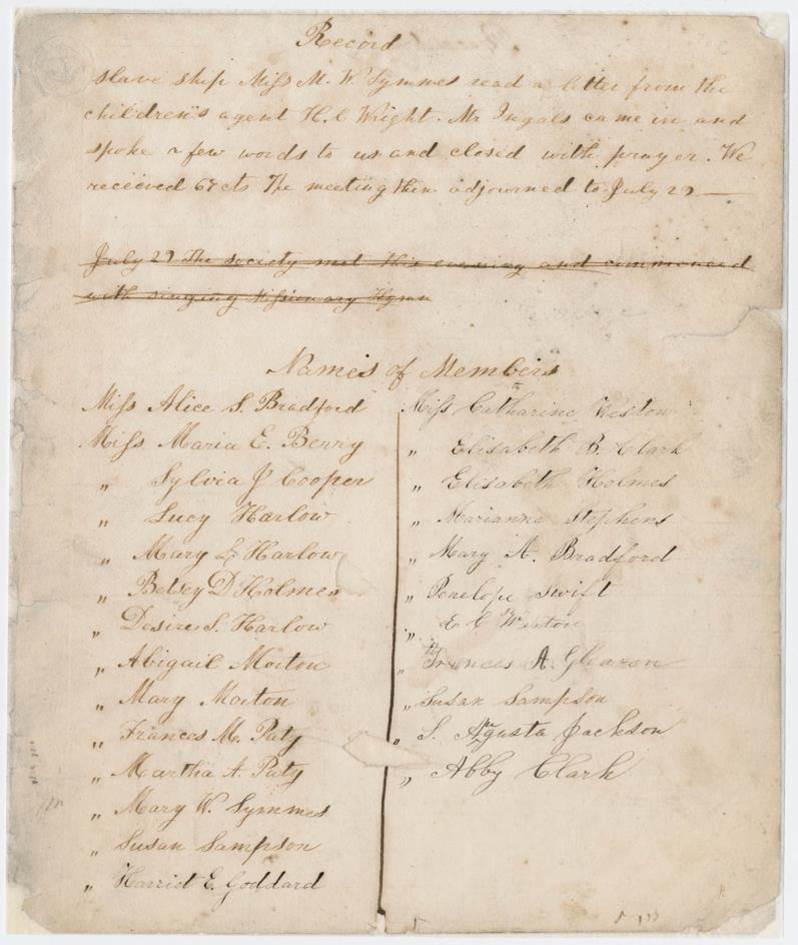
Juvenile Anti-Slavery Society records, 1837-1838
http://www.masshist.org/collection-guides/view/fa0427

Massachusetts Association Opposed to the Further Extension of Suffrage to Women, 1895-1920
http://www.masshist.org/collection-guides/view/fa0121

New England Freedmen’s Aid Society records, 1862-1878
http://www.masshist.org/collection-guides/view/fa0423

Rose Dabney Forbes papers, 1902-1932
http://www.masshist.org/collection-guides/view/fa0212

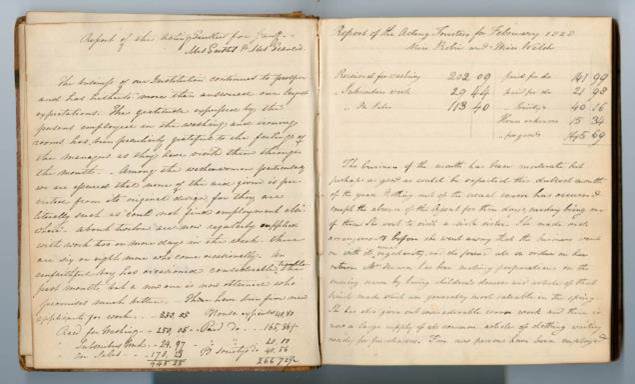
Society for the Employment of the Female Poor trustees’ reports, 1827-1834
http://www.masshist.org/collection-guides/view/fa0428

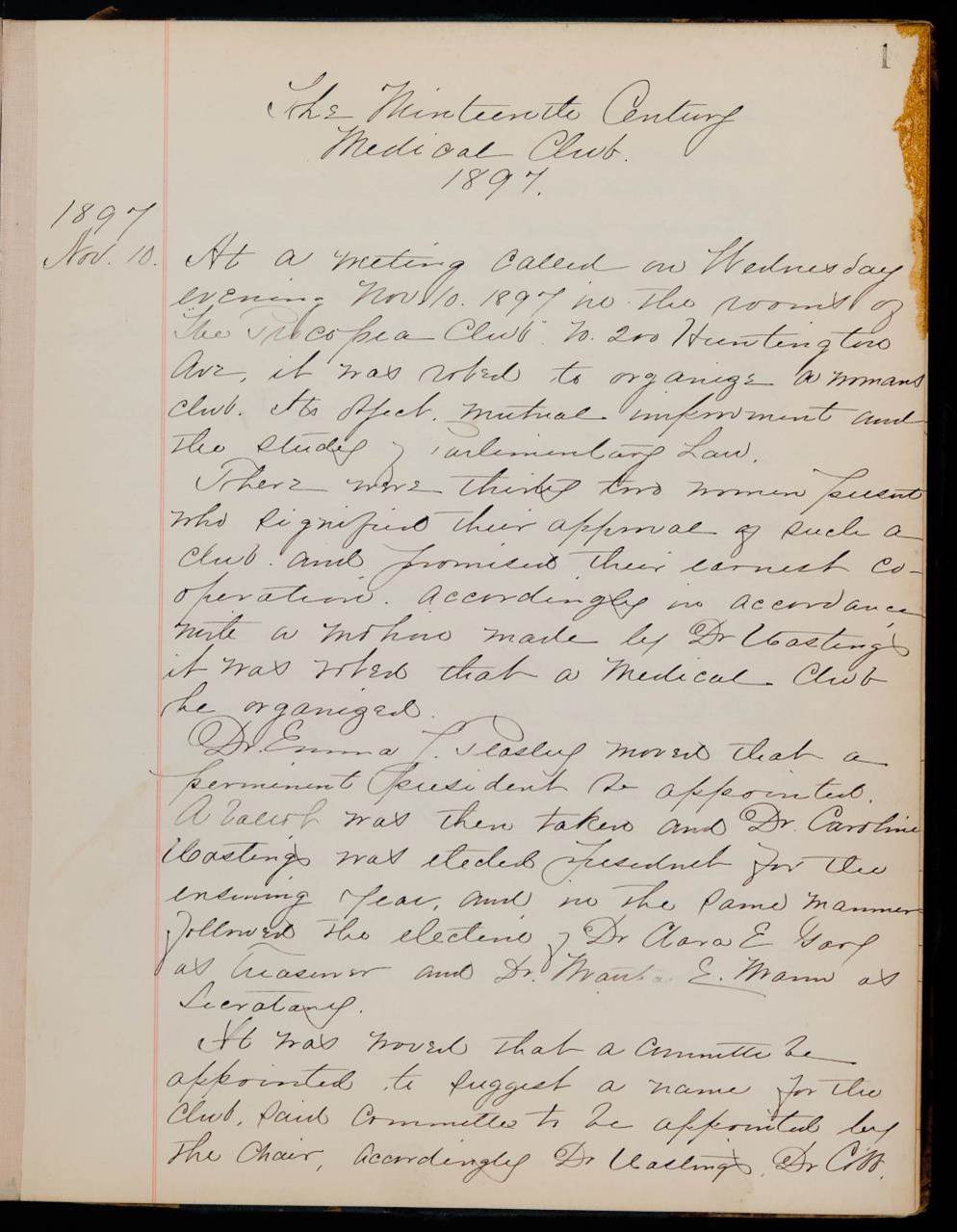
Twentieth Century Medical Club records, 1897-1911
http://www.masshist.org/collection-guides/view/fa0411

Woman’s Education Association (Boston, Mass.) records, 1871-1935
http://www.masshist.org/collection-guides/view/fa0393

The work for the grant included the detailed review of all the documents in the collections, preparation for digitization and the creation of metadata for the master images.  The majority of the high-quality uncompressed master digital images were created at MHS with some images created by the Northeast Document Conservation Center.  The production steps required for the web presentation were completed by MHS staff.

Please explore these new collections!   


This Week @ MHS

By Dan Hinchen

Our program schedule is ramping-up as we enter October. Here’s a quick look at all of the events on offer in the week ahead:

– Monday, 3 October, 6:00PM : The first program of the week is an author talk with James Traub. Join us for a talk about his new book, John Quincy Adams: Militant Spirit, which tells the story of a brillian, flinty, and unyielding man whose life exemplified political courage. This talk is open to the public and registration is required at a price of $10 (no charge for MHS Members or Fellows). A pre-talk reception begins at 5:30PM with the program starting at 6:00PM.

– Tuesday, 4 October, 5:15PM : “Reconsidering Slavery and Slave Law in Early Massachusetts” is the next installment in the Society’s Early American History series. Largely considered unexceptional in its attitude towards slavery – even culpable for laying a foundation for slavery – in this paper, Holly Brewer of the University of Maryland offers a nuanced reading fo the MAssachusetts policy debates of the 1640s to emphasize considerable resistance to the ideas of forced labor. Comment provided by Annette Gordon-Reed of Harvard Law School. Seminars are free and open to the public; RSVP requiredSubscribe to receive advance copies of the seminar papers.

– Wednesday, 5 October, 12:00PM : “Reading Textiles as Text: An Examination of Pre-1750s Survivals at MHS” is a Brown Bag talk with Kimberly Alexander of the University of New Hampshire. The project sets the experience of fashion, consumerism, and consumption within a cosmopolitan Atlantic world, with particular attention paid to the textiles associated with the Byles and Hancock families in Boston. This talk is free and open to the public. 

– Friday, 7 October, 12:00PM : The second Brown Bag talk of the week is titled “A Muss Among the Flunkies: Unruly Choristers and Instrumentalists in the Antebellum Opera.” Presented by Rachel Miller of University of Michigan, this project traces how the haphazard strikes of anonymous choristers and instrumentalists – “a muss among the flunkies” – grew into the nation’s first performers’ unions and protective associations, which in turn continue to shape our contemporary ideas and practices of creative work. This talk is free and open to the public.

– Friday, 7 October, 2:00PM : “Turning Point: The U.S. Constitution” features Kyle Jenks, a James Madison reenactor, who will discuss Elbridge Gerry’s criticism of the Constitution. This event is free and open to the public. 

– Saturday, 8 October, 10:00AM : The History and Collections of the MHS is a 90-minute docent-led walk through our public rooms. The tour is free, open to the public, with no need for reservations. If you would like to bring a larger party (8 or more), please contact Curator of Art Anne Bentley at 617-646-0508 orabentley@masshist.org.

While you’re here you will also have the opportunity to view our current exhibition: Turning Points in American History.


Reference Collection Book Review: Chinese in Boston

By Rakashi Chand, Reader Services

Chinese in Boston, 1870-1965 by Wing-Kai To and the Chinese Historical Society of New England (Charlestown, SC: Arcadia Publishing, 2008), part of the Images of America Series, tells the story of the Chinese experience in New England with a focus on Boston, MA through historic photographs with captions. The book is divided into seven chapters, which range from the first arrivals of Chinese immigrants in New England to the Settlement of Boston’s Chinatown, to various other topics until finally arriving at the modern experience of the Chinese in Boston. The text is brief as the photographs are the main source of history and context in this book.


The images come from a variety of sources ranging from the Bostonian Society to the Peabody Essex Museum to the Chinese Historical Society of New England, which was founded in 1992 to document the coherent and vibrant culture of Chinese Americans in New England. The book features the first Chinese owned business, notable members of the Chinese community, and photographic evidence of cultural assimilation as well as cultural preservation carried out in New England. The photographs are well presented and illustrative of the Chinese American experience in New England.

This book is useful for people trying to familiarize themselves with the Chinese history in New England and due to its length and format, can be read/viewed easily and quickly. It is hard to research the history of immigrant groups or minorities who were often not affluent and therefore not the subject of art, photography or historical records, making this book a rare source of an under-represented topic of New England History. This book begins circa 1870 with the first (known) photographic evidence of Chinese immigrants in New England and concludes with present day imagery.

Related Collections:

For more general history of Chinese immigrants in America the library of the Massachusetts Historical Society offers there secondary sources:

The Chinese in America: A Narrative History by Iris Chang (New York: Viking, 2003).

Asian America: Chinese and Japanese in the United States since 1850 by Roger Daniels  (Seattle: University of Washington Press, 1988).

Nothing Like It in the World: The Men Who Built the Transcontinental Railroad, 1863-1869 by Stephen E. Ambrose (New York: Simon & Schuster, 2000).

For the Chinese Exclusion Act we offer:

The Chinese Exclusion Act, Known as the Geary Law: Speech of Hon. Elijah A. Morse, M.C., of Massachusetts, in the House of Representatives, Friday, October 13, 1893 (Washington : [s.n.], 1893).

Amendment of the Chinese Exclusion Act. Speech of Hon. William Everett, of Massachusetts, in the House of Representatives, Saturday, October 14, 1893 (Washington: s.n., 1893).

Chiang Yee: The Silent Traveller from the East: A Cultural Biography by Da Zheng; foreword by Arthur C. Danto. New Brunswick (N.J. : Rutgers University Press, 2010).  

An Anglo-Chinese calendar for the year …: corresponding to the year for the Chinese cycle era (Canton : Office of the Chinese Repository).

Circular letter, signed C. L. Woodworth, regarding the Associations efforts with Chinese immigrants, Indians and African Americans. [Boston : s.n., 1880]

The library of the Massachusetts Historical Society houses a rich collection of China Trade papers and resources:

“Manuscripts on the American China trade at the Massachusetts Historical Society” by Katherine H. Griffin. Proceedings of the Massachusetts Historical Society, v. 100 (1988), p. 128-139.

Researchers on site also have access to the Adam Mathew database of primary source materials China, America and Pacific: Trade & Cultural Exchange.


An Adams Homecoming

By Amanda M. Norton, Adams Papers

On September 4, 1801, John Quincy Adams stepped ashore in Philadelphia, returning to the United States almost exactly seven years after he had left on his diplomatic mission to the Netherlands. He was not returning alone however; now his wife, Louisa Catherine Adams, and their first son, five-month-old George Washington Adams, accompanied him. Greeted by his brother Thomas Boylston Adams who was living in the city, the reunion was a happy but brief one. Both Louisa and John Quincy were anxious to see their parents once more but as the Johnsons lived in Washington, D.C., and the Adamses in Quincy, going together would mean a long wait for one of them. Neither wanted to put off greeting their families and so they went in opposite directions for the first time in their marriage. Louisa departed on the stage on September 12 with their son headed south, and John headed first to New York to see his sister, Nabby, before completing the journey to Massachusetts.

The decision to go independently was not without its concerns, however. Although her father was American, Louisa was “yet a forlorn stranger in the land of my Fathers” and ultimately in an unfamiliar country with an infant. John Quincy noted his distress over the separation in his Diary: “I parted from her and my child with pain and no small concern and anxiety.”

In her Autobiography, Louisa recalled reuniting with her parents for the first time in four years: “When I arrived after a tedious and dangerous journey, my Father was standing on the steps at the door of the house, expecting his Child, yet he did not know me— After he had recovered from the shock at first seeing me; he kept exclaiming that ‘he did not know his own Child,’ and it was sometime before he could calm his feelings, and talk with me.” John Quincy’s experience on the other had was quite different; on the 21st he recorded the event: “Here I had the inexpressible delight of finding once more my parents. After an absence of seven years— This pleasure would have been unalloyed but for the feeble and infirm state of my mother’s health. My parents received me with a welcome of the tenderest affection.”

As both John Quincy and Louisa settled in, they reunited with old friends and wrote to each other from afar. Although the plan was for Louisa to once again travel alone and meet John Quincy in Massachusetts, John Quincy agreed to meet Louisa and escort her and their son northward for one more significant homecoming—on November 25 John Quincy “had the pleasure of introducing my wife and child to my parents.” For her part, Louisa acknowledged that she had been received “very kindly,” but after London and Berlin, Quincy was quite an adjustment, and indeed Louisa declared, “Had I steped into Noah’s Ark I do-not think I could have been more utterly astonished.” It would take time for this homecoming to feel like home.


This Week @ MHS

By Dan Hinchen

As September draws to a close, seminar season kicks into gear and with it comes a slew of public programs in the weeks ahead. Here’s what’s on tap this week:

– Tuesday, September 27, 8:00AM : Local innovators, investors, and influencers share their insights and perspectives on the history and future of innovation in the Boston region, a locale known for breakthroughs and firsts. The History and Future of Mass Innovation addresses such questions as: Why has Boston been the key center of social and technological change? What can community and business leaders and local governments do to nurture the factors that promote innovation? This talk is free and open to the public, though registraiton is required. This program will be held at the Stratton Student Center at MIT – 84 Massachusetts Avenue, Cambridge, MA 02139.

– Tuesday, September 27, 5:15PM : The first seminar of the fall is part of the newly named Modern American Society and Culture series. Donna Murch of Rutgers University presents “The Color of War: Race, Neoliberalism, and Punishment in Late 20th Century Los Angeles.”  Drawing on the recent history of urban rebellions and punishment campaigns stemming from the late 1960s, this presentation will place our current movement for black lives in historical context. Andrew Darien of Salem State University provides comment. Seminars are free and open to the public; RSVP requiredSubscribe to receive advance copies of the seminar papers.

– Wednesday, September 28, 12:00PM : “A Hero of Two Worlds” is a Brown Bag talk presented by Sam Allis which explores a recently published work of historical fiction set in Rome in the early 1860s, when the great fight to unify Italy into a country was raging. The work features a protagonist who hails from Bangor, Maine, as well as a group of Boston expatriates. This event is free and open to the public. 

– Thursday, September 29, 5:30PM : The second seminar of the week is part of the History of Women and Gender series. “Developing Women: Global Poverty, U.S. Foreign Aid, and the Politics of Productivity in the 1970s” emerges from a chapter of a book-in-progress on US involvement campaigns to end global poverty in the 1970s and 1980s. Joanne Meyerowitz of Yale University leads the program with Priya Lal of Boston College providing comment. Seminars are free and open to the public; RSVP requiredSubscribe to receive advance copies of the seminar papers. This event takes place at the Schlesinger Library at Harvard University

– Saturday, October 1, 10:00AM : The History and Collections of the MHS is a 90-minute, docent-led walk through the public spaces at the Society’s home on Boylston St. The tour is free and open to the public with no need for reservations for individuals or small groups. Larger parties (8 or more) should contact Curator of Art Anne Bentley in advance at 617-646-0508 or abentley@masshist.org. While you’re here you will also have the opportunity to view our current exhibition: Turning Points in American History.

– Saturday, October 1, 1:00PM : Join us for a public discussion of Puritan writings to discover just how fervently they loved in marriage and in faith, contrary to popular belief. “Sweet Talk – The Passion of Puritans in LEtters, Diaries, and Sermons” is part of the Begin at the Beginning series sponsored by the Partnership of Historic Bostons. Lori Stokes and Sarah Stewart guide the conversation. This program is open to the public free of charge, though registration is required. 

Autumn Dinner in the White Mountains, September 1875

By Rakashi Chand, Reader Services

It is ‘Leaf Peeping’ (fall foliage viewing) season in New England, so here are a few inspired leaves of thought…

Looking through our collections I came across an intriguing broadside, having read about the once opulent Hotels that dotted the New Hampshire Countryside in the mid nineteenth century. The [Dinner menu and wine list for Sunday September 12], no doubt, would serve as a glimpse into the grandeur of the majestic New Hampshire Resorts.

This unique Broadside attests to the lavish dinners served at the Crawford House, located in Crawford Notch New Hampshire. The most fascinating feature of this broadside is the material on which it is printed, a lovely piece of Birch bark. Birch trees are known for their beautiful lenticel marked white bark and can be seen throughout the forests of the White Mountains.


The single page pamphlet is printed on both sides and folded in half conveniently presenting the day’s fare and other pieces of information for hotel guests. For those intrigued by gastronomical history this is a fascinating specimen. Examining what was served on Sunday, September 12th 1875, one can truly note the changes in our collective palate and food culture over 150 years.


Finally, the last page features an extensive wine list, after all, how else would one be on a proper vacation? Modern coinsures will be intrigued by the Hock (German White wine) and Sauternes (French sweet wine) being such popular categories, but otherwise the list is quite familiar. Moet et Chandon champagne was a full $4.00 (The equivalent of $86.96 modern currency) proving that some things never change!


The first Crawford House was built in 1850. Described as having “a three and a half story central pavilion with a fine Greek Revival portico, identical five-bay, two and a half story wings, topped by pitched roofs with dormer windows.”  By 1852 there was such a high demand for rooms, that the owners of the Crawford House expanded, to create 200 sleeping rooms, by enlarging each wing by “eight bays”. Unfortunately the first Crawford House succumbed to fire, although within two days plans for the new Crawford House were already underway. Cyrus Eastman and his partners utilized a workforce of 175 men and 75 oxen and horses to complete the fastest hotel construction 1859 had ever seen.   Opening night was July 13th when 40 guests were received for dinner and 100 were entertained for the night, and the press noted that it was “the most spacious hotel about the mountain”.  In Eastman’s words “The Crawford House is a large and new edifice, very commodious and agreeable for a summer hotel. There are pleasant piazzas on the outside, and five halls, much used in the evening for promenading, run the entire length of the house within. The parlor is large and well furnished, the dining room ample in its proportion, and its tables always supplied with the delicacies of the metropolitan markets, as well as such substantial articles of mountain production, as delicious berries, and the richest milk and cream. The office is situated in the central part of the house… Here also is the post office of this wild region. Portraits of two of the Crawfords, patriarchs of these mountains, adorn the wall. The lodging rooms of the house are well furnished, and pleasant, especially those which have windows toward the Notch. Connected with the hotel are a bowling-alley for rainy-day and evening amusement, and extensive stables, furnished with a large number of horses… Last summer two tame bears afforded guests much amusement.” http://balthazaar.masshist.org/cgi-bin/Pwebrecon.cgi?DB=local&BBID=129906

Bostonians have always flocked to the White Mountain of New Hampshire to enjoy the striking natural beauty, although we in the modern era will never experience the grandeur met there by our predecessors.  A great transformation came to the region in the 1850s, the beginning of a huge tourist Industry, prompted by the laying of railroads, and later fueled by the Industrial Revolution which created a surplus of wealth in eastern cities. In the 1820s and 30s, the mountains and lakes were home to only a few highway taverns and Inns that provided rest for the weary stagecoach traveler on the harrowing passage north. After 1850, the region that had only been visited by a few hundred, started to see tens of thousands of tourists. This was the heyday of the White Mountain Resorts and Hotels. Rising up from scenic valleys, construction began on the grandest hotels in America in the mid-nineteenth century. These hotels were famous for their luxurious lodging, exquisite dinning, and state of the art facilities such as gas lighting. Travelers came from Europe to admire the grandeur of these Hotels, and to admire the beauty of the White Mountains, which, according to some European Newspapers, rivaled that of the Alps. Each of these hotels could accommodate 200-500 or more guests, offering extensive entertainment, numerous excursions, exquisite gardens, elegant parlors and dining halls serving the finest cuisine. Some of these Hotels had their very own railroad stations, conveniently bringing guests from Boston, Portland and New York directly to their doors and promising a scenic journey through the mountains before arriving at the their lavish lodgings. These hotels were The Crawford House, the Fabyan House, the Profile House, the Maplewood, and the Waumbek.

Unfortunately, the grand Hotels of New Hampshire were all built of wood, and almost all perished in fire. The Appalachian Mountain Club Highland Center sits on the site of the former Crawford House. The last of the majestic hotels built in the region was the Mount Washington Hotel, the grandest and largest, which still remains, a testament of the elegance and luxury of a bygone era and the largest wooden structure in New Hampshire.

The Massachusetts Historical Society lists 153 titles under the heading ‘Menu’ in our catalog. For this broadside, or to search for other broadsides in our collection, please use ABIGAIL, our online catalog. Visit the library of the Society to research more culinary history!

______________

Next up:

Nineteenth Century Travels through New Hampshire

(Burrage, Mary Greene Hunt. Letter to Margaret Howe (Cotton) Hunt [transcript] [1854} in Miscellaneous Manuscripts 1854)

Followed by:

The first map of the White Mountains done by none other than our very own Jeremy Belknap!


From the Bay State to the Free State: A Massachusetts Soldier in Maryland

By Susan Martin, Collection Services

The Civil War diary of Joseph Warren Phinney, a recent acquisition of the MHS, is a small unassuming leather volume. Probably fewer than half the pages are covered with smudged pencil entries dated 13 July 1864-22 April 1865, as well as miscellaneous memoranda. But even a cursory look into its contents reveals fascinating details.

Phinney hailed from Sandwich, Mass. and served with the 5th Massachusetts Infantry Regiment, Company A. His diary complements our other holdings related to this regiment, which include the papers of Charles Bowers, William Wallace Davis, Benjamin Newell Moore, and George L. Prescott. But it was Phinney’s entry of 8 October 1864 that piqued my interest. It begins: “To-day I was detailed to go with a squad to protect the Polls in a small town on the Eastern Shore of Maryland.” October was too early for the presidential election, but Phinney didn’t provide any context, so I consulted Alfred S. Roe’s 1911 history of the regiment to learn more.

Phinney was, in his small way, taking part in a momentous day in Maryland’s history. The Emancipation Proclamation had freed slaves in the Confederacy nearly two years before, but Maryland had never seceded and so was still a slave-holding state. In fact, its 1851 Constitution explicitly outlawed “any law abolishing the relation of master or slave.” October 1864 saw Marylanders voting to ratify a new constitution which would, among other things, abolish slavery in the state. (It ultimately squeaked by with a tiny majority of 375 votes.)

The 5th Massachusetts Infantry sent several squads from Baltimore’s Fort McHenry down the Chesapeake Bay to protect polling places along the Eastern Shore. Phinney’s squad was detailed to the small town of Trappe in Talbot County. They were quartered there for about a week, first in a schoolhouse and then a church.

But this 19-year-old bachelor wasn’t thinking about his place in history. He wrote: “We received many favors from the inhabitants and lived high on sweet potatoes and johnny cake brought in by them. The boys had plenty of liberty and improved it by seeing all they could and tasting all they saw.”

If you sense a certain tone to his words, you’re not imagining things. After his return to Baltimore, Phinney elaborated: “How much I enjoyed my visit at Trappe I can’t well express, but a long letter, containing three closely written sheets of good sensible sized note paper seems to tell me that I wan’t the only one who remembers with pleasure my visit to the ‘Eastern Shore.’” His correspondent was someone named either Emma or Erma—I can’t quite make out his handwriting. Whoever she was, he called her “darling” and “a good sweet little dear” and cherished her “token of love and friendship more than I shall dare to express here.”

I won’t keep you in suspense: as far as I can tell, Phinney and the young lady in question never saw each other again. But she wrote to him six months later, prompting him to reflect, in the only other entry he wrote about her: “Who would imagine that she would remember me enough to write such a letter after such a time since we met has elapsed. I am sure I didn’t when we enjoyed ourselves so pleasantly on the Eastern Shore of ‘Maryland, My Maryland,’ – as she used to sing so sweetly.” But she lived too far away, and he was a “wandering vagabond” and “scallawag” who couldn’t provide for a family. So he concluded: “I guess it will be best policy to let them all slide Nettie, Emma, and Lizzie, the whole boodle of them.”

Phinney didn’t let the whole boodle slide, however, at least not permanently. He married in 1869 to Susan Jane Turner, with whom he had two children before she died 13 years later. Phinney then married Priscilla Chase Morris and had four more children.

Other entries in Phinney’s diary are interesting, funny, or just plain cryptic. He had a tendency to scribble down random thoughts, financial memoranda, aphorisms, etc. He also sometimes vented his frustration. After his promotion to sergeant of the guard, he wrote: “Hullo, Sergeant Phinney? Your three stripes look better than two. How mad Walsh was that he didn’t get the warrant. I don’t give a damn!”


And here’s an excerpt from his description of the day Abraham Lincoln died, which stretches for several pages: “This has been a day of sorrow and mourning for the nation. […] On the opening of the telegraph office there was an immense crowd gathered in front of the entrance, awaiting, with intense anxiety, something definite in regard to the matter. Alas! The news was too true, for the wire confirmed what we had before hesi[ta]ted to believe. We cannot depict the horror and grief that seized our community.”

The MHS also holds a copy of Catch ’ems?, a beautiful two-volume compilation of the letters of Phinney’s daughter Ellis Phinney Taylor, published in 2004 by other members of the family. Although the letters date from the early 20th century, Catch ’ems? gave me my first glimpse of Joseph Warren Phinney and the Phinney family.


Phinney was born in 1845, the only son and youngest child of Warren and Henrietta J. (Smith) Phinney. His mother died just a few months after his birth, and his father a few years later, so young Phinney was raised by his maternal grandparents. After the Civil War, he became a printer and type founder and designed several typefaces. He died in 1934 at the age of 89.

This Week @ MHS

By Dan Hinchen

Summer officially ends this week. With its demise comes a rise in programs here at the Society. Here is what’s on tap this week:

– Wednesday, 21 September, 6:00PM : With a major election looming, you might wonder what the young vote can do to alter the outcome. First, get some historical perspective. Join us for a public author talk featuring Jon Grinspan of the Smithsonian as he talks about his new book, The Virgin Vote: How Young Americans Made Democracy Social, Politics Personal, and Voting Popular in the Nineteenth Century. Registration is requried for this event with a fee of $10 (no charge for MHS Members or Fellows). A pre-talk reception starts at 5:30PM and the program begins at 6:00PM. 

– Thursday, 22 September, 6:00PM : Calling all graduate students and faculty! Please join us on for our seventh annual Graduate Student Reception for students in history, American Studies, and related fields. Enjoy drinks and hors d’oeuvres as you meet colleagues from other universities working in your field. Take a behind-the scenes tour and learn about the resources the MHS offers to support your scholarship, from research fellowships to our seminar series.

– Saturday, 24 September, 10:00AM : Come on in for a free tour of the Society’s home at 1154 Boylston St. The History and Collections of the MHS is a 90-minute, docent-led tour of the public spaces at the MHS. The tour is free and open to the public with no need for individuals or small groups to set reservations. Larger parties (8 or more) should contact Curator of Art Anne Bentley in advance at 617-646-0508 or abentley@masshist.org