Fathers of the American Navy: John Paul Jones and John Adams

By Amanda M. Norton, Adams Papers

On July 6, 1747, John Paul Jones was born in Scotland. He is widely credited as the father of the American Navy for his successful campaigns as a captain during Revolutionary War. It would be fair, however, to say that John Adams might deserve a share in that title as well. From his role in drafting the original rules for the Continental Navy in 1775 to his organization of the newly created Department of the Navy as president in 1798, Adams had been a strong advocate of “Floating Batteries and Wooden Walls” as the primary system of war and defense for the young nation.

Jones and Adams got to know each other in the late 1770s while Adams was in Europe, and no one who is familiar with the Adamses will be surprised to learn that both John, and later Abigail, formed strong opinions about Jones.

John Adams noted his impression in his diary entry for May, 13 1779: “This is the most ambitious and intriguing Officer in the American Navy. Jones has Art, and Secrecy, and aspires very high. . . . Excentricities, and Irregularities are to be expected from him— they are in his Character, they are visible in his Eyes. His Voice is soft and still and small, his Eye has keenness, and Wildness and Softness in it.”

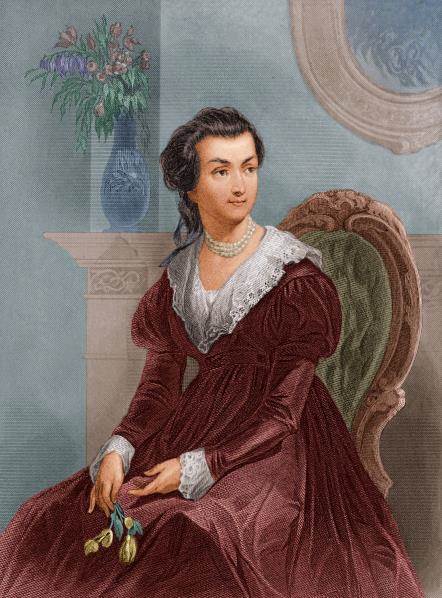
Abigail met Jones when she joined John in Europe after the war had ended, but he was nothing like she had imagined the naval hero to be: “Chevalier Jones you have heard much of. He is a most uncommon Character. I dare Say you would be as much dissapointed in him as I was. From the intrepid Character he justly Supported in the American Navy, I expected to have seen a Rough Stout warlike Roman. Instead of that, I should sooner think of wraping him up in cotton wool and putting him into my pocket, than sending him to contend with Cannon Ball,” she wrote. “He is small of stature, well proportioned, soft in his Speach easy in his address polite in his manners, vastly civil, understands all the Etiquette of a Ladys Toilite as perfectly as he does the Masts Sails and rigging of a Ship. Under all this appearence of softness he is Bold enterprizing ambitious and active.”


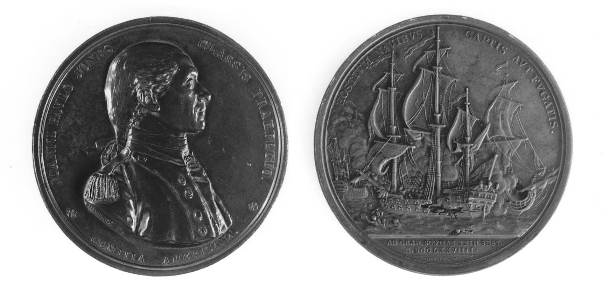
While they did not become close friends, John Paul Jones did offer JA his bust, and to the end of his life, JA remembered Jones as intelligent, a good letter writer, and “gentlemanly in his dress & manner.” As both men regarded the American Navy as central to the success of the nation, Adams never failed to respect Jones’ naval ability or the “glorious success” of Jones’ famous capture of the British frigate Serapis, for which the Continental Congress awarded Jones a medal, the first to commemorate a naval victory. A restrike of that medal is housed within the collections of the Massachusetts Historical Society. 


This Week @ MHS

By Dan Hinchen

Please note that the Society is CLOSED on Monday, 4 July, in observance of Independence Day. Normal hours resume on Tuesday, 5 July. 

We’re back after a long holiday weekend and we’re ready to give you some more public programs! Here is what we have lined up this week:

– Wednesday, 6 July, 12:00PM : Join us for a Brown Bag lunch talk with David Faflik of the University of Rhode Island. The talk is titled “Passing Transcendental: Harvard, Heresy, and the Modern American Origins of Unbelief.” The project examines the idea of the transcendentalists of Boston in the 1830s, 1840s, and 1850s, as “infidels” in their day. Faflik also asks if the alternative faith that they articulated constituted not just a kind of unorthodoxy, but of outright unbelief. This talk is free and open to the public. 

– Wednesday, 6 July, 6:00PM : Bone Rooms: From Scientific Racism to Human Prehistory in Museums is an author talk featuring Samuel Redman of UMASS – Amherst. Redman unearths the story of how human remains became highly sought-after artifacts for both scientific research and public display. This talk is open to the public with a fee of $10 (no charge for MHS Members and Fellows). A pre-talk reception begins at 5:30PM and the talk begins at 6:00PM. 

– Saturday, 9 July, 10:00AM : The History and Collections of the MHS is a 90-minute docent-led walk through our public rooms. The tour is free, open to the public, with no need for reservations. If you would like to bring a larger party (8 or more), please contact Curator of Art Anne Bentley at 617-646-0508 or abentley@masshist.org.

While you’re here you will also have the opportunity to view our current exhibition: Turning Points in American History.

The Lynn Shoemakers’ Strike of 1860

By Susan Martin, Collection Services

The MHS just acquired a letter written by an eyewitness to the historic shoemakers’ strike in Lynn, Mass. in 1860. I decided to dig into the story and, as usually happens, learned much more than I anticipated. It’s remarkable how much history can be represented in a single document.


Moses Folger Rogers (1803-1886) was a Quaker living in Lynn. Most of his 6 March 1860 letter to John Ford of Marshfield, Mass. is dedicated to the biggest story in town, the shoemakers’ strike then underway. Lynn was a major center for the manufacture of shoes. Labor unrest in that industry had been growing for many reasons—increased mechanization, market glut, the economic crisis of 1857—all of which resulted in record low wages.

Workers took to the streets on George Washington’s birthday, 22 February 1860, and the strike lasted for several weeks. Newspapers covered it extensively, and many historians have written about it, but it’s hard to overstate the value of first-hand accounts like this one.

Rogers was not pleased. He lamented the “agitated & excited state of this community.” A week before, it had appeared “that it might be thought necessary to call out the malitia to quell the mob, but with the additional Police force, which came from Boston, order & quiet were restored without the aid of the malitia, a fact for which I feel very grateful, for I feared there might be blood shed – every thing here is now very orderly & quiet, though the ‘Strikers’ continue to hold on, to the number of from 2500 to 3000 persons and what will be the final result remains to be known.”

There had been some violence, including clashes with police and seizures of goods. But it subsided after the first few days, and the rest of the strike consisted of meetings, marches, rallies, and other demonstrations of peaceful solidarity. It was the largest strike in American history up to that time, spreading across New England and involving tens of thousands of workers.

But it wasn’t just the possibility of bloodshed that worried Moses Rogers. He was also dismayed by the active involvement of women in the uprising. In fact, the Lynn strike was notable for the vital role women played in both planning and execution. It makes sense—women were integral to the shoemaking industry. They worked at home as “binders,” or hand stitchers, or operated sewing machines in factories. In his book Class and Community, Alan Dawley wrote: “Without the action of women, it is questionable whether the strike would have occurred at all, and certainly without them it would have been far less massive in its impact.”

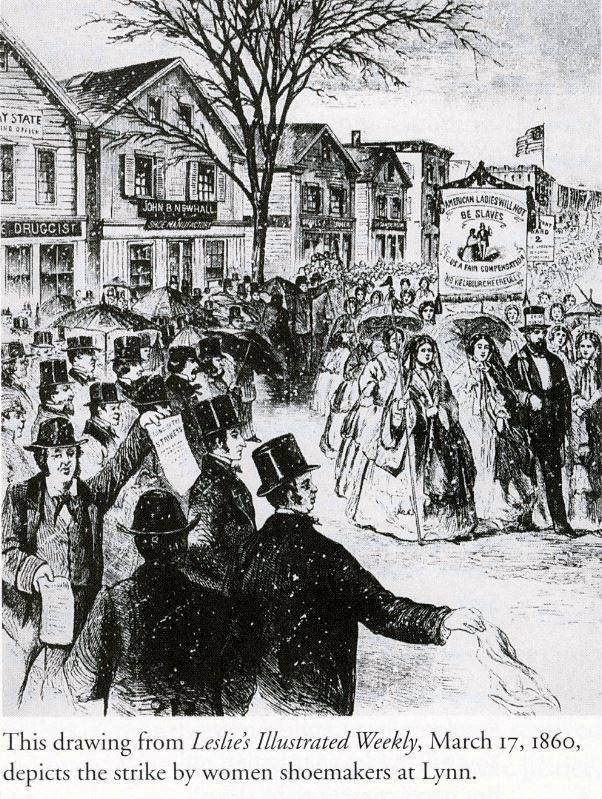
But Rogers described these developments in a horrified tone with lots of outraged underlining: “In addition to the above number there is a strike amongst the Ladies, who I understand propose parading the streets tomorrow to the number 2000.” The march did happen, and in dramatic fashion. Thousands participated, including 800 women, in the midst of a snowstorm. Frank Leslie’s Illustrated Newspaper published an illustration.


Rogers finished his diatribe with a flourish: “I will not undertake to give an account of the disgraceful & shameful deeds enacted in this city since the Strike commenced, suffice it to say that I never witnessed anything in my life which appeared so appaling & fearful.” His response to the strike was not atypical, judging by newspaper accounts. But the strikers had substantial support from townspeople, Lynn’s Bay State newspaper, and even Abraham Lincoln, who was campaigning for president at the time. (The shoemakers’ demonstrations, protest songs, and slogans were infused with antislavery rhetoric.)

Although the Lynn strikers had some temporary political success, ousting most of the city government in the next election, they ultimately failed as negotiations fell apart and workers’ differences proved insurmountable. When the Civil War broke out a year later, attention shifted away from the issue, and war-time demand for manufactures accelerated. However, the Lynn shoemakers’ strike was a watershed moment in American history, remarkable for its size and scope, a clash of old and new systems that foreshadowed labor disputes of the next 150 years.

——————-

Select sources:
– Dawley, Alan. Class and Community: The Industrial Revolution in Lynn. Cambridge, Mass.: Harvard University Press, 1976.
– Faler, Paul G. Mechanics and Manufacturers in the Early Industrial Revolution: Lynn, Massachusetts, 1780-1860. Albany, N.Y.: State University of New York Press, 1981.
– Juravich, Tom, William F. Hartford, and James R. Green. Commonwealth of Toil: Chapters in the History of Massachusetts Workers and Their Unions. Amherst, Mass.: University of Massachusetts Press, 1996.
– Lewis, Alonzo and James R. Newhall. History of Lynn, Essex County, Massachusetts: Including Lynnfield, Saugus, Swampscot, and Nahant. Boston: John L. Shorey, 1865.
– Melder, Keith E. “Women in the Shoe Industry: The Evidence from Lynn.” Essex Institute Historical Collections 115.4 (October 1979): 270-287.


This Week @ MHS

By Dan Hinchen

It is a quiet week here at the Society as we approach the holiday. Here’s what’s happening:

– Wednesday, 29 June, 6:00PM : “A New Perspective on the 19th Century Rivalry Between New York and Boston” is a talk about how changing technology introduces tools that can change the way we see and understand history. Join Dr. Michael Wheeler who will talk about the use of Historical Geographic Information Systems (HGIS) in the development of three-dimensional animated maps for studying historical events, placing New York and Boston in the limelight. This talk is open to the public free of charge, registraiton required. A recption precedes the talk at 5:30PM and the event begins at 6:00PM. 

– Saturday, 2 July, 10:00AM : The History and Collections of the MHS is a 90-minute docent-led walk through our public rooms. The tour is free, open to the public, with no need for reservations. If you would like to bring a larger party (8 or more), please contact Curator of Art Anne Bentley at 617-646-0508 or abentley@masshist.org.

While you’re here you will also have the opportunity to view our current exhibition: Turning Points in American History.

Please note that the Society is CLOSED on Monday, 4 July, in observance of Independence Day. Normal hours resume on Tuesday, 5 July.

Retail and Romance: Boston’s First Department Store

By Grace Wagner, Reader Services

Behind this façade
lies a story – the romance of a great
New England institution
It is worth telling. It should be
worth reading
In the hope that the public 
may find it so, it is
here set down


In reading this verse and examining the accompanying sketch, you may be surprised to learn that the “great New England institution” referenced is, in fact, a department store. Strange as it might seem today, department stores were highly influential in shaping urban spaces and changing how the consumer industry was run in the nineteenth and early twentieth century. By incorporating an unprecedented variety and quantity of apparel, home goods, and entertaining diversions, and showcasing these items in vast, high-ceilinged and well-lit halls, department stores lent glamour to the middle-class shopping experience.

The above inscription is an excerpt from the book, Retail and romance, which recounts the history of Jordan Marsh & Company, the first, and for a long time, the most prominent department store in Boston. Struck by the intriguing title and the compelling case made by its author, Julia Houston Railey, I decided to explore the history of Jordan Marsh.


Railey’s story begins in 1841, when Eben Jordan, the founder of Jordan Marsh, established his first store at the age of 19. At this time, Jordan also conducted his first sale, which consisted of “one yard of cherry colored hair ribbon,” sold to Louisa Bareiss, a young girl, who, according to Railey, was just as breathless with excitement over the purchase as Jordan himself (9). This story is depicted pictorially in this publication as well as the centennial Tales of the Observer by Richard H. Edwards, published in 1950. Jordan’s famous sideburns are present in both imaginings.


In 1851, Jordan partnered with Benjamin L. Marsh and in 1880, they established Jordan Marsh’s Main Store at 450 Washington Street, where it would remain for the next 100 years. An 1884 article in the Boston Post referred to this establishment as “the most colossal store the world ever saw, surpassing by far anything that had been attempted either in New York or Philadelphia” (The story of a store, 4).

Railey’s book also discusses the continued philanthropic efforts of the Jordan family, particularly those of Jordan’s son, Eben Jordan, Jr., who was particularly active in the arts community. Jordan, Jr. built the Boston Opera House, founded Jordan Hall for the New England Conservatory, and installed art exhibits at the Main Store on Washington Street (22).

Whereas Retail and romance focuses on the romantic aspects of Jordan’s humble beginnings and subsequent charitable endeavors, The story of a store, published by the Jordan Marsh Company in 1912, captures the glamorous nature of early department stores. This publication is filled with glossy black-and-white photos and descriptions of the innumerable goods contained in each department of Jordan’s store.


This set of images showcases several large glass display cases in the women’s department, containing from top to bottom: handkerchiefs, gloves, laces, and neckwear. However, commodities of all kinds were sold at Jordan Marsh. To name a few: umbrellas, children’s apparel, jewelry, silverware, eyeglasses, toiletries, books, leather goods, upholstery, rugs, stationary, luggage, kitchen goods, hardware, garden tools, and toys.

Like some of the best department stores of the nineteenth and early twentieth centuries, Jordan Marsh also offered a variety of services for patrons, including store credit (a new concept at the time), personal services like a Post Office, Telegraph and Cable Station, and Waiting Rooms, complete with “easy chairs, writing materials, newspapers, check-rooms, lavatories, and other necessary conveniences for customers” (28)


Today, 450 Washington Street, formerly the site of Jordan Marsh’s Main Store, is occupied by Macy’s. Although the Jordan Marsh Company continued to thrive and expand throughout much of the twentieth century, it was eventually bought out and replaced by the larger company entirely by 1996.

This story is not an uncommon one in the business world. Massachusetts Historical Society has a number of records that provide insight into the former business and commercial world of Boston. Perhaps you may discover a former company or store, similarly overlooked or forgotten today.


#BSS16! A Second Year of the Boston Summer Seminar @ MHS

By Anna Clutterbuck-Cook, Reader Services

Tomorrow night will be the final celebration for 2016 participants in the GLCA Boston Summer Seminar, a three-week program offered by the Great Lakes Colleges Association and hosted at the Massachusetts Historical Society. After a successful inaugural year, we had a competitive group of applications submitted to the Seminar last winter, from which we selected three teams to join us this June. Over the past three weeks, we have been excited to get to know a new group of soon-to-be alumni BSS16 participants:

Albion College

“Northern Black Lives Matter: The Experience of Black Northerners in the Era of Southern Emancipation”

Marcy Sacks, Chair & John S. Ludington, Endowed Professor of History

with students Corey Wheeler and Elijah Bean

Denison University

“Boston and New England in Atlantic Contexts”

Frank “Trey” Proctor III, Chair & Associate Professor of History

with students Rachael Barrett and Margaret “Maggie” Gorski

Oberlin College

“Haunted Subjects: Occult Practices and New Literary Traditions in Nineteenth-Century America”

Danielle Skeehan, Assistant Professor of English

with students Amreen Ahmed and Sabina Sullivan


These three teams have been with us since June 6th, conducting research at the Massachusetts Historical Society as well as the Seminar’s other partner institutions: the Center for the History of Medicine at Countway Library, Houghton Library, Northeastern University Archives & Special Collections, and Schlesinger Library.

The Seminar’s guest presenters this year were Kimberly Hamlin, Director of American Studies at Miami University of Ohio, and Stephen R. Berry, Associate Professor of History at Simmons College. Hamlin spoke to the group about her research on evolutionary theory, gender, and race in the archive; Berry walked participants through the intricacies of using ships’ logbooks as sources of information on the practice of religion at sea.

A new feature of the program this year, enthusiastically received by the group – despite the windy evening on which it was scheduled! — was the opportunity to participate in a walking tour, Boston’s Construction of Self, which introduced our participants from the American Midwest to some key moments and public history sites in central Boston.

We wish all of our 2016 participants a fruitful last few days in the archive and a productive return to campus this fall. Learn more at bostonsummerseminar.org and, if you are a faculty member or student one of the GLCA member institutions, watch for BSS17 call for proposals which will be posted and circulated during the upcoming fall semester.

This Week @ MHS

By Dan Hinchen

It’s time for our programs round-up. On the slate this week, we have : 

– Monday, 20 June, 6:00PM : “The Defender: How the Legendary Black Newspaper Changed America.” Drawing on dozens of interviews and extensive archival research, author Ethan Michaeli constructs a revelatory narrative of race in America and brings to life the reproters who braved lynch mobs and policemen’s clubs to do their jobs, from the age of Teddy Roosevelt to the age of Barack Obama. This talk is open to the public, registration required with a fee of $10 (no charge for MHS Members or Fellows). Reception begins at 5:30PM and the talk begins at 6:00PM.

– Wednesday, 22 June, 5:00PM : MHS Fellows Annual Meeting & Reception. MHS Fellows are invited to the Society’s annual business meeting. RSVP required. The meeting begins at 5:00PM

N.B.: The library closes early at 4:00PM on Wednesday, 22 June, in preparation for the annual meeting.

– Saturday, 25 June, 10:00AM : The History and Collections of the MHS is a 90-minute docent-led walk through our public rooms. The tour is free, open to the public, with no need for reservations. If you would like to bring a larger party (8 or more), please contact Curator of Art Anne Bentley at 617-646-0508 or abentley@masshist.org.

While you’re here you will also have the opportunity to view our current exhibition.


Transcription Challenge, Round 2

By Dan Hinchen, Reader Services

A few weeks ago here on the Beehive I posted an image of a medieval document (here and here) with the hope that someone out there would be able to make sense of it and provide us with some information. What I thought would be a longshot turned out to be a wonderful display of crowdsourced transcription and translation, thanks in no small part to the Boston Globe, who took the image and ran with it. We even got responses from the UK which provided geographic context for the contents of the item. All in all, it was a great result!

So now I am back with another challenge. This time, the document is written in Spanish and the penciled date written by a cataloger here at the MHS at some time in the past is “1474? Jan. 12.”

Since my Spanish is slightly better than my Latin I decided to take a stab at transcribing this one as best I could. Below is what I came up with along with a couple of images of the document. Words that appear in [brackets] are words that I am unsure about. Spots that only contain underscoring _____ are words that I had no clue about. 

While I think I made a decent go of it, the writing style and letter forms, along with possibly outmoded means of spelling, made it difficult. This is a sloppy transcription, at best, so please be gentle!

Can anyone out there step up and help us out this time? If you think you can fill in any blanks – or correct my many errors – please do! You can leave any comments at the bottom of the page or e-mail us at library@masshist.org, using the subject line Spanish Blog.

———-

Front of the Document [Hold Ctrl and press + to zoom in]

Muy ynclito duque nuestro muy caro primo  Nos 
la princesa de castilla y de leon Reyna de _____ princesa de aragon. 
[Vos enbiamos] mucho sa-

ludat como aquel {that one} que mucho amamos y preciamos por pero 
ocho a [debeci] nuestro vasallo y _____ dela nuestra villa de bilbao 
que es encl nuestro condado 

senorio de viscaya nos es fecha relacion que encl mes de otubre 
proximo pasado. llego con [vna nao] suya y de sancho yuanco de laris 
patron della encl 

puerto de la abdat de genoua el dicho sancho yuanes detaris su 
cun~ado. la qual [yua] cargada de atun y de otras 
mercadurias para las descargar en la 

dicha [abdat]. A que en la dicha nao yuan fusta nouenta  
[onbres] marcantes asi mesmo vasallos nuestros. los quales como` 
llegaron encl puerto y muelle 

dela dicha abdat. luego en continente entraron en la dicha nao las 
____ della poderosamente y prendieron al dicho patron sanchoyuanes de 
[latis] 

y lo enbiaron preso [avucstro] poder y que lo teneys preso y que esto 
asi fecho [sacaron] dela dicha nao las velas y vergas todos los otros 
a [parclos] armas

y artilleri`a que en ella [ama] y lo lleuaron ala ducha abdat de 
genoua con mas las mercaderias cayas ropas armas y prouisiones 
[provisions] que en la dicha nao esta

uan. Creo nos fecha saber que la causa por que eso [sefizo] y con ___ 
fue por que ___ de la ____ prendio [dossesenderos] vuestros y que 
fusta aquellos [secr]

libres ___ entendeys de soltar al dicho patron ___ menos restituyr 
les la dicha nao con las cosas suso dichas O si esto asics nos 
maravyllamos mucho

que por esta razon nuestros vasallos ayan deseer veyados y 
[purificados] de tal manera mayor mente leyendo el dicho vohan de las 
cano de la pro-

vincia de [grypusova]de quien continua mente nuestros vasallos del 
dicho nuestro condado y senorio de viscaya son fatigados y mal 
tratados yndemida-

mente. O por que nestro deseo ha leydo y es de vos agradar y con 
plazer en todo lo que pudieremos y que los genouesesy otras personas 
estrangeras de 

vuestras tierras que al dicho nuestro condado v____ gran honreados 
bien tratados y favorecidos como es razon. Por [endo] afectuosamente 
vos

rogamos que por contenplacion nuestra delibreys al dicho patron 
sancho yuanes de la prision en que esta y [la fagayo] enteramente 
restituyr la 

dicha [nao] con todas las cosas suso dichas que enella yuan. O asi 
mesmo [hemyenda] y satisfacion de todos los [dapnos] y costas que por 
esta causa ___

les han _____ de manera que el que de satisfecho y contento do todo 
ello lo qual sin duda vos ternemos en singular ___ de cimiento i nos 
______ 

por ello ___ para mirar con toda buena voluntad por el honor i favor 
vuestro i de todas vuestras cosas por queeste es nuestrodeseo de la 
muy noble

_____ de seg__  __ XI dias de enero del xx mi anos

Back of the Document — Note the clear watermark of a down-turned hand and star.

This Week @ MHS

By Dan Hinchen

It’s time again for the weekly round-up of events coming your way. Here’s what’s on tap at the Society this week:

– Wednesday, 15 June, 12:00PM : The first of two Brown Bag lunch talks this week is given by Zach Hutchins of Colorado State University and is titled “Briton Hammon in the Archives” and traces the circum-Atlantic journey of Massachusetts resident Briton Hammon. The enslaved Hammon published a narrative of his travels in 1760, an account many have described as the first slave narrative. This talk is free and open to the public. Please join us!

– Wednesday, 15 June, 6:00PM : Also on Wednesday is an author talk with Daniel R. Coquillette and Bruce A. Kimball who will discuss their book On the Battlefield of Merit: Harvard Law School, the First Century. Currently working on the second volume that will bring the story to the present, the authors will also relate this history to recent challenges faced by the school including questions of the relation of its seal to a fortune made on the backs of slaves. This talk is open to the public for a fee of $20 (no charge for MHS Members and Fellows). A pre-talk reception begins at 5:30PM and the program begins at 6:00PM. 

– Friday, 17 June, 12:00PM : The second Brown Bag of the week features Ben Davidson of New York University who presents “Freedom’s Generation: Coming of Age in the Era of Emancipation.” Davidson’s research traces the lives of the generation of black and white children, in the North, South, and West, who grew up during the Civil War era and were the first generation to come of age after the end of slavery. This talk is free and open to the public. Pack a lunch and come on in!

– Saturday, 18 June, 10:00AM : The History and Collections of the MHS is a 90-minute docent-led walk through our public rooms. The tour is free, open to the public, with no need for reservations. If you would like to bring a larger party (8 or more), please contact Curator of Art Anne Bentley at 617-646-0508 or abentley@masshist.org.

While you’re here you will also have the opportunity to view our current exhibition.

Commemorating War, Promoting Peace

By Susan Martin, Collection Services

What is the best way to remember our wars? What kinds of public commemorations are appropriate after peace has been achieved? What effect do such commemorations have on our relations with allies who were once our enemies? These were questions that concerned Noah Worcester (1758-1837), Revolutionary War veteran, Unitarian minister, and one of the founders of the Massachusetts Peace Society.


In early 1825, when Worcester heard that newly elected U.S. Rep. Edward Everett would be delivering an address on the fiftieth anniversary of the battles of Lexington and Concord, he decided to reach out. Of course, 1825 was not only a Revolutionary War anniversary year; it was also just ten years out from America’s more recent war with England.

A draft of Worcester’s 16 March 1825 letter to Everett was recently acquired by the MHS. It reads, in part: “The manner in which Anniversaries of the Revolution have too commonly been conducted, has been to me a source of much regret. The prejudices excited by war are apt to be too strong and durable. When a treaty of peace has been made between two nations, which had been at war, Christianity, prudence and magnanimity unite in requiring that nothing should be done by either party to perpetuate the spirit of animosity. On the contrary, all that can be done should be done, to abate prejudices, and to cultivate friendly feelings between the parties. The practice of rehearsing the wrongs of Britain, and boasting of our own successes in the war, appear to me of a very injurious nature, and perfectly inconsistent with the Christian principles of love, forbearance and forgiveness.”


Most Americans undoubtedly celebrated these Revolutionary anniversaries with patriotic pride, but Worcester was disturbed by their emphasis on triumphalism over reconciliation. While he “sincerely rejoice[d]” in America’s victory, he felt that blame for the conflict “was not all on one side” and that the colonists “had less cause of complaint than we imagined” at the time. He warned against rehashing old resentments and encouraged Everett to promote “a new and pacific character to our Anniversaries of the Revolution,” even quoting some of Everett’s own pacifistic words back to him.

Worcester’s letter definitely made an impression. In his diary, Everett wrote with some contempt: “Shortly after my appointment to deliver the Oration at Concord was announced, Noah Worcester wrote to me to caution me against any thing which could look like encouraging War; said America had no great reason to revolt; that the motives & feelings of the Soldiers (of whom he was one) were not good &c. I did not answer his letter. Today he sends me a number of the ‘Friend of Peace,’ in which he has quoted some remarks from my book[…]; from which sentiment he deduces, by inference, the impropriety of commending & celebrating warlike exploits.”


And Everett’s Concord address was scathing. While he did not name Worcester publicly, he devoted several paragraphs to rebutting Worcester’s arguments in tones of muscular nationalism: “There are those, who object to such a celebration as this, as tending to keep up or to awaken a hostile sentiment toward England. But I do not feel the force of this scruple. […] A pacific and friendly feeling towards England is the duty of this nation; but it is not our only duty, it is not our first duty. America owes an earlier and a higher duty to the great and good men, who caused her to be a nation. […] I am not willing to give up to the ploughshare the soil wet with our fathers’ blood; no! not even to plant the olive of peace in the furrow.”

Everett called “abject” any person who would “think that national courtesy requires them to hush up the tale of the glorious exploits of their fathers and countrymen.” But Worcester hadn’t suggested that we forget the past; he just took issue with the way we remember it. This mischaracterization of his position may have been what Worcester meant when he annotated this draft of his letter: “The above letter was sent to Mr E. soon after its date. The effect it had on his mind, as it appeared in his subsequent oration, was to me a matter of deep regret.”


Next Friday is Bunker Hill Day here in Massachusetts. On 17 June 1825, a ceremony was held in Charlestown, Mass. and the cornerstone laid for the Bunker Hill Monument. Worcester, who had fought in the battle as a teenager exactly fifty years before, did not attend the dedication ceremony and declined to subscribe to the monument. Instead, he wrote a poem called “Solitary Commemoration.” Here’s an excerpt:

In every conflict of the martial kind,

Each party thinks he sees the other blind;

But neither sees how hatred on his part,

Deforms the soul while rankling in the heart.

Hatred to whom he knows not, but to those

Who chance to bear the general name – his foes.

Alas! tho’ fifty years have passed away,

Since on that Hill was seen the bloody fray –

On that same ground, lo! myriads celebrate,

Those mournful deeds of horror, death, and hate!

May I, as one preserved in that dread scene,

Ask what these pompous celebrations mean?