Natural Beauty

By Kittle Evenson, Reader Services

Spring has officially, if tardily, sprung here in Boston and researchers and staff alike are again staring distractedly out of the reading room windows at the green grass, new leaves, and vibrant sunshine.

To draw our wandering attention back inside, I decided to showcase a few examples of early Bostonians preserving and portraying the natural world in all its beauty.

While the MHS offers countless examples of artistic depictions of nature, I chose just two to share here: one for its pure beauty, the other for its scientific bent.

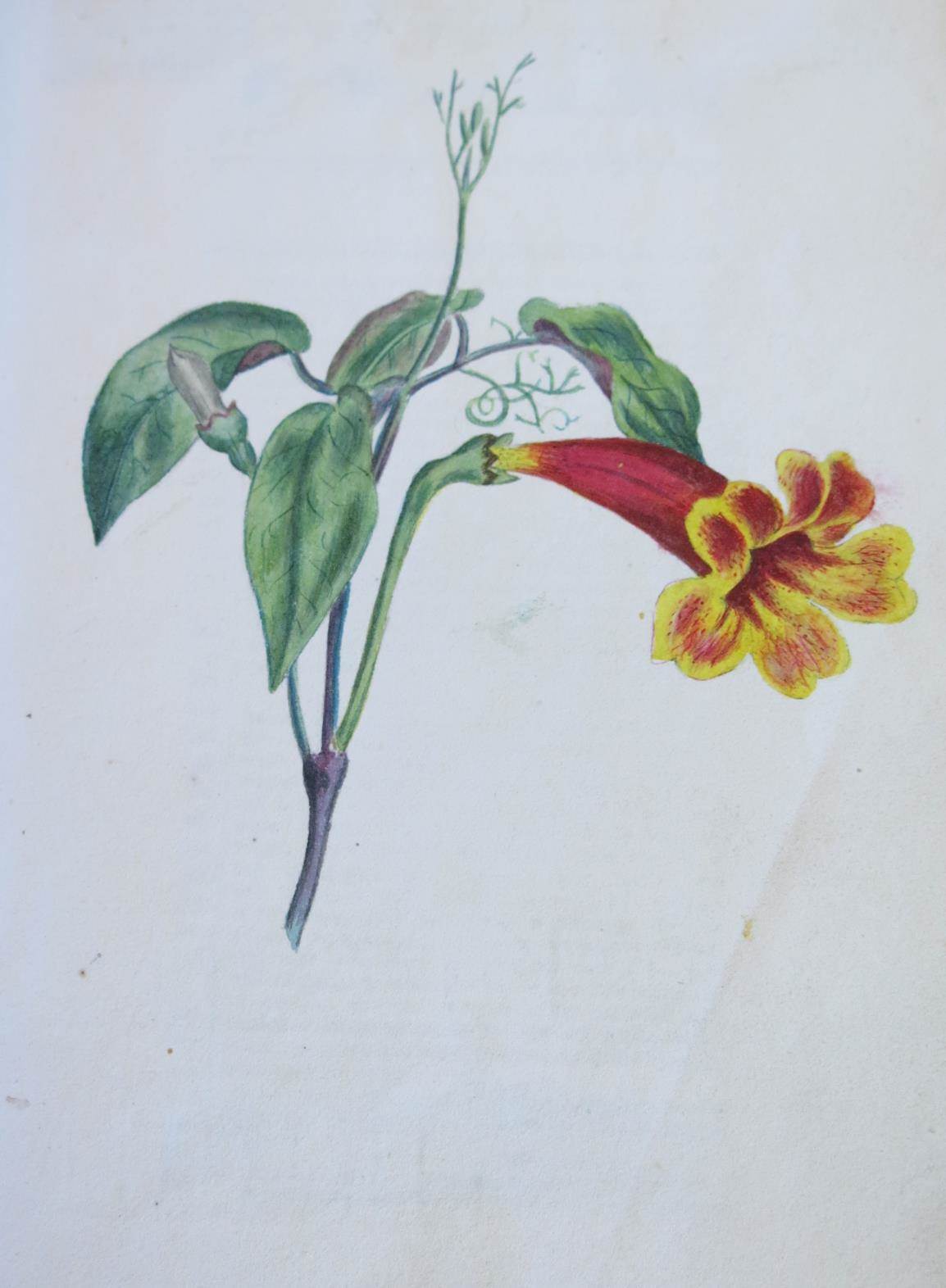
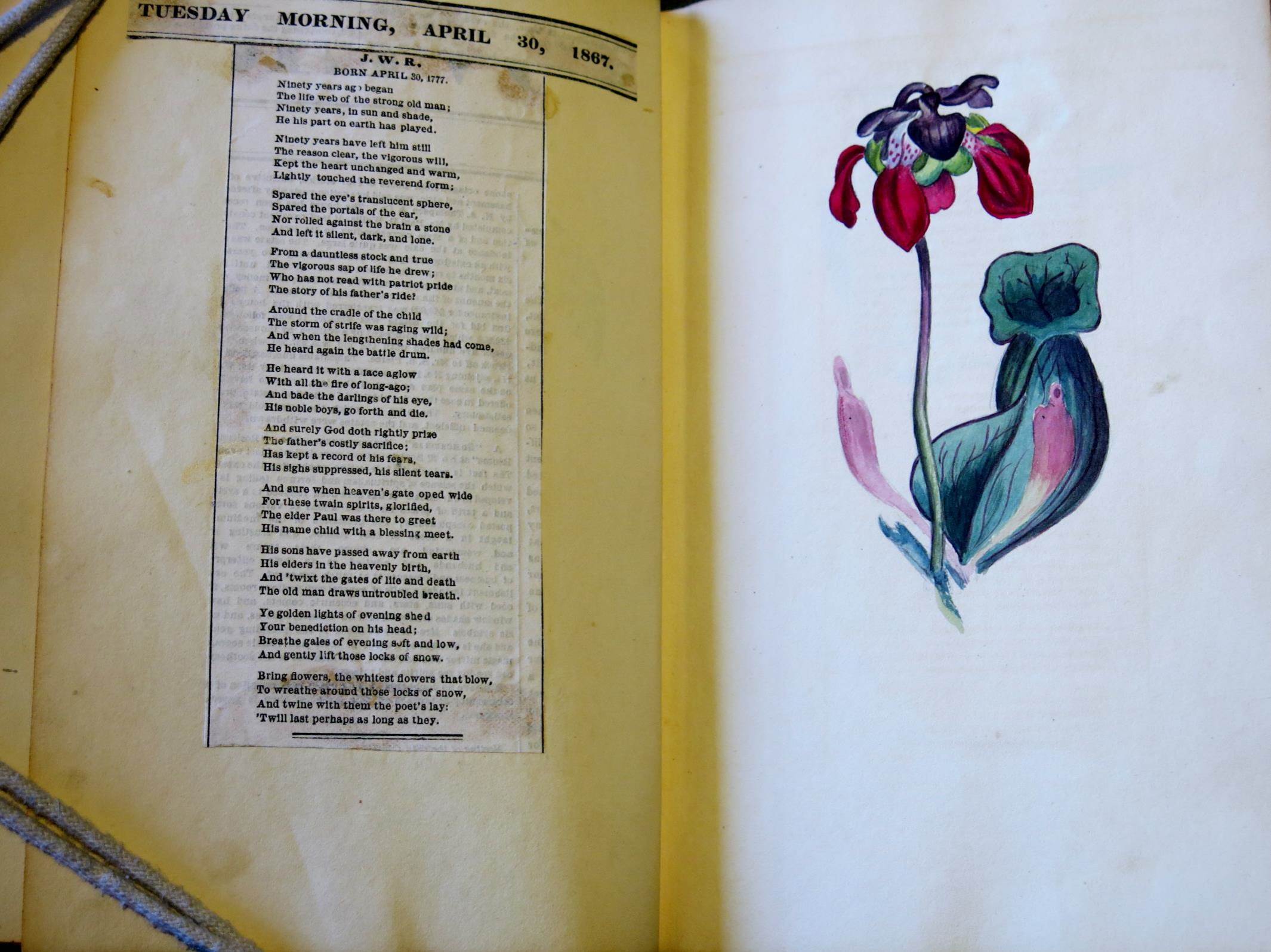
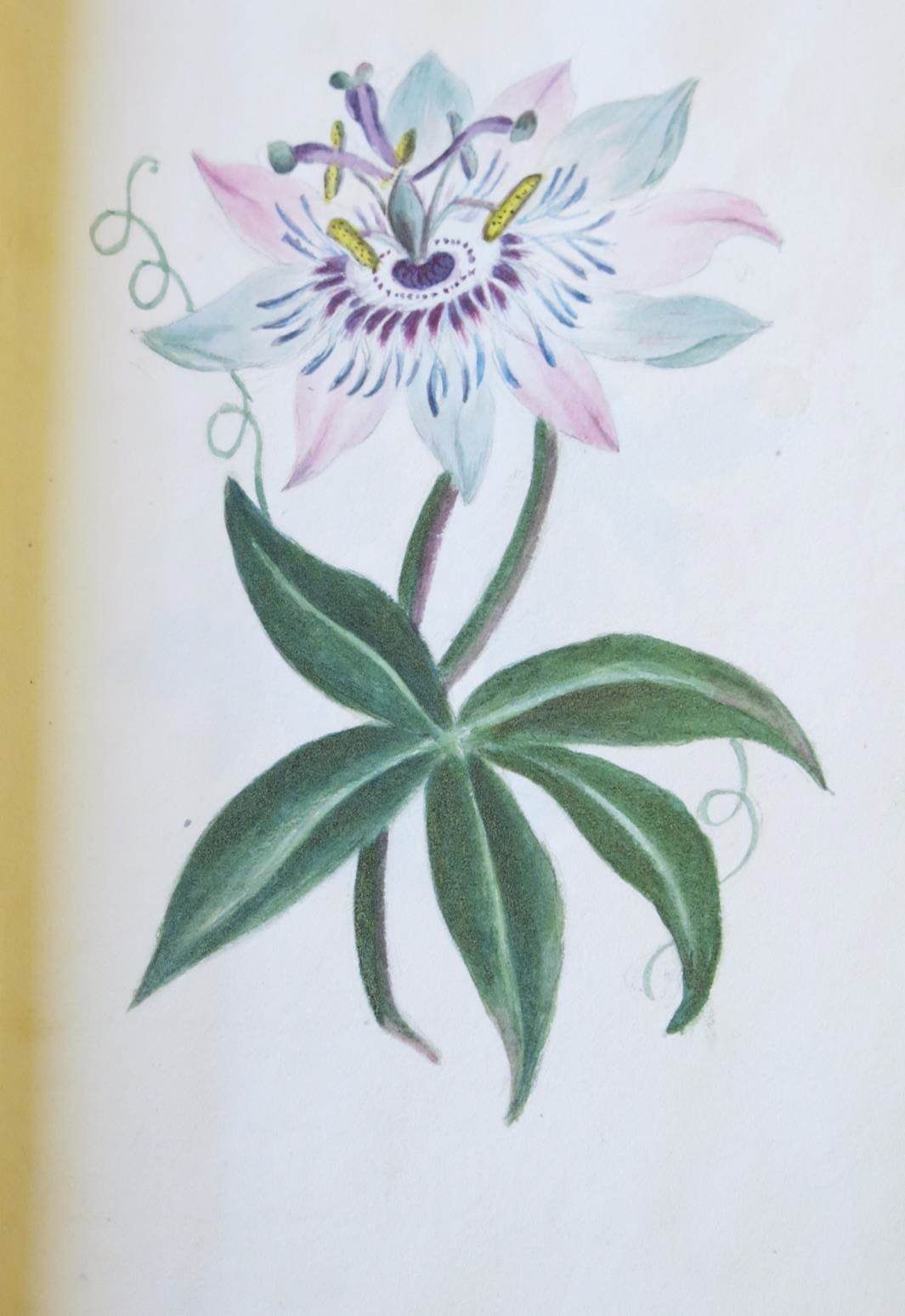
The first is a nondescript volume from the Quincy-Howe family papers. Labeled as “Flower paintings, clippings — Eliza S. Quincy,” and dating to the mid-19th century, the volume is part scrapbook, part sketchbook, with newspaper clippings of familial news mounted opposite hand-drawn sketches of ornate flowers.


Colorful painting of a flower in Eliza S. Quincy’s 19th century album of flower paintings and clippings


The emphasis of this work is artistic, the mood of the drawings complements the clippings. They are at turns mournful and celebratory, with romantic lines and rich colors.

A painting of a somewhat mournful-looking flower sits opposite a 1867 poem on the life and death of J.W.R.


A delicately-colored painting of a flower in full bloom is unaccompanied by a newspaper clipping


From a similar period (1850s-1870s) the second example is far more scientific, although the beauty of nature is not lost on the viewer (or creator).


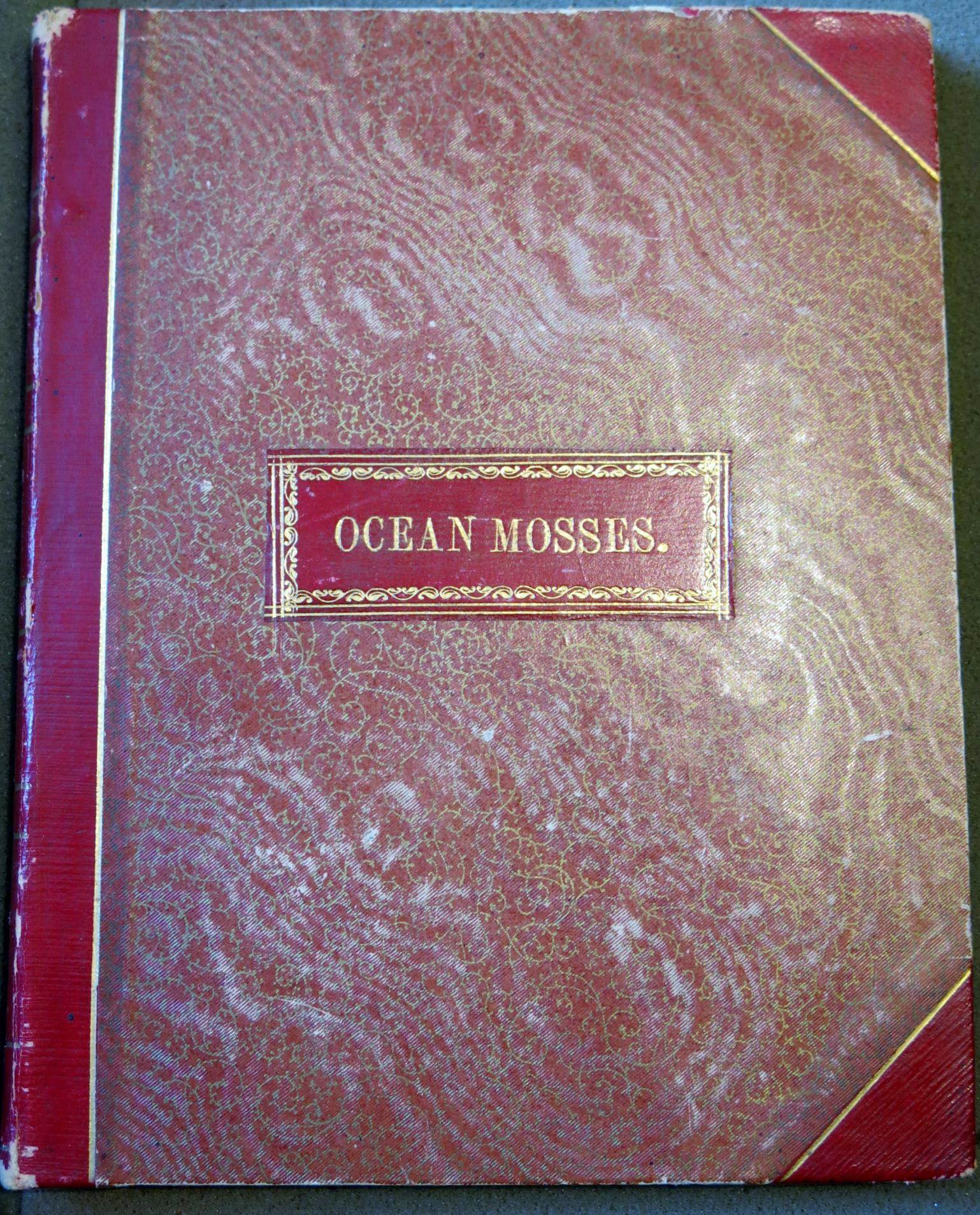
The cover of Ocean Mosses from 1872, owned, if not assembled, by Mrs. Edwin Lamson


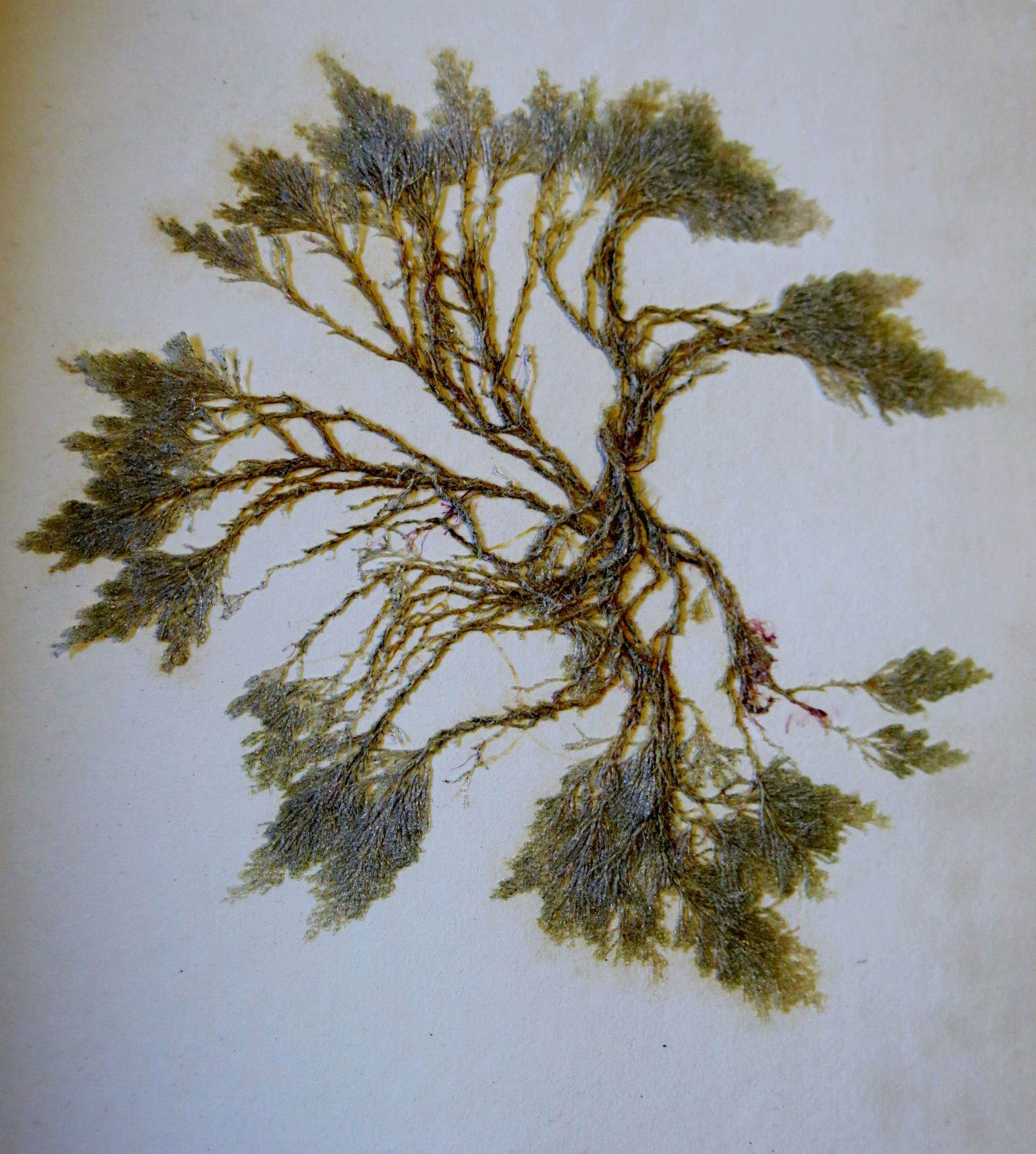
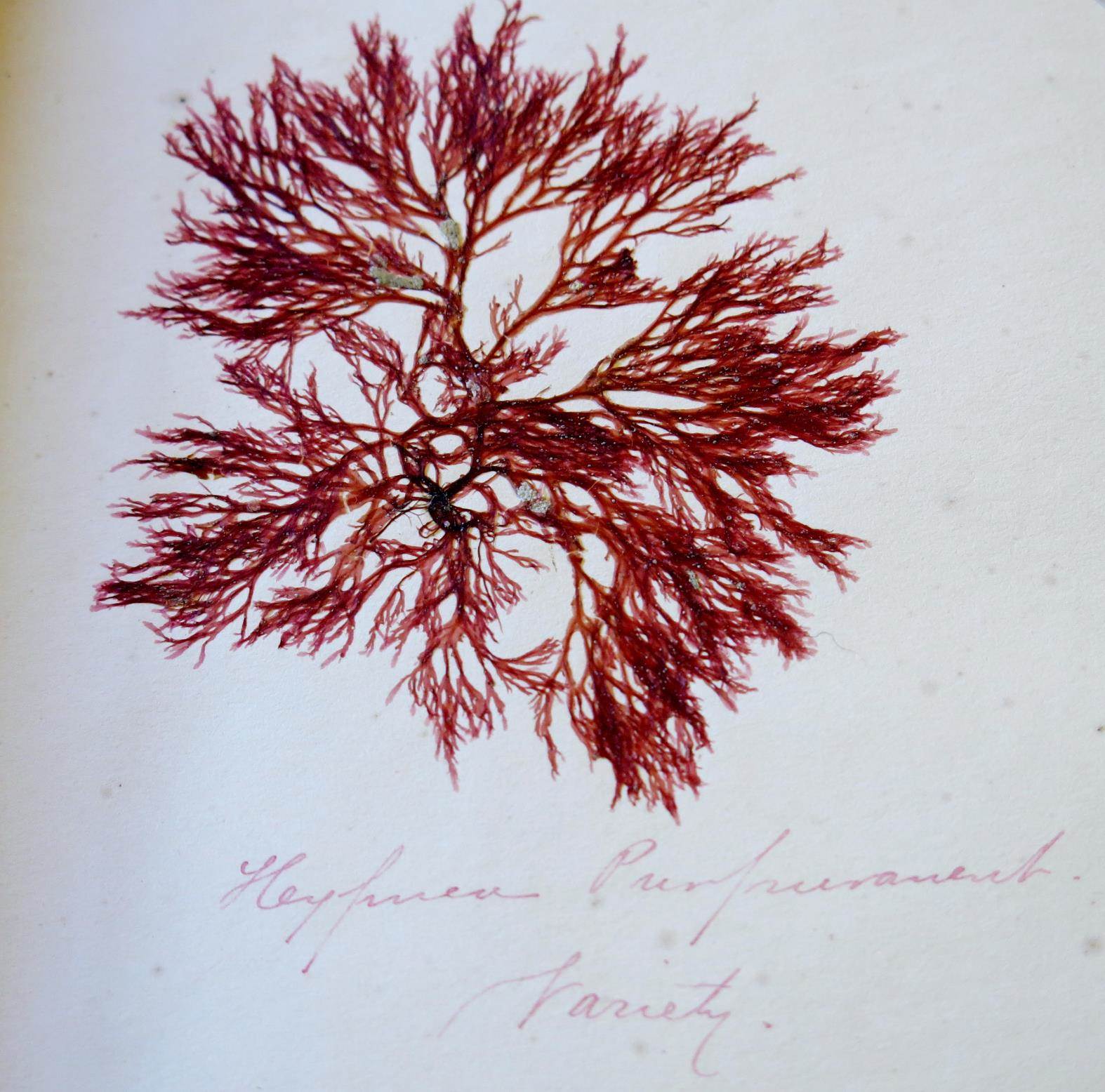
Inside 3 bound volumes from the Lamson family papers are pressed clippings of “ocean mosses” and “ocean flowers” collected along New England coastlines. Some are identified with binomial nomenclature, others are left unlabeled. All are impressively well intact for being approximately one-hundred-and-fifty years old.

An unlabeled segment of ocean moss from a Lamson family volume entitled Ocean Mosses c. 1850


A labeled segment of ocean moss from Mrs. Edwin Lamson’s 1872 volume


Even though this collection tend towards a more scientific look at underwater nature, the elegance and beauty of these plants prevails.


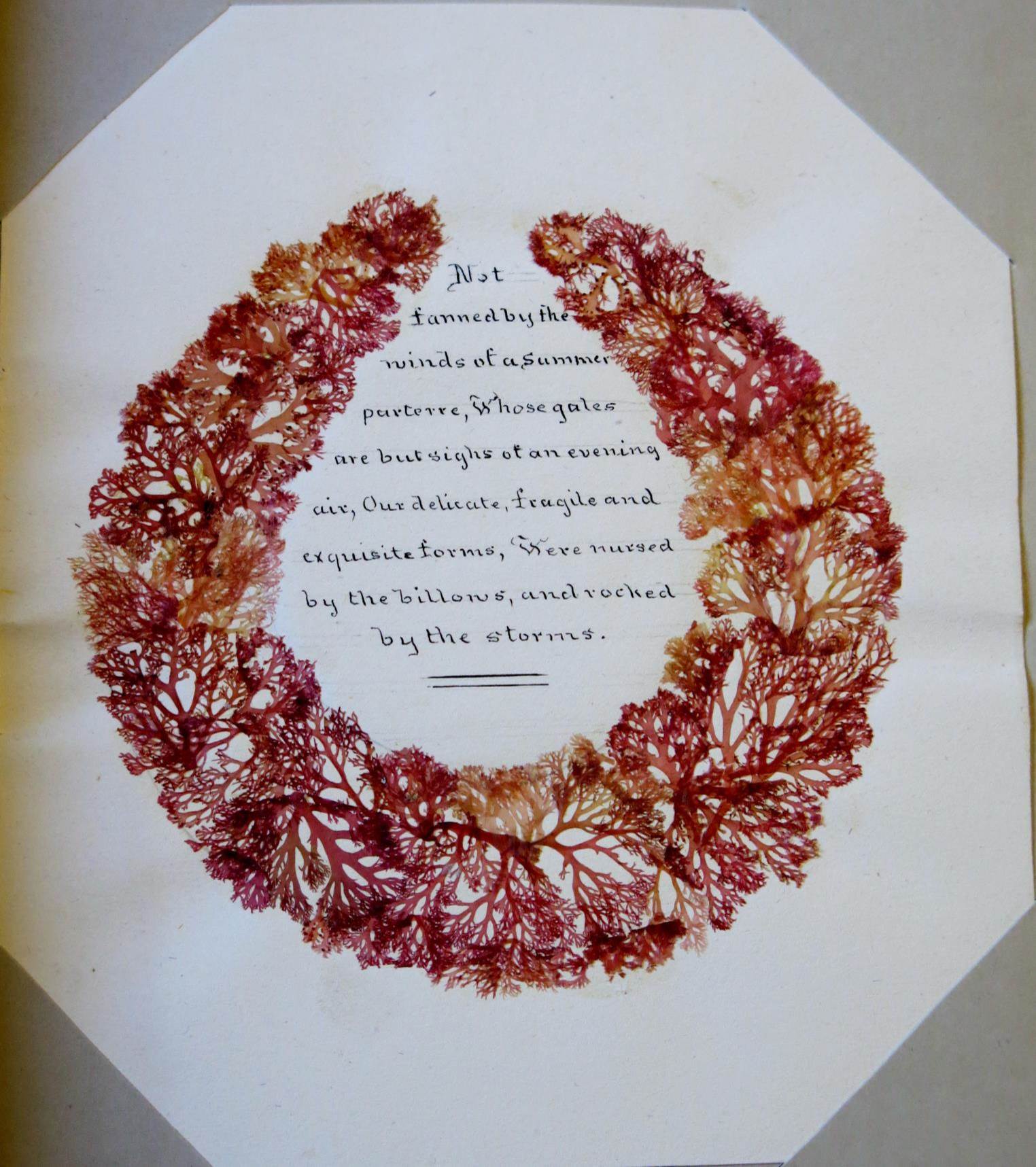
Artfully arranged ocean mosses surround a poem in Mrs. Edwin Lamson’s June 22, 1872 volume

The poem wreathed by moss reads:

Not

fanned by the

winds of a summer

parterre, Whose gales

are but sighs of an evening

air, Our delicate, fragile and 

exquisite forms, Were nursed

by the billows, and rocked

By the storms. 


Investigating a bit, this appears to be a slightly modified verse of a longer poem entitled “Seaweeds”:

Oh call us not weeds, but flowers of the sea,

For lovely, and gay, and bright-tinted are we;

Our blush is as deep as the rose of thy bowers,

Then call us not weeds, — we are ocean’s gay flow’rs,

 
Not nurs’d like the plants of the summer parterre,

Whose gales are but sighs of an evening air;

Our exquisite, fragile, and delicate forms

Are the prey of the ocean when vex’d with his storms


I found several versions of this poem, although few bore official attribution. One version, attributed to a Miss Elizabeth Aveline of Lyme Regis, England, that I found most interesting was mentioned in a book by Patricia Pierce on Mary Anning, an English paleontologist whose early 19th century discoveries of Jurassic marine fossils helped shape our scientific understanding of the world. Pierce mentions how Anning scrawled this poem in an album under a clutch of dried seaweed. An eerily similar description to Lamson’s treatment pictured above.

While I found no reference to Anning amongst the Lamson volumes, this tentative, poetic link piqued my interest in the transatlantic discussions of scientific discoveries had by 19th century women. A topic I am sure to continue exploring.

If 19th century depictions of the natural world strike your fancy and you would like to see these volumes in person, please feel free to stop in and visit our library. If you are interested in seeing what other materials we have related to botany and the beauty of nature you can browse our online catalog, ABIGAIL, from the comfort of your own home.


Following Their Bliss: Two Very Different Trips to California

By Susan Martin, Collection Services

Serendipity is one of the great things about working in archives. Just a few months apart, the MHS acquired, purely by chance, two collections related to members of the Bliss family. Pelatiah Lawrence Bliss (Lawrence to his friends) and James Wheaton Bliss were very, very, very distant cousins. In fact, to trace their exact connection, you’d have to go back many generations, to the 17th century.

While Lawrence and James were contemporaries, there’s no reason to believe they knew—or even knew about—each other. And they didn’t have much in common. Lawrence (1821-1851) was the youngest child of a West Springfield, Mass. tanner. He tried his hand at various careers, working as a store clerk, teacher, and farmer in Georgia, Alabama, and Michigan, apparently without much happiness or success at any of them.

James (1825-1875), on the other hand, was an established Boston businessman. According to the Bliss family genealogy published by a relative, “as a prominent and successful merchant in the clothing trade [James] was highly esteemed. […] Few men of his age were more frequently consulted by their business associates.” He served on the Executive Committee of the Boston Board of Trade.

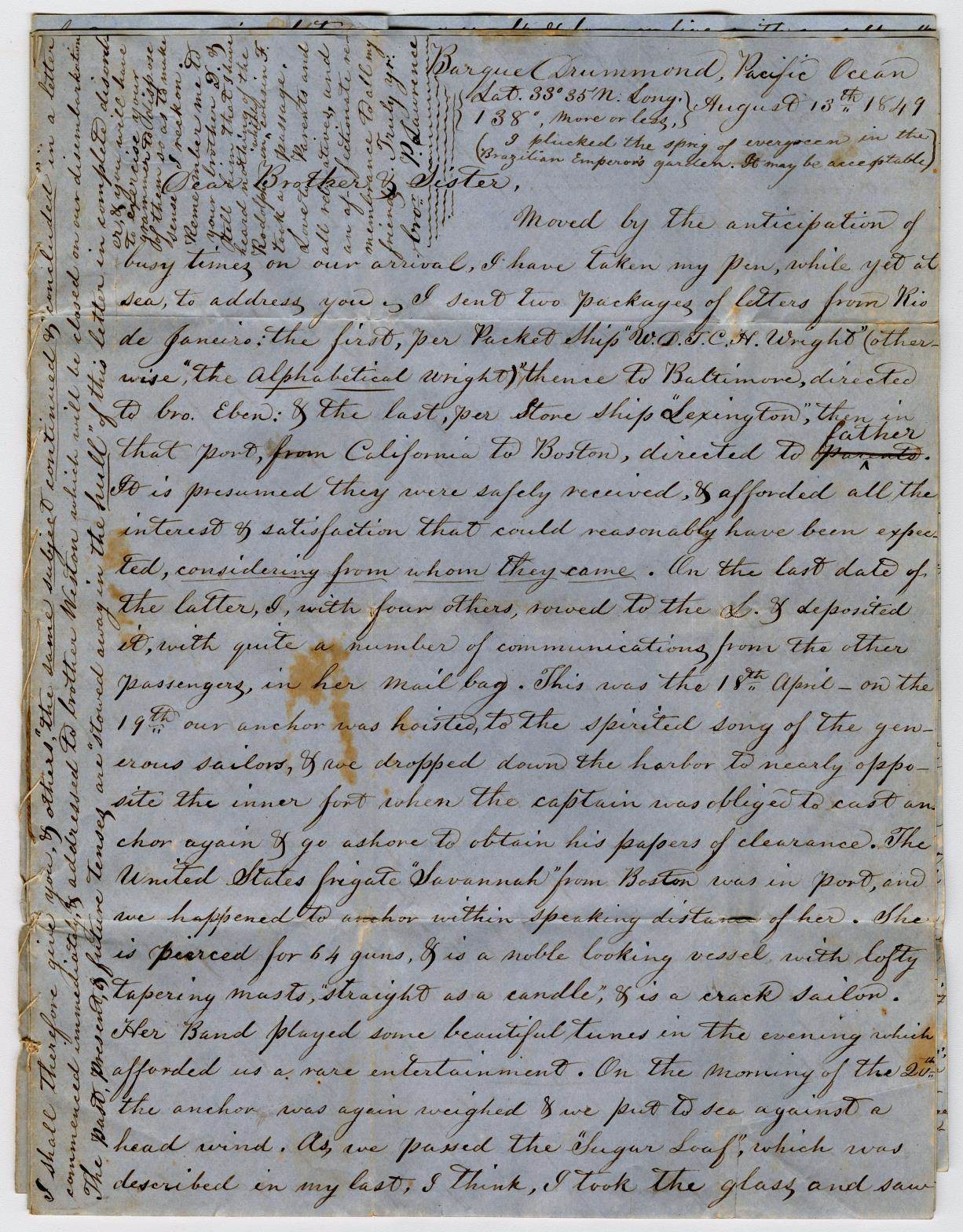
I did find one interesting parallel between Lawrence and James: both men traveled from Boston to San Francisco, though under dramatically different circumstances. In 1849, Lawrence joined the California Gold Rush and sailed on the Drummond around Cape Horn. The trip took seven months. Twenty-one years later, his distant cousin James rode on the first chartered transcontinental railroad excursion to San Francisco and back. He was home in just over a month.

Both manuscript collections are small, but Lawrence’s papers consist primarily of correspondence, including a detailed 18-page letter he wrote during his voyage on the Drummond. He seemed to have no illusions about his prospect for success in the Gold Rush, worrying, as he watched a sunset, about how “deceitful luster” can lead to “perished expectations.”


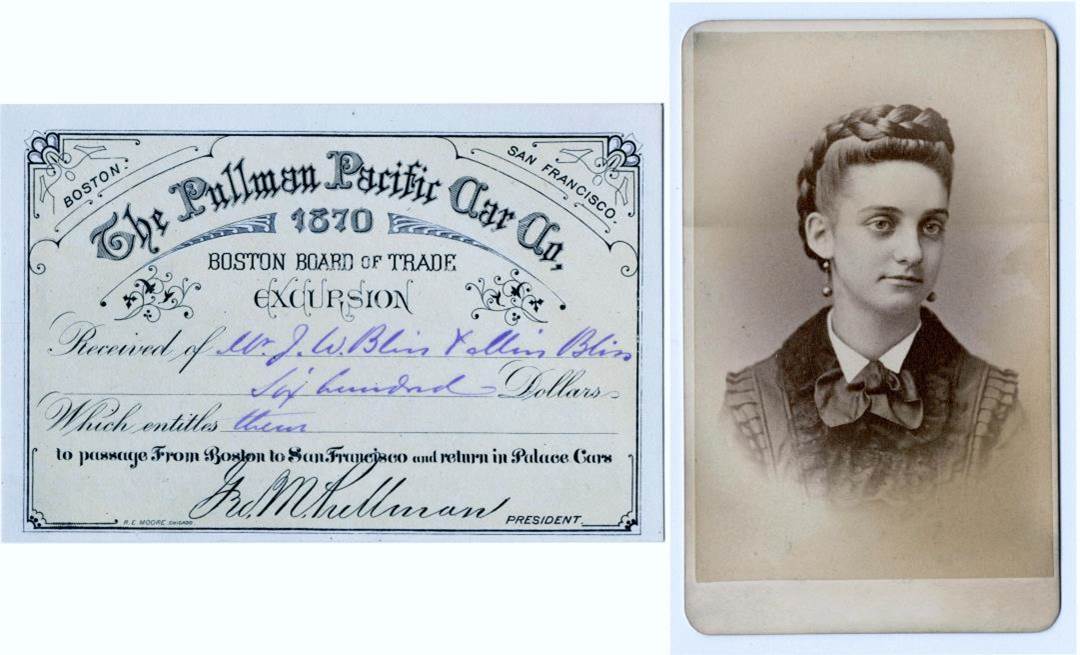
James’s train trip was luxurious. A colleague described the Pullman excursion here at the Beehive a few years ago. The MHS has also digitized a broadside about the trip, as well as the first issue of the newspaper printed on the train. You can find James and his teenage daughter Josie, who accompanied him, listed on both documents. I don’t have a picture of James, but here’s Josie, with the receipt for their fare.


Lawrence was unfortunately unsuccessful as a gold prospector. On 8 Aug. 1850, he wrote home, “Misfortune, disaster, & disappointment seem to have attended me ever since I arrived in the country. […] Don’t let anybody come to California whom you can influence.” And a few weeks later, “I cannot blame myself for my ill success, as I have done the best I could.” He died penniless in San Francisco just three days shy of his thirtieth birthday.

As for James, he married Sarah Jane Wood in 1849 (the same year of Lawrence’s fateful trip west) and had six children, four of whom lived to adulthood. He died in 1875.

This Week @ MHS

By Dan Hinchen

It feels like spring finally arrived here in Boston. Why not get outside and take a walk to the MHS for some public programs? This week we are heavy on our lunchtime Brown Bag talks, but there are also a couple other public programs to balance things out. Here’s what’s coming:

– Monday, 16 May, 12:00PM : The first Brown Bag talk of the week is titled “Valuing the Body of the Enslaved: From the Cradle to the Grave.” Pack a lunch and come listen to short-term research fellow Daina Ramey Berry of the University of Texas at Austin. Berry presents her framework for understanding the valuation of enslaved peoples from birth to beyond death, based on 10 years of research in northern and southern archives. This talk is free and open to the public. 

– Monday, 16 May, 6:00PM : “Jefferson the Architect” is the final public program from the Jefferson Series, which centers around our current exhibition. In this talk, Henry Adams of Case Western Reserve University explores the impact of Jefferson in American architecture and the legacy he has left on our country’s built environment. This talk is open to the public, though registration is required with a fee of $20 (no charge for MHS Fellows and Members). There is a pre-talk reception at 5:30PM and the talk begins at 6:00PM. 

 – Wednesday, 18 May, 12:00PM : Brown Bag talk number two this week is presented by Sarah Templier of Johns Hopkins University, and is called “The Lives of Textiles: Trading and Consuming Clothing, Fabrics, and Apparel Accessories in French and British North America, 1720s-1770s.” The progam presents an overview of Templier’s dissertation research. This talk is free and open to the public. 

– Thursday, 19 May, 6:00PM : POSTPONED: Mass Momentum: Highlighting the Innovation Hub.”

– Friday, 20 May, 12:00PM : The third and final Brown Bag talk this week features Travis Jacquess, University of Mississippi. In his talk, “‘My Principles for Government…Are Fixed,’ Declarations of Independence between Fathers and Sons in the Age of Revolution,” Jacquess argues that the spirit of of independence – the spirit of ’76 – gave rise to the spirit of individualism, which was passed from father to son as a natural product of their experience in the Revolution and their engagement in the new American Republic. This talk is free and open to the public. 

– Saturday, 21 May, 1:00PM : Join us for the final instalment of this season’s discussion of primary readings, Begin at the Beginning, led by Dr. Abby Chandler. “John Gyles’ Odd Adventure : A Different Captivity Narrative” tells a story of his upbringing among the Micmac and Maliseet peoples: a story of understanding and respect, unlike most Puritan captivity narratives that tell tales of horror and fear. This program is open to the public and registration is required at no cost; Please RSVP

Finally, if you have not yet come in to see the Private Jefferson, your time is running out. The exhibition remains on view to the public through Wednesday, May 26. Don’t miss it!

There is no Saturday tour this week


Margaret Russell’s Diary, May 1916

By Anna J. Clutterbuck-Cook, Reader Services

Today, we return to the line-a-day diary of Margaret Russell. You can read previous installments here:

January.

February.

March.

April.

Margaret Russell’s diary entries for May 1916 presented a puzzle which was solved through the collective sleuthing of archivists on social media. Early on in my transcribing I stumbled upon a word in the May 3 entry I could not decipher:


I posted the image on Twitter and by the end of the evening not only had the word been successfully translated (“sessions”), but the larger story behind the entry had been hunted down by curious followers. It turned out that in May 1916, the National Society of the Colonial Dames of America held a meeting in Washington, D.C. at which Margaret Russell attended as a Massachusetts delegate (she writes of being part of “the Boston Party”). Unfortunately, she fell ill while in D.C. and spent much of her time there bedridden. She reports on May 9th that “people [were] very kind in sending flowers.” She spent much of the month feeling poorly, though her diary also records afternoon drives and occasional social calls or family dinners.


* * *

May 1916


1 May. Monday – Left on the 10 o’clock spent the night at Colony Club & saw Kate who is quite poorly.


2 May. Tuesday – Did a few errands, very hot. Met the Boston Party with Francis P. at 3.30 for Washington.

3 May. Wednesday. Opening of the sessions. Felt poorly and thought it was the heat. Lunched at Hattie’s. Drove with F. P. down Potomac. 

4 May. Still hot & do not feel well. Went to White House & thought Mrs. Wilson very attractive. Took drive to Chevy Chase camp. Mass. party in evening.

5 May. Had a bad night & feel feverish so went for Dr. Handin who says it is [liver?]. Ankles red & swollen.

6 May. Saturday. In bed.

7 May. Sunday – still in bed.

8 May. Monday. Frances & all hands left. Miss Didier [illegible] came & is bright & pleasant.

9 May. Tuesday – People very kind in sending flowers. Still in bed but feel better.

10 May. Wednesday – In bed but days pass quickly.

11 May. Thursday – Like Dr. Handin so much.

12 May. Friday. In bed but better.

13 May Friday – Got up after lunch & went for hour’s drive with Hattie & then back to bed.

14 May. The same – Dr. Handin comes every day.

15 May. Sunday – left at 12.30 & got to N.Y. very comfortably. Spent night at Belmont also Miss. Didier.

16 May. Monday – Kate Cary came to see me. Said good job to Miss D– & left on 12 o’c. Miss Ahler joined me at the Springfield. Not too tired. Family to dine.

17 May. Tuesday – Stayed in bed till lunch & then on couch for the rest of day. Felt the fatigue of the journey.

18 May. Wednesday – Sent for Dr. Smith who looked me over. Let me go to drive in the P.M.

19 May.  In bed till twelve – drive to Swampscott after lunch. Then rested. Margaret Bradley engaged to Roger [illegible].

20 May. Friday – In bed till twelve. Went out in my new car for long drive. Feel better.

21 May. Saturday – Out at eleven for errand & to see Aunt Emma. Rested & then to see M. Bradley.

22 May. Sunday – Stayed in till I went to lunch with H.G.C.’s. Then to drive & to Fall River Hosp. to see E. Murray. Family to dine.

23 May. Monday – Doctor says I have improved in all respects. Went to see Marian then Mary’s & after lunch to botany lesson.

24 May. Tuesday. Lunched at Alice Burn’s. Only Sallie Ames & Mrs. Bell. Went to dine & home to rest.

25 May. Wednesday – Errands in the morning. Went to Swampscott.

26 May. Thursday.

27 May. Friday – Walked down town & bought flag. Took a long drive.

28 May. Saturday – Great preparedness procession. Went out & walked about, great enthusiasm.

29 May. Sunday. Walked to cathedral. Photographer came to take the 4 generations. Baby was good. Family to dine.

30 May. Monday – lunched with Marian. To E & E & then Good S–. Saw Aunt Emma.Came home & rested.

31 May. Packing – Packing.


* * *

If you are interested in viewing the diary in person in our library or have other questions about the collection, please visit the library or contact a member of the library staff for further assistance.


*Please note that the diary transcription is a rough-and-ready version, not an authoritative transcript. Researchers wishing to use the diary in the course of their own work should verify the version found here with the manuscript original.


Image: Edith Wilson, no date. Portrait from the Library of Congress


Implementing Technology in Current Jefferson Exhibition was a TAG Team Effort

By Nancy Heywood, Collections Services

Last fall, as the Massachusetts Historical Society planned its current exhibition, The Private Jefferson, an interdepartmental team of staff members successfully pursued a wonderful opportunity to incorporate technology into the galleries.  Thanks to the efforts of Gavin Kleespies, Director of Programs at MHS, and Ryan Gaspar, Director of Strategic Partnerships, Microsoft, MHS staff members were able to showcase MHS digital content in an interactive content management system for exhibitions, Touch Art Gallery (TAG).  Numerous high resolution digital images, short videos, and interactive features are available on a variety of touchscreen devices within the Jefferson exhibition.

TAG was developed by a team of programmers (mostly undergraduate computer science students) at Brown University led by Professor Andries van Dam, the Thomas J. Watson Jr. Professor of Technology and Education.  Carolyn Gress, Marketing Project Manager, Microsoft, coordinated a meeting in October between some staff from the MHS and Professor van Dam and some of his students.  During the visit to Providence, Rhode Island, MHS staff saw and interacted with the digital museum experience they created using TAG for the Nobel Foundation.

Notable features of the TAG system include: the display and delivery of high resolution images of exhibition items and their associated metadata in various sets (“collections”); management of related material including audio and video clips; and interactive segments on topics (“tours”).  Gallery visitors can browse the items, “grab” and zoom in to closely examine the high resolution digital images, select, start (and interrupt) the interactive tours to closely examine the featured images.

Due to several previous grant-funded digitization projects, MHS has many existing high resolution digital images of documents within the Coolidge Collection of Thomas Jefferson Manuscripts.  These digital assets and the existing metadata were good starting points for the implementation of TAG within the Jefferson exhibition, but it took intensive work and effort by many staff members to ready the digital features by the opening date of the Jefferson exhibition.

The digital team (Laura Wulf, Peter Steinberg and I) had to work efficiently to assemble over a hundred images and descriptions.  Bill Beck, MHS’s web developer, worked with Trent Green (the Brown University student who our main contact for TAG server and software issues) on the batch ingest and overall configuration of the system.  Several staff members (Gavin, Sara Sikes, Sara Georgini, Peter Drummey and I) focused on the content for six interactive features and developed outlines and scripts to tell specific stories about the Jefferson materials.  The production of those interactive tours was truly a team effort with Gavin and Bill taking the lead on many sequencing and editing tasks; the digital team assembling more images; Sara, Sara and Peter providing narration for some tours; and Jim Connolly and Hobson Woodward recording additional audio clips.  Three staff members, Chris Coveney, Carol Knauff and Laura Lowell, provided excellent feedback regarding the multimedia overviews (the “tours”).

The digital content and the touch screens of various sizes–ranging from one large (65″) screen to two Dell All-in-Ones and one Microsoft Surface tablets–had to be physically incorporated into the exhibition. Gavin worked with exhibition designer Will Twombly and MHS’s Chris Coveney to ensure that the screens were accessible and functional in the gallery spaces.

The result of so many people’s efforts with the planning meetings, the configurations, the production tasks and deployment steps is an exhibition celebrating MHS’s 225th anniversary with significant historical manuscripts (the core of the collections) as well as value-added digital content on current touch-screen devices.  We strived to make the digital content as informative and user-friendly as possible. 

Please visit the Jefferson exhibition to examine both the original manuscripts on display as well as the digital components on the touch screen devices in the galleries.  Professor van Dam and some of his students will be giving a gallery talk about the development of the Touch Art Gallery system on Friday, May 13, at 2PM.


Image:  Screenshot of a tweet Liz Loveland sent during the Jefferson exhibition opening with an image of a manuscript page from the Farm Book delivered on a touch screen device.


Part of the Process (ing)

By Dan Hinchen, Reader Services

In many archives, staff numbers are so low that all members must perform many different functions, from accepting new donations of material and housing the material for storage, to arranging and describing (processing) and providing reference assistance. Often, there is even much more on top of this (think: budgeting, fundraising, outreach, etc.). In past jobs I had the opportunity/necessity of donning these different hats.

Here at the MHS we are extremely fortunate in that we have several different departments that are all responsible for carrying out these functions, not in isolation but with focus and a degree of specialization.  All of this results in the smooth operation of the organization as an archive.

As someone who works (and very much enjoys) working on the public side of things, being part of a dedicated reference staff is great. I am able to focus much of my attention on the researchers, both in-person and remote, who want to utilize the collections we hold. However, this means that I run the risk of growing rusty with other archival functions. Thankfully, this is a collaborative organization and we get the chance to work with other departments to varying degrees at different times.

In the past year, I had the opportunity to take part in the re-processing of the George Bancroft papers. This collection of papers from the 19th century historian/diplomat relates to his time as a student – both at Harvard University and at Georgia Augusta University in Gottingen, Germany – as a schoolmaster, poet, historian, and diplomat. Bancroft’s writings and correspondence correlate to myriad events in American history during the 19th century and are a vital source of information for his lifetime.

Bancroft at work in his later years

(from the Marian Hooper Adams photographs, MHS)


Until now, this large collection (60+ boxes, 50+ volumes) was only given a basic level of description in our online catalog, ABIGAIL. While the material has been arranged and accessible to researchers, there was very little information forthcoming about the content of the papers and volumes. With that in mind, the Society decided to revisit the collection and give it a bit more attention in the hopes that more researchers will find their way to it.

While the MHS’ Collection Services department carries out our normal processing activities, we in Reader Services are occasionally able to get a hand in so that we can keep our non-reference skills sharp. The Bancroft papers were my opportunity to get into the process.

I was tasked with going through the 50+ volumes in the collection in order to get a grasp on the general types of volumes they are (i.e. diaires, journals, memoranda books, account books, etc.) and to get some idea of the content therein, then to house the material appropriately, and then to provide descriptions of the various volumes, along with a biographical profile of the man, for inclusion in a new online finding aid.

What this means for me is that I not only learned a great deal about Bancroft’s early life as a student in Germany, but also that I got to practice my processing. This was a bit of a reeducation for me since I have not been in a position to process materials for a few years now. 

Aside from re-housing all of the material in the collection (new boxes for loose papers, cases for many volumes, etc.), the major deliverable item from this project is the new online finding aid for the Bancroft papers. Unlike the catalog records in ABIGAIL, our online finding aids are discoverable via web searches using search engines like Google. Our hope is that now many more people from near and far can more easily learn about what the collection holds and perhaps come to the library to dig in even deeper.

Are you interested in learning more about Mr. Bancroft and his milieu? Take a look through the guide and then consider Visiting the Library!


“Big city life at its very best”: Urban Renewal, Vice, and Adult Entertainment in 1970s Boston

By Brendan Kieran, Reader Services

During the 1970s, Boston’s Combat Zone, a (now former) adult entertainment district located around lower Washington Street, was at the center of urban renewal plans. After looking through the finding aid for the Park Plaza Development Project records, I decided to dig in and see if I could unpack attitudes toward the Combat Zone during this period. I largely focused on a group of reports produced during the planning period by the Park Plaza Civic Advisory Committee (CAC), a citizen’s group formed in response to the plans of the Boston Redevelopment Authority (BRA) for the project. These records provide insights into the shifting attitudes toward regulation of adult entertainment and vice in Boston during the 1970s, and also shed some light on the goals of urban renewal projects, the physical and social geography of the city, and desired models for maintaining order in the city.


The BRA’s plans for the Park Plaza project called for the demolition of parts of the Combat Zone. In a May 1973 report, the BRA discusses the impacts of this demolition on adult entertainment in the city. The report mentions the prior demolition of Scollay Square and its impact on adult entertainment. Businesses did not move from the Square to the Washington Street area when it was demolished; rather, the Washington Street adult district already existed. This implies that when the Combat Zone is destroyed, adult businesses from the Washington Street area will not move elsewhere, and the businesses in other areas will not be impacted. The report then states the City of Boston’s desire to increase surveillance and management of “remaining adult entertainment,” utilizing “new street lighting, public mini-parks, sign control, expanded police enforcement, continued police ‘visibility’, and possible additional control under various regulatory measures.”

The “Combat Zone” area is to the left in this photo.


The BRA met resistance to this plan, however. Writing in July 1974, CAC member Daniel J. Ahern criticizes the demolition plan, and writes about proposals to preserve the district. His report represents a different view than the earlier one taken by the BRA; he suggests that containment of adult entertainment in that district is necessary for the well-being of the city. Ahern makes his views on the matter clear in Appendix A of his report, a memo dated 1 May 1973. In the memo, he is very critical of the “earthy” forms of entertainment in the Combat Zone that he thinks certain people “associate with big city life at its very best.” However, he argues that the best approach is to maintain it in that location, invest in it, and keep it available for people who want it while protecting other parts of Boston from those forms of entertainment.

Along these lines, an Entertainment District Subcommittee of the CAC was formed to work on these issues. Connections were formed between the CAC and business owners in the area, who wanted to privately invest in plans for improvements to the area. Additionally, both the CAC and the business owners expressed interest in working with the BRA to implement new plans. The BRA, however, while expressing a willingness to work with the CAC and business owners, was fairly uncooperative. As of Ahern’s writing in July 1974, and at least as late the release of a February 1975 CAC newsletter, the demolition plan was still in place.


These discussions about vice and urban planning took place within a broader context of urban renewal in 1970s Boston. The Park Plaza reports call for revitalization of underutilized areas, and predict an influx of newer, wealthier residents and customers into the area. According to a March 1974 Department of Community Affairs report, over three-quarters of the new housing proposed as part of the Park Plaza project were for “middle and upper income residents.” The influence of big developers and the lack of affordable housing in the proposal serve as points of contention for some people. This suggests room for analysis of class dynamics and who would have benefited from the developments.

As I only looked at this small group of reports, it’s safe to say that I haven’t come close to unpacking the whole story. For example, I’m interested in the roles that race and gender may have played in these discussions and developments. If you’re interested in conducting some investigations of your own, the Park Plaza Development Project records are open for research here in the library at the MHS.


This Week @ MHS

By Dan Hinchen

May is arrived! With it comes a full month of programs taking place here at the Society for public consumption. Kicking off the month, we have

– Tuesday, 3 May, 5:15PM : “‘They bid me speak what I thought he would give’: The Commodification of Captive People During King Phillip’s War” is an Early American History seminar event presented by Joanne Jahnke Wegner from the University of Minnesota. Wegner’s essay addresses the systems of human trafficking that circulated both Native American and English captives during King Phillip’s War. Kate Grandjean of Wellesley College provides comment. Seminars are free and open to the public; RSVP requiredSubscribe to receive advance copies of the seminar papers.

– Wednesday, 4 May, 12:00PM : Join us at noon for our next Brown Bag lunch talk, this time featuring Michael Zakim of Tel Aviv University and the Charles Warren Center. “Fear and Loathing at the Crystal Palace: the Failure of America’s First World’s Fair” examines how an enthusiastic group of New Yorkers, hoping to repeat the success of London’s 1851 Exhibition, ended up stoking ongoing American debate over the changing meaning of industry in these years of the Industrial Revolution. This talk is free and open to the public. 

– Saturday, 7 May, 10:00AM : Stop by for The History and Collections of the MHSa docent-led walk through our public rooms. The tour is free, open to the public, with no need for reservations. If you would like to bring a larger party (8 or more), please contact Curator of Art Anne Bentley at 617-646-0508 or abentley@masshist.orgWhile you’re here you will also have the opportunity to view our current exhibition.

– Satuday, 7 May, 5:00PM : “Mad for Glory: The True Story of Two Americans and the Fate of the Pacific World” is an author talk with Robert Booth. This book tells a story set amidst the confusion of the War of 1812 in which two charismatic Americans played out an astonishing drama of nation-building and imperialism in the Pacific. This talk is open to the public, registration required for $10 (no charge for MHS Members and Fellows). A pre-talk reception begins at 4:30PM. 

Announcing 2016-2017 Research Fellowships

By Elaine Heavey, Reader Services

The MHS is thrilled to receive the list of the incoming research fellows for the 2015-2016 cycle.  Each year our various fellowship programs bring a wide variety of researchers working on a full range of topics into the MHS library. The Reader Services Staff enjoys getting to know the fellows, many of whom become career-long friends of the Society, returning to our reading room year after year. 

If any of the research topics are particularly interesting to you, keep an eye on our events calendar over the course of the upcoming year, as all research fellows present their research at brown-bag lunch programs as part of their commitment to the MHS.

For more information about the different fellowship types, click the headings below.

*******

MHS-NEH Long-term Research Fellowships (With special thanks to the support of the National Endowment for the Humanities, an independent agency of the U.S. government):

Manisha Sinha, University of Massachusetts – Amherst, “Men for All Seasons: Sumner, Stevens, and the Making of Radical Reconstruction”

Kara Swanson, Northeastern University, “A Passion for Patents: Inventiveness, Citizenship and American Nationhood”


Suzanne and Caleb Loring Research Fellowship On the Civil War, Its Origins, and Consequences (with the Boston Athenaeum):

Kent McConnell, Phillips Exeter Academy, “A Time-Stained God: Spiritual Lives, Civil War Deaths and the Violent Remaking of Religion in America”


MHS Short-Term Research Fellowships:

African-American Studies Fellow

James Shinn, Yale University, “Republicans, Reconstruction, and the Origins of U.S. Imperialism in the Caribbean, 1865-1878”


Andrew Oliver Fellow

Kimberly Alexander, University of New Hampshire, “Exploring Anglicization Through Pre-1750 Textiles”


Andrew W. Mellon Fellows

Abigail Cooper, Brandeis University, ‘“Lord, Until I Reach My Home’: Inside the Refugee Camps of the American Civil War”

Stephen Engle, Florida Atlantic University, “Champion in Our Hour of Need: The Life of John Albion Andrew”

Jessica Farrell, University of Minnesota, “(Re)Capturing Empire: A Reconsideration of Liberia’s Precarious Sovereignty and American Empire as Exception in the 19th Century”

Andrea Gray, Papers of Thomas Jefferson and George Mason University, “’Leaving their callings’: Retirement in the Early Republic”

Ross Nedervelt, Florida International University, “The Border-seas of a New British Empire: The British Atlantic Islands in the Age of the American Revolution”

Luke Nichter, Texas A&M University – Central Texas, “Henry Cabot Lodge, Jr., and the Decline of the Eastern Establishment”

Franklin Sammons, University of California, Berkeley, “The Long Life of Yazoo: Land Speculation, Finance, and Dispossession in the Southeastern Borderlands, 1789-1840”

Michael Verney, University of New Hampshire, “’Our Field of Fame’: Naval Exploration and Empire in the Early American Republic, 1815-1860”

Stephen West, Catholic University of America, “A Constitutional Lost Cause: The Fifteenth Amendment in American Memory and Political Culture, 1870-1920”


Benjamin F. Stevens Fellow

Abram Van Engen, Washington University in Saint Louis, “American Model: The Life of John Winthrop’s City on a Hill”


Louis Leonard Tucker Alumni Fellows

Catherine Kelly, University of Oklahoma, “Making Peace: Loyalists in the Early U.S. Republic”

David Montejano, University of California, Berkeley, “From Southern Plantation to Northern Mill: Traveling along the Cotton Trail during the American Civil War”


Malcolm and Mildred Freiberg Fellow

Nora Slominsky, Graduate Center, CUNY, “’The Engine of Free Expression’[?]: The Political Development of Copyright in the Colonial British Atlantic and Early National United States”


Marc Friedlaender Fellow

Julia Rose Kraut, New York University, “A Fear of Foreigners and of Freedom: Ideological Exclusion and Deportation in America”


Massachusetts Society of the Cincinnati Fellow

Craig Smith, Lesley University, “Redemption: The American Revolution, Ethics, and Abolitionism in Britain and the United States”


Ruth R. & Alyson R. Miller Fellows

Evan Haefeli, Texas A&M University, “The Delaware as Women and the Iroquois Great Peace of 1670”

Cathryn Halverson, University of Copenhagen, “Faraway Women and The Atlantic Monthly”


W. B. H. Dowse Fellows

Nathan Fell, University of Houston, “The Nature of Colonization: Native Americans, Colonists, and the Environment in New England, 1400-1750”

Michael Hattem, Yale University, “The Past is Prologue: The Origins of American History Culture, 1730-1800”


New England Regional Fellowship Consortium (NERFC) Awards (* indicates that part of fellowship will be completed at the MHS):

*Cassandra Berman, Brandeis University, “Motherhood and the Court of Public Opinion: Transgressive Maternity in America, 1768-1868”

Amy Breimaier, University of Massachusetts – Amherst, “’I learn my Books well’: Child Readers and the Economics of Cultural Change in New England, 1765-1815”

Jamie Brummitt, Duke University, “Protestant Relics: The Politics of Religion and the Art of Mourning in the Early American Republic”

*Emily Burns, Auburn University, “Innocence Abroad: The Cultural Politics and Paradox of American Artistic Innocence in Fin-de-Siècle France”

Ben Davidson, New York University, “Freedom’s Generation: Coming of Age in the Era of Emancipation”

Mary Draper, University of Virginia, “The Tropical Metropolis: Cities and Society in the Early Modern British Caribbean”

*John Garcia, University of Pennsylvania, “Specimen Pages: Critical Bibliography and Digital Analysis of 19th-Century Subscription Publishing in America”

*Louis Gerdelan, Harvard University, “Calamitous Knowledge: Understanding Disaster in the British, Spanish, and French Atlantic Worlds, 1666-1755”

Matthew Ghazarian, Columbia University, “Famine and the American Protestant Mission: Humanitarianism and Sectarianism in Turkey, 1858-1893”

*Kenyon Gradert, Washington University in St. Louis, “The Second Reformation: Protestant Inheritance in Antislavery New England”

Nalleli Guillen, University of Delaware, “Round the World Every Evening: Panoramic Spectacles, Entertainment Culture, and a Growing Imperial Consciousness in Nineteenth-Century America”

Jane Hooper, George Mason University, “’Let the Girls Come Aboard’: Intimate Contact between America and Madagascar”

Rachel Knecht, Brown University, “Inventing the Mathematical Economy in Nineteenth-Century America”

*Jonathan Lande, Brown University, “Disciplining Freedom: Union Army Slave Rebels and Emancipation in the Civil War Courts-Martial”

*Rachel Miller, University of Michigan, “Capital Entertainment: Creative Labor and the Modern Stage, 1860-1930”

Alexandra Montgomery, University of Pennsylvania, “Projecting Power in the Dawnland: Colonization Schemes, Imperial Failure, and Competing Visions of the Gulf of Maine World, 1710-1800”

Carrie Streeter, University of California, San Diego, “Before Yoga: Self-Expression and Health in the Age of Nervousness”

Andrew Wasserman, Louisiana Tech University, “Bang! We’re All Dead: The Places of Nuclear Fear in 1980s America”

Harriet the Spy

By Susan Martin, Collections Services

Last week, the U.S. Treasury Department announced that Harriet Tubman will be featured on the new $20 bill, becoming simultaneously the first African American and the third woman (after Pocahontas and Martha Washington) to appear on our federal paper currency. An escaped slave, “conductor” on the Underground Railroad, Union scout, armed raider, humanitarian, suffragist: the more you learn about Tubman, the more fascinating she becomes. John Brown called her “General Tubman.” I decided to search the MHS collections for material related to this remarkable woman.

Unfortunately (but perhaps unsurprisingly) I didn’t find much. We do have three photographs of Tubman in our collection of Portraits of American Abolitionists, one from 1886 and two taken in 1906, when she was in her eighties.


We also hold a copy of Sarah H. Bradford’s 1886 biography, Harriet, the Moses of Her People, a second edition and revision of Bradford’s 1869 Scenes in the Life of Harriet Tubman. Both books were written from personal interviews with Tubman, who was, by all accounts, illiterate all her life.


But when I looked at manuscript collections, I turned up only two passing references to Tubman, neither of which mention her by name. Both appear in the correspondence of John A. Andrew, the famous Civil War governor of Massachusetts. Sparse in content, these particular letters are important and intriguing primarily because of context.

First, some background. According to Bradford, “In the early days of the war, Governor Andrew of Massachusetts, knowing well the brave and sagacious character of Harriet, sent for her, and asked her if she could go at a moment’s notice, to act as spy and scout for our armies, and, if need be, to act as hospital nurse, in short, to be ready to give any required service to the Union cause.” (pp. 93-94)

It looks like the two letters in our collection document Tubman’s trip south from Boston as she embarked on this espionage mission. Both were written by Col. Frank E. Howe in New York, formerly a member of Gov. Andrew’s staff. The first dates from 10 January 1862 and begins: “Colored woman arrived & is cared for.”


On 21 January 1862, Howe wrote to Andrew again, this time marking his letter “Confidential.” After discussing other matters, he said: “I have a letter from Washington informing me that the colored underground woman did not sail in the Baltic, but her luggage did – will send a pass on for her – & its all I can do.”


Subterfuge may have been the reason Howe didn’t use Tubman’s name. Presumably, she was traveling through New York and Washington to points south. Abolitionist Franklin B. Sanborn later confirmed: “In 1862, I think it was, she went from Boston to Port Royal, [S.C.] under the advice and encouragement of Mr. Garrison, Governor Andrew, Dr. Howe, and other leading people.” (Bradford, pp. 136-137)

I’d be surprised if there weren’t more references to Harriet Tubman buried in other manuscript collections here at the MHS, but unfortunately item-level subject access to our vast holdings is impossible. I found these two letters in Andrew’s papers because of an index to the collection created 35 years ago and encoded as part of the online guide. We hope our intrepid researchers will uncover more!