Stephen Greenleaf Bulfinch, Post 27

By Elaine Grublin

The following excerpt is from the diary of Stephen Greenleaf Bulfinch.

Sunday, Nov. 8th

Of military affairs, the rumor is now, – said to be confirmed to-day, – of the taking of Fort Sumter by our forces. We hear of late sad accounts of the treatment of Union prisoners by the rebels, – their suffering from want of food, etc. Their own destitution may partly extenuate this wrong. God grant the end be soon, & the victory of Union & freedom!

Sunday, November 15th

The rumor mentioned in my last entry [the recapturing of Fort Sumter] was not corroborated; but successive advantages give good hope for the cause of Union and Freedom. We lament meanwhile, for the sufferings of our brave men, prisoners in Richmond, said to be almost starved. A plot has been revealed through the British authorities, formed by refugees in Canada, for attacks on our lake cities etc.

Monday Nov. 23d 1863

Last week occurred the Dedication of the Battle Cemetery at Gettysburg. An oration by Mr. Everett, & some noble words from President Lincoln.

Sunday Nov. 28th

Of public events, I must name with solemn gratitude the victory granted to the union arms near Chattanooga & Lookout Mountain. Hope is again encouraged that the end of this awful strife is near.


Fur Trade in the Dorr Family Papers, Part II

By Andrea Cronin, Reader Services

“We desire you to embrace the first favourable Wind and weather and proceed to … any other ports places or Islands where you may think it likely to find seal plenty,” wrote the Boston fur merchants Ebenezer Dorr, Ebenezer Jr. Dorr, Joseph Dorr, and John Dorr to the captain of their snow  Pacific Trader, Samuel Edes, on 11 September 1799. The four-page letter details the responsibilities expected of Captain Samuel Edes during his voyage, including those expectations of the crew to capture and skin any available seal for profit.

The letter stipulates instructions on the preservation of seal hides.

…on your arrival at a suitable place for sealing you will immediately secure your vessel and set your people to work killing seal and preserving their hides either by drying or Pickling as the weather will permit, always remembering, that to have them well dried is our wish in Preference to Salting or Pickling.

This preference for dried hides over pickled ones benefited the merchants twofold. Dried pelts were more stable to transport aboard a sailing vessel because pickled ones were subject to putrefaction and other means of deterioration. Dried pelts additionally yielded higher profits than pickled pelts in Canton. If the process of pickling a seal skin seems curious, it may be interesting to know that pickling (preservation of perishables in brine or vinegar) is often part of the tanning process (the conversion of animal skin to leather by use of tannic acid or other chemicals) . The Dorr merchants informed the captain of their preservation preferences to achieve higher profit in market.


This Week @ MHS

By Dan Hinchen

It is a shortened week for us here at the Society with just a couple of public programs happening but, with the end of the Red Sox season, there are no excuses to miss out on any evening events.

First up, on Tuesday, 5 November, is an Early American History seminar presented by Elaine Crane of Fordham University, with Irene Q. Brown, University of Connecticut, providing comment. Beginning at 5:15PM, “The Poison Plot” looks at the marital failing of early 18th century Rhode Islanders Benedict Arnold and his wife, Mary, who in 1738 tried to poison her husband. The story offers new insights into a range of social fault lines that extended beyond their domestic circle: infidelity, illegitimacy, abuse of husbands, female dependency, criminal proceedings, and the role of the state as mediator. Seminars are free and open to the public, RSVP required. Subscribe to received advance copies of the seminar papers.

And on Wednesday, 6 November, come in at noon for a Brown Bag lunch talk given by MHS-NEH Long-term fellow, Nancy Shoemaker, University of Connecticut. Shoemaker will discuss research for her project “Pursuing Respectability in the Cannibal Isles: Americans in Nineteenth-Century Fiji,” which resurrects the history of the China Trade and the early nineteenth-century Pacific as key sites of American economic and political intervention. It explores the formation of an American sense of self through a study of several individuals, including a “beachcomber,” a sea captain’s wife, and a U.S. Consul.

The library of the MHS is closed on Thursday, 7 November, in preparation for the evening’s event, the fourth annual Cocktails with Clio. Named for the muse of history, this festive evening celebrates American history and the 222-year-old mission of the Society. The evening will feature a cocktail buffet at the Society’s building at 1154 Boylston St., followed by a conversation with political commentator, author, and MHS Overseer, Cokie Roberts, at the nearby Harvard Club. Ms. Roberts will discuss her approach to writing bestselling books about history and historical figures, her work as a political commentator, and how she has used the MHS collections in her research. RSVP required. Tickets are $250 per person. All net proceeds from the event will support the Society’s outreach efforts. For more information, please contact Carol Knauff at cknauff@masshist.org or 617-646-0554.

The MHS will be closed on Saturday, 9 November, and Monday, 11 November, in observance of the Veterans Day holiday. Normal hours will resume on Tuesday, 12 November.

Be sure to keep an eye on our events calendar to stay up-to-date with all of the goings-on here at the Society. And do not forget to come in to see our current exhibition, “The Cabinetmaker & the Carver: Boston Furniture from Private Collections,” on display six days per week, Monday-Saturday, 10:00AM-4:00PM. The exhibit is open to the public with a suggested donation of $5.


Coming Soon: Massachusetts Historical Review, Volume 15

By Jim Connolly, Publications

Fractious centennial commemorations reveal ethnic and socioeconomic tensions in Boston!

Daguerreotype of “white slave girl” rocks the North, stirs antislavery fervor!

Radical agrarian thumbs nose at Knox, describes self as “Plaintive worm”!

Real cause of Cape Cod salt industry decline EXPOSED!

So we begin in media res with my unofficial headlines for the four research articles that make up the meat of volume 15 of the Massachusetts Historical Review, a rich and satisfying historical meal with all the trimmings followed by a dessert of three book review articles. But first, readers will enjoy an invigorating apéritif in the form of distinguished professor and writer Gordon S. Wood’s “Remarks on Receiving the John F. Kennedy Medal,” which makes plain his views on the current divide between academic and popular history writing.

“Claiming the Centennial: The American Revolution’s Blood and Spirit in Boston, 1870–1876,” by Craig Bruce Smith

The 1870s—the decade in which Boston held celebrations to commemorate key events of the American Revolution—was fraught with conflict. Classes, lineages, races, and sexes raged in the press, in the streets, and in the meeting venues of Boston for the assumed right to “claim the centennial.”


“The Real Ida May: A Fugitive Tale in the Archives,” by Mary Niall Mitchell

In the mid 1850s, a daguerreotype of a young girl named Mary Botts—a freed slave so light-skinned she “passed” for white—caused a sensation. The image shocked its audience into a kind of empathy for slaves (and generally for African Americans and Africans under the Fugitive Slave Law) that many might not have felt otherwise. Botts’s story and others related in this essay illustrate the power of the early photographic image to speak to hearts and to change minds.


“‘Persecuted in the Bowels of a Free Republic’: Samuel Ely and the Agrarian Theology of Justice, 1768–1797,” by Shelby M. Balik

Follow the adventures of Samuel Ely, a New England minister and agrarian radical who never missed an opportunity to stir up trouble in the name of divine justice. The outspoken Ely railed against what he saw as the unfair distribution of land patents. Eden, he argued, “was a garden containing six acres only, . . . not a Patent, thirty miles square, nor seventy miles long.”


“The Making and Unmaking of a Natural Resource: The Salt Industry of Coastal Southeastern Massachusetts,” by William B. Meyer

The Cape might be coveted real estate today, but before the 20th century, it held very few economic opportunities. One of them was the production of salt by the solar evaporation of seawater. Domestic saltmaking was viable because of heavy tariffs on imported salt—for a time, the duty was the federal government’s main source of revenue. This essay tells the fascinating story of the industry’s rise and decline and offers keen analysis that will make you think twice before using the term “natural resource.”


The MHR is a benefit of MHS membership. Those who are not yet members can learn about subscription to the MHR or order individual copies here.

Anti-Suffrage Activists Gossip about Emily Balch

By Anna J. Clutterbuck-Cook, Reader Services

In 1917 Margaret C. Robinson picked up her pen and wrote a note to her friend and fellow anti-suffrage activist Mary Bowditch Forbes. In addition to passing along a pro-suffrage newspaper column a friend had forwarded from Utica, New York, and apprising Mary Forbes about her high hopes for the latest issue of her Anti-Suffrage Notes newsletter, Margaret Robinson gleefully offered up a juicy piece of political gossip:

Emily Balch asked [Henry] Ford to pay her expenses for a year in Christianin [,Egypt] to work for peace. She got leave from Wellesley for last year and had her plans all made to go. He not only refused but told her he wanted nothing more to do with women! Emily Balch told this to the person who told me! She ^(Miss Balch) and other pupils of Rosika [Schwimmer] have started the People’s Council which is openly demanding the overthrow of our government! Isn’t that great anti-suffrage material?

What is the truth behind this second-hand hearsay? A bit of research using the MHS reference resources fills out this story in more detail. Emily Greene Balch (1867-1961) was a professor of sociology and economics at Wellesley from 1896 to 1918. She was a politically active pacifist and a founding member of the Women’s International League for Peace and Freedom (WILPF). In 1915 she stood as a delegate to the International Congress of Women at The Hague, at which female peace activists from North America and Europe attempted to broker an end to the First World War. The following year, while on sabbatical from Wellesley, she took part in the International Committee on Mediation in Stockholm, Sweden, with financial support from industrialist Henry Ford. Ford had supported other women peace activists, including Rosika Schwimmer, in their work before — so Emily Balch may have had good reason to believe he would be interested in supporting further ventures.

As the United States entered World War I in April of 1917, Balch took an additional year of unpaid leave from Wellesley to pursue anti-war activism. During this year she helped organize the People’s Council of America for Democracy and the Terms of Peace, a group opposed to the U.S. involvement in the war. The pacifist position during wartime was almost universally seen as unpatriotic (as Robinson notes, tantamount to “openly demanding the overthrow of our government!”) and Wellesley was one among many institutions of higher learning to curtail their faculty’s academic freedom by demanding they not speak out against the war. Emily Balch’s resolute anti-war stance led the Trustees of Wellesley to decide not to renew her contract for the 1918-1919 academic year. Margaret Robinson and Mary Forbes likely would have approved their decision. In 1946, Emily Balch was awarded the Nobel Peace Prize for her work — a recognition that would surely have been a bee in the bonnet of these two fellow New Englanders.

Robinson’s original letter can be found in the Mary Bowditch Forbes Papers here at the MHS; we also hold a small collection of materials related to the Massachusetts Public Interests League, one of Margaret Robinson’s anti-communist organizations. A letter from the MPIL collections was featured as our February 2011 object of the month. Both collections are available for research here in the library.

This Week @ MHS

By Dan Hinchen

As the fall chill takes grip and the leaves begin to lose theirs, there are still plenty of reasons to step out and visit the MHS this week. As always, our current exhibition is on view six days per week, 10:00AM-4:00PM, and open to the public. “The Cabinetmaker & the Carver: Boston Furniture from Private Collections” is just one of many events taking place across the commonwealth this autumn to celebrate four centuries of furniture-making in Massachusetts. After you visit the Society to see this exhibition, visit fourcenturies.org to find out about all of the other institutions participating in the collaborative project.

Come in on Tuesday evening, 29 October, for a long-overdue seminar from the Immigration and Urban History series. Rescheduled from April 2013 and beginning at 5:15PM, “Dynamic Tensions: Charles Atlas, Immigrant Bodybuilders, and Eugenics, 1920-45” explores the paradox of bodybuilders such as Atlas espousing eugenics principles while highlighting their own allegedly innate weaknesses as a marketing strategy for their diet and exercise regimens. Presented by Dominique Padurano of Scarsdale High School, the paper argues that both techniques functioned as assimilation strategies for the immigrant and ethnic bodybuilding community at a time when the U.S. was less than hospitable to foreigners. Comment provided by E. Anthony Rotundo of Phillips Academy, Andover. Be sure to RSVP for this program by emailing seminars@masshist.org or phoning 617-646-0568.

The following evening, Wednesday, 30 October, the Society hosts Joyce Chaplin of Harvard University for an author talk: “Around the World in 500 Years.” Chaplin, the James Duncan Phillips Professor of Early American History at Harvard University, asks if people today are more “global” than those in the past, better able to span and understand the entire planet. The project asserts that our awareness of living on a globe with finite resources began with the now-500-year-old tradition of going around the world. Around-the-world travelers’ long and self-aware tradition of engagement with the planet questions our sense of uniqueness and may teach us something worth knowing about why we think of the Earth the way we do. There is a pre-talk reception for this event beginning at 5:30PM and the talk commences at 6:00PM. Registration is required for this event. Tickets are $10 per person (no charge for Fellows and Members). Please call 617-646-0560 or register online by clicking here.

And on Saturday, 2 November, the Society will host another free tour. Beginning at 10:00AM, The History and Collections of the MHS is a 90-minute, docent-led tour which exposes visitors to all of the public space in the building at 1154 Boylston St., touching on the art, architecture, history, and collections of the Massachusetts Historical Society. The tour is free and open to the public. No reservation is required for individuals or small groups. Parties of 8 or more should contact the MHS prior to attending a tour. For more information please contact Curator of Art Anne Bentley at 617-646-0508 or abentley@masshist.org.

MHS Hosts Wiki-edit-a-thon

By Andrea Cronin, Reader Services

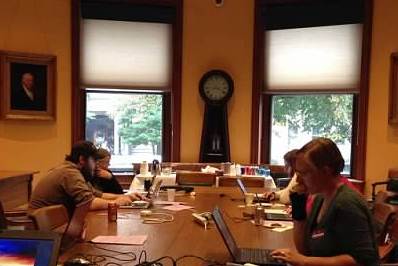
On Tuesday, 22 October, the MHS held a Wikipedia edit-a-thon as part of the Open Access Week 2013. The goal of the MHS edit-a-thon was to create and/or improve Wikipedia articles related to philanthropy and philanthropists in Massachusetts in the 19th century. The MHS’s first foray into the edit-a-thon world attracted a small but very enthusiastic crowd of aspiring Wikipedia editors.  

Adam Hyland, a developer with Bocoup in Boston, presented an introduction to Wikipedia. He explained the Five Pillars of Wikipedia to the newest Wikipedians, emphasizing that anyone can edit Wikipedia! He also encouraged the group to start with small edits to familiarize themselves with the Wiki markup language. Adam’s passion, wit, and knowledge clearly energized the session and gave the new editors confidence. 


During the MHS session, the Wikipedians made minor text edits and added links to several articles, including Timeline of Boston history, Forbes family, Massachusetts Humane Society, and Charitable Irish Society of Boston. A new page was created for the Massachusetts Society for Promoting Agriculture. You can view the results from our event page. By the end of the session, the group had successfully edited several pages pertaining to Massachusetts philanthropic history during the 19th century and the MHS staff and volunteer editors had an excellent adventure in Wikipedia editing. 

Interested?  The MHS hopes to hold future Wikipedia events to encourage the use of our collections and the sharing of information! Stay tuned for more information.


Stephen Greenleaf Bulfinch, Post 26

By Elaine Grublin

The following excerpt is from the diary of Stephen Greenleaf Bulfinch.

Sunday Oct. 4th, 1863

“Of public news, the battle near Chattanooga, & in which my relative Major Sidney Coolidge, and my friend S. Hall’s son Henry were wounded, – The favorable news from England, – and the arrival of a Russian fleet at New York, where it is warmly welcomed, are the chief items. The first is unfavorable, but on the whole, our country’s cause seems advancing, thanks be to God!”

This Week @ MHS

By Dan Hinchen

This week at the Society we have three events for public consumption, consisting of a tour, a seminar, and plenty of furniture.

Starting on Wednesday, 23 October, the MHS plays host to another public program that is part of the Massachusetts Furniture Series. Beginning at 6:00PM, “‘Newest Fashion’ Furniture in Boston, 1690-1730: A Transatlantic View,” is a program that explores how the influx of English cabinetmakers an chairmakers and the fashionable desires of a new Boston elite combined to transform the furniture trade in Boston in the period after the establishment of the new Charter in 1691. The talk is presented by Edward S. Cooke, Jr., the Charles F. Montgomery Professor of American Decorative Arts in the Department of the History of Art at Yale University, who has published extensively on both historical and contemporary furniture and was a former curator at the Museum of Fine Arts, Boston, and taught at Boston University. There is a pre-talk reception at 5:30PM. Registration is required for this event and tickets are $10 per person (no charge for Fellows and Members). Please call 617-646-0560 or register online by clicking here.

And on Thursday, 24 October, join us for the next in the Biography Seminar series. “Telling Lives: Megan Marshall Interviews George E. Vaillant about the Harvard Graduate Study” will begin at 5:30PM and is free and open to the public. For more than three years, Vaillant, of the Harvard Medical School, directed the longitudinal study known as the Harvard Grant Study. His recent book, Triumphs of Experience, traces the men’s lives into their nineties. Marshall’s interview will look at the art of writing case studies and the implications for biographers of his finding on human development through the life course. RSVP required for this seminar. Subscribe to receive advance copies of the seminar papers.

Finally, on Saturday, 26 October, stop by at 10:00AM for The History and Collections of the MHS. This 90-minute, docent-led tour exposes visitors to all of the public space in the building at 1154 Boylston St., touching on the art, architecture, history, and collections of the Massachusetts Historical Society. The tour is free and open to the public. No reservation is required for individuals or small groups. Parties of 8 or more should contact the MHS prior to attending a tour. For more information please contact Curator of Art Anne Bentley at 617-646-0508 or abentley@masshist.org.

And do not forget that we currently have a major exhibition on display, “The Cabinetmaker & the Carver:Boston Furniture from Private Collections.” The exhibit is open to the public six days per week, Monday-Saturday, 10:00AM-4:00PM. Visit fourcenturies.org to see more information about the major collaboration of which this exhibition is a part.

Wikipedia Edit-a-thon at the MHS

By Anna Clutterbuck-Cook

Have you ever wondered who adds the references to Wikipedia articles? The answer is YOU!

Join us on Tuesday, 22 October 2013 from 2:00 PM to 6:30 PM for a Wikipedia Edit-a-thon! The MHS is hosting a Wikipedia Edit-a-thon to edit Wikipedia articles using our materials on philanthropy and philanthropists in 19th-century Boston. This event is part of the week-long Open Access to Massachusetts History 2013.

1154 Boylston Street

The event will include a short how-to on Wikipedia basics, a behind-the-scenes tour of the Society and refreshments. If you are new to Wikipedia editing or an experienced Wikipedian, all are welcome! Just bring your laptop, power cord, a government-issued ID, and a ready mind. Learn more about the event and RSVP