This Week @ MHS

By Dan Hinchen

Calling all graduate students! 

Are you studying American history or some other related subject? Are you interested in meeting fellow students and faculty members who work in your field? Then consider attending a special Graduate Student Reception at the Massachusetts Historical Society this week. Beginning at 6:00PM on Thursday, 18 September, this event is a great way to network with your peers in the area, tour our historic building at 1154 Boylston Street, and to learn about the range of resources available to support your work, including MHS fellowship programs. This event is free for graduate students and faculty members, though RSVP required by September 17. Email kviens@masshist.org or phone 617-646-0568 with your name and affiliation. Indicate whether you are a graduate student or faculty member. We hope to see you there!

Also at the Society this week, we continue our exhibition of World War I photographs, letters and memorabilia with “Letters and Photographs from the Battle Country: Massachusetts Women in World War I.” As always, the exhibit is open Monday – Saturday, 10:00AM – 4:00PM, free of charge. And on Saturday, 20 September, stop by at 10:00AM for “The History and Collections of the MHS,” a free 90-minute tour of the Society’s building. The tour is free and open to the public. No reservation is required for individuals or small groups. Parties of 8 or more should contact the MHS prior to attending a tour. For more information please contact Curator of Art Anne Bentley at 617-646-0508 orabentley@masshist.org.


The Western Front Recedes: The St Mihiel Operation

By Dan Hinchen

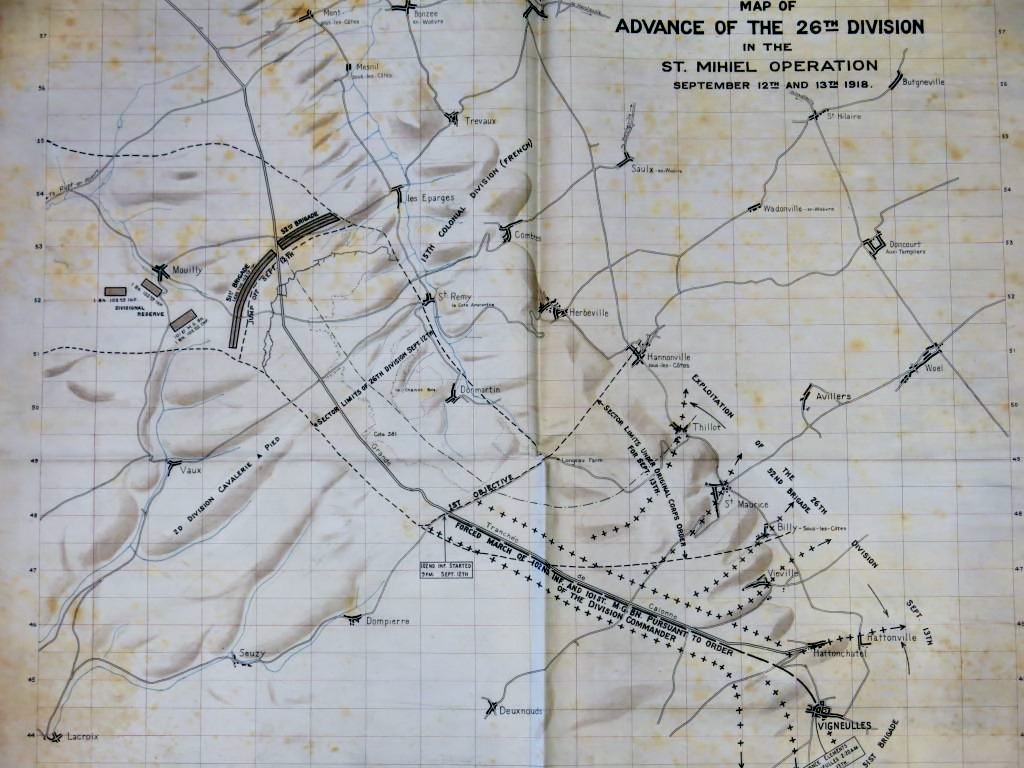
In the autumn of 1918, the Great War in Europe was nearing its termination after four years of fighting. Beginning in August of that year, the Allies launched what became known as the Hundred Days Offensive, a series of attacks against the Central Powers which pushed the Western Front and the German lines out of France and, ultimately, resulted in an armistice. One such two-day offensive occurred near the French town of St. Mihiel on 12-13 September. The action was carried out by the 26th Infantry Division under the command of Maj. Gen. Clarence R. Edwards.


The 26th was formed by Edwards in the summer of 1917 and the first units of the Yankee Division sailed in September, “the first fully formed American division in France.” Over the next several months the division undertook training in France with their English and French counterparts so that they could acclimate to life in trenches and amidst hostile fire.

Fast forward to September 1918. Edwards and his division were in the area of St. Mihiel as a result of several months of fighting on the move in the northeast of France. Despite the rain and mud that slowed down some units from reaching their start line the night before the offensive, “the attack came off without any major hitch, following a tremendous artillery barrage during the early morning hours of September 12, 1918.”

Here at the Society are the Clarence Ransom Edwards papers, within which are several reports providing details about the operations performed by the 26th Division. One intelligence report, dated September 11 to September 12th, 1918, 16 o’clock to 16 o’clock, states that

The enemy, surprised by our attack, and with all communication to the rear out by our artillery fire, offered what resistance he could during the day, chiefly with his machine guns. In the open country the resistance was very weak. In the woods his machine gun nests proved fairly effective. The first day’s objective was reached before 22 o’clock.

These intelligence summaries, along with correspondence, memoranda, and other materials in the Edwards papers provide detailed insight into some of the operations of the “war to end all wars” and also highlight some of the personal drama between Edwards and his military colleagues. If you would like to learn more, visit the MHS library and see them for yourself!


-Shay, Michael E., Revered Commander, Maligned General: The Life of Clarence Ransom Edwards, 1859-1931. Columbia: University of Missouri Press, c.2011.


This Week @ MHS

By Dan Hinchen

It seems that summer is trying to reassert itself here in September but it is quiet and cool at the MHS. There is but one public program on the calendar this week in the form of a Brown Bag lunch talk on Wednesday, 10 September. Come by at noon for “Sculpting the Citizen Soldier: Civil War Memory and the Life Cycle of Monuments,” presented by short-term research fellow Sarah Beetham, University of Delaware. In this talk, Dr. Beetham will explore how Civil War citizen soldier monuments have factored into community life in the century and a half since the war’s end. Soldier monuments have been interpreted and interpreted, vandalized and hit by cars, amended and moved to new locations. How do these interventions affect our understanding of post-Civil War memory? This talk is open to the public free of charge. 

There is also a free tour this week on Saturday, 13 September, starting at 10:00AM. “The History and Collections of the MHS” is a 90-minute, docent-led tour that allows visitors to see all of the public spaces at the Society while learning about the art, architecture, history, and collections in the building at 1154 Boylston. The tour is free and open to the public with no reservations required for individuals or small groups. However, groups of 8 or more should contact the MHS before attending the tour. For more information, please contact Curator of Art Anne Bentley at 617-646-0508 or abentley@masshist.org

And while this September is pretty quiet here at the MHS, seminar season is nearly upon us. Be sure to keep an eye on the online events calendar to see all of the public events on tap later this month and into October. 


“Signed, sealed and delivered”: The Treaty that Ended the Revolutionary War

By Amanda A. Mathews, Adams Papers


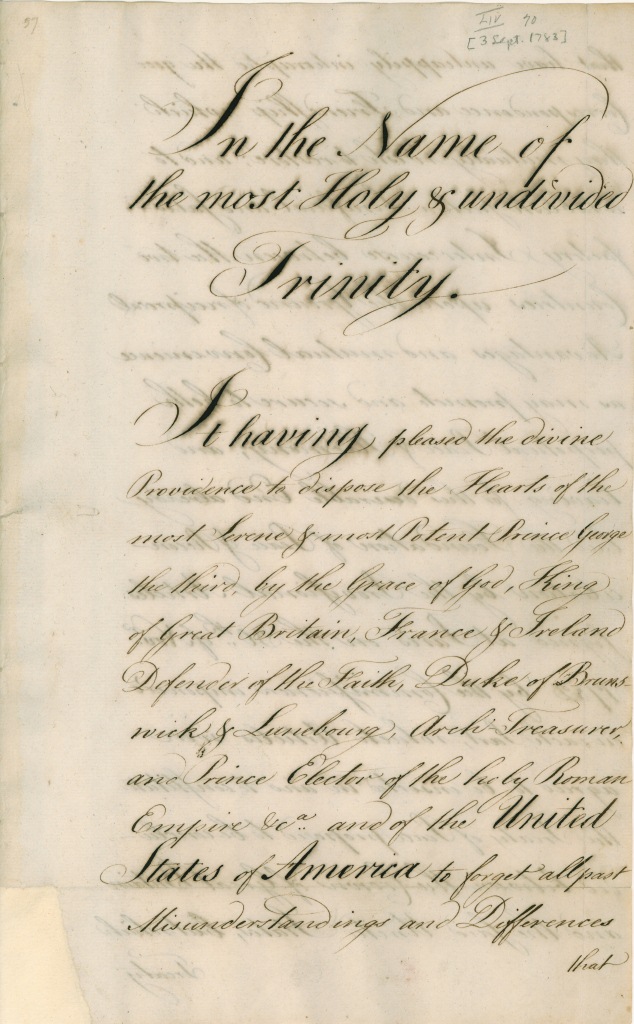
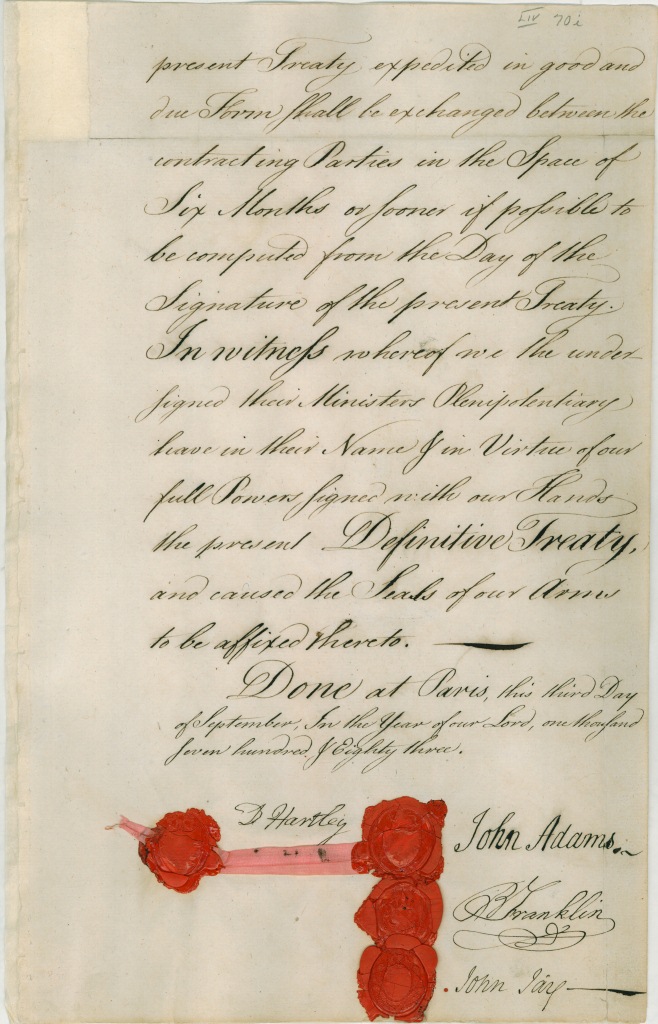
“On Wednesday the third day of this Month, the American Ministers met the British Minister at his Lodgings at the Hôtel de York, and signed, sealed and delivered the Definitive Treaty of Peace between the United States of America and the King of Great Britain.” John Adams reported this news to the President of Congress on September 5, 1783 and congratulated Congress on the “Completion of the work of Peace.”

It was eight o’clock in the morning when John Adams along with Benjamin Franklin and John Jay, met the British peace negotiator, David Hartley, at his residence in Paris and months of negotiations, first the previous year leading to the preliminary peace treaty, and then in earnest from April until the end of August culminated in this definitive treaty.

While this was no doubt a significant moment—after all, eight long years of war were officially ending with complete American independence—the signing was more of an anticlimax for Adams. His immediate feelings, as he revealed to Abigail the following day, were that as the definitive treaty was no more than “a Simple Repetition of the provisional Treaty,” they had “negotiated here, these Six Months for nothing.” Nevertheless, Adams understood that given the political realities of their position relative to Great Britain, “We could do no better Situated as We were.”

The key provisions of the Treaty of Paris guaranteed both nations access to the Mississippi River, defined the boundaries of the United States, called for the British surrender of all posts within U.S. territory, required payment of all debts contracted before the war, and an end to all retaliatory measures against loyalists and their property. Throughout John Adams’s term as minister to Great Britain in the 1780s, he and the British foreign secretary, the Marquis of Carmarthen, regularly discussed the actions each side saw as breaches of and a failure to fulfill the treaty—a debate that went unresolved until the signing of the Jay Treaty in 1794.

When editors at the Adams Papers Editorial Project are asked to name our favorite document in the immense collection that is the Adams Family Papers, John Adams’s copy of the Treaty of Paris, is certainly a top choice. This duplicate original in the Adams Papers is the only original not in a government archive. One can easily imagine that the legal- and legacy-minded John Adams was keen to retain a copy of this founding document over which he had so long toiled so far from his home for his posterity. Of particular interest are the seals—as there was no official seal for the American commissioners to use, each used whatever was convenient to him. See here for a full discussion of the Boylston family coat of arms, which Adams used as his seal on both the preliminary and definitive treaty and for more on Adams’s thoughts at the conclusion see the newly launched digital edition of Papers of John Adams, volume 15.

Image: First and last pages of the Definitive Peace Treaty between the United States and Great Britain (Treaty of Paris), September 3, 1783, Adams Family Papers.

This Week @ MHS

By Dan Hinchen

**Please note that the Society is closed on Monday, 1 September, in observance of Labor Day.**

September is upon us and it makes its appearance quietly as we begin the month with a holiday closure. The only main item of note this week on the calendar is a Brown Bag lunch talk on Wednesday, 3 September. Come by the MHS at noon for “Unspeakable Loss: North America’s Invisible Throat Distemper Epidemic of 1735-1765,” presented by Nicholad Bonneau, University of Notre Dame. While the New England throat distemper epidemic never achieved the notoriety acquired by other more notorious diseases of the colonial era, no single epidemic of that period proved more deadly to European settlers. This project asks why this epidemic escaped comment by contemporaries and past historians while raising interpretive questions informing our larger views of change, the priority of documentation, and the role of memory. This talk is free and open to the public so pack a lunch and come on by! 

And remember that on most Saturdays, including 6 September, you can visit the Society for a free tour. The History and Collections of the MHS is a 90-minute docent-led tour that explores all of the public spaces in the Society’s home.. This event is free and open to the public and begins at 10:00AM. And while you are here for the tour you can also view our current exhibition, “Letters and Photographs from the Battle Country: Massachusetts Women in World War I,” open Monday-Saturday, 10:00AM-4:00PM.

**Library Hours Changing! Effective 1 September, the library is no longer open late on Tuesday evenings. New hours for the library are Mon-Fri, 9:00AM-4:45PM, and Saturday, 9:00AM-4:00PM.**


Library Hours Changing

By Elaine Heavey, Reader Services

I write with sadness that as of 1 September 2014 the MHS library is reducing its hours, eliminating the extended hours on Tuesday evenings.  The new library hours will be:

Monday through Friday – 9:00 AM to 4:45 PM
Saturday – 9:00 AM to 4:00 PM

Unfortunately the reduction in hours was necessary. Once this became evident, many staff members looked at library use patterns to determine where cuts could best be made.  Over the years, especially since reinstating Saturday hours in the spring of 2008, evening use had steadily declined. That is not to say that we do not appreciate that this change will impact researchers – especially those visiting from great distances and those that enjoyed using the library until minutes before attending a Tuesday evening seminar. But it does mean that based on current use patterns, it is hoped that eliminating the evening hours would have the least impact on our researchers. In other words, the lesser of two evils. 

This morning, as I checked the MHS website, the outgoing phone messages, and library handouts to ensure that our hours had been updated in all the necessary places, I began to think about how an era was ending.  When I first started at the MHS in 2006 evening hours were a well-established part of the library schedule.  I knew we had switched the hours from Thursdays to Tuesdays a few years back (with almost no change in use statistics with that move), but as I began to wax nostalgic, I got to wondering just how long the MHS library had been offering evening hours to researchers. 

I went to the reference shelf and grabbed a box containing back issues of Miscellany, the MHS newsletter, and began browsing for notices of library hours. The first issue in the box I selected was dated 1990. I discovered that at that time the MHS was open Monday through Friday 9:00 AM to 4:45 PM.  Those hours did not change until June 1997 when Saturday hours (9:00 AM to 1:00 PM) were added.  I was surprised to learn that it was not until September 2001 that the Thursday evening hours (through 8:00 PM) were added.  And they were added as the Saturday hours were eliminated, hoping that the evenings would see greater readership. 

So as we say adieu to our evening hours, and offer researchers three less hours per week to explore our collections, I am happy to say that we are still offering Saturday hours, which on its second go-round was amazingly successful,** and that the MHS library continues to offer more operating hours than it did throughout most of the 20th century. 


**Perhaps being open until 4:00 PM allows weekend researchers to sleep in a bit on their Saturday morning and still feel they can have a worthwhile research day.


Stephen Greenleaf Bulfinch Diary, Post 35

By Elaine Heavey, Reader Services

The following excerpt is from the diary of Stephen Greenleaf Bulfinch.

Tuesday, Aug. 7th, 1864

Thursday was a day of fasting for our national afflictions; – a day of thanksgiving too to the community for a blessed rain the day before after an unexampled drought.

Tuesday, Aug. 28th

Uncertain rumors of peace negotiations, & political arrangements, are the order of the day. Democ. Convention to nominate candidate meets tomorrow at Chicago.

This Week @ MHS

By Dan Hinchen

There are no events scheduled for this, the last week of August, but you can still come in any time, 10:00AM-4:00PM, to see our current exhibition. Please be sure to keep an eye on our online events calendar to start planning your visits for September! 

**The Society is closed on Saturday, 30 August, and Monday, 1 September, in observance of Labor Day. Normal hours resume on Tuesday, 2 September. Enjoy the long weekend!

Marion Learns About the Family: Sexuality Education in the 1930s (Part One)

By Anna J. Clutterbuck-Cook, Reader Services

Wearing my historian hat, I am interested in the ways in which twentieth-century Americans made sense of shifting sexual and gender practices. The mainstream media often figures conflict over sexual morality as fallout from the post-Sixties “culture wars,” feminist activism and backlash, and the rising visibility of queer citizens. In actuality, American anxiety over — and enthusiasm for adopting — modern family and relationship practices can be traced back to at least the Progressive Era.

These anxieties often manifested themselves, much as they do today, through adult debates over what youth should know about human sexuality and when they should know it. By 1929, adult fears about discussing sex with young people were familiar enough that satirists E.B. White and James Thurber devoted a whole chapter of their book Is Sex Necessary?: or, Why You Feel the Way You Feel to the question of “What Should Children Tell Their Parents?”:

If young folks lack the tact of intelligence requisite to enlightening their parents, the task should be intrusted to someone else. Yet it is hard to say to whom. A child should think twice before sending his father around to the public school to secure sex information … women teachers, to borrow a phrase, are apt to be ’emotionally illiterate.’

Here in the Massachusetts Historical Society we can find evidence of the lessons teens have been taught throughout the past two centuries regarding sexual health and sexual relationships. Within the Frank Irving Howe, Jr. Family Papers, for example, we find course materials for a class on “The Family,” offered at Walpole (Mass.) High School during the 1934-1935 academic year — a few years after Is Sex Necessary? went to print. The class was attended by high school senior Marion Howe, whose Thurber-like doodles offer visual commentary on the curriculum’s typescript pages.

“The Family” is perhaps best understood as a course on the sociology of family life. It is part premarital counseling, part anthropological study. Readings — drawn from religious pamphlets, sociological writings, and popular journalism — cover the various forms of marriage, divorce, religious views on family life, family planning, sexuality within and “without” marriage, homosexualty (“inversion”) and birth control. Absent from this 1930s “sex ed” curriculum is frank discussion of sexual hygiene, the mechanics of partnered sex, or discussion of sexual pleasure beyond such vague phrases as “the sex instinct” or “a sex experience.” Perhaps Thurber and White spoke from experience when they suggested youths should “think twice” before securing reliable information about human sexuality from public school teachers — at least those in Walpole, Massachusetts!

Many of the social issues outlined by curriculum’s introduction have a familiar, if slightly fusty, ring to them. “The problems of sex and the family are more acute and more wide-spread today,” the anonymous author begins, observing an “increased desire for freedom without an accompanying sense of responsibility.” Shifts in social order, including the industrial revolution, “has made marriage an economic liability instead of an asset for the man … [and] no longer the only career open” to women. Prolonged education leads to postponed marriage, while contraception “eliminates the fear of offspring.” As in the twenty-first century, feminism is criticized for encouraging bad behavior among women: “Many women [today] are making the single standard the low one practiced by many men.”


In other sections, the rhetoric of 1935 stands in stark contrast to what would be socially acceptable to articulate in a mainstream sexuality textbook today. Consider the following passage on family planning: 

The question of the right of couples to remain childless involves the question of the desirability of race survival and the obligation of desirable potential parents to assume their share of the burden… With the rapid increase of undesirable human stock and the rapid depletion of desirable stock, an obligation certainly rests on those who have valuable biological and environmental contributions to make. The choice between single blessedness and a home with children cannot be settled altogether on a personal basis.

While such racialized fears and negative stereotypes about non-parenting couples still inform debates about family policy and morality today, the language of “undesirable human stock” and “the burden” of “race survival” used earnestly within a public school curriculum suggest how acceptable expression of anxieties change over time, even if the anxiety itself remains alive and well.

What did eighteen-year-old Marion Howe make of her education in “the family”? In part two of this story, we will endeavor to answer that question by cracking open her diary. Kept intermittently between 1934-1937, the volumes document her social activities and academic studies during her final year of school, as well as her first marriage (1936-1941) and the birth of her first child in 1937. Stay tuned!

The Mysteries of the Elisha W. Smith, Jr. Logbook, 1853-1857: Part I

By Andrea Cronin, Reader Services

Several questions burn brightly in my mind when I look through the Elisha W. Smith, Jr. logbook,1853-1857. If curiosity is a wildfire, this particular logbook sets me aflame in that it contains not one but two ship logs and a scrapbook. Elisha W. Smith, Jr., son of Elisha W. Smith and Ruth A. Smith of Wellfleet, Mass., served as a mariner and log keeper for the schooner Flying Dragon in 1853 and the schooner William Freeman in 1857. While these voyages are by no means uninteresting, the myriad mysteries surrounding the physical logbook and its various chroniclers captivate my attention. I will unveil three mysteries I uncovered within this logbook in a series of blog posts.

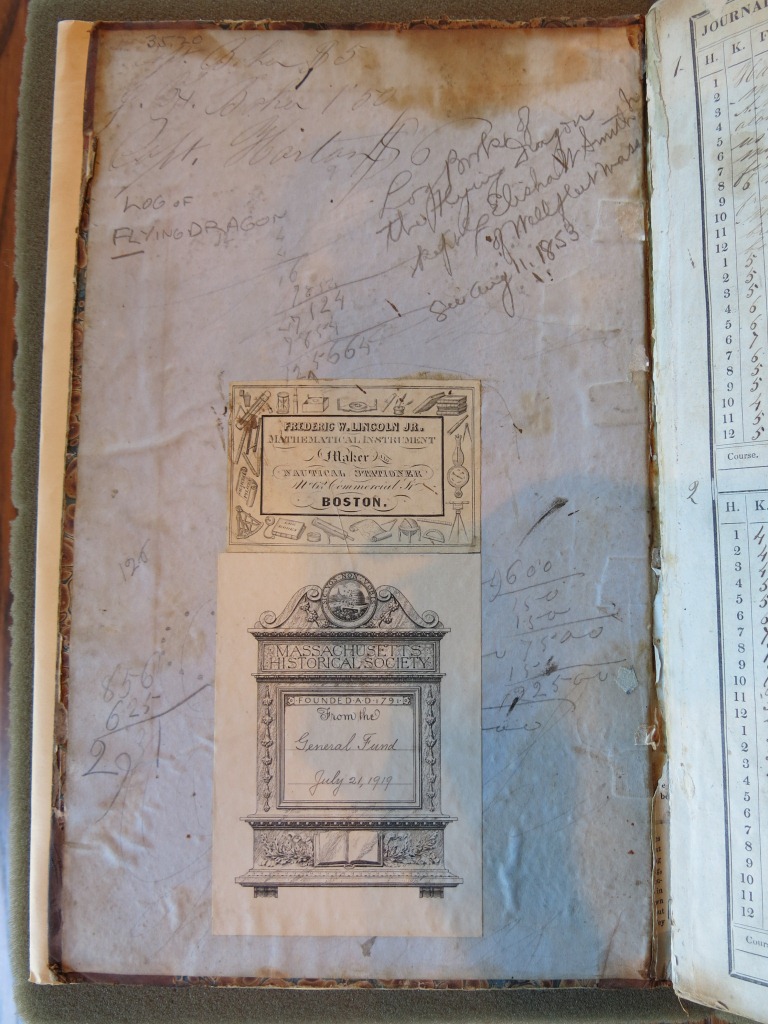
Inside cover of the Elisha W. Smith Jr. Logbook, 1853-1857

The inside cover of the logbook resembles a communal notebook. The cover contains not only the book plates of the MHS General Fund dated 21 July 1919 but also the book plate of nautical stationer Frederick W. Lincoln, Jr. There are several penciled accounting notes as well one fading inked note, but more interesting to me is this message in the top right corner written by a distinctly different hand: “Log book of the Flying Dragon kept by Elisha W. Smith Jr of Wellfleet, Mass. See Aug 11, 1853”.

Immediately I questioned the “see” note. What was important about this particular date in the logbook of the schooner Flying Dragon? The voyage of the Flying Dragon from Boston to San Francisco commenced on 22 July 1853. The log does not, however, confirm that the schooner found safe harbor in San Francisco. The last entry dated 29 September 1853 describes a “Hurricane” during the passage around Cape Horn. The log entry of 11 August 1853 reads:

Commences with light
winds & clear weather
2 P.M. tacked to the East-
ward 6 P.M. furled main
skysail 11 P.M. furled
Royals.
—————————————-

12 might tight
baffling winds, with
heavy rain squalls.
—————————————-

7 A.M. made all sail
This day ends with light
winds & cloudy weather
All draging sail set
by the wind
No Observation.
Elisha W. Smith jr

A brief glance through the pages of the log confirmed that this entry contains the first date on which the log keeper signed his name. The note on the inside cover refers to this entry by date as proof that the log belongs to Elisha W. Smith, Jr. The mystery of the cover note is solved!

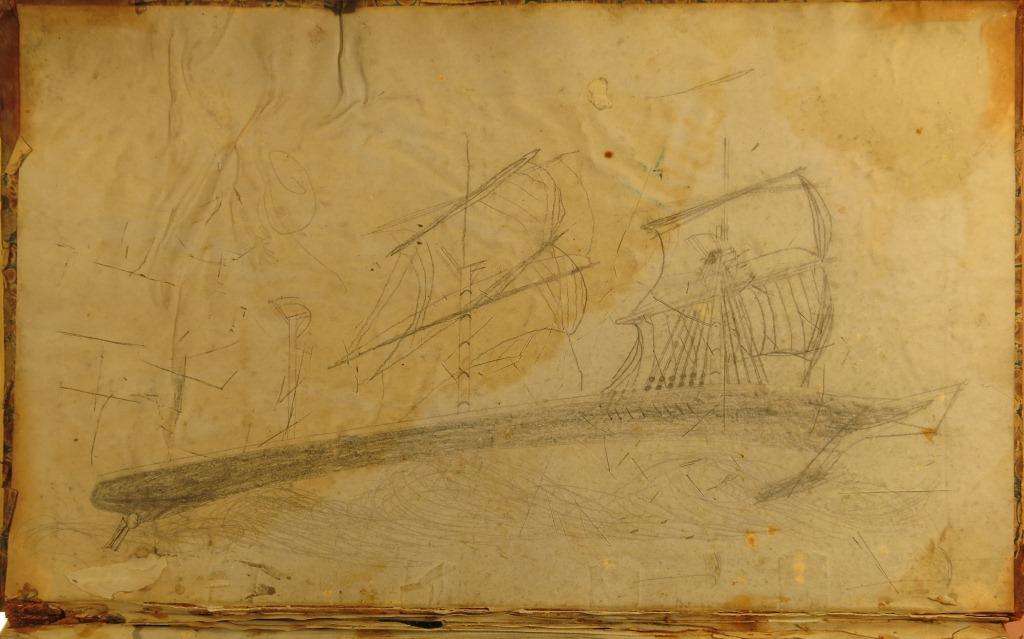
However, I wonder who wrote this particular note. Did a member of the succeeding Smith family write it? Was it inscribed on the logbook by an MHS staff member in 1919? The logbook holds such a curious mix of ship logs, sketches, printed poems, engravings, and literary clippings. Here is a sketch of a ship on the back inside cover. In the next post in this series, I will discuss these sketches, poems, engravings, and literary clippings included within the log. Stay tuned!

Back cover of the Elisha W. Smith Jr. Logbook, 1853-1857