
New and Improved: The Tufts Family Logbooks

By Susan Martin, Processing Archivist & EAD Coordinator

My work as a processing archivist here at the Massachusetts Historical Society involves not only cataloging new manuscript collections, but also improving descriptions and access for collections that have been sitting on our shelves for some time. Case in point: the Tufts family papers, which was recently brought to my attention by Laura Wulf, the MHS’s photographic and digital imaging specialist. While working on digital images from that collection, she noticed an oversight in our online catalog ABIGAIL.

The collection consists of correspondence, diaries, logbooks, and other papers of the notable Tufts family of Charlestown, Mass. Included are two logbooks dating from the mid-1850s, kept by brothers George and Alfred Tufts. Normally, logbooks that are part of a larger collection are individually cataloged to allow for more detailed subject access. As Laura discovered, Alfred’s had been cataloged, but George’s was nowhere to be found.
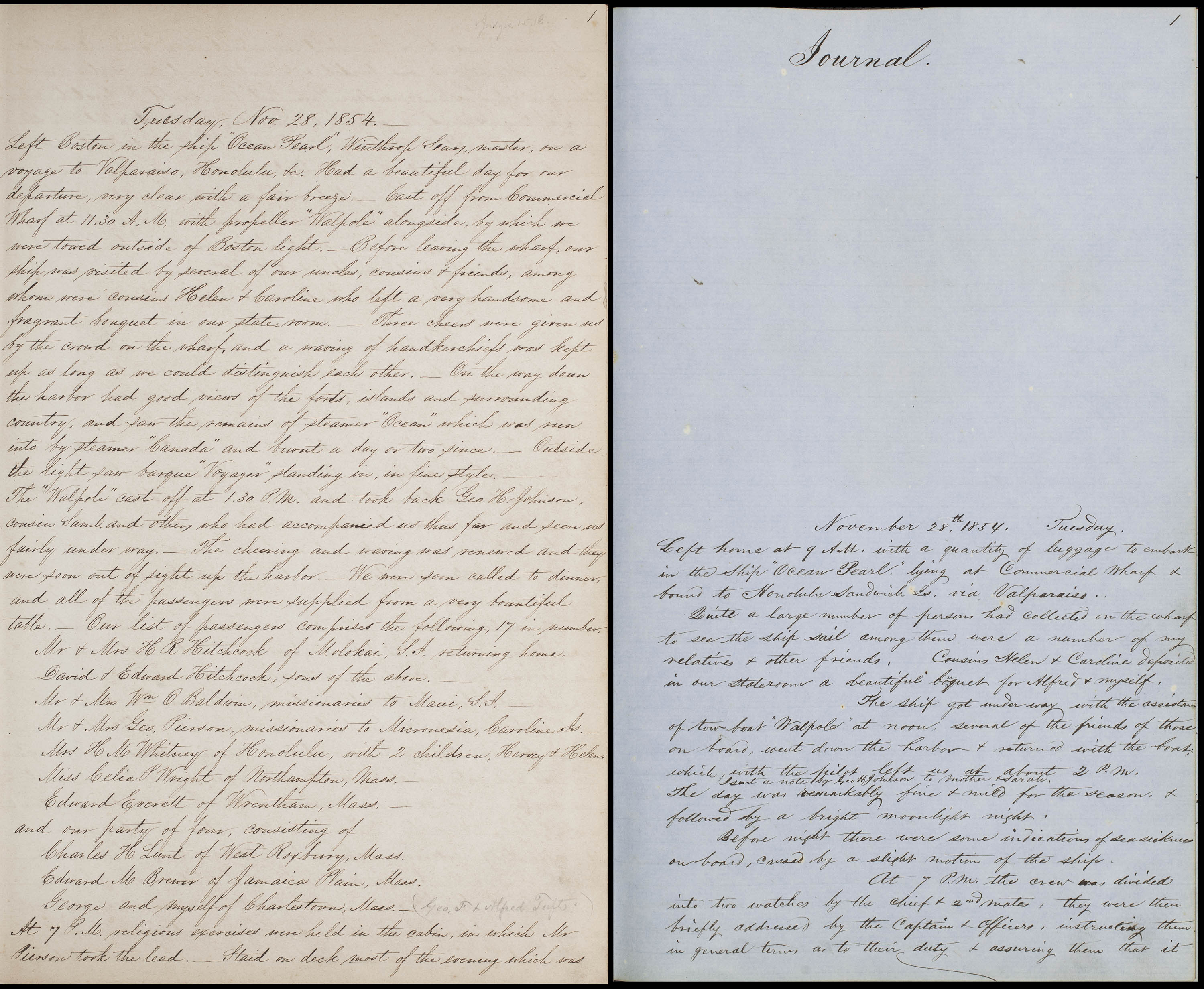
The oversight was understandable—the brothers were actually traveling together on the same ship, the Ocean Pearl, and it’s pretty easy to make a mistake about who kept which volume if you don’t have time to examine them closely. But George deserved his due, and I was sorry to see him overshadowed by his younger brother like that! So the first thing I did was create a new, separate catalog record for his log.

I enjoy doing this kind of clean-up, not only because it makes our catalog more useful and our collections more discoverable for researchers, but also because it gives me the opportunity to add more detail to ABIGAIL and to familiarize myself with our older collections. The Tufts family papers were donated to the MHS back in 1962, and I don’t think I’ve ever had reason to look at them before. It’s a really fun and interesting collection.

In their logbooks, George and Alfred kept the usual navigational records—longitude, latitude, wind, course, temperature, etc.—but they didn’t stop there. The logs are also journals, fleshed out with long-form descriptions of daily life on a ship, including who got seasick (George), who lost his hat overboard (Alfred), who got drenched (pretty much everybody at some point), what Mr. and Mrs. Baldwin were arguing about (the window shutter), and what was really going on between Capt. Sears and Mrs. Whitney (who knows?). The two volumes complement each other; the brothers recount the same events, often in very similar language, although Alfred’s entries tend to be longer. Both logs also contain sketches of icebergs, islands, and other sights.

The Ocean Pearl sailed from Boston on 28 November 1854, around Cape Horn at the southern tip of South America, and landed at Honolulu, Hawaii. There, it turns out, the brothers split up—Alfred continued on the Ocean Pearl to the Far East, but George stayed in Hawaii for six months, where he wrote terrific descriptions of the islands’ natural and cultural wonders. On 26 September 1855, George embarked for San Francisco, overlapping with the tail end of the California Gold Rush, then sailed across the Pacific to Hong Kong and other points in Asia. Adding insult to injury, these voyages had been mistakenly attributed to Alfred, too!

After straightening out the catalog records for both logbooks, I noticed the collection contained another journal kept by George in 1850. On closer inspection, I found it described a trip up the Mississippi and Ohio Rivers via steamboat, so I added some detail to that catalog record, as well. Like the logbooks, there’s a lot more to this volume than meets the eye. For example, here’s one of George’s entries from June of that year:

In the afternoon went in a canoe to Crow wing village 6 miles below St Paul. I had seen the indians among the whites, but here they were by themselves on their own soil doing things in their own way. When I arrived at the village they had just been dancing the scalp dance, over the scalps they had taken this spring from the Chippeways. When the scalps were taken they made a mark on the knee & are to dance every other day till the grass gets to that height. A group of them were sitting on the ground playing a game with moccasins accompanied with singing, drumming & yelling with “variations.” I heard their noise when two miles from the place. Their burial ground is on a hill back of the town. The bodies are mounted on a scaffold with the articles used by the deceased in his life time hanging about it. Also the clothing & locks of hair. They leave them in this way about 6 weeks & then bury them.

High-quality digital images of the Ocean Pearl logbooks of George and Alfred Tufts, as well as material from related collections at the MHS and other repositories, are available as part of the China, America and the Pacific online resource, published by Adam Matthew Digital. You’ll have to visit our library in person (or another participating library) to use this subscription database, and we hope you will. If you have questions about any of our collections, please don’t hesitate to contact our reference staff.
The First Publication of Phillis Wheatley

By Daniel T Hinchen, Reader Services

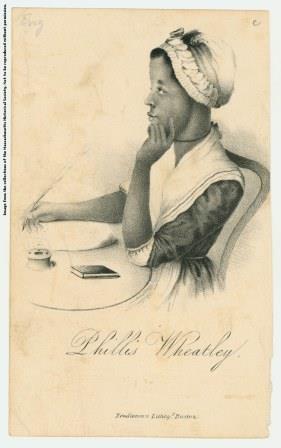
Recently, the MHS hosted a program called “No more, America,”* which featured a conversation with Henry Louis Gates Jr. and Peter Galison, both of Harvard University. In it, the two men reimagined a 1773 debate between graduating Harvard seniors Theodore Parsons and Eliphalet Pearson who deliberated on the compatibility of slavery and “natural law.” In the program, Gates and Galison added a third contemporary voice to the argument, that of the then-enslaved Phillis Wheatley, the acclaimed poet who lived just over the Charles River from the two Harvard students.

Now, just over a week later, we recognize the anniversary of the first publication of one of Wheatley’s poems. “On Messrs. Hussey and Coffin” appeared on December 21, 1767, in the Newport Mercury, a Rhode Island weekly newspaper. According to Vincent Carretta in his 2011 biography of Wheatley, this poem was not published again during Wheatley’s lifetime.

When Wheatley submitted her poem to the Newport Mercury, she addressed a note to the printer which was to precede the poem.

Please to insert the following Lines, composed by a Negro Girl (belonging to one Mr. Wheatley of Boston) on the following Occasion, viz. Messrs Hussey and Coffin, as undermentioned, belonging to Nantucket, being bound from thence to Boston, narrowly escaped being cast away on Cape-Cod, in one of the late Storms; upon their Arrival, being at Mr. Wheatley’s, and, while at Dinner, told of their narrow Escape, this Negro Girl at the same Time ‘tending Table, heard the Relation, from which she composed the following verses.

On Messrs. Hussey and Coffin

Did Fear and Danger so perplex your Mind,

As made you fearful of the Whistling Wind?

Was it not Boreas knit his angry Brow

Against ? or did Consideration bow?

To lend you Aid, did not his Winds combine?

To stop your passage with a churlish Line,

Did haughty Eolus with Contempt look down

With Aspect windy, and a study’d Frown?

Regard them not; — the Great Supreme, the Wise,

Intends for something hidden from our Eyes.

Suppose the groundless Gulph had snatch’d away

Hussey and Coffin to the raging Sea;

Where wou’d they go? Where wou’d be their Abode?

With the Supreme and independent God,

Or made their Beds down in the Shades below,

Where neither Pleasure nor Conten can flow.

To Heaven their Souls with eager Raptures soar,

Enjoy the Bliss of him they wou’d adore.

Had the soft gliding Streams of Grace been near,

Some favourite Hope their fainting hearts to cheer,

Doubtless the Fear of Danger far had fled:

No more repeated Victory crown their Heads.

To see what materials the MHS holds related to Phillis Wheatley’s life and work, you can search our online catalog, ABIGAIL, then consider Visiting the Library, but be sure to consult our online calendar for upcoming holiday closures.

*Watch a recording of the event that took place at the MHS on 12 December 2018.


References

Carretta, Vincent, Phillis Wheatley: Biography of a Genius in Bondage, University of Georgia Press, 2011.

Christmas 1918

By Rakashi Chand, Reader Services

Christmas of 1918 should have been jubilant–the war was over, soldiers were starting to come home and women were on the verge of gaining suffrage. But sadly, dark shadows loomed over festivities and revelry that year, as the aftermath of the war and the widespread Influenza and tuberculosis left hundreds of thousands dead, sick or wounded. The Nation’s central relief organization was the American Red Cross, which desperately needed funding, so they launched a membership drive called the ‘Christmas Roll Call’ from 16 through 23 December, 1918.

“When the United States entered the World War the people appointed the Red Cross as its steward to minister to the wants of human beings in distress whenever aid and succor were needed.

… This is in brief the service work of the Red Cross expressed in unemotional statistics. The real work of aiding suffering humanity, of nursing the ill, and ministering to those in want – the service of relieving the worries of our men overseas- the thousand and one things done in a day’s work- all that can not be told in numerals.

But to continue this work for humanity, to serve as steward for the American people, will require the united support of all Americans. With this end in view, the Red Cross will hold it’s second annual Christmas Roll call during the week of December 16 to 23rd, when it is hoped that every one will renew the nation-wide pledge of last year to uphold the flag – a vow taken by 22,000,000 million adults and 8,000,000 children.

Some day, and that day seems near at hand, the world will wish to spend as much effort and gold for the prevention of war as it does now for the amelioration of its infinite ills. At this hour, however, the American Red Cross is the sacrament oT the nations, the visible expression of the mother-heart of the race, the beacon and the hope of the world’s wounded and storm-tossed everywhere. Membership in the American Red Cross defines and honors the members and scatters healing where healing is sorely needed.” said the Advocate of Peace in December of 1918.

The Broadsides created to promote the ‘Christmas Roll Call’ or Membership drive of 1918 are some of the most beautiful pieces of 20th century ephemera. The MHS houses some of the famous broadsides (or posters) created for the Roll Call. The posters’ popularity eclipsed the roll call itself–they are perhaps the most beautiful images ever associated with the Holiday Season. The artists that created these images were some of the best of the time, working pro-bono for the Red Cross effort, such as Harrison Fisher, who created a new stereotype for American woman as bold and beautiful, known as the “Fisher girls.

Christmas a century ago reminds us to be thankful for our blessings, and to continue to support those who work tirelessly to end suffering and alleviate pain, towards the betterment of all humans and life on this shared earth.

The MHS will be closed from 24 December through 1 January, but we welcome you to visit the Library during regular hour through Saturday, December 22nd to enjoy exploring our collections including our wonderful Ephemera collection of broadsides, posters and greeting cards.

A lovely day for a cup of Tea!

By Rakashi Chand, Reader Services

“This is the most magnificent Movement of all. There is a Dignity, a Majesty, a Sublimity, in this last Effort of the Patriots, that I greatly admire. The People should never rise, without doing something to be remembered — something notable And striking. This Destruction of the Tea is so bold, so daring, so firm, intrepid and inflexible, and it must have so important Consequences, and so lasting, that I cant but consider it as an Epocha in History.” (John Adams diary entry for 17 December 1773)

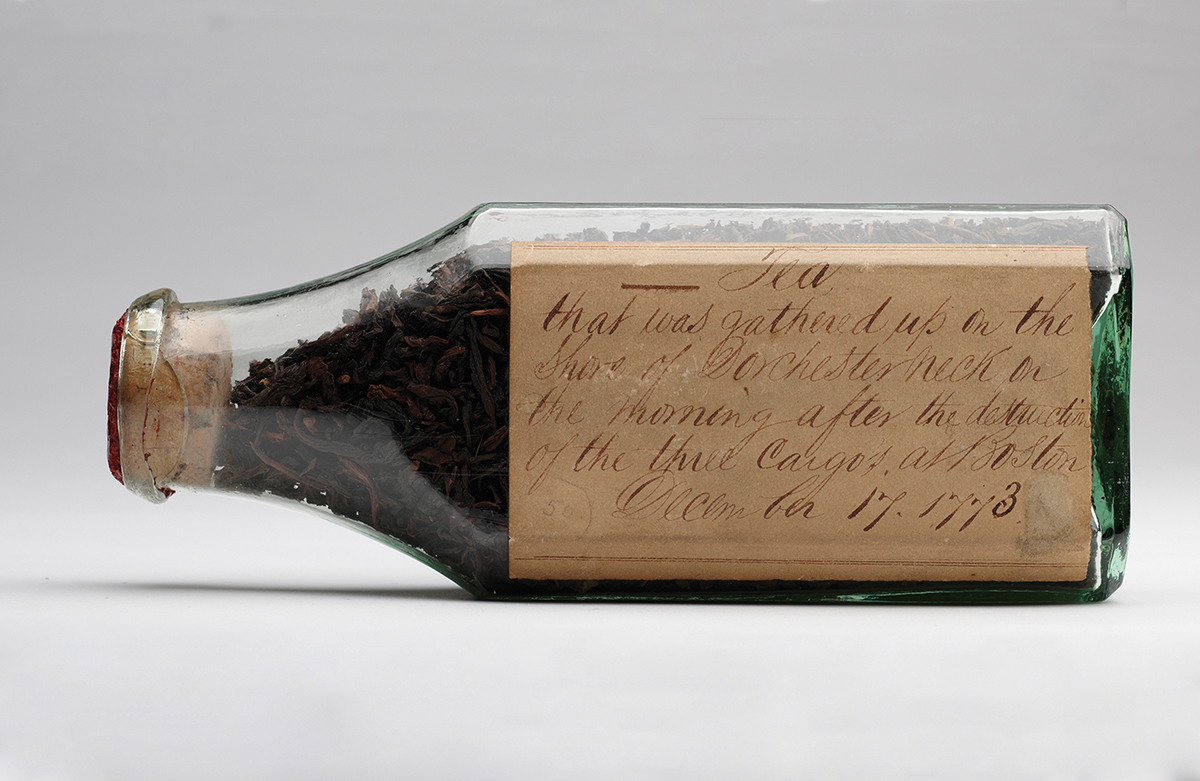
On this day, 245 years ago, tea leaves washed up on the shore of Dorchester Neck. Some of those tea leaves were collected and put into a glass bottle for safe keeping. Why? Because inhabitants of Boston were very proud of what they had brewing in the harbor the night before! Read about the events leading up to the Boston Tea Party at the Coming of the American Revolution: The Boston Tea Party.

Along with the tea leaves collected at Dorchester Neck, the MHS has 4 relics related to the Boston Tea Party inlcuding tea caddies said to have been emptied at the Tea Party and the Edes Family Tea Party punch bowl. The MHS also holds the Boston Tea Party meeting minutes from 29-30 November 1773 and 14-16 December 1773.

For more information, visit the MHS library with or e-mail us at library@masshist.org.

“On the Borders of Nonsense”: John Quincy Adams, Poet

By Rhonda Barlow, Adams Papers

It was a rainy day in May 1839 and John Quincy Adams, stuck inside, was amusing himself writing poetry. He was trying to imitate the Roman poet Horace, and outdo the English poet Alexander Pope. Horace’s Ode 4.9  encapsulated the idea that without a poet to praise him, the hero was forgotten. Achilles had Homer, Satan had Milton, and Lollius had Horace.

As Pope wrote in his Imitations of Horace,

Sages and chiefs long since had birth
Ere Cæsar was, or Newton named;
Those raised new empires o’er the earth,
And these new heavens and systems framed.

 Vain was the chief’s, the sage’s pride!
They had no poet, and they died!
In vain they schemed, in vain they bled!
They had no poet, and are dead.

With his sarcastic sense of humor, John Quincy admired Horace, and understood that Horace was being ironic: Lollius was not worthy of a poet, yet would be remembered because of Horace. John Quincy caught the irony with these lines of his own:

The pebble on the beach outshines
The Diamond sleeping in the mines
And hidden from the day.

Who were the poets with the power to rescue the heroes from oblivion? Pope had the advantage of England’s rich literary history, and named John Milton and Edmund Spencer. But the young United States had nothing to compare. Undaunted, John Quincy reached back to the classical past:

Hark! on your ears, Tibullus steals
Lucretius Nature’s Law reveals
And Juvenal’s caustic burns.

Anyone familiar with the testy satires of the Roman poet Juvenal can appreciate the jauntiness of the final line. As John Quincy wrote in the margin of his diary, “and here I stick on the borders of nonsense.”

John Quincy spent days working on his poem, captivated by the idea that both the poet and the hero could escape death: “What a magnificent panegyric upon his friend. What consciousness of his own transcendent powers! what a sublime conception of the gifts of poetical inspiration!”

He had not always held Horace’s “consciousness” in such high esteem. Fifty-three years earlier, John Quincy, after reading Horace boast that “I have built a monument more lasting than bronze” and “a great part of me shall escape death,” wrote in his diary:

“I finished this morning the third book of Horace’s Odes. Many of them are very fine, and the last one shows he was himself, sufficiently Sensible of it. When a Poet promises immortality to himself, he is always on the safe side of the Question, for if his works die with him, or soon after him, no body ever can accuse him of vanity or arrogance: but if his predictions are verified, he is considered not only as a Poet, but as a Prophet.”

John Quincy Adams’ diary permits us to see his long engagement with Horace, from his days as a schoolboy to the closing years of his life. As he wrote to his brother, Thomas Boylston, in 1802: “When once a man takes up Horace, it is not easy to lay him down again.”

Barefoot Families and Demon Rum: The Work of an Urban Missionary

By Susan Martin, Processing Archivist & EAD Coordinator

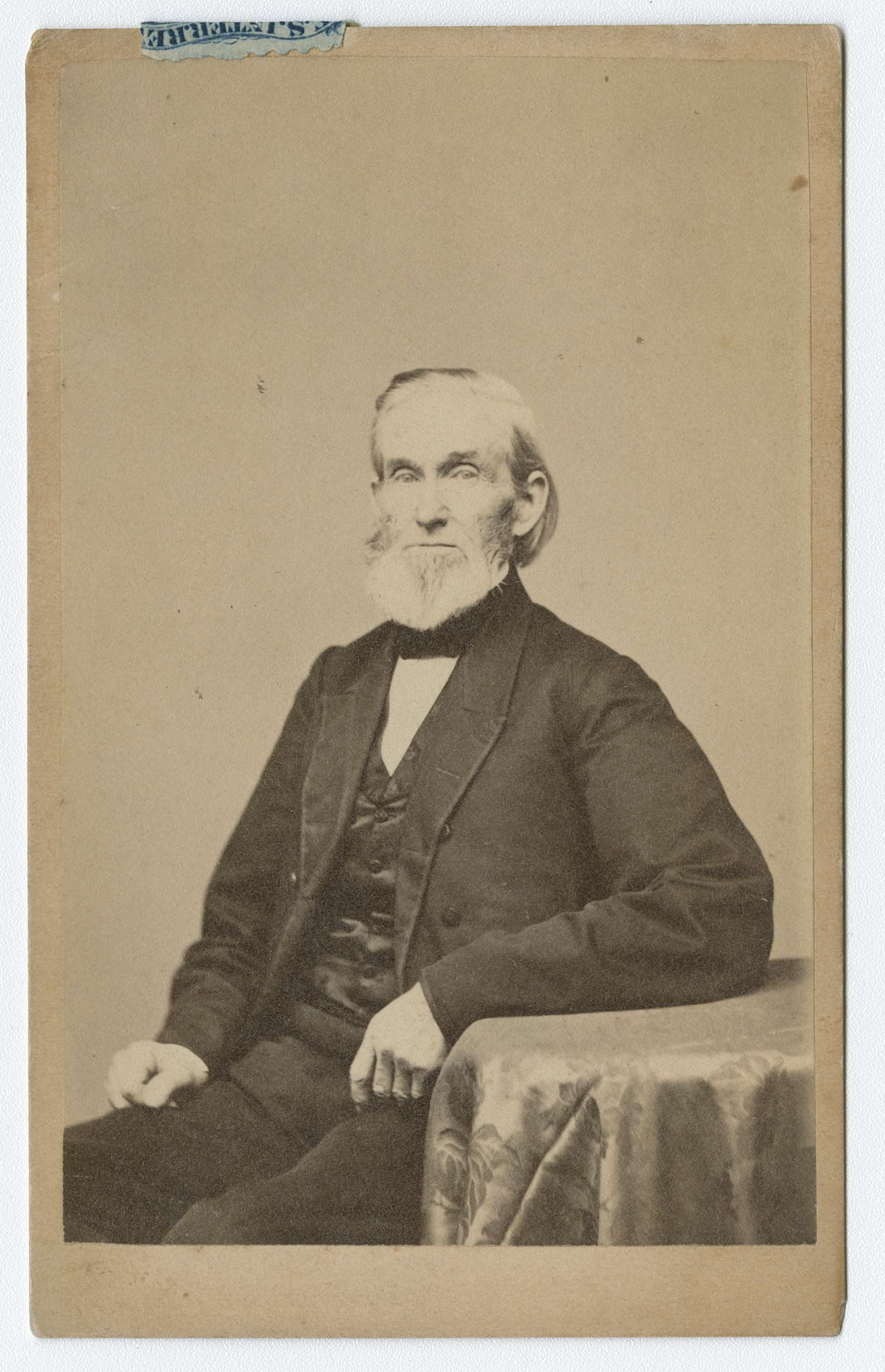
In June 1854, the Boston City Missionary Society appointed a Methodist Episcopal clergyman named Luman Boyden to serve as missionary to the poor in East Boston. The 48-year-old Boyden (pictured above, about ten years later) had had a distinguished 20-year career as a minister in Sudbury, Oxford, Dorchester, Chelsea, Fitchburg, Holliston, Spencer, Roxbury, Salem, and Waltham. The Society offered him a salary of $650 a year, and he would earn an additional $200 preaching at Union Chapel in East Boston.

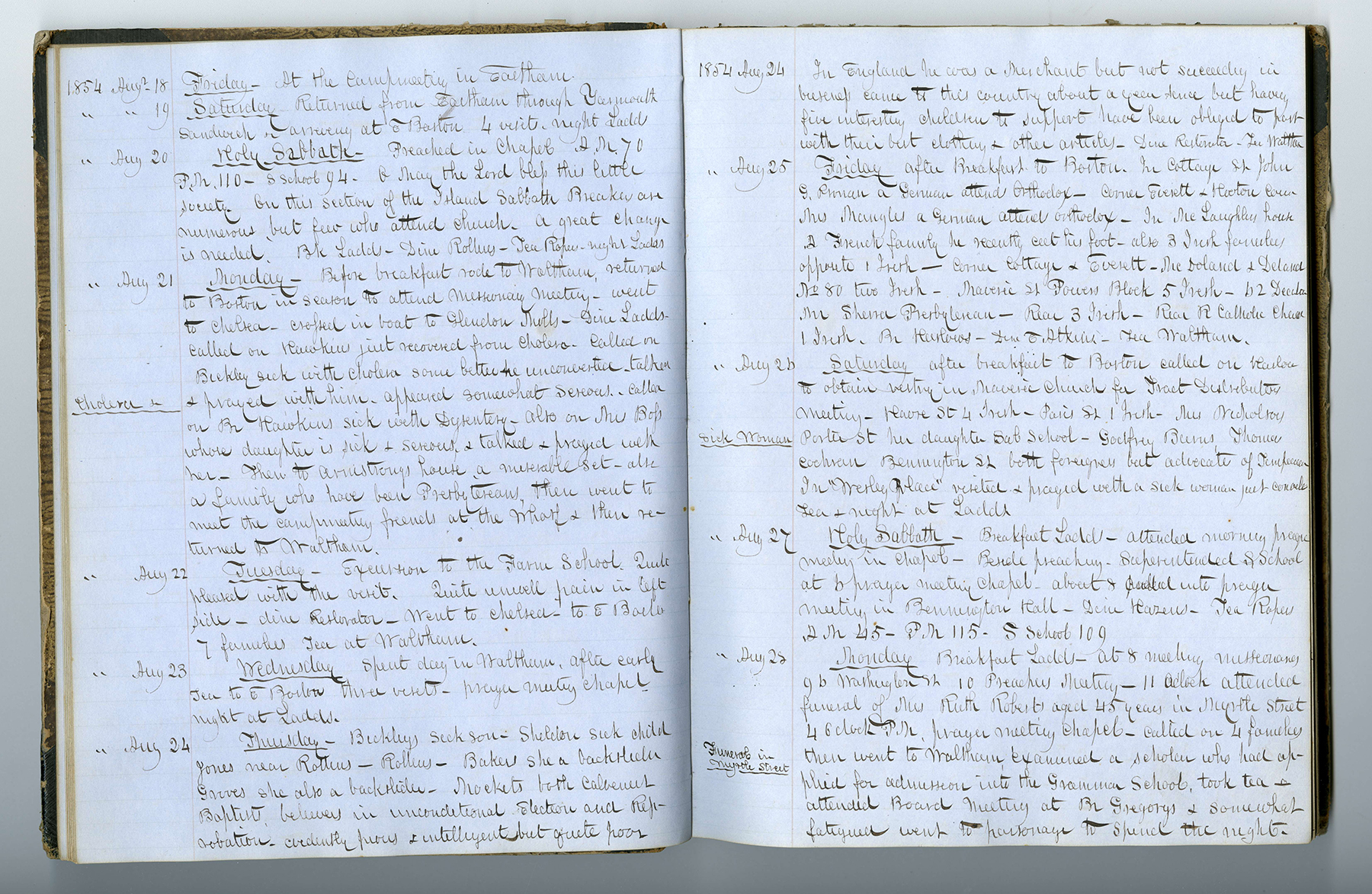
Earlier this year, the MHS acquired four manuscript journals Boyden kept during this time, 1854-1863, primarily documenting his missionary work. He wrote in them every day and described, in compelling detail, the poverty in East Boston, as well as the ravages of alcoholism, domestic violence, other crimes, suicides, and illnesses such as tuberculosis, smallpox, and typhoid fever. Boyden visited the homes of Protestant, Irish Catholic, African American, and immigrant families, many suffering from terrible privation. His journals are a fascinating social history of the city and a record of 19th-century urban life in general.

Rev. Boyden hit the ground running. His first day on the job was 1 July 1854, and just 17 days in, he was attending the family of a Mr. Rose, who had attempted to kill himself by cutting his own throat with a razor blade. Two days later, Boyden visited a woman “putrid with disease,” a young woman dying of consumption, and the family of a suicide victim. He was shocked and horrified by the things he saw. When three people he’d met were arrested for murder, he wrote disbelievingly, “Did not think Monday that I was talking with those who would so soon be considered murderers.”

The pages of Boyden’s journals are filled with daily tragedies. He visited multiple families a day, and while his compassion for the poor was clearly genuine, he was not a disinterested party. One of his primary goals was conversion, and he distributed Bibles and religious tracts and proselytized about sin and salvation. He used language like “den of pollution” and “hive of iniquity” to describe some homes. About others, he simply wrote, “There Satan appears to reign.” As you can imagine, he encountered resistance from Irish Catholic residents, the dominant immigrant group in the neighborhood.

The journals contain a wealth of information, including names and addresses, and some entries go on for multiple pages. In one, Boyden paints a vivid picture of a tenement building as he moves floor to floor, and you also get a sense of his attitude toward the tenants.

Went into Bee Hive No 2 on Havre Street. It is a large old building in the rear of Bee Hive No 1. In each house 16 Tenements which rent for 1 ¼ dollar each week or $65.00 a year. The amount of rent for each year 1040.00. The Hive No 2 is not worth beside land $400.00. […] The houses are owned by a shoe firm in the city & the Tenants make shoes for the firm so the rent is secure & to obtain work the Tenements are filled. […] As I descended flight after flight I found others of the same class, poor, ignorant, depraved & who must be saved or lost forever.

Boyden reserved his fiercest animosity for alcohol. In the margins alongside his text, he scribbled headings like “Rum & Poverty,” “Rum & Beggary,” “Rumsellers Abomination,” etc. Other headings include “Motherless Boy,” “Barefoot Family,” “Poor & Proud,” “Blind Girl in Waltham,” “Furious Woman,” “Singular Case,” and “Children Under Table.”

Speaking of children, many of those Boyden met on his rounds did not attend or had never attended school. Boyden strongly advocated for the education of all children. On 28 September 1854, he wrote about the Nute family.

House kept quite neat, children dressed neatly but in consequence of being colored they are suffering by a most oppressive arrangement. Their children are allowed to attend the primary school with white children but as soon as they become qualified to enter the grammar school, they are not admitted to the schools in E. Boston, but go to the colored school [the Abiel Smith School] in Belknap St about 2 miles from home. In doing this they are obliged to cross the Ferry & pay two cents toll each way. They have three who attend the school in Belknap St at an expense of ferriage of 12 cents a day. […] They feel afflicted that while the dirtiest, vilest white children are admitted that theirs are excluded. Say they have applied to the General School Com[mitte]e but have accomplished nothing. I am resolved to plead their cause.

Incidentally, less than one year later, the Massachusetts legislature passed the first law in the United States prohibiting segregation in public schools. The campaign was led by Benjamin F. Roberts, whose children had also been excluded from the white schools near their home. Roberts had previously lost his case at the Massachusetts Supreme Judicial Court in Roberts v. City of Boston (1850).

In his journals, Boyden often recorded follow-up visits, so we know how some of the stories developed, who lived and who died, who went to jail or the almshouse, who converted, who repented, and who didn’t. For example, here’s an amazing passage that caught my eye. On 20 March 1857, Boyden visited an African American family on Bennington Street, consisting of Mrs. Russell, her adult daughter, and the daughter’s two children.

[The daughter] is very black & I noticed the infant in her arms was far from being black. I asked if her husband was a pious man? She said I may as well tell the truth, I have no husband. I inquired is not the father to that child a white man? She made no reply, excepting a coarse laugh. I told her that it belonged to the father of the child to support it & I could not help her till he had been seen & if he had anything compelled to aid. […] She has another child about 6 years old the same color. I spoke to her plainly of her wickedness. She said with apparent anger, it is Gods will or it would not be so. The old Lady seemed to feel deeply the ruin of her only child.

Miss Russell told Rev. Boyden the name of her baby’s father, who was white and had a wife and other children. Boyden said he would visit the man, although I couldn’t determine if he ever did. Unfortunately, when he returned to the Russell home about a month later . . .

Her daughter in quite a rage because several weeks since I reproved her as she think[s] to[o] severely. She then said it was the Lords will. I told her it was the work of the devil. She replied that she knew that the Lord made her & he did every child. Today she said the child died several weeks ago.

While most entries relate to Boyden’s missionary and ministerial work, some give us glimpses into his personal life. He and his wife Mary had two children—at the start of the first journal, Helen Maria was 24 and Jeremiah Wesley 15. There had been another daughter, Mary Elizabeth, but she died in 1837 at the age of three. Boyden wrote about her several times.

Luman Boyden died in 1876 at the age of 70. His wife Mary lived until 1897. Both parents outlived their son Jeremiah, who served as a U.S. Navy surgeon in the Civil War before dying of yellow fever at 27. Daughter Helen worked as a teacher, married Thomas Warren Thayer, and died in 1922 at 92 years old.

P.S. Interestingly, Boyden frequently referred in his journals to another missionary for the Boston City Missionary Society, Armeda Gibbs. Gibbs was an abolitionist who helped freedom seekers and is probably best known as the first female nurse for the Union army during the Civil War. Sure enough, Boyden noted on 6 August 1862, “Heard Miss Gibbs offered to go as nurse in the army.”

Barbara Hillard Smith’s Diary, December 1918

By Lindsay Bina, Intern and Anna Clutterbuck-Cook, Reader Services

Today we return to the 1918 diary of Newton teenager Barbara Hillard Smith. You may read our introduction to the diary, and Barbara’s previous entries, here:

January | February | March | April | May | June | July | 

 August | September | October | November

As regular readers of the Beehive know, we are following Barbara throughout 1918 with monthly blog posts that present Barbara’s daily life — going to school, seeing friends, playing basketball, and caring for family members — in the words she wrote a century ago.

This post is the final in our year-long series sharing Barbara’s diary. The series will return in January 2019 with a new narrator hailing from the year 1919. In the meantime, take a moment or two to learn about Barbara’s December–full of basketball, babies, and a trip to New York to visit her friend Babe. Read along and–as Barbara says in her final entry for the year–“Watched old year out.”

Here is Barbara’s December, day by day.

* * *

SUN. 1   DECEMBER
Church. Sunday S. Dr. Drew here. Over to Aunt Mabels for supper.

MON. 2
School. Babies

TUES. 3
School. Studied. Cousin Bert took us to Westminster and saw “Fiddler’s three

WED. 4
School. Babies. Pastor’s Reception

THUR. 5
School. Swimming. Shampoo

FRI. 6
School. Awful snow storm. Mrs. Reed

SAT. 7
Worked around Mrs. Reed’s. K-C for week end with Pete.

SUN. 8
Church Sunday School. Supper at Lasell.

MON. 9
School. In town. Got suit

TUES. 10
School. Basket Ball Starter. Fitting for suit

WED. 11
Got sick in school. Went to babies

THUR. 12
Home sick

FRI. 13
School. Dance with Spud

SAT. 14
Hung around. Christmas play at Seminary.

SUN. 15
Sunday School. Lasell Christmas Vespers

MON. 16
School. Took care of baby

TUES. 17
School. Basketball. Cousin Bert here.

WED. 18
School. Took care of baby. Mr. Reed home from operation

THURS. 19
School. Basketball.

FRI. 20
School. Babies

SAT. 21
Took care of sonny. [Havene] for weekend. Christmas party. Freddie’s show

SUN. 22
Church. Sunday School. Concert. C. Endeavor. Spud’s for supper.

MON. 23
In town. Took care of baby. Women’s club concert

TUES. 24
Up to Reed’s all day. Trained, so didn’t have caroling. Sick

WED. 25                     CHRISTMAS DAY
Had presents. Dance at Spud’s

THUR. 26
Went to New York to visit Babe. Met Jack Palmer.

FRI. 27
Went to Mrs. Learnerd’s for lunch. Keith’s in afternoon.

SAT. 28
Babe’s singing lessons. Went to Ladies First

SUN. 29
Company for dinner. Out for walk. Reg + Gladys came over.

MON. 30
Went to movies.

TUES. 31
John Ross. Went to Mrs Andrew’s with Jack. Watched old year out

If you are interested in viewing the diary in person in our library or have other questions about the collection, please visit the library or contact a member of the library staff for further assistance.

*Please note that the diary transcription is a rough-and-ready version, not an authoritative transcript. Researchers wishing to use the diary in the course of their own work should verify the version found here with the manuscript original. The catalog record for the Barbara Hillard Smith collection may be found here.

Remembering Former President George H. W. Bush

By MHS

As the United States remembers former President George H. W. Bush, who died on Friday, 30 November 2018, at the age of 94, the MHS remembers him too.


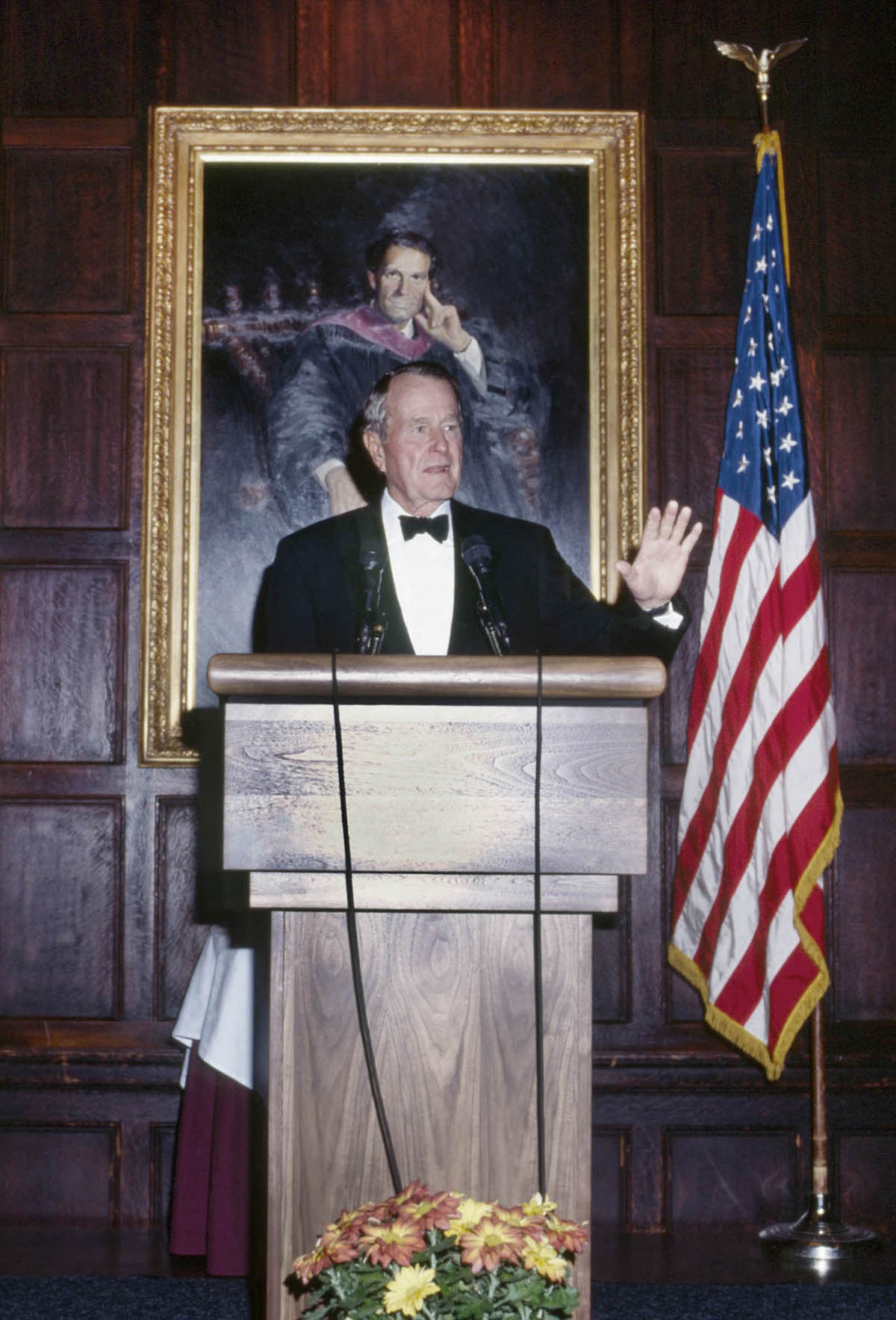
George H. W. Bush addressing guests at the MHS Annual Dinner on 10 October 2002.

In 2002, MHS staff (and items from the collections!) had two notable encounters with George H. W. Bush. On 11 March 2002, the exhibition Fathers and Sons opened at the George Bush Presidential Library and Museum on the grounds of Texas A&M University in College Station, Texas. The exhibition focused on the private and public careers of the two father and son sets of presidents: John Adams and John Quincy Adams and George H. W. Bush and George W. Bush. Staff from both the Bush Library and the MHS worked from September 2001 to January 2002 on establishing and finalizing which items from the Adams Family Papers and other collections would be on display in Texas. All in all, the Bush Library borrowed 26 manuscripts, 5 printed texts, 2 engravings, and 8 artifacts from the MHS for the exhibition. William M. Fowler, Jr., Director of the MHS (in 2002), joined George H. W. Bush, and his wife, Barbara, and many guests at the official opening of the show.

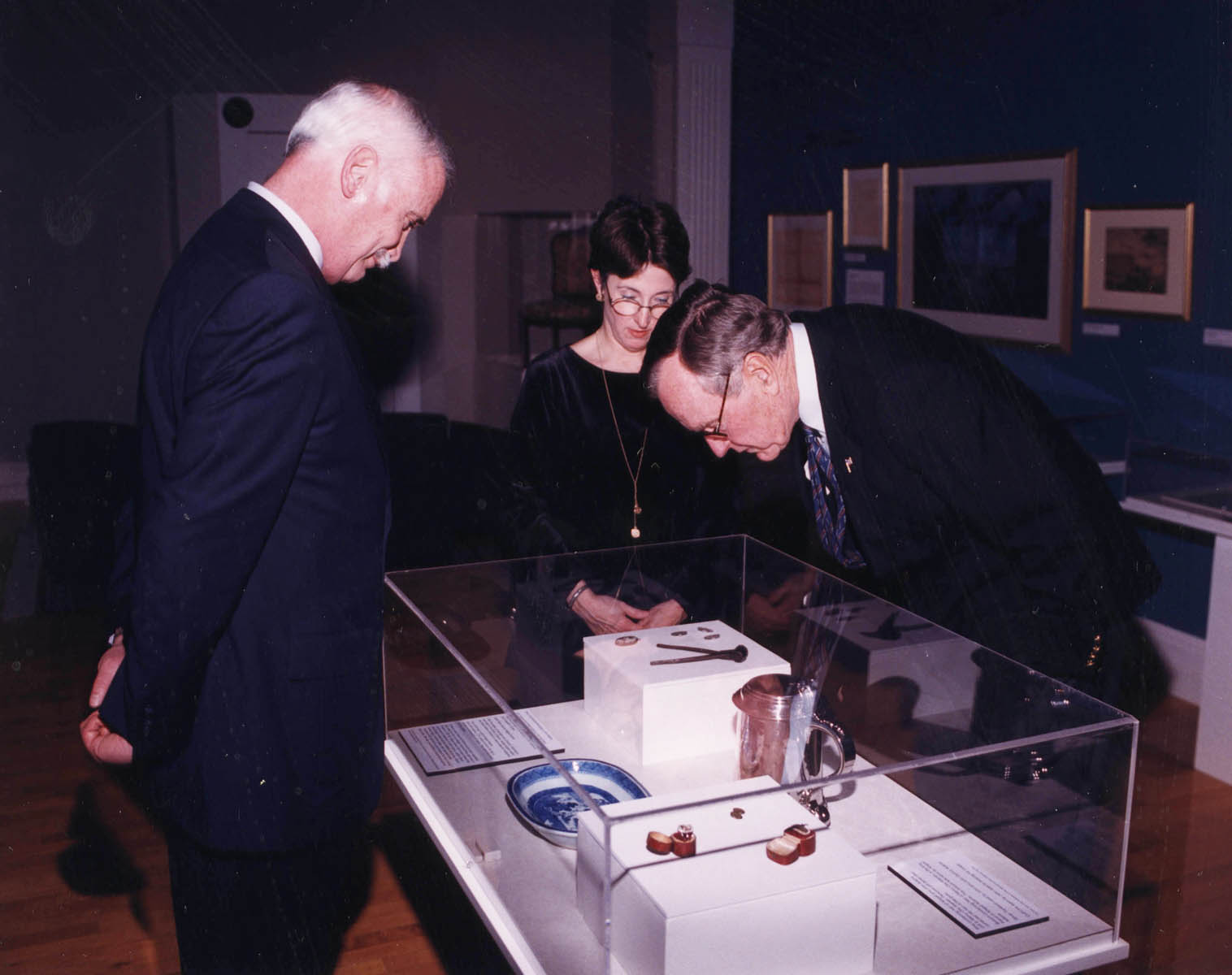
William M. Fowler, Jr.,  George H. W. Bush, and Patricia Burchfield examine Adams family artifacts from the MHS on display at the George Bush Presidential Library in March 2002.   

William M. Fowler, Jr. with George H. W. Bush and Barbara Bush in March 2002.

About seven months later, Mr. Bush travelled to Boston, Mass. and spoke at the MHS Annual Dinner held at the Harvard Club on 10 October 2002. Not since John Quincy Adams addressed the members in 1841 had a president spoken to the MHS. Before the well-attended formal dinner, Mr. Bush visited the MHS. David McCullough, the well-known historian and author of the book, John Adams, and MHS Stephen T. Riley Librarian, Peter Drummey, shared information about selected items from MHS’s collections, including the manuscript of George Washington’s Newburgh Address, Thomas Jefferson’s Farm Book, and Paul Revere’s account of his famous ride to Lexington. 

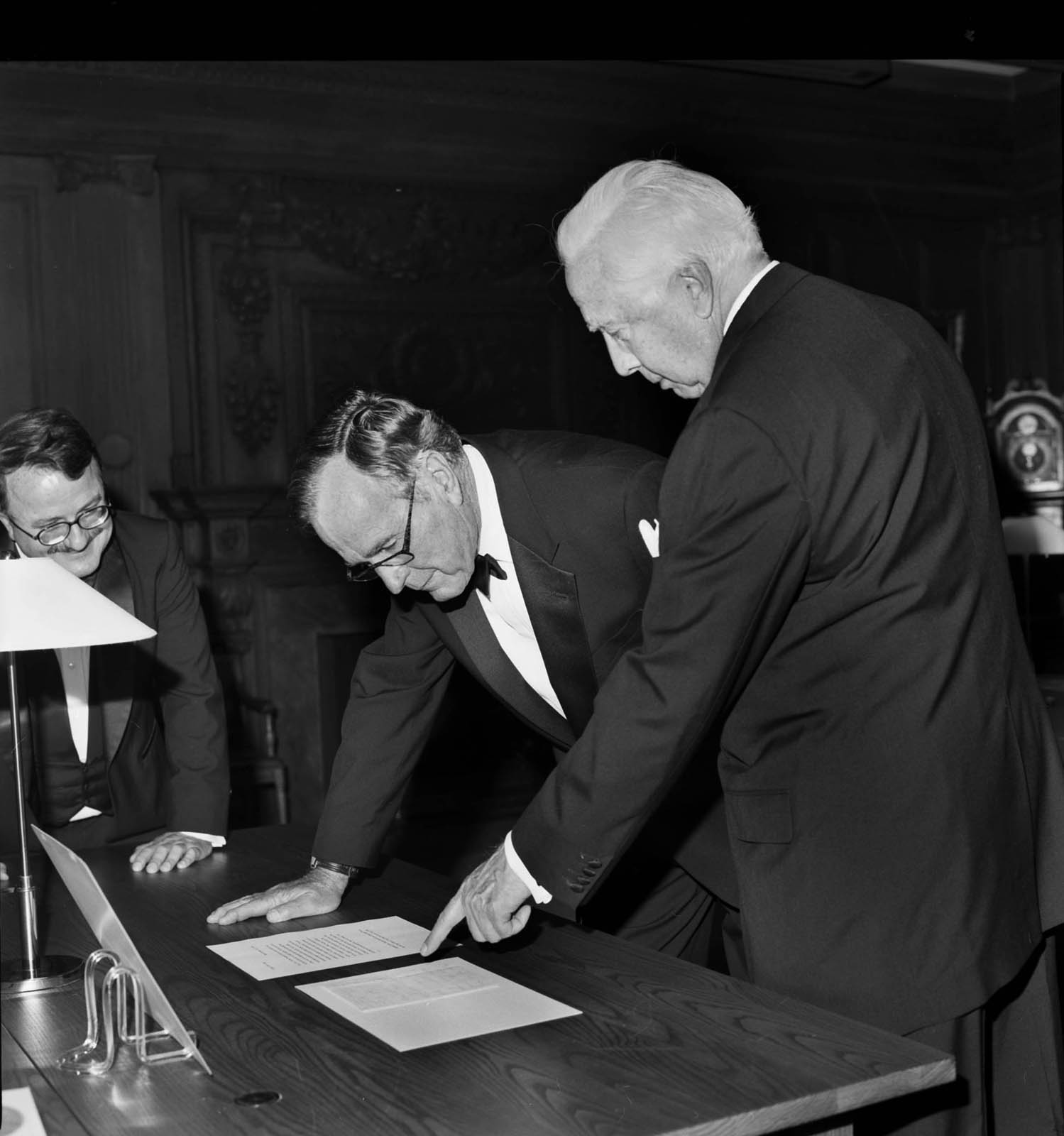
George H. W. Bush examining documents from the collection of the MHS with David McCullough (right) and Peter Drummey (left).


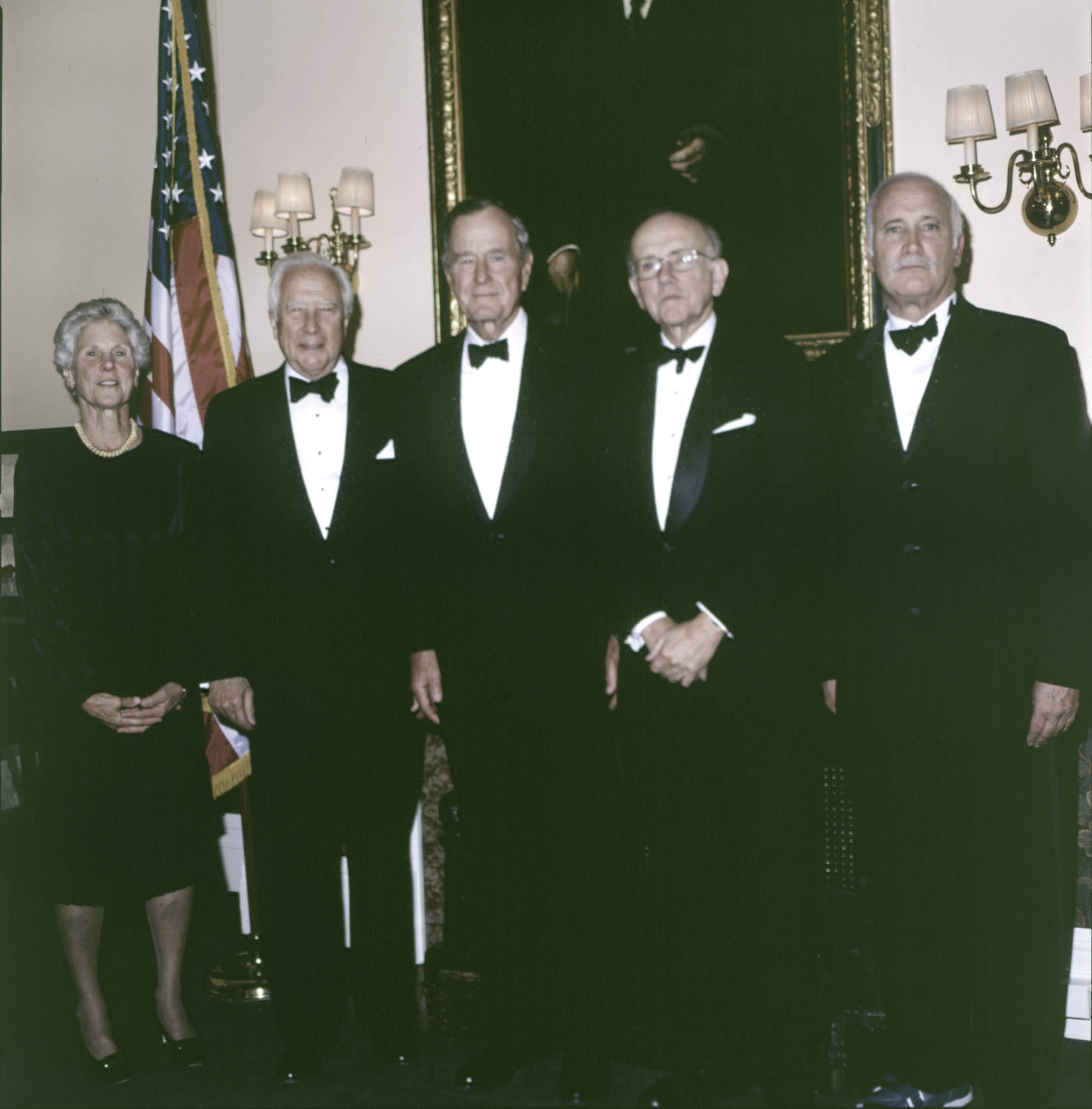
From left to right: Amalie M. Kass (MHS President  in 2002), David McCullough, George H. W. Bush, Levin H. Campbell, and William M. Fowler, Jr. (MHS Director in 2002).

Women at Sea: Ann Johnson and Abbie Clifford

By Susan Martin, Processing Archivist & EAD Coordinator

In 1849, the ship Lanerk sailed from Boston to California as part of the Gold Rush. On the ship was a clergyman named Truman Ripley Hawley, and the MHS recently acquired a transcript of his diary of the journey. It contains a lot of terrific detail, but one particular digression caught my eye. On 4 August 1849, off the west coast of South America, the Lanerk met the ship Christopher Mitchell, captained by Thomas Sullivan of New Jersey. Sullivan told Hawley about the following “amusing incident”:

He [Sullivan] sailed from Nantucket with his crew, shipped from different states in the union, only one of whom before the mast had ever been to sea before. On the voyage out all had done their duty, and all had been in the boats as usual. One of the crew was taken sick […] when one of the crew came aft […] and informed the captain that one of the crew in the forecastle who went by the name of George Johnson was a female! It very much surprised him, as well as all on board, and the man was told to go forward and send George into the cabin. He did so, and George made his appearance. The Capt. after interrogating her gave up a birth [sic] in his cabin for her and immediately put back to Peyta [Paita, Peru], gave her $100 and sent her home on board a vessel.

I learned from Eric Jay Dolin’s Leviathan: The History of Whaling in America (pp. 237-40), as well as other sources, that the woman was 19-year-old Ann Johnson of Rochester, N.Y. Her identity was discovered in July 1849 when (ahem) some of her clothes fell away in a feverish delirium. Why had Johnson dressed as a man and joined the crew of the Christopher Mitchell? Well, her story made the newspapers, but contemporary accounts varied widely, and historians haven’t been able to come to a consensus. Here’s Sullivan’s explanation:

She said in her story that she was decoyed away from home, Rochester, N.Y. by a man with whom she lived a few months when he left her, that she then went to her home but was forbid to enter by her father, that she then went and dressed in boy’s clothes, and went to ride horse on the canal, towing boats; that afterwards she went into a shipping office and asked for a birth [sic] on board a ship in the capacity of cabin boy, but finding no encouragement consented to ship as a youngster in a whaler. That she was sent to Nantucket and engaged by the owners of this vessel. Romantic truly!

I can’t say whether this version is definitive, but Hawley was hearing it from the captain himself only one month after it happened. Amazingly, Johnson had been able to maintain her disguise for seven months!

The story of Ann Johnson reminded me of another female sailor I learned about earlier this year when I cataloged the letters of Augustus Percival. Her name was Abbie Clifford, and she sailed with her husband, Captain Edwin Clifford, on a brig that bore her name. The Cliffords were from Maine. Percival served as their first mate in 1869 and mentioned them often in letters to his wife back in East Orleans, Mass.

The Abbie Clifford was engaged in the China trade, and in the fall of 1869, the ship was anchored at Shanghai waiting for a freight of tea. Percival occupied the cabin adjoining the Cliffords, and the three often ate and talked late into the evening on a variety of subjects, including religion. His letters reveal an unmistakable affection for the “free hearted” couple and an admiration, especially, for Mrs. Clifford.

Mrs Clifford is quite a Sailor, has been over 10 years with the Capt and I dont know as she has missed a voyage since he has been Master. She is a fine looking woman, and very pleasant, and quite a talker. [24 September 1869]

She lets me see all the things she buys on shore and I like her much, and we have all got along first rate so far, and hope we shall continue the same, but I know he is a very timid man & very nervous, but then he has much to worry him. [5 October 1869]

Every day brings us nearer a Charter, but he is almost discouraged at times, while She is always looking on the bright side, which is proper. [9 October 1869]

The end of November 1869 found the Abbie Clifford at Swatow (now called Shantou) chartering to take hundreds of “coolies” to Singapore. Percival’s intimacy with the Cliffords had only grown. He described the captain in fraternal terms and continued to praise Mrs. Clifford for her seafaring abilities, as well as her domestic qualities.

Mrs. C. generally looks after his Books, and is very good in figures and is a very good Navigator also and works time for the Capt or did on the passage out. [4 December 1869] 

It seems good to live in such a friendly way, and as it seems good to have some one to confide in, I say many things to Mrs. that I do not to others, and she is very good to me, will sew on a Button, offered to mend my Socks, &c. [6 December 1869]

By December 1870, Percival had moved on to another ship. But events of 1872 proved his admiration for Abbie Clifford very well-founded.

That spring, off the coast of Pernambuco, Brazil, yellow fever ravaged the Abbie Clifford, killing at least five crew members, including the steward, first mate, and Captain Clifford. When Percival heard the news, he wrote to his wife about Mrs. Clifford: “I pity her, but trust she will bear up under her trials with Christian fortitude.”

That she did. After her husband’s death on 5 April 1872, Mrs. Clifford (according to some accounts, suffering from yellow fever herself) gamely took command of the ship and sailed the thousands of miles north to New York, with the help of those men well enough to work. On the way, the crew withstood a five-day gale above Cape Hatteras that destroyed several of the ship’s spars and sails. They arrived at their destination on 12 May 1872.

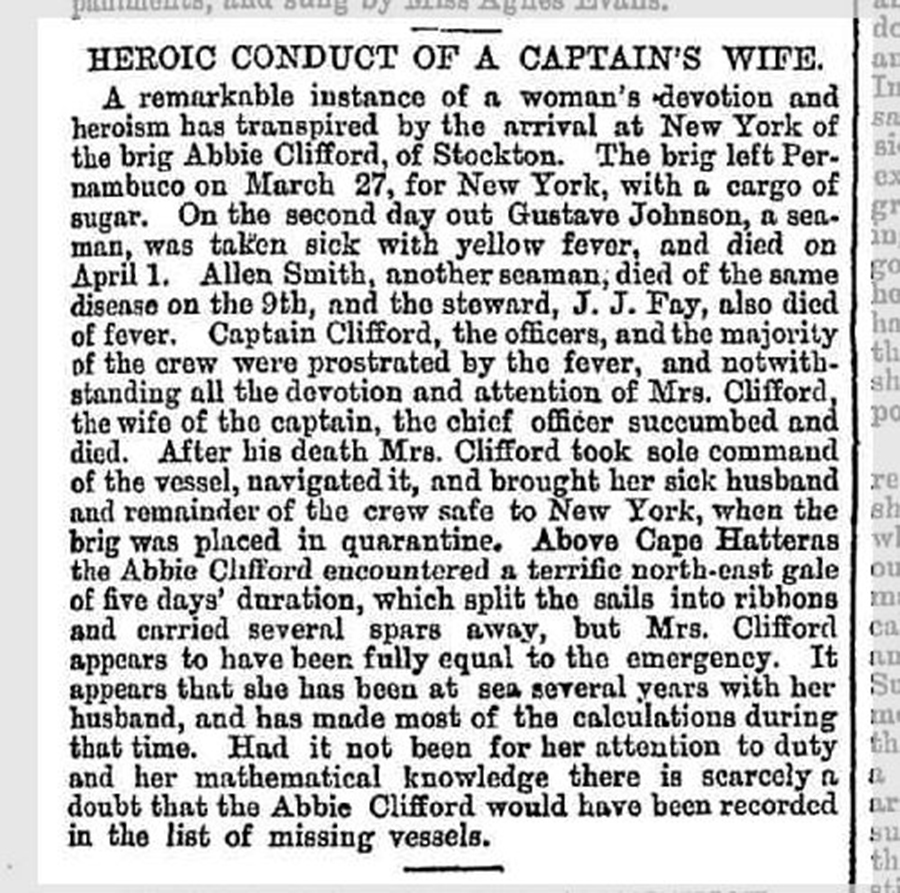
Abbie Clifford’s exploits were recounted in glowing terms in newspaper articles of the day, like this one from as far away as Australia:

And as early as 1883, she was profiled in books like Daughters of America; or, Women of the Century (pp. 716-7) alongside some of the greatest 18th- and 19th-century American women. The Illustrated History of Kennebec County, Maine (pp. 757-8), published in 1892, mentions Abbie Clifford’s second marriage in 1877 to George Brown and goes on to describe her like this:

Mrs. Brown is a lady of genial bearing, a broad, well disciplined mind, and rare courage. She made several sea voyages with Captain Clifford, who commanded vessels in the merchant service. While on these voyages she studied navigation as a pastime, and when the necessity came of putting her knowledge of chart and compass to the test, her courage was not wanting.

Abbie J. Longfellow, later Clifford, later Brown, was born in 1839, which would make her only 32 or 33 at the time of her triumphal return to New York at the helm of the Abbie Clifford. She died in 1901.


Barbara Hillard Smith’s Diary, November 1918

By Lindsay Bina, Intern and Anna Clutterbuck-Cook, Reader Services

Today we return to the 1918 diary of Newton teenager Barbara Hillard Smith. You may read our introduction to the diary, and Barbara’s previous entries, here:

January | February | March | April | May 

June | July | August | September | October

As regular readers of the Beehive know, we are following Barbara throughout 1918 with monthly blog posts that present Barbara’s daily life — going to school, seeing friends, playing basketball, and caring for family members — in the words she wrote a century ago.

 November was both a regular and not-so-regular month for Barbara as she balanced school and babycare and social outings with news of the Great War — “Rumor peace was declared,” reads her entry on November 7th, sandwiched between “School” and “Senior Tea.” Then on the eleventh day of the eleventh month at the eleventh hour … “Peace declared. Parade. Babies. Hair up<.”

>Here is Barbara’s November, day by day.

* * *

FRI. 1   NOVEMBER
School. Babies. Movies at Waltham

SAT. 2
Hung around all day.

SUN. 3
Sunday School. Mrs. R- sick. Cousin Alice here

MON. 4
School. Babies.

TUES. 5
School

WED. 6
School. Babies

THUR. 7
School. Rumor peace was declared. Senior Tea.

FRI. 8
School. Babies

SAT. 9
In town. Sailors dance with Ben

SUN. 10
Sunday School. Pete to Dinner

MON. 11
Peace declared. Parade. Babies. Hair up.

TUES. 12
No school. In town. Parade

WED. 13
School. Over to Pete’s

THUR. 14
School. Over to Peg’s

FRI. 15
School. Took care of Baby.

SAT. 16
Knitted madly. Spud took me to Sybil’s party.

SUN. 17
Church Sunday School. K. to dinner. Studied

MON. 18
School. Took care of baby

TUES. 19
School. Swimming

WED. 20
School. Took care of baby

THUR. 21
School. Swimming. Aunt Mabel came to see Grandmas

FRI. 22
School. Lecture with Mother. Wartime France. Babies.

SAT. 23
Hung around. Mrs. Reed’s. Cousin M. to supper. Heard Dr. A- was detained.

SUN. 24
Put in teacher’s training class. Bob Hayes home. Spud to supper.

MON. 25
School. Took care of sonny.

TUES. 26
School. Sick? Hung around in afternoon. Got report cards. Safe I guess.

WED. 27
School. Got out at 12. Went to Babies. Sick in evening

THUR. 28
Went to Muriel’s. Thanksgiving dinner. Sailor’s dance.

FRI. 29
In town. Up to babies. Dinner and Dance at Spud’s. Bed at 1:20

SAT. 30
Slept until 11:20. Saw “Seventeen” [adapted from the novel Seventeen by Booth Tarkington]

If you are interested in viewing the diary in person in our library or have other questions about the collection, please visit the library or contact a member of the library staff for further assistance.

*Please note that the diary transcription is a rough-and-ready version, not an authoritative transcript. Researchers wishing to use the diary in the course of their own work should verify the version found here with the manuscript original. The catalog record for the Barbara Hillard Smith collection may be found here.