Math and Medicine: The Notebooks of Andrew Croswell

By Dan Hinchen, Reader Services

In the news recently there is a lot of coverage of the Zika virus and the late rise in outbreaks related to it. With that in mind I wanted to check our collections to see what the MHS holds relating to viruses. When I searched our online catalog, ABIGAIL, using Virus as the subject term I came up with no results. Using a method I briefly described in my last post on the Beehive, I started clicking around to see what related terms there might be. Instead of Virus diseases, ABIGAIL pointed me to three narrower terms: Influenza, Measles, and Rabies. Not satisfied with these options and the results they yielded, I tried searching for simply Diseases instead. The first result I found with this search is what this post is all about. 

Andrew Croswell (1778-1858) was a student at Harvard University in the late 1790s. He later studied medicine in Plymouth, MA, and practiced there and in Fayette and Mercer, ME. In the collections here we hold two notebooks that were kept by Croswell. The first is a mathematical notebook which contains definitions and problems in geometry, trigonometry, and surveying. The second is a physician’s notebook that contains notes on the treatment of diseases and injuries, as well as the use of some medicines. 

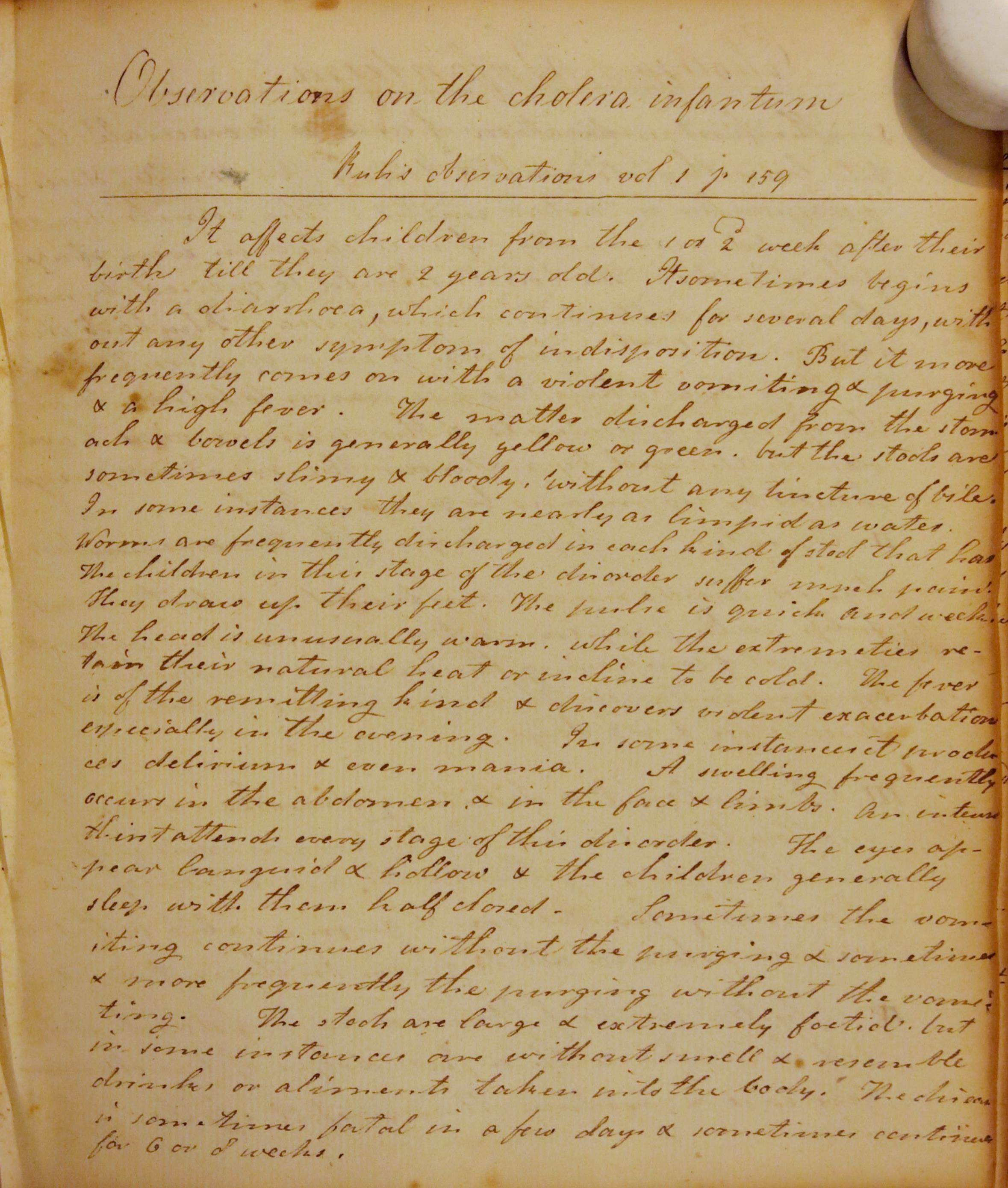
The second notebook, relating to various diseases and treatments, is text-heavy in its content. Croswell – who had very nice, neat, and even handwriting – copied observations from published medical texts, especially the work of Dr. Benjamin Rush. 

Observations on the cholera infantum

Rush’s observations vol 1 p159


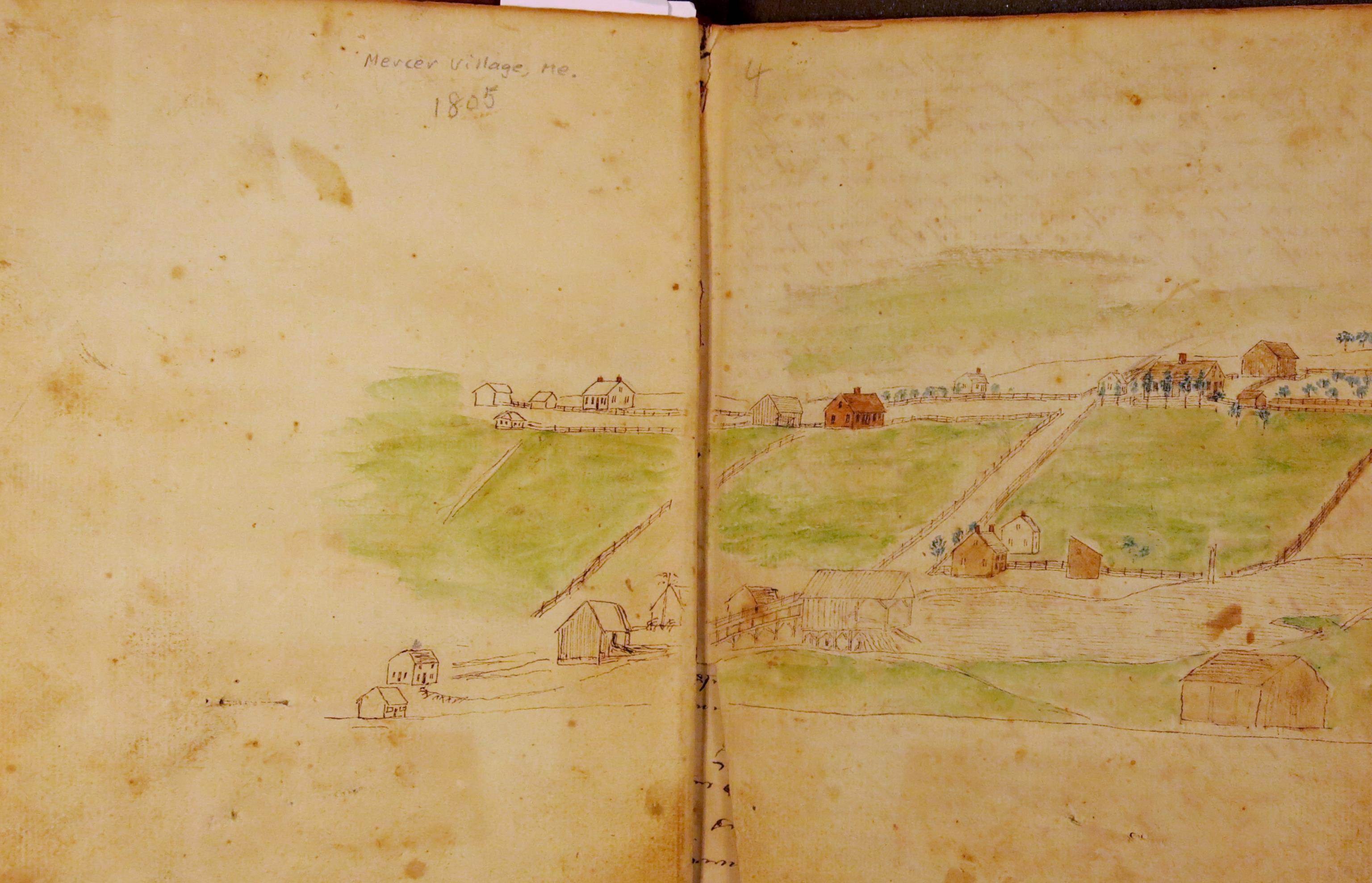
Also, Croswell includes illustrations of a few little villages in Maine where he practiced medicine.

Mercer Village, ME 1805


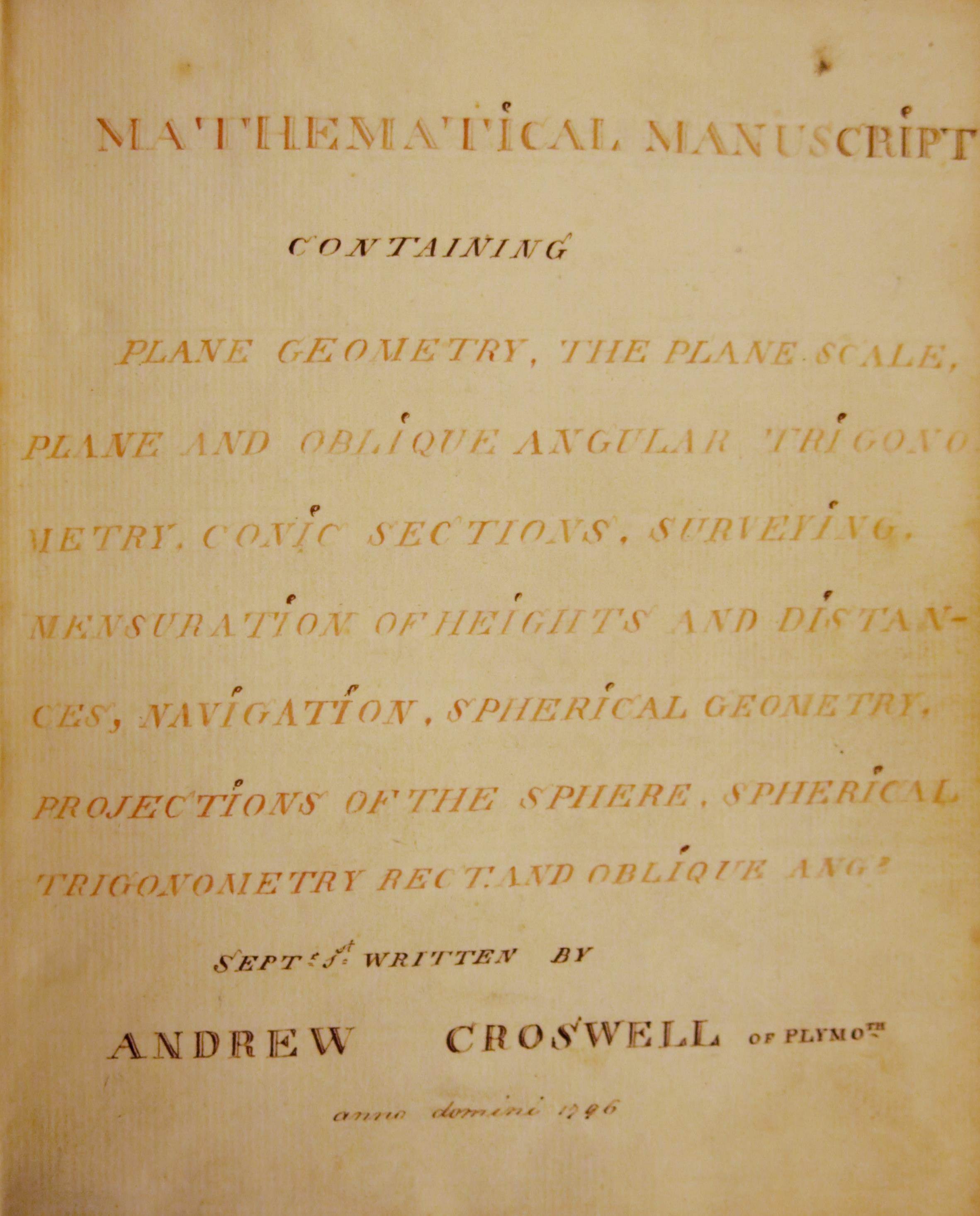
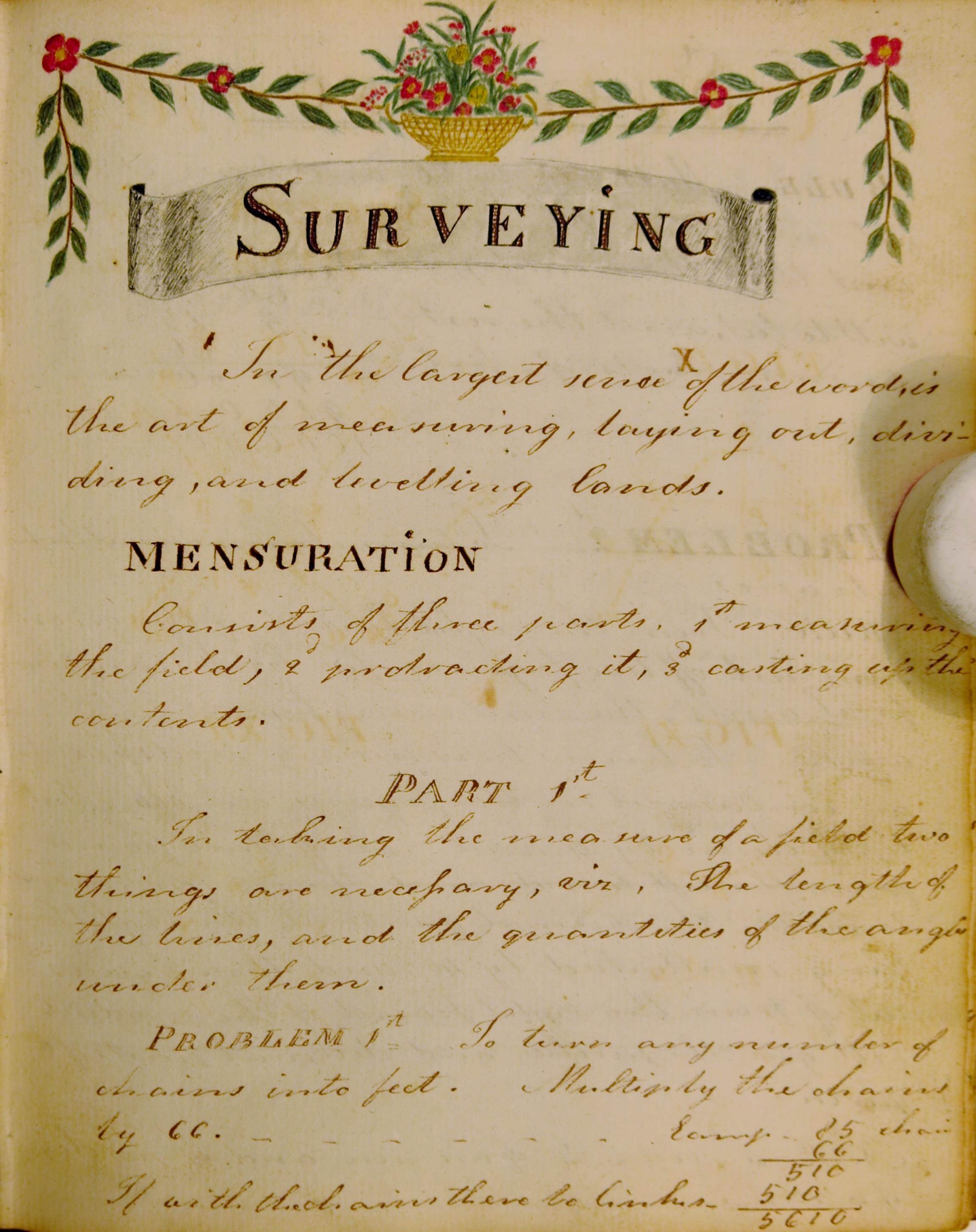
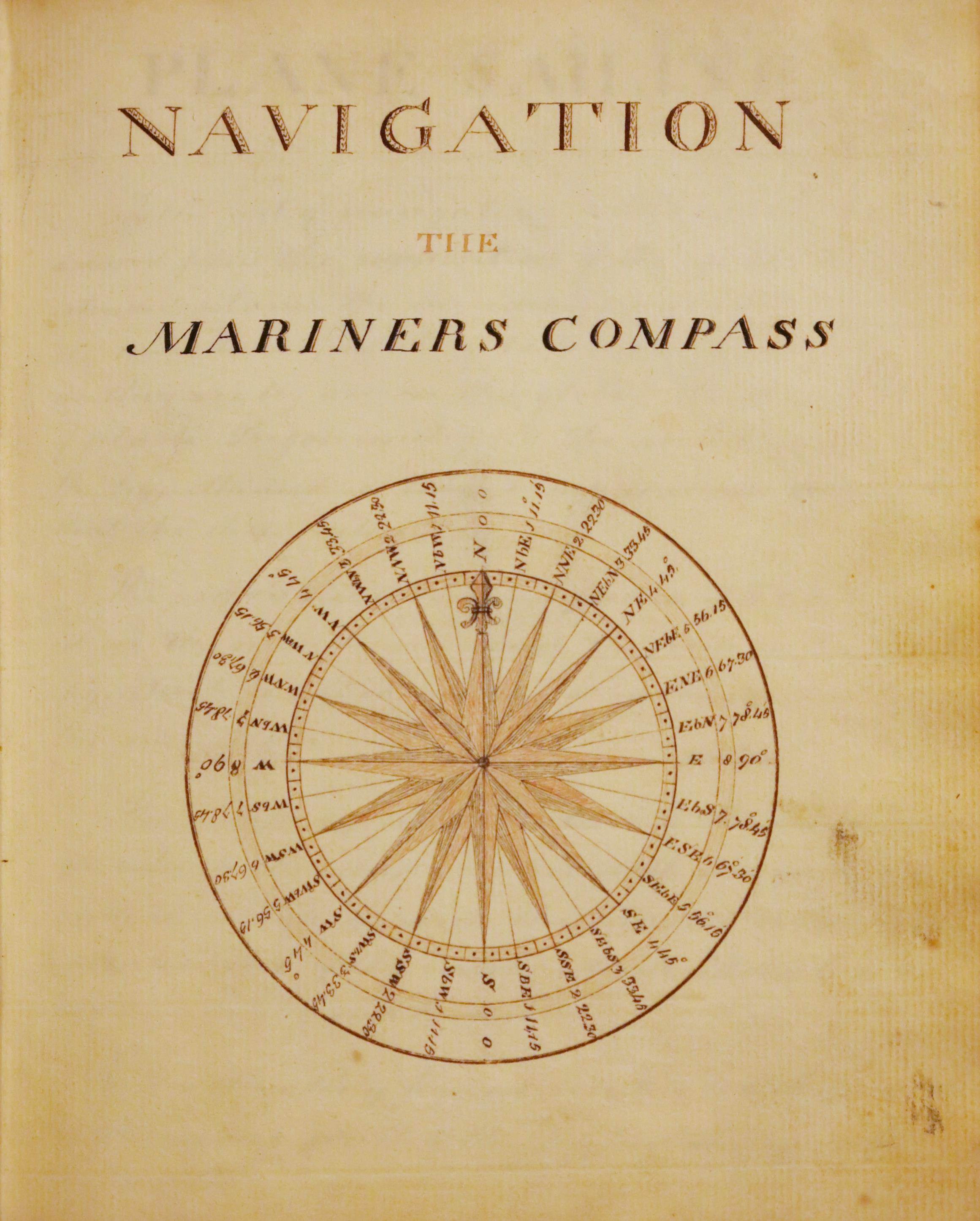
While it was the search for disease that exposed me to Mr. Croswell, it was his non-medical notebook that really captured my attention. Given my aversion to math in my educational career, this was an accomplishment. Croswell’s mathematical notebook, kept while a student at Harvard, was impressive not only in its order, clarity, and neatness, but in the embellishments that he included. The title page gives us a very good idea of what to expect in terms of content before we get into the notebook:


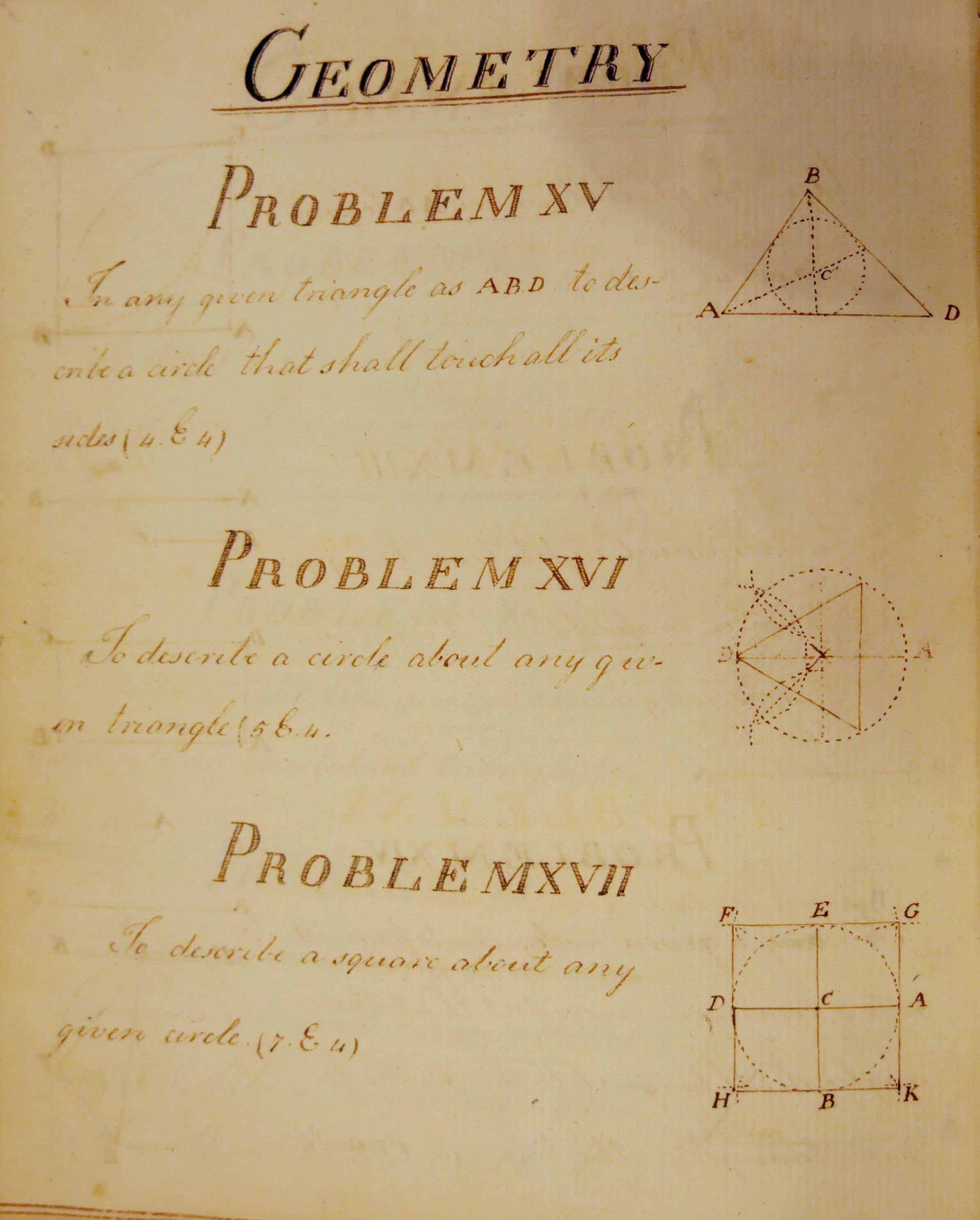
The first section of notebook deals with geometry. Croswell started by writing out definitions of terms relating to the subject and then goes on to tackling geometric problems. It is here that the notebook becomes, to me, much more visually striking as he starts to include geometric figures alongside the various problems. Generally, the figures start out fairly simple and then get more complex.


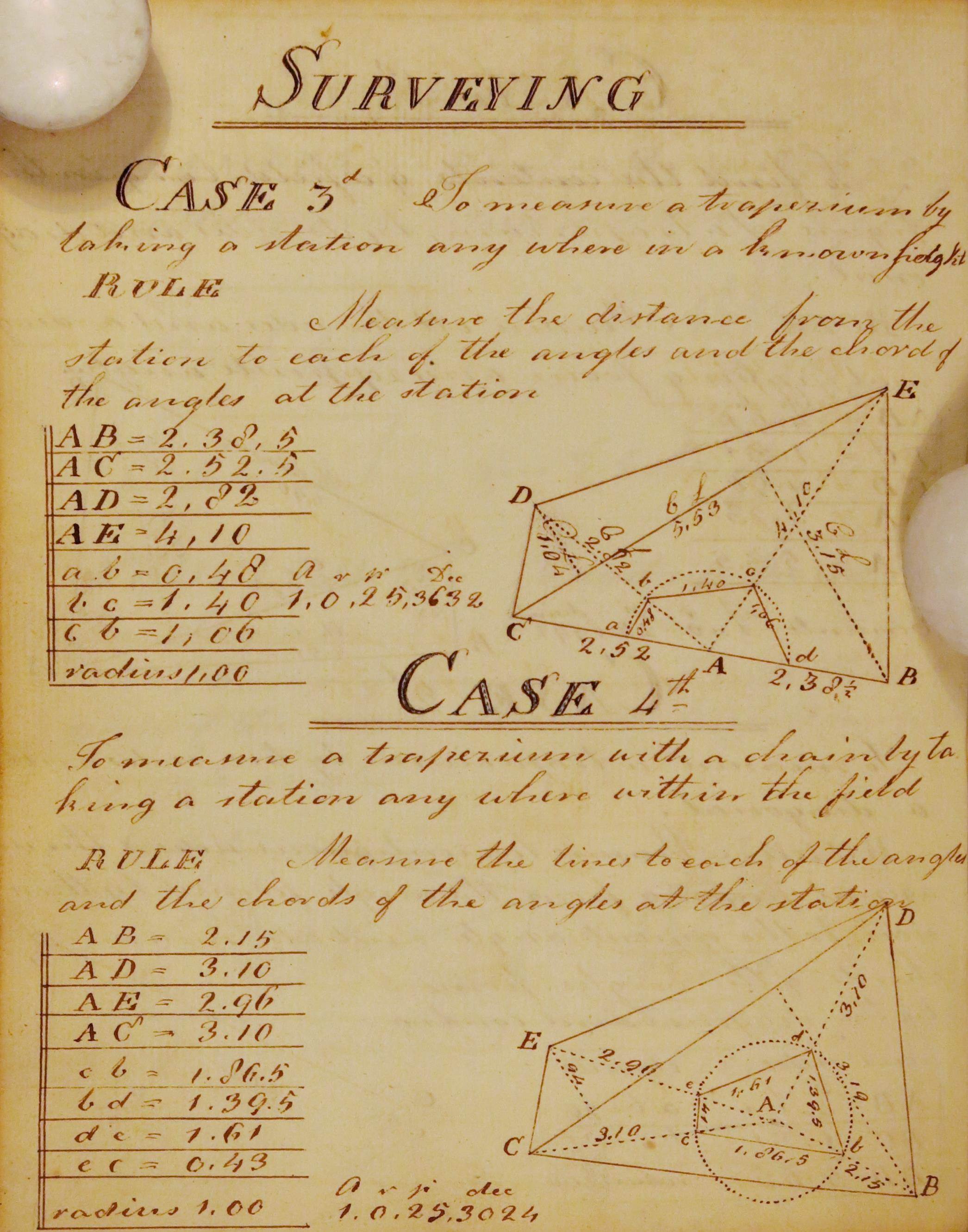
After his work on geometry, Croswell moves into the field of surveying and problems of trigonometry. Again, he steps-up his detail and the intricacy of his illustrations, adding color and tables as he solves problems relating to land area:


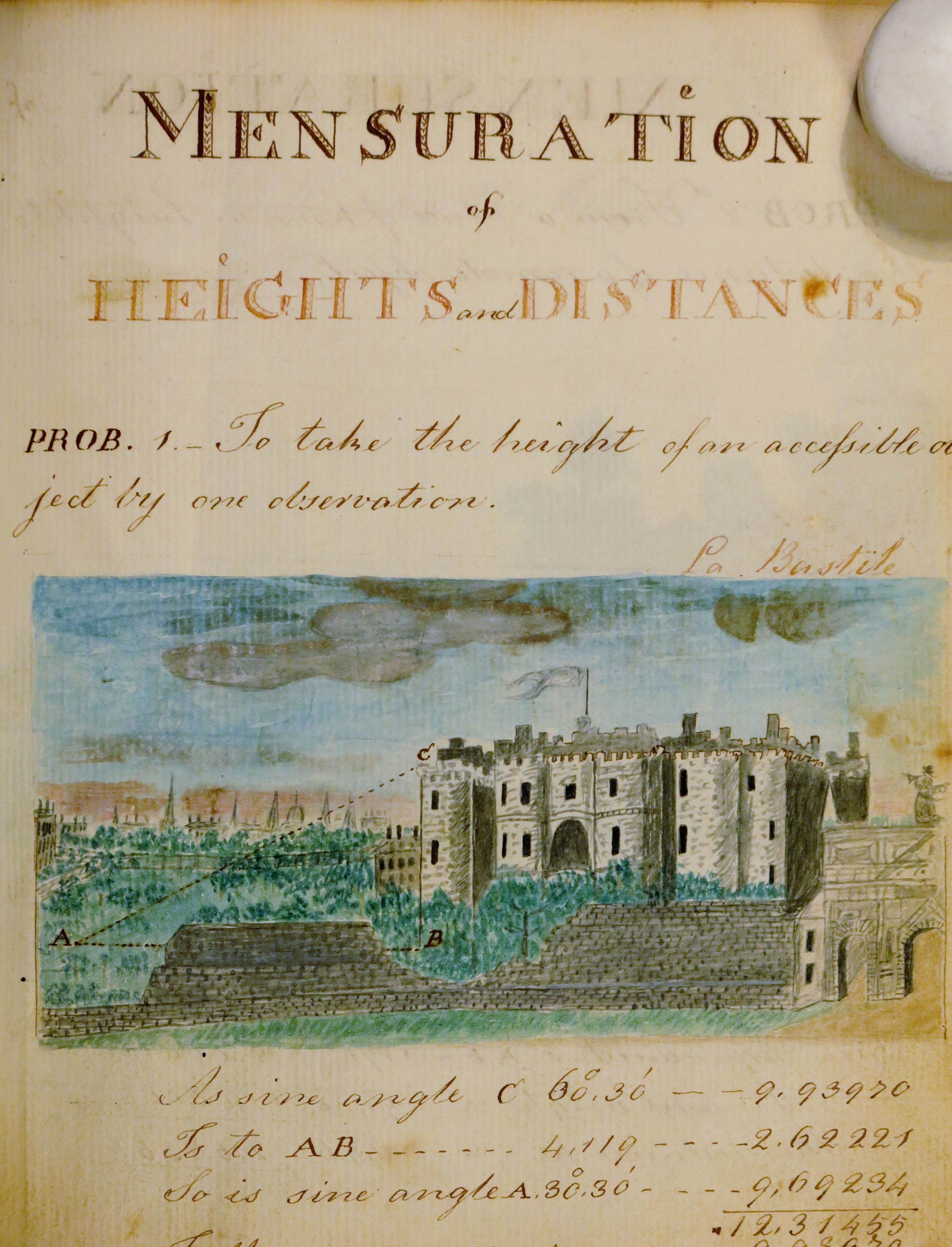
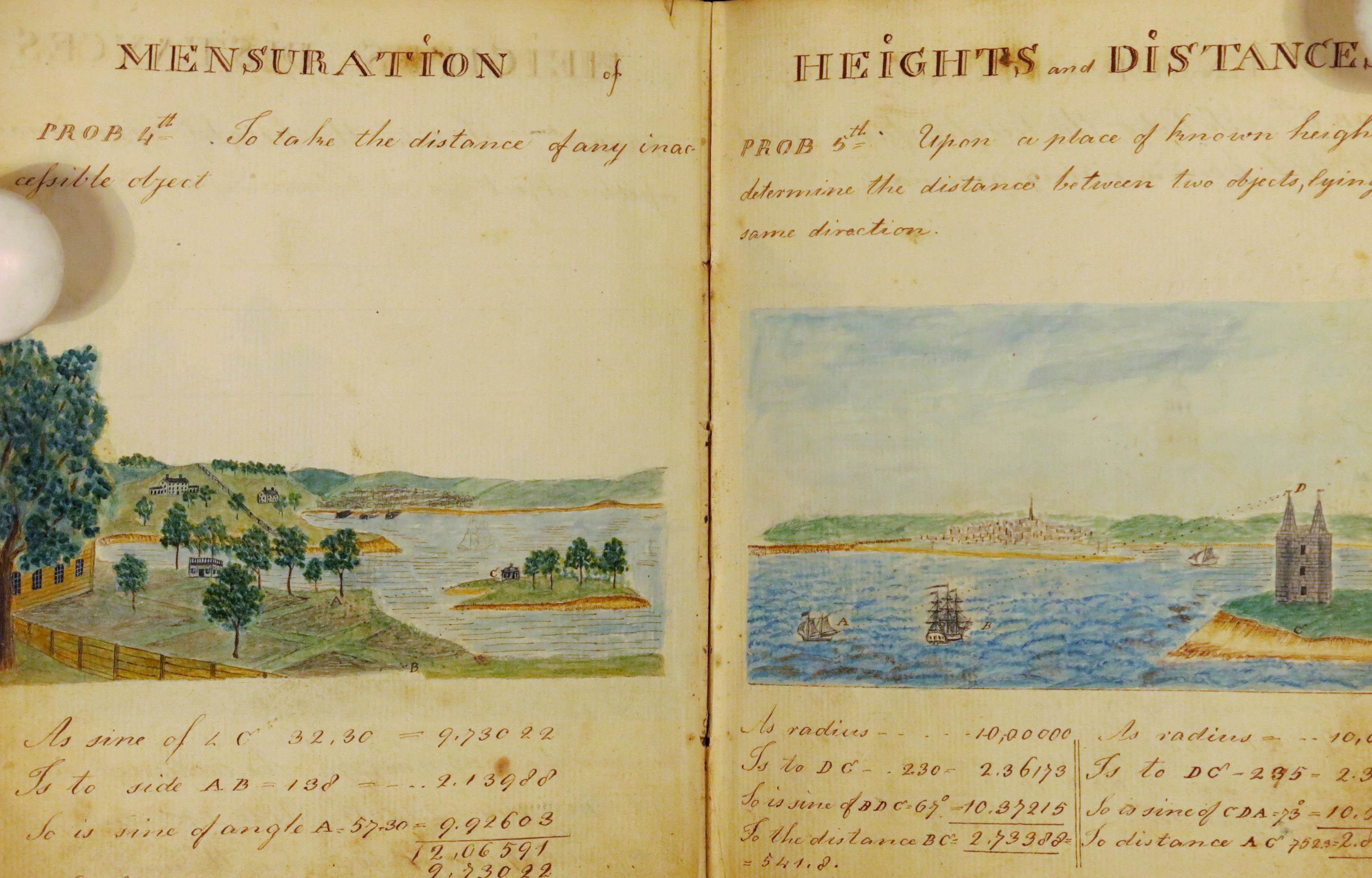
He then proceeds to “Mensuration of Heights and Distances” through the use of trigonometric functions. Again, Croswell takes his illustrations up another level, this time depicting full scenes which represent the mathematical problems at hand. The problems contain variables such as whether a location is accessible to people and the situation of the ground from which observations are made.

PROB. 1. _ To take the height of an accessible object by one observation.


PROB 4th. To take the distance of any inaccessible object. | PROB 5th. Upon a place of known height determine the distance betwee two objects, lying in the same direction.


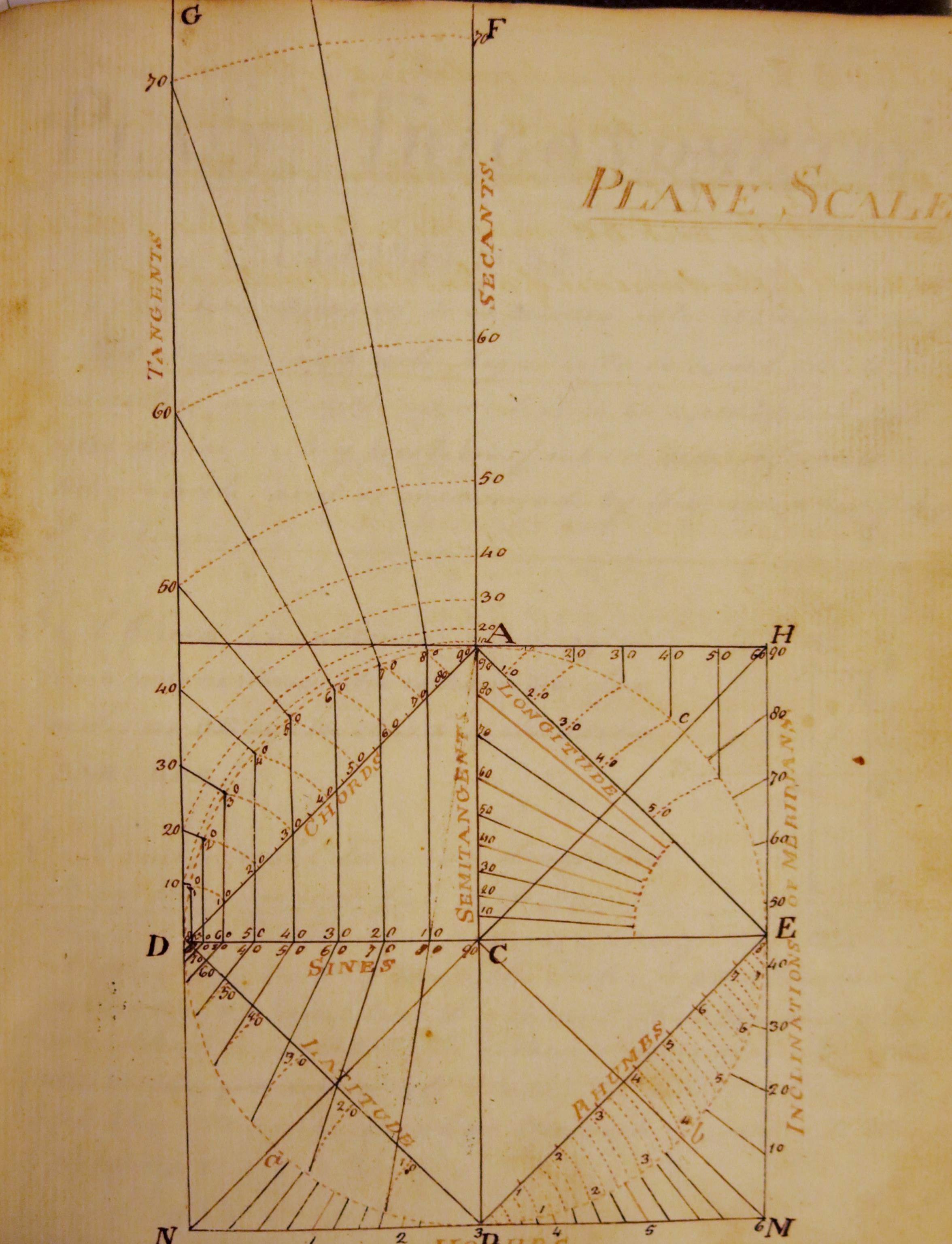
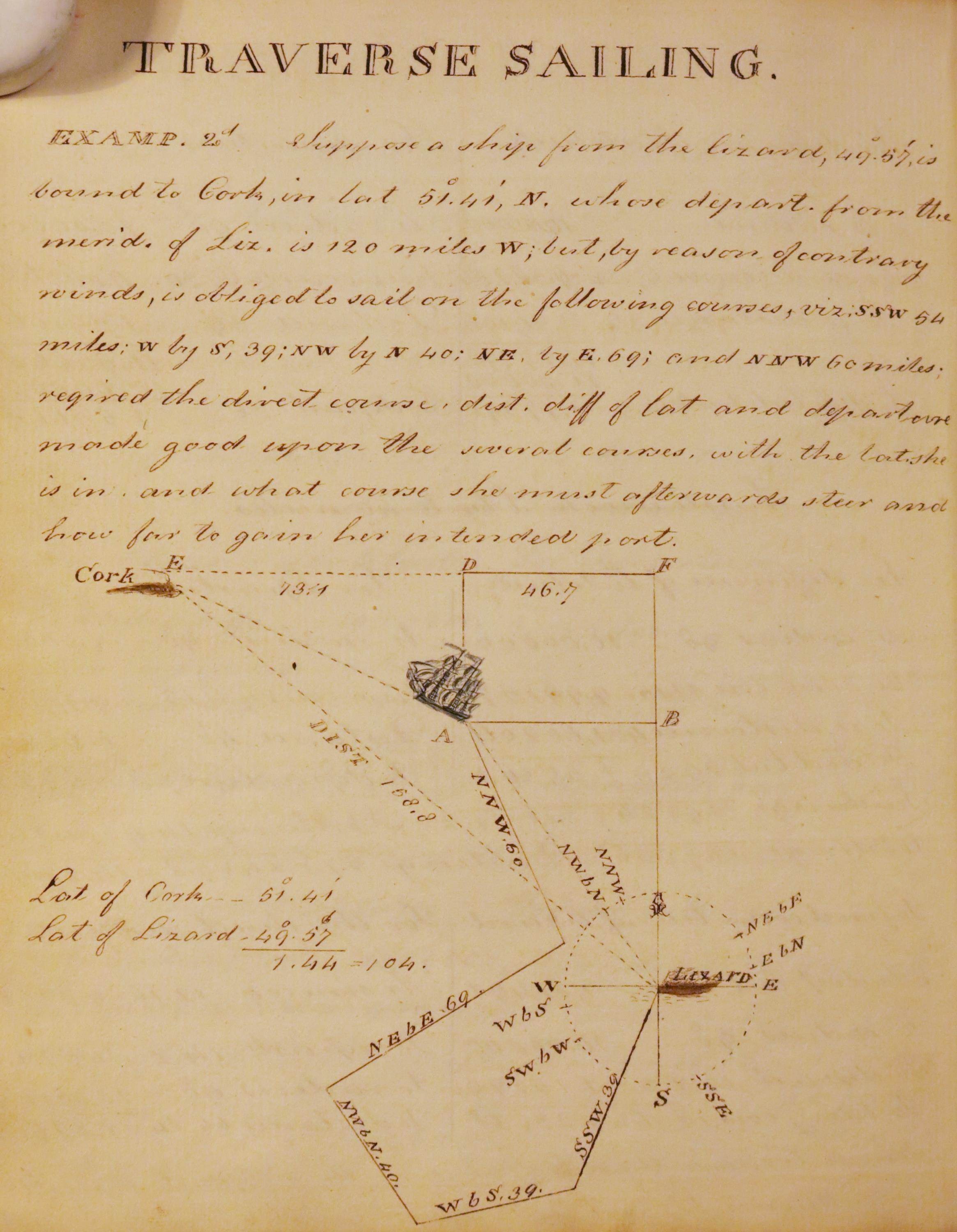
The last section of this mathematical notebook concerns itself with matters of maritime navigation. 


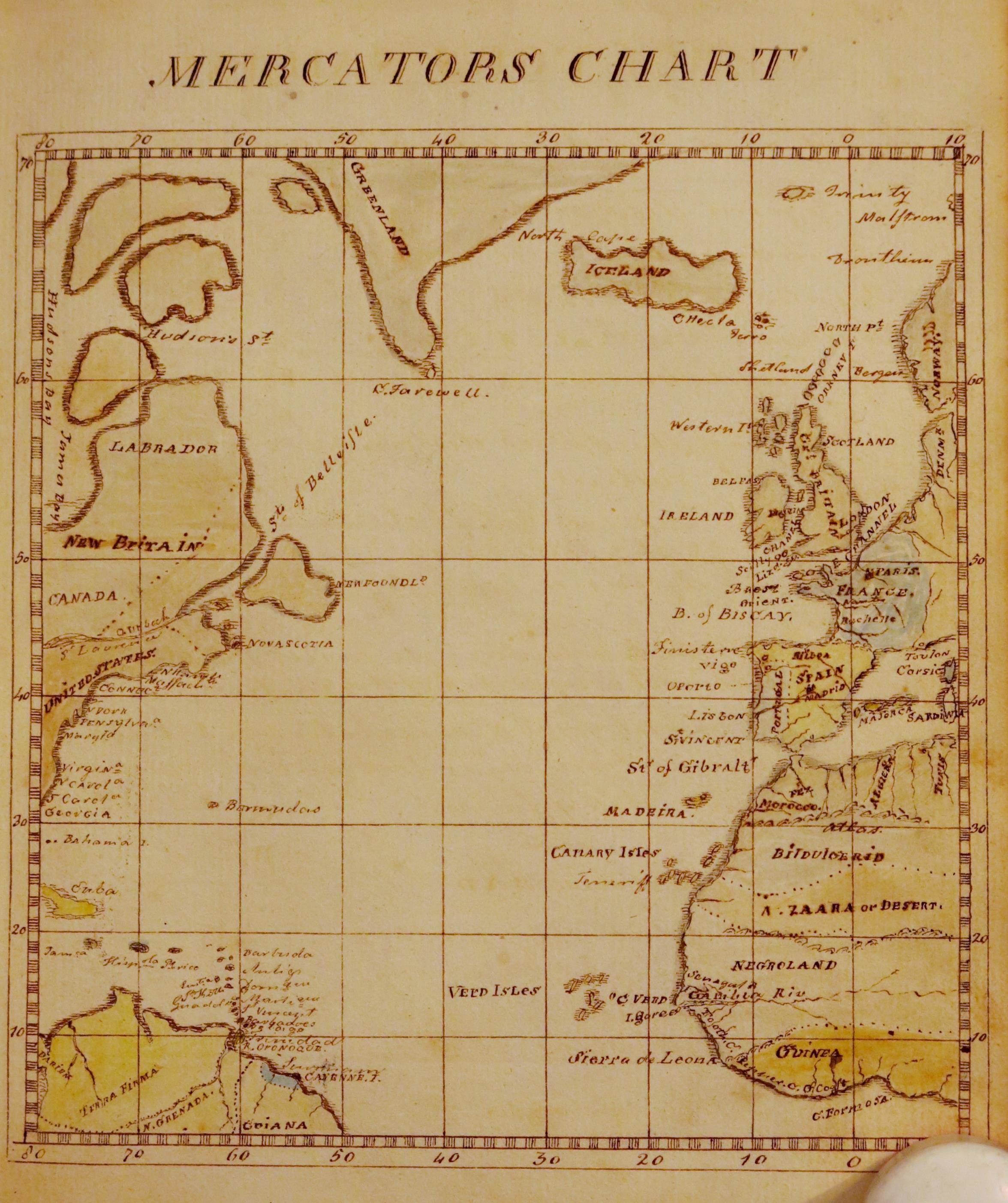
Again, Croswell draws out intricate geometric designs to illustrate the problems of navigation and sailing. He even includes a hand-drawn and colored map of the Atlantic Ocean (the judges deduct one point on this for his representation of the North American coastline). 


Pretty cool, right? To think, that from hearing about a modern medical issue in the news, I ended up with such a meticulously written and illustrated mathematical guide to solving problems of navigation! Now it’s your turn. Pick a starting point in ABIGAIL and see how far afield you find yourself after just a few minutes. Then visit the library and check out what you discover!


Immigrants Needing Protection from Themselves? The Padrone System in Boston’s North End

By Rakashi Chand, Reader Services

In the late nineteenth century the Reverend Gaetano Conte created a scrapbook about the founding of the Society for Protection of Italian Immigrants in Boston, Massachusetts. The scrapbook, titled Societies for the protection of Italian immigrants: documents and illustrations, 1894-1906,  is a unique collection of notes, letters, newspaper clippings, annual reports, and photographs kept by Conte during his years in Boston and through his return home to Italy.

Interestingly this organization was not formed with the intention of protecting the newly arriving Italian Immigrants from Americans or other immigrants, but from fellow Italian immigrants! Why was there such a need as described by the Reverend and the inhabitants of Boston’s North End? What were the Italian Immigrants exposed to that other immigrants were not? What was it that put fear and anger in the hearts of families and young men when they arrived on American shores? The answer to each question is the same: The Padrone.

The Padrone System was a network that began in the towns of Italy and spread to the cities and towns of America. The Padrone -from the Italian word for manager or boss- were labor brokers. These were men who victimized their fellow countrymen as they arrived lost and alone in a foreign land. The new immigrants were in need of guidance, guidance that the Padrones would provide…at a price. The Padrone would offer employment opportunities to young men in Italy, often promising them safe passage and housing. The Padrone also offered banking for the immigrants; providing them with a “safe” place to save the money they earned and a way to “send” money home to Italy. Other Padrone would simply solicit Italian men who were already in America with the prospect of a “great” new job; all they had to do was agree to go to Maine for a year…

The degree of corruption varied, but the Padrone always profited from the relationship. Passage from Italy was on ships owned by companies with whom they had contracts. Housing was poor tenement apartments shared among many immigrants in sub-human standards.  The jobs they offered in America were often extremely hard with very little pay. The Padrone “banks” would often make large portions of the immigrant’s savings disappear for various fees. The money the immigrants would try to send home to their families in Italy would often never arrive. And the “great” new jobs would often be far from their new homes in Boston, such as in the woods of Maine where they would labor endlessly under the Padrone, often without seeing the wages they had been promised. The Italian immigrants often found themselves lost and confused in this new country; they couldn’t speak the language, they didn’t understand the customs and they were often uneducated. So the services of the Padrone seemed the only choice they had to survive; they felt they had no one else to help them.

The Immigration Act of 1864, supposedly to encourage immigration, created the opportunity for Padrones in America; it allowed manufacturers to bring in a cheap foreign labor force under contract, hence needing a middleman or labor broker to negotiate between the laborers and the employers. Although largely unheard of, the Padrone Act of 1874 tried to stop the padrone system to protect immigrants from “involuntary servitude.”  

Rev. Conte came to the United States in 1893 to help his fellow Italians who had moved to America. Upon arriving in America and beginning his work here, the Reverend began to keep records of the social situation of the Italian immigrants. He found the Italian immigrants needed more than just their souls saved, and the Reverend was not going to allow his people to suffer. He became the superintendent of the Boston Society for the Protection of Italian Immigrants. He was also involved in the North End Italian Mission, the Association for Protecting Italian Workmen, and the Society for Protection of Italian Immigrants.

Rev. Conte’s work with Italian Immigrants in Massachusetts was pioneering and heroic. His notes are aptly named after the Society that he created. The revered was not only interested in protecting Italians from the Padrone; he also sought to improve schooling, housing and health care.  The collection here at the MHS covers many aspects of the immigrants’ lives, social, political, religious and moral. It illustrates elements of the social aspects of immigration and life in the North End along with observations of religious, moral and ethical issues. It also contains photographs, illustrations and legal records, annual reports and statistical information. Finally the collection has many newspaper clippings from both American and Italian immigrants portraying the victimization by the Padrone and the actions of the Societies for the protection of Italian immigrants.


Also in the collection are two versions of a memoir written by Conte and focusing on issues of Italian emigration to North American at the turn of the 20th century. There is a 1903 Italian-language printing, Dieci anni in America: impressioni e ricordi, and a 1976 translation titled Ten Years in America: impressions and recollections…  

Interested in U.S. immigration over the years? Try searching our catalog, ABIGAIL, for subject terms like United States Emigration and immigration


This Week @ MHS

By Dan Hinchen

On the calendar this week we have a pair of seminars, a pair of public programs, and a free tour. Here’s how it all shakes out:

– Tuesday, 9 February, 5:15PM : Join us for an Environmental History seminar discussion with presenter Laura J. Martin of Harvard University, and commentor Brian Payne of Bridgewater State University. The talk focuses on Martin’s paper, “The History of Ecological Restoration: From Bombs to Bac-O-Bits,” which explores the intellectual and cultural history of ecological restoration from 1945 to 1965. Seminars are free and open to the public; RSVP requiredSubscribe to receive advance copies of the seminar papers.

– Thursday, 11 February, 5:30PM : Laura Briggs of UMass-Amherst presents “All Politics are Reproductive Politics: Welfare, Immigration, Gay Marriage, Foreclosure” as part of the History of Women and Gender seminar series. The project looks at the collision of two forces – increasing unpaid care burdens, and ever more need for wage labor – and how they have radically reconfigured both families and political common sense in particularly racialized ways over the last forty years. Suzanna Danuta Walters of Northeastern University provides comment. Seminars are free and open to the public; RSVP requiredSubscribe to receive advance copies of the seminar papers. This event takes place at the Schlesinger Library, Harvard.

– Thursday, 11 February, 6:00PM : “Culture of Modernism” is the second of a four-part series on the topic of Modernism. This talk features author Alexandra Lange; Jane Thompson of the Thompson Design Group; and Michael Kubo of Collective-LOK. There will be a pre-talk reception at 5:30PM. Registration is required for this program. This program takes place at the Concord Museum.

– Friday, 12 February, 2:00PM : “Jefferson’s Journey to Massachusetts: The Origin of the Coolidge Collection at the MHS” is a free gallery talk focused on our current exhibition, The Private Jefferson. Stephen T. Riley Librarian, Peter Drummey, explains the provenance of this collection and how the largest collection of this Virginian’s private papers arrived at the MHS. This talk is free and open to the public. 

– Saturday, 13 February, 10:00AM : The History and Collections of the MHS is a docent-led walk through our public rooms. The tour is free, open to the public, with no need for reservations. If you would like to bring a larger party (8 or more), please contact Curator of Art Anne Bentley at 617-646-0508 or abentley@masshist.orgWhile you’re here you will also have the opportunity to view our current exhibition.

Curiosities and Monstrosities

By Dan Hinchen, Reader Services

As I sat trying to think of ideas for this post, I opened our online catalog, ABIGAIL, to brainstorm and see if I could think of any odd subject headings I wanted to explore. There, in that sentence, lay the answer. I typed in “oddities” to see what we might have in our holdings with that tag. The number of results I got with that search was a big fat goose egg. Thankfully, ABIGAIL, though often cruel in her adherence to a controlled vocabulary, offered me a bit of help and gave me another term that I should look into: “Curiosities and Wonders.” 

And so I was off, looking into what curious and wondrous items the MHS holds. There are 33 titles associated with that subject heading in the catalog, with further subdivisions pointing to specific geographic locations (Lawrence and Boston, MA; NY, NY; Great Britain), photographs, even juvenile literature. Confining myself to the original 33, I started browsing the titles for common themes or links among them. It was soon apparent that we had a decent little number of items relating to the grotesque, freakish, and monstrous. 


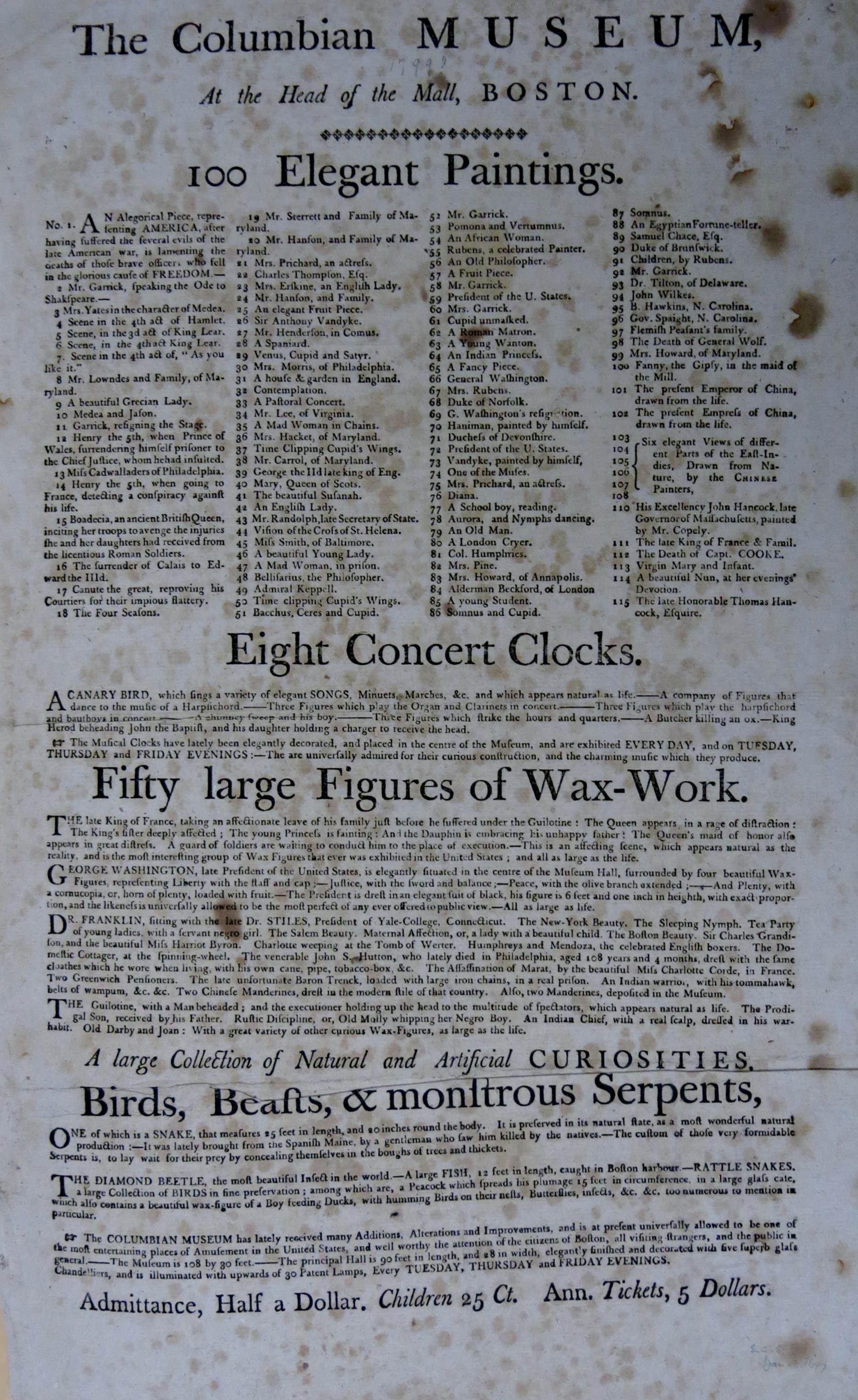
Opened by Daniel Bowen in 1795, the Columbian Museum showcased a broad range of curiosities: waxen figures of John Adams; larger-than-life depictions of Scriptural scenes, like David and Goliath; and exhibitions of various animals. “A procupine, a bear, a raccoon, and a rabbit were announced by their proprietor as ‘very great curiosities.’ There was an elephant which, in conformity with the habits of the day, drank ‘all kinds of spirituous liquors;’ and the public were assured that ‘thirty bottles of porter, of which he draws the corks himself, is not an uncommon allowance.’… spectators were informed that ‘he will probably live between two and three hundred years,’ — an announcement which shows that the effect of alcohol upon animal tissue was not then so well understood as it is thought to be at present.”1 The Columbian Museum operated until 1825 when the collections were acquired by Ethan Allen Greenwood for his New England Museum.


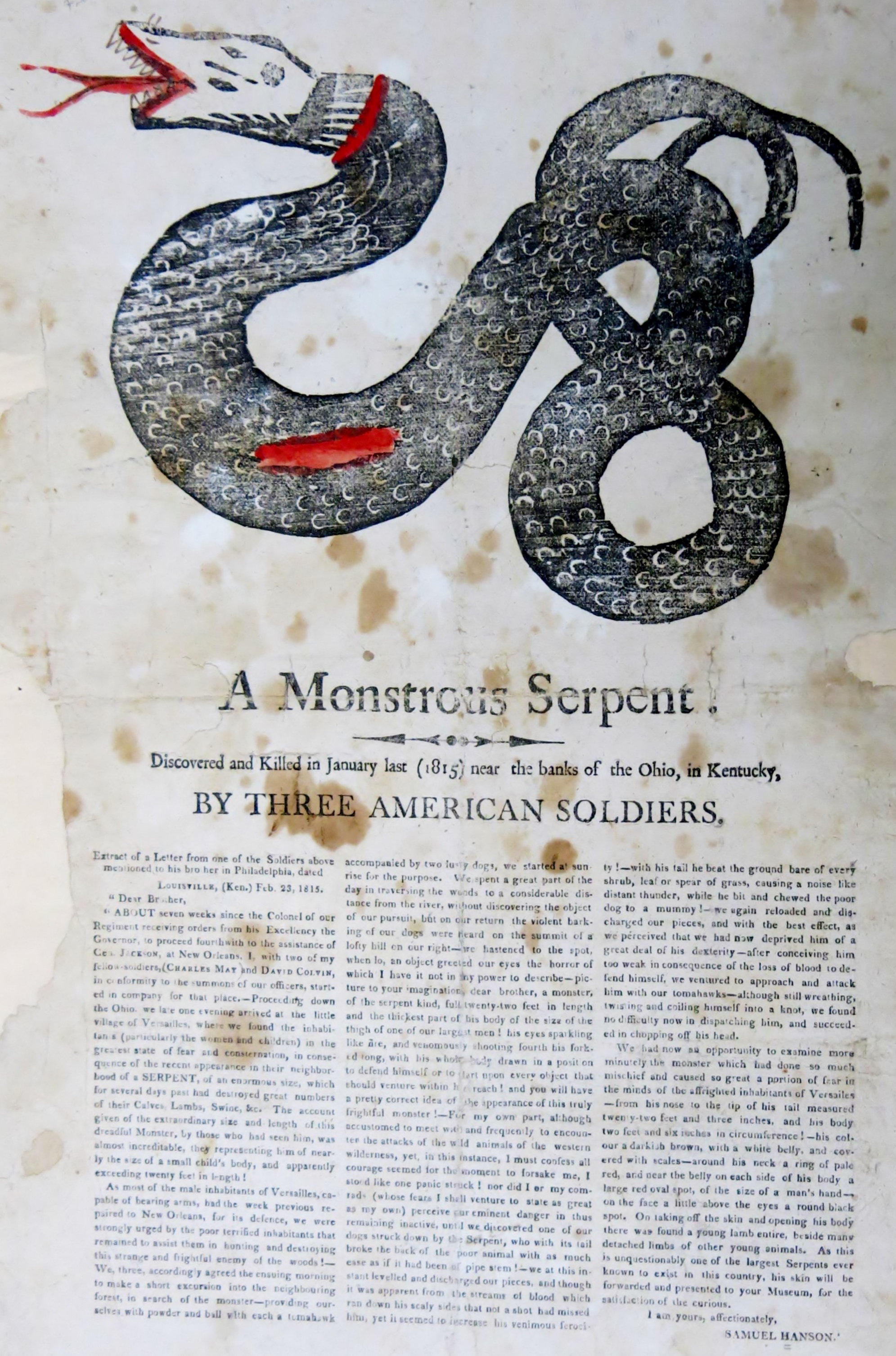
This broadside relates a piece of correspondence written by Samuel Hanson to his brother. Hanson, along with two other soldiers, is ordered to travel from Louisville, KY, to New Orleans in order to assist General Jackson there. Along the way, the three men stop for a night in the town of Versailles, KY, on the Ohio River. They are told tales of an enormous serpent that has been menacing the town and eating livestock. With all the able-bodied men of the town already off in New Orleans to join in the fighting, the townspeople aske these three soldiers to help them get rid of the threat. They agree and, the next day head out with their two dogs to search for the beast in the woods. After some time, they finally find “a monster, of the serpent kind, full twenty-two feet length, and the thickest part of his body of the size of the thigh of one our largest men! his eye sparkling like fire, and venomously shooting forth his forked tongue…” The men eventually succeeded in killing the beast and taking its head. 


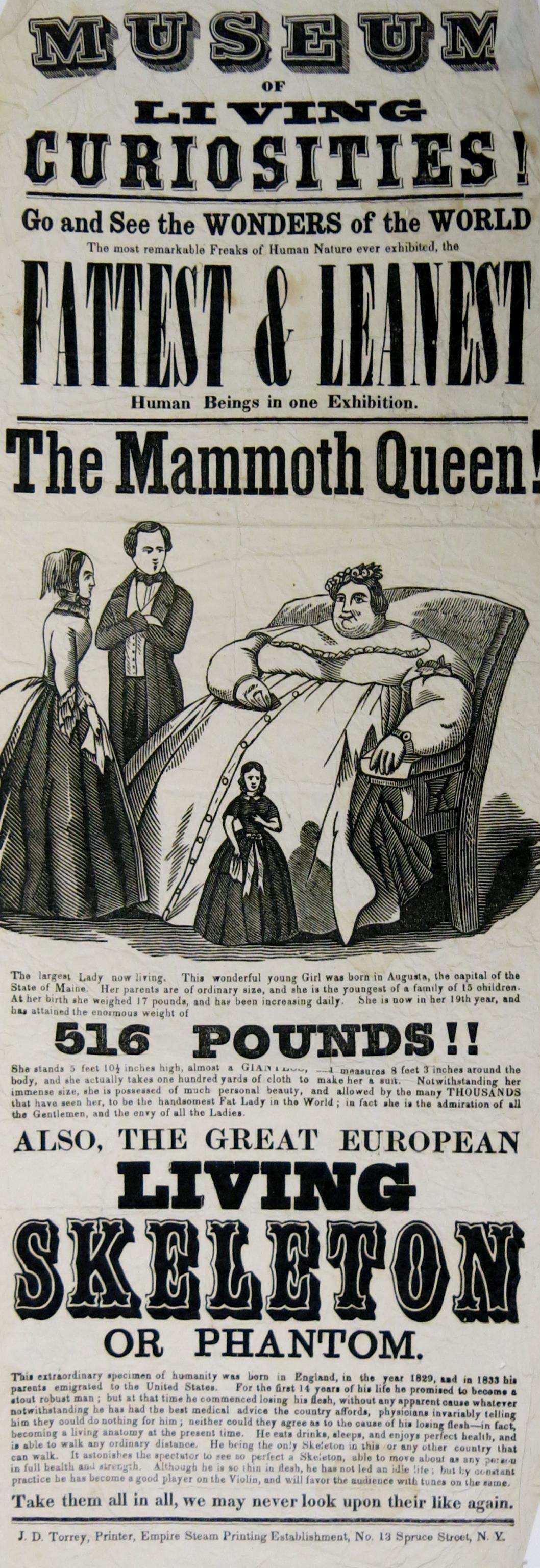
Finally, this broadside caught my eye mainly because of the image that dominates the center. However, after a closer look, it is the feature at the bottom that really stands out. Upon closer reading, we find that the audience has the opportunity to see a living man who, early in life, promised to be a robust man later on. However, due to some unexplained circumstance, the man lost all flesh and was, seemingly, a living skeleton, and one that could play the violin, to boot!

Clicking through ABIGAIL with little direction can yield some interesting and entertaining items. Take a trip down the rabbit hole, see what you find, and then visit the library!


1. Winsor, Justin, The Memorial History of Boston : including Suffolk County, Massachusetts, Boston: Osgood, 1881


The Wanderer

By Susan Martin, Collections Services

The Fay-Mixter family papers here at the MHS includes a folder of material related to the fascinating story of the Wanderer, a luxury yacht refitted in 1858 to engage in the illegal trans-Atlantic trade of enslaved persons. The importation of enslaved people to America was prohibited by the U.S. Congress fifty years before, but smuggling was common. Multiple sources cite the Wanderer as the last known ship to bring enslaved Africans to the United States, but we now know that the Clotilda arrived the following year.

By all accounts, the Wanderer was a very fast vessel, capable of sailing up to 20 knots. William C. Corrie of Charleston, S.C. purchased the yacht in early 1858. He and his business partner, Charles Augustus Lafayette Lamar—cotton planter, radical Fire-Eater, pro-slavery secessionist—immediately began refitting the yacht for its nefarious purpose. Their work aroused the suspicions of officials in New York, who temporarily seized the ship for inspection. Newspaper articles speculated (rightly, it turned out) about the true reason for the modifications, excessive provisions, and foreign crew. But with no definite proof, the ship was released.

The ship sailed on 3 July 1858, arriving at the African coast in September. Corrie got past the British and American anti-slavery patrols stationed there, according to one account, primarily using a charm offensive—friendly dinner parties, etc. The crew of the Wanderer claimed to be on a pleasure cruise up the Congo River. They even sailed under the pennant of the New York Yacht Club. And it worked: the vessel was apparently never inspected.

The Wanderer returned to the U.S. on 28 Nov. 1858, landing at Jekyll Island off the coast of Georgia with over 400 African captives. Dozens had died en route. The arrival of these new enslaved people, along with some questionable documentation, attracted the attention of the authorities, and the jig was up. The ship was seized and the conspirators arrested. In May 1860, Lamar, Corrie, and others were tried for piracy in federal court in Savannah…and acquitted. One of the judges in the case was Lamar’s father-in-law.

The Wanderer material forms part of the Fay-Mixter collection because James Story Fay held a bond of indemnity for the ship. The papers include twelve letters to Fay’s colleague E. D. Brigham in Boston, dated 5 Jan.-10 Apr. 1860, in the run-up to the trial. During this time, Charles Lamar regained possession of the ship and sent it to Havana, under the care of C. R. Moore, to be sold. Three of the letters were written by Moore in Havana, and these are, I think, the most interesting of the group.

Moore praised the speed and agility of the Wanderer, but not its mission: “She is one of the finest little vessels that it was ever my fortune to get on board of, and I wish she could be in some legitimate business, that I could sail her.” He had “fixed her up like a fiddle” and thought he could get $18,000-20,000.

Because of its history, the Wanderer held a certain fascination. Moore received many visitors onboard, including American tourists and British lords, all curious to see the famous ship. But selling proved difficult. The vessel was simply “to[o] expensive and to[o] notorious.” Moore felt the watchful eyes of the English and Spanish fleets and guessed that the English in particular resented the ship. He wrote: “I am asked all kinds of questions here and have to be carefull what I say.”

In his letters to Brigham, Moore discussed his future plans and weighed his options. More than once, he expressed a desire to captain the Wanderer, but he refused to resort to the trade of enslaved people, which was still legal in Cuba. He had received offers:

“There was some parties offered me $16,000 to go to the Coast [of Africa]. I refused. […] If I cannot get a livelihood without going in a Guineaman I will starve in the streets although I am no abolitionist. […] I will stay [in Havana] until I feel that its unhealthy for me to stay. You know I am fat and hot weather and musketoes operate bad on a fat man. […] I love the Wanderer but I cannot feel she will ever give me any permanent business.”

In his third and longest letter, dated 10 Apr. 1860, Moore painted a broader picture of the trade of enslaved people in Havana:

“They prefer the old vessels here for the Coast and there are 7 or 8 fitting out here for the Coast. The ship Erie cleared yesterday, and everybody knows where she is bound. The Captain an American, Gordon his name, cleared before the Consul without difficulty. The Gov Gen is poor and winks at it. He gets $50 a head. I have had offers to go in this vessel, they would bye her for me, but I have tried to live an honest life so far and as long as I have sailed out of Boston. If the Merchants will not give me legitimate employment I will starve before I will go after blackbirds, although I do not think a negro as good as a white man, and am not an abolitionist. But when I coil my ropes up for the last time, I shall feel happyer if I have lived and practised the precepts that my parents taught me.”

The more I researched the Wanderer and the people connected to it, the more interesting the story became. A biography of Charles Lamar, for example, could fill volumes. C. R. Moore described rumors of the firebrand’s colorful exploits: “What I can learn about the young man is not much to his credit […] They tell me here that he is a remarkable small man always carryes Revolvers in his belt has shot 1 or 2 men […]” The rumors were apparently well-founded; in the month of May 1860 alone, Lamar was not only tried for piracy, but also participated in a prison break and a duel!

The Wanderer was seized once more by the U.S. government in 1861 for use against the Confederacy during the Civil War. After the war, it passed into private hands and sailed commercially for a few years before sinking off the coast of Cuba.

So what happened to the hundreds of enslaved Africans smuggled across the Atlantic on the Wanderer? Unfortunately, their fate was no different than that of the millions who preceded them. They were trafficked across the South, and the brazen Charles Lamar even kept some of them himself. The federal government showed as little interest in protecting them as it had in punishing their enslavers.

Because of its notoriety, there has been significant research into this case over the years. One of the earliest studies I found is a 1908 article in American Anthropologist by Charles J. Montgomery. Published fifty years after the ship’s fateful passage, while many of the “Wanderer Negroes” were still alive, the article contains an uncomfortable anthropological focus and some unfortunate language. However, it also includes specific information about a few of the captives, as well as their histories and photographs.

In 2008, the state of Georgia erected a monument to the ship’s African survivors on Jekyll Island, and some of their descendants attended the dedication ceremony.

For more information, see The Slave Ship Wanderer by Tom Henderson Wells (Athens, Ga.: University of Georgia Press, 1967) and The Wanderer: The Last American Slave Ship and the Conspiracy That Set Its Sails by Erik Calonius (New York: St. Martin’s Press, 2006).

This Week @ MHS

By Dan Hinchen

At the top of the list this week is our recently unveiled exhbition! Come by anytime Mon-Sat, 10:00AM-4:00PM, to take a look at The Private Jefferson. The exhibit is free to the public and will remain on display through 20 May 2016. 

There are four other items on the calendar this week for public consumption:

– Tuesday, 2 February : There is an Early American History seminar beginning at 5:15PM. “Sound Believers: Rhyme and Right Belief” is presented by MHS-NEH long-term fellow Wendy Roberts, SUNY-Albany. Roberts’ project examines the connection between poetry and evangelicalism in the 18th and early-19th centuries. Stephen A. Marini of Wellesley College provides comment. Seminars are free and open to the public; RSVP requiredSubscribe to receive advance copies of the seminar papers.

– Wednesday, 3 February : Starting at noon is a Brown Bag talk given by independent scholar Robert G. Mann. His work, “Making Another Massachusetts of South Carolina: Reconstruction in the Sea Islands,” evaluates the achievements and disappointments of a unique, integrated community centered around Beaufort, South Carolina, in the years 1863-1880 through the intertwined stories of three Massachusetts men and one former slave. This talk is free and open to the public. 

– Wednesday, 3 February : Join us for the first of a four part series on Modernism, “Brutalism to Heroic.” This conversation features Mark Pasnik, AIA, Over, Under; Chris Grimley, AIA, Over,Under; and Michael Kubo, Collectiove-LOK. There is a pre-talk reception that begins at 5:30PM with the talk beginning at 6:00PM. Registration is required for this event. 

– Saturday, 4 February : The History and Collection of the MHS is a docent-led tour that is free and open to the public. Spend about 45 minutes learning about the Society and touring the library area and then take the opportunity to visit our exhibition space. No need for reservations for individuals or small groups. Parties of 8 or more should contact Curator of Art, Anne Bentley, in advance at abentley@masshist.org or 617-646-0508.

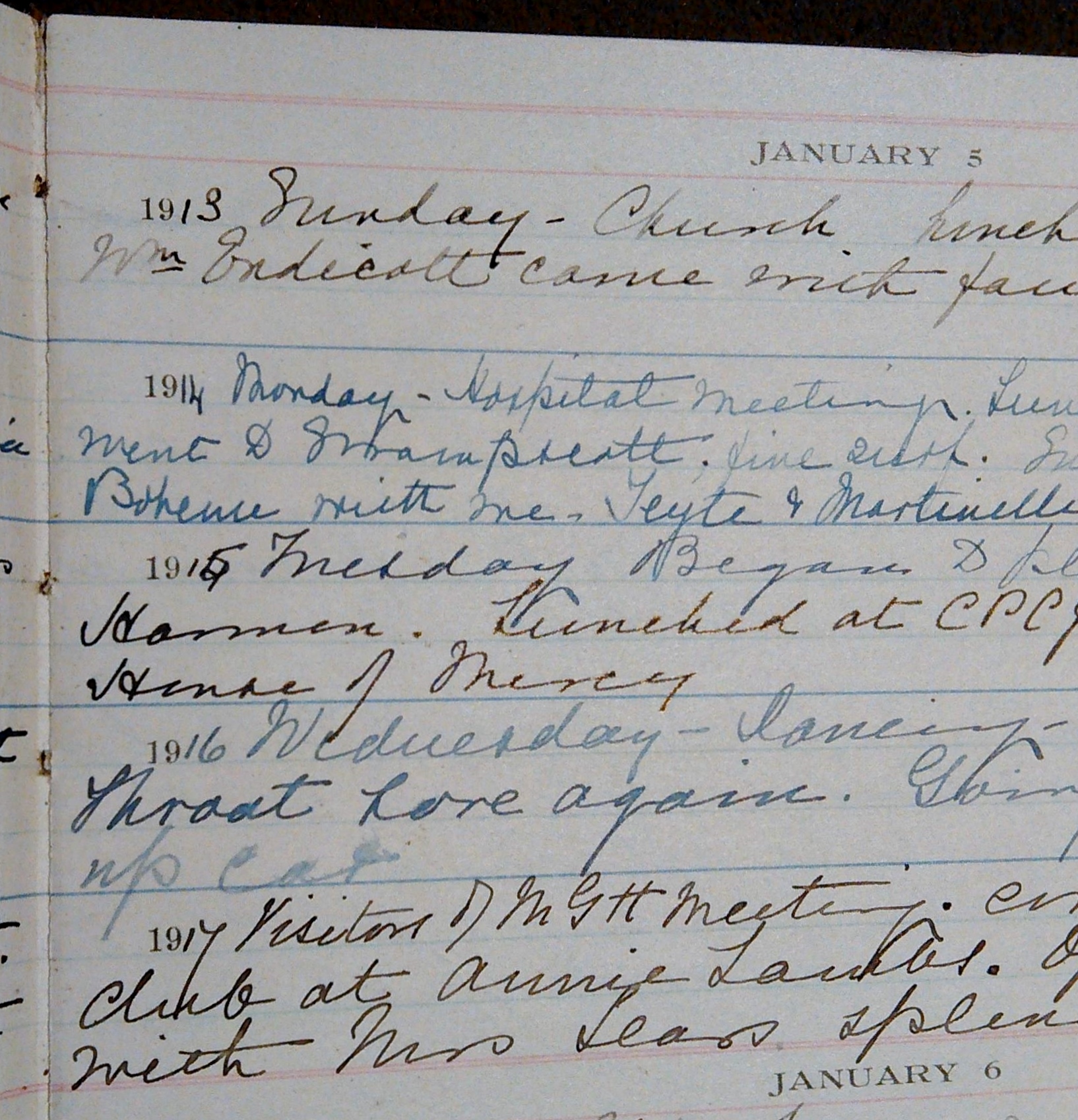
Margaret Russell’s Diary, January 1916

By Anna Clutterbuck-Cook, Reader Services

After receiving positive feedback on last year’s serial documenting a journey up the Nile by an anonymous diarist, I decided to repeat the format in 2016 but with a very different type of diary from the MHS collections.


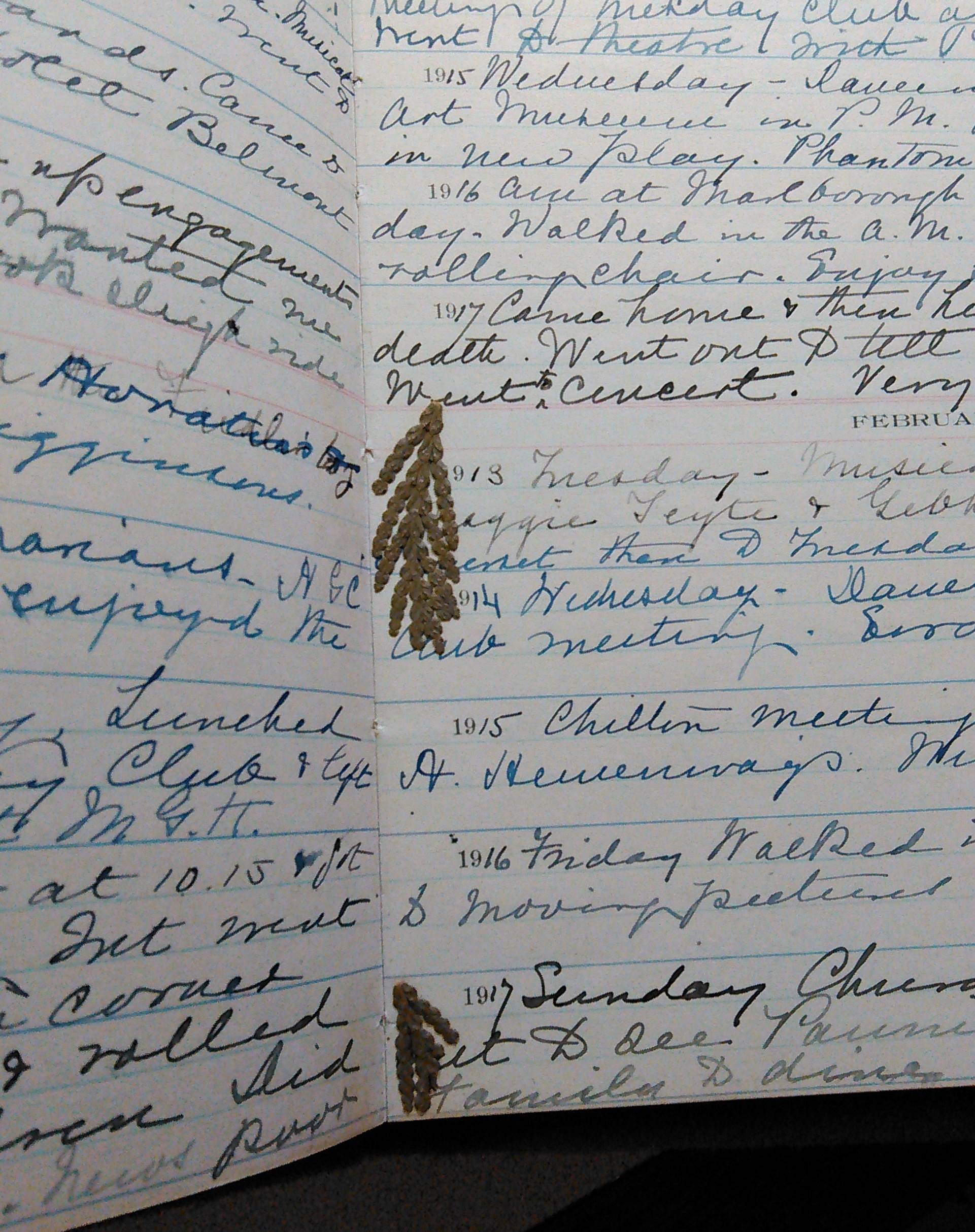
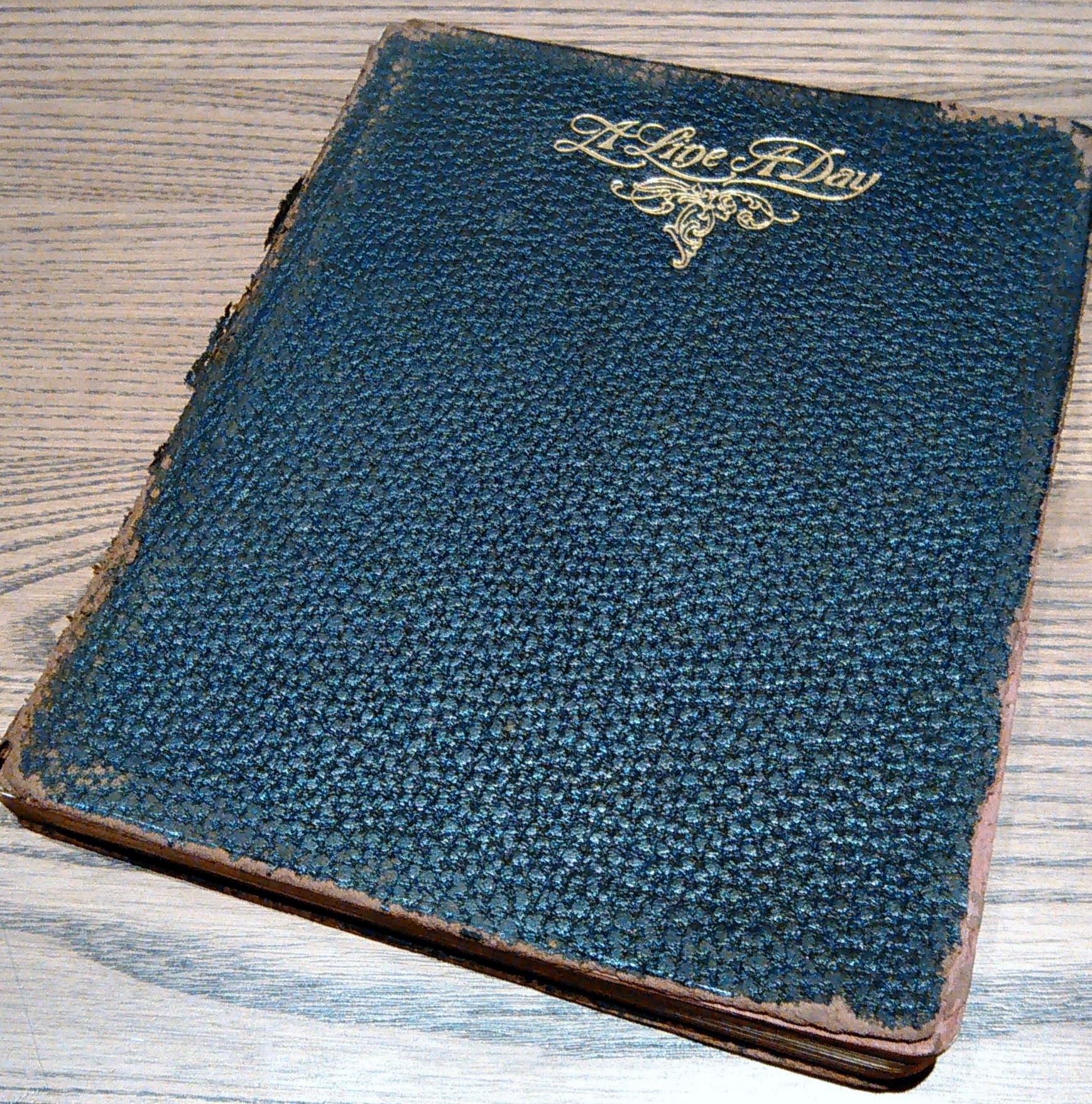
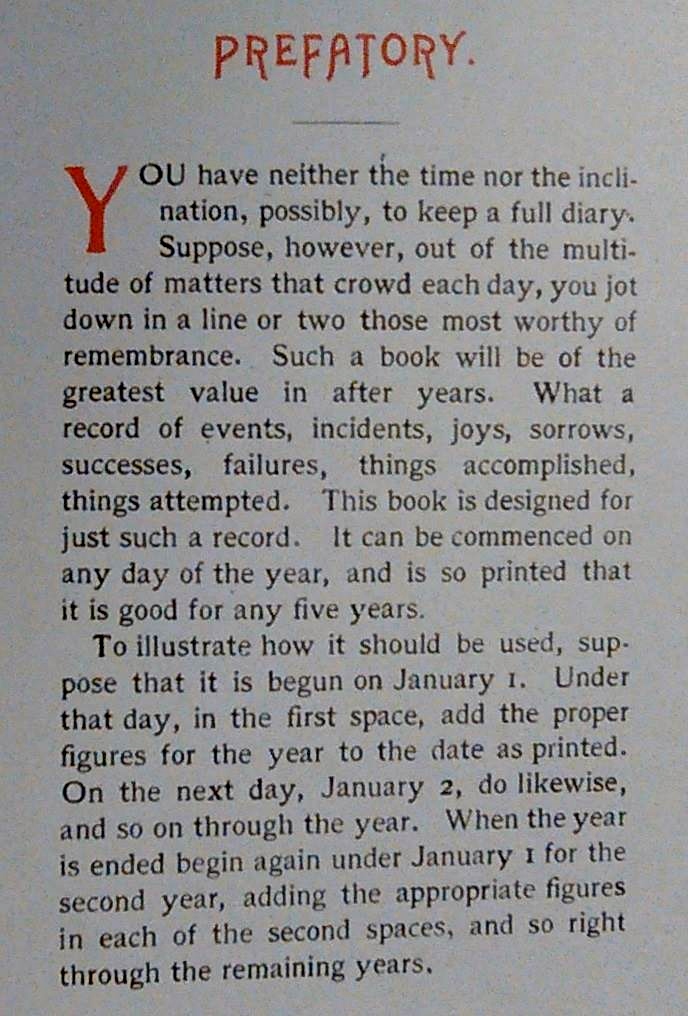
Between 1913-1922, Margaret Russell kept track of her activities in Ward’s line-a-day diaries pre-formatted to accommodate five years worth of daily records. As historian Molly McCarthy documents in her history of the daily planner, these standard blank books rose in popularity toward the end of the 19th century. The Samuel Ward Company of Boston, Massachusetts copyrighted their format in 1892, offering a “condensed, comparative record for five years” with the tagline, “nulla dies sine linea (not a day without a line).” Russell’s volume, which she began filling in 1913 at the age of fifty-five, offers prefatory instructions for the inexperienced diarist:


Russell appears to have found satisfaction in keeping her line-a-day record, because three years later in January 1916 she is still diligently writing daily in her Ward’s volume. The first month of the year is punctuated by poor weather and ill-health, as well as a full slate of social activities. While brief, in aggregate form the diary entries grant us view of daily life for a white, upper middle-class woman in middle age, living in Boston in the second decade of the twentieth century.


1 Jan. Saturday. Snowing & raining. Ear & Eye hosp. & errands. Went to Cambridge to see Katey & Aunt E–. Concert with Mrs. Schelling & Mrs. Sears.*

2 Jan. Sunday – Church – Lunched at H.G.C.’s. Family to dine & then to Slater musical. Gov. W– very prominent.

3 Jan. Monday – Hosp. meeting. [word] lunch at Marian’s. Botany lecture & drove to Swampscott. Very heavy roads.

4 Jan. Tuesday – Paying bills – walked downtown to Dr. Crockett for third time about my ear. Lafayette Fund show with Georgie.

5 Jan. Wednesday – dancing – Ward lecture. Throat sore again. Going to [word] I put up car.

6 Jan. Thursday. Felt poorly with [word] cold. Went to tableaux with Marian R. A beautiful show.

7 Jan. Friday Walked for errands & Dr. Crockett who says I better go to Woodstock to have [word]. Stayed at home all the afternoon.

8 Jan. Saturday. Mr. Surette’s first lecture very interesting. Went to Ellen’s dancing school. Meant to go to assembly but throat prevented.

9 Jan. Sunday – Felt feverish so stayed in all day. Family to dine.

10 Jan. Warm & rainy. Drove to Cambridge with Miss A– for botany lecture with slides. Much depressed by my ignorance.

11 Jan. Monday-Felt very poorly. Dr. C.sent me home & I passed the P.M. on my couch with pleasure. Gave up dinner at Burr’s. 

12 Jan. Wednesday – In the house all day this is the fourth sustained attack I have had.


13 Jan. In the house – better.

14 Jan. In the house. Sat in the window for a short time.Miss A- sent for as sister has pneumonia but she died before Miss A- got there.

15 Jan. So cold I gave up going out but sat in the window in the warm sun. Susan Bradley came to see me.

16 Jan. Sunday – did not go out. Mr Fenno came to call & family came to dine.

17 Jan. Monday – very cold & windy but drove to May R.’s birthday lunch and back .Botany lesson here. Ellen & teacher to play here.

18 Jan. Tuesday – lovely cold day.Feel better at last. Sat in the open window & went to Swampscott in P.M. Roads very good.

19 Jan. Wednesday. Went to Mrs.Ward’s lecture.Llunched at Chilton. Lecture at Art [word] & tea for Emily [word] at Mrs. T. Motley’s.

20 Jan. Thursday – Errands but began to snow and then rain so stayed at home in the P.M. Feeling better.

21 Jan. Friday. Went to concert & took Mrs.Hadder

22 Jan. Saturday Went to Mrs.Tyson’s in the P.M. did not feel so well.

23 Jan. Sunday Stayed in bed till dinner time & felt better. Family to dine.

24 Jan. Monday. Stayed in bed in the morning. Botany lesson & then rested.

25 Jan. Monday. Sat in the window & after lunch went to drive. Really warm. Gave up Lyman dinner.

  26 Jan. Wednesday.Drove morning & afternoon & feel better.

27 Jan.Thursday. Drove in the morning & went to bank. Lunch club at [word]. Went to see Dr. Balch who says I must be careful.

28 Jan. Friday – [word] not get up in the A.M. Lunched at Bell’s – took a drive & feel better.

29 Jan.Saturday-Mrs.Tyson’s in the A.M. To see Dr. Balch who called in Dr. W.D. Smith in consultation. Both say be careful.

30 Jan. So tired after yesterday’s performance that I stayed in bed until P.M. Lucy Bradley & Jessie came to call. Family to dine.

31 Jan. Monday -Feel better. Had my hair washed. Lunch at Marian’s & home for botany lesson. Rested. Mrs. McL– called home.


Join me once a month throughout the year as we continue to follow Margaret Pelham Russell’s daily activities as she recorded them one hundred years ago.

If you are interested in viewing the diary in person in our library or have other questions about the collection, please visit the library or contact a member of the library staff for further assistance.


*Please note that the diary transcription is a rough-and-ready version, not an authoritative transcript. Researchers wishing to use the diary in the course of their own work should verify the version found here with the manuscript original.


This Week @ MHS

By Dan Hinchen

It’s hard to believe that the end of the month is here already but we have a big exhibit opening to round out our January programs. More on that down the page. Here’s what is on tap at the MHS this week:

– Tuesday, 26 January, 5:15PM : This week’s lone seminar is part of the Immigration and Urban History series. This time around, Cristina Groeger of Harvard University presents “Laborers, Servants, and Schools: Aspirations of Mobility and the Reproduction of Inequality in Boston, 1880-1940.” John McClymer of Assumption College provides comment. Seminars are free and open to the public; RSVP requiredSubscribe to receive advance copies of the seminar papers

– Wednesday, 27 January, 12:00PM : Pack up a lunch and spend an hour here at the Society so you can hear short-term research fellow Alisa Wade, The Graduate Center – CUNY, present her Brown Bag talk: “‘Prepared to do Businessy with Many’: Elite Women’s Investment in Early National New York City.” This project traces, among other things, women’s participation in New York’s transition to market capitalism in the early republic. The talk is free and open to the public. 

– Thursday, 28 January, 6:00PM : “‘The Private Jefferson’ Preview Reception.” SOLD OUT This special member event gives visitors a sneak peak at the Society’s newest exhibition before opening to the public. Remarks by Peter S. Onuf begin at 6:00PM, and the reception and preview begin at 6:30PM. 

This event is sold out. If you would like to be placed on the waiting list, please call 617-646-0518 or click on the RSVP link to submit your name online.

– Friday, 29 January, 9:00AM : The Private Jefferson, Special Breakfast PreviewMHS Fellows and Members are invited to a special breakfast preview. For those who are unable to attend the preview the night before, we will open the galleries at 9:00 AM. Stroll through the galleries and talk to MHS Stephen T. Riley Librarian Peter Drummey before the doors open to the public. Coffee and pastries will be available. 

– Friday, 29 January, 10:00AM : The Private Jefferson opens to the public. This exhibit is open Monday-Saturday, 10:00AM-4:00PM, free of charge until 20 May 2016. 

– Saturday, 30 January, 10:00AM : “The History and Collections of the MHS” returns! Stop by for a free tour of the Society. This docent-led tour is open to the public, free of charge. While you’re here you can also take in the current exhibition (see above). 

Guild Library Discoveries

By Wesley Fiorentino, Reader Services

As I mentioned in a previous Beehive post, there are all kinds of interesting discoveries to be made when exploring MHS collections. This time around I will be talking about a collection of books that I came across almost by accident while navigating through ABIGAIL, our online catalog.  I found a link to a book on Norse mythology, written by Rasmus Bjorn Anderson, which intrigued me quite a bit.  Working in an institution with a clear focus on Massachusetts history, I admit I was confused when I found an item on Scandinavian antiquities.  I put in a request for the title, and when it came to me, it was in a large record carton with a number of other books. 

To my surprise, when I opened the carton there were ten volumes inside, only one of which was the book by Rasmus Bjorn Anderson.  Of the other nine, all were written by different authors, with the exception of a two volume edition of Evelina, by Fanny Burney.  In addition to Anderson’s Norse Mythology are included an English edition of Goethe’s fable Reynard the Fox and Edward B. Lytton’s historical novel The Last Days of Pompeii.  Why was Anderson’s volume on the mythology of ancient Scandinavia housed with these other intriguing yet disparate works?  The books are all part of the Guild Library, an eclectic private collection which is one of several such private collections gifted to the MHS throughout our institutional history consisting of books on a truly broad range of topics.  The library belonged to Curtis Guild, Jr., Governor of Massachusetts and MHS member, and was donated to the MHS under the terms of the will of his wife Sarah Louisa Guild in April of 1949 (MHS Proceedings, vol. 69).  Below are a few of the works I found particularly interesting, and just a taste of what the Guild Library has to offer.


Rasmus Bjorn Anderson, born in 1846 to Norwegian parents in Wisconsin, heavily promoted the Viking exploration of the New World and also originated Leif Erikson Day.  In his bookNorse Mythology, Anderson celebrates the linguistic and literary heritage of the Scandinavian countries, as well as that of Germany and England.  Anderson praises the efforts of nineteenth century scholars who promoted the study and spread of Anglo-Saxon and Old Norse literature.  He then goes on to provide a preface to some of the major poems and written works that have survived in Old English and Old Norse, mainly from England and Iceland. 


The copy of Reynard the Fox has been translated from Goethe’s German into English verse by Thomas James Arnold.  Arnold, a nineteenth-century English barrister and magistrate, was known for his translations of Goethe and other German writers.  In addition to Reynard the Fox, Arnold translated Goethe’s Faust and Friedrich von Schiller’s ‘Song of the Bell’ into English.  Reynard the Fox is an epic verse adaptation of the story of Reynard the Fox, the central character in a cycle of fables dating to the Middle Ages, mainly from England, France, Germany, and the Netherlands.  The main character, Reynard, is a trickster figure whose adventures involve a number of other animal characters including Bruin the Bear, Sir Isegrim the Wolf, and Noble, the King of Beasts.  The stories surrounding Reynard’s exploits seem to parody the political and religious institutions of the Middle Ages, as a number of characters are clearly modeled on such familiar positions as the monarch, the priest, and the soldier. 


The Last Days of Pompeii, written by Lord Edward Bulwer Lytton in 1834, is a work of historical fiction focusing on events in the city of Pompeii leading up to the fateful eruption of Mount Vesuvius in 79 AD.  The novel was popular throughout the rest of the nineteenth century and well into the twentieth century, although today its popularity has severely waned.  The plot centers on a number of the city’s inhabitants.  The principal characters include a Greek aristocrat, an Egyptian sorcerer, an enslaved noblewoman, and a Christian persecuted for his faith.  The novel has been adapted to a variety of other mediums, including opera, film, and television.  Notably, the 1959 film version, directed by Sergio Leone, is considered a standard of the “sword-and-sandals” epic genre.  The cover is beautifully decorated with an image of townspeople fleeing as Vesuvius erupts, as well as with gilding and patterning along the borders. Throughout the book are intricate illustrations of scenes from the novel, though the illustrator’s name is not included.  The book is a perfect read for those hoping to learn more about nineteenth century printing, historical fiction, or romanticized memories of classical antiquity.

My curiosity about a book on Norse mythology would lead me to a number of other exciting discoveries.  I never thought that I would find a translation of a Goethe poem or a copy of a nineteenth-century historical fiction novel in the MHS collections, let alone boxed together with Anderson’s text.  The Guild Library collection covers a number of other topics as well, including African exploration and big game hunting in the nineteenth century.  There are all sorts of interesting items for the steadfast researcher or the inquisitive reader.  I can personally attest that hoping to examine just a single item, namely Anderson’s Norse Mythology, led me down a literary rabbit-hole I would not have thought existed.  Yet another example of what can happen while just browsing through MHS collections (http://www.masshist.org/library).  


“He has so damnd himself to everlasting Infamy”: Alexander Hamilton and Abigail Adams

By Amanda Norton, Adams Papers

Between the $10 bill and a smash-hit musical, everybody seems to be talking about Alexander Hamilton. January marks not only the anniversary of Hamilton’s birth, and his resignation as Secretary of the Treasury in 1795, it also marks the anniversary of the most famous, or infamous, insult hurled Hamilton’s way. It was on 25 January 1806 that John Adams memorably referred to Hamilton as the “bastard brat of a Scotch Pedler.”

John Adams’s hostility toward Hamilton late in life is well known and is usually attributed to the role Hamilton played in the Election of 1800, attacking Adams and contributing to his defeat. But the Adamses, both John and Abigail, had expressed distrust of Hamilton long before then, and Abigail was just as colorful as John was. In 1794 when opponents of his economic proposals condemned Hamilton, Abigail noted that while some of the criticism was unwarranted, it was not entirely unfounded. Alluding to William Shakespeare’s Julius Caesar, Abigail cautioned John, “I have ever thought with respect to that Man, ‘beware of that spair Cassius.’”

The next few years did nothing to improve Abigail’s opinion. Hamilton was widely believed to have unsuccessfully meddled in the 1796 Election, attempting to keep Thomas Jefferson out of the vice presidency, even, or perhaps, especially, if it meant sacrificing John Adams’ candidacy. Hearing of Hamilton’s interference in December 1796, Abigail wrote, “I have often said to you, H——n is a Man ambitious as Julius Ceasar, a subtle intriguer. his abilities would make him Dangerous if he was to espouse a wrong side. his thirst for Fame is insatiable. I have ever kept My Eye upon him.”

The revelation of Hamilton’s affair with Maria Reynolds in 1797 was a breaking point for Abigail, leading to some of her most vitriolic comments. As the Quasi-War with France was building and the United States formed a new army, Abigail could not understand those who wanted Hamilton to be commander-in-chief. “That man would in my mind become a second Buonaparty if he was possessd of equal power,” she wrote to her cousin in July 1798. By January 1799, Abigail was increasingly heated. Learning that her son Thomas Boylston Adams who had been in Europe was to return to the United States on board the ship Alexander Hamilton, Abigail sneered, “I dont like even the Name of the ship in which he is to embark” and in letters written to John on 12 and 13 January, she railed against Hamilton. Abigail firmly believed that Hamilton’s failure to uphold his private marriage vow inevitably made any public vow he made suspect. In a Biblical allusion to King David, she warned that with Hamilton in charge of the army, “Every Uriah must tremble for his Bathsheba.”

While John’s acerbity is well known, Abigail Adams was no more timid in her remarks. Throughout the 1790s, Alexander Hamilton was on the receiving end of her barbs, even though Abigail maintained that she saw no “breach of Charity” in her observations.