New Titles in the MHS Library’s Reference Collection

By Anna J. Clutterbuck-Cook, Reader Services

Here in the MHS library it is always a pleasure to see the fruits of scholarly labor pursued in our reading room come back to us as the form of publications hot off the presses. In recent months, we have been delighted to add a number of titles to our collection gifted to us by their authors.


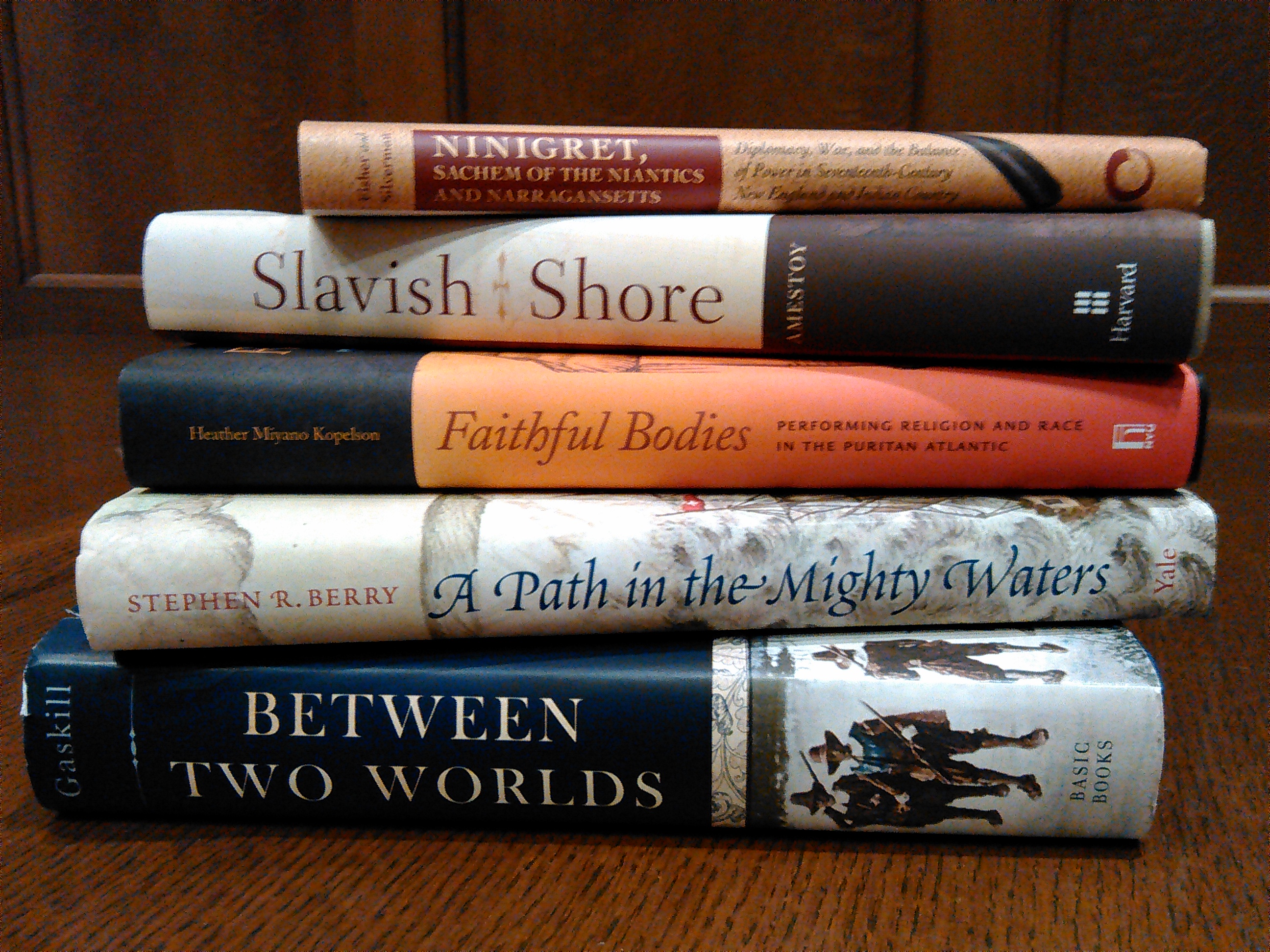
The following recently-published titles have been cataloged and are now available for use as part of our reference collection:

Amestoy, Jeffrey L. Slavish Shore: The Odyssey of Richard Henry Dana Jr. (Harvard University Press, 2015).

Balik, Shelby. Rally the Scattered Believers: Northern New England’s Religious Geography (Indiana University Press, 2014).

Berry, Stephen. A Path in the Mighty Waters : Shipboard Life & Atlantic Crossings to the New World (Yale University Press, 2015).

Blanck, Emily. Tyrannicide: Forging an American Law of Slavery in Revolutionary South Carolina and Massachusetts (University of Georgia Press, 2014).

Fisher, Julie A. and David J. Silverman. Ninigret, Sachem of the Niantics and Narragansetts : Diplomacy, War, and the Balance of Power in Seventeenth-century New England and Indian Country (Cornell University Press, 2014).

Gaskill, Malcolm. Between Two Worlds : how the English became Americans (New York: Basic Books, 2014).

Hodes, Martha. Mourning Lincoln (Yale University Press, 2015).

Kopelson, Heather Miyano. Faithful Bodies: Performing Religion and Race in the Puritan Atlantic (New York University Press, 2014).

Morrison, Dane. True Yankees: Sea Captains, the South Seas, and the Discovery of American Identity (Johns Hopkins, 2014).

Researchers are welcome to visit the MHS library during our regular business hours to consult these and other titles. If you are an author who has written a work drawing on research done at the MHS, we invite you to send a copy of your book to the Reference Librarian for inclusion in the Society’s collection. 


This Week @ MHS

By Dan Hinchen

It is a busy holiday week at the MHS with plenty of programs on offer to meet your daily required amount of history. Please note that the library is closed on Monday, 12 October, in observance of Columbus Day. Despite the library closure, our doors remain open! Stop by anytime 10:00AM-3:00PM to enjoy Opening Our Doors, a city-wide celebration of free arts and cultural events. In addition to our two current exhibitions, visitors can also enjoy a special one-day presentation of “Doors from the MHS Collections.” 

On Tuesday, 13 October, we return to our normal schedule, including an evening Environmental History Seminar presented by David Hecht of Bowdoin College. Beginning at 5:15PM, Hecht discusses “How Rachel Carson Became a Revolutionary: Environmental Politics and the Public Sphere.” Chris Bosso, Northeastern University, provides comment. Seminars are free and open to the public; RSVP requiredSubscribe to receive advance copies of the seminar papers.

Then, on Wednesday, 14 October, join us for the first in a new program series, “Transforming Boston: From Basket Case to Innovation Hub, Program 1—Turning the City Around, 1945–1970.” This panel discussion features Lizabeth Cohen, Frank Del Vecchio, Mel King, and David Fixler, with Tunney Lee moderating the talk. The talk is open to the public for a fee of $10 (no charge for MHS, BARI, or Rappaport Fellows or Members) and registration is required. A pre-talk reception kicks-off at 5:30PM and the talk begins at 6:00PM. 

Friday, 16 October, is a day of two beginnings. First, “Maritime Massachusetts: Boston Stories and Sources” is a two-day workshop that explores the maritime history of Boston. The workshop continues on Saturday, 17 October, and runs 9:00AM-4:00PM both days. The workshop is open to educators and history enthusiasts for a fee of $35/person. For more information or to register, complete this registration form, or contact the education department at education@masshist.org or 617-646-0557.

Also beginning on Friday is a new exhibition. “The Unitarian Conscience: Letters & Publications from the George E. Nitzsche Unitariana Collection” celebrates the sesquicentennial of the founding of the Unitarian Society of Germantown in 1865 through a display of letters and publications from the collection. Exhibitions are open to the public, free of charge, Monday-Saturday, 10:00AM-4:00PM. 

Last but not least, on Saturday, 17 October, the Society hosts its weekly free tour, the History and Collections of the MHS. Starting at 10:00AM, this docent-led tour explores all of the public spaces of the Society’s building on Boylston St, providing information about the history of the organization and the materials it has collected and maintained over the years. Tours are open to the public free of charge. No need for reservations for individuals or small groups. However, groups of 8 or more should contact Curator of Art Anne Bentley in advance at 617-646-0508 or abentley@masshist.org


Boston by Broadside, part II: Fashionable Footwear

By Dan Hinchen

Welcome to my new series here on the Beehive: “Boston by Broadside.” Here I will use examples from the MHS’ collection of broadsides to show various views of our fair city as it used to be.


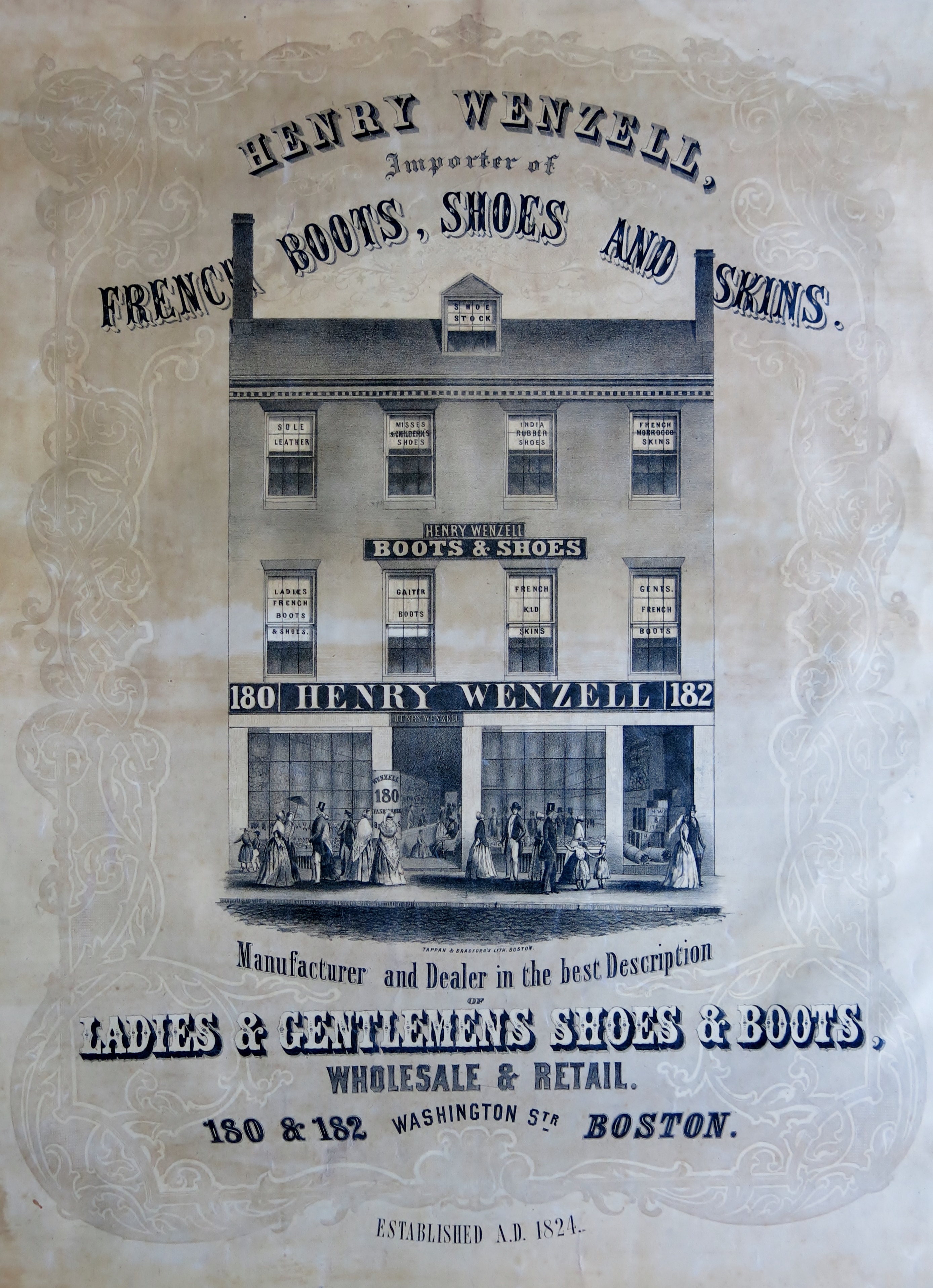
As we leave Prof. Boulet’s Gymansium behind after a bracing work-out, we are ready to start exploring the city a little bit more. Since we will probably be on our feet for a while we need to make sure that we have some trusty (and stylish) footwear to get us around. With that in mind, we’ll head into the city proper and proceed to 180-182 Washington St. to pay a visit to Mr. Henry Wenzell. 


As you can see from Messr. Wenzell’s handsome advert, he specializes in importing the finest and most fashionable French footwear, and has for some years now. I think that I will go with a sturdy pair of boots in case we are struck with a sudden downpour on our walk. 

And now, with our toes cozy, we can set off once again to see what sights Boston-that-was has to offer us. Check back soon to stay on the trail!

This Week @ MHS

By Dan Hinchen

The first week of October is a busy one here at the Society. Here’s what’s coming up!

Starting things off on Monday evening, 5 October, is a public author talk. Beginning at 6:00PM, author Andrea Wulf will discuss her new book, The Invention of Nature: Alexander von Humboldt’s New World. Co-sponsored by the Arnold Arboretum of Harvard University, this talk is open to the public with a $20 fee (no charge for MHS Fellows and Members); registration required. A pre-talk reception starts at 5:30PM. Click here to learn about Wulf’s talk the following day at the Arboretum.

On Tuesday, 6 October, stop by the Society at 5:15PM for an Early American History seminar. This time, Jane Kamensky of Harvard University presents “Copley’s Cato or, The Art of Slavery in the Age of British Liberty,” taken from several chapters of her manuscript, Copley: A Life in Color. David L. Waldstreicher of the Graduate Center at CUNY provides comment. Seminars are free and open to the public; RSVP requiredSubscribe to receive advance copies of the seminar papers.

Looking for a lunch date on Wednesday, 7 October? Why not pack a lunch and come by the Society at noon for a Brown Bag talk. Cynthia Bouton of Texas A&M University discusses her book project with this talk titled “Subsistence, Society, Commerce, and Culture in the Atlantic World in the Age of Revolution.” This talk is free and open to the public. 

Then, on Thursday, 7 October, we have seminar number two for the week, this time from the History of Women and Gender series. “Capitalism, Carceral Culture, and the Domestication of Working Women in the Early American City” is presented by Jen Manion of Connecticut College, with Cornelia Dayton of UConn providing comment. The talk will begin at 5:30PM and is taking place at the Schlesinger Library. Seminars are free and open to the public; RSVP requiredSubscribe to receive advance copies of the seminar papers.

And on Friday, 8 October, there is a gallery talk focused on our main exhibition, Terra Firma: The Beginnings of the MHS Map Collection. Stop by at 2:00PM on Friday for “Terra Firma: Too Big to Show.” In this talk the MHS’ Senior Cataloger, Mary Yacovone, will provide an up-close look at atlases that didn’t make it into the exhibition. This talk is free and open to the public. 

Finally, on Saturday, 9 October, come in at 10:00AM for “The History and Collections of the MHS,” a 90-minute docent-led talk that explores the public spaces in the building at 1154 Boylston Street and passes on information about the history, holdings, art, and architecture at the MHS. This tour is free and open to the public. Reservations are not necessary for individuals and small groups. Parties of 8 or more should contact Art Curator Anne Bentley in advance at 617-646-0508 or abentley@masshist.org

Remember to keep your eye on our online calendar for updates on programs, and to read about our current exhibitions!

Prospect Hill Tower and the Grand Union Flag

By Bonnie McBride, Reader Services

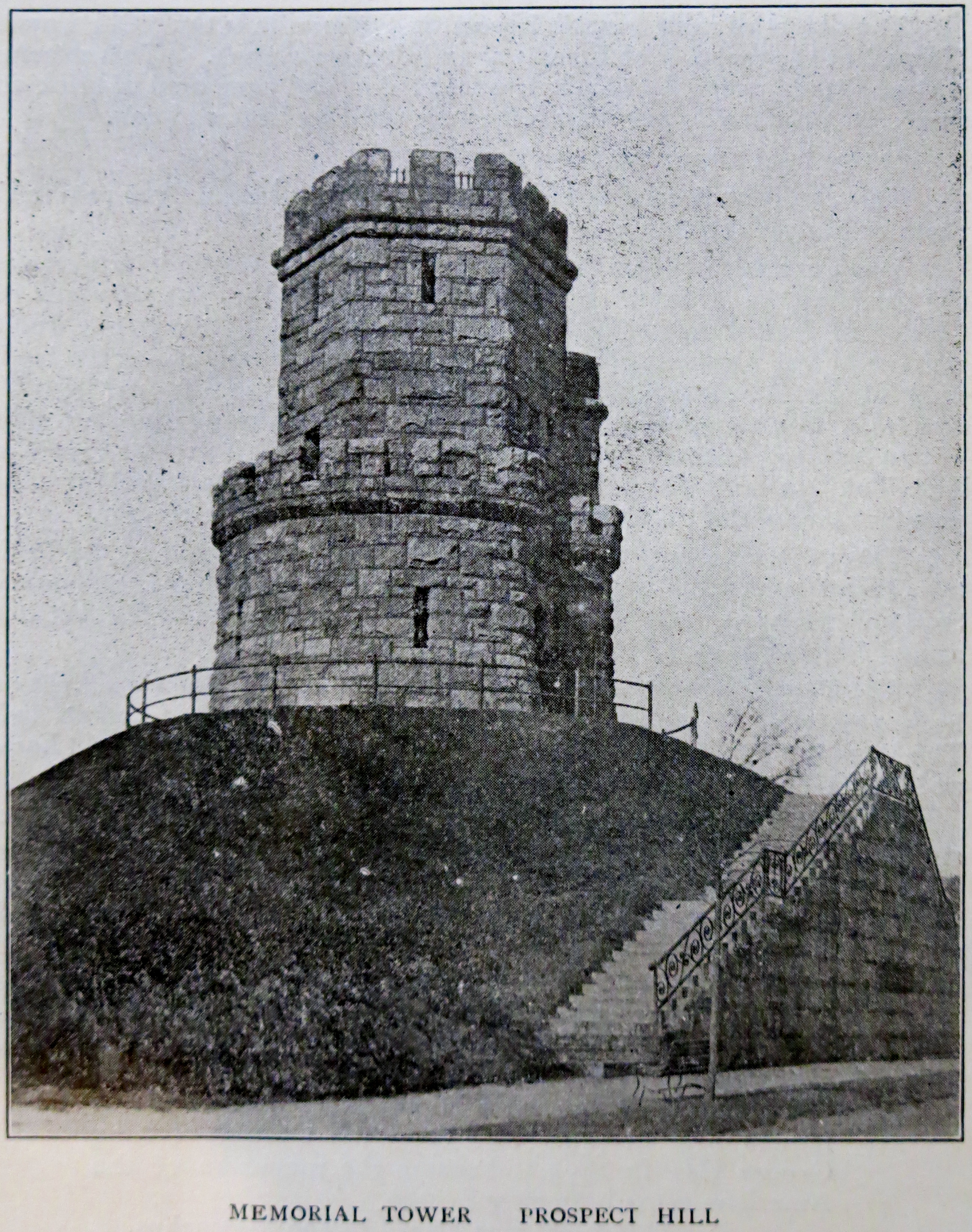
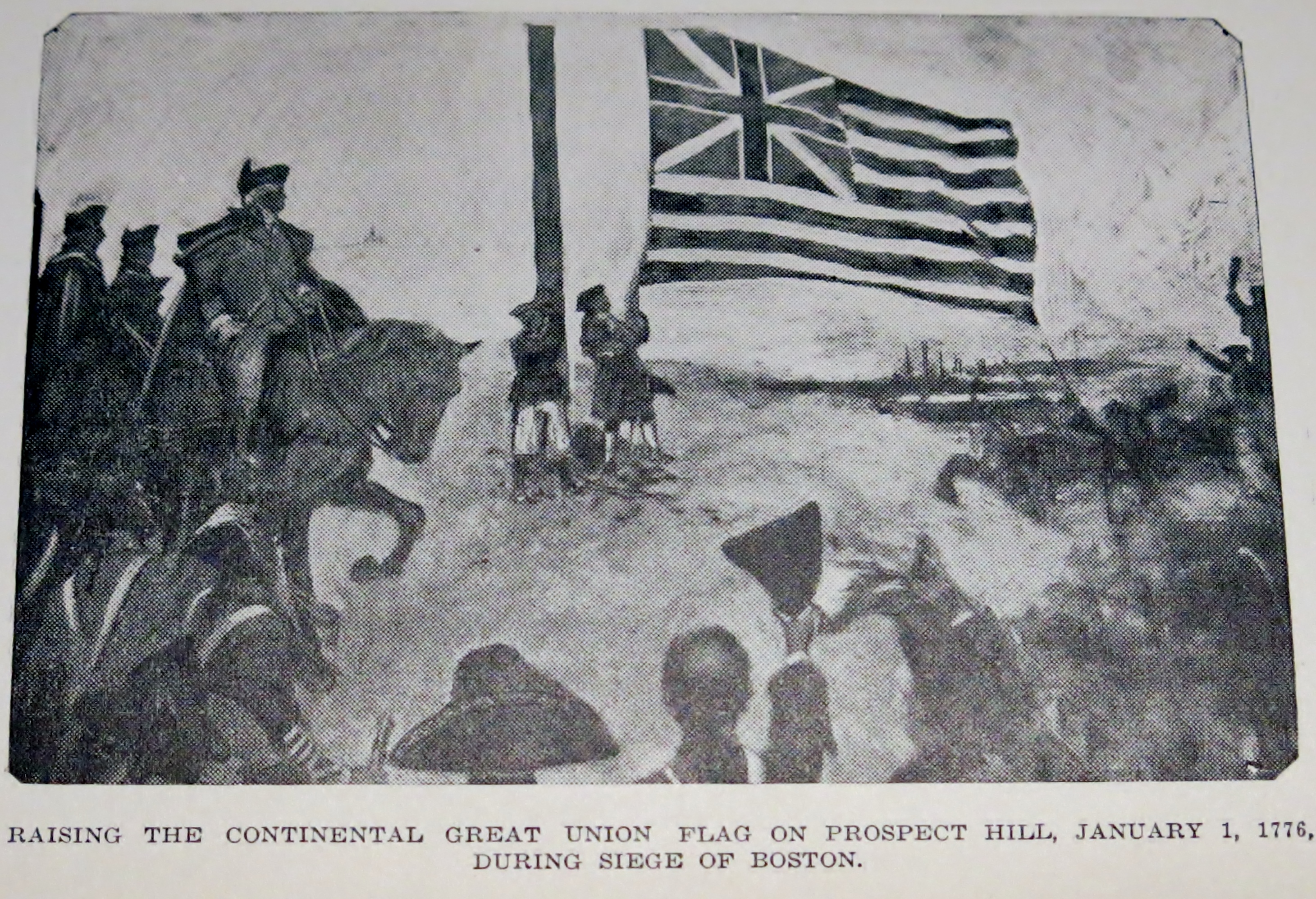
One day when wandering through Somerville, my boyfriend, a recent transplant to Cambridge, noticed what looked like a castle tower in the distance. He asked me about it, and rather than just find the answer online, we decided to have an adventure and discover in person what this tower was all about. It turns out that there is not a secret castle in Somerville, rather it is the Prospect Hill Tower, built in 1903 to commemorate the first flying of the Grand Union Flag on that same hill 1 January 1776.


As someone who is a fan of early Massachusetts history, I was surprised that I did not know about this tower and even more surprised that the first flag representing the United States had looked as if it had a Union Jack quartered on it. The next day I decide to search our collections here at MHS to see what materials we held about the Prospect Hill Tower and the first flying of the Grand Union Flag.


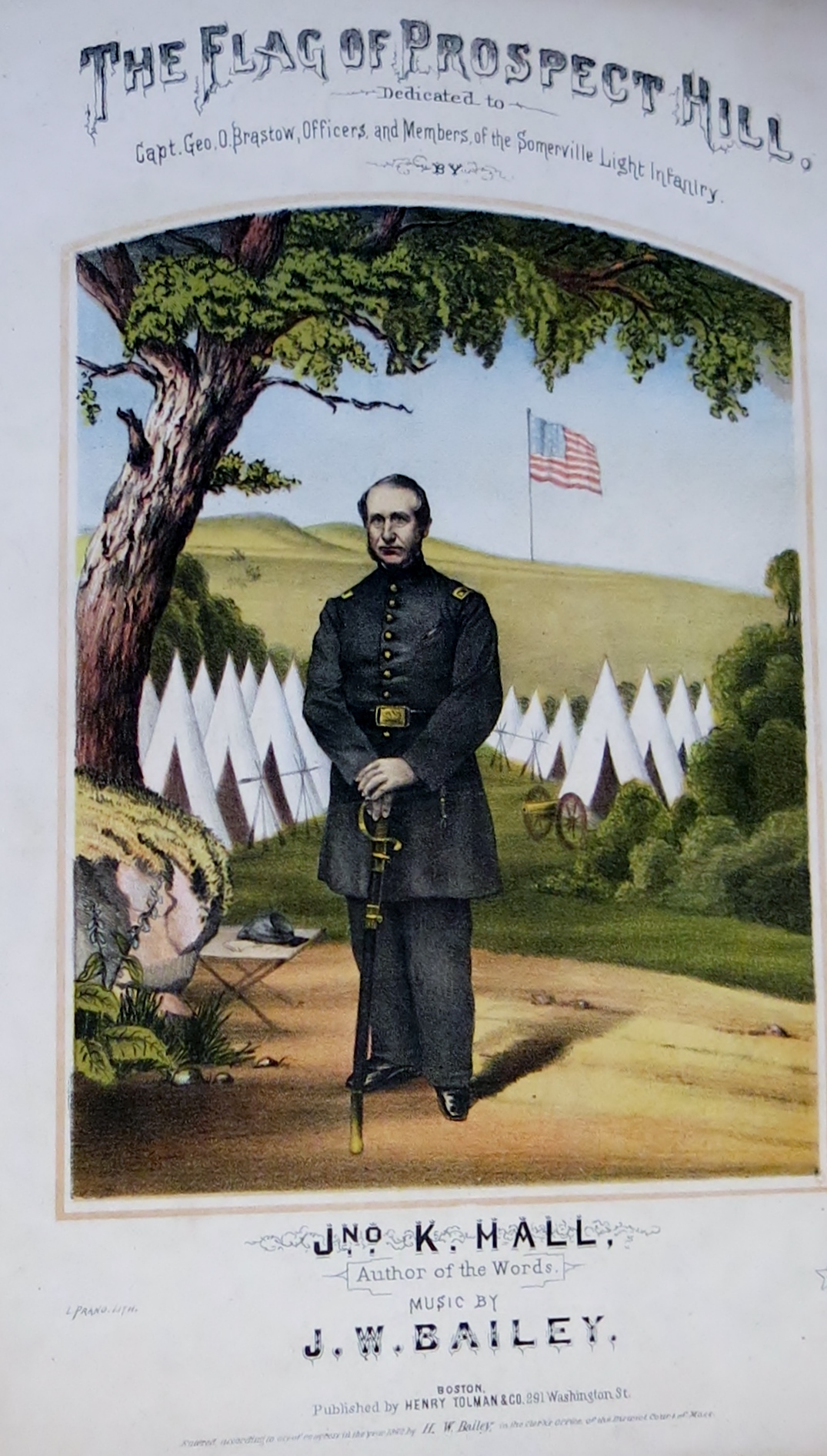
We do hold a number of secondary sources about both Prospect Hill and the flag flying, ranging from published historic guides of Somerville to sheet music composed about the first flag flying. The sheet music, pictured below, was printed in 1862 and while it is about the first raising of the flag in 1776, you will notice that the soldier pictured on the cover is dressed in a Civil War uniform, with tents in the background. Prospect Hill was used during the Civil War as a training camp. Most of our materials regarding the flag and Prospect Hill are from the late 19th and very early 20th centuries, which was about the time the tower was erected.


One of these sources is a bound scrapbook, created by Alfred Morton Cutler in 1921. In it, he pasted clippings of articles he had written for newspapers, such as the Cambridge Tribune, between 1918 and 1921. A number of the clippings were Letters to the Editor, in response to articles on the location and flag, with Cutler writing in to correct errors. All the articles go into great detail about not only the location of the first flag on Prospect Hill but also the type of flag. Cutler describes the first American flag as having “thirteen stripes, and containing in the field the crosses of St. George and St. Andrew.” At the end of the scrapbook is a clipping from a letter to the editor from William E. Wall: “An attempt is being made by the Librarian of the Cambridge Public Library to rob our city of Somerville of the honor which it has held so long, viz., that on January 1, 1776, on Prospect Hill (then a part of Charlestown) the flag of the United Colonies ‘first flung defiance to an enemy.’” Mr. Wall goes on to encourage readers to read closely Mr. Cutler’s “answer to assertions of the Cambridge librarian.” Unfortunately the letter written by the Librarian of the Cambridge Public Library was not included in the scrapbook, though this was the apparent conflict which prompted Cutler to correct the narrative.


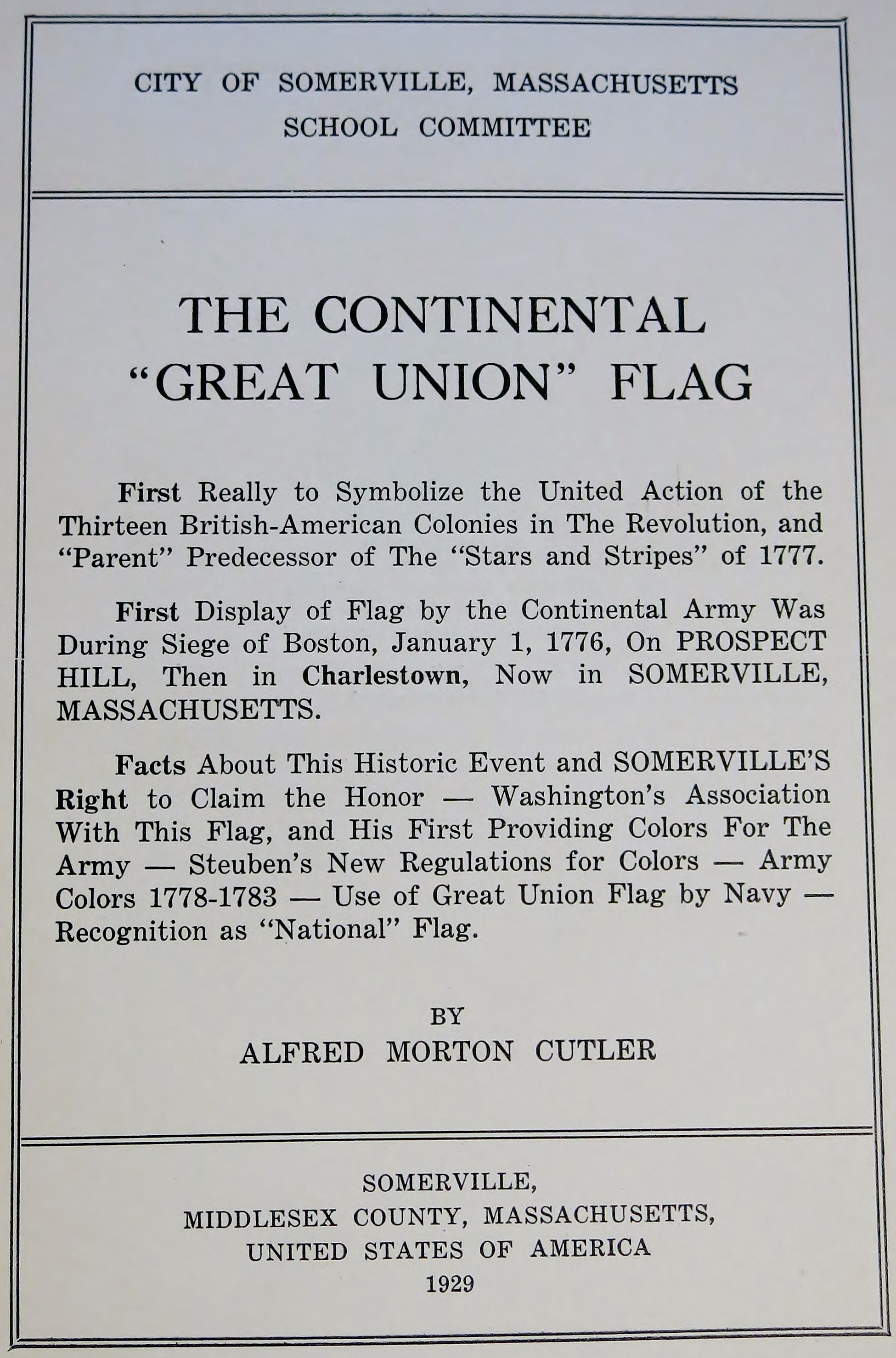
Perhaps realizing that a book would have a wider audience than a newspaper, Cutler re-works many of his articles and letters into a short book titled The Continental “Great Union” Flag which was published in 1929. Similar to his letters to the editor, which contained short citations, Cutler goes to great lengths to prove the validity of his claims by citing in detail his various sources, which I am sure would lead to more delightful discoveries if a researcher ever chose to track them down.


Stop by and visit the library to help answer your own early Massachusetts or local town history questions! Though you can find answers to many questions online, it is more interesting (and fun!) to see how scholars thought about those same questions many years ago. 


This Week @ MHS

By Dan Hinchen

As October begins so too does our heavy programming season. Strap in and see what’s on tap this week at the Society!

On Tuesday, 29 September, join us for our first Immigration and Urban History seminar of the season. Beginning at 5:15PM, Susan Eckstein of Boston University presents “Cuban Immigration and Exceptionalism: The Long Cold War.” In this project, Eckstein focuses on the complex roots of expanded benefits extended to Cuban refugee and immigrants over those from other Communist regimes, and the likely reform in Cuban immigraiton policy. Christine Thurlow Brenner of Univeristy of Massachusetts – Boston provides comment. Seminars are free and open to the public; RSVP required. Subscribe to receive advance copies of the seminar papers. Note that this session only will begin with a light supper at 5:15PM, and the program will follow at 6:00PM. 

Then, on Wednesday, 30 September, stop by at noon for a Brown Bag lunch talk with Gregg Lint, Series Editor for the Papers of John Adams: “Forty Years of Living with John Adams.” This talk is about the life and times of a young editor who grew old reading the mail of a man who always had something to say on almost every conceivable subject, and kept everything. This talk is free and open to the public. 

Also on Wednesday is a special film screening at the Society. Co-sponsored by the Arnold Arboretum of Harvard University, “Wilderness in America: A History of America & the Land From Conquest to Conservation,” looks at the legacy of conservation in America, unmatched anywhere else in the world. The film tells the story of four centuires of American history and the changing view of the land by leaders, writers, artists, photographers, teachers, and organizations, and the resulting environmental legislation of the last half-century. Registration is required at no cost. A reception begins at 5:30PM and the screening begins at 6:00PM.

On Thursday, 1 October, there is a special MHS Fellows and Members event for the unveiling of the Society’s next exhibition. “Terra Firma: The Beginnings of the MHS Map Collection Preview Reception” is a chance for our Members and Fellows to get a first peek at the upcoming public exhibition, Terra Firma. Stephen T. Riley Librarian Peter Drummey will provide remarks at 6:00PM while the reception and preview will begin at 6:30PM. 

And on Friday, 2 October, the Society opens two new exhibits to the public. First is the aforementioned “Terra Firma: The Beginnings of the MHS Map Collection.” This exhibit celebrates the beginning of one of the most diverse and interesting collections here at the MHS as we approach our 225th year. Also opening on Friday is “‘Always Your Friend’: Letters from Theodore Roosevelt to Henry Cabot Lodge, 1884-1918.” This exhibit highlights selections from a remarkable collection of letters from the extensive correspondence between these two friends and their spouses. Both of these exhibitions are open to the public, free of charge, until 9 January 2016. Galleries are open Monday-Saturday, 10:00AM-4:00PM.

Rounding out the week, on Saturday, 3 October, the Society is hosting a teacher workshop and a free tour. “Painless: A Survival Guide to the (Dreaded) History Project” uses the broad themes of “Exploration, Encounters, and Exchange in History” as a springboard to dive into the research process and discover how to use primary sources to uncover the nineteenth-century global adventures of Massachusetts men and women. The program is open to students, teachers, librarians, and archivists, and begins at 9:00AM. There is a fee of $10 (free for students and teachers accompanied by students) and registration is required; please RSVP. To register, or for more information, contact the education department at education@masshist.org or 617-646-0557.

Finally, at 10:00AM on Saturday, 3 October, is the return of our free tour. The History and Collections of the MHS is 90-minute, docent-led walk through the public spaces at the Society, touching on the art, architecture, history, and collections of the Society. The tour is open to the public with no need for reservations for small groups or individuals. Parties of 8 or more should contact Curator of Art Anne Bentley in advance at 617-646-0508 or abentley@masshist.org

An American Woman in Egypt, 1914-1915: At the Cataract Hotel, Asswan

By Anna Clutterbuck-Cook, Reader Services

Today we rejoin our anonymous female diarist as she journeys down the Nile in the winter of 1914-1915. You can read previous installments of this series here (introduction), here (Cairo to Aysut), here (Aysut to Asswan), here (Asswan to Abu Simbel), and here (Wadi Halfa to Asswan).


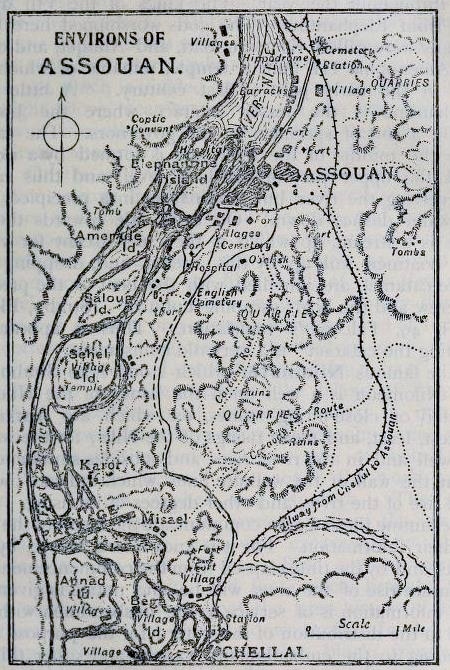
Image from Cook’s Handbook for Egypt and Egyptian Sudan (1911), p. 723.


Having returned to Asswan and checked into the Cataract Hotel — a luxury hotel for foreign travelers — our anonymous diarist settles into a daily routine in the days before the Christian holidays. No longer constantly moving from location to location, our diarist’s daily routines still revolve around sightseeing, shopping, and socializing with fellow travelers.


Dec. 16. A.M. Went to bazar; bought [kimono?] & Miss. M. a blue stone. Also got post-cards. P.M. took a walk up on the hills of the desert beyond hotel & got fine view of the first cataract. Could see to the dam. Got back for sunset & watched it from terrace. Talking with the Brown’s [sic]. Wrote before dinner.

Dec. 17. A.M.Went to bazar again; bought some beads, cards, etc., & saw many pretty things in [illegible word] shop. P.M. had a shampoo, then went over to Hotel Lobby & had tea, but missed the sunset.

Dec. 18 A.M. Went to shops, I bought India scarf. P.M. took a boat and went over to the rock tombs first, then to Convent of St. Simeon & sailed about a little after-wards, getting back at 6.15.

Dec. 19. Took donkeys & rode out to granite quarries on the desert to see statue of Ramses laying in the sand. A 2 hour trip. P.M. Did some writing then at 4 we went out & walked up on the hill by the fort to see sunset. Wrote before dinner.

Dec. 20. Went to bazar for last time & bought some more charms & a few little things. P.M. tried to walk out along the road to Hotel [illegible] Palace but came to end of it & had to turn around. Sat on a seat in the Public Gardens & watched the sunset. In evening there was a small dance.


A contemporary description of the Monastery of St. Simeon, written for a tourist population, can be found in the 1911 Cook’s travel guide to Egypt:


On the western bank of the Nile, at about the same height as the southern point of the Island of Elephantine, begins the valley which leads to the monastery called after the name of Saint Simon, or Simeon. It is a large, strong building, half monastery, half fortress, and is said to have been abandoned by the monks in the thirteenth century, but the statement lacks confirmation; architecturally it is of very considerable interest. It was wholly surrounded by a wall from about 19 to 23 feet high, the lower part, which was sunk in the rock, being built of stone, and the upper part of mud brick; within this wall lay all the monastery buildings. (730)


You can read the full description in Cook’s Handbook for Egypt and the Egyptian Sudan (1911)   online at The Internet Archive.

In our next installment, we will get a glimpse of how our traveler celebrated Christmas far from home.


This Week @ MHS

By Dan Hinchen

As we hurtle toward October and a full month of programming, we start to increase the offerings a bit this week. 

First up, stop by on Wednesday, 23 September, for a Brown Bag Lunch talk with Ben Vine of the University of Sydney. Join us at noon for “Class and War in Revolutionary Boston, 1776-80,” a talk that considers the state of class relations in Boston while the town was dealing with the trials of the Revolutionary War and explores how reconceptualizing class can illuminate greater complexities in the relations among Boston’s classes during the period. This talk is free and open to the public. 

Also on Wednesday is a public author talk. Please consider joining us for “Slavish Shore: The Odyssey of Richard Henry Dana, Jr.” In 1834, Dana left Harvard on a maritime journey to California as a common seaman and witnessed brutal floggings and other injustices on board. His account of the journey, “Two Years Before the Mast,” became an American classic. In “Slavish Shore,” author Jeffrey Amestoy, Harvard Kennedy School, tells the story of Dana’s unflagging determination to keep his vow to combat injustice in the face of nineteenth-century America’s most exclusive establishment: the Boston society in which he was born and bred. This talk is open to the public with a $20 fee (no charge for Fellows and Members). Registration is required, so please RSVP. There is a pre-talk reception beginning at 5:30PM with the talk beginning at 6:00PM.

And on Thursday, 23 September, all graduate students in American History and related subjects are invited to attend the MHS’ Graduate Student Reception. Attendees can enjoy refreshments, tour the various departments of the MHS, and learn about the range of resoruces available to support their work, including MHS fellowship programs. Refreshments and networking begin at 6:00PM and run throughout the evening. The program begins at 6:30PM. No charge to attend but RSVP is required by September 23. Email seminars@masshist.org or phone 617-646-0568 with your name and affiliation. Indicate whether you are a graduate student or faculty member.


Making History: Boston’s Bicentennial

By Amanda M. Norton, Adams Papers

On September 17, 1830, Boston celebrated the bicentennial of its settlement. Such a noteworthy occasion would hardly be complete without the presence of one of the state’s leading families, particularly a former president. Thus, John Quincy Adams was invited to participate in the commemoration events held in Boston that day. Before meeting with the other members of the parade at the State House, John stopped by to see if his son Charles Francis Adams was in his Boston office and would join him. Charles, however, was not there but at his home in Medford. He reported in his diary entry for the day, “As this was the day destined for the Celebration of the Anniversary of the settlement of Boston, and about to produce a tremendous consequent fuss I thought it would be expedient for me to have nothing whatever to do with it. I have a great horror of Crowds, and if I make up my mind to attend public days always have cause to repent it.”

A grand procession of city and state officials as well as Boston residents marched through Boston Common and down Tremont and State Street to Old South Church. There the President of Harvard University and former Boston mayor, Josiah Quincy III, gave an oration that John Quincy Adams considered, “worthy of the subject and received with universal approbation” and a number of songs were sung in celebration of the city. The music included a rewrite of Great Britain’s “God Save the King” with new lyrics by Rev. John Pierpont and Handel’s “Hallelujah Chorus.” The group processed back to the State House. That evening, fireworks were set off over the common and John Quincy attended a party hosted by Lieutenant Governor Thomas Winthrop.

The momentous occasion also included the first hints of a historic event on the horizon—Adams’s election to the House of Representatives. Before returning to Quincy for the evening, a number of gentlemen at the party approached Adams to discuss an article which ran in the September 6, 1830 issue of the Boston Courier, which suggested that Adams be nominated for the Plymouth congressional district of which Quincy was a part. John Quincy was initially dismissive of the idea: “As the Editor of the Paper has been uniformly hostile to me, I supposed this nomination was made with the same Spirit, and did not imagine it was seriously thought of by any one.” Serious it was though, and two months later, President John Quincy Adams was representative-elect Adams—the first and only president to serve in Congress after his presidency.


This Week @ MHS

By Dan Hinchen

It is a quiet week here at the Society as far as programs go, with only two items on the calendar. 

First up, on Thursday, 17 September, is a talk given by author and historian Joseph Ellis of Williams College. In this Pauline Maier Memorial Lecture, Ellis discusses his book The Quartet. The talk is open to the public with a fee of $20 (no charge for Fellows and Members). There is a pre-talk reception at 5:30PM and the talk begins at 6:00PM. NOTE: This program will take place at MIT’s Wong Auditorium at the intersection of Amherst and Wadsworth Streets in Cambridge (map). This is a four minute walk from the Kendall Square MBTA station or there is street parking along Memorial Drive and a parking garage at the Marriot Hotel in Kendall Square. 

And on Saturday, 19 September, is the next installment of “Begin at the Beginning: Boston’s Founding Documents,” a program sponsored by the Partnership of Historic Bostons discussion group. This time around, the group discusses “What’s in a Name: From Boston, Lincolnshire to Boston, Massachusetts.” The illustrated presentation and discussion of readings is led by independent scholar and author Neil Wright of Lincolnshire, England, a member of hte Partnership of Historic Bostons. The talk begins on 1:00PM here at the MHS. Registration is required at no cost, so please RSVP.