This Week @ MHS

By Dan Hinchen

There are no events scheduled here at the Society this week.

Please note that the Library of the MHS is closed beginning Tuesday, 24 December, and will reopen on Thursday, 2 January. The galleries are open to the public Thursday, 26 December – Saturday, 28 December, and again on Monday, 30 December, 10:00AM-4:00PM. Be sure to come in and take a look at our current exhibition, “The Cabinetmaker & the Carver: Boston Furniture from Private Collections” before it closes on 17 January. And keep an eye on our events calendar to see what is coming up in January.

Wouldn’t it be fun…

By Nancy Heywood

Wouldn’t it be fun if the Boston Red Sox World Series Trophies from 2004, 2007, and 2013 got to meet the 1912 Boston Red Sox medal from the collections of the Massachusetts Historical Society?   Staff members love picturing this scenario!   And, we’ve tweeted a pitch (pun intended!) about this possibility to the Red Sox Holiday Trophy Caravan!

The Red Sox announced that today (Thursday, December 12) they would bring the trophies to several hospitals and after visiting with patients, they would go to three Boston-area businesses in the afternoon.  Organizations have been asked to tweet using the hashtag #WeWantTheTrophies and explain why their office deserves to be selected.  

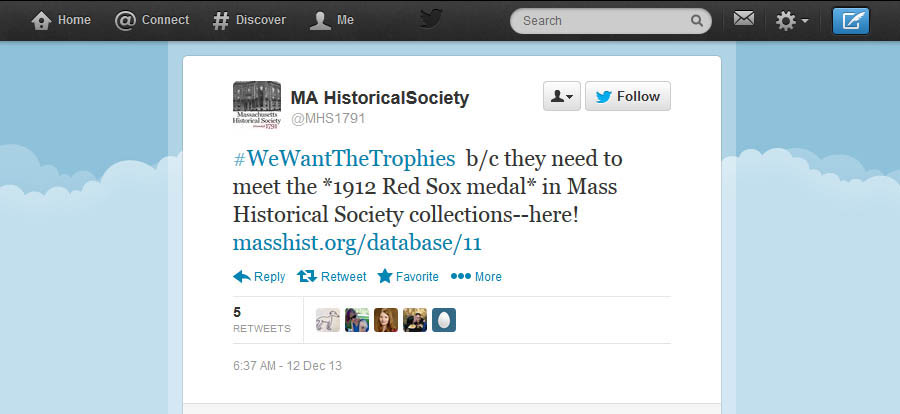
MHS sent this tweet:

MHS Tweet December 12, 2013

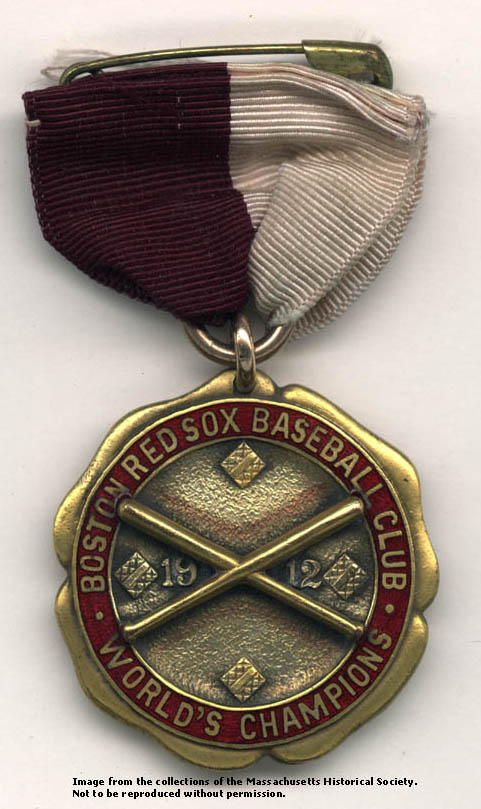
The MHS has a small number of sports-related medals in our collections including the 1912 Red Sox medal.

1912 Red Sox medal

The bronze medal was made by a Boston jeweler, Frank A. Gendreau.  MHS’s medal is made of bronze and some people speculate that our medal might have been a model because it isn’t as fancy as the two other known examples that were given to players on the team. (Those medals were made of gold with precious stones.) Read more about our medal.


“Long Sleeps Last Night for Both Sophias”: A New Mother’s Diary from 1910

By Anna J. Clutterbuck-Cook, Reader Services

As one of our staff prepared to depart on maternity leave this fall, I took the opportunity to delve into the print and manuscript materials in our collection related to pregnancy and childbirth, parenting and childhood. The MHS has a wide variety of print, manuscript, art and artifact materials related to the history of parents and children, from Cotton Mather’s Help for Distressed Parents, Or, Counsels & Comforts for Godly Parents Afflicted with Ungodly Children (1695) to the children’s health diaries of Helen C. Morgan (in the Allen H. Morgan Papers), who kept tidy notes on her children’s growth, eating habits, childhood illnesses, and medical treatments from their infancy through their college years (1923-1951).

One of my favorite discoveries was the diary kept by Sophie French Valentine during the first months of her daughter’s life. Perhaps in anticipation of her daughter’s birth, Sophie purchased a page-a-day Standard Diary for 1910. In the days before Internet-based social media was our platform of choice for documenting the everyday, Standard Diaries offered a way for many Americans to keep account of their own comings and goings with “status updates” that continue to resonate with intimate immediacy for future generations.

Sophie Valentine’s 1910 diary remained blank until the page for Saturday, July 23, on which she wrote simply, “She came. 8 pounds 7 ounces, 21 inches. Thoroughly healthy. abt 11.42 a.m.”

While her infant daughter was healthy, Sophie was not. On August 2nd she had to undergo an operation (unspecified), that necessitated separation from her daughter and several days’ sedation with “narcotics.” Sophie wrote on the page for August 2nd, “I nursed the baby every three hours up to this time – but just before the operation it was decided best to take her from me!”

As the summer waned, Sophie recovered from her surgery and chronicled the comings and goings of her household, as well as the growth of her daughter (also christened Sophia). Several weeks after the birth, the family doctor paid a visit and pronounced “the little one…sound and vigorous.” Three days later, infant Sophie “went out in the bassinette in front of the house” for the first of what would be many afternoons in the fresh air with her mother. Sophie’s husband, a diplomat, appears to have been away during much of his wife’s convalescence, but a steady stream of female friends and relatives populate the pages of Sophie’s diary. On August 14th, for example, the day “the little one” was baptized Sophia French Valentine, she “had pictures taken with Harriet, Charles, Aunt Martha, Auntie May; and Elizabeth and Lucy,” as well as with her mother and Aunt Caroline (“who held her and talked to her lots”). Later she was visited by “Theodore, Mrs. Graves, and Auntie Beth.”

By Thursday of that week the social whirl may have worn thin for both mother and daughter: the entry for August 18th reads simply, “Long sleeps last night for both Sophias.” A heartfelt status update that will no doubt resonate with many new parents generations hence.

The Sophie French Valentine Papers are part of the Robert G. Valentine Family Papers and available for use by researchers in the reading room of the MHS library.


This Week @ MHS

By Dan Hinchen

As we edge closer to the New Year, the MHS offers a slew of public programming this week.

First up, on Tuesday, 10 December, is a panel discussion. “Telling Environmental History,” will explore different ways of presenting environmental history, including the use of GIS, the intersection of environmental history and planning history, incorporating visual materials, and environmental history as narrative. Anthony Penna of Northeastern University will moderate the panel comprised of Brian Donahue of Brandeis University, Karl Haglund of the Department of Conservation and Recreation, Megan Kate Nelson of Brown University, and Aaron Sachs of Cornell University. Seminars are free and open to the public though, RSVP required. Discussion begins at 5:15PM.

On Wednesday, 11 December, at 12:00PM is a Brown Bag lunch talk focused on a piece of colonial history. Christine DeLucia, Mount Holyoke College, presents “The Memory Frontier: Memorializing King Philip’s War in the Native Northeast.” The late 17th-century conflict known as King Philip’s War has haunted colonial New Englanders and diverse tribal communities.  Their remembrances of this violence have taken shape in highly local ways, through material objects, performances, and stories about landscapes.  This study highlights the importance of such overlooked sources for understanding the persistent, widespread effects of warfare and settler colonialism in the Northeast. Brown Bag talks are free and open to the public so come on in and have a piece of history with your lunch.

Also on Wednesday is a public program presented by students of the Boston University course “Making History.” During this presentation, “Making History: The Salem Witch Trials in Documents & Artifacts,” the students discuss the MHS exhibition that they have researched and compiled. The semester-long project on Salem and the wider fear of witches in England and colonial America includes work on letters and diaries, sermons, early printed books, and objects form the period. James H. Johnson, who teaches the course and will facilitate the program, is Professor of History and a prize-winning author. This program is free and open to the public though registration is required. Pre-talk reception begins at 5:30PM and the program starts at 6:00. To register at no cost, please call 617-646-0560 or email eduation@masshist.org.

And on Thursday, 12 December, join us for the second seminar of the week, this time a part of the History of Women and Gender series. Beginning at 5:30PM, Amy Kesselman of SUNY, New Paltz, presents “Women versus Connecticut: Insights from the Pre-Roe Abortion Battles.” In the early 1970s lawsuit Abele v. Markle, Women versus Connecticut coupled litigation with grassroots organizing in a strategy that stimulated public discussion of reproductive rights and brought women’s experiences of Connecticut’s abortion laws to bear on what went on in the courtroom. The story illustrates the role of the feminist reproductive rights movement in shaping Roe v. Wade. Linda Gordon of New York University will provide comment for the discussion. This seminar is free and open to the public, RSVP required.

Rounding out the week on Friday, 13 December, is our final public program of 2013. Come in at 2:00PM as Michael Wheeler shines a spotlight on our current exhibition with “Patriotic Banding: Red, White, and Blue.” In the federal period (1790-1820), wealthy Boston merchants expanded trade to the West Indies and China. As part of this trade, they imported rare and expensive lumber into Boston. Mechanical inventions and the harnessing of waterpower made sawing this lumber into thin veneers possible. Inlay makers, were able to dye, stack, and cut those veneers into decorative geometric bandings which cabinetmakers used as inlays in neoclassical furniture. Guest speaker Michael Wheeler has recently discovered that red, white, and blue banding was made in Boston during the federal period. In his presentation, he will take us through his discovery and research, followed by a gallery tour of the inlaid furniture in our exhibition and his example of modern patriotic banding.This program is free and open to the public.

And thus ends our schedule of programs for this calendar year. Begin planning for the New Year now and resolve to check out our online calendar for Seminars, Brown Bags, and other assorted Public Programs coming up in 2014. And remember that our current exhibition, “The Cabinetmaker & the Carver: Boston Furniture from Private Collections” remains on display six days per week until 17 January.

Please note that the Society will be closed beginning Tuesday, 24 December, and will reopen on Thursday, 2 January. The exhibition galleries will be open Thursday, 26 December – Saturday, 28 December, and again on Monday, 30 December, from 10:00AM until 4:00PM.

Are those sketches of penguins?

By Andrea Cronin, Reader Services

Penguins unexpectedly cover the first page of a 1939 sketchbook in the Henry Daland Chandler papers. The rest of the sketches within the book are detailed and shaded images of Bermudian buildings created with the critical eye of the professional architect, Henry Daland Chandler. These penguins from the Bermuda Aquarium add a delightful and personal touch to this small volume.

I nominate the chubby grump in the lower left corner as “cutest penguin.” Do any of these penguins speak to you?

Stephen Greenleaf Bulfinch, Post 28

By Elaine Grublin

The following excerpt is from the diary of Stephen Greenleaf Bulfinch.

Monday Dec. 7th, 1863

Mr. Loring declines my book, considering it too much founded on the subject of slavery to suit the present taste. Don’t know; but have this morning secured a perusal of it from Mr. Spencer…The war goes on, with further gain in Tennessee & Georgia, but a check on the Rappahannock. Congress meet to-day. God bless their deliberations!

Tuesday Dec. 22d 1863

Of public affairs, the president’s message & proclamation, with his plan for reorganization of the insurgent states, are most observable. Heaven has given us a great blessing in our wise and firm chief magistrate.

This Week @ MHS

By Dan Hinchen

We return from our Thanksgiving break well-rested, well-fed, and grateful for the respite it provided. We have two hectic weeks ahead here at the Society before we slow down once again for the next holiday break. This week we have a plethora of programs on tap for public consumption.

Starting things off on Tuesday, 3 December, is a public seminar from our Early American History series. Serena Zabin of Carleton College present “Occupying Boston: An Intimate History of the Boston Massacre.” In this talk, Zabin shows the fundamental component that women constituted in the British army’s experience in Boston, evidenced by the records of some forty marriages of military men and more than a hundred baptisms of their children. This chapter from a larger study of the occupation of Boston examines the personal, social, and political meanings of these new families. Comment provided by Lisa Wilson, Connecticut College. The seminar begins at 5:15PM and is free and open to the public. RSVP required. Subscribe to received advance copies of the seminar papers.

On Wednesday, 4 December, spend your lunch hour at the Society for “To Spread Liberty to the North: The Invasion of Canada and the Coming of American Independence, 1774-1776.” In this Brown Bag talk, Amy Noel of Boston University presents research on her project which seeks to explain the enormous changes taking place in American society between 1774 and 1776 by examining the failed invasion of Canada. The campaign played a crucial role in shaping colonial attitudes toward Catholicism and Britishness, the escalation of rebellion into an imperial civil war, and the looming issue of American independence. The talk begins at 12:00PM and is free and open to the public.

And on Wednesday evening, join us for “Elegant Interiors in Early 19th-Century Boston.” In this public program related to our current exhibition, Richard and Jane Nylander discuss the new styles of architecture and furniture that appeared in early 19th-century Boston and will provide a glimpse of the interiors of the homes of some of the city’s wealthiest citizens, among them Nathan Appleton, Charles Russell Codman, Benjamin Bussey, Barney Smith, and David Hinckley. Pre-talk reception begins at 5:30PM and the talk begins at 6:00PM. Registration is required for this event and you can RSVP here. This program is part of the Massachusetts Furniture Series.

On Thursday, 5 December, the Society hosts a special year-end reception for MHS Fellows and Members to celebrate the season with the Trustees and staff of the MHS. The event begins at 6:00PM and is open only to MHS Fellows and Members at no cost. Please RSVP here.

Then, on Friday, 6 December, there is a public author talk. Join us at 2:00PM for “End of Days: The Assassination of John F. Kennedy.” Fifty years ago, our country was jolted by tragedy: our 35th president was shot. In End of Days: The Assassination of John F. Kennedy, historian James L. Swanson offers a comprehensive understanding of this historic day, lending edge-of-your-seat storyteller’s mastery to the subject. This event is free.

And last but certainly not least, on Saturday 7 December, come by the Society at 10:00AM for “The History and Collections of the MHS.” This 90-minute docent-led tour exposes visitors to the Society’s public rooms and touches on the history, collections, art, and architecture of the Society’s historic building at 1154 Boylston Street. The tour is free and open to the public. No reservation is required for individuals or small groups. Parties of 8 or more should contact the MHS prior to attending a tour. For more information please contact Curator of Art Anne Bentley at 617-646-0508 or abentley@masshist.org.


Considering Collation: Decoding the Formula (2)

By Dan Hinchen, Reader Services

If you have ever had the pleasure of perusing books from the 18th century, or earlier, you may have noticed the appearance of sequences of letters and numbers that appear at the bottom of pages. Maybe you saw a series of four pages that had C, C2, C3, C4, in that order, followed by four pages without those letters. Then, four pages with the same sequence using the letter D, and so on through the alphabet. If you have noticed these, have you ever wondered what they mean? Well if so, keep reading because this post is for you.

During the hand-press period of printing books, the printers included these alpha-numeric sequences, called signatures, to indicate to the binder the order in which the material should be bound together. Nowadays, when constructing descriptive bibliographies of these rare books, examination of the signatures can show anomalies in the printing process and can help distinguish among various printings of a single title.

In my last post I provided a collation formula for a book called The Doctrine of Devils and explained how to determine the format of the book. Now we can look at the collation and signing statement. As you might remember, the collation formula for the book looks like this:

8°: A4 B-O8; [$4 (-A3,4) signed; missigning I4 as I3]; 108 leaves; pp. [8] 1-205 [3].

We know that the first part means that the book is an octavo which we determined by looking at various physical clues to find out that the pages were created on large sheets of paper that were folded three times to create gatherings of eight leaves, or 16 pages. Now, we can use that information to explain the collation of the book and the signing statement. These two pieces of the puzzle appear in the formula as: 

A4 B-O8; [$4 (-A3,4) signed; missigning I4 as I3]

The first part, the collation, tells us how many sections are in the book and how many leaves are in each section. Here, we see that section A has four leaves, while sections B-O have eight leaves each. [If the book was longer, it might go from B, all the way to Cc, meaning that we ended the alphabet once and started again in double]. The second piece, appearing in brackets, is the signing statement, which informs us of the pattern of signatures throughout the book and also indicates any mistakes or deviations. $4 tells us that the printer signed the first four leaves of each gathering, or half of the gathering (-A3,4 indicates that in gathering A only the first two leaves had signatures). Also, we see that the printer incorrectly signed the leaf that was to be I4 and instead used I3 again. Otherwise, there appear to be no other mistakes or deviations, pretty simple.

108 leaves

One last step is to do a leaf count, which is just as it sounds, and then determine the pagination. We can use the leaf count to double-check our collation to ensure it makes sense. In this case, the leaf count yielded a total of 108 leaves. We know from the collation that section A has four leaves, and that each section, B-O (excluding J*) contains eight leaves. So, we have 4 + (8 x 13) = 108. It appears to all match up.

pp. [8] 1-205 [3]

The pagination statement is a check to see how the pages are numbered and if any got skipped or left out. The statement above means that there were eight pages of front matter that did not get numbered, so they are in brackets. Then we have the pages that were numbered, 1-205, with no mistakes. Finally, there are three pages at the end that also are unnumbered. Adding those together, we get a page count of 216, which is exactly double the leaf count. Everything agrees!

So the next time you have your hands on an old book, pay attention to all of these little signs and indicators and you might just be able to figure out your own collation formula for the book and have your own little coded description.

And since this will probably be my last post about collation for a while, I want to leave you with one more example of a formula that is a bit more complex, just to illustrate how long and tedious these can get. Unfortunately, I no longer have the title of the work, just that it was published in London in 1773. Good luck deciphering!

2°: [A]1a2b1 B-6Z2 7B2*7B2 7D-7F2 χ7F2 7G-7I2 [$1signed]; 296 leaves; pp.[8]1-548 553-557 [=553] [31] [misnumbering 200 as 300, 248 as 548, and 412 as 112].


*Printers used the 23-letter Latin alphabet when creating their signatures rather than our modern 26-letter alphabet. In the 23-letter alphabet, I and J are interchangeable, though never both used; ditto for the letters U and V; last, there is no W in the Latin alphabet.

Thanksgiving in War-time, 1862-1864

By Susan Martin, Collection Services

The life of a Civil War soldier was difficult even at the best of times, but holidays were particularly poignant. Many of the men were very young and away from home for the first time. Edward J. Bartlett of Concord, Mass. had been just 20 years old when he enlisted in August 1862. In his letters home in November of that year, written from New Bern, N.C., he described his first Thanksgiving as a soldier, the elaborate preparations, the decorations, and especially the food:

First we had oysters then turkey and chicken pie then plum pudding then apple raisin & coffee with plenty of good soft bread & butter. After we had all eaten a little too much, people usualy do on Thanksgiving days and we who had lived so long on hard tack did our best[,] we had a fine sing.

The meal was followed by songs (including “Auld Lang Syne”), speeches, toasts to President Lincoln and the troops, games, and a dance. Deep in hostile territory, the men were determined to celebrate “in the true home style.” Bartlett concluded that:

The whole day was very succesfull every thing went of[f] pleasently, not a thing went wrong. We were surprised that such a dinner could be got up in this God forsacken country. Twas pleasent to celebrate Thanksgiving in such a way.

The next year, his letters were more sober. Writing on 15 November 1863 from Nashville, Tenn., Bartlett reflected:

Our company Thansgiving in the barracks last year is a day that I can never forget. Six of those boys are now dead. Poor Hopkinson, the president, in his address, [said] “that he hoped the next year would see us all at our own family tables.” He died two months after.

Bartlett spent Thanksgiving 1864 stationed at Point Lookout, Md., guarding Confederate prisoners-of-war. He wrote to his sister Martha about his homesickness on the evening before the holiday:

Thankgiving eve. I sat over the fire, thinking of what you were doing at home, and what I had done on all the Thanksgiving eve’s, that I could remember.

The day itself, however, proved to be a rousing celebration that included music and dancing (“It was fun to see them kick thier heels about.”), horse races, sack races (“Such a roar of laughter I never heard before. Most of them were flat in the dirt before they had gone three steps.”), wheelbarrow races, a turkey shoot, greased-pole climbing, and greased-pig chases (“This made more sport than all the rest put together.”). Bartlett again, unsurprisingly, lingered over his description of the meal: oysters, turkey, duck, beef, chicken, vegetables, apple pie, pumpkin pie, mince pie, etc., finished off with cigars.

Edward J. Bartlett survived the Civil War and lived to 1914. To learn more about Bartlett, visit our Civil War Monthly Document feature for November 1863 or visit the MHS Library to read more of the papers in his collection.

This Week @ MHS

By Dan Hinchen

We start this week’s installment of the events calendar by noting that the MHS is closed Thursday, 28 November – Saturday, 30 November, in observance of Thanksgiving. Normal hours resume on Monday, 2 December. But before that we have two public programs for you.

First, on Monday, 25 November, the Society hosts and author talk with Thomas Whalen of Boston University who will present “JFK & His Enemies: A Profile in Power, 1946-1963.” At nearly every stage of his political career, Kennedy collected his fair share of enemies. Whalen will discuss the complex and strained relationships Kennedy had with FBI director J. Edgar Hoover and how their mutual hostility inadvertently led to this assassination on 22 November 1963. This public program begins at 6:00PM with a pre-talk reception starting at 5:30PM. Please RSVP for this event.

On Tuesday, 26 November, is the latest in our Immigration and Urban History seminar series. Join us as David Hernández of Mount Holyoke College presents “A Place Reeking with Rottenness: The ‘Corpus Christi Situation’ (1933) and Legacies of Abusive Immigrant Detention.” This talk examines an internal investigation of the Immigration Service in 1933 which exposed allegations of violence, sexual abuse, extortion, and coerced testimonies in a detention facility run by Julia and Olivia Valente. The event is part of a legacy of detainee abuse–from denial of legal rights and poor conditions of incarceration to violence, sexual abuse, and death that is widespread in immigrant facilities today. The case of the Valente Detention Home thus provides the operating terms for understanding contemporary detention practices, in particular, the use of private and non-federal facilities and management for detaining immigrants. Comment provided by Daniel Kanstroom of Boston College Law School. Seminars are free and open to the public; RSVP required. Talk begins at 5:15PM.

Happy Thanksgiving!