Chinese Hanzi Characters in 1801

By Andrea Cronin, Reader Services


On 30 July 1801 the snow Pacific Trader bound for Canton floundered in the Pacific Ocean when the vessel took on water in the midst of a violent two-day gale. The winds tore the sails and mangled the rigging so terribly that the ship and its small crew limped into safe harbor at Macao on 23 August 1801. Proprietors William and Sullivan Dorr in Canton received more than ten letters from Captain Samuel Edes aboard the Pacific Trade in the subsequent month while the ship sheltered and was repaired in Macao. These letters are contained in the Samuel Barrett Edes papers held at the MHS.

On 27 September 1801 Captain Edes writes to inform the Dorrs of the progress of ship repairs and the condition of the cargo. However, it is the verso page of the letter that truly captures my imagination. The verso functioned as the envelope, containing the address information of the intended recipient, Sullivan Dorr. Far more interesting than the address is the beautiful example of Chinese Hanzi characters composed on the verso.

I imagine that the Hanzi message reveals directions due to its location close to the address, just near the seal. However, a larger question looms in my mind. Who wrote this inscription? The small crew of the Pacific Trader hailed from Massachusetts, New York, Virginia, Ireland, St. Croix, Guadeloupe, and Bengal according to a crew list in the Samuel Barrett Edes papers. None of these men were native to China or surrounding countries that utilized Hanzi script. Although some crewmen may have learned the spoken language, the beautiful and careful script of the Hanzi suggests to me that a native writer composed the message.

Are you familiar with 19th century Chinese Hanzi script? Can you read this inscription? We would love to hear from you!

John Adams and the Bill of Rights

By Amanda A. Mathews, Adams Papers

On this day in 1789, President George Washington wrote a short letter to each state’s governor, enclosing a copy of twelve proposed amendments to the new United States Constitution for consideration, which Congress had passed on September 25 with the signatures of the Speaker of the House and the President of the Senate, Vice President John Adams. Of the twelve, ten received the necessary ratification and collectively became known as the Bill of Rights.

These amendments corresponded with many of the changes for which John Adams had expressed a desire when he first read the proposed Constitution. “A Declaration of Rights I wish to see with all my Heart,” he confided in early 1788, “though I am sensible of the Difficulty of framing one, in which all the States can agree.— a more compleat Seperation of the Executive from the Legislative too, would be more Safe for all. The Press, Conscience & Juries I wish better Secured.— But is it not better to accept this Plan and amend it hereafter?”

Adams certainly was “sensible of the Difficulty” of writing a constitution. A decade earlier, in the fall of 1779, he toiled over his draft of the Massachusetts constitution, drawing upon the other states’ constitutions as well as his own extensive study and consideration of law and government. Not only did he include protections for the press, religious belief, and juries, but reflecting the importance the Declaration of Rights held for Adams, he had placed it ahead of the frame of government itself.

While the proposed amendments did not repair all the defects that Adams perceived in the federal Constitution (he particularly opposed the limited presidential veto and the need for Senate approval of nominations), he understood that the Constitutional Convention’s achievements could not be diminished, even if the final product remained flawed. “A result of accommodation cannot be supposed to reach the ideas of perfection of any one,” Adams admitted in the conclusion of his Defence of the Constitutions of Government of the United States, “but the conception of such an idea, and the deliberate union of so great and various a people in such a plan, is, without all partiality or prejudice, if not the greatest exertion of human understanding, the greatest single effort of national deliberation that the world has ever seen.” The new Bill of Rights moved the nation another step toward a “more perfect union.”

This Week @ MHS

By Dan Hinchen

It is a busy week here at the Society with a variety of public programs for your enjoyment, so clear your calendar and check out ours!

Starting the week off on Tuesday, 1 October, is the first event of the season from our Early American History Seminar series. Join us as Karin A. Wulf of William and Mary College presents a “Town Hall Meeting with the New Director of the Omohundro Institute of Early American History and Culture.” This town hall meeting will provide an opportunity to discuss the present and future of the OIEAHC. Through conferences, fellowships, and publications including the William and Mary Quarterly, the institute fosters scholarship on colonial and early national American history as well as the Atlantic world. Wulf began her tenure on 1 July. Be sure to RSVP for this program by e-mailing seminars@masshist.org or phoning 617-646-0568. Program begins at 5:15PM.

On Wednesday, 2 October, come in at noon for a Brown Bag Lunch talk. This week, Marisa Benoit of Oxford University presents “New England Teares, for Old England’s Feares: Comparing Attitudes Toward Infertility in Early Modern England and Colonial New England.” Through analysis of a wide variety of sources from 1650 to 1750, this comparative study of attitudes toward infertility in colonial New England and early modern England examines two societies linked by cultural and religious norms but facing different challenges. These challenges are explored by analyzing infertility’s representation in popular, religious, and medical literature and personal writings from both societies. Analysis of these representations of infertility provides a different angle through which to view the links between “Old” and New England, a relationship often described through reproductive language, while highlighting the connections between the sources themselves. The topic provides the opportunity to untangle the web of emerging anatomical discoveries, social ideas about gender relations, the family, and the importance of children, and religious ideas about generation that characterized attitudes toward reproduction in the early modern period. This event if free and open to the public. Pack a lunch and come on by!

Thursday, 3 October, will see the preliminary unveiling of the Society’s newest exhibition. MHS Fellows and Members are invited to a special preview and reception for “The Cabinetmaker & the Carver,” beginning at 6:00PM. This exhibit provides visitors with an opportunity to view nearly 50 examples of rarely seen furniture borrowed from distinguished private collections in the greater Boston area. Ranging in date from the late-17th century to about 1900, these privately held treasures, generously lent by their owners, provide a look at the trajectory of cabinetmaking in the Hub.Tickets are $25 (no charge for MHS Fund Giving Circle members) and RSVP is required. To register by phone or e-mail, call 617-646-0552 or e-mail bwillett@masshist.org.

This exhibit opens to the public on Friday, 4 October, and will be on display Monday through Saturday, 10:00AM to 4:00PM, until 17 January 2014. The furniture pieces are supplemented with documents, portraits, and other material from the Society’s collections that help place them in historical context.

Coinciding with the public opening of the exhibition, also on Friday, 4 October, is “New Thoughts on Old Things: Four centuries of Furnishing the Northeast.” This day-long symposium, co-sponsored by the Museum of Fine Arts, Boston, the Colonial Society of Massachusetts, and the MHS, is devoted to new scholarly research on the design, production, and circulation of furnishings in New England. The program will feature keynote speaker Glenn Adamson, Head of Research at the Victoria and Albert Museum in London, along with a select group of emerging scholars. Taking place at the Museum of Fine Arts and beginning at 10:00AM, the symposium is free with admission to the museum. Advanced ticketing is recommended. For information, please contact Lauren Spengler at lspengler@mfa.org.

The Society’s exhibition and the public symposium are presented as part of Four Centuries of Massachusetts Furniture, a collaborative project of the MHS and ten other institutions that features exhibitions, lectures, demonstrations, and publications to celebrate the Bay State’s legacy of furniture-making. Visit fourcenturies.org to learn more.

Finally, on Saturday, 6 October, the MHS, in collaboration with the National Archives at Boston and Massachusetts History Day, will present “Painless: A Survival Guide to the ‘Dreaded’ History Project.” This free workshop for teachers, students, librarians, and archivists explores how to approach primary source research in special libraries and archives through a range of historical documents including letters, diaries, songs, petitions, and government records. The workshop will take place at the National Archives in Waltham and begins at 9:00AM. For more information, or to register, please contact Kathleen Barker at the Massachusetts Historical Society: eduation@masshist.org or 617-646-0557.


Attention researchers: The library of the MHS will close at 3:30PM on Thursday, 3 October.


“[Otters] Are Your Principall Object”: Fur Trade in the Dorr Family Papers, Part I

By Andrea Cronin, Reader Services

“…perhaps you will find that you are to far up the Country for otters,” Boston merchant Ebenezer Dorr advises his son Ebenezer Dorr, Jr. who served as the supercargo onboard the schooner Amelia in a 10 December 1787 letter contained in the Dorr Family Papers. The elder Dorr continues, “if so one of you can scower the Seashore for them, they are your principall object, we are now making our first shipment on the new plan & making preparation for the second, the third expect you will proceed with if business turns out as I expect.”

The fur trade between the United States and China boomed in the late 18th century after the gates of Canton’s markets opened to United States merchant shipping in 1784. The Dorr family invested heavily in the fur trade expeditions of the schooner Amelia (1787), the sloop Lucretia (1792), and the snow Pacific Trader (1799-1801). In this letter Ebenezer Dorr instructs his son to collect otter pelts from the Pacific Northwest for trade in Canton where such furs commanded substantial returns. The Chinese merchants sought American furs, paying premium prices for luxurious otter pelts. The crew of the schooner Amelia engaged in sealing and trapping in the Pacific Northwest in efforts to bolster their wares before continuing passage to Canton.

The market of pelts employed not only the efforts of Chinese and American merchants, but Russians too. While otter fur exacted better prices, other furs sold in this market included seal, beaver, buffalo, wild cat, and even raccoon. In the very same letter the elder Dorr writes to his son that he should seek out, “rackoon if blackhaired & well furr’d … & wild cat they being furrs fashionable in Russia.” Those savvy Dorrs in Boston understood the unique demands of the participating powers in the fur trade and aimed to capitalize on their fur trading endeavors in the Pacific Northwest and Canton.

This week @ MHS

By Dan Hinchen

During this last week of September, as we edge closer to the unveiling of our next major exhibition, there is a spate of public programs here at the MHS for you to come in and enjoy. Kicking things off on Monday, 23 September, is “City Water, City Life: The Infrastructure of Ideas in Urbanizing Boston.” In this public author talk, Carl Smith of Northwestern University discusses how a city is more than a massing of citizens, a layout of buildings and streets, or an arrangement of political, economic, and social institutions. Using as illustration the construction of Boston’s first comprehensive public waterworks, the Cochituate aqueduct system which opened in October 1848, Smith shows how a city is also an infrastructure of ideas, an embodiment of the beliefs, values, and aspiration of the people who created it. Carl Smith is the Franklyn Bliss Snyder Professor of English & American Studies at Northwestern University where he teaches American literature and cultural history. This talk is open to the public and registration is required. Tickets are $10 per person (no charge for Fellows and Members). To Register: Please call 617-646-0560 or register online. Program begins at 6:00 PM with a pre-talk reception at 5:30 PM.

On Tuesday, 24 September, Carl Rollyson, professor of journalism at Baruch College, presents “Amy Lowell Anew.” In this author talk, Rollyson focuses on the discovery of letters in the Society’s collections that altered his understanding of the shape and significance of the life of the controversial American poet, Amy Lowell (1874-1925). Lowell excelled as the impresario for the “new poetry” that became news across the U.S. in the years after World War I. This provocative new biography restores Amy Lowell to her full humanity in an era that, at last, is beginning to appreciate the contributions of gays and lesbians to America’s cultural heritage. This program is free and open to the public and begins at 12:00 PM.

Also on Tuesday is this season’s first seminar in the Immigration and Urban History series. Join us at 5:15 PM as John Logan of Brown University presents “Emergent Ghettos: Black Neighborhoods in New York and Chicago, 1880-1940.” William Julius Wilson of Harvard University will provide comment. RSVP is required for this event. Subscribe to receive advance copies of the seminar papers. Authors will  not read their essays but will offer brief remarks. Please read the paper ahead of time and come prepared to join in the discussion. If you are not a subscriber you may pick up a copy at the MHS front desk on the day of the program. Please phone 617-646-0568 with any questions.

Finally, on Wednesday, 25 September, stop by at 12:00 PM for a free Brown Bag discussion as author Louis Thomas presents “Narrative of a Journey: Louisa Catherine Adams and the Vexed Question of Identity.” In this talk, Thomas will discuss research from a forthcoming biography of Louisa Catherine Johnson Adams, focusing on new evidence about her background. It will also explore tensions in her writings, in an attempt to understand her better as a Johnson, as an Adams, and simply as herself. Brown Bag talks are free and open to the public. Pack a snack and drop in for the discussion!


Stephen Greenleaf Bulfinch, Post 25

By Elaine Grublin

The following excerpt is from the diary of Stephen Greenleaf Bulfinch.

Bridgewater, Tuesday, Sept 1. 1863

I have received to-day a very pleasant letter from Maria….She writes pleasant intelligence also, of my brother-in-law and former assistant, George A. Howard. He is now in beleaguered Charleston, but the seriousness of the time, or some other cause, seems to have made a very happy change in him. His nephew and mine, my godson, Cyrus Bulfinch Carter, is in the Confed service, & has been stationed at Fort Wagner, at Charleston.

With a sigh for all the miseries of this time, – of which, as of its crimes, a most awful example is given by the recent massacre of Lawrence, Kansas, – I yet rejoice at the increasing success of the Union Arms – God grant his keeping for the restoration of peace, & the progress of freedom!

Sunday, Sept. 6th

Today I went in to preach at King’s Chapel but did not, owing to some mistake. Heard a good sermon from Mr. Foote, referring touchingly to the losses by the war, – particularly the cares of Major Paul Revere and Mr. Perkins, the death of the latter having been only learned of yesterday.

Sunday, Sept. 20 1863

The war continues with varied success in individual encounters, but important gain on the whole, to the cause of Union and Freedom. The eyes of public expectation are now fixed on Charleston, – Northwestern Georgia, – the Texas expedition, – and the Rappahannock. There is anxiety about our foreign relations, but we can hardly think English statesmen will be guilty of so great a crime and folly as to force us into a war. God grant that way be spared us! Mr. Sumner’s speech, recently delivered, must, one would think, make them feel the unworthiness of their position. The danger from France seems to be passing away.

This Week @ MHS

By Dan Hinchen

It is time, once again, for the roundup of events to come this week here at the MHS.

First up, on Wednesday, 18 September, is a Brown Bag lunch talk, presented by Lindsay Schakenbach of Brown University. “Manufacturing Advantage: Boston Merchant-Industrialists and the Federal Government, 1790-1840” is a project that examines the process by which the federal government made possible the rise of the Waltham-Lowell system, the first integrated factory system in the United States. Typically viewed as a product of merchant wealth and innovative entrepreneurship, this predecessor to modern industry also benefited from federal support in the form of diplomacy, national expansion, and patent legislation. Schakenbach’s research is part of her dissertation which seeks to explain the early republican transition from merchant to industrial capitalism through analysis of the development of the New England arms and textile industries in the context of federal patronage and expanding U.S. geopolitical dominance in the Americas. This talk begins at 12:00 PM and is free and open to the public. 

Also on Wednesday the MHS hosts an author talk featuring another member of the Brown University community. In “Smuggler Nation: How Illicit Trade Made America,” author Peter Andreas provides a sweeping narrative history from colonial times to the present. It is the first book to retell the story of America as a series of highly contentious battles over clandestine commerce. Andreas demonstrates how smuggling has played a pivotal role in America’s birth, westward expansion, and economic development, while anti-smuggling campaigns have enhanced the federal government’s policing powers. Andreas is Professor of Political Science and International Studies at Brown University. His research focuses on the intersection between security, political economy, and cross-border crime in comparative and historical perspective. Registration is required for this event at a cost of $10 per person (no charge for MHS Fellows and Members). To register, please call 617-646-0560 or click here. Pre-talk reception begins at 5:30 PM and the program begins at 6:00 PM.

And on Thursday, 19 September, at 6:00 PM the Society welcomes graduate students and faculty from the Boston area for a Graduate Student Reception. This event is an opportunity for students in history, American Studies, and related fields to meet people from other universities, enjoy great refreshments, and learn about the resources that the MHS has to offer. Last year, students from more than a dozen universities participated. This event is free of charge but RSVP is required. Please call 617-646-0568 or email kviens@masshist.org.

Return from RBS

By Dan Hinchen

During the last week of July I attended a course at Rare Book School, housed at the University of Virginia, Charlottesville. The class was an introduction to bibliographic description or, basically, the physical description of books created during the hand-press period, or, up to about the mid-19th century. The course focused mainly on the printing process that occurred in between the functions of the author and the binder.

The course concentrated on just a few elements of bibliographic description, namely format, collation formulae, signing statements, and pagination. This information seems a bit esoteric at first but it can be valuable for researchers who study printing processes or who examine all editions of a given title in order to identify printing errors and corrections and discrepancies among various printings.

As I walk through the stacks here at the Society now, I keep my eyes peeled for interesting-looking volumes that I can practice with. Trebly-beneficial, this will allow me to 1) keep my newly-acquired skills sharp, 2) familiarize myself more with the MHS’ rare book collection, and 3) potentially aid our cataloging department in the cases where these descriptions are not already present.

And with that said, I will share one such example of a collation formula to illustrate the practice. The volume I chose has a long title so I will only give part: “Pansebeia: or, A view of all the religions in the world…” (London, 1664). The MHS has three different copies of this title from three different dates. This 1664 version is the fourth edition. When I checked in our online catalog, ABIGAIL, I noticed that this copy did not have a collation formula attached while the other two did.

I start by measuring the size of the leaves and examining the paper for evidence of chain lines and watermarks. These will give clues as to the format of the book (folio, octavo, duodecimo, etc.). Then I perform a leaf count which is just as it sounds, counting all the leaves in the book that would have been involved in the printing process (this excludes things like blank leaves at the front and back, and illustrations that would have been inserted after printing).  Next is the collation formula. This step involves identifying signature marks that appear throughout the text and then, using the pattern in which they appear, forming a signing statement. The signatures consist of letters and numbers at the bottom of the page that, along with other clues, informed the binder of the order in which pages should be arranged before binding. The last step is to identify the pagination, or, how the pages are numbered and where mistakes are made. All of this description is put into a formula that looks much like an algebraic statement:

8°: A8 a8 B-I8 L-R8 T-2M8 2N4 3A8 3a4 3B-3F8 (K8 S8  3F8 missing; 2D6 missing, removed); [$4 (-3A2, 3a4) signed; missigning V4 as U4]; 345 leaves; [32] 1-544 [545-552]; 2[24] 1-78 [79] [misnumbering 68 as 63, 78 as 73, 206 as 106, 479 as 463, and 266 as 96].

Look confusing? In my next post I will explain the formula and some of the terminology associated with bibliographic description. Stay tuned!


This Week @ MHS

By Dan Hinchen

With the summer fading out, we closed two exhibitions here at the Society last week as preparations begin for the next major installation. In the meantime there are a few public programs to fill the void.

Kicking off the week on Monday, 9 September, is an author talk presented by law professor and writer, Thomas Healy. Mr. Healy will discuss his recent publication “The Great Dissent: How Oliver Wendell Holmes Changes His Mind & Changed the History of Free Specch in America.” This is a story of a remarkable behind-the-scenes campaign by a group of progressives to bring a legal icon around to their way of thinking. Mr. Healy reconstructs Supreme Court Justice Holmes’ journey from free-speech opponent to First Amendment hero in a deeply touching human narrative of an old man saved from loneliness and despair by a few unlikely young friends. The talk is free and open to the public and begins at 12:00pm.

On Wednesday, 11 September, come in for a Brown Bag Lunch talk in which Jill Bouchillon, University of Stirling, discusses her research into “Friendship in Colonial New England, 1750-1775.” Ms. Bouchillon’s research examines the different types of friendships presented in New England’s pre-Revolutionary era print culture. While some interpersonal elements about friendship are inherently understood, the normative social construction of friendship is particular to this time and place. The popularity of certain texts and characters, in how they were received by New England colonists and how they represented nuances of friendship during the period illustrate these constructions and norms. This Brown Bag talk is free and open to the public, beginning at 12:00pm. Pack a lunch and join us!

Finally, on Thursday, 12 September, another author talk takes place, this time at 6:00pm. This talk is presented by Pulitzer Prize-winning author/historian Bernard Bailyn, Adams University Professor and James Duncan Phillips Professor of Early American History emeritus at Harvard University. Mr. Bailyn will present “History Matters: Reflections on Efforts to Make It Come out Right.” Pre-talk reception begins at 5:30pm. Registration is required for this event at a cost of $10 per person (no charge for MHS Fellows and Members). Please call 617-646-0560 or register online.


“There is not moments in a day but I think of home:” The Letters of Civil War Sharpshooter Moses Hill, Part 5

By Susan Martin, Collection Services

Unfortunately we’ve come to our last installment on the letters of Moses Hill here at the MHS. After the devastating fighting around Richmond that I described in my previous post, Robert E. Lee drove the Union army south to Berkeley Plantation on the shores of the James River. This estate served as George B. McClellan’s headquarters in July and August 1862, and here Moses and the other Andrew Sharpshooters got a short respite, a chance to regroup while the Union forces were replenished with new recruits.

Over the last two weeks, Moses had fought in multiple battles, including Savage’s Station on June 29, Glendale on June 30, and Malvern Hill on July 1. He wrote to his wife Eliza about the grueling retreat:

I think there must of been a great meny sick & wonded left behind. After I gave out I saw hundreds of wonded & sick limping and working themselvs along the best way they could. It was a horable sight to see them exert every nurve and strife for life. I am glad you did not see them. Horses would run over them and nock them down. They had to creep crall any way to get along.

Union morale was low after the failure to take Richmond, but Moses still hoped to be back home in Medway, Mass. soon. He treasured a photograph Eliza had sent him:

I received your Picture and I think it looks very naturel or as you looked when I left home. I think I shold remember how you all looked if I was off for a long while. I like to take your picture out and look at it. I think of you a great deal and the children too.

However, Moses had been complaining more frequently of illness, and he finally confessed to his wife, “I have been quite unwell long back.” He suffered from diarrhea and fatigue, weighed only 126 pounds, and was sometimes too weak to walk even a half-mile. His clothes were in tatters, and he was plagued by the heat and the flies. His mother, Persis Hill, described one of his letters as “the most disenharted letter he ever has rote. It seames he is all down and discouraged.”

On 16 Aug. 1862, the Union troops decamped from Berkeley Plantation and moved downriver to Newport News. Moses wrote to his family from there a week later. But while he had been a regular correspondent during his year of military service, they wouldn’t hear from him again for almost a month. On September 18, he wrote from Harewood Hospital in Washington, D.C.:

It is a very pleasant place but it is not home….Eliza I should of writen before but I have been so unwell that I did [not] feel as I could. I think I have wored about you as much as you have about me, for I knew that you did not know what had be[c]ome of me. I am run down and I want a good nursing. I ought to be at home. Some days I am better and then I am worse, but If I take good care of myself I think I shall get a little stronger….Dear Eliza do not worry about me for I shal try to getalong. I will write again soon. You must excuse me for I am very tired. My love to all and lots of kisses.

This is the last letter in the collection written by Moses Hill.

His family received his letter “with the greatest pleasure imaginable.” Eliza was relieved he had been spared from the battle at Antietam, where his regiment suffered terrible losses. (She added guiltily, “I know it is selfish to say so, but I cannot help it.”) She and their teenaged daughter Lucina wrote to Moses several times at the hospital, but did not receive any replies. Their letters became more and more frantic. On October 5, Eliza wrote:

I feel very anxious about you. If you are not able to write yourself, do get some one to write for you. Mother Hill and your sisters are as worried as I am. We want to know just how you are, what ails you. I want to have you come home for me to take care off, if it is possible….I think of you, and pray for you, daily, and hourly….I want to see [you] so much. I send you my best love, and wishes, with many kisses.

Lucina added a postscript about her three-year-old brother: “Georgie askes for father about every day.”

With the help of George Lovell Richardson of East Medway, Moses Hill was discharged from service on 13 Oct. 1862. Richardson accompanied him home, and they reached Medway on the 17th. Moses died of consumption 12 days later. He is buried at Prospect Hill Cemetery in Millis, Mass.

Eliza Hill died in 1888.
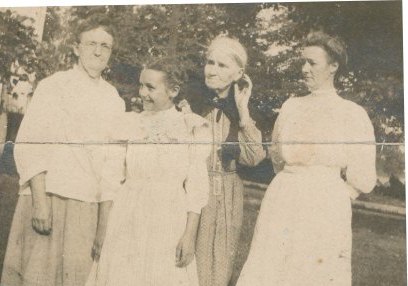
Left to right: Lucina (Hill) Howe, Helen Richardson, Eliza Hill, and Genieve Richardson

Undated photograph, circa 1885. Frank Irving Howe, Jr. Family Papers.