By Elaine Grublin
Although the actual letter is no longer extant, it is widely accepted that in early May of 1861 Boston businessman Amos A. Lawrence wrote a letter to Senator Andrew Johnson of Tennessee suggesting he might provide “material aid” to Johnson to support Johnson’s anti-secession stand in Tennessee. Why is it assumed that Lawrence, a wealthy textile merchant and member of the Constitutional Union Party, wrote such a letter to Johnson? Primarily because on 15 May 1861 Johnson replied stating “I received your kind favor on yesterday & hasten to reply.” But did Johnson really write that letter?
It was not entirely unexpected that Lawrence would write to Johnson. In December of 1860, Lawrence wrote Johnson commending him for the “position which you have taken in your patriotic speech in the Senate.” In this speech, delivered on the eve of South Carolina’s secession, Johnson vociferously declared his opposition to secession as an answer to the national crisis, declaring that it was “no remedy for the evils” currently facing the country. More to the point, he declared that the people of Tennessee would “stand by the Constitution” and thus would save “the greatest Government on earth.”
Johnson received the 20 December 1860 letter from Lawrence. But he never received the letter written in early May 1861. That letter was intercepted by Knoxville postmaster Charles W. Charlton. Charlton was a supporter of Tennessee’s pro-secession Governor, Isham Harris, and after intercepting Lawrence’s letter Charlton, Harris, and others became embroiled a in conspiracy to embezzle as much as $10,000.00 from Lawrence and his fellow Union men in New England in order to aid Governor Harris in raising and arming regiments to fight for the Confederate army.
There is disagreement as to who actually forged the letters. Some scholars believe Charlton was the forger. Others, including William Brownlow a contemporary that claimed to recognize the handwriting, claim the forger was William G. Swan. Swan was a lawyer and future confederate congressman from Tennessee. Either way, the conspiracy definitely involved Charlton, who intercepted at least two (perhaps three) of Lawrence’s letters to Johnson, and Governor Harris, who had two of Lawrence’s letters and several incriminating letters from Charlton in his possession when Nashville fell to Union forces in early 1862. The letters in Harris’ possession eventually came to Johnson and are currently part of the Andrew Johnson Papers held by the Library of Congress.
Lawrence responded immediately to “Johnson’s” 15 May letter stating “if y[ou]r note to me were printed in our newspapers it would be good for Ten Thousand Dollars in three days time.” But Lawrence did not have the letter printed in the newspapers. If he had perhaps the scheme would have been stopped in its tracks, but understanding that he must “use it as a private letter” Lawrence instead called a meeting of like-minded men in Boston and shared the letter privately. (You can read more about the outcome of that meeting a read Lawrence’s letter of 22 May 1861 describing the meeting here.)
Johnson sends two more letters to Lawrence. On 23 May he writes “If I could command…. Say $10,000 I have no doubt I could hold this State onto the Federal Union” and asks for “assurance that we can get men & guns before the 8th of June”.
The 8th of June being the date set by the Tennessee legislature (which had already voted to approve secession) for the popular vote on the secession issue. On 6 June, too late to allow for any effective assistance from Lawrence before the secession vote, he writes again asking for “ 5 or $10,000 in New England Currency in large bills, by mail via Cincinnati” for the purchase of arms.
Lawrence had no reason to believe he was not corresponding with the actual Andrew Johnson. During the three weeks that the correspondence strung out, Johnson was traveling through East Tennessee making anti-secession speeches in an attempt to impact the 8 June vote, and there is nothing to indicate that Lawrence had ever seen Johnson’s handwriting. It was known throughout the nation that Harris had refused Abraham Lincoln’s call for troop on 15 April, stating “Tennessee will not furnish a single man for purpose of coercion, but 50,000 in necessary for the defense of our rights and those of our Southern brethren.” And that on 8 May Harris, with the approval of the legislature, entered into an alliance of sorts with the Confederate government, placing the entire militia of Tennessee under the control of the Confederate government. Lawrence would have known that Johnson had little hope of support from within his own state. And would have been happy to lend that needed support to Johnson in order to retain Tennessee for the Union.
The forgers’ scheme began to unravel on 11 June when the Richmond Enquirer published one of Lawrence’s letters to Johnson. Presumably Governor Harris or one of the conspirators provided the letter to the Enquirer in an attempt to humiliate Johnson, but the publication of the letter only drew attention to the fact that forged letters were being exchanged. Although there was question as to the fate of a $1000.00 draft sent by Lawrence sent on 18 May, after the conspiracy was revealed Lawrence and Andrew Johnson engaged in a long personal correspondence which did result in Lawrence provided some monetary aid to Johnson to support the Unionists in East Tennessee.
For more of the story see Barry A. Couch, “The Merchant and the Senator: An Attempt to Save East Tennessee for the Union,” East Tennessee Historical Society Publications, 46 (1974): 53-75.
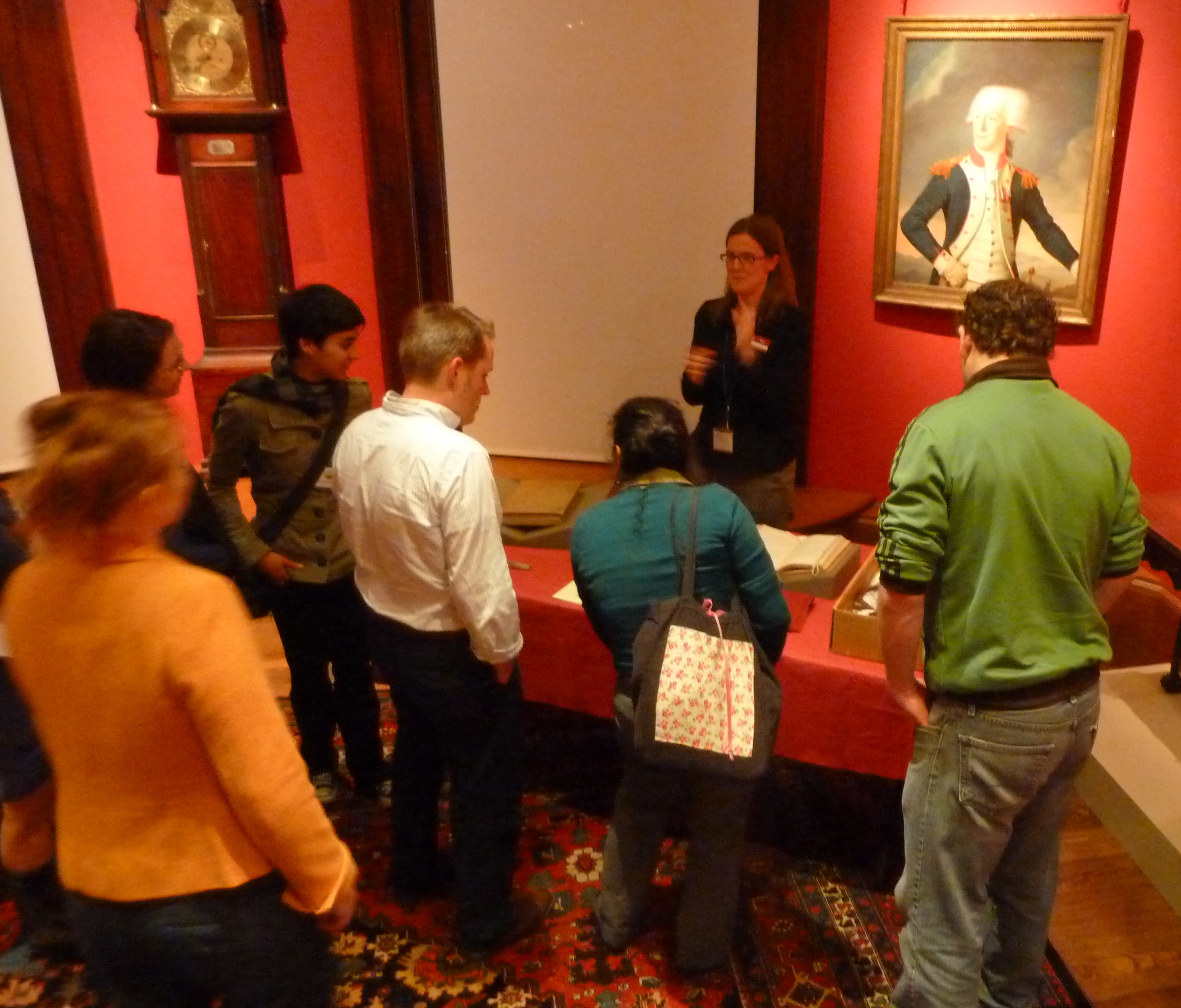
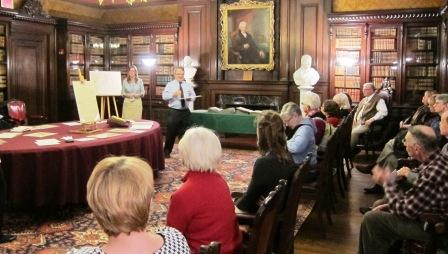 The guests arrived promptly at 6:00 PM for brief introductory remarks in the Dowse Library. The group then explored the building, guided by MHS staff. Anne Bentley, curator of art, lead a tour of the art and artifacts on display throughout the building, including portraits of famous North Enders such as
 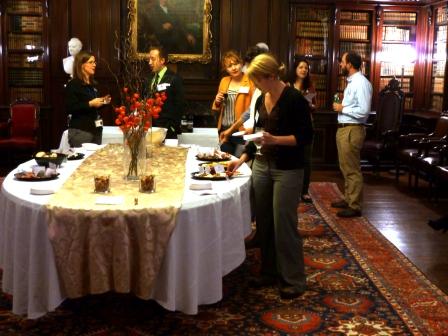 On Wednesday, 19 October, the Massachusetts Historical Society opened its doors to current and potential
 For those unable to attend, a number of these items were highlighted in Boston Magazine in 2009 and
 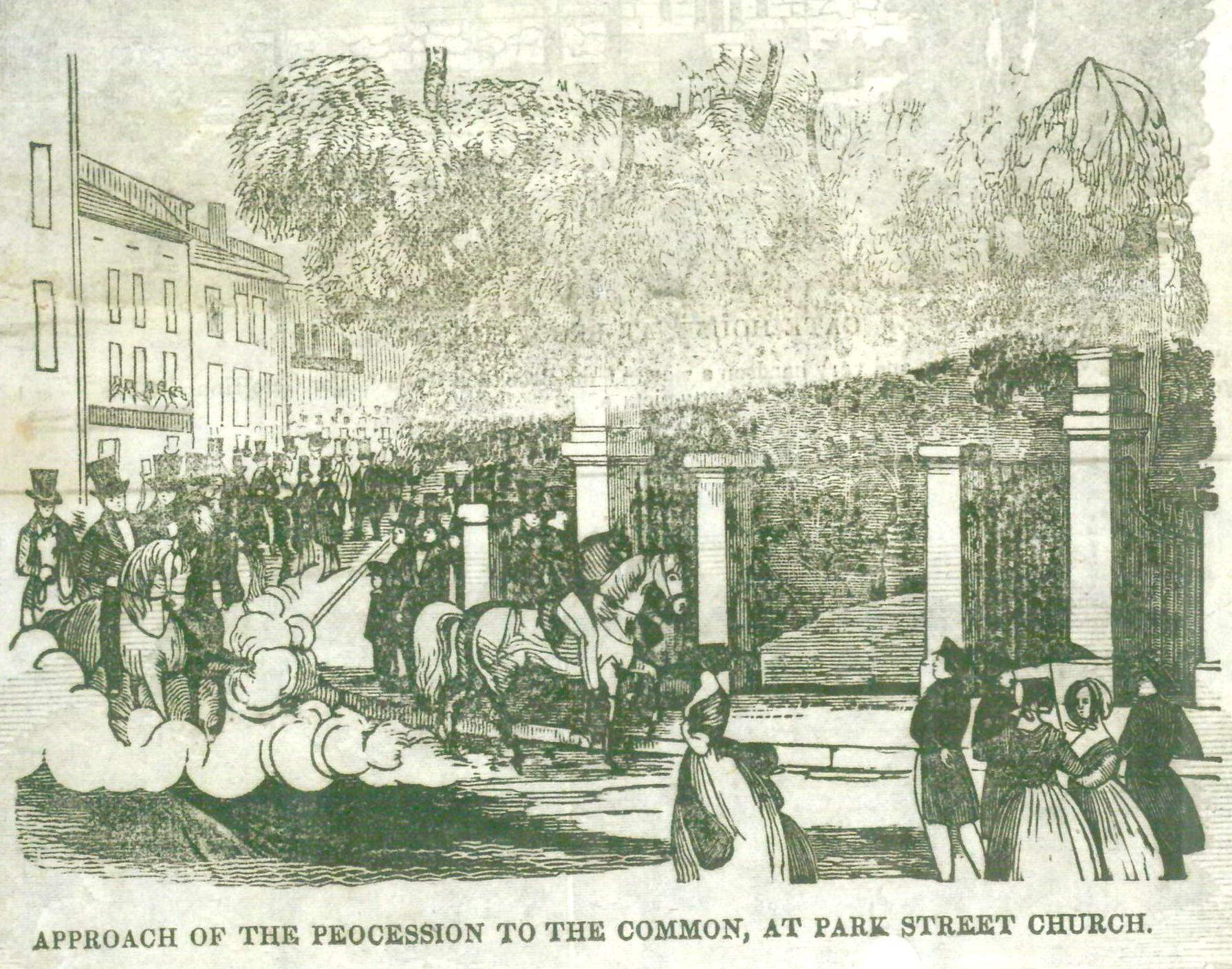 While a modern day parade that hails our sports teams as champions draws thousands of loyal fans to the streets, none will celebrate an event that had such an impact on the city or attract such a diverse crowd. While some put their hopes and emotion into supporting the Bruins or the Red Sox and cheer their victories, this was a cause to celebrate lives saved and enriched.
 The procession ended at Boston Common, at which point the performances began. There was singing by the Handel & Haydn Society, a prayer by a reverend minister, an ode sung by schoolchildren and penned by James Russell Lowell. A report on behalf of the Water Commission followed, along with an address by the Mayor. Finally, the water was turned on and the chorus from the Oratorio of Elijah was proclaimed.