By Anna J. Cook
Back in 2009 Jeremy Dibbell brought us an account of colonial Boston’s Pope’s Day celebrations of 1745 as witnessed by Rev. James Freeman, a founding member of the Massachusetts Historical Society. Little remembered today, Pope’s Day was an annual festival here in Boston – the New England counterpart to the English Guy Fawkes Day. You can explore the origins of Pope’s Day on the excellent 5th of November in Boston website, sponsored by the Bostonian Society.
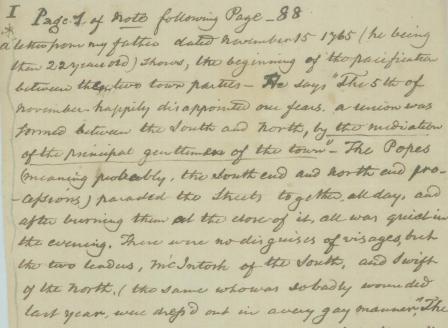
Today, I’d like to share with you another account of Pope’s Day as written by Boston merchant and loyalist Isaac Winslow (1743-1793). In a letter on 15 November 1765 and later incorporated into a family history written by his son, also named Isaac. Isaac Winslow, Jr., writes in the Winslow Family Memorial:
[My father] says “The 5th of November happily disappointed ones fears, a union was formed between the South and North, by the mediation of the principal gentlemen of the town” – The Popes (meaning probably, the South end and north end processions) [“] paraded the Streets together, all day, and after burning them at the close of it, all was quiet in the evening. There were no disguises of visages, but the two leaders, M’cIntosh of the South, and Swift of the North, (the same who was so badly wounded last year, were dress’d out in a very gay manner, The authorities[”] he says [“]did not interfere at all in the matter[”] (MacKintosh was one of the most active of the mob which destroyed Governor Hutchinsons house in North Square 26 August 1765, and was arrested by the Sheriff, but could not be committed on account of the popular interference).
The younger Isaac goes on to write:
On the anniversary of “Pope day” on the 5th of November, there had always existed a bitter rivalry between the South and North parts of the town, which party should capture and destroy each others Pope – the effigies of whom accompanied by others of the Devil and his Imps were carried about in procession on that day & he added by a distinguished fighting character from each Section – the Northern procession going to the South, and vice versa accompanied each other with a vast concourse of people – They usually met each other in or about Dock Square where the contest took place – These conflicts were very severe, but this year (1765) the popular leaders had excited in the minds of the people such a determined opposition to the Stamp act, that they succeeded in making peace, between the two parties who had before always been at swords points with each other.
A full transcript of the Winslow Family Memorial can be read online (PDF). The account of Pope’s Day is on page 65-66 of the transcript.
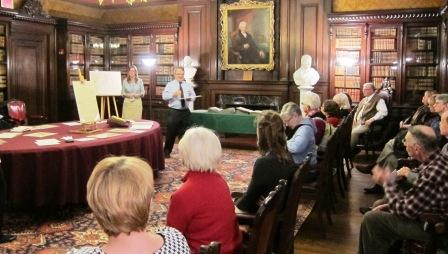 The guests arrived promptly at 6:00 PM for brief introductory remarks in the Dowse Library. The group then explored the building, guided by MHS staff. Anne Bentley, curator of art, lead a tour of the art and artifacts on display throughout the building, including portraits of famous North Enders such as
 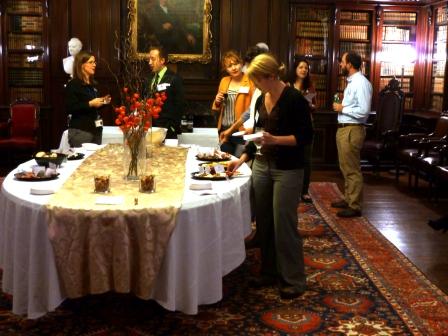 On Wednesday, 19 October, the Massachusetts Historical Society opened its doors to current and potential
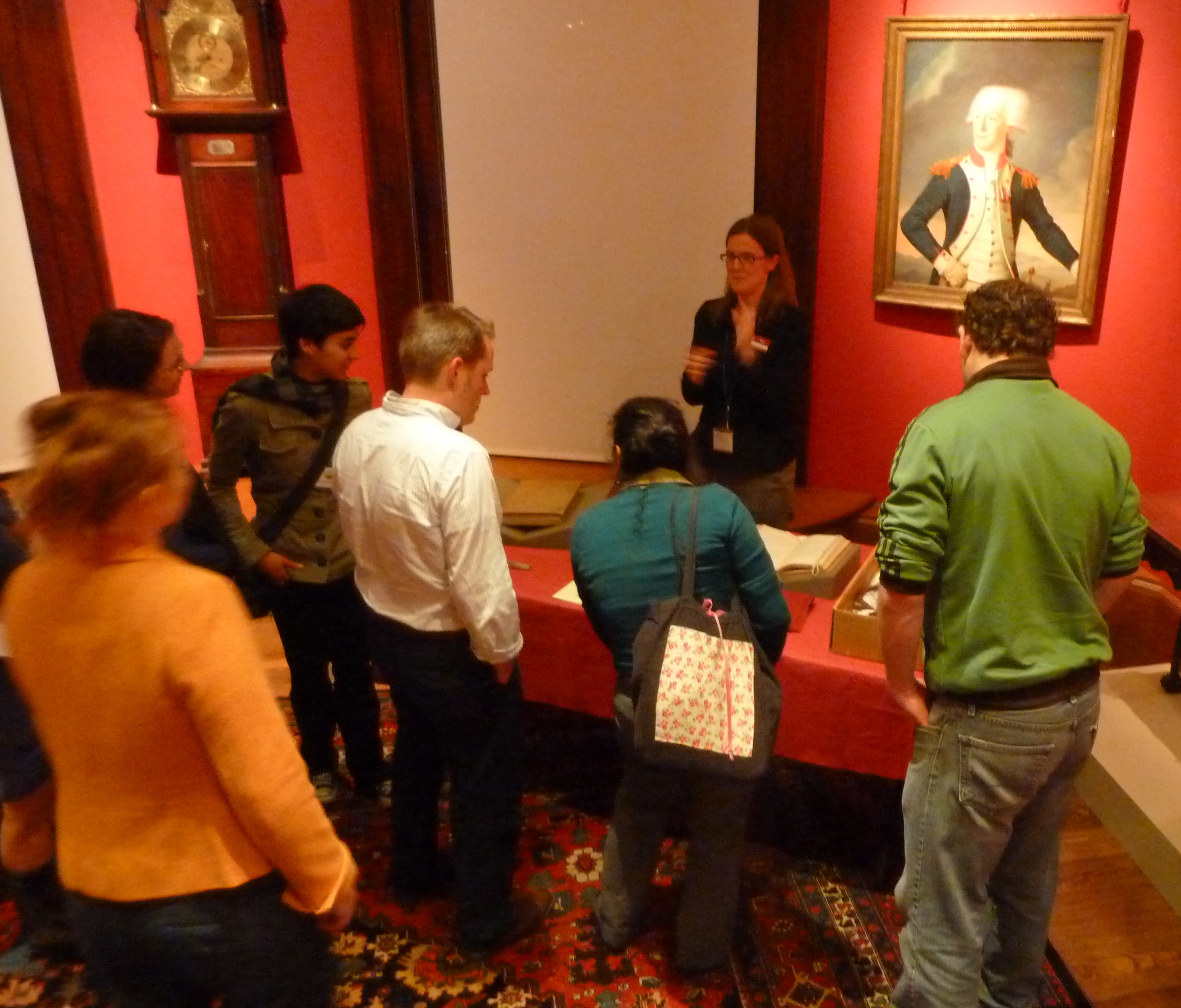 For those unable to attend, a number of these items were highlighted in Boston Magazine in 2009 and
 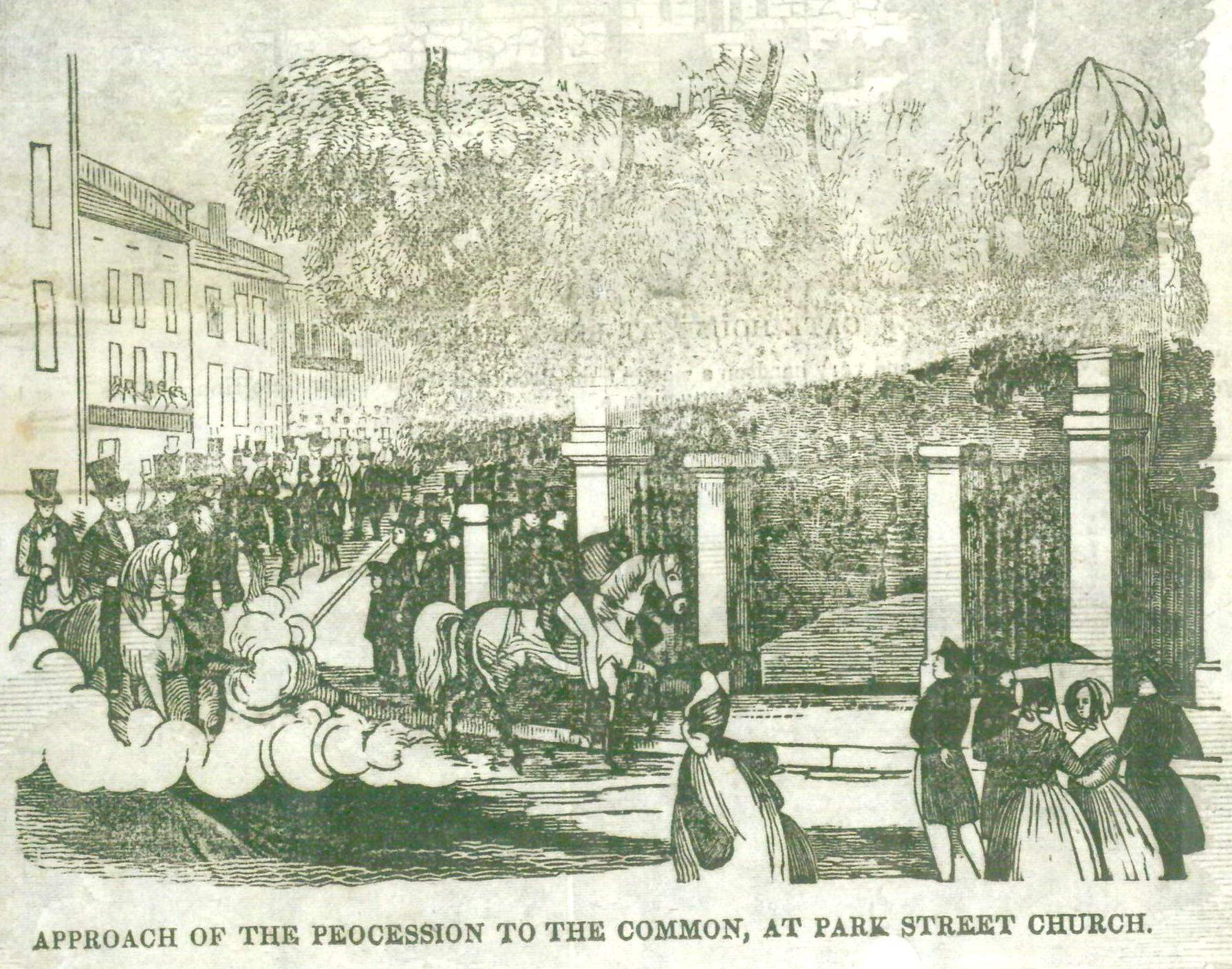 While a modern day parade that hails our sports teams as champions draws thousands of loyal fans to the streets, none will celebrate an event that had such an impact on the city or attract such a diverse crowd. While some put their hopes and emotion into supporting the Bruins or the Red Sox and cheer their victories, this was a cause to celebrate lives saved and enriched.
 The procession ended at Boston Common, at which point the performances began. There was singing by the Handel & Haydn Society, a prayer by a reverend minister, an ode sung by schoolchildren and penned by James Russell Lowell. A report on behalf of the Water Commission followed, along with an address by the Mayor. Finally, the water was turned on and the chorus from the Oratorio of Elijah was proclaimed.