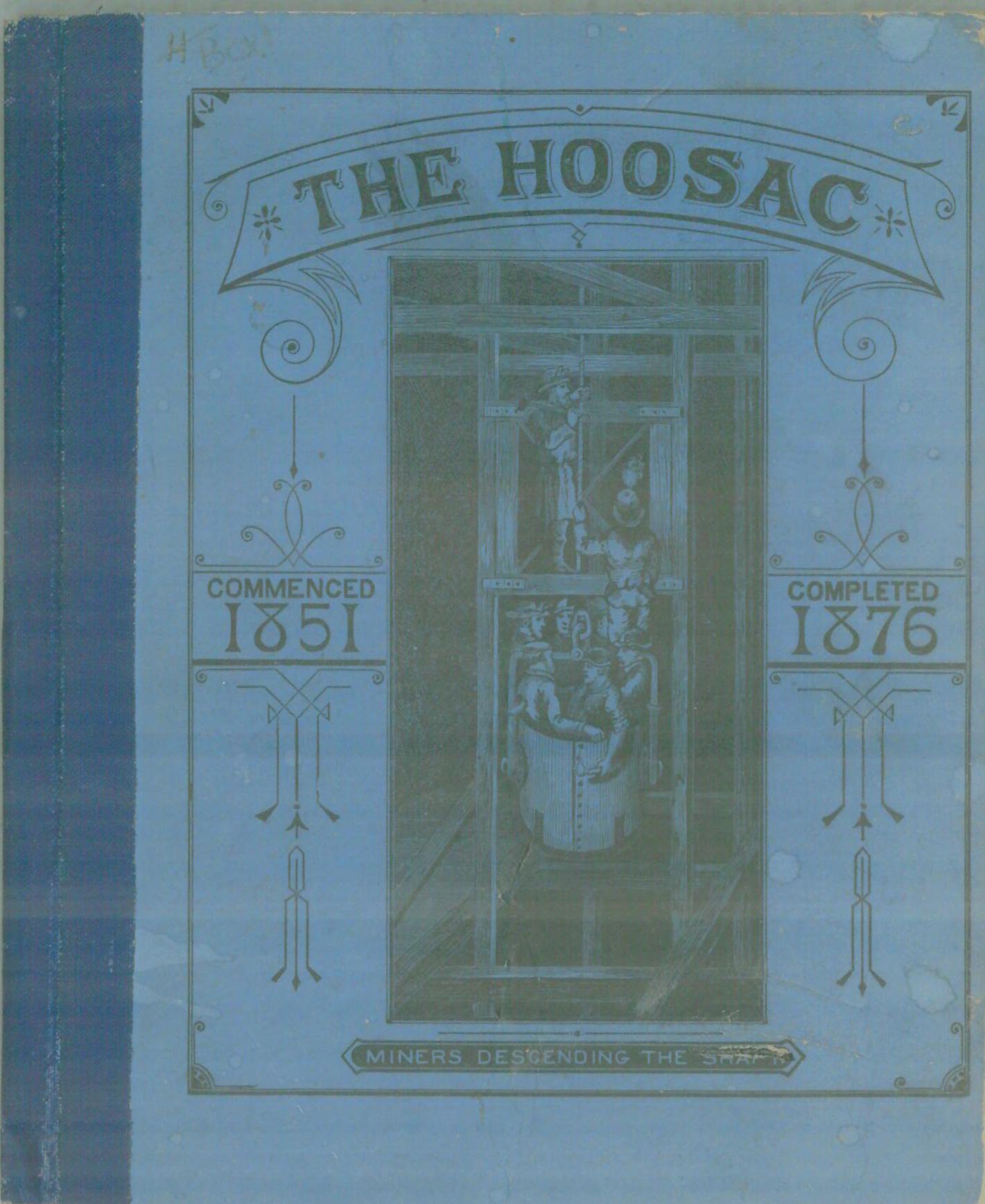
The Hoosac Tunnel Completed

By Daniel Hinchen

“…to write a history of the Hoosac Tunnel in all its details would be an almost endless task. The legislative bills and hearings, the reports of committees, remonstrances and private pamphlets on the subject, if stacked up in an orderly pile, would rival the size of the mountain itself.” (Orson Dalrymple, History of the Hoosac Tunnel 3.)

One of the benefits of creating these blog posts is the opportunity to gain some background on topics that were previously unfamiliar to me. While the research does not go into a great deal of depth, it is a good way to get some “quick and dirty” facts and to expand familiarity with the great collections here at the MHS.

And today’s topic is no exception. When initially given the assignment, the name itself, the Hoosac Tunnel, was not completely unfamiliar to me, but there was absolutely no background knowledge in my mind to illustrate it.

So, a few specifics: the Hoosac Tunnel is about 4.75 miles long and is located between Florida, Mass. and North Adams, Mass. It cuts through the Hoosac Range, a southern extension of Vermont’s Green Mountains. It was a part of the Boston and Maine Railroad, connecting Boston to Troy, New York by way of Greenfield, Mass. This rail system is now part of the Pan Am Railways network.

While the physical work of creating the tunnel started in 1851, the original planning for a new route across Massachusetts began as early as 1819 with discussion of a canal project, which, even then, proposed a tunnel through the Hoosac Range. Over time, proposals and ideas morphed and the national rail building craze turned the canal project into a tunnel project, with formal fundraising beginning in 1848.
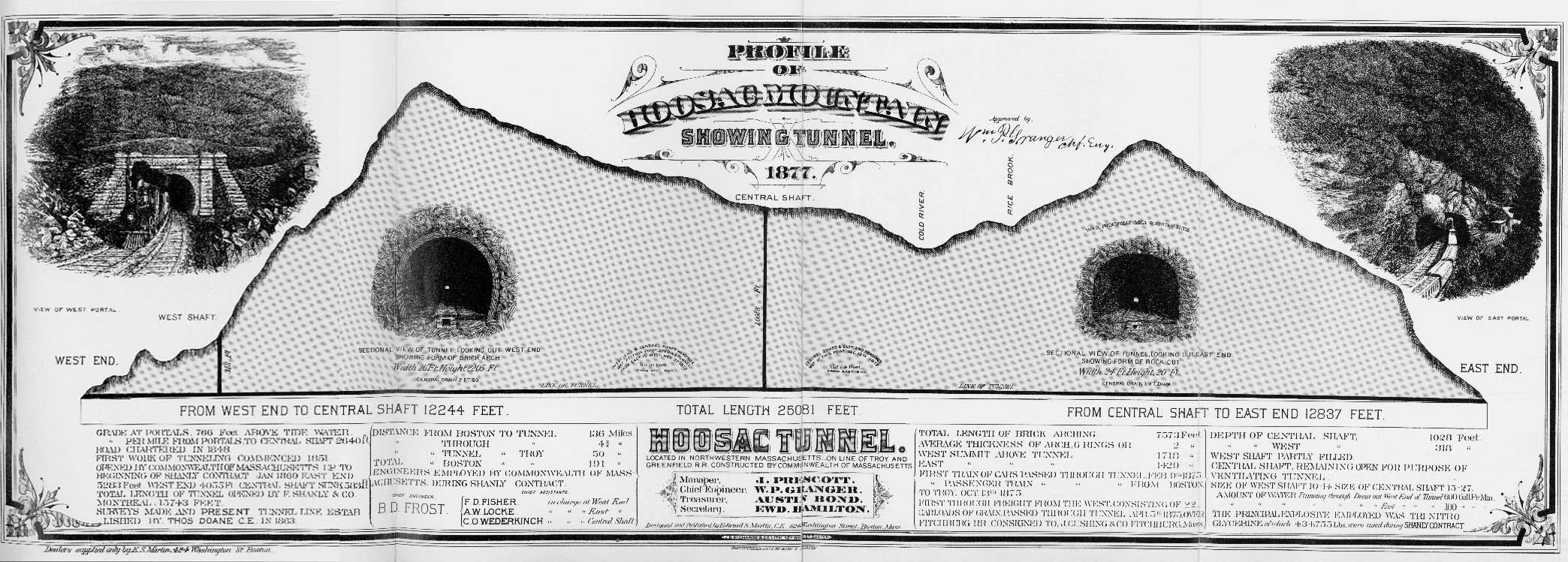
Ambiguous beginnings were matched by indefinite endings, and the completion of the Hoosac Tunnel included many firsts: the first work train passed through on 9 February 1875. In that same year the first freight train passed through on 5 April, and the first passenger train on 13 October. The work was totally finished in 1877 with the completion of the stone facing on the east portal. But the reason that the tunnel gets our attention today is that on 27 November 1873 the center of the tunnel was opened, joining the eastern and western halves. With the final blast, the longest tunnel in the western hemisphere (second in the world) was finally completed. It would hold this title until 1916.

And that is the quick and dirty of the Hoosac Tunnel.

If you would like to find out more about this impressive feat of engineering in Massachusetts History, visit the MHS website to search our online catalog, ABIGAIL, and search for the subject “Hoosac Tunnel” and find out what resources we have available! 

This Week @ MHS

By Elaine Grublin

It will be a quiet week at the MHS. Please note that the library and exhibition areas will be closed Thursday, 24 November through Saturday, 26 November in observance of the Thanksgiving holiday. Regular hours will resume on Monday, 28 November.

If you are roaming the city early in the week and looking for something to do, the exhibition areas will be open Monday through Wednesday 10:00 AM to 4:00 PM . We currently have two shows onview: The Purchase by Blood: Massachusetts in the Civil War 1861-1862 and “Like a Wolf for the Prey”: The Massachusestts Historical Society’s Collection Begins.


Isaac Winslow Writes of Pope’s Day, 1765

By Anna J. Cook

Back in 2009 Jeremy Dibbell brought us an account of colonial Boston’s Pope’s Day celebrations of 1745 as witnessed by Rev. James Freeman, a founding member of the Massachusetts Historical Society. Little remembered today, Pope’s Day was an annual festival here in Boston – the New England counterpart to the English Guy Fawkes Day. You can explore the origins of Pope’s Day on the excellent 5th of November in Boston website, sponsored by the Bostonian Society.

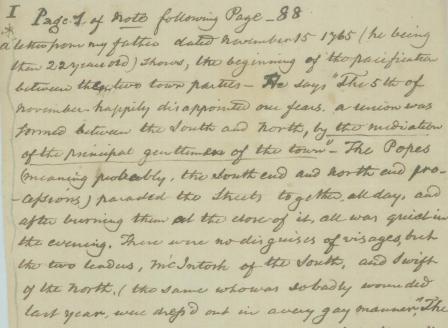
Today, I’d like to share with you another account of Pope’s Day as written by Boston merchant and loyalist Isaac Winslow (1743-1793). In a letter on 15 November 1765 and later incorporated into a family history written by his son, also named Isaac. Isaac Winslow, Jr., writes in the Winslow Family Memorial:

Image of manuscript item written by Isaac Winslow of Boston

 [My father] says “The 5th of November happily disappointed ones fears, a union was formed between the South and North, by the mediation of the principal gentlemen of the town” – The Popes (meaning probably, the South end and north end processions) [“] paraded the Streets together, all day, and after burning them at the close of it, all was quiet in the evening. There were no disguises of visages, but the two leaders, M’cIntosh of the South, and Swift of the North, (the same who was so badly wounded last year, were dress’d out in a very gay manner, The authorities[”] he says [“]did not interfere at all in the matter[”] (MacKintosh was one of the most active of the mob which destroyed Governor Hutchinsons  house in North Square 26 August 1765, and was arrested by the Sheriff, but could not be committed on account of the popular interference).

The younger Isaac goes on to write:

On the anniversary of “Pope day” on the 5th of November, there had always existed a bitter rivalry between the South and North parts of the town, which party should capture and destroy each others Pope – the effigies of whom accompanied by others of the Devil and his Imps were carried about in procession on that day & he added by a distinguished fighting character from each Section – the Northern procession going to the South, and vice versa accompanied each other with a vast concourse of people – They usually met each other in or about Dock Square where the contest took place – These conflicts were very severe, but this year (1765) the popular leaders had excited in the minds of the people such a determined opposition to the Stamp act, that they succeeded in making peace, between the two parties who had before always been at swords points with each other.

 A full transcript of the Winslow Family Memorial can be read online (PDF). The account of Pope’s Day is on page 65-66 of the transcript.

North End Historical Society Visits MHS

By Elaine Grublin

On Tuesday, 2 November, a group of 20 members of the North End Historical Society (NEHS) visited the MHS for a tour and document show and tell. The visit was arranged by Alex Goldfeld, the president of the NEHS and Elaine Grublin, the head of reader services at the MHS. 

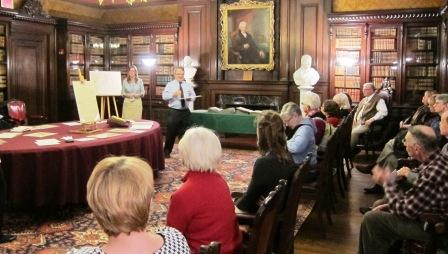
Peter Drummey addressing seated crowd in Dowse LibraryThe guests arrived promptly at 6:00 PM for brief introductory remarks in the Dowse Library. The group then explored the building, guided by MHS staff. Anne Bentley, curator of art, lead a tour of the art and artifacts on display throughout the building, including portraits of famous North Enders such as Paul Revere. Elaine Grublin offered an introduction to using the MHS library.
Reconvening in the Dowse Library guests were treated to a North End focused document show and tell that included large detailed maps of the North End in 1798 drawn by Samuel Chester Clough, Paul Revere’s deposition recounting his midnight ride, documents related to Father Taylor and the Seamen’s Bethel, an early 19th century engraving of Commercial Wharf, and a number of other treasures from our collections. Librarian Peter Drummey, offered an overview of the items on display (pictured) before the guests had an opportunity to view the materials up close. 

It was a wonderful evening for all that attended. We hope to see many of the North End Historical Society members return to the MHS in the future. 


This Week @ MHS

By Elaine Grublin

It is a busy week at the MHS, offering a bit of something for everyone.  There are assorted daytime, evening, and off-site programs, including an outdoor walking tour.

Tuesday, 1 November at 5:15 PM the Boston Early American History Seminar continues with Todd Estes, Oakland University, presenting his research The Constitution Goes Public: Strategy and Timing in the Ratification Debate, Early Fall 1787.  Pauline Maier, Massachusetts Institute of Technology, will give the comment. This event will take place at McMullen Museum at Boston College, where participants will have the opportunity to view the “Making History” exhibit following the program.

Wednesday, 2 November, at 12:00 PM visitors can participate as NEH-MHS long-term fellow Joshua Greenberg, Bridgewater State University, presents aspects of his current project Face to Face Value: American Interactions with Paper Money in the Early 19th Century at a brown-bag lunch program. 

Also on Wednesday, at 6:00 PM, Vincent Carretta, University of Maryland, will discuss his latest publication, Phillis Wheatley: Biography of a Genius in Bondage. Copies of the book will be available for purchase and signing after the lecture.

Thursday, 3 November, 5:30 PM a new seminar series begins at the MHS. The New England Biography Seminar will open with Michael Burlingame, Dean Grodzins, and Tony Horwitz presenting Sowing and Reaping: Biography and the Civil War: Theodore Parker, John Brown, Abraham Lincoln. Author Carol Bundy will moderate the session, which will address the rewards and challenges of looking at the American Civil War from a biographical perspective.

Sunday, 6 November, from 2:00 PM – 4:00 PM the MHS will team up with Barbara Berenson, Supreme Judicial Court of Massachusetts and author of Walking Tours of Civil War Boston, for a guided walking tour in the city.  Civil War on the Freedom Trail requires pre-registration. Registered participants will receive directions to the tour’s starting place in advance and a copy of the guide book when they arrive. The cost for participating in this programs is $10 for MHS members; $15 for non-members.

Do not forget the MHS has two exhibitions open. The exhibition halls are free and open to the public Monday through Saturday, 10:00 AM to 4:00 PM. Currently on view are “Like a Wolf for the Prey”: The Massachusetts Historical Society Collection Begins and The Purchase by Blood: Massachusetts in the Civil War, 1861-1862.  On Friday, 4 November at 2:00 PM, join MHS art curator Anne Bentley as she presents a gallery talk in The Purchase by Blood exhibition space.  

“Gloriously Gruesome” Welcomes Enthusiastic Crowd

By Anna J. Cook

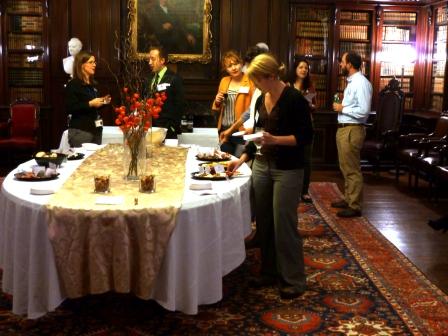
Guests enjoying reception in Dowse LibraryOn Wednesday, 19 October, the Massachusetts Historical Society opened its doors to current and potential associate members for a reception and presentation of some of the “gloriously gruesome” items in our collections. Guests were treated to food and drink in the historic Dowse Library, followed by a show and tell given by Elaine Grublin, Head of Reader Services.
Refreshments were catered by Formaggio Kitchen (Cambridge, Mass.) and the appropriately gruesome “dark and stormy” rum punch received high marks from the taste-testers.

Guests viewing exhibition cases

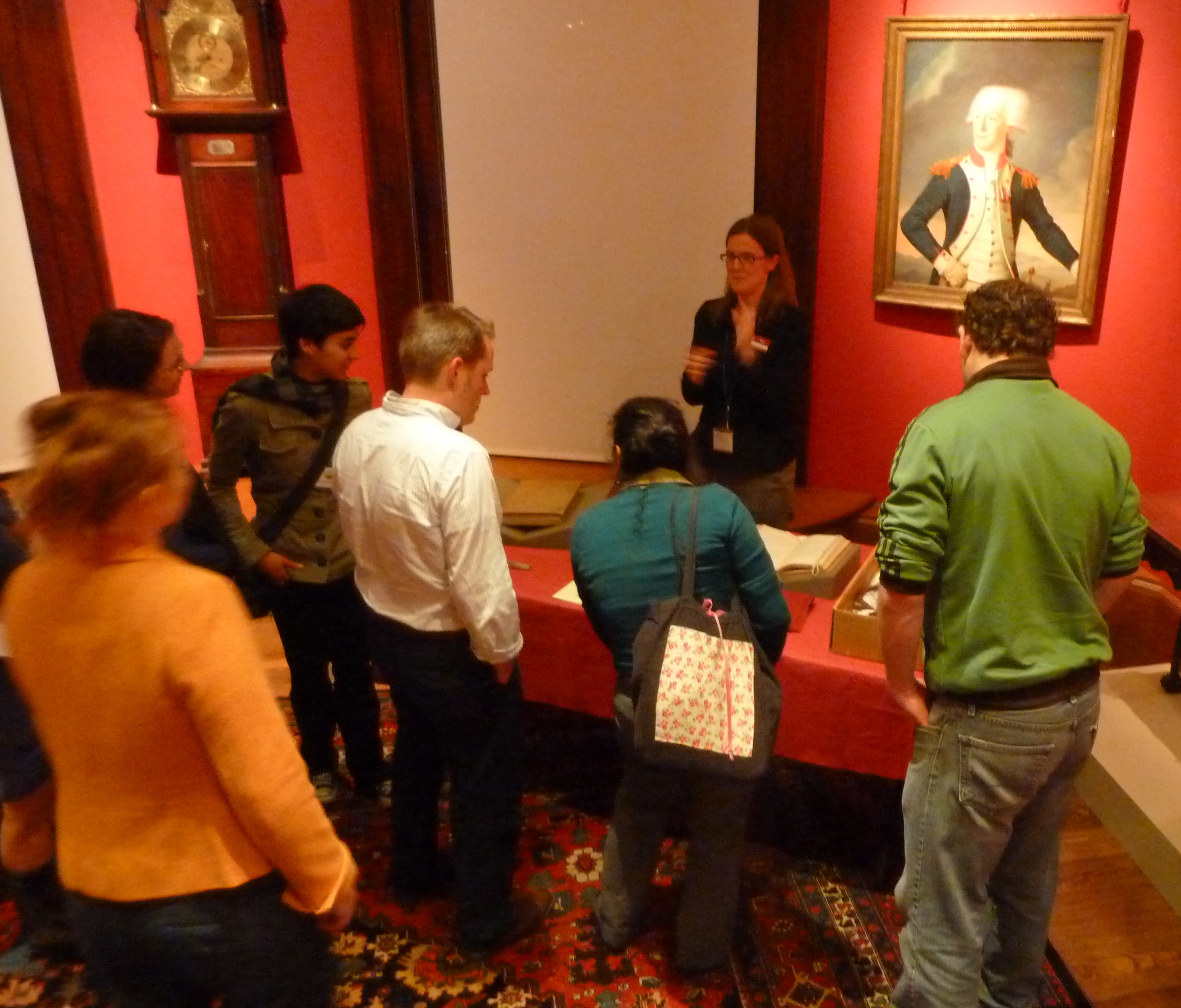
During the reception portion of the evening, guests wandered the public galleries on a scavenger hunt. Here, two attendees examine manuscript items on display as part of The Purchase of Blood: Massachusetts in the Civil War, 1861-1862 exhibition.

The presentation was held in our portrait gallery, and following a brief welcome by Dennis Fiori, President of the Society, Elaine Grublin introduced a number of objects in our collections with shady histories. These included a bronze death mask, an account of murder and dismemberment at Harvard Medical School, a scrap of towel bearing the blood of Abraham Lincoln, specimens of human hair and bone, a bird preserved in arsenic, and the noose that is purported to have hanged John Brown.

Guests viewing gruesome items on display For those unable to attend, a number of these items were highlighted in Boston Magazine in 2009 and an online version of that article is still available.
Following the talk, guests were invited to the front of the room for a closer viewing.

We were excited to see many first-time visitors at the Society, and hope that everyone felt warmly welcomed. We invite folks to consider membership at the MHS, to return as researchers, or to attend one of our many public programs

Celebrating Water with a Gala Day!

By Daniel Hinchen

“Never since the clink of the first hammer of civilization that rung its notes upon the tri-mountains of the present town or city of Boston, has there been or is there likely to be, such a gala day as that of the 25th of October, 1848! The entrance and reception of Washington, of Lafayette, and the still greater acclamation, parade and pageant that welcomed ‘Old Hickory,’ the Bunker Hill Celebration, all, all fall far behind the brilliancy, fervor and grandeur of the demonstration mode by the citizens of Boston and country adjacent upon this great occasion—introduction of the waters of Lake Cochituate into our city!”

Such was the joy in Boston and surrounding areas when the new aqueduct was opened in 1848, giving the citizens what they wanted and needed for so long: water that was not only fresh, but free.

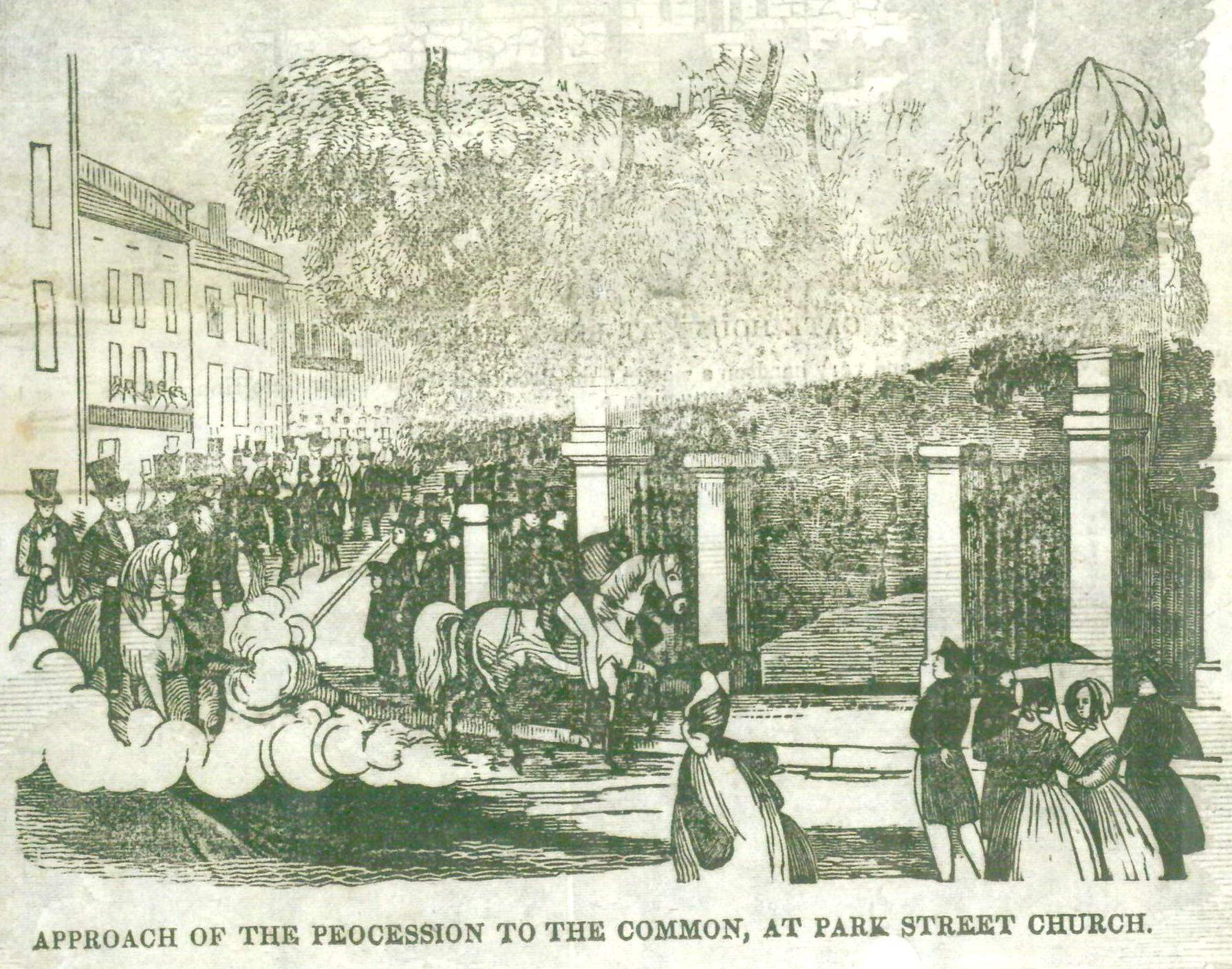
Newpaper image of Procession on Park Street, BostonWhile a modern day parade that hails our sports teams as champions draws thousands of loyal fans to the streets, none will celebrate an event that had such an impact on the city or attract such a diverse crowd. While some put their hopes and emotion into supporting the Bruins or the Red Sox and cheer their victories, this was a cause to celebrate lives saved and enriched.

People from all walks and all professions were in attendance. The great procession included, among others: firemen, military, various committee members, Governor Briggs, state officers, municipal authorities, clergy, physicians, mechanics, reporters. There were printers pulling a printing press that spat out flyers and programs as the group proceeded. All of these groups were represented in the first two divisions of the parade, which consisted of at least six divisions! And this does not include the people watching the procession. “We certainly never saw Boston so packed with people before; for miles nothing but compact masses of human beings were to be seen in our streets.”

Map of boston showing parad routeThe procession ended at Boston Common, at which point the performances began. There was singing by the Handel & Haydn Society, a prayer by a reverend minister, an ode sung by schoolchildren and penned by James Russell Lowell. A report on behalf of the Water Commission followed, along with an address by the Mayor. Finally, the water was turned on and the chorus from the Oratorio of Elijah was proclaimed.
Thinking of this event serves as a reminder of the major steps that a city like Boston takes in its development, and that the running water that is now taken for granted was once cause for unparalleled festivities, celebration, and joy.

To learn more about the celebration, or the struggle to bring additional clean water into Boston in the 19th century, visit the MHS library to discover additional source materials.

Web Presentation Launched Today: Massachusetts in the Civil War, 1861-1862

By Peter K. Steinberg

In connection with the exhibition The Purchase by Blood: Massachusetts in the Civil War, 1861-1862, the Massachusetts Historical Society has digitized a number of letters, photographs, and broadsides from its collections to present online. Available are small and large high resolution images as well as transcriptions of letters to facilitate reading where the handwriting may be difficult to discern.

Image of web page banner

The pages in the web presentation represent a subset of the documents in the exhibition, narrating micro-stories of some battles which took place in Virginia (Ball’s Bluff, Peninsula Campaign, Cedar Mountain) and Maryland (Antietam). Regimental units were formed based on networks of friendships and alliances, and the featured materials convey the close connections between many of the soldiers. Each page highlights at least one of Massachusetts’s fallen sons, providing both a photographic image of a soldier and, in most instances, a letter which provides contextual information about a particular battle and/or a soldiers’ actions in the war and in death. Among those individuals featured are William Lowell Putnam, James Jackson Lowell, Richard Goodwin, Richard Cary, and Wilder Dwight. 

The launch is particularly timely as today is the 150th anniversary of the Battle of Ball’s Bluff, a battle explored in both the exhibition and the accompanying web presentation. 

In addition to this web presentation, please visit the The Massachusetts Historical Society Commemorates the Civil War subject portal to find additional online content, including our monthly presentation of a Civil War document from 150 years that month, a timeline, selected publications, classroom tools, and a list of past and future events held at the MHS.

Seminar Recap: Paying For “Freedom” with Her Health

By Anna J. Cook

On Thursday evening, October 13th, the Boston Seminar on the History of Women and Gender welcomed Helen Zoe Veit of Michigan State University who presented her paper “Paying For ‘Freedom’ with Her Health: Rising Life Expectancy, Women’s Aging, and American Youth Culture,” with comment by Brooke L. Blower of Boston University. Veit is an historian of food and nutrition whose first book, Victory Over Ourselves: American Food in the Era of the Great War (forthcoming in 2012) examines the modernization of food through home economics, food science, and self-discipline. While conducting research for Victory Over Ourselves, Veit discovered the work of Eugene Fiske and the Life Extension Institute, during the 1920s, in promoting the concept of self-discipline over “the one thing you couldn’t possibly apply [self-control of the body] to – that is, death.” “Paying For ‘Freedom’” examines the changing attitudes towards aging in the interwar period, with particular attention to the ways in which notions about the consequences of aging – and advice on anti-aging strategies – were framed differently for female and male audiences.

In comment, Blower commended Veit on her “classic cultural history objective” of seeking to understand how the discourse of self-discipline over the body as a means for extending life (and even defeating death?) has cast a “long shadow” over the 20th century. She pointed out how Veit brings our attention to the fact that, in the 1920s, Americans had to be sold on the idea that growing old could be a positive thing. One of the ways the fear of old age became managed was through separating the idea and performance of youth from one’s numerical age – the notion that acting young could actually make you physically youthful, no matter how many years you had been alive. Blower raised the question of whether the growing emphasize on youth in American culture may not, in fact, mask the reality that political and economic power remained in the hands of the late-middle-aged: “’youth’ rules; the young do not,” she suggested. Finally, she challenged Veit to provide more context – particularly exploring the way in which life extension efforts might relate to Teddy Roosevelt’s advocacy of “the strenuous life,” to fears of neurasthenia, and to the work of eugenics advocates. She was interested in popular reception of ideas concerning life extension, and whether Fiske’s advice had any noticeable effect on public practice. Given the gendered nature of the debate, she also wondered whether any women might be found pushing back against the new rhetoric of yourhfulness, and where and how they did so.

The discussion period was lively, as audience members discussed how persuasive Veit had been in her argument concerning the differing expectations of male and female youth and vitality. The consensus seemed to be that while the idea had promise, more evidence was needed. A number of suggestions were made for further exploration of context: Christian Science theology from the period, discussions of fertility and motherhood, the connections between nationalism and public health, the development of the life insurance industry and modern statistics collection, and scientific research on hormones.

The seminar series at the Massachusetts Historical Society are open to the public free of charge, with a small subscription fee for those wishing to receive the pre-circulated paper. We welcome you to explore our offerings, and hope to see you at upcoming sessions!

This Week at MHS

By Elaine Grublin

Our latest exhibition, The Purchase by Blood: Massachusetts in the Civil War, 1861-1862, is free and open to the public Monday through Saturday 10:00 AM to 4:00 PM. In addition to seeing the exhibition visitors will have the opportunity to attend two gallery talks this week. On Wednesday, 19 October, from 11:00 AM to 12:00 PM, and again on Friday, 21 October from 2:00 PM to 3:00 PM members of the exhibition’s curation team we speak about elements of the exhibition.

On Wednesday, 19 October at 6:00 PM current and potential associate members are invited to a special event just for them. Gloriously Gruesome at the MHS will feature a number of gruesome objects from the MHS collections. Registration is required for this event. 

And do not forget our weekly building tour The History and Collections of the MHS. The 90-minute tour departs our lobby at 10:00 AM.