Barefoot Families and Demon Rum: The Work of an Urban Missionary

By Susan Martin, Processing Archivist & EAD Coordinator

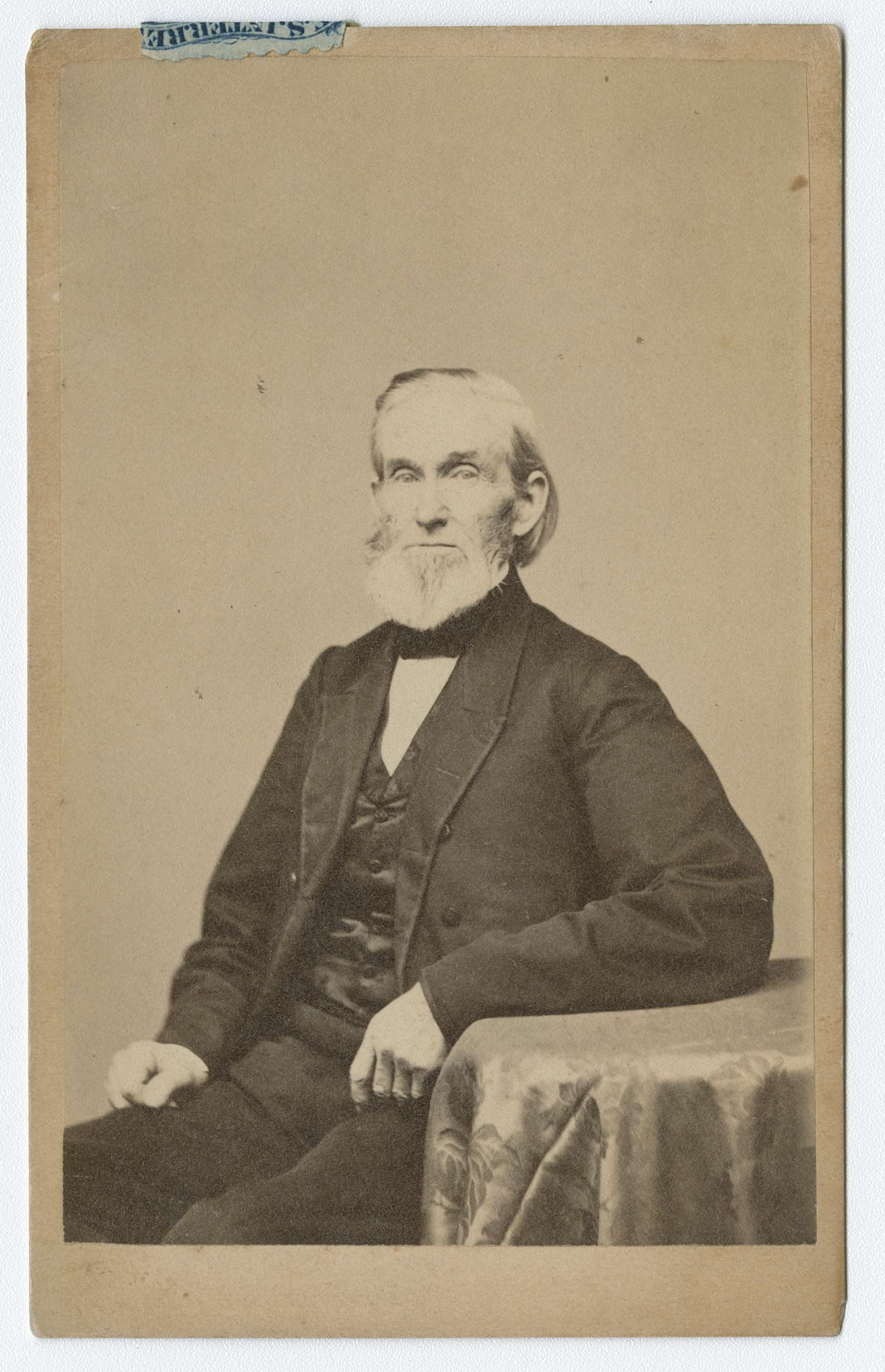
In June 1854, the Boston City Missionary Society appointed a Methodist Episcopal clergyman named Luman Boyden to serve as missionary to the poor in East Boston. The 48-year-old Boyden (pictured above, about ten years later) had had a distinguished 20-year career as a minister in Sudbury, Oxford, Dorchester, Chelsea, Fitchburg, Holliston, Spencer, Roxbury, Salem, and Waltham. The Society offered him a salary of $650 a year, and he would earn an additional $200 preaching at Union Chapel in East Boston.

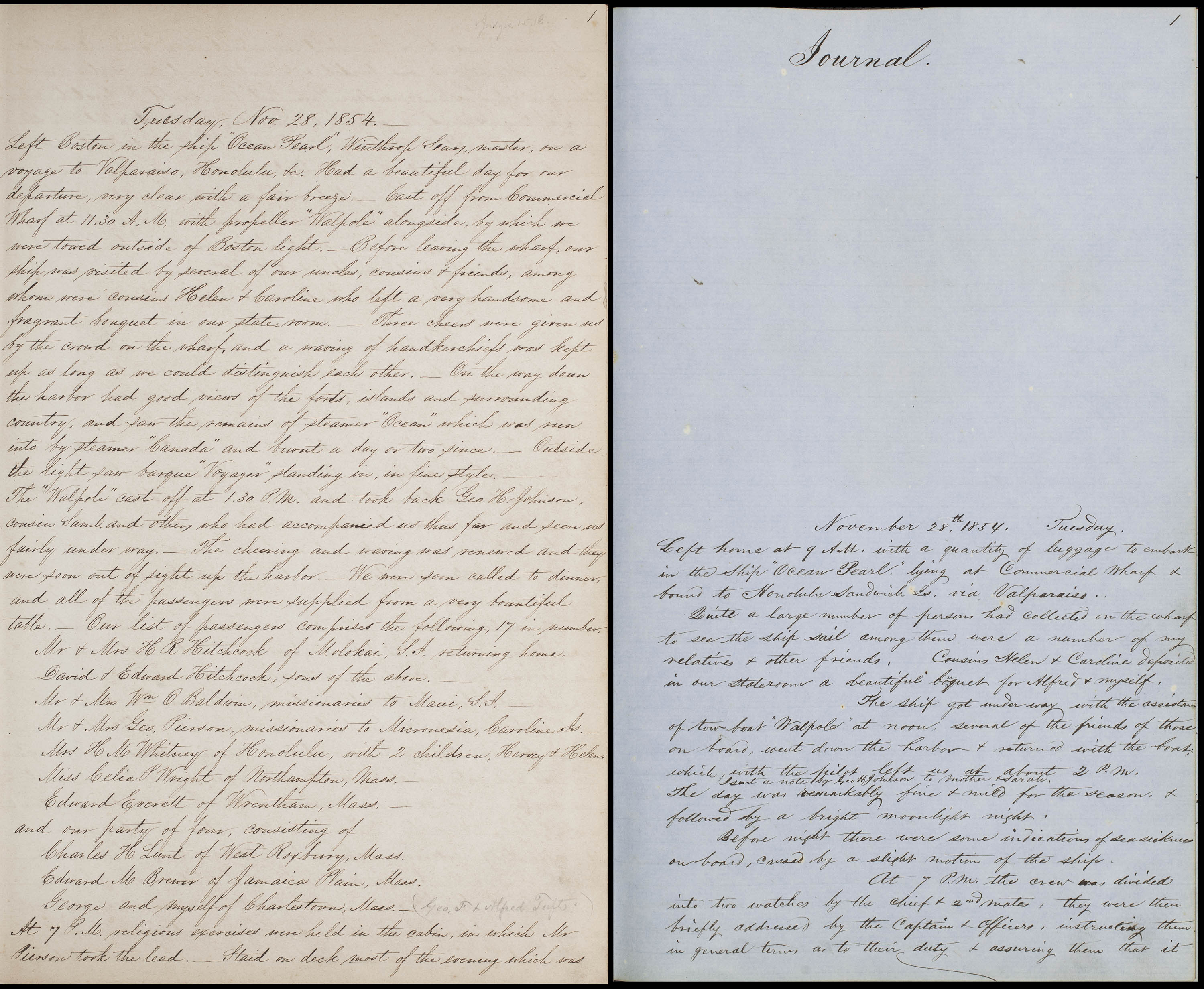
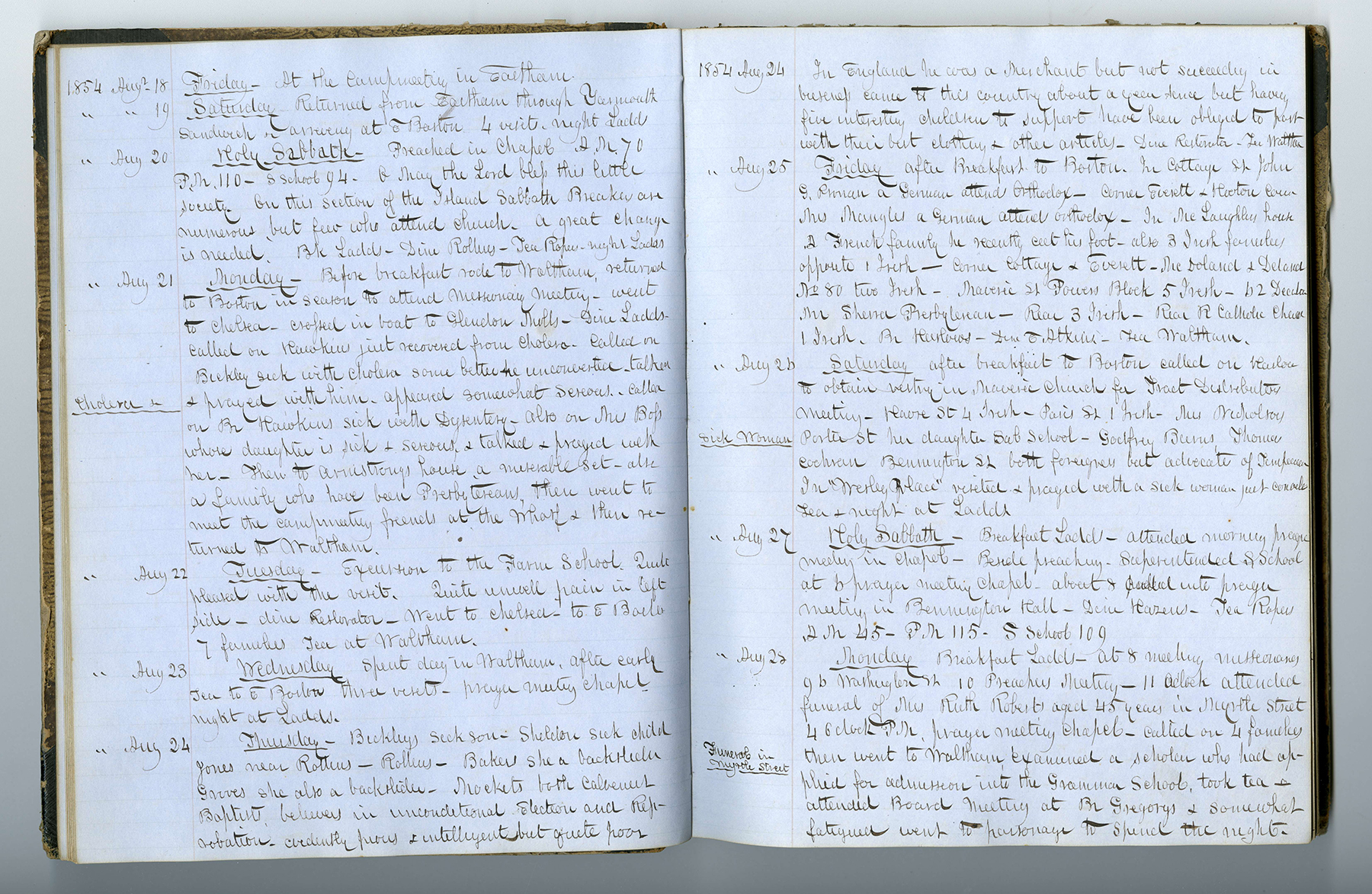
Earlier this year, the MHS acquired four manuscript journals Boyden kept during this time, 1854-1863, primarily documenting his missionary work. He wrote in them every day and described, in compelling detail, the poverty in East Boston, as well as the ravages of alcoholism, domestic violence, other crimes, suicides, and illnesses such as tuberculosis, smallpox, and typhoid fever. Boyden visited the homes of Protestant, Irish Catholic, African American, and immigrant families, many suffering from terrible privation. His journals are a fascinating social history of the city and a record of 19th-century urban life in general.

Rev. Boyden hit the ground running. His first day on the job was 1 July 1854, and just 17 days in, he was attending the family of a Mr. Rose, who had attempted to kill himself by cutting his own throat with a razor blade. Two days later, Boyden visited a woman “putrid with disease,” a young woman dying of consumption, and the family of a suicide victim. He was shocked and horrified by the things he saw. When three people he’d met were arrested for murder, he wrote disbelievingly, “Did not think Monday that I was talking with those who would so soon be considered murderers.”

The pages of Boyden’s journals are filled with daily tragedies. He visited multiple families a day, and while his compassion for the poor was clearly genuine, he was not a disinterested party. One of his primary goals was conversion, and he distributed Bibles and religious tracts and proselytized about sin and salvation. He used language like “den of pollution” and “hive of iniquity” to describe some homes. About others, he simply wrote, “There Satan appears to reign.” As you can imagine, he encountered resistance from Irish Catholic residents, the dominant immigrant group in the neighborhood.

The journals contain a wealth of information, including names and addresses, and some entries go on for multiple pages. In one, Boyden paints a vivid picture of a tenement building as he moves floor to floor, and you also get a sense of his attitude toward the tenants.

Went into Bee Hive No 2 on Havre Street. It is a large old building in the rear of Bee Hive No 1. In each house 16 Tenements which rent for 1 ¼ dollar each week or $65.00 a year. The amount of rent for each year 1040.00. The Hive No 2 is not worth beside land $400.00. […] The houses are owned by a shoe firm in the city & the Tenants make shoes for the firm so the rent is secure & to obtain work the Tenements are filled. […] As I descended flight after flight I found others of the same class, poor, ignorant, depraved & who must be saved or lost forever.

Boyden reserved his fiercest animosity for alcohol. In the margins alongside his text, he scribbled headings like “Rum & Poverty,” “Rum & Beggary,” “Rumsellers Abomination,” etc. Other headings include “Motherless Boy,” “Barefoot Family,” “Poor & Proud,” “Blind Girl in Waltham,” “Furious Woman,” “Singular Case,” and “Children Under Table.”

Speaking of children, many of those Boyden met on his rounds did not attend or had never attended school. Boyden strongly advocated for the education of all children. On 28 September 1854, he wrote about the Nute family.

House kept quite neat, children dressed neatly but in consequence of being colored they are suffering by a most oppressive arrangement. Their children are allowed to attend the primary school with white children but as soon as they become qualified to enter the grammar school, they are not admitted to the schools in E. Boston, but go to the colored school [the Abiel Smith School] in Belknap St about 2 miles from home. In doing this they are obliged to cross the Ferry & pay two cents toll each way. They have three who attend the school in Belknap St at an expense of ferriage of 12 cents a day. […] They feel afflicted that while the dirtiest, vilest white children are admitted that theirs are excluded. Say they have applied to the General School Com[mitte]e but have accomplished nothing. I am resolved to plead their cause.

Incidentally, less than one year later, the Massachusetts legislature passed the first law in the United States prohibiting segregation in public schools. The campaign was led by Benjamin F. Roberts, whose children had also been excluded from the white schools near their home. Roberts had previously lost his case at the Massachusetts Supreme Judicial Court in Roberts v. City of Boston (1850).

In his journals, Boyden often recorded follow-up visits, so we know how some of the stories developed, who lived and who died, who went to jail or the almshouse, who converted, who repented, and who didn’t. For example, here’s an amazing passage that caught my eye. On 20 March 1857, Boyden visited an African American family on Bennington Street, consisting of Mrs. Russell, her adult daughter, and the daughter’s two children.

[The daughter] is very black & I noticed the infant in her arms was far from being black. I asked if her husband was a pious man? She said I may as well tell the truth, I have no husband. I inquired is not the father to that child a white man? She made no reply, excepting a coarse laugh. I told her that it belonged to the father of the child to support it & I could not help her till he had been seen & if he had anything compelled to aid. […] She has another child about 6 years old the same color. I spoke to her plainly of her wickedness. She said with apparent anger, it is Gods will or it would not be so. The old Lady seemed to feel deeply the ruin of her only child.

Miss Russell told Rev. Boyden the name of her baby’s father, who was white and had a wife and other children. Boyden said he would visit the man, although I couldn’t determine if he ever did. Unfortunately, when he returned to the Russell home about a month later . . .

Her daughter in quite a rage because several weeks since I reproved her as she think[s] to[o] severely. She then said it was the Lords will. I told her it was the work of the devil. She replied that she knew that the Lord made her & he did every child. Today she said the child died several weeks ago.

While most entries relate to Boyden’s missionary and ministerial work, some give us glimpses into his personal life. He and his wife Mary had two children—at the start of the first journal, Helen Maria was 24 and Jeremiah Wesley 15. There had been another daughter, Mary Elizabeth, but she died in 1837 at the age of three. Boyden wrote about her several times.

Luman Boyden died in 1876 at the age of 70. His wife Mary lived until 1897. Both parents outlived their son Jeremiah, who served as a U.S. Navy surgeon in the Civil War before dying of yellow fever at 27. Daughter Helen worked as a teacher, married Thomas Warren Thayer, and died in 1922 at 92 years old.

P.S. Interestingly, Boyden frequently referred in his journals to another missionary for the Boston City Missionary Society, Armeda Gibbs. Gibbs was an abolitionist who helped freedom seekers and is probably best known as the first female nurse for the Union army during the Civil War. Sure enough, Boyden noted on 6 August 1862, “Heard Miss Gibbs offered to go as nurse in the army.”

This Week @MHS

Join us for a program at the MHS this week!

– Tuesday, 11 December, 12:00 PM: Robert Treat Paine’s Life & Influence on Law with Maura Healey, Massachusetts Attorney General; Alan Rogers, Boston College; Christina Carrick, Assistant Editor, The Papers of Robert Treat Paine, and moderator Catherine Allgor, MHS President. Join us for a special event with the current Attorney General looking at the first Massachusetts Attorney General’s life and influence on law and order during the Revolutionary era. This event celebrates the completion of the five-volume series The Papers of Robert Treat Paine. A pre-talk reception begins at 11:30 AM; the speaking program begins at 12:00 PM. This program is free and open to the public.

– Tuesday, 11 December, 5:15 PM: A Nice History of Bird Migration: Ethology, Expertise, & Conservation in 20th Century North America with Kristoffer Whitney, Rochester Institute of Technology, and comment by Marilyn Ogilvie, University of Oklahoma.This paper focuses on the historical relationships between migratory birds, scientists, and amateur experts in 20th-century North America, especially Margaret Morse Nice. Nice, simultaneously a trained ornithologist and an enthusiastic amateur across disciplines, almost single-handedly introduced the American ornithological community to European ethology. Her bird-banding work exemplified the tensions in natural history around expertise, gender, and conservation.This is part of the Boston Seminar on Environmental History series. Seminars are free and open to the public.

– Wednesday, 12 December, 12:00 PM: Ecology of Utopia: Environmental Discourse and Practice in Antebellum Communal Settlements with Molly Reed, Cornell University. During the 1840s, members of short-lived intentional communities debated strategies for “getting back to nature” and explored emerging meanings of “natural” through radical hygiene, diet, and agricultural practices. This talk examines how Transcendentalist and Fourierist communitarians articulated human-environment relationships in terms that reflected and informed their visions for social change.This is part of the brown-bag lunch program.

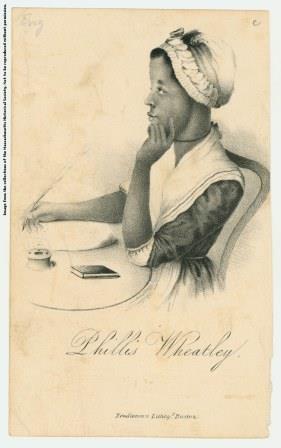
– Wednesday, 12 December, 6:00 PM:  No More, America with Peter Galison, Harvard University; Henry Louis Gates Jr., Harvard University. In 1773, two graduating Harvard seniors, Theodore Parsons and Eliphalet Pearson, were summoned before a public audience to debate whether slavery was compatible with “natural law.” Peter Galison’s short film, “No More, America” co-directed with Henry Louis Gates, reimagines this original debate to include the powerful voice of Phillis Wheatley, an acclaimed poet, then-enslaved, who lived just across the Charles River from the two Harvard students. Join us for a film screening followed by a discussion between Peter Galison and Henry Louis Gates. A pre-program reception begins at 5:30 PM; the speaking program begins at 6:00 PM. There is a $10 per person fee (no charge for MHS Fellows and Members or EBT cardholders). 

– Saturday, 15 December, 10:00 AM: The History & Collections of the MHS. Join is for a 90-minute docent-led walk through of the public rooms of the MHS. The tour is free, open to the public, with no need for reservations. If you would like to bring a larger party (8 or more), please contact Curator of Art Anne Bentley at 617-646-0508 or abentley@masshist.org.

Fashioning the New England Family is open Monday through Saturday,, from 10:00 AM to 4:00 PM. The exhibition explores the ways in which the multiple meanings of fashion and fashionable goods are reflected in patterns of consumption and refashioning, recycling, and retaining favorite family pieces. Many of the items that will be featured have been out of sight, having never been exhibited for the public or seen in living memory. The exhibition is organized as part of Mass Fashion, a consortium of cultural institutions set up to explore and celebrate the many facets of the culture of fashion in Massachusetts. 

Please note that the library will open at 2:00 PM on Tuesday, 11 December and will close at 3:30 PM on Thursday, 13 DecemberTake a look at our calendar page for information about upcoming programs.

Barbara Hillard Smith’s Diary, December 1918

By Lindsay Bina, Intern and Anna Clutterbuck-Cook, Reader Services

Today we return to the 1918 diary of Newton teenager Barbara Hillard Smith. You may read our introduction to the diary, and Barbara’s previous entries, here:

January | February | March | April | May | June | July | 

 August | September | October | November

As regular readers of the Beehive know, we are following Barbara throughout 1918 with monthly blog posts that present Barbara’s daily life — going to school, seeing friends, playing basketball, and caring for family members — in the words she wrote a century ago.

This post is the final in our year-long series sharing Barbara’s diary. The series will return in January 2019 with a new narrator hailing from the year 1919. In the meantime, take a moment or two to learn about Barbara’s December–full of basketball, babies, and a trip to New York to visit her friend Babe. Read along and–as Barbara says in her final entry for the year–“Watched old year out.”

Here is Barbara’s December, day by day.

* * *

SUN. 1   DECEMBER
Church. Sunday S. Dr. Drew here. Over to Aunt Mabels for supper.

MON. 2
School. Babies

TUES. 3
School. Studied. Cousin Bert took us to Westminster and saw “Fiddler’s three

WED. 4
School. Babies. Pastor’s Reception

THUR. 5
School. Swimming. Shampoo

FRI. 6
School. Awful snow storm. Mrs. Reed

SAT. 7
Worked around Mrs. Reed’s. K-C for week end with Pete.

SUN. 8
Church Sunday School. Supper at Lasell.

MON. 9
School. In town. Got suit

TUES. 10
School. Basket Ball Starter. Fitting for suit

WED. 11
Got sick in school. Went to babies

THUR. 12
Home sick

FRI. 13
School. Dance with Spud

SAT. 14
Hung around. Christmas play at Seminary.

SUN. 15
Sunday School. Lasell Christmas Vespers

MON. 16
School. Took care of baby

TUES. 17
School. Basketball. Cousin Bert here.

WED. 18
School. Took care of baby. Mr. Reed home from operation

THURS. 19
School. Basketball.

FRI. 20
School. Babies

SAT. 21
Took care of sonny. [Havene] for weekend. Christmas party. Freddie’s show

SUN. 22
Church. Sunday School. Concert. C. Endeavor. Spud’s for supper.

MON. 23
In town. Took care of baby. Women’s club concert

TUES. 24
Up to Reed’s all day. Trained, so didn’t have caroling. Sick

WED. 25                     CHRISTMAS DAY
Had presents. Dance at Spud’s

THUR. 26
Went to New York to visit Babe. Met Jack Palmer.

FRI. 27
Went to Mrs. Learnerd’s for lunch. Keith’s in afternoon.

SAT. 28
Babe’s singing lessons. Went to Ladies First

SUN. 29
Company for dinner. Out for walk. Reg + Gladys came over.

MON. 30
Went to movies.

TUES. 31
John Ross. Went to Mrs Andrew’s with Jack. Watched old year out

If you are interested in viewing the diary in person in our library or have other questions about the collection, please visit the library or contact a member of the library staff for further assistance.

*Please note that the diary transcription is a rough-and-ready version, not an authoritative transcript. Researchers wishing to use the diary in the course of their own work should verify the version found here with the manuscript original. The catalog record for the Barbara Hillard Smith collection may be found here.

Remembering Former President George H. W. Bush

By MHS

As the United States remembers former President George H. W. Bush, who died on Friday, 30 November 2018, at the age of 94, the MHS remembers him too.


George H. W. Bush addressing guests at the MHS Annual Dinner on 10 October 2002.

In 2002, MHS staff (and items from the collections!) had two notable encounters with George H. W. Bush. On 11 March 2002, the exhibition Fathers and Sons opened at the George Bush Presidential Library and Museum on the grounds of Texas A&M University in College Station, Texas. The exhibition focused on the private and public careers of the two father and son sets of presidents: John Adams and John Quincy Adams and George H. W. Bush and George W. Bush. Staff from both the Bush Library and the MHS worked from September 2001 to January 2002 on establishing and finalizing which items from the Adams Family Papers and other collections would be on display in Texas. All in all, the Bush Library borrowed 26 manuscripts, 5 printed texts, 2 engravings, and 8 artifacts from the MHS for the exhibition. William M. Fowler, Jr., Director of the MHS (in 2002), joined George H. W. Bush, and his wife, Barbara, and many guests at the official opening of the show.

William M. Fowler, Jr.,  George H. W. Bush, and Patricia Burchfield examine Adams family artifacts from the MHS on display at the George Bush Presidential Library in March 2002.   

William M. Fowler, Jr. with George H. W. Bush and Barbara Bush in March 2002.

About seven months later, Mr. Bush travelled to Boston, Mass. and spoke at the MHS Annual Dinner held at the Harvard Club on 10 October 2002. Not since John Quincy Adams addressed the members in 1841 had a president spoken to the MHS. Before the well-attended formal dinner, Mr. Bush visited the MHS. David McCullough, the well-known historian and author of the book, John Adams, and MHS Stephen T. Riley Librarian, Peter Drummey, shared information about selected items from MHS’s collections, including the manuscript of George Washington’s Newburgh Address, Thomas Jefferson’s Farm Book, and Paul Revere’s account of his famous ride to Lexington. 

George H. W. Bush examining documents from the collection of the MHS with David McCullough (right) and Peter Drummey (left).


From left to right: Amalie M. Kass (MHS President  in 2002), David McCullough, George H. W. Bush, Levin H. Campbell, and William M. Fowler, Jr. (MHS Director in 2002).

This Week @MHS

Here is a look at what is going on this week at the MHS:

– Monday, 3 December, 6:00 PM:  Rochambeau: The French Military Presence in Boston with Robert Selig, The Washington-Rochambeau National Historic Trail. In July 1780, the French troop transport Île de France sailed into Boston Harbor. Thus began 30 months of uninterrupted French military presence in Boston as the city became the most important French base in North America until Christmas Day 1782, when a fleet under Admiral Vaudreuil sailed from Boston for the West Indies carrying the comte de Rochambeau’s infantry. This talk provides an in-depth look at this little-known episode in Massachusetts and Boston history. A pre-talk reception begins at 5:30 PM; the speaking program begins at 6:00 PM. There is a $10 per person fee (no charge for MHS Fellows and Members or EBT cardholders). 

 – Tuesday, 4 December, 5:15 PM: “Attend to the Opium”: Boston’s Trade with China in the Early 19th Century with Gwenn Miller, College of the Holy Cross, and comment by Dael Norwood, University of Delaware. The opium trade is the nefarious flip-side of the opulence of the American China trade. The involvement of so many Boston families in this trade would contribute to the growth of the city and its institutions by the end of the nineteenth century. Homes decorated with Chinese art, porcelains, silks, and meticulously curated gardens were made possible by profits initially rooted in the fur trade, and in large part sustained by opium.This is part of the Boston Area Seminar on Early American History series. Seminars are free and open to the public.

– Wednesday, 5 December, 12:00 PM: Seas of Connection: Narratives of Migration through Local American Wards with Nicholas Ames, University of Notre Dame. Mass emigration during the 19th and early 20th centuries produced rapidly shifting cityscapes across America. This talk investigates changes at the neighborhood (ward) level in three industrial American communities, Pittsburgh, PA, Cleveland, OH, and Clinton, MA, to understand the impact of historic Irish immigrants on community development within “quintessential” America. This is part of the brown-bag lunch program. Brown-bags are free and open to the public.

– Wednesday, 5 December, 6:00 PM: MHS Fellows & Members Holiday PartyMHS Fellows and Members are invited to the Society’s annual holiday party. Please note that the event is SOLD OUT.

– Thursday, 6 December, 6:00 PM: Boston in the Great War: Manuscripts & Artifacts of World War I with facilitator Bruce J. Schulman, Boston University. Prof. Bruce Schulman and students from Boston University will present a collection of artifacts and documents from the holdings of the MHS. From printed propaganda and personal recollections to battle plans and victory gardens, this presentation and virtual exhibit will explore the many ways in which Bostonians were affected by the Great War. Light refreshments will be served after the presentation. This program is free and open to the public.

– Friday, 7 December, 12:00 PM: Sylvia Plath’s Letters & Traces with Peter K. Steinberg, Co-Editor of the two-volume edition of The Letters of Sylvia Plath. In this talk, Peter K. Steinberg will discuss his role in editing the two-volume Letters of Sylvia Plath, published recently by HarperCollins. He will also highlight the professional and personal responses to Plath in her lifetime, as well as share an archival discovery made on a piece of carbon typing paper. This is part of the brown-bag lunch program.

– Saturday, 8 December, 10:00 AM: The History & Collections of the MHS. Join is for a 90-minute docent-led walk through of the public rooms of the MHS. The tour is free, open to the public, with no need for reservations. If you would like to bring a larger party (8 or more), please contact Curator of Art Anne Bentley at 617-646-0508 or abentley@masshist.org.

Fashioning the New England Family is open Monday through Saturday, from 10:00 AM to 4:00 PM. The exhibition explores the ways in which the multiple meanings of fashion and fashionable goods are reflected in patterns of consumption and refashioning, recycling, and retaining favorite family pieces. Many of the items that will be featured have been out of sight, having never been exhibited for the public or seen in living memory. The exhibition is organized as part of Mass Fashion, a consortium of cultural institutions set up to explore and celebrate the many facets of the culture of fashion in Massachusetts.

Take a look at our calendar page for information about upcoming programs.

This Week @MHS

Here is a look at what is going on this week at the MHS:

– Tuesday, 27 November, 5:15 PM: In Search of the Costs of Segregation with Elizabeth Herbin-Triant, University of Massachusetts—Lowell, and comment by Kenneth W. Mack, Harvard Law School. Historians generally treat Jim Crow as a legal, political, and cultural system shaping where African Americans went, whether they voted, and how they acted. Yet it was also an economic system that imposed financial burdens. This paper explores how segregation made the activities undertaken by African Americans—from gaining education to property—more expensive for them and how it excluded them from economic advancement. This is part of the Boston Seminar on Modern American Society and Culture series. Seminars are free and open to the public.

– Wednesday, 28 November, 12:00 PM: Mules, Fuels, & Fusion: Overcoming Entropy & Crossing the Isthmian Transit Zone 1848-1977 with Jordan Coulombe, University of New Hampshire. This talk explores American attempts to construct transportation infrastructures in Panama between the creation of the Panama Railroad and the Carter-Torrijos Treaties. It focuses specifically on the role proliferating energy sources played in restructuring the Isthmian environment.

– Thursday, 29 November, 6:00 PM: After Emily: Two Remarkable Women & the Legacy of America’s Greatest Poet with Julie Dobrow, Tufts University. Despite Emily Dickinson’s world renown, the story of the two women most responsible for her initial posthumous publication—Mabel Loomis Todd and her daughter, Millicent Todd Bingham—has remained in the shadows of the archives. A rich and compelling portrait of women who refused to be confined by the social mores of their era, After Emily explores Mabel and Millicent’s complex bond, as well as the powerful literary legacy they shared. A pre-talk reception begins at 5:30 PM; the speaking program begins at 6:00 PM. There is a $10 per person fee (no charge for MHS Fellows and Members or EBT cardholders) 

– Friday, 30 November, 12:00 PM: The American Debates over the China Relief Expedition of 1900 with Xiangyun Xu, Pennsylvania State UniversityThis talk examines the American debates over the country’s participation in the eight-nation alliance to relieve the Chinese Boxers’ siege of internationals in Tianjin and Beijing. It places U.S. participation within the context of concurrent controversies over the Spanish-American and Philippine-American war as well as the assertive U.S. policy in East Asia.

– Friday, 30 November, 2:00 PM: Fashioning the New England Family Gallery Talk with Kimberly Alexander, University of New Hampshire. Material culture specialist and guest curator, Dr. Kimberly Alexander will help viewers explore and contextualize rarely seen costumes, textiles and fashion-related accessories mined from the MHS collection. Representing three- centuries of evolving New England style, most of the pieces have never before been on view to the public.

– Saturday, 1 December, 9:00 AM to 4:00 PM: Remembering Abigail Adams workshop. Abigail Adams lived at the heart of American politics for nearly half a century. She was a revolutionary First Lady, urging her husband to “Remember the Ladies” in the colonial quest for independence, and a huge influence on the nation’s sixth president, John Quincy Adams. In her letters to her family and a wide circle of influential colleagues, Abigail was candid and colorful in depicting the hard work and great reward of nation-building. Join us as we remember the life and legacy of Abigail Adams, one of the many women who helped build early America. This program is open to all who work with K-12 students. Teachers can earn 22.5 Professional Development Points or 1 graduate credit (for an additional fee). There is a $25 per person fee. For questions, contact Kate Melchior at education@masshist.org or 617-646-0588.

Fashioning the New England Family is open Monday through Saturday, from 10:00 AM to 4:00 PM. The exhibition explores the ways in which the multiple meanings of fashion and fashionable goods are reflected in patterns of consumption and refashioning, recycling, and retaining favorite family pieces. Many of the items that will be featured have been out of sight, having never been exhibited for the public or seen in living memory. The exhibition is organized as part of Mass Fashion, a consortium of cultural institutions set up to explore and celebrate the many facets of the culture of fashion in Massachusetts.

Take a look at our calendar page for information about upcoming programs.

This Week @MHS

Looking for something to do before the Thanksgiving holiday? Here’s a look at what is planned at the MHS this week:

– Monday, 19 November, 6:00 PM: Black Flags, Blue Waters: The Epic History of America’s Most Notorious Pirates with Eric Jay Dolin. Set against the backdrop of the Age of Exploration, Black Flags, Blue Waters reveals the dramatic history of American piracy’s “Golden Age”—spanning the late 1600s through the early 1700s—when lawless pirates plied the coastal waters of North America and beyond. Eric Jay Dolin illustrates how American colonists at first supported these outrageous pirates in an early display of solidarity against the Crown, and then violently opposed them. A pre-talk reception begins at 5:30 PM; the speaking program begins at 6:00 PM. There will be a special rum tasting courtesy of Privateer Rum at the reception.There is a $10 per person fee (no charge for MHS Fellows and Members or EBT cardholders).

– Wednesday, 21 November, 12:00 PM : The American Debates over the China Relief Expedition of 1900 with Xiangyun Xu, Pennsylvania State University. This talk examines the American debates over the country’s participation in the eight-nation alliance to relieve the Chinese Boxers’ siege of internationals in Tianjin and Beijing. It places U.S. participation within the context of concurrent controversies over the Spanish-American and Philippine-American war as well as the assertive U.S. policy in East Asia.

Fashioning the New England Family is open Monday through Saturday, from 10:00 AM to 4:00 PM. The exhibition explores the ways in which the multiple meanings of fashion and fashionable goods are reflected in patterns of consumption and refashioning, recycling, and retaining favorite family pieces. Many of the items that will be featured have been out of sight, having never been exhibited for the public or seen in living memory. The exhibition is organized as part of Mass Fashion, a consortium of cultural institutions set up to explore and celebrate the many facets of the culture of fashion in Massachusetts. 

Please note that the building will be closed on Thursday, 22 November, Friday, 23 November, and Saturday, 24 November.

Take a look at our calendar page for information about upcoming programs.

Women at Sea: Ann Johnson and Abbie Clifford

By Susan Martin, Processing Archivist & EAD Coordinator

In 1849, the ship Lanerk sailed from Boston to California as part of the Gold Rush. On the ship was a clergyman named Truman Ripley Hawley, and the MHS recently acquired a transcript of his diary of the journey. It contains a lot of terrific detail, but one particular digression caught my eye. On 4 August 1849, off the west coast of South America, the Lanerk met the ship Christopher Mitchell, captained by Thomas Sullivan of New Jersey. Sullivan told Hawley about the following “amusing incident”:

He [Sullivan] sailed from Nantucket with his crew, shipped from different states in the union, only one of whom before the mast had ever been to sea before. On the voyage out all had done their duty, and all had been in the boats as usual. One of the crew was taken sick […] when one of the crew came aft […] and informed the captain that one of the crew in the forecastle who went by the name of George Johnson was a female! It very much surprised him, as well as all on board, and the man was told to go forward and send George into the cabin. He did so, and George made his appearance. The Capt. after interrogating her gave up a birth [sic] in his cabin for her and immediately put back to Peyta [Paita, Peru], gave her $100 and sent her home on board a vessel.

I learned from Eric Jay Dolin’s Leviathan: The History of Whaling in America (pp. 237-40), as well as other sources, that the woman was 19-year-old Ann Johnson of Rochester, N.Y. Her identity was discovered in July 1849 when (ahem) some of her clothes fell away in a feverish delirium. Why had Johnson dressed as a man and joined the crew of the Christopher Mitchell? Well, her story made the newspapers, but contemporary accounts varied widely, and historians haven’t been able to come to a consensus. Here’s Sullivan’s explanation:

She said in her story that she was decoyed away from home, Rochester, N.Y. by a man with whom she lived a few months when he left her, that she then went to her home but was forbid to enter by her father, that she then went and dressed in boy’s clothes, and went to ride horse on the canal, towing boats; that afterwards she went into a shipping office and asked for a birth [sic] on board a ship in the capacity of cabin boy, but finding no encouragement consented to ship as a youngster in a whaler. That she was sent to Nantucket and engaged by the owners of this vessel. Romantic truly!

I can’t say whether this version is definitive, but Hawley was hearing it from the captain himself only one month after it happened. Amazingly, Johnson had been able to maintain her disguise for seven months!

The story of Ann Johnson reminded me of another female sailor I learned about earlier this year when I cataloged the letters of Augustus Percival. Her name was Abbie Clifford, and she sailed with her husband, Captain Edwin Clifford, on a brig that bore her name. The Cliffords were from Maine. Percival served as their first mate in 1869 and mentioned them often in letters to his wife back in East Orleans, Mass.

The Abbie Clifford was engaged in the China trade, and in the fall of 1869, the ship was anchored at Shanghai waiting for a freight of tea. Percival occupied the cabin adjoining the Cliffords, and the three often ate and talked late into the evening on a variety of subjects, including religion. His letters reveal an unmistakable affection for the “free hearted” couple and an admiration, especially, for Mrs. Clifford.

Mrs Clifford is quite a Sailor, has been over 10 years with the Capt and I dont know as she has missed a voyage since he has been Master. She is a fine looking woman, and very pleasant, and quite a talker. [24 September 1869]

She lets me see all the things she buys on shore and I like her much, and we have all got along first rate so far, and hope we shall continue the same, but I know he is a very timid man & very nervous, but then he has much to worry him. [5 October 1869]

Every day brings us nearer a Charter, but he is almost discouraged at times, while She is always looking on the bright side, which is proper. [9 October 1869]

The end of November 1869 found the Abbie Clifford at Swatow (now called Shantou) chartering to take hundreds of “coolies” to Singapore. Percival’s intimacy with the Cliffords had only grown. He described the captain in fraternal terms and continued to praise Mrs. Clifford for her seafaring abilities, as well as her domestic qualities.

Mrs. C. generally looks after his Books, and is very good in figures and is a very good Navigator also and works time for the Capt or did on the passage out. [4 December 1869] 

It seems good to live in such a friendly way, and as it seems good to have some one to confide in, I say many things to Mrs. that I do not to others, and she is very good to me, will sew on a Button, offered to mend my Socks, &c. [6 December 1869]

By December 1870, Percival had moved on to another ship. But events of 1872 proved his admiration for Abbie Clifford very well-founded.

That spring, off the coast of Pernambuco, Brazil, yellow fever ravaged the Abbie Clifford, killing at least five crew members, including the steward, first mate, and Captain Clifford. When Percival heard the news, he wrote to his wife about Mrs. Clifford: “I pity her, but trust she will bear up under her trials with Christian fortitude.”

That she did. After her husband’s death on 5 April 1872, Mrs. Clifford (according to some accounts, suffering from yellow fever herself) gamely took command of the ship and sailed the thousands of miles north to New York, with the help of those men well enough to work. On the way, the crew withstood a five-day gale above Cape Hatteras that destroyed several of the ship’s spars and sails. They arrived at their destination on 12 May 1872.

Abbie Clifford’s exploits were recounted in glowing terms in newspaper articles of the day, like this one from as far away as Australia:

And as early as 1883, she was profiled in books like Daughters of America; or, Women of the Century (pp. 716-7) alongside some of the greatest 18th- and 19th-century American women. The Illustrated History of Kennebec County, Maine (pp. 757-8), published in 1892, mentions Abbie Clifford’s second marriage in 1877 to George Brown and goes on to describe her like this:

Mrs. Brown is a lady of genial bearing, a broad, well disciplined mind, and rare courage. She made several sea voyages with Captain Clifford, who commanded vessels in the merchant service. While on these voyages she studied navigation as a pastime, and when the necessity came of putting her knowledge of chart and compass to the test, her courage was not wanting.

Abbie J. Longfellow, later Clifford, later Brown, was born in 1839, which would make her only 32 or 33 at the time of her triumphal return to New York at the helm of the Abbie Clifford. She died in 1901.


Barbara Hillard Smith’s Diary, November 1918

By Lindsay Bina, Intern and Anna Clutterbuck-Cook, Reader Services

Today we return to the 1918 diary of Newton teenager Barbara Hillard Smith. You may read our introduction to the diary, and Barbara’s previous entries, here:

January | February | March | April | May 

June | July | August | September | October

As regular readers of the Beehive know, we are following Barbara throughout 1918 with monthly blog posts that present Barbara’s daily life — going to school, seeing friends, playing basketball, and caring for family members — in the words she wrote a century ago.

 November was both a regular and not-so-regular month for Barbara as she balanced school and babycare and social outings with news of the Great War — “Rumor peace was declared,” reads her entry on November 7th, sandwiched between “School” and “Senior Tea.” Then on the eleventh day of the eleventh month at the eleventh hour … “Peace declared. Parade. Babies. Hair up<.”

>Here is Barbara’s November, day by day.

* * *

FRI. 1   NOVEMBER
School. Babies. Movies at Waltham

SAT. 2
Hung around all day.

SUN. 3
Sunday School. Mrs. R- sick. Cousin Alice here

MON. 4
School. Babies.

TUES. 5
School

WED. 6
School. Babies

THUR. 7
School. Rumor peace was declared. Senior Tea.

FRI. 8
School. Babies

SAT. 9
In town. Sailors dance with Ben

SUN. 10
Sunday School. Pete to Dinner

MON. 11
Peace declared. Parade. Babies. Hair up.

TUES. 12
No school. In town. Parade

WED. 13
School. Over to Pete’s

THUR. 14
School. Over to Peg’s

FRI. 15
School. Took care of Baby.

SAT. 16
Knitted madly. Spud took me to Sybil’s party.

SUN. 17
Church Sunday School. K. to dinner. Studied

MON. 18
School. Took care of baby

TUES. 19
School. Swimming

WED. 20
School. Took care of baby

THUR. 21
School. Swimming. Aunt Mabel came to see Grandmas

FRI. 22
School. Lecture with Mother. Wartime France. Babies.

SAT. 23
Hung around. Mrs. Reed’s. Cousin M. to supper. Heard Dr. A- was detained.

SUN. 24
Put in teacher’s training class. Bob Hayes home. Spud to supper.

MON. 25
School. Took care of sonny.

TUES. 26
School. Sick? Hung around in afternoon. Got report cards. Safe I guess.

WED. 27
School. Got out at 12. Went to Babies. Sick in evening

THUR. 28
Went to Muriel’s. Thanksgiving dinner. Sailor’s dance.

FRI. 29
In town. Up to babies. Dinner and Dance at Spud’s. Bed at 1:20

SAT. 30
Slept until 11:20. Saw “Seventeen” [adapted from the novel Seventeen by Booth Tarkington]

If you are interested in viewing the diary in person in our library or have other questions about the collection, please visit the library or contact a member of the library staff for further assistance.

*Please note that the diary transcription is a rough-and-ready version, not an authoritative transcript. Researchers wishing to use the diary in the course of their own work should verify the version found here with the manuscript original. The catalog record for the Barbara Hillard Smith collection may be found here.

This Week @MHS

We have two seminars and a gallery talk scheduled at the MHS this week. 

– Tuesday, 13 November, 5:15 PM: Ditched: Digging Up Black History in the South Carolina Lowcountry with Caroline Grego, University of Colorado Boulder, with comment by Chad Montrie, University of Massachusetts–Lowell. For nearly three centuries, Black sea islanders enslaved and free have dug thousands of miles of ditches that channeled the South Carolina Lowcountry, for purposes from rice to phosphate to mosquito control. This piece explores the evolving projects of environmental use and management in the Lowcountry, through the conduit of ditches, and traces the history of how the environment, politics, and labor intersected in the miry ditches of the region from the eighteenth to the twentieth centuries. This is part of the Boston Seminar on Environmental History series. Seminars are free and open to the public. 

– Thursday, 15 November, 5:15 PM: An “Organic Union”: Ecclesiastical Imperialism and Caribbean Missions with Christina Davidson, Harvard University, and comment by Greg Childs, Brandeis University. In 1880, hundreds of black clergy and lay delegates of the African Methodist Episcopal Church (AME) gathered to discuss reunion with the British Methodist Episcopal Church of Canada. Factions within both denominations disputed the nature and procedure of the proposed organic union. This paper argues that the organic union debate was in fact crucial to AME expansion and the development of foreign missions in Haiti and the broader Caribbean. This is part of the Boston Seminar on African American History series. Seminars are free and open to the public. 

– Saturday, 17 November, 2:00 PM: Gallery Talk: Fashioning the New England Family with Kimberly Alexander, University of New Hampshire. Material culture specialist and guest curator, Dr. Kimberly Alexander will help viewers explore and contextualize rarely seen costumes, textiles and fashion-related accessories mined from the MHS collection. Representing three- centuries of evolving New England style, most of the pieces have never before been on view to the public.

Fashioning the New England Family is open Monday through Saturday, from 10:00 AM to 4:00 PM. The exhibition explores the ways in which the multiple meanings of fashion and fashionable goods are reflected in patterns of consumption and refashioning, recycling, and retaining favorite family pieces. Many of the items that will be featured have been out of sight, having never been exhibited for the public or seen in living memory. The exhibition is organized as part of Mass Fashion, a consortium of cultural institutions set up to explore and celebrate the many facets of the culture of fashion in Massachusetts. 

Please note that the building is closed on Monday, 12 November. The library will close at 3:00 PM on Friday, 16 November. Take a look at our calendar page for information about upcoming programs.