A Wedding at Windsor

By Gwen Fries, Adams Papers

On May 19th, HRH Prince Harry and Ms. Meghan Markle will wed at St. George’s Chapel in Windsor Castle. The couple has decided to update several royal wedding rituals, but their choice of venue is steeped in tradition. On March 10, 1863, Prince Harry’s great-great-great-grandfather, Prince Edward VII, married Princess Alexandra of Denmark in the same chapel. As with so many historical events, an Adams was there to witness and record it.
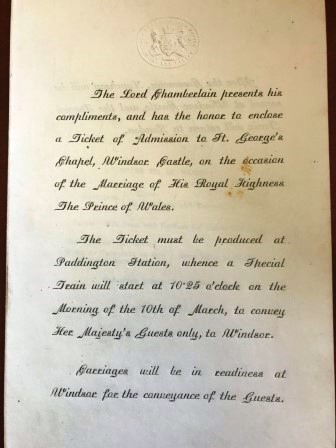
 

Charles Francis Adams was serving as U.S. minister to the Court of St. James’s when his invitation to the heir apparent’s wedding arrived. With his son Charles Francis 2d fighting in the American Civil War, the elder Adams had more pressing concerns on his mind. But, as evidenced by the dwindling number of documents crossing his desk, the British were absorbed by the union of their future king and queen, and it was Adams’s diplomatic obligation to attend. (To read more about CFA’s diplomatic career, see his 1861–1865 diaries that have been digitized by the MHS and are available here.)

With five days left before the wedding, Charles Francis took his wife, Abigail, to Garrard’s to see the diamond jewelry prepared for Princess Alexandra. Adams recorded in his diary that employees told him the crowds of oglers “had been constant since nine in the morning.” Three days before the nuptials, Charles Francis took his youngest son, Brooks, to observe the public’s reception of Alexandra herself. The streets of London were mobbed with Brits hoping to catch a glimpse of the young bride. Though he and his son (uncomfortably wedged in the mass of humanity) waited more than an hour to witness the event, “the banners of the Livery companies and the quaint dresses of some of the servants and postilions constituted all the display.” Princess Alexandra and Prince Edward processed in a carriage surrounded by horsemen and escorting coaches. “The thing itself was not worth the trouble of seeing,” Adams reflected, “but the city of London in a convulsion of enthusiasm about a girl of eighteen of whom nobody yet knows anything good or bad, fully repaid my fatigue.” On the night before the wedding, Charles Francis and Brooks again ventured out into the cold to observe the men arranging the “illuminations,” or fireworks, prepared for the occasion.
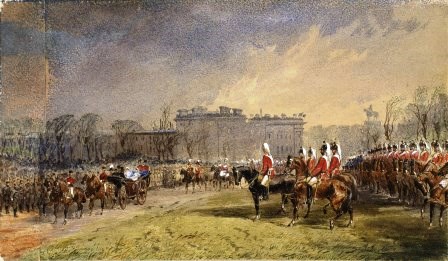
Arrival of Princess Alexandra from Denmark for her marriage to the Prince of Wales, 1863: the Princess passing the lines of Volunteers in Hyde Park c.1863 by Robert Dudley / Royal Collection Trust / © Her Majesty Queen Elizabeth II 2018

Adams and his wife woke early on the day of the ceremony, braved heavy fog and the crowds at Paddington Station and boarded the train to Windsor Castle. Once inside, the Adamses took their designated place at the north side of the altar and waited for the ceremony to begin.

“The scene was very impressive,” Adams wrote of the chapel space. “Here amidst the emblems of a remote age were assembled all there is of rank and official reputation in the kingdom. Here the greatest dignitaries of the Church performed the solemn service which waited a young couple destined under Providence to continue the line of monarchy for another age.”
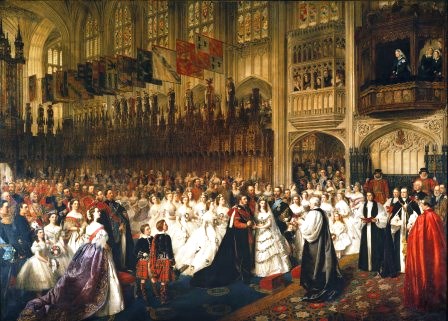
The Marriage of the Prince of Wales with Princess Alexandra of Denmark, Windsor, 10 March 1863 by William Powell Frith / Royal Collection Trust / © Her Majesty Queen Elizabeth II 2018

Adams noted how young the bride and groom were—Edward was 21 and Alexandra was 18—and mentioned that the couple “are supposed to be attached,” which he recognized as a rarity for royal unions. Charles Francis was impressed by their calm demeanor, especially young Alexandra’s as he looked down upon her and her eight bridesmaids kneeling at the altar. The Archbishop of Canterbury performed the half-hour service, and the newlyweds left the chapel to Beethoven’s “Hallelujah” chorus. Guests were then ushered into St. George’s Hall for refreshments.

“With the surroundings of the royal family, the household and the Court resplendent with gay attire for the first time the conception dawned upon me of the political importance of all the paraphernalia that surround a throne,” he wrote. “Satin and lace and diamonds and gold embroidery all contribute to make a pageant which knits the wealth of the land into the texture of the crown itself. It is a ponderous machine enough, but may-be necessary.”
Shedding Light on Boston’s Baseball Past

By Rakashi Chand, Reader Services

Baseball season is in full swing and this year marks the 100th anniversary of the 1918 World Series, a series that became a part of city lore ever since the “Curse of the Bambino” was cast on Boston. Baseball has a long history in Boston which precedes the Red Sox, the Curse of the Bambino, and even Fenway Park.

Bostonians have enjoyed playing baseball since the 1850s and in 1871 Boston acquired a team in the newly formed National Association of Professional Base Ball Players. Boston manager William Henry (Harry) Wright helped organize the National Association and went on to lead the Boston Red Stockings to four consecutive pennants. In 1874, Wright even took his unstoppable Red Stockings to England in hopes of popularizing baseball worldwide. By 1876 the National Association was replaced by the National League, a change which provided players more stability as they were bound to specific clubs.

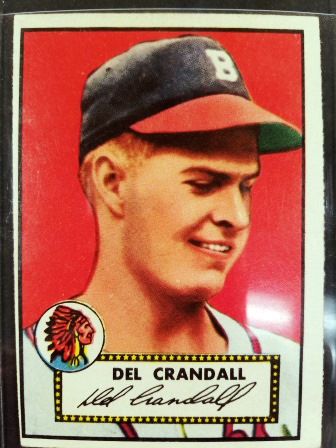
Boston Braves baseball card
Boston Braves Baseball Cards, circa 1949
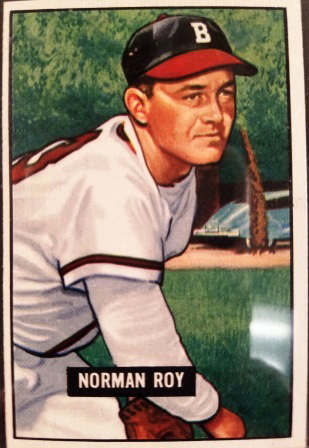
Boston Brave baseball card
Boston Braves Baseball Cards, circa 1949

(from the Boston Braves baseball collection, compiled by Richard O. Jones. Massachusetts Historical Society)

By the turn of the 20th century Boston had not one but two teams: the National League had the Boston Braves (formerly the Red Stockings, Red Caps, and Beaneaters), and the upstart American League had the Boston Americans. Each team had their own playing field in the city. The Braves played on the South End Grounds, moving in 1915 to Braves Field on Commonwealth Avenue (current site of Boston University’s Nickerson Field). After 82 years in Boston, 1871-1952, the Braves moved to Milwaukee in 1953, and then to Atlanta in 1966. The Boston Americans played at the Huntington Avenue Baseball Grounds – located just over the railroad tracks from the South End Grounds – from 1901 to 1911, and was the site of the first modern World Series in 1903 when the Boston Americans played the Pittsburgh Pirates. In 1908, the moniker for Boston’s American League team was officially changed to the Red Sox, and in 1912 the team relocated to the newly-built Fenway Park.


Cy Young and other baseball players at the Huntington Avenue Grounds

(from the Sweet family glass plate negatives, 1897-1911. Massachusetts Historical Society)

The above image of the Huntington Avenue Grounds was also featured on the MHS website as the July 2017 Object of the Month. Click on the link to see more information about the grounds, as well as suggestions for further reading about Boston’s baseball past.

*****

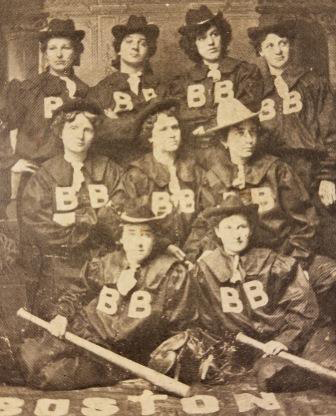
More interesting than the Boston Americans or the Boston Braves, though, is another local team that most have never heard of…The Boston Bloomers!

Women’s baseball teams, called Bloomer Teams due to the preferred “bloomer” style of dress which allowed for easier play, were popular all across the country between 1890 and 1930. These women traveled the country, wore pants, and received pay as professional players, providing a level of independence that was uncommon in a time when such “priveleges” were often not extended to women.

The Boston Bloomers, [photograph] [ca.1890s-1910s].
Bloomer teams began in colleges in New England and New York, then spread across the country as hundred of women started playing baseball. The teams often consisted of seven women and two men who barnstormed the country playing local amateur, semi-pro, and minor league men’s teams. Sadly, the Bloomer Teams lost popularity with the onset of World War I and the pioneering women of baseball were soon forgotten. Women such as Boston Bloomer Maud Nelson – a famous pitcher who went on to form and manage her own team in 1911, the Western Bloomer Girls – are only now gaining recognition for their contributions to the game.

If you are interested in learning more about the role of women in America’s Pastime, consider joining us next month for The All-American Girls: Women in Professional Baseball, a panel discussion led by Gordon Edes, offical historian of the Boston Red Sox. Click the link to find out more the event and how to register.

When men across the country entered the draft for World War II, Philip Wrigley foudned the All-American Girls Professional Basebeall League in hopes of keeping baseball alive. The league started in 1943 and lasted until 1954. In 1992, the league was made famous by the feature film “A League of Their Own,” and lead many to believe that this was the first time women took the field professionally. In truth, they were following int he footsteps of their talented foremothers, the Bloomer Girls.

To find out what else the MHS holds relating the nation’s game, you can search our online catalog ABIGAIL, and when you find something interesting, consider Visiting the Library to see it in the reading room!


Sources

–  Allen, Erin, “A League of Their Own,” Library of Congress Blog. Access 16 May 2018 at https://blogs.loc.gov/loc/2013/04/a-league-of-their-own/.

– Gregorich, Barbara, “My Darling Clementine,” Originally published in the May 2, 1996 issue of New City, accessed 16 May 2018 at http://www.barbaragregorich.com/index.php?subsub=%204.

– Official Website of the All-American Girls Professional Baseball League Players Association, accessed 16 May 2018 at http://www.aagpbl.org/index.cfm/pages/league/12/league-history.

– Library of Congress, “Topics in Chronicling America – Bloomer Girls: All-girls novelty act sweeps country playing baseball,” accessed 16 May 2018 at https://www.loc.gov/rr/news/topics/bloomergirls.html

This Week @ MHS

By

The week ahead is a little bit lite on the number of public programs available. However, the MHS is pleased to announce that the newest exhibition is now open for viewing! The Furniture of Isaac Vose & Thomas Seymour, 1815 to 1825 is open to the public free of charge Monday-Saturday, 10:00AM – 4:00PM. 

Here are the other events taking place this week:

– Tuesday, 15 May, 6:00PM : In 1805 and 1806, former vice president Aaron Burr traveled through the trans-Appalachian West gathering support for a mysterious enterprise, for which he was arrested and tried for treason in 1807. The Burr Conspiracy was a cause célèbre of the early republic-with Burr cast as the chief villain of the Founding Fathers—even as the evidence against him was vague and conflicting. James E. Lewis, Jr. of Kalamzaoo College will explore how Americans made sense of the reports of Burr’s intentions and examine what the crisis revealed about the new nation’s uncertain future.

This talk is open to the public and registration is required with a fee of $10 (no charge for MHS Members and Fellows or EBT cardholders). Pre-talk reception begins at 5:30PM, followed by the speaking program at 6:00PM.

– Thursday, 17 May, 6:30PM : We invite you to join us for a festive evening in support of the Center for the Teaching of History at the MHS featuring Harvard President Drew Faust in conversation with MHS President Catherine Allgor. The evening will begin with a cocktail reception. A seated dinner will follow. Feast, sip, and celebrate history at the eighth Cocktails with Clio

Tickets are $300 per person. Purchase tickets today!

– Saturday, 19 May, 10:00AM : The History and Collections of the MHS is a 90-minute docent-led walk through our public rooms. The tour is free, open to the public, with no need for reservations. If you would like to bring a larger party (8 or more), please contact Curator of Art Anne Bentley at 617-646-0508 or abentley@masshist.org.

While you’re here you will also have the opportunity to view our current exhibition: Entrepreneurship & Classical Design in Boston’s South End: The Furniture of Isaac Vose & Thomas Seymour, 1815 to 1825.

Charles Cornish Pearson and the Great War, Part VI

By Susan Martin, Collection Services

This is the sixth post in a series about the wartime experience of Charles Cornish Pearson. Go back and read Part I, Part II, Part IIIPart IV, and Part V for the full story.

After the Battle of Château-Thierry on 18 July 1918, Sgt. Charles Cornish Pearson of the 101st Machine Gun Battalion, American Expeditionary Forces, was granted a 48-hour leave, so he went to Paris to see the sights. (These two days, 6-8 August, would be his only leave during the war.) Of course, he enjoyed the respite very much, calling Notre-Dame Cathedral “the most wonderful building I ever saw, but I haven’t spent all my time admiring buildings.” He sent postcards to his family back home, including one to his little niece from “Uncle Buster.”

Just a few days after rejoining his battalion, Charles was on the road again. According to Philip S. Wainwright’s history, the 101st moved several times between mid-August and mid-September, first southeast to the town of Étrochey, then northeast again to the Rupt Sector. There the battalion took part in the Battle of Saint-Mihiel, which Charles described in an eight-page letter to his sister Jean, dated 15 September 1918. He began with his arrival at the front and what he saw as he came over a hill.

What a scene. Those guns had knocked those trenches some I can tell you, and the trenches were pretty well destroyed. Pill boxes, concrete dugouts & everything had been knocked to pieces in fine shape.

Charles spared Jean the grisly details—every letter had to pass the watchful eyes of censors, and the Censorship Bureau had forbidden any mention of casualties. But he did tell her about the grueling hikes to various positions, the sight of villages burning in the distance, and the capture of hundreds of German soldiers “who offered no resistance & seemed only too glad to be thru with the war.” The war was taking its toll on Charles, too, who wrote his Aunt Florence that same day, “It is great to be in all these drives but I tell you they are heart breakers and at times you wonder how you are going to keep going but still you manage it someway.” He longed for civilian life, but was proud of his service and the bravery and comradeship of his fellow soldiers.

A lot of Charles’ correspondence deals with items shipped back and forth between France and the U.S. His family sent care packages, and he sometimes requested specific items. For example, there’s this great insight into the life of a soldier:

Mighty glad to learn from Dads letter that you are sending a couple of books over. Any late popular & light fiction appeals to one over here. Of course one reads a great deal about the boys desiring the serious heavy stuff but far from it. They get too much of that in their days work. Any thing that will bring a smile is worth a thousand dollars I can tell you.

Meanwhile, Charles sent gifts home when he could, including a German helmet and gas mask for his nephew Bobby. “Suppose they are rather gruesome articles,” he admitted. He’d retrieved them himself from enemy lines after the German troops were driven off, weaving his way through the French trenches, across No Man’s Land, over barbed wire, and around shell holes—“havoc,” he called it, left by four years of fighting. He was impressed by the German trenches, though, some of which were 40 or 50 feet deep.

The spoils most prized by Allied soldiers were German pistols, belts, and belt buckles carved with the famous motto “Gott mit uns.” I don’t know if Charles ever found those, but he did send a second helmet to his brother Bill.

Picked yours up near a dead Hun. Didn’t quite feel like taking the one he had on although someone ahead of me had evidently cut his belt off for a souvenir. I am not quite so keen after souvenirs as that. Dont mind the sight of the dead but not very keen for handling them.

As always, Charles was humble about his letters. He wrote to Bill on 6 October 1918:

Am afraid my letters prove rather uninteresting reading as a rule. I don’t write an awful lot about this war stuff practically impossible to describe it in the proper way. It is a good deal made up of sensations and some of them aren’t especially pleasant.

Stay tuned for the seventh and final chapter of Charles Cornish Pearson’s story.

Barbara Hillard Smith’s Diary, April 1918

By Lindsay Bina, Intern and Anna Clutterbuck-Cook, Reader Services

Today we return to the 1918 diary of Newton teenager Barbara Hillard Smith. You may read our introduction to the diary, and Barbara’s previous entries, here:


January | February | March | April

May | June | July | August

September | October | November | December


As regular readers of the Beehive know, we are following Barbara throughout 1918 with monthly blog posts that present Barbara’s daily life — going to school, seeing friends, playing basketball, and caring for family members — in the words she wrote a century ago. Here is Barbara’s May, day by day.


* * *

WED. 1                       MAY

School. Took care of sonny.

THUR. 2

School. Took care of sonny

FRI. 3

School. Took care of sonny.

SAT. 4

Cleaned. Swimming. Pegs

SUN. 5

Church. Sunday School. Studied

MON. 6

School. Took care of sonny

TUES. 7

School. Took care of sonny. Swimming. Waited on table at church

WED. 8

School. Took care of sonny. Cousin Bert here

THUR. 9

School. Went to Arleen Pratt’s

FRI. 10

School. Took care of sony

SAT. 11

Swimming. Pegs.

SUN. 12

School. Sunday School. Studied

MON. 13

School. In Town. Sick?

TUES. 14

School. Baby’s. K.O.K.A. with Spud

WED. 15

School. Baby’s. Search Light Club Play

THUR. 16

School. Took care of Sonny

FRI. 17

School: Bill Wellman cheering practice. Went to get Wigwam and cut trees for float

SAT. 18

Dentist. Red Cross Parade. Mother starts for Portland

SUN. 19

Sunday School. Peg here. Service in evening

MON. 20

School. Mrs. Reeds. Kitten’s Came

TUES. 21

School. Mrs. Reed’s

WED. 22

School. Cheer Practice. Preliminary Baseball Game

THUR. 23

School. Mrs Hurt knee. Bob Hayes Up to the house

FRI. 24

School. Field Day. Red Cross Function at Seminary

SAT. 25

Mrs Reed’s. Dance at Nash’s

SUN. 26

Sunday School. Studied

MON. 27

School. Mrs. Reed’s

TUES. 28

School. Mrs. Reed’s

WED. 29

School. Mrs. Reed’s

THUR. 30                    MEMORIAL DAY

Swimming. Tennis

FRI. 31

Baby’s. In Town

* * *

If you are interested in viewing the diary in person in our library or have other questions about the collection, please visit the library or contact a member of the library staff for further assistance.


 *Please note that the diary transcription is a rough-and-ready version, not an authoritative transcript. Researchers wishing to use the diary in the course of their own work should verify the version found here with the manuscript original. The catalog record for the Barbara Hillard Smith collection may be found here.


This Week @ MHS

By

The program schedule this week culminates with the opening of our newest public exhibition! Before we get to that, though, here is the full list of programs in the week ahead:

– Monday, 7 May, 6:00PM : Starting the week is a conversation with Ann Hulbert of The Atlantic and Megan Marshall of Emerson University. They will discuss Hulbert’s new book, Off the Charts: The Hidden Lives & Lessons of American Child Prodigies, which examines the lives of children whose rare accomplishments have raised hopes about untapped human potential and questions about how best to nurture it. The conversation will draw on a range of examples that span a century—from two precocious Harvard boys in 1909 to literary girls in the 1920s to music virtuosos today. Hulbert and Marshall will explore the changing role of parents and teachers, as well as of psychologists, a curious press and, above all, the feelings of the prodigies themselves, who push back against adults more as the decades proceed.

This talk is open to the public and registration is required with a fee of $10 (no charge for MHS Fellows and Members or EBT cardholders). A pre-talk reception begins at 5:30PM followed by the speaking program at 6:00PM.

– Wednesday, 9 May, 12:00PM : Pack your lunch and come in for a Brown Bag talk with Lindsay Keiter of the Colonial Williamsburg Foundation. While historians have analized the rise of companionship and romance in marriage, they have overlooked a critical continuity: marriage continued to serve vital financial functions. Keiter’s talk, “For Love and Money: Marriage in Early America,” briefly sketches the economic importance of marriage and families’ strategies for managing wealth across generations.

This talk is free and open to the public.

– Thursday, 10 May, 6:00PM : MHS Fellows and Members are invited to attend the Entrepreneurship & Classical Design in Boston’s South End: The Furniture of Isaac Vose & Thomas Seymour, 1815-1825 Preview and Reception

Registration required at no cost.

– Friday, 11 May, 10:00AM : All are welcome to view our new exhibition, Entrepreneurship & Classical Design in Boston’s South End: The Furniture of Isaac Vose & Thomas Seymour, 1815 to 1825. Virtually forgotten for 200 years, Isaac Vose and his brilliant furniture are revealed in a new exhibition and accompanying volume. Beginning with a modest pair of collection boxes he made for his local Boston church in 1788, Vose went on to build a substantial business empire and to make furniture for the most prominent Boston families. The exhibition and catalog restore Vose from relative obscurity to his rightful position as one of Boston’s most important craftsmen. Opening at the MHS on May 11, the exhibition will be on view through September 14.

The complementary book, Rather Elegant Than Showy (May 2018), by Robert Mussey and Clark Pearce, will be available for sale at the MHS.

– Saturday, 12 May, 10:00AM : With the opening of our new exhibition we also see the return of our free Saturday building tours. The History and Collections of the Massachusetts Historical Society Tour is a 90-minute docent-led walk through our public rooms. The tour is free, open to the public, with no need for reservations. If you would like to bring a larger party (8 or more), please contact Curator of Art Anne Bentley at 617-646-0508 or abentley@masshist.org.

MHS and Massachusetts History Day

By Amanda Fellmeth, Intern and Kate Melchior, Education

As the State Affiliates for Massachusetts History Day, Mass Historical and the Center for the Teaching of History are excited to celebrate the incredible work of young historians across the state.  From over 5,000 students competing at the school level to the 63 students advancing to the 2018 National History Day Competition outside Washington D.C. this June, a fabulous group of young people across the state have actively engaged in the research and re-telling of a broad range of historical topics.  

National History Day is a year-long, primary source-based research project for students in grades 6-12 that encourages exploration of local, state, national, and world history.  The competition takes place in two divisions (Junior (Grades 6-8) and Senior (Grades 9-12). The students present their research within the format of five different categories: Research Paper, Exhibit, Performance, Documentary, or Website, and can choose to participate individually or as part of a group.  This year’s theme is “Conflict and Compromise”, and students worked with educators, archivists, librarians, and historians all over the state to research their chosen subjects in this theme.  The diverse array of student topics this year included:

  • – “Guilty Until Proven Innocent: Vilifying Women During the Conflict in Salem”
  • – “The Flapper Story: A History of Lesbian Development, Modern Feminism and Gender Roles in the 1920s”
  • – “A Cloying Compromise: The Story of the Hawaiian Annexation”
  • – “Murky Past, Clean Future: The Clean Air Act of 1970”


Mass History Day will also be celebrating student work in a celebration of the life of Frederick Douglass next month! In honor of the Frederick Douglass Bicentennial, MHS and Mass History Day teamed up with Mass Humanities, the Massachusetts Cultural Council, and Primary Source to offer special student awards, school scholarships, and teacher stipends for works that illuminate the life and legacy of Frederick Douglass. Students will present their projects and have the chance to speak with noted Douglass scholars David Blight of Yale University, Lois Brown of Wesleyan University, and John Stauffer of Harvard University at the Mass History Day Frederick Douglass Bicentennial on 2 June. For more information on the program and how to attend, visit the Mass Humanities website.

Massachusetts History Day is one of the rare programs that helps students refine critical thinking and research skills used in all subject areas. This competition gives students an opportunity to dive deep and truly engage with primary resources, an experience that not only helps to build their appreciation for history and the importance of research societies and libraries, but gives them valuable practice in higher education-type research. The format of the projects and the flexibility in research topics also allows students to play to their own strengths and interests. These types of activities also help students bring their education outside the classroom and engage with students, historians, and enthusiasts from all over the nation. Mass Historical and Mass History Day are proud of our 2018 participants and excited to watch the next generation of historians in action!


A Choise Garden of Rarest Flowers: John Parkinson’s “Paradisi in Sole Paradisus Terrestris”

By Shelby Wolfe, Reader Services

Somewhere amid April snow showers, I took my desire to see long-awaited signs of spring into my own hands and dug into a number of volumes here at the MHS regarding all things flora. I spent some time in A Little Book of Perennials (1927) by Alfred C. Hottes, consulted the floral clock in the appendix of Christopher Dresser’s Art of Decorative Design (1862) in anticipation of near-future blooms, and found the not-so-secret language of flowers outlined in a miniature Burnett’s Floral Handbook and Ladies’ Calendar for 1866 intriguing and rather amusing (if someone sends you laurestinus flowers, they may be trying to convey the sentiment “I die if neglected”; lettuce expresses cold-heartedness, a yellow carnation disdain).

I slowed down when I started paging through John Parkinson’s 1656 volume on horticulture, descriptively titled Paradisi in Sole Paradisus Terrestris, or, A choise Garden of all sorts of Rarest Flowers, with their Nature, place of Birth, time of flowring, Names, and Vertues to each Plant, useful in Physick, or admired for Beauty. To which is annext a Kitchin-Garden furnished with all manner of Herbs, Roots, and Fruits, for Meat or Sawce used with us. With the Art of planting an Orchard of all sorts of fruit-bearing Trees and Shrubs, shewing the nature of Grafting, Inoculating, and pruning of them. Together with the right ordering, planting, and preserving of them, with their select vertues : All unmentioned in former Herbals. Parkinson, who held the distinctions of Apothecary of London and the King’s Herbalist, preludes this work with a dedication to the queen. Our 1659 copy of Paradisi in Sole is a later edition of the original, first printed in 1629, making this a dedication to Henrietta Maria of France, wife of Charles I of England. Parkinson writes, “Accept, I beseech your Majesty, this Speaking Garden, that may inform you in all the particulars of your store, as well as wants, when you cannot see any of them fresh upon the ground.” As I had yet to see any signs of spring fresh upon the ground and was indeed in want of them, I decided to give this Speaking Garden a try. 

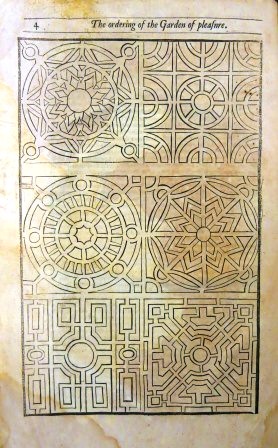
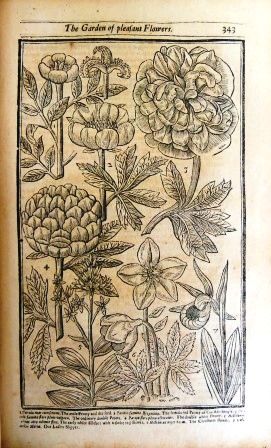
I wasn’t disappointed – Parkinson’s collection of horticultural advice, wisdom, and instruction includes a number of beautiful woodcut illustrations. An early section, “The ordering of the Garden of pleasure,” includes intricate designs as suggestions for attractive garden layouts.


“The ordering of the Garden of pleasure.”


 “The Garden of pleasant Flowers,” showing various specimen of Peony.


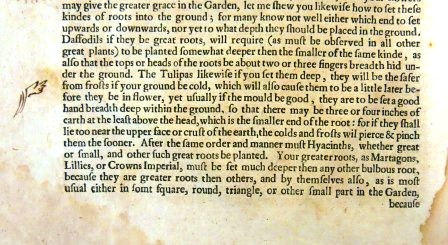
Some illustrations near the beginning of the book bear signs of a previous owner, having been partially colored. Other sections of the text have been underlined or annotated. Evidently one reader wanted to remember when planting Tulipas, “if you set them deep, they will be the safer from frosts if your ground be cold, which will also cause them to be a little later before they be in flower …” as it has been called out with a manicule.


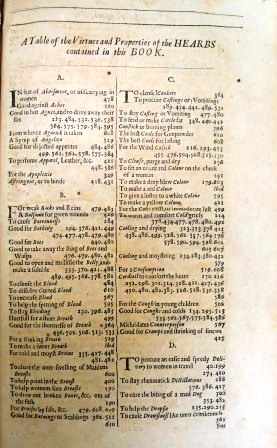
In addition to the main text with its beautiful illustrations, Paradisi in Sole includes helpful appendices to help navigate a volume brimming with knowledge, insight, and sometimes seemingly strange advice. My favorite was “A Table of the Virtues and Properties of the HEARBS contained in this BOOK,” which provides a concise guide to locating remedies for standard ailments and even one’s most obscure complaint.


How could I not turn to pages 364, 436, 502, 506, 513, or 533 to see what I should do “For cold and moyst Brains”? Apparently Tabacco [sic], the Tree of life, Garden Mustard, Cabbages and Coleworts, Leeks, or Licorice would do the trick and clear the lungs of phlegm. What are Parkinson’s nineteen suggestions for a “Cordiall to comfort the heart”? Among them he includes Saffron, Monkeshood, Marigolds, Roses, and Strawberries. Plenty more “virtues” had me flipping back and forth, from index to referenced page, out of sheer curiosity and bewilderment. If you would like to do the same, visit the library to work with this volume and others that pique your interest.

As I finish this blog post and prepare to reshelve Paradisi in Sole, I see a bed of daffodils and tulips through a window in the reading room. 

The Bygone Celebrations of May Day in Boston

By Rakashi Chand, Reader Services

Today is the 1st of May, a day once celebrated with merriment, song, dance and baskets. The celebration of May Day originated in pre-Christian Europe as a festival to celebrate the coming of Spring and the first planting. The boisterous celebrations of May Day suffered a bit with the onset of Christianity, but what emerged was a more innocent and beautiful festival. It was this festival, brought over from Europe, which reached its peak in nineteenth century America. Bostonians celebrated May Day with concerts, dances, and by making May Day Baskets.

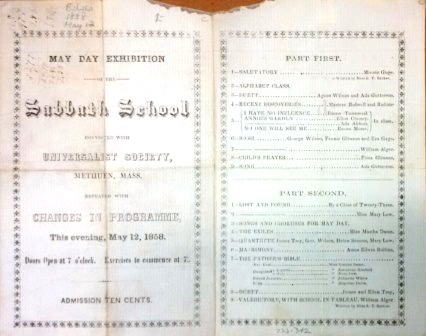
May Day exhibition of the Sabbath School connected with the Universalist Society of Methuen, Mass…


The May Day holiday was perhaps the loveliest of all celebrations. Adorned in flowers and beautiful colors, this was a day to truly celebrate beauty, friendship and happiness, as well as the coming of spring and all the wonderful sights, smells, tastes and feelings that accompany the warmer months. The holiday was as sweet and as beautiful as the season it heralded. May Day baskets were often homemade baskets that would be filled with freshly picked flowers, sweets, and sometimes even small gifts, to be left on the doors of friends, neighbors and possibly even a romantic interest. The May baskets were secretly hung on the door of friends and loved ones on May 1st.

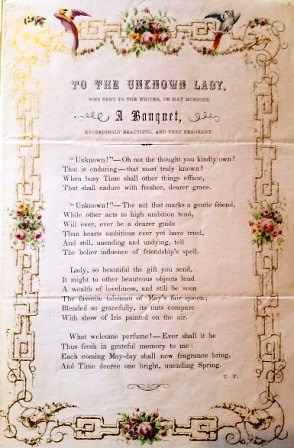
In 1850, a Massachusetts man named Thomas Power composed an ode (below) to an unknown woman who presented him with a May Day basket.

To the Unknown Lady: who sent to the Writer, on May morning, a bouquet, exceedingly beautiful, and very fragrant


…Lady, so beautiful the gift you send,

It might to others beauteous objects lend

A wealth of loveliness, and still be seen

The favorite talisman of May’s fair queen;

Blended so gracefully, its tints compare

With show of Iris painted on the air.


What welcome perfume! –Ever shall it be

Thus fresh is grateful memory to me:

Each coming May-day shall new fragrance bring,

And Time decree one bright, unending Spring.


150 years ago the city was rife with concerts and dances to celebrate May Day. Children jubilantly danced around May Poles as their rite of Spring, and schools held assemblies and choral concerts. Adults and children alike enjoyed the festivities, songs, and dances that accompanied the festivals.

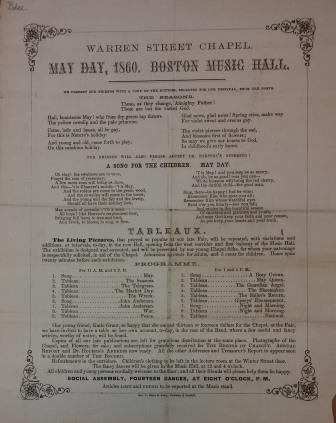
One such event was sponsored by the Warren Street Chapel in 1860. The festivities that took place at the Boston Music Hall included poems, songs like Dr. Parson’s “A Song for the Children. May Day,” and the very fashionable tableaux, “The Living Pictures,” which had swept over Europe and then became vogue in America. The entire thing wrapped up with a “Social Assembly, Fourteen Dances, at Eight O’Clock, P.M.”

May Day, 1860: Boston Music Hall


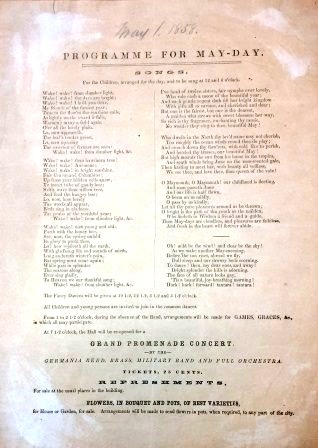
Another celebration held in 1858 featured songs specially arranged for the day and to be sung at specific times; “Fancy Dances” held at set times throughout the day; “Games, Graces, &c.” to occupy revelers during lulls in the music and dancing; and in the evening, a “Grand Promenade Concert” performed by the Germania Reed, Brass, Militrary Band and Full Orchestra.” In addition, visitors could purchase bouquets and potted flowers to take home (with delivery to any part of the city an option).

Programme for May-Day…


So, consider rekindling some of these bygone May Day traditions and festivities. Prepare a basket, sing a song, and dance a dance, and celebrate the season with these words:

Oh! Mild be the wind! And clear be the sky!

                As we wake another May-morning.

Before the sun rises, abroad we fly,

                Dull sleep and our drowsy beds scorning,

To dance! Then, my dear ones, and away!

                Bright splendor the hills are adorning.

The face of all nature looks gay,

                ‘Tis a beautiful, joy-breathing morning!

Hark! hark! forward! tantara! tantara!


Have a lovely May Day!


Sources

Encyclopaedia Britannica online, “May Day: European seasonal holiday.” Accessed 30 April 2018 at https://www.britannica.com/topic/May-Day-European-seasonal-holiday.

– Weeks, Linton, “A Forgotten Tradition: May Basket Day.” NPR History Department, 30 April 2015. Accessed 30 April 2018 at https://www.npr.org/sections/npr-history-dept/2015/04/30/402817821/a-forgotten-tradition-may-basket-day.

– “The May-Day Festival: Symposium,” Francis W. Parker School Year Book, Vol. 2, The Morning Exercise As A Socializing Influence (June 1913), p. 150-157. Accessed 30 April 2018 at http://www.jstor.org/stable/41102642


This Week @ MHS

By

Are you looking for some history-themed events to help pass your week as we head into May? Well then, you’re in luck! Here are some programs coming in the week ahead here at the MHS:

– Tuesday, 1 May, 5:15PM : First up this week is a seminar from the Early American History series. Join us as Matthew Kruer of the University of Chicago presents “The Time of Anarachy: the Susquehannock Scattering and the Crisis of English Colonialism, 1675-1685,” which is part of a larger book project. This paper argues that the seemingly distinct conflicts across the English colonies in the 1670s were actually connected by the political initiatives of the scattered Susquehannock Indians. The dispersion of the Susquehannocks caused instability in surrounding Native American and colonial societies, drawing them into a spiral of violence interrupted only by Susquehannock success, which brought stability to the northeast and shattered the southeast. Linford Fisher of Brown University is on-hand to provide comment.

Seminars are free and open to the public; RSVP required. Subscribe to receive advance copies of the seminar papers. To RSVP: email seminars@masshist.org or call (617) 646-0579.

– Wednesday, 2 May, 12:00PM : The Brown Bag talk this week centers on some 20th century topics. David Shorten of Boston University presents “Neutrality and Anti-Imperialism: A New Synthesis for the 1920s.” After the war, a movement comprised of scholars, journalists, peace activists, and “anti-monopolist” US Senators worked together to articulate a new conception of US neutrality. Unlike the more widely discussed international war outlawry movement, this national movement focused narrowly on one radical conclusion: that protection of capitalist interests had motivated World War I, and thus, that the US government must permanently disavow the right to protect those interests in order to prevent war’s future recurrence.

Brown Bag lunch talks are open to the public, free of charge.

– Wednesday, 2 May, 6:00PM : The final event in the This Land is Your Land Series is “The Future of Our Land.” The Boston metropolitan area is in the enviable spot of having more people who want to live and work here than there is space for. Real estate regularly sells for prices that would have seemed inconceivable twenty five years ago. This situation puts more funds in municipal coffers, but what will this increased demand and density do to plans to preserve open space? How will climate change impact our priorities for preserving open space and how might it limit our options? Join us for this panel discussion with Kathy Abbott, Boston Harbor Now; Austin Blackmon, Chief of Environment, Energy and Open Space for the City of Boston; Madhu C. Dutta-Koehler, City Planning and Urban Affairs, Boston University.

This program is open to the public, registration required with a fee of $10 (no charge for MHS Fellows and Members or EBT cardholders). Pre-talk reception begins at 5:30PM, followed by the speaking program at 6:00PM.

Please note that the library is CLOSED on Saturday, 5 May, to make room for a special teacher workshop. See below for details.

– Saturday, 5 May, 9:00AM : Known as the “master of the art of narrative history,” David McCullough is the winner of two Pulitzer Prizes, two National Book Awards, and has received the Presidential Medal of Freedom, the nation’s highest civilian award. In a special teacher workshop, “History and the American Spirit,” he will join us to discuss his perspective on history, education, and American legacy. This workshop is FULL and registration has closed. Please contact Kate Melchior at kmelchior@masshist.org or 617-646-0588 with any questions.