This Week @ MHS

By

First things first in this weekly round-up: The Society is CLOSED on Monday, 15 January, in observance of Martin Luther King, Jr., Day. Normal hours resume on Tuesday, 16 January.

Now that we have that out of the way, on to the programs scheduled for the coming week:

– Tuesday, 16 January, 5:15PM : The seminar this week is part of the Environmental History series. In this program Jeffrey Egan of the Unviersity of Connecticut and commenter Karl Haglund of the Massachusetts Department of Conservation and Recreation discuss “The Fight before the Flood: Rural Protest and the Debate over Boston’s Quabbin Reservoir, 1919-1927.” In 1919, state engineers proposed solving Boston’s water supply crisis by damming the Swift River, flooding a western Massachusetts valley and evicting 2,500 people. The contentious six-year debate that followed does not fit the standard story of urban conservationists versus rural peoples, as many valley residents defined themselves as rural and conservationist, and thus offers scholars a chance to see fresh nuances in early twentieth-century land management, rural life, and urban development. 

Seminars are free and open to the public; RSVP requiredSubscribe to receive advance copies of the seminar papers.

– Wednesday, 17 Janauary, 12:00PM : “Skulls, Selves, and Showmanship: Itinerant Phrenologists in 19th-Century America” is a Brown Bag talk with research fellow Katherine Duffy of Brown University. Proponents of phrenology — a controversial, influential science — believed that the shape of one’s cranium revealed one’s character. This talk explores the world of phrenological lecture-demonstrations and the circulation of materialist ideas about the self. This talk is free and open to the public. 

– Wednesday, 17 January, 6:00PM : Join us for the Pauline Maier Memorial Lecture – Madison’s Hand: Revising the Constitutional Convention. In this talk and recent book with the same name, Mary Sarah Bilder of Boston College Law School reveals that James Madison revised his famed Notes on the 1787 Constitutional Convention to a far greater extent than previously thought. With this work, Bilder offers a biography of a document that, over two centuries, developed a life and character all its own. This talk is open to the public; registration required with a fee of $10 (No charge for MHS Members or Fellows, or EBT Cardholders). 

– Saturday, 20 January, 10:00AM : The History and Collections of the MHS is a 90-minute docent-led walk through our public rooms. The tour is free, open to the public, with no need for reservations. If you would like to bring a larger party (8 or more), please contact Curator of Art Anne Bentley at 617-646-0508 or abentley@masshist.org.

While you’re here you will also have the opportunity to view our current exhibition: Yankees in the West.

A Midwinter’s Tale

By Sara Georgini, Adams Papers


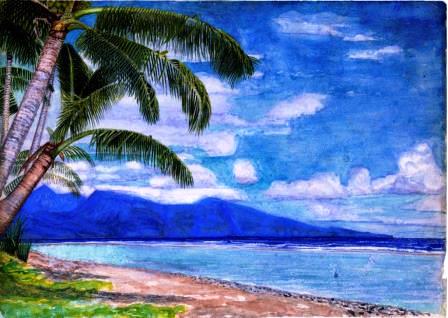
At eight o-clock on a January morning in 1891, and a world away from the ice-caked streets of his native New England, 52-year-old Henry Adams leisurely began to go about his day. Armed with coffee, he surveyed the two-room cottage that he had rented in Apia, Samoa, with the artist John LaFarge. Eager to skip the worst heat of the day, he puttered inside, answering letters and reading Homer. Often, Henry unearthed his 24-tube watercolor set and “whacked great daubs of color on paper,” creating a lush portfolio of postcard views of the local paradise. Just before dusk, Henry paddled out in a small, rough-hewn canoe. On some evenings he kept to the harbor and stared down the Pacific Ocean’s crashing walls of surf. Other nights, Henry rowed right on past, idling in the refuge of Matafangatele’s deep bay. A cozy dinner on the veranda, with strong cigars and a full stack of new novels, followed next. Local residents, laughing and chatting their way down the grass path, hailed the American historian lounging between the coconut palms: “Alofa, Akamu!” (“How are you, Adams”). “Such a life,” Henry Adams wrote home, “seems pleasant enough, especially in Beacon Street in winter, but a true traveller should be restless, and I am qualified in that particular to be high in the profession.”


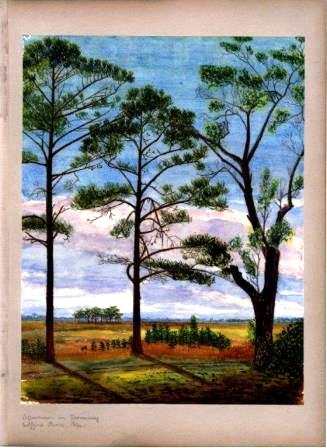
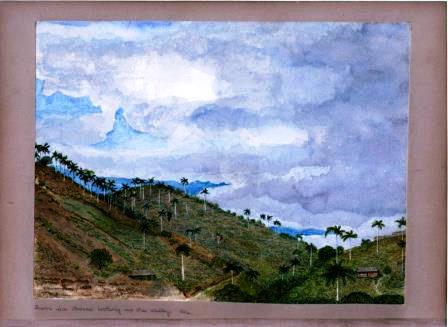
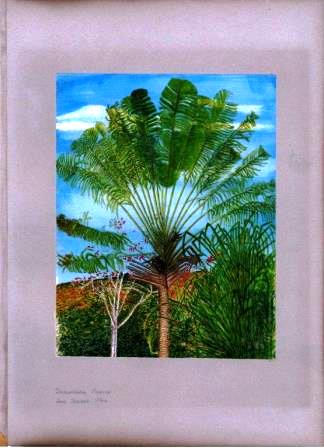
Henry Adams (1838-1918), Harvard professor of medieval history and eponymous author of the provocative Education, spent most of his life on the road. Adams traveled widely, soaking up foreign experiences and reveling in aesthetic journeys through Europe, Latin America, Japan, and the South Seas. Throughout the 1890s, he saved his warm-weather destinations for Boston’s bitterest months. He steamed off to Samoa, Cuba, Mexico, and Tahiti with friends, books, lavish wardrobes, and prized watercolors in tow. Partly inspired by his late wife Clover’s photography, Adams spent the last decades of his life capturing the sights and scenes of the late Victorian world as he traveled through it. Like many Americans, Henry adopted the post-Civil War passion for watercolors as a way to document natural beauty. In letters sent from exotic datelines like Coffin’s Point, Dos Bocas, and Apia, Henry reveled in his amateur pursuit. “I slobber water-colors again,” he told John Hay. “I labor whole days to do the most prosaic field I can find, and at the end of the week I throw it away in despair,” he confessed to Elizabeth Cameron. Later that year, camped in “Yellowstone country,” Adams plied his brushes to make the views on display in our Yankees in the West exhibit, but thought his niece Mabel Hooper would have done a better job. “I wanted you there to sketch for me. I was quite sick in spirit that I could not catch a tone of the country, for it was American to the very snow,” he wrote to her on 6 October 1891. “I wanted awfully to be an artist to see if I could make anything out of the American ideal, which is like the American women–not suited to pictorial or plastic art.” (Learn about Mabel Hooper LaFarge’s art career–including her watercolor portrait of Henry–here, thanks to Houghton Library).


Henry, who honed his critical edge at the North American Review’s helm, was hard on his own artistic abilities. “I have passed my morning trying to finish a sketch, but my sketches here are more lamentable than ever, and break my heart with mortification,” he wrote of Mexico. “Ten thousand objects about us are crying out to be painted, but the simplest are too difficult for me, and the difficult ones are a chaos of lights and lines… If I could only do some of the ravines in the hills, with sides of rock, and with sunlight dropping down through a network of foliage, and lianas, on ferns and mosses, I could amuse myself forever, but one such sketch would need a year, if it attempted drawing. The greens here are the richest I ever saw, and as for the reds, the earth and sky glow with them.” Journey here for information on Henry Adams’ watercolors.


Charles Cornish Pearson and the Great War, Part II

By Susan Martin, Collection Services

A few weeks ago, I introduced you to the MHS collection of Charles Cornish Pearson papers. Charles served with the 101st Machine Gun Battalion in France during World War I. We pick up his story in the village of Mont-lès-Neufchâteau in the early days of 1918.

Charles and the other men of the 101st spent three months immersed in intensive training at Mont-lès-Neufchâteau. They drilled with their machine guns and gas masks, marched long distances, and prepared for trench warfare. Charles didn’t have much time to write home, but he was learning a lot. He wrote to his brother Bill on 20 January 1918:

Hardly seems possible that it is six months now since I started working for the U.S.A. Don’t feel a bit richer and as far as being a soldier, well I guess I have got a h–l of a lot more to learn before I will be one. Still at the rate they are drilling us over here, why I may be one before I realize it.

Charles’ company was motorized and served as a mobile reserve unit that could be sent quickly into battle as needed. According to Philip S. Wainwright’s History of the 101st Machine Gun Battalion, the battalion’s vehicles “consisted of about fifty second-hand Ford ambulances. Great was the excitement on the day that these Fords were driven over from Neufchâteau.” (p. 25) This excitement is evident in some of the photographs that came to the MHS with Charles’ papers.
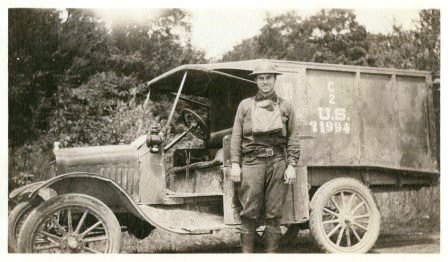


Mont-lès-Neufchâteau was about 64 kilometers south of the front line. On 8-9 February, the 101st piled into their vehicles, or “flivvers,” and headed northwest to Vregny, a reserve position much closer to the front. Vregny, a town in the Chemin des Dames sector, had seen some heavy fighting by that time. Wainwright’s published history includes a description of the area, but I like Charles’ version:

Went for a long hike this morning after the service, very interesting still depressing when one stops to realize what all this destruction & waste must mean. A whistle & a terrific roar, far away but impressive never the less. Would like the chance to describe my little walk in detail, but I suppose it would be censored so will wait until some later time.
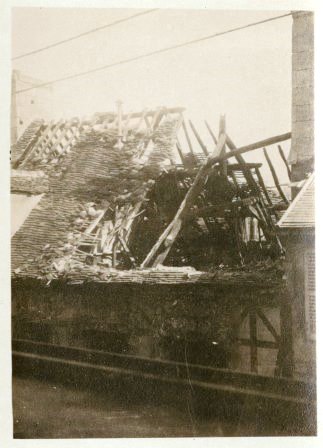


Charles didn’t reveal his location to his family at home, or even let on that he had moved. He only told them not to worry if they didn’t hear from him for a while.

Charles saw action for the first time in late February and early March 1918, when his company was sent to support French infantry fighting in the trenches about 12 kilometers away. I’ll quote at length from Charles’ March letters, since they paint such a vivid picture. Here’s how he described his experiences to his mother:

Imagine you realized from my last few letters that we were getting ready for our first round of duty and you can rest assured that it is no picnic.

Came up here one dark night in our flivvers and it was some ride. No lights and every little ways we would stike [sic] a shell hole or something and you would get a nice little jounce. Of course, we weren’t in any danger but still under the conditions it kept you pretty well keyed up.

When we arrived at the point where we got out why our worthy comrades were shelling away and believe me it sounded like bedlam let loose. After getting out we had a nice ½ mile hike with our packs & the rest of our stuff thru a long trench, pitch dark. Still we got here after a fashion all safe and sound.

[…]

Had a big barrage here the other night, our guns in action for awhile. Then night before last my gun did some harassing fire. Lay your gun on a target (center of a town, cross road or the like) and fire on it every few minutes on the chance of hitting someone. Great sport until they discover you then beat it, if you have time which you usually do.

In another letter to his mother a few days later, he opened up a little about the toll his recent experiences had had on him, at the same time reassuring her that he was safe.

Am still in our little palace here below and am feeling fine, have gotten over much of the hollow feeling I had the first few hours here, and can listen to the whistle of a shell without having palipitation [sic] of the heart.

[…]

Well I am in a very quiet sector and barring accidents am just as safe as in our former quarters. Of course there is some activity shells flying bombs exploding etc, but as a rule they are a long way from us and the nearest we come is being an audience to a grand set of fire works. It sure is a stupendous sight to be on guard at night and watch the action in different directions. All kinds of sky rockets & star shells, flashes of the big guns, noise of the machine guns rifles etc. It is interesting from a spectators stand point but hardly from a participants.

Our quarters here are in a dugout several feet below ground (built by the Boche in fact) and are in a way comfortable although crampt. […] We sometimes do a little harassing fire at night trusting to luck on hitting some unsuspecting Boche 2-3 thousand metres away. It is all good training gives the boys a little insight into what action really is and prepares them for their work on the more active fronts.


To his sister, Charles wrote:

Glad to hear you are doing work for the Red Cross. It is a case of us all doing our bit in any way we can, and Red Cross & YMCA work is just as important as sitting down at a machine gun & pumping lead into the unsuspecting Boche.

[…]

Sure was a funny experience tramping thru this trench not knowing where it led to and our first shell travelling overhead, with what seemed to us a damn mournful whistle accompanied by an explosion which seemed very close. […] We had a glimpse of about every thing connected with our work, got gassed a couple of times, bombed & shelled and the like, but if one was careful why practically no danger. There was a certain fascination to it all, and although you couldn’t help but be pretty frightened at times still you cannt [sic] help but want to be back again taking a chance in a good cause.

And to his uncle Fred:

We are just back from our first trick at the Front. A novel & exciting experience to a rooky I can tell you. Your first few hours you feel sure are your last but you soon get your feet down on the ground & your hair down on your head and realize that with a little care your chances of living for a while longer are pretty good. Of course we were on a comparatively quiet sector but even on more active ones I believe that with due care the danger is not as great as we are all apt to picture it before going up. […] We quickly found out that dugouts & deep trenches are great places to be in when any shelling is going on. We did more or less firing while on duty but like artillery fire machine gun fire is mostly indirect & done at night, so we couldn’t tell whether we did much damage or not, still it gave us a lot of satisfaction to hear the gun send them across.

The 101st Machine Gun Battalion left the Chemin des Dames sector on 18 March 1918. Check back here at the Beehive for the next installment of Charles’ story.

 

This Week @ MHS

By

It is a very quiet week here at the Society as we await the thaw following last week’s storm. Here are the calendar notes for the coming days:

The Exhibition Galleries are CLOSED on Monday, 8 January and Tuesday, 9 January. Normal hours resume on Wednesday, 10 January.

– Saturday, 13 January, 10:00AM : The History and Collections of the MHS is a 90-minute docent-led tour of the Society’s public spaces. The tour is free and open to the public with no need for reservations for indivudals or small groups. If you would like to bring a larger party (8 or more), please contact Curator of Art Anne Bentley at 617-646-0508 or abentley@masshist.org

While you’re here you will also have the opportunity to view our current exhibition: Yankees in the West.

A New Year’s Greeting from Merrymount Press, 1918

By Anna J. Clutterbuck-Cook, Reader Services


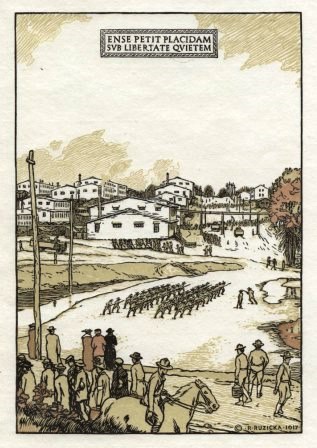
Welcome to the future! In this first week of the new year, I bring you a New Year’s greeting from one hundred years in the past. This illustration by Rudolph Ruzicka (1883-1978) graced the annual greeting to the friends of Merrymount Press, Boston at the dawn of the year 1918. The image is a view of the parade ground at Camp Devens (Ayer, Mass.) and the Latin text at the top of the image is the official motto of the Commonwealth of Massachusetts, “Ense petit placidam sub libertate quietem,” translated into English as “she seeks with the sword a quiet peace under liberty” — a solemn message for the advent of a year under the shadow of World War One.

The Massachusetts Historical Society holds a collection of illustrations by Ruzicka, himself a member of the Society for many years, as well as many titles printed by Merrymount Press. You are welcome to explore our print holdings through our online catalog ABIGAIL and reach out to the library staff with any questions you have about accessing items in our collection.

We look forward to welcoming you to the library in 2018 and beyond!


This Week @ MHS

By

We are back to business this week at the Society, thought it appears that Mother Nature may have other plans for us. Without thinking about the weather, here is what is on the calendar for the first week of the new year:

– Wednesday, 3 January, 12:00PM : Derek O’Leary of the University of California, Berkeley, kicks off the year with the first Brown Bag talk of 2018, “Excavating the Western Indian Mound and Building the American Archive.” Settlers and travelers moving westward in the early republid encountered the myriad Indian mounds scattered along the American frontier. These sundry earthworks furnished ample grist for various projects: frontier infrastructure, literary nationalism, the national historical narrative, and – as this talk explores – the emergence of the American archives. This talk is free and open to the public. 

– Saturday, 6 January, 10:00AM : The History and Collections of the Massachusetts Historical Society Tour is a 90-minute docent-led walk through our public rooms. The tour is free, open to the public, with no need for reservations. If you would like to bring a larger party (8 or more), please contact Curator of Art Anne Bentley at 617-646-0508 or abentley@masshist.org.

While you’re here you will also have the opportunity to view our current exhibition: Yankees in the West.

Throughout the winter, please keep an eye on our main website and online calendar for information about weather-related closings. 

This Week @ MHS

By

The library is CLOSED this week but you can still stop in and view our current exhibition, Yankees in the West. Gallery hours for the week between Christmas and New Year are as follows:

– Monday, 25 December : CLOSED

– Tuesday, 26 December : 10:00AM-4:00PM 

– Wednesday, 27 December : 10:00AM-4:00PM 

– Thursday, 28 December : 10:00AM-4:00PM 

– Friday, 29 December : 10:00AM-4:00PM 

– Saturday, 30 December : 10:00AM-4:00PM. There is also a free building tour on Saturday. Be here at 10:00AM for the History and Collections of the MHS

The Society is CLOSED on Monday, 1 January. Normal hours resume on Tuesday, 2 January. 

Happy Holidays!

Winter in Boston

By Rakashi Chand, Reader Services

Happy Winter Solstice!

I have gathered a few historic winter views of Boston for you to enjoy on this long winter’s night.


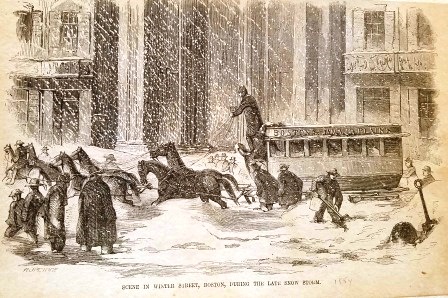
To begin, let’s just say that Bostonians have always been a hardy lot. “Scene in Winter Street, Boston, during the late snow storm” by W. J. Peirce, illustrates the horse-drawn Boston & Jamaica Plains Trolley attempting to get through the storm of 1854. Today we complain about trolley service delays during snow storms, imagine trudging out with a shovel to clear the trolley path through Boston’s congested city streets in 1854. 

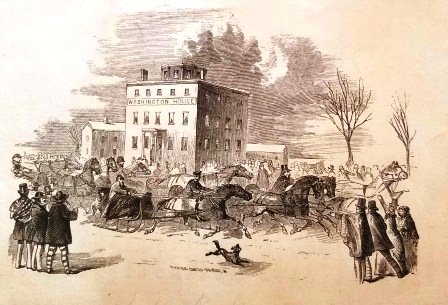
In modern culture we romantically idealize sleigh rides through the snow as a common winter pastime of “yester-year”. Well, apparently that was not enough for Bostonians who clearly craved much more excitement. Lets reimagine that “Currier and Ives” Christmas image and instead think of Sleigh Racing on Boston Neck circa 1850. Sleigh Racing was a popular winter activity at the time and this graphic depicts the crowds milling around applauding the action as men race down Boston Neck (now filled in) with the Washington House in the background. 

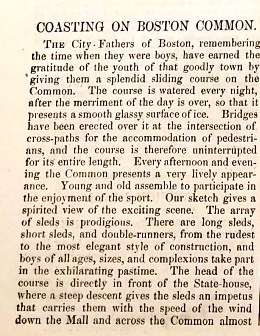
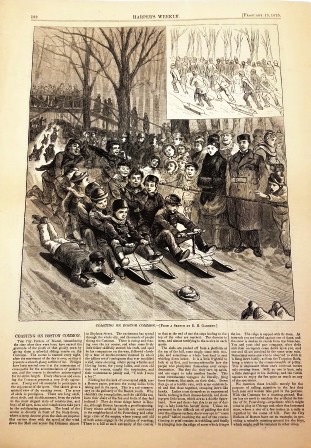
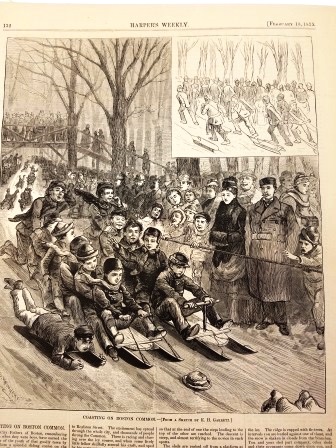
And perhaps the most wonderful of all Winter activities, with an equally delightful description, “Coasting on the Common” seems like the perfect winter thing to do, doesn’t it? For those of you who are not familiar with Boston, the Boston Common is a public park in the middle of the city, directly in front of the Massachusetts State House. Published in Harper’s Weekly, V. 19, no. 946, February 13, 1875 p.132 this graphic “Coasting on Boston Common” from a sketch by Edmund Henry Garrett, depicts boys on sleds on Boston Common racing downhill, while adults in the crowd look on. An insert in the upper righthand corner shows the boys pulling their sleds back up the hill. The city of Boston actually built and maintained the ‘coasting’ course, and even built bridges over the course for spectators to watch the action from overhead. 


The article states “boys of all ages, sizes and complexions take part in this exhilarating pastime.” And that “Nothing but the lack of unoccupied sleds, says a Boston Paper, prevents the young ladies from taking part in the sport. This is a sad commentary on the gallantry of Boston youth. Why shouldn’t the young ladies, and the old folks too, have their share of fun and frolic if they feel inclined?” Although the article does go on to say that “young ladies “come to grief” before reaching the end on the course”, it is still rather liberal for 1875, indicating that ‘Coasting on the Common’ was truly open to all.


If you happen to be in Boston to enjoy the winter holiday, stop into to see our exhibitions, which are free and open to the public.  The exhibitions includes a special display of the “Anti-Christmas laws”- yes! you read that correctly! Curious to learn more? Stop in to see the Anti-Christmas proclamation.During the holiday week, the galleries will be open Tuesday (12/26) through Saturday (12/30) from 10am to 4pm.


This Week @ MHS

By

There is just one event on the calendar for the coming week here at the Society:

– Tuesday, 19 December, 5:30PM : This week’s seminar is part of the History of Women and Gender series. Micki McElya of University of Connecticut leads the discussion and Genevieve A Clutario of Harvard University provides comment. “Miss America’s Politics: Beauty and the Development of the New Right since 1968” examines the centrality of the Miss America pageant, its local networks, and individual contestants to the rise of conservative women and the New Right in the 1960s and 1970s. It analyzes the celebration, power, and political effects of normative beauty, steeped in heterosexual gender norms and white supremacy, and argues for the transformative effect of putting diverse women’s voices at the center of political history and inquiry. 

Seminars are free and open to the public; RSVP requiredSubscribe to receive advance copies of the seminar papers.

Please note that the library closes early on Monday, 18 December, at 3:30PM, and the building closes at 4:00PM. Also, the MHS is CLOSED on Saturday, 23 December. The library remains closed the following week and reopens on Tuesday, 2 January. See the online calendar for more details about holiday closures and gallery hours. 

This Week @ MHS

By

As the end-of-year holidays approach we are slowly applying the brakes to our programming schedule here at the Society. However, we still have a few public events coming in the next couple of weeks. Here are the items on offer in the week ahead:

– Tuesday, 12 December, 5:15PM : Hannah Anderson of University of Pennsylvania leads the discussion in the this week’s Environmental History Seminar. “Lived Botany: Settler Colonialism, Household Knowledge Production, and Natural History in Eighteenth-Century Pennsylvania” examines how colonists developed ways of interpreting their landscapes that simultaneously partook of and deviated from the norms of eighteenth-century natural history. Domestic spaces became sites where colonists created information about the natural world, allowing them to feel secure in the new environments where they claimed dominion. Thomas Wickman of Trinity College is on-hand to provide comment. Seminars are free and open to the public. To RSVP, e-mail seminars@masshist.org or call 617-646-0579. Subscribe to receive advance copies of the seminar papers.

– Wedensday, 13 December, 6:00PM : Come in for an author talk with Manisha Sinha of University of Connecticut, whose most recent work is The Slave’s Cause: A History of Abolition. This book broadens the chronology of abolition beyond the antebellum period, and sets the abolition movement in a transnational context and illustrates how the abolitionist vision ultimately linked the slave’s cause to the struggle to redefine democracy and human rights across the globe. This event is open to the public; registration is required with a fee of $10 (no charge for MHS Members or Fellows). A pre-talk reception begins at 5:30PM, followed by the speaking program at 6:00PM.

– Saturday, 16 December, 10:00AM : The History and Collections of the Massachusetts Historical Society Tour is a 90-minute docent-led walk through our public rooms. The tour is free, open to the public, with no need for reservations. If you would like to bring a larger party (8 or more), please contact Curator of Art Anne Bentley at 617-646-0508 or abentley@masshist.org.

While you’re here you will also have the opportunity to view our current exhibition: Yankees in the West