Winter in Boston

By Rakashi Chand, Reader Services

Happy Winter Solstice!

I have gathered a few historic winter views of Boston for you to enjoy on this long winter’s night.


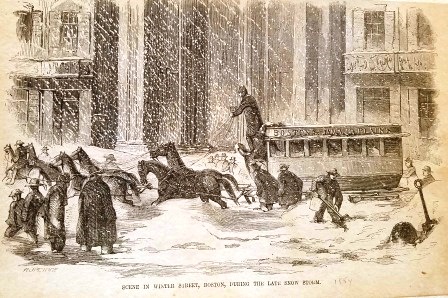
To begin, let’s just say that Bostonians have always been a hardy lot. “Scene in Winter Street, Boston, during the late snow storm” by W. J. Peirce, illustrates the horse-drawn Boston & Jamaica Plains Trolley attempting to get through the storm of 1854. Today we complain about trolley service delays during snow storms, imagine trudging out with a shovel to clear the trolley path through Boston’s congested city streets in 1854. 

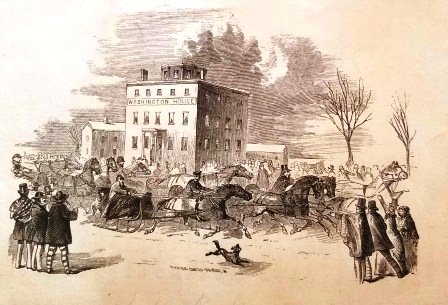
In modern culture we romantically idealize sleigh rides through the snow as a common winter pastime of “yester-year”. Well, apparently that was not enough for Bostonians who clearly craved much more excitement. Lets reimagine that “Currier and Ives” Christmas image and instead think of Sleigh Racing on Boston Neck circa 1850. Sleigh Racing was a popular winter activity at the time and this graphic depicts the crowds milling around applauding the action as men race down Boston Neck (now filled in) with the Washington House in the background. 

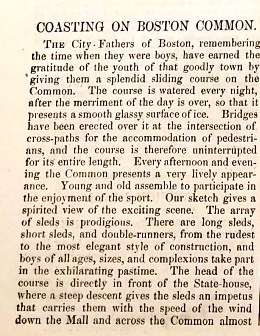
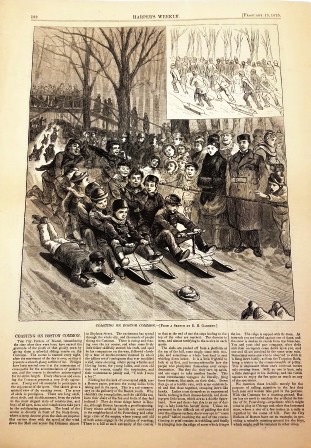
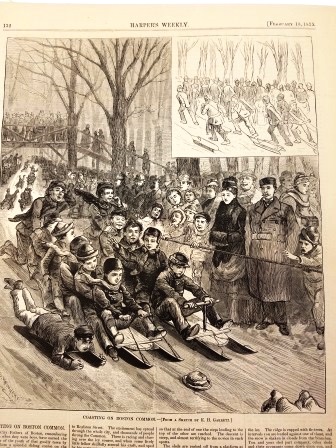
And perhaps the most wonderful of all Winter activities, with an equally delightful description, “Coasting on the Common” seems like the perfect winter thing to do, doesn’t it? For those of you who are not familiar with Boston, the Boston Common is a public park in the middle of the city, directly in front of the Massachusetts State House. Published in Harper’s Weekly, V. 19, no. 946, February 13, 1875 p.132 this graphic “Coasting on Boston Common” from a sketch by Edmund Henry Garrett, depicts boys on sleds on Boston Common racing downhill, while adults in the crowd look on. An insert in the upper righthand corner shows the boys pulling their sleds back up the hill. The city of Boston actually built and maintained the ‘coasting’ course, and even built bridges over the course for spectators to watch the action from overhead. 


The article states “boys of all ages, sizes and complexions take part in this exhilarating pastime.” And that “Nothing but the lack of unoccupied sleds, says a Boston Paper, prevents the young ladies from taking part in the sport. This is a sad commentary on the gallantry of Boston youth. Why shouldn’t the young ladies, and the old folks too, have their share of fun and frolic if they feel inclined?” Although the article does go on to say that “young ladies “come to grief” before reaching the end on the course”, it is still rather liberal for 1875, indicating that ‘Coasting on the Common’ was truly open to all.


If you happen to be in Boston to enjoy the winter holiday, stop into to see our exhibitions, which are free and open to the public.  The exhibitions includes a special display of the “Anti-Christmas laws”- yes! you read that correctly! Curious to learn more? Stop in to see the Anti-Christmas proclamation.During the holiday week, the galleries will be open Tuesday (12/26) through Saturday (12/30) from 10am to 4pm.


This Week @ MHS

By

There is just one event on the calendar for the coming week here at the Society:

– Tuesday, 19 December, 5:30PM : This week’s seminar is part of the History of Women and Gender series. Micki McElya of University of Connecticut leads the discussion and Genevieve A Clutario of Harvard University provides comment. “Miss America’s Politics: Beauty and the Development of the New Right since 1968” examines the centrality of the Miss America pageant, its local networks, and individual contestants to the rise of conservative women and the New Right in the 1960s and 1970s. It analyzes the celebration, power, and political effects of normative beauty, steeped in heterosexual gender norms and white supremacy, and argues for the transformative effect of putting diverse women’s voices at the center of political history and inquiry. 

Seminars are free and open to the public; RSVP requiredSubscribe to receive advance copies of the seminar papers.

Please note that the library closes early on Monday, 18 December, at 3:30PM, and the building closes at 4:00PM. Also, the MHS is CLOSED on Saturday, 23 December. The library remains closed the following week and reopens on Tuesday, 2 January. See the online calendar for more details about holiday closures and gallery hours. 

This Week @ MHS

By

As the end-of-year holidays approach we are slowly applying the brakes to our programming schedule here at the Society. However, we still have a few public events coming in the next couple of weeks. Here are the items on offer in the week ahead:

– Tuesday, 12 December, 5:15PM : Hannah Anderson of University of Pennsylvania leads the discussion in the this week’s Environmental History Seminar. “Lived Botany: Settler Colonialism, Household Knowledge Production, and Natural History in Eighteenth-Century Pennsylvania” examines how colonists developed ways of interpreting their landscapes that simultaneously partook of and deviated from the norms of eighteenth-century natural history. Domestic spaces became sites where colonists created information about the natural world, allowing them to feel secure in the new environments where they claimed dominion. Thomas Wickman of Trinity College is on-hand to provide comment. Seminars are free and open to the public. To RSVP, e-mail seminars@masshist.org or call 617-646-0579. Subscribe to receive advance copies of the seminar papers.

– Wedensday, 13 December, 6:00PM : Come in for an author talk with Manisha Sinha of University of Connecticut, whose most recent work is The Slave’s Cause: A History of Abolition. This book broadens the chronology of abolition beyond the antebellum period, and sets the abolition movement in a transnational context and illustrates how the abolitionist vision ultimately linked the slave’s cause to the struggle to redefine democracy and human rights across the globe. This event is open to the public; registration is required with a fee of $10 (no charge for MHS Members or Fellows). A pre-talk reception begins at 5:30PM, followed by the speaking program at 6:00PM.

– Saturday, 16 December, 10:00AM : The History and Collections of the Massachusetts Historical Society Tour is a 90-minute docent-led walk through our public rooms. The tour is free, open to the public, with no need for reservations. If you would like to bring a larger party (8 or more), please contact Curator of Art Anne Bentley at 617-646-0508 or abentley@masshist.org.

While you’re here you will also have the opportunity to view our current exhibition: Yankees in the West


Charles Cornish Pearson and the Great War, Part I

By Susan Martin, Collections Services

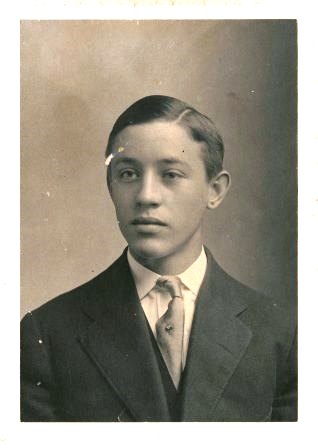
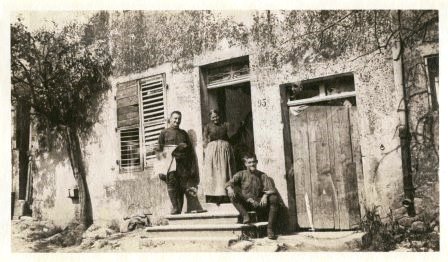
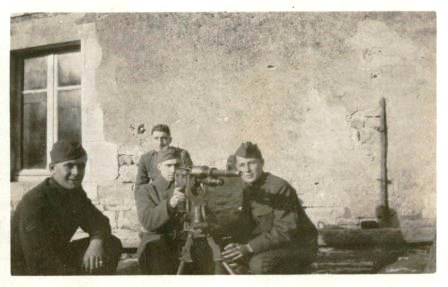
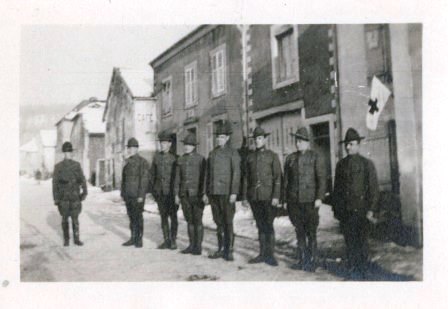
I’d like to introduce Charles Cornish Pearson, a young man who served during World War I in the 101st Machine Gun Battalion, 26th Division, American Expeditionary Forces. The MHS acquired his papers a few months ago, but as I looked at them more closely, I realized there was so much good material that I’m going to stretch his story out over several posts. I hope you’ll enjoy it as much as I have. The collection also came to us with 32 terrific photographs, undated and mostly unidentified, some of which I’ll be using as illustrations.


Charles C. Pearson was born on 2 April 1890, the son of Charles H. and Gertrude (Cornish) Pearson. He grew up in Arlington, Mass. with his older brother Bill and younger sister Jean. He graduated from Somerville Latin High School in 1908 and Massachusetts Agricultural College in 1912. The MAC yearbook described him like this:

This is little “Napoleon.” When he came here, he hit the studies hard and now he doesn’t have to plug, because the “Profs.” pass him on general principles. He holds the reputation of being one of the really good-looking men in the class who doesn’t fuss. “Connie” had an awful time electing his courses. He wanted to take everything, but of course they wouldn’t let him. We shouldn’t be a bit surprised to see him a member of Phi Kappa Phi.

Charles worked as a salesman after college, specifically as manager of the Hartford, Conn. office of E. Naumburg & Co. The U.S. entered World War I on 6 April 1917, Charles enlisted 12 June, was appointed corporal 1 July, and shipped out to France in early October. His letters at the MHS were written primarily to his mother Gertrude, his father Charles, his aunt Florence, and his brother and sister. He signed his correspondence variously as Charles, Cornish, C.C.P., and most often as “Buster,” but I’ll just call him Charles for simplicity’s sake.

Philip S. Wainwright’s History of the 101st Machine Gun Battalion, published in 1922, is a great resource for all things 101st. I’ll be using Wainwright’s text to add some details, but I want to focus primarily on Charles’ letters, his personal reaction to events, and his evolution over the course of the war.

Spirits were high as the men of the 101st embarked for Europe, and Charles’ first letters home were sent from “a little village in France” in November 1917. He wasn’t allowed to reveal his exact location, but I learned from Wainwright that Charles was stationed in Mont-lès-Neufchâteau in the northeastern part of the country. He was cheerful, except when it came to the weather, which was too wet and muddy for his liking. (A recurring motif.) He urged his family to write often and requested a number of items from home, including clothes, toiletries, cigarettes, and especially reading material. He also reassured them.

Believe me you & Dad and the rest of the family are constantly in my mind, and for your part don’t worry about me, have been in fine health ever since I left Niantic and believe I will keep so, and as regards getting into actual fighting why that is too far off to start worrying about.

Things had been fairly quiet for Charles so far. The training was rigorous, but he suffered few hardships, except monotony. He also liked the locals, despite the language barrier.

The French people here in the village are an interesting lot. Understand practically no English & as most of us are lacking in French, we don’t make much head way. However they all seem only too glad to do what they can for us & jabber away in French just as though we could understand every word they said.


The men of the battalion were “looking forward to when we begin to do our bit” and working hard to master their weapons and other equipment. Two days before Christmas, Charles wrote to his mother about some of this training.

Had my first experience with gas today. Tried out a couple of the masks we have issued to us. We non-coms had the pleasure of going into what they call a gas chamber (which in truth was a well built cattle shed) put on our masks & let them turn the gas on. Nothing very exciting happened if you did things as directed but if not well you would be lucky if you got away with slight sickness. […] However we have to get used to them, learning how to put them on quickly, test for gas etc, so that when we get up against the real thing why we will know what to do.


The 101st Machine Gun Battalion celebrated Christmas 1917 with the French villagers of Mont-lès-Neufchâteau. Many soldiers received care packages from home, and Charles described the meal and entertainment. The holiday was “complete except for being away from our families and believe me you could notice a far away look in the boys faces as they opened their packages and thought of the folks at home.”


Join me in a few weeks when I pick up the story of Charles Cornish Pearson in his new year and ours.


Gertrude Codman Carter’s Diary, December 1917

By Anna Clutterbuck-Cook, Reader Services

Today we return to the 1917 diary of Gertrude Codman Carter. You may read the previous entries here:


Introduction | January | February | March | April | May

June | July | August | September | October | November


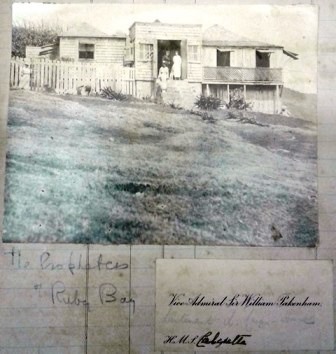
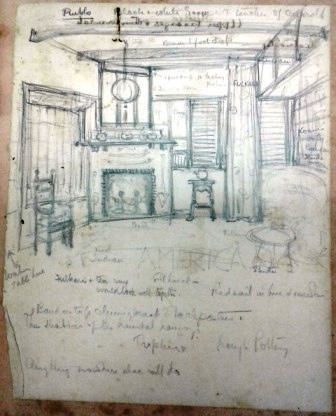
It is the final month of 2017 and 1917 as well; Gertrude Carter left scant record behind as the Carter family’s year ended in news of the death of Gertrude’s grown stepson, Otho, when his ship was torpedoed on November 28th. News reached his father on December 4th, the final page of the diary. The only items left in the journal are pasted in, a photograph, cryptically captioned “the Prophets of Ruby Bay,” and a sketch of a room — “Black & white room” — with Gertrude’s design notations penciled in — “Writing table here” and “Beam 1 foot deep”.

It seems fitting that we let Gertrude’s work as an artist and architect close out our year with her. Thank you for joining us on our journey with Gertrude Codman Carter through 1917! In January we will be introducing our diarist from 1918, a Newton (Mass.) teenager named Barbara Hillard Smith.


* * *

Dec 1.

Tea at the [illegible] Yearwoods.


Dec 2.

A very jolly [illegible] party. The Hancocks, Carpenters, Mrs. Smith [illegible], Laddie, Mr. Fell, Mrs. Da Costa. We sang & danced & had a generally jolly time of it.


Dec 3.

Met Mr. Eustace at L. Challum’s office. The [boots?] departed for the front.


Dec 4.

Poor G. came back from the town with a cable which had been handed him as he passed through. The cable was from Evelyn & said, “Otho lost at sea.” At first we could not grasp it for we had imagined him still in Africa — however when our letters came we found alas~ That he had been invalided home & they were expecting him shortly. G. went to the [illegible] who kindly cabled to the Colonial office & received the official confirmation that the “Apapa” had been torpedoed & sunk with severe loss of life & Otho amongst the lost.


Prophets of Ruby Bay”


 Black and White Room

* * *

As always, if you are interested in viewing the diary or letters yourself, in our library, or have other questions about the collection please visit the library or contact a member of the library staff for further assistance.


This Week @ MHS

By

The calendar is a bit top-heavy this week with a slew of events in the first few days. Here is a look at the programs in the week ahead:

Please note that on Thursday, 7 December, the library opens late at 12:00PM.

– Monday, 4 December, 6:00PM : Join us for a special program presented by a group of undergraduate students from Boston University, called Reforming Boston: Remaking the 19th-Century City. In this presentation and virtual exhibit, Professor Andrew Robichaud and his students present more than twenty rare artifacts and documents from the collection of the Massachusetts Historical Society. From prison and asylum reform, to education and temperance, to women’s rights and abolitionism, this presentation explores many dimensions of reform in Boston. How did Boston reformers understand their changing world, and how did they understand social change and improvement? This program is open to the public at no cost, though registration is required. Light refreshments served after the presentations. 

– Tuesday, 5 December, 5:15PM : This week’s seminar is from the Early American History series and features Adrian C. Weimer of Providence College, with Walter Woodward of University of Connecticut providing comment. “Petitions and the Cry of Sedition” looks at the political upheavals of the early Restoration in which a remarkable number of Massachusetts men and women expressed keen dissatisfaction with the monarch or General Court, leading to trials over seditious speech. The rich theological language in the petitions and feisty curses in the trial records offer an unrivaled glimpse into the significance of religion for the mobilization of local political communities in this tumultuous era. Seminars are free and open to the public. To RSVP, e-mail seminars@masshist.org or call 617-646-0579. Subscribe to receive advance copies of the seminar papers. 

– Wednesday, 6 December, 12:00PM : Chris Pastore of State University of New York at Albany leads this week’s Brown Bag discussion with “Constructing the Ocean’s Edge: Toward an Environmental History of the Atlantic World.” This presentation examines the environmental history and cultural geography of the North Atlantic shore during the Age of Exploration. A closer look at the ways coasts blurred the bounds of natural knowledge, conventions of conduct, and even the distinction between good and evil, may help us write uncertainty into an otherwise linear narrative of human progress, and, by extension, global expansion.

– Wednesday, 6 December, 6:00PM : MHS Fellows and Members are invited to the Society’s annual holiday party. Enjoy an evening of holiday cheer, celebrate the season, and wish a happy retirement to MHS President Emeritus Dennis Fiori. Holiday cocktail attire requested. RSVP by 1 December. Not a Member? Join today!

– Saturday, 9 December, 10:00AM : The History and Collections of the Massachusetts Historical Society Tour is a 90-minute docent-led walk through our public rooms. The tour is free, open to the public, with no need for reservations. If you would like to bring a larger party (8 or more), please contact Curator of Art Anne Bentley at 617-646-0508 or abentley@masshist.org.

While you’re here you will also have the opportunity to view our current exhibition: Yankees in the West.

The “industrious Citizen’s” guide to preparing for cold season

By Alex Bush, Reader Services

With flu season fast approaching and many coworkers and peers already succumbing to illness, the time has come to consider our health and safety for the wintry months ahead. What can we, “the enterprising Mariner—the hardy Soldier—the industrious Citizen,” do to mitigate “the direful consequences of infection?” William Burrell, a late-1700s seller of special medicine chests designed for sailors, collaborated with several physicians to create a pamphlet designed to adapt his sailors’ medicine chests for use by the common citizen. It contains page upon page of useful advice on treating anything from the common cold to gunshot wounds. Note that while William Burrell may not have been an actual doctor, his expertise in preparing medicine chests was definitely enough to qualify him to publish medical advice.


Published in 1798, Medical advice; chiefly for the consideration of seamen: and adapted for the use of travellers, or domestic life can be found within the MHS’ Evans microfiche collection of Early American Imprints. Within this pamphlet Mr. Burrell describes dozens of maladies common during the late 18th century with an eye toward prevention and quick recovery via home remedy. Burrell acknowledges that, shy of “devising and applying means to destroy the Fons et origo mali, (fountain and origin of evil,) and restore the purity of the atmosphere in which the patient breathes,” the best practice for combating illness is to keep the patient clean and comfortable. Most of this is achieved by way of steam, hot water, and a combination of chemicals. Although it is unlikely that Burrell’s medicine chests are still on the market today, the pamphlet fortunately includes a compilation of names and suggested doses for most of the medicines mentioned. Simply visit your local pharmacy for everything listed except, perhaps, tinctures of opium.


In general, Burrell warns that cold climates as well as rapid changes in temperature can predispose one to sickness. The same is true for excessive drinking of beer and spirits, so take care to stay sober during any upcoming holiday parties. Should you find yourself becoming ill, restrict your diet to bland foods such as gruel, pasta, oysters, and boiled meat. Those who remain healthy should bolster their diets with “sallads,” which are “saponaceous, detergent, cooling, and antiseptic,” as well as “opening and diuretic.” However, Burrell warns that salads should be avoided if one feels cold or nervous.

Lithograph showing a phlebotomy, London 1804, Armed Forces Institute of Pathology


In terms of cold symptoms, Burrell’s advice varies according to diagnosis and outside conditions. Most of it, however, involves bloodletting. Bloodletting (or bleeding) was a popular method of treatment for a wide range of ailments from the 1600s into the 1800s, after which it slowly declined in popularity. According to Burrell, bloodletting is an especially necessary step when the climate is cold. For fevers, intersperse repeated bleedings with induced vomiting. For coughs, bleeding and periodic doses of tincture of opium are recommended. In order to prevent malaria while vacationing in warmer areas, remove a pint of blood to account for the change in temperature and allow yourself to sweat freely.

Bear in mind, however, that a footnote to Burrell’s pamphlet warns against the dangers of excessive bloodletting:

it is of the utmost importance not to reduce the system by bleeding or any other evacuation whatever, below the ordinary healthy standard, as a firm constitution and a chearful and fearless mind, most powerfully resist the sedative action of pestilential contagion.


“Life of George Washington: The Christian,” lithograph by Claude Regnier, after Junius Brutus Stearns, 1853. Washington Library, Mount Vernon, VA.


Recall, for instance, the circumstances under which George Washington died. In December of 1799, after spending most of the day supervising his Mount Vernon farm in freezing rain and snow, the former president refused to remove his wet clothing for dinner. Naturally, the next day he developed a sore throat. Spending another full day outside in three inches of snow only made his sore throat worse, and by the following morning he was terribly ill and having trouble breathing. Attended by three physicians and his wife, Washington was given a mixture of molasses, vinegar, and butter to soothe his throat. A firm believer in the healing power of bloodletting, he also asked that half a pint of blood be removed from his arm while refusing other medicines and treatments. “You know I never take anything for a cold,” he said. “Let it go as it came.” As his condition worsened over the next ten hours, an estimated total of two and a half quarts of blood were removed from Washington’s body, amounting to over half of the blood in his body. He passed away at 10 p.m. on Saturday, December 17, 1799. Take care to remember this story while treating your own cold-weather ailments using bloodletting.

Chemicals in the form of gargles, tinctures, and skin treatments are also popular cures in Burrell’s pamphlet. According to Burrell, most oils and tinctures work best when dissolved in plain water or “common nitrous drink,” which can be made by dissolving a few grains of nitre in water. Add citrus juice, molasses, or vinegar to aid in digestion and soothe the throat. Bodily aches and pains caused by influenza or infection can be remedied using a blister, a paste made from mashing a special type of “blister beetle,” to draw toxins to the surface of the skin. The blistering toxin found in blister beetles has been used medically as a vesicant- an agent that causes blistering – as well as an aphrodisiac since the 12th century BC. Use it well, but do not eat it—you will almost definitely die.

With Burrell’s expert and up-to-date advice in mind, venture forth into this year’s cold season without fear!


References

Burrell, William, Medical advice; chiefly for the consideration of seamen: and adapted for the use of travellers, or domestic life, (New York: Printed for the author by R. Wilson, 1798).

“The Death of George Washington,” Mount Vernon Ladies’ Association, 2017, accessed on 30 November 2017, http://www.mountvernon.org/digital-encyclopedia/article/the-death-of-george-washington/

Vadakan, Vibul, MD, FAAP, “The Asphyxiating and Exsanguinating Death of President George Washington,” The Permanente Journal 8, No. 2, Spring 2004, accessed on 30 November 2017, http://www.thepermanentejournal.org/files/Spring2004/time.pdf.

Schmidt, Justin, “Cantharidin and Meloids: a review of classical history, biosynthesis, and function,” 2002, accessed on 30 November 2017, http://archive.li/Srh6y.



Bring Your Students to MHS!

By Kate Melchior, Center for the Teaching of History

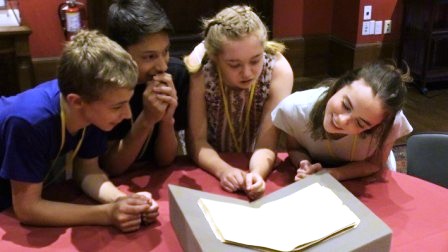
December is knockingon the door which means that the Center for the Teaching of History at the MHS is wrapping-up its inaugural semester of class visits! This fall, the MHS hosted a number of programs for middle school, high school, and college students who want to learn about primary sources and experience the work of historians first-hand.

Students getting up close and personal with MHS documents.


Our collection of Revolutionary War-era material is popular with middle and high school classes who come to MHS to learn about the real people behind Boston’s Freedom Trail. For example, Cohasset-based Chris Luvisi’s AP US History class examined artifacts and documents related to the Boston boycott of British goods in the 1760s and 1770s, including the 1767 “Address to the Ladies” which encouraged Boston women to forgo imported British luxuries in order to appear “Fair, charming, true, lovely, and cleaver” to young men. After taking on identities of Boston craft workers, merchants, shopkeepers, and domestic housewives, students voted on whether to support or ignore the nonimportation agreement. While most students supported the boycott in theory, a number of them admitted that they would likely keep buying their imported tea under the table!

Students were excited to get a close look at a bottle of tea leaves collected from Dorchester Neck the morning after the Boston Tea Party in 1773.


Vincent Bradley’s AP US History class from Catholic Memorial School also engaged with the history of the Revolution, this time through the perspective of John Adams. Students explored how Adams’ views on protest and dissent changed over time by looking at his opinions on the Boston Tea Party, the Boston Massacre, Shay’s Rebellion, and the Alien and Sedition Acts. Bradley’s class also saw historians in action while participating in one of MHS’ Brown Bag Lunches, where they heard Kabria Baumgartner from the University of New Hampshire speak about her current research on Black girlhood and the desegregation of Massachusetts public schools. Catholic Memorial students asked Professor Baumgartner questions about her work and listened as she workshopped her research with other local historians and visitors.

Students deciphered John Adams’s notes from the Boston Massacre trials to learn about his motivation for defending British soldiers. 


As the state coordinators for Massachusetts History Day, the Center for the Teaching of History (CTH) also helps many students learn research strategies for their upcoming projects. Megan Brady’s eighth grade history club from the John F. Kennedy School in Somerville came in on a Saturday so that they could learn about the collections at MHS and practice working with primary sources. Her students, whose National History Day interests range from early Pilgrim-Wampanoag relations to LGBTQ History in the 1920s, posed thoughtful questions to Stephen T. Riley Librarian Peter Drummey while looking at Sarah Gooll Putnam’s Civil War-era childhood diary and a daguerreotype of author and reformer Annie Fields, who lived in a “Boston marriage” with her partner Sarah Orne Jewett for decades. You can learn more about National History Day and find inspiration for your own projects at the Massachusetts History Day website, the National History Day site, or at our own Center webpage.

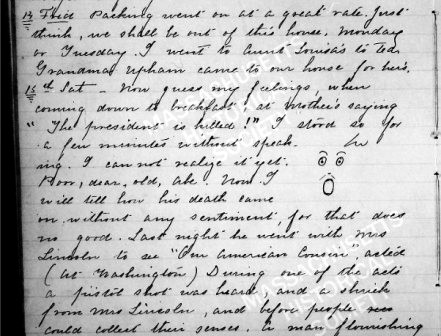
Sarah Gooll Putnam’s diary entry on 14 April 1865. The young artist drew her own expression at hearing of President Lincoln’s asssassination to illustrate how she felt at the news.


The Center sometimes partners with Library Reader Services to help host college visits as well, which gives the perfect excuse to explore more specific and unusual themes in the MHS collections. Erika Boeckeler brought two of her Northeastern University classes this fall to explore Children’s Literature and Shakespeare in America, leading to rediscovery of gems in our stacks such as a homemade morality tale titled “Adventures of a ruffle” that was written by Anne Harrod Adams, John and Abigail’s daughter-in-law! On another day, Cathy McCarron’s class joined us from Middlesex Community College to explore Elizabeth Freeman and Quock Walker’s court petitions for manumission and their leadership in ending slavery in Massachusetts. We discussed the different types of primary sources that illustrate the lives of individuals who previously lacked a voice in traditional historical narratives.

If you would like to bring students to visit us, or have the Center for the Teaching of History come to you, please contact the Center for the Teaching of History at kmelchior@masshist.org. All of our student programs are free of charge, and we would love to work with you to create a memorable program with your class!  For more information on our programming, visit the Center at http://www.masshist.org/teaching-history

This Week @ MHS

By

After a nice long holiday weekend it’s time to put down the turkey legs and get back to the business of history. Here are the programs on-tap in the week ahead:

– Monday, 27 November, 6:00PM : Join us for an author talk with Henry Louis Gates, Jr., and Maria Tatar, both of Harvard University, as they discuss their new book, The Annotated African American Folktales. This new publication presents nearly 150 African American stories, among them familiar Brer Rabbit classics, but also stories like “The Talking Skull” and “Witches Who Ride,” as well as out-of-print tales from the 1890s’ Southern Workman. Arguing for the value of these stories as part of a sophisticated, complex, and heterogeneous cultural heritage, Gates and Tatar show how these stories deserve a place alongside the classic works of African American literature and American literature more broadly. This talk is open to the public. Registration is required with a fee of $10 (no charge for MHS Members or Fellows). The talk begins at 6:00PM and is preceded by a reception at 5:30PM. 

– Tuesday, 28 November, 5:15PM : This week’s seminar is part of the Modern American Society and Culture series. “Volunteerism and Civil Society in the Twentieth Century” is a panel discussion with K. Ian Shin of Bates College, and Chris Staysniak of Boston College, with Timothy Neary of Salve Regina University providing comment. This panel considers volunteerism as sponsored by ethnic and service organizations. Both essays challenge our notions of “belonging” in a civil society, including our understandings of assimilation, activism, and protest. Shin’s paper is “Masons, Scouts, and Legionnaires: Voluntary Associations and the Making of Chinese American Civil Society, 1864-1945.” Staysniak’s essay is “Poverty Warriors, Service Learners, and a Nationwide Movement: Youth Volunteer Service, 1964-1973.” Seminars are free and open to the public. To RSVP: email seminars@masshist.org or call (617) 646-0579. Subscribe to receive advance copies of the seminar papers.

– Thursday, 30 November, 6:00PM : The second author talk of the week features Russell Shorto of the New York Times Magazine who will discuss his recent work Revolution Song: A Story of American Freedom. With America’s founding principles being debated today as never before, Shorto looks back to the era in which those principles were forged. Drawing on new sources, he weaves the lives of six people into a seamless narrative that casts fresh light on the range of experience in colonial America on the cusp of revolution. While some of the protagonists play major roles, others struggle no less valiantly. Through these lives we understand that the Revolution was, indeed, fought over the meaning of individual freedom. This talk is open to the public. Registration is required with a fee of $10 (no charge for MHS Members or Fellows). Pre-talk reception kicks-off at 5:30PM, followed by the speaking program at 6:00PM. 

– Saturday, 2 December, 9:00AM : “The Political Lives of Historical Monuments and Memorials,” is a teacher workshop hosted by the MHS. This workshop is now full. Please join us on March 17, 2018, for another workshop on the topic of Monuments and Historical Memory

There is no tour this Saturday, 2 December, but remember to come in and see the current exhibition, Yankees in the West, open to the public with no charge Monday-Saturday, 10:00AM-4:00PM. 


John Quincy Adams’ Would-be Assassin: George P. Todsen

By Neal Millikan, Adams Papers

On November 30, 1826, President John Quincy Adams learned that Dr. George P. Todsen (Todson) wanted to assassinate him. A native of Denmark, Todsen immigrated to St. Louis in 1817 where he established a medical practice. In 1824 he became an assistant surgeon in the U.S. Army but was cashiered out of service by sentence of a court martial in 1826 for embezzling public stores. Adams had reviewed the sentence and declined renominating Todsen for a military position.

Adams recorded in his diary that Dr. Henry Huntt “came very seriously to put me on my guard against” Todsen, who “had determined to murder me, for revenge.” Col. Thomas Randall, Todsen’s legal counsel, informed Adams that Todsen “had avowed to him his determination to assassinate me; and that he believed it was no idle menace— That the man was desperate, and upon this subject perfectly mad.” The news of Todsen’s hostility did not, however, impact the president’s daily schedule—Adams continued his solitary early morning walks around Washington, D.C.

The following month, on December 16, Todsen himself called at the White House. Adams recorded the visit in detail in his diary, noting that Todsen “demanded that I should nominate him for reappointment.” Adams informed Todsen that “there was no more painful duty within the compass of my service, than that of confirming a sentence of dismission; and it had been peculiarly painful to me in his case— But after the maturest consideration I had deemed it to be my duty, and I had seen no ground upon which I could retract that decision.” Adams stated he “was perfectly willing to consider the threats” of assassination “as the effect of a momentary alienation of mind,” and Todsen then “said he had given up the idea” since Adams “had expressed sentiments of compassion upon his case.”

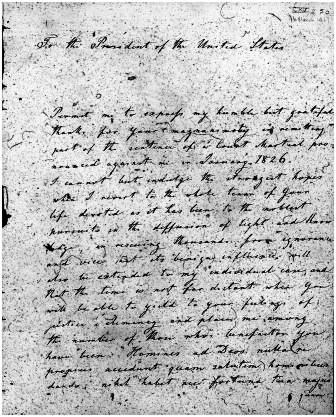
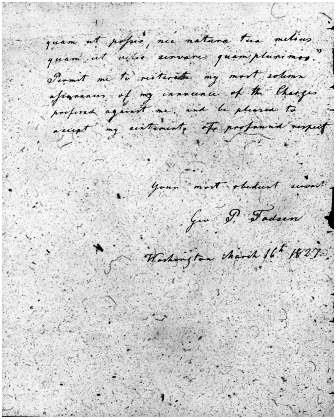
George P. Todsen to John Quincy Adams, March 16, 1827, Adams Family Papers, microfilm edition, 608 reels (Boston: Massachusetts Historical Society) reel 479.


On March 15, 1827, Todsen returned to ask for remission of a $47 payment from his court martial sentence, to which Adams assented; Todsen subsequently wrote Adams a letter of thanks. On June 2, Adams recommended Todsen to serve as doctor on an American vessel, and when Todsen came to thank Adams for the position, the president “observed to him that his future destiny would depend very much upon the propriety of his conduct under this appointment, and that I hoped it would be such as to justify the Government in appointing him, and as entirely to retrieve his character.” Even after Adams left the presidency the two men still kept in touch. As late as January 28, 1845, Todsen, then employed making translations for the U.S. State Department, visited congressman Adams in Washington, D.C.