“All things are in common now”

By Susan Martin, Collections Services

Today is the 242nd anniversary of the battles of Lexington and Concord, the first battles of the American Revolution. The MHS holds some terrific letters and diaries containing first-hand accounts of that famous day, not to mention related books, pamphlets, maps, and artifacts. We’ve also digitized select items over the years, and they’re available on our website with full transcriptions. My favorites are the letters of two refugees, Sarah Winslow Deming and Hannah Winthrop.
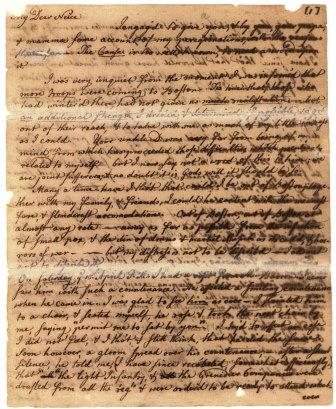
 

Sarah Winslow Deming (1722-1788) wrote to her niece Sally Coverly, possibly sometime in June, two months after the battles. In her 12-page journal-style letter, she recounted her harrowing flight from Boston after that “fatal” and “dreadfull” day. Early the following morning, she was told that British troops had closed all roads to carriages and that she was essentially “Genl Gage’s prisoner.” Nevertheless she persisted.

I then determined to try if my feet would support me thro’, tho’ I trembled to such a degree, that I could scarce keep my feet in my own chamber, had taken no sustenance for the day, & very sick at my stomack. […] ah! can any one that has not felt it, know my sensation? Surely no.

Learning that some carriages had gotten out, she, her husband John, and others borrowed a chaise and managed to pass through the British checkpoints without incident, but with no idea of their final destination.

We had got out of the city of destruction; such I lookt upon Boston to be, yet I could not but lift up my desires to God that he would have mercy upon, & spare the many thousands of poor creatures I had left behind. […] I was far from being elated with my escape. I remember my sensations but cannot describe ‘em.

Along the way, the Demings encountered other refugees, including many women and children.

A lad who came out of Boston wth us […] run up to our chaise wth a most joyful countenance & cry’d, Sir, Sir; Ma’m, here are the cannon – Our cannon are coming […] The matter of his joy was terror to me […] We met little parties, old, young, & middle aged, some with fife & drum, perhaps not an hundred in the whole, a kind of pleasant sedateness on all their countenances. We met such parties all the way, which gave me the Idea of sheep going to the slaughter.

Drenched from a downpour of rain, they stopped at the house of Rev. William Gordon in Jamaica Plain, a man they barely knew but who immediately offered them accommodation. As Gordon told Sarah Deming, “all things are in common now.” Deming’s husband rode off to return the chaise, which was needed to rescue other stranded residents, and she was terrified she’d never seem him again.

Read about the rest of her narrow escape here.
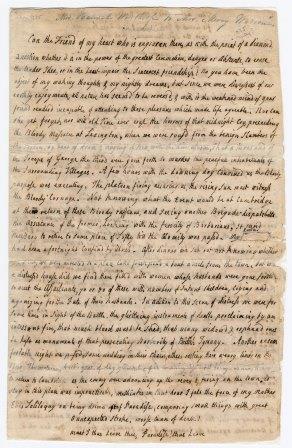
 

The letter from Hannah Fayerweather Winthrop (1727?-1790) to her friend Mercy Otis Warren was written around May 1775 and forms part of our online exhibit of their correspondence. In this letter, Winthrop described her flight from Cambridge the day of the battle, first to a house a mile outside of town.

What a distressd house did we find there filld with women whose husbands were gone forth to meet the Assailiants, 70 or 80 of these with numbers of Infant Children, Crying and agonizing for the Fate of their husbands. In adition to this scene of distress we were for Some time in Sight of the Battle, the glistening instruments of death proclaiming by an incessant fire, that much blood must be shed, that many widowd & orphand ones be Left as monuments of that persecuting Barbarity of British Tyranny.

The next day, in the aftermath of the battles, Winthrop and others were forced to move again, which she compared to Eve’s expulsion from the Garden of Eden. But while Deming was making her way south, Winthrop fled north to the town of Andover, “alternately walking & riding.” The sights she saw along the way were gruesome.

What added greatly to the horror of the Scene was our passing thro the Bloody field at Menotomy which was strewd with the mangled Bodies, we met one Affectionate Father with a Cart looking for his murderd Son & picking up his Neighbours who had fallen in Battle, in order for their Burial.

Like Deming, Winthrop found asylum with a “very obliging” family. Her rural refuge in Andover was peaceful, a surreal juxtaposition with the historical moment in which she lived. Read the rest of her letter here.

For more information on the battles of Lexington and Concord and the people who experienced them, search our online catalog ABIGAIL or our website.
 

This Week @ MHS

By Dan Hinchen

After you recover from the Marathon why not take in some public progams here at the Society. Here is what is lined up for the week ahead:

The MHS is CLOSED on Monday, 17 April, in observance of Patriots’ Day.

– Tuesday, 18 April, 2:00PM : Looking for something to do with the kids during vacation week? Come on in Tuesday at 2:00PM for Make Your Own Comic: The Jamestown Relief Mission to Ireland, a hands-on history program. After hearing from historians about the famine relief mission from Boston to Ireland led by Robert Bennet Forbes aboard the Jamestown, local comic book artists will help the young historians make their own historical comic depicting stories of Irish immigration. This event is open to the public free of charge though registration is required.

– Thursday, 20 April, 9:00AM : Boston to the Rescue: Robert B. Forbes & Irish Famine Relief is a full-day teacher workshop open to K-12 educators and students. Participants will explore the history of earliy Irish immigration to Boston and the tensions divided Catholic immigrants and Protestant New Englanders in the 1830s and 1840s. Registration is required at a cost of $25 (free for students). Please e-mail education@masshist.org or call 617-646-0557 for more information or to register. 

– Thursday, 20 April, 5:30PM : Lauren Meyer of Yale University presents this weeks History of Women and Gender Seminar, “Sadie Alexander, Black Women’s Work, and Economic Citizenship during the New Deal Era.” This argues that Sadie Alexander, the first black woman to earn a Ph.D. in economics and a successful practicing lawyer, offered an alternative, black feminist definition of economic citizenship that shifted discourses on the relationship between race, gender, labor, and the meaning of citizenship. Martin Summers of Boston College provides comment. Seminars are free and open to the public; RSVP requiredSubscribe to receive advance copies of the seminar papers.

– Saturday, 22 April, 10:00AM : The History and Collections of the MHS Tour is a 90-minute docent-led walk through our public rooms. The tour is free, open to the public, with no need for reservations. If you would like to bring a larger party (8 or more), please contact Curator of Art Anne Bentley at 617-646-0508 or abentley@masshist.org.

While you’re here you will also have the opportunity to view our current exhibition: The Irish Atlantic: A Story of Famine Migration and Opportunity.

Gertrude Codman Carter’s Diary, April 1917

By Anna Clutterbuck-Cook, Reader Services

Today we return to the 1917 diary of Gertrude Codman Carter. You may read the previous entries here: 

Introduction | January | February | March

The Merriam-Webster dictionary defines “paleography” as “the study of ancient writings and inscriptions.” This practice however, and the word to describe it, are increasingly used to refer to the practice of deciphering handwritten manuscripts in an age when typescript is what many of us encounter on a daily basis beyond the scribbled shopping list or note to self in one’s planner — unless you, like many of us, have abandoned the print version in favor of Google calendars or a planner-like app. The art of slow reading, when making sense of a densely-handwritten letter might take the better part of a day in the archive’s reading room — and often an intimate familiarity with the writer’s hand — is a skill that we must increasingly practice with intent rather than one that we develop passively through everyday exposure.

Gertrude’s diary and letters are no exception to this rule, and in the spirit of this rough-and-ready transcription project I have undertaken for the year, I often find myself inserting [illegible] in the place of partially or wholly impenetrable words that by the end of a year spent in Lady Carter’s company might well seem perfectly understandable. Another solution to [illegible] manuscripts, one that we are often called upon to assist with in the MHS reading room, is crowdsourcing: enlisting a second, or third, or an entire list of social media followers to cast their eyes over the scribblings that befuddle a researcher and see what we can decipher as a group.

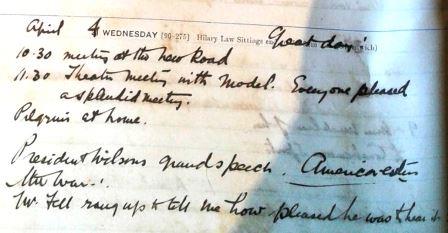
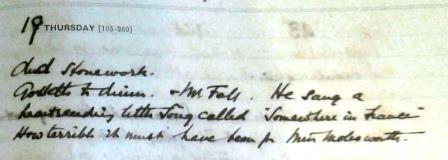
In the spirit of demonstrating the labor of paleography, I offer in this month of April the rough-and-ready transcription of Gertrude’s scattered April 1917 entries alongside the phrases that confounded me at first and second pass. Think you have an idea of what a word may be? Leave a comment below or let us know on Twitter @mhs1791!

* * *

2 April.

Paid bills.


3 April.

[left blank]


4 April. Great day!

10.30 Meeting at the [illegible] Road.

11.30 Theater meeting with the model. Everyone pleased. A splendid meeting.

[Pilgrims?] at home.

President Wilson’s grand speech. America enters the war.

Mr. Fell rang to tell me how pleased he was to hear it.


Here the diary skips to April 19 and continues on.


19 April.

[illegible] stonework.

G[odettes?] to dinner & Mr. Fell. He sang a heartrending little song called “Somewhere in France”. How terrible it must have been for Mrs. [Water?]worth.


20 April.

Band at the Savannah Club

Had an offer for 501 which was depressing & yet I don’t dare refuse $18,000 ($15,000 on mortgage at 4 ½ %). I cabled 5% or $20,000 which was very clever (so Charlie said in his letter) – I got the 5%. This was some time ago.


21 April.

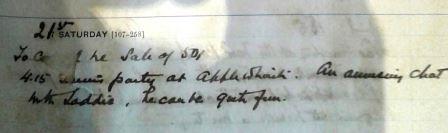
I [damaged text] sale of 501.

4.15 Dinner party at [illegible]. An amusing chat with Laddie. He can be quite fun.


22 April.

To church.

To Erdiston in the afternoon.


23 April.

Consul again.

4 Miss Packer re: Savannah beautification

Later Mr. Carpenter. Jolly chat.


24 April.

8.30 Miss Packer

Laddie Challum motored me out to Caledonia. He has a nice little Ford car, a ripper at hills.


25 April.

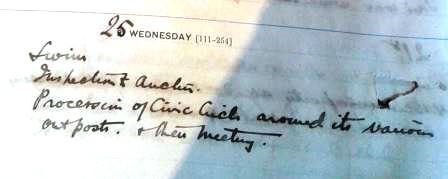
Swim

[illegible] to auction

Procession of Civic Circle around its various outposts & then meeting.


Here ends the April 1917 entries remaining in the diary.

* * *

If you are interested in viewing the diary or letters yourself, in our library, or have other questions about the collection please visit the library or contact a member of the library staff for further assistance.

This Week @ MHS

By Dan Hinchen

There is a flurry of activity to start the week here at the Society before we ease into a long weekend. Here is what we have in store:

– Monday, 10 April, 6:00PM : We begin the week with an author talk featuring Ronald H. Epp, whose recent book is titled Creating Acadia National Park: The Biography of George Bucknam Dorr. In his work, Epp examines the pioneering role of Dorr’s seminal contributions – largely unacknowledged – to the American environmental movement. This talk is open to the public and registration is required with a fee of $10 (no charge for MHS Members or Fellows). A pre-talk reception begins at 5:30PM followed by the speaking program at 6:00PM. 

– Tuesday, 11 April, 5:15PM : This weeks Environmental History Seminar is a panel discussion titled “Fishing the Commons.” The talk will feature Erik Reardon of University of Maine at Orono and his paper “New England’s Pre-Industrial River Commons: Culture and Economy,” as well as Stacy Roberts of University of California, Davis, and her essay “The Private Commons: Oyster Planting in 19th-century Connecticut.” Matthew McKenzie of University of Connecticut at Avery Point provides comment. Seminars are free and open to the public; RSVP requiredSubscribe to receive advance copies of the seminar papers.

– Wednesday, 12 April, 12:00PM : Come in for a Brown Bag talk on Wednesday titled “Radical Enlightenment in the Struggle over Slavery,” featuring Matthew Stewart, author of Nature’s God: The Heretical Origins of the American Republic. This talk draws material from a work in progress to lead a discussion about the role of Enlightenment ideas in shaping abolitionism, anti-slavery politics, and the Civil War. This talk is free and open to the public so grab your lunch and stop by!

– Wednesday, 12 April, 6:00PM : “The Rise and Fall of the American Party” is a public program that is part of The Irish Atlantic Series which is centered on our current exhibition. In this talk, Stephen T. Riley Librarian of the MHS, Peter Drummey, looks at the meteoric rise of the American Party – the “Know Nothings” – as well as its rapid decline with the approach of the Civil War. This talk is free and open to the public though registration is required. Pre-talk reception kicks-off at 5:30PM and the program starts at 6:00PM. 

– Saturday, 15 April, 10:00AM : The History and Collections of the Massachusetts Historical Society Tour is a 90-minute docent-led walk through our public rooms. The tour is free, open to the public, with no need for reservations. If you would like to bring a larger party (8 or more), please contact Curator of Art Anne Bentley at 617-646-0508 or abentley@masshist.org.

While you’re here you will also have the opportunity to view our current exhibition: The Irish Atlantic: A Story of Famine Migration and Opportunity.

Please note that the Society is CLOSED on Monday, 17 April, in observance of Patriot’s Day.

Celebrate National Beer Day!

By Daniel Tobias Hinchen, Reader Services

If you are like me then you were unaware until this morning that today is National Beer Day in the United States. And just like that, you learned an important fact on a Friday afternoon.

On 13 March 1933, President Franklin Delano Roosevelt drafted a memo which read:

To the Congress:

I recommend to the Congress the passage of legislation for the immediate modificaiton of the Volstead Act, in order to legalize the manufacture and sale of beer and other beverages of such alcoholic content as is permissable under the Constitution; and to provide through such manufacture and sale, by substantial taxes, a proper and much-needed revenue for the Government. I deem action at this time to be of the highest importance. 1


According to the folks at that National Constitution Center, on 22 March 1933, Roosevelt signed the Cullen-Harrison Act, a piece of legislation that amended the Volstead Act of 1919. The Cullen-Harrison Act went into effect on 7 April 1933 and was met with celebration around the country. Happily for many, the CHA did not stick around long; it was voided upon ratification of the 21st Amendment to the Constitution in December 1933.2

In commemoration of the Cullen-Harrison Act of 1933, here are two recipes from the collections of the MHS to brew your own beer and spruce beer:

To brew Beer

     Take 3 pints of malt, a double handful of Hops, as much of bran or shorts, boil these in ten gallons of soft water for two hours. then strain it, and when cold, add half a pint of molasses a half a pint of yest and work it well. To colour it add a handfull of roasted barley whilst it is boiling. The yest of this beer put in a bottle with water, & kept in a cool place, will serve to make Bread.__

Spruce Beer

          Take half a pint of Spruce. boil it two hours in five gallons of soft water, a quart of molasses. When cold work in a large tea cup full of good thick yest. let it work 24 hours & then bottle it off. it will be pleasant Beer without the Spruce.__ 3


While it is too late to brew and sample today, you have a full year to practice your brewing and have a homemade batch for the next National Beer Day. I, for one, look forward to reader submissions to see who creates the best brew.

Cheers!

***

1. Franklin D. Roosevelt: “Message to Congress on Repeal of the Volstead Act.,” March 13, 1933. Online by Gerhard Peters and John T. Woolley, The American Presidency Project. http://www.presidency.ucsb.edu/ws/?pid=14551. Accessed 7 April 2017.

2. National Constitution Center, “The constitutional origins of National Beer Day.,” April 7, 2017. Constitution Dailyhttps://constitutioncenter.org/blog/the-constitutional-origins-of-national-beer-day/. Accessed 7 April 2017.

3. From an Anonymous recipe book, ca. 1800.


This Week @ MHS

By Dan Hinchen

It’s a pretty quiet week here at the Society as we begin a new month. Here is what lies ahead:

– Tuesday, 4 April, 5:15PM : Agnès Delahaye of the Université Lyon II presents this week’s Early American History seminar titled “Promotional Literature and Identity in Colonial Massachusetts.” This essay examines the institutional and cultural factors behind promotional literature, the body of colonial sources written for metropolitan audiences. The essay details the tropes and expressions of the commonality of purpose that Delahaye sees in most New England historiography, and explores the relationship between colonial historiography and exceptionalism in the New England tradition. Conrad E. Wright of the MHS provides comment. Seminars are free and open to the public; RSVP required.
Subscribe to receive advance copies of the seminar papers.

– Wednesday, 5 April, 12:00PM : Julia Rose Kraut of the Historical Society of the New York Courts leads this week’s Brown Bag lunch talk, entitled “A Fear of Foreigners and of Freedom: Ideological Exclusion and Deportation in America.” This talk examines the history of the exclusion and deportation of foreigners from the United States based on their beliefs, associations, and/or expressions, from the Alien Act of 1798 to the War on Terror. This talk is free and open to the public.

– Saturday, 8 April, 10:00AM : The History and Collections of the MHS is a 90-minute docent-led walk through the public spaces here at the Society. The tour is free and open to the public with no need for researvations for individuals and small groups. Larger parties (8 or more) should contact Curator of Art Anne Bentley in advance at 617-646-0508 or abentley@masshist.org.

While you’re here you will also have the opportunity to view our current exhibition: The Irish Atlantic: A Story of Famine Migration and Opportunity.

Bread Pudding: an experiment with Mary Channing Eustis’ recipe book

By Alex Bush, Reader Services

The Pemberton collection, a compilation of materials from several New England families connected by marriage, includes a few artifacts from Mary Channing Eustis of Milton, Massachusetts. A dedicated recorder of recipes and what we now lovingly refer to as “life hacks,” Eustis filled two commonplace books with directions for the making of everything from plum cakes to stomachache cures. After recently rediscovering Emilie Haertsch’s 2012 blog post on Ben Franklin’s milk punch (http://www.masshist.org/blog/838), I figured another experiment with a vintage recipe was long overdue. Should this post instill you with further curiosity about Massachusetts’ cooking-related past, consider attending the MHS public program series “Cooking Boston.” The next installment (2 of 6) is scheduled for the 27th of April.

With that, let us explore Mary Channing Eustis’ recipe for bread pudding. Since I’d been planning to attempt a bread pudding anyway, I was quite excited to find this recipe. To my untrained eye it looked like the perfect choice—easy, simple, and delicious.

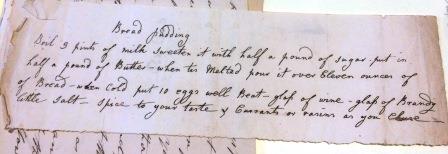
 “Boil 3 pints of milk sweeten it with half a pound of sugar put in half a pound of Butter – when tis melted pour it over Eleven ounces of [of] Bread – when cold put in 10 eggs well Beat – glass of wine – glass of Brandy little salt – spice to your taste & Currants or raisins as you Choose—”


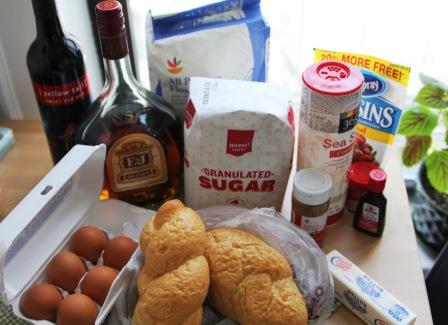
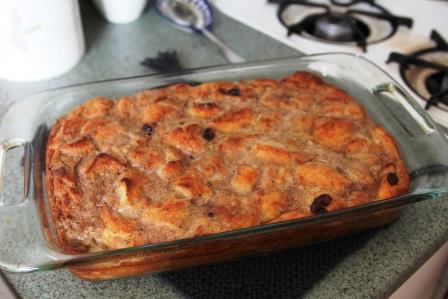
The photo and transcript above represent the recipe in its entirety. It is vague at best, with some decidedly odd proportions. In order to accommodate my lack of a kitchen scale as well as my unwillingness to sacrifice 10 eggs, I halved the recipe and converted each measurement into its approximate equivalent in cups. Pictured below is the full array of ingredients as well as a bag of flour, which I was almost positive the recipe included despite having read it multiple times. Milk was also included in the recipe, but is not pictured here. Obviously the baking nerves were already setting in.


First, Eustis indicates that the milk should be boiled and sweetened with sugar. However, due to her disinclination toward comma usage, I was unsure whether she meant that the sugar should be added right away or after the milk was boiled. I was also unsure as to whether boiling milk is ever a good thing to do. Instead, I put the milk in a pot over medium heat and brought it to just before boiling, adding sugar gradually until it dissolved. As the milk heated, I chopped the bread into cubes (despite the recipe not specifying that I should do so) and put it into a bowl. After this, the recipe calls for an off-putting amount of butter to be melted into the milk before the whole mixture is poured over the bread.

 “Speak softly and melt a big stick of butter.” -Theodore Roosevelt, (Historical note: Theodore Roosevelt did not, in fact, say this.)


Honestly, this was the recipe at its best. You might as well stop reading right here. Even so, at this point my sweetened bread and dairy concoction was likely pretty far from what Mary Channing Eustis would have had. I used skim milk, while Eustis almost certainly would have used whole milk or even cream, considering the fact that skim milk was not sold in U.S. stores until around World War II. The same goes for the overall differences in quality between my Stop n’ Shop rolls and whatever delicious, probably homemade bread Eustis had on hand. I am also fairly certain that Eustis had never heard of Craisins, which I added later on.

A festival of health.


Eustis’ recipe instructs that the above mixture should chill before the next steps can be taken. While chilling, my bread absorbed most of the milk mixture and became incredibly soggy. This made the next step in the recipe especially painful. To the bread and milk, the (halved) recipe instructs that five well-beaten eggs must be added. This made the eggs to milk ratio almost equal, creating what can only be described as a sweet, uncooked bread omelet.

There are no words.


The recipe then calls for one glass each of wine and brandy. Nowhere is it specified how much a “glass” is supposed to be, so I estimated by adding half a standard-sized wine glass of each. At this point, I figured, adding a little alcohol would only make things easier for everyone. I also added a few handfuls of Craisins to substitute for currants, and spiced the pudding “to my taste” with vanilla, nutmeg, cinnamon, and a pinch of salt. All in all, the uncooked pudding did not look half bad. It looked fairly similar to other bread puddings I’d seen previously, and the spices and wine made it smell quite lovely! With nothing in the recipe indicating how long or at what temperature the pudding should be baked, I was forced to guess. I cross-referenced a few other bread pudding recipes and came up with 350 degrees for 40 minutes. With an inflated sense of optimism, I placed the pudding into the oven to bake.

Before.


After.


Admittedly, the pudding looked very handsome at the end of its bake. My apartment was filled with the fragrant scents of cinnamon and butter, the top of the pudding was beautifully brown, and it appeared that most of the liquid had been absorbed. However, the sheen of butter grease coating the surface did not inspire confidence, nor did the fact that my first spoonful of the pudding revealed a pale and wobbly interior beneath the crust. The sad result of this experiment was a bread pudding that resembled a sweet frittata more closely than anything else. The spices, sugar content, and baking time were spot on. Had the proportions been slightly more even, this probably would have turned out well. However, the sheer amount of butter and eggs in this recipe coupled with the comparably small amount of bread made for a greasy, breakfasty mess.

There are many reasons why this could have turned out as badly as it did. First of all, Mary Channing Eustis likely compiled this book of recipes for herself, her family, or her peers. All of those people undoubtedly had some background in the cooking techniques needed for these recipes, including knowledge of typical oven temperatures or a sense of how many eggs is too many eggs. Second, as I mentioned before, it was impossible to recreate the dish with complete accuracy given the supplies, skills, and hardware I had on hand. Finally, it may just be the case that eggy puddings were in vogue back in the 1840s and 50s, and that this egg purgatory was inescapable. While I personally cannot see the appeal, Eustis obviously could, given the fact that this book is absolutely full of similar recipes. Any avid egg-eater is welcome and encouraged to attempt this recipe and share the outcome.

Despite the eggy result, this was a fascinating experiment and a great look into an older take on a still-popular dish. I certainly look forward to revisiting Eustis’ recipe book for more questionable recipes in the future. Perhaps I’ll look into her home cure for an upset stomach first.

They’re Comin’ Out, They Want the World to Know: Boston’s Depression Debutantes

By Susan Martin, Collections Services

Elizabeth Elliot Mixter was born in Boston on 24 January 1913. She was the oldest child and only daughter of renowned neurosurgeon William Jason Mixter and his wife Dorothy (Fay) Mixter. Like other young women hailing from the elite Brahmin families of Boston, coming of age meant a “debut” into society at around the age of 18. Elizabeth’s debut took place in the fall of 1932, in the depths of the Great Depression.

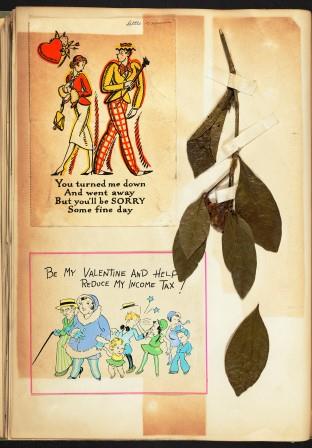
The MHS collection of Fay-Mixter family papers contains a large scrapbook of newspaper clippings, programs, invitations, photographs, and other papers documenting Elizabeth’s ”Coming Out Year 1932-1933.”


Elizabeth made her official debut on 9 November 1932 at a tea held in her honor by her grandmother, Elizabeth Elliot (Spooner) Fay, at 330 Beacon Street. Pourers at the tea included other young ladies from the so-called “smart set.” Many of their names are recognizable—for example, Polly Binney, whose family’s papers are located right here at the MHS, just a few shelves away from Elizabeth’s. Another pourer was Abigail Aldrich, none other than the niece of John D. Rockefeller, Jr.

Elizabeth’s cousin Anne Mixter, also one of that year’s debs, couldn’t make it to the tea because of an emergency appendectomy. Neither could “plucky” 17-year-old Frances Proctor, who’d been mugged just two days before and apparently punched in the mouth when she refused to surrender her car keys. Frances’ story is told in a newspaper clipping entitled “Society Girl Is Beaten by Holdup Man.”


According to the Boston Evening Transcript of 4 June 1932, more than 150 debutantes were formally presented in the 1932-33 season in Boston, an “unusually large” number. After coming out, a deb’s life became a whirlwind of parties, dinners, concerts, costume balls, charity events, etc. Elizabeth was invited to join exclusive clubs like the Junior League of Boston and the Vincent Club. She took part in theatrical performances and studied cooking and home economics.

A deb was photographed, or “snapped,” around town, and the society pages detailed her clothing and appearance. For example, on their way to a luncheon, two young ladies were “nicely turned out in their new fall costumes, so modishly trimmed with fur.” Polly Cunningham was described as “the luscious, rounded type with golden curls and merry blue eyes, beautifully poised and magnetic.” And here’s what one article had to say about a roller skating party: “One of the prettiest of the skaters was Miss Elizabeth E. Mixter of Brookline. Like many others, she took dainty falls but enjoyed the frolic.” Another writer used the word “pulchritudinous.”

Amidst the high-society gossip and fashion tips are a few hints of the tough economic times then plaguing the country. One page of the scrapbook contains a re-written version of Psalm 23 that begins: “The politician is my shepherd – I am in want / He maketh me to lie down on park benches.” Also included is an article entitled “Depression Debutantes,” from the 12 November 1932 Saturday Evening Post, which makes the argument that “coming out” prepares a young woman not just for marriage, but also for work. Perhaps most revealing, Elizabeth filled out an elaborate budget sheet, probably as part of her home economics coursework, detailing how to save money on clothing purchases over three years.


As for the uncomfortable premise of the whole debutante phenomenon—the marketing of young women of a certain social standing as eligible marriage prospects—Elizabeth’s scrapbook has that covered, too. It includes a column from the gossip magazine Tatler and American Sketch by an anonymous author, aptly named “Audacious.” In the column, Boston debs are sorted into “grades” based on, well, the blueness of their blood.

Grade A includes Abigail Aldrich and Polly Cunningham, as well as Misses Appleton, Coolidge, Hallowell, Holmes, Jackson, Lawrence, Loring, Peabody, Perkins, Saltonstall, Shaw, Winthrop, and others. Elizabeth, her cousin Anne, and Polly Binney are all listed in Grade B. “Plucky” Frances Proctor rates Grade C, though I would argue she deserves much higher!

The mercenary nature of these rankings shocked some contemporary journalists. When the Tatler and American Sketch went out of business in January 1933, editor John C. Schemm, outed as the author of the column, said: “I meant that department to be a constructive force, but it can’t be done. No matter how intelligently you strive to do the job, or how constructively, you cannot avoid creating hard feelings.”

Elizabeth E. Mixter married Dr. Henry Thomas Ballantine, Jr. in 1938, and the couple had two children. She died in 1998.

This Week @ MHS

By Dan Hinchen

Even though March is on its way out, it seems bent on imposing its will. Escape the late-winter bluster in the week ahead with some history:

– Monday, 27 March, 6:00PM : First up this week is a public program centered on our current exhibit, The Irish Atlantic, and is the first in a series. In The Mission of the Jamestown, William Fowler, Jr., guest curator of the exhibit, leads a discussion on the relief efforts of the Jamestown on the eve of the 170th anniversary of its voyage. Joining him are Catherine Shannon, Professor Emerita of History at Westfield State University, and Christine Kinealy, Director of Ireland’s Great Hunger Institute at Quinnipiac University. This talk is free and open to the public though registration is required. A pre-talk reception takes place at 5:30PM and the talk begins at 6:00PM. 

–  Tuesday, 28 March, 5:15PM : This week’s Modern American Society and Culture Seminar continues the Irish theme. In “Moving News, Affecting Relief: The Irish Famine’s Trans-Atlantic Circulations,” Anelise H. Strout of California State University – Fullerton demonstrates that ships which carried Irish famine victims to America also brought tragic stories of those left behind; in response, North Americans sent millions of dollars to help relieve rural suffering. The paper argues that exploring the interactions between these various circulations reveals a tension between aiding strangers overseas and welcoming them in American cities. Kevin Kenny of Boston College provides comment. Seminars are free and open to the public; RSVP requiredSubscribe to receive advance copies of the seminar papers.

– Wednesday, 29 March, 12:00PM : This week’s midday Brown Bag lunch talk is with Amy Hughes of Brooklyn College, CUNY. Join us as she presents “An Actor’s Tale: Theater, Culture, and Everyday Life in Nineteenth-Century U.S. America,” her monograph-in-progress inspired by the diary of U.S. actor Harry Watkins (1825-1894). This talk is free and open to the public. 

– Wednesday, 29 March, 6:00PM : Tea Sets and Tyranny: The Politics of Politeness in Early America is a recent book from Steven C. Bullock, Worcester Polytechnic Institute, and is also the final program in the Politics of Taste series. The politics of politeness, he argues, helped make opposition to overbearing power central to early American thought and practice. This talk is open to the public and registration is required with a fee of $10 (no charge for MHS Members or Fellows). A pre-talk reception takes place at 5:30PM, followed by the speaking program at 6:00PM.

– Saturday, 1 April, 10:00AM : The History and Collections of the Massachusetts Historical Society Tour is a 90-minute docent-led walk through our public rooms. The tour is free, open to the public, with no need for reservations. If you would like to bring a larger party (8 or more), please contact Curator of Art Anne Bentley at 617-646-0508 or abentley@masshist.org.

While you’re here you will also have the opportunity to view our current exhibition: The Irish Atlantic: A Story of Famine Migration and Opportunity.

Gertrude Codman Carter’s Diary, March 1917

By Anna Clutterbuck-Cook, Reader Services

Today we return to the 1917 diary of Gertrude Codman Carter. You may read the previous entries here:

Introduction | January | February

All but the last page of March 1917 is sliced out of the diary; a practice of selective record-keeping that seems to have been somewhat routine for Carter (or her descendents).  On the page for March 29 – 31, we are left a few brief notes about a charity auction, Palm Sunday, and a pencil sketch of son John refusing his medicine — “see preceding page,” reads the note, below, referring to an entry no longer available to us.


In search of any additional information the  MHS library might hold related to Carter’s life during this time, I called up a box from the Marian Lawrence Peabody papers in which can be found four folders of letters from Marian’s friend Gertrude. Carter was apparently out of the habit of dating her letters, but did charmingly illustrate her missives much as she does her diary. In the absence of March 1917 diary entries, I instead share with you two of Carter’s undated letters with their accompanying illustrations, that survive within the Peabody papers. Both seem to post-date the period of the diary which we are reading, since the first recounts the adventures of an adolescent John and the second suggests that John was an independent adult who might drop by “to pass the time” with his mother.

The first letter I selected was written in late September (of an unknown year, perhaps in the 1920s) while traveling on board the R.M.S. Mauretania.

* * *

Sunday
29th Sept

Dear Marian,

This is a fine ship but the writing desks are arranged for hippopotomi. I can’t get near this one and I am, as you know, no sylph. Still, nothing shall prevent me from returning our correspondence, especially when I remember what a nice welcome you gave me in Bar Harbour.


All of America was splendid but we did look back on Bar Harbour as the best of all. Those pines and mountains, the glorious air & all the various dinner picnics, etc. The frescoes impress me more than words can say. I’d give anything if you’d come down & paint the grand canal of venice on my staircase. I believe we could amuse you for a fortnight — I have to remember that you said Gertrude’s holidays didn’t work out properly. In that case you’ll have to dash down without her. They are certainly very safe at her age, schools & relations have them in care & as they have to do what they are told, you can rest in safety. I realise this especially at this juncture — Eton takes such enveloping care. A “dame” lives there with a complete pharmacy in [case of] accidents & a battery of pills & powders — when I realize that John next week will be [illegible] on his own at Cambridge & no one noticing whether he is ill or not or cold or not, I tremble. — We went to Boston from Bar Harbour & proceeded to inspect Codman roots at Lincoln, Parker roots at [illegible], the rum-running industries at Cohasset. Only we saw nothing of it except the fog. Cousin Susy took us to a lovely Carillon of Bells, & John was handed over to some of the young people in the neighborhood. Charlie Cobb took us afterward to the Bank & John was enchanted with the amusement of Checking the Securities & learning the difference between a share & a bond.  Then we went out to Dover in the last of the time. Tony Parker was always a friend of John & gave him motor lessons in the truck. I saw plenty of Forbes & [illegible] & Potters, etc. I missed Terry Morse’s entertainments, he was always so full of amusements. Miss Forbes was awfully nice in giving John, [illegible] flat at the [illegible] house to keep his things & sleep as we flitted from place to place, while I was at the Club. Washington was a joy. Perfect weather sunshine & fall moon & the Admiralty came to see the [illegible] in, a nice Captain [illegible] was most kind and useful. The [illegible] New York was thrilling. John in love with these [illegible] of engineering and with the same [illegible] with which he climbed the Mts. of Mt. Deseret, ascended everything & dived into the subway. Gerry C. materialized & took us to dine at the St. Regis [illegible] & to a play. We saw the “Little Show” which had some good times. I am [illegible] with the idea of turning the Churches into apartment houses who rent will pay all the expenses of running a chapel on top or a crypt. I haven’t discovered which! Now do write to me & tell me everything from the moment of my departure. Address c/o [illegible] 43 Charing X, London. As I shall not go to Barbadoes much before Dec. Lots of love, Gertrude.

* * *

The second letter, likely post-dating the first, was written while in Boston and struggling with what appears to have been chronic knee pain.

* * *

56 Commonwealth
Friday Eve

My dear Marian, I was hoping for a word from you, especially today, as I finally called upon Dr. Wheeler — the old reliable of a 20-year arrangement — and he sent me around to a Dr. Morrison to be x-rayed — isn’t it a painful process? — I never can understand the medical mind. The last time I hurt my knee, Dr. Moore concentrated on my ankle & to-day all the interested was centered on my back, none of the photographs (five) appeared to be aimed at my knee at all! — I have given the matter profound thought & have decided there’s a dash of Christian Science in the treatment & the idea is produce a happy state of mind in the patient — I can see that the beautiful time you are having in that wonderful house & with your charming hostess is being very beneficial. Wheeler is a merry Andrew. His prescription (which I opened in the taxi on the way to the x-ray place) read: “If you don’t want to go back to the nurse & formetations [sic], instead – soak in a hot bath 1/2 hour three times a day, take lots of aspirin — 6 or 8 tablets a day, (signed), love & kisses Roy Wheeler (!!). On the whole your programme of gay [illegible] sounds much nicer but the idea is the same — build up the ego! — But the prescription is certainly difficult.


Suppose the telephone rings. Or the laundry arrives. Or dear little Miss Forbes arrives with some strawberries or John Codman drops in to pass the time of day? So I have arranged to take two of the baths per day at the Club. I hope it will work out all right. It seems a waste of time. But after all town is empty and time is what I have got a lot of.

Your affectionate,

Gertrude

* * *

If you are interested in viewing the diary or letters yourself, in our library, or have other questions about the collection please visit the library or contact a member of the library staff for further assistance.