This Week @ MHS

By Dan Hinchen

The coming week will see the opening of a new exhibit as well as a few public programs to take in. Here is what’s on the calendar:

– Tuesday, 7 March, 5:15PM : Come in for the next installment from the Early American History seminar series, “A History of Violence: The Harpe Murders and the Legacies of the American Revolution.” Kate Grandjean of Wellesley College shares information about this project which looks at a series of murders in Appalachia in the 1790s committed by former Loyalists. By following the lives of the Harpe borthers, who left a trail of blood through early Tennessee and Kentucky, it explroes the violent legacies of the American Revolution – especially in the southern borderlands. Eliga Gould of the University of New Hampshire provides comment. Seminars are free and open to the public; RSVP requiredSubscribe to receive advance copies of the seminar papers.

– Wednesday, 8 March, 12:00PM : “Inventing Citizens: Patents, Investors, and Civil Rights” is a Brown Bag lunch talk with Kara Swanson of Northeastern University. Swanson’s project examines the foundational relationship between the growing republic and its accessible patent system by demonstrating how the patent system became a resource for marginalized groups making claims to full civil rights, particularly women and African Americans. This talk is free and open to the public. 

– Thursday, 9 March, 6:00PM : SOLD OUT – “The Irish Atlantic” Fellows & Members Preview Reception. MHS Fellows and Members are invited to a special program, reception, and chance to preview The Irish Atlantic. The exhibition explores 175 years of the Irish in Boston. Guest curator William Fowler will give an overview, beginning with a look at the Irish community in Massachusetts stretching back into the 18th century, through famine relief efforts led by Capt. Robert Bennet Forbes at the helm of the Jamestown, to a mass migration movement, decades of community and institutional building, and a rise in political power.

– Friday, 10 March, 10:00AM : The Irish Atlantic begins. This exhibit is open to the public free of charge, Monday-Saturday, 10:00AM-4:00PM, through 22 September 2017.

– Friday, 10 March, 12:00PM : Stop by for the second Brown Bag lunch talk of the week, this time with Stephen A. West of the The Catholic University of America. “A Constitutional Lost Cause: The Fifteenth Amendment in American Memory and Political Culture, 1870-1920” examines how Americans – across lines of race, region, and party – placed the voting rights amendment at the center of their memores of Reconstruction, and how those memories shaped their debates about citizenship and the very nature of the Constitution. This talk is free and open to the public. 

– Saturday, 11 March, 10:00AM : The History and Collections of the MHS is a 90-minute, docent-led walk through the public spaces of the Society at 1154 Boylston St., providing information about the historic building, collections, artwork, and architecture of the MHS. This event is free and open to the public with no need for reservations for individuals or small groups. Larger parties (8 or more) should contact Curator of Art Anne Bentley in advance at 617-646-0508 or abentley@masshist.org. While you’re here you will also have the opportunity to view our current exhibition: The Irish Atlantic: A Story of Famine Migration and Opportunity.

Gertrude Codman Carter’s Diary, February 1917

By Anna Clutterbuck-Cook, Reader Services

Today we return to the 1917 diary of Gertrude Codman Carter — artist, wife of Sir Gilbert Thomas Carter, a British colonial official, and mother to a young son, John Codman Carter. In February of 1917 the family resided in Barbados where Gertrude spent her days overseeing the construction of Ilaro Court, the family residence she had designed, and participating in a wide variety of social engagements.

Although physically far removed from the war raging in Europe, the family and their neighbors were intimately connected to the violence across the Atlantic. On February 18th, Gertrude interrupts the short-form structure of her typical diary entries to give an account of the injury and later loss of a neighbor’s son in battle.

While diaries invite us to see the world through the eyes of the diarist, that perspective is not always a comfortable one. On February 17th, she notes that she took her son John and a friend to a carnival dressed as a pirate and an “Indian Chief.” Toward the end of the month, between describing social calls and an afternoon playing tennis, Gertrude sees fit to remark that she received a call from “a dreadful little Jew. These casual displays of racism and anti-semitism remind us of the larger British and American imperial hierarchies within which this white New England woman was embedded.


*** February 1917 *** 

8 Feb. Ilaro. Mr. Carter seems to be doing well.
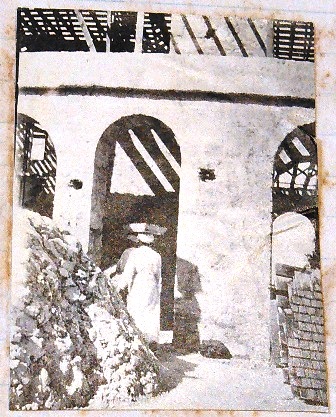


The Harold [Whytes?] gave us a jolly little lunch at the Bridgetown Club. The Harrells, & Lady Challum, Mrs. Ball Greene from [illegible] & ourselves.

9 Feb. Plans for theatre. Called Evelyns.

10 Feb. Another engagement (doesn’t say what – so I imagine it was a [illegible]).

11 Feb. Ilaro. Took  [illegible].

Lady Clark’s [illegible]. She is much better.

12 Feb. Ilaro. Called Skeet.

13. Ilaro. John in nursery window.
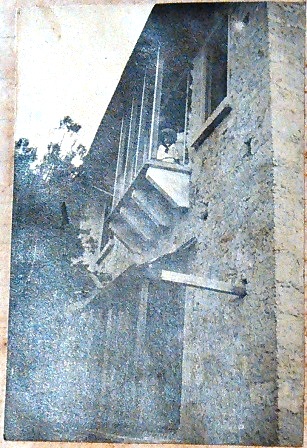
 

14 Feb. Women Self-Help Committee Meeting.

15 Feb. (What did I do all this time? Calendar says nothing). Government House at home.

16 Feb. Ilaro. 3 [illegible] Called [illegible] Mrs. Cullen. 9. Hall Clarks. Personal [illegible].

17 Feb. Auction at Mandon. Children’s carnival at [illegible] Park. John as a Pirate walked with Lyall as an Indian Chief. Took Hamilton.

18 Feb. E.F.S. Bowen to see house.

To Wm. Mannings to tea. A lovely afternoon & I took the Hamiltons to see the place. Mrs. Manning was very cheery having just received a letter from her son John saying “The Germans seem to be out of the stuff they need to kill me!” After tea on the verandah we went out on the lawn. The telephone bell rang & Mrs. Manning trotted off to answer it. I saw her coming back with her head up like a brave soldier. “Bad news,” she said, “John is wounded. They are sending up the cable. I walked up and down with her while the others melted away. Presently a boy on a bicycle came wheeling up the drive & the butler with a tragic face brought the orange envelope across the lawn. The sun was savagely bright & the yellow and blue macaw shrieked as he swung on his perch. I opened it & read it to her.

“Regret to inform you Lieutenant John Manning brought in dressing station severely wounded. 17th instant.”

Mr. Sam Manning came across the lawn: his face was impassive & he still held a fossil shell in his hand. Mrs. Manning was sobbing in my arms. She raised her head & said, “Sam. Wasn’t it odd? You remember yesterday afternoon?” “Indeed yes,” said the husband to me. “Mrs. Manning was sitting in her room & she looked up & saw John come in.”

(There seems to have been no doubt that this was a real case of telepathy, that the dearly loved son appeared to his mother of whom he thought constantly to say goodbye. It does not to me [impair?] the example of telepathy the fact that the man who came in to Mrs. Mannings room was her other son Herbert. She saw the face of John later form upon the face of Herbert for only a few moments.)

I sat with Mrs. Manning for an hour, trying vainly to give comfort. “He isn’t missing dear Mrs. Manning, he’s comfortable. They are taking care of him, he is at the dressing station. They’ll do everything for him.” But the mother shook her head. “He will die,” she said slowly. It was to say goodbye that he came yesterday.”

And indeed I was not surprised the next day to see the flags of the town at half mast for the boy who had gone. It was to me significant that his farewell should have been to his mother rather than the graceful little wife who married him in a rush & repented it afterward.

19 Feb. A nice swim. Called [illegible] etc. etc. in P.M.

Lady Godfrey & Mrs. Austin [illegible]. Dined at the Hamilton who have moved into [illegible].

20 Feb. Tea at Mrs. Burton’s. Stone carving.

21 Feb. Took John to make calls.

22 Feb. Another nice swim. [illegible] at 11. Mrs. Clifton [Whyte’s?] party [for?] Edna

23 Feb. Took Mrs. Burton to Ilaro. Some nice [gossetts?] to Lewis. Colonel G’s son’s [fiancee?] (he was killed at Ypres) a Miss [illegible].

 [illegible] on theatre plans.

24 Feb. [illegible] Tea at the Felix Hayley’s. Theatre plans.

25 Feb. Meet Mr. Bowen & Mr. Carlin at Ilaro about sash weights. Called Wilkinson’s & Laws.

[illegible] round plan.

 

26 Feb. Burtons at 9. House at 10. 2 o’clock a call from Mr. R. Davis the theatre promoter. Very full of excitement. A dreadful little Jew. Hamiltons to tennis.

27 Feb. Electricity at 11. At Ilaro.

2 o’clock meeting of the Theatre Committee. [illegible] outside plan of theater for model. Worked rest of p.m.

28. Feb. Worked on [illegible] for theater. 4.30 Civic [illegible] at the Budges.

Dined at the Hamilton & played Pirate [illegible].

***

If you are interested in viewing the diary yourself, in our library, or have other questions about the collection please visit the library or contact a member of the library staff for further assistance.

These transcriptions are preliminary and not meant to be authoritative. In all cases where a word could not be contextually surmised [illegible] has been inserted in its place.

 

Spend your Summer with the CTH

By Kathleen Barker, Center for Teaching History

The calendar has turned to March, which means here at the Center for the Teaching of History we are thinking of summer! Every K-12 teacher knows that it’s never too early to begin planning your upcoming professional development activities. If you teach the American Revolution, nineteenth-century immigration, or the Civil Rights movement, we have a program for you. Participants can earn professional development points at each workshop, as well as graduate credits (for an additional fee) at most events. We are continually adding new programs to our line-up, so we hope you will bookmark our website and visit us often: www.masshist.org/teaching-history. In the meantime, take a peek at some of the workshops we will be hosting this spring and summer.

April 20: Boston to the Rescue: Robert Bennet Forbes & Irish Famine Relief
On April 12, 1847 Boston merchant Robert Bennet Forbes arrived in Ireland aboard the U.S.S. Jamestown. The ship carried more than 8,000 barrels of food and provisions to the island inhabitants at the height of the Great Famine. Learn more about this venture and the history of Irish immigrants in Boston at this one-day workshop, offered in conjunction with the upcoming MHS exhibition, The Irish Atlantic.

April 29: Civil Rights in America
Offered in conjunction with the Ashbrook Institute, this program will explore the tumultuous path of the Civil Rights Movement. The Thirteenth Amendment abolished slavery in the United States, and the Fourteenth Amendment should have guaranteed freedoms, equality, and civil rights for all men. Instead, it would take many generations of struggle, court cases, and additional legislation for this reality to be achieved. Join Dr. Peter Myers for a discussion on the complicated road endured by African Americans after the Civil War.

July 19-20: The American Revolution in Art & Artifacts
How were the growing tensions between great Britain and her American colonies depicted in art here and abroad? In this workshop we will explore portraits, artifacts, songs, plays and other art forms created during the era of the American Revolution. We will also investigate how the Revolution has been portrayed in art forms over the last 250 years, from epic poems to Broadway musicals!

July25 & 27: America in World War I
Massachusetts men and women joined the war effort long before America entered the conflict in 1917. Using first-hand accounts, we will follow the work of Red Cross volunteers, soldiers, pilots, and medical professionals. We will also take a closer look at America’s conflicted approach to WWI though an examination of propaganda posters, political cartoons, government documents, and other primary sources,

August 9-11: Food in American History
Experience the connections between food and history through historical accounts and field trips to local producers and providers!  There will be opportunities to consider the importance of food items such as coffee, tea, and chocolate; Boston’s role in the creation of American food culture; and the role of cookbooks, television, and other media in creating the myth of the American melting pot.

All programs will be offered at the Society’s headquarters at 1154 Boylston Street. For more information, or to register, contact education@masshist.org or 617-646-0557.


This Week @ MHS

By Dan Hinchen

Here is what’s on tap at the MHS as we enter a new month:

– Monday, 27 February, 6:00PM : Self-Evident Truths: Contesting Equal Rights from the Revolution to the Civil War is a new book by Richard Brown of University of Connecticut. This book offers a much-needed exploration of the way revolutionary political ideas penetrated popular thinking and everyday practice. In this talk, Brown discusses how the ideal that “all men are created equal” was tested in struggles over race and ethnicity, religious freedom, gender and social class, voiting rights and citizenship. He shows how high principles fared in criminal trials and divorce cases when minorities, women, and people from different social classes faced judgment. This talk is open to the public and registration is required with a fee of $10 (no charge for MHS Members and Fellows). Pre-talk reception begins at 5:30PM, followed by the program at 6:00PM. 

– Tuesday, 28 February, 5:15PM : “Vietnamese Political Prisoners and the Politics of Family, 1975-1996” is a seminar featuring Amanda C. Demmer of the University of New Hampshire and is part of the Modern American Society and Culture series. This project dispels the myths that American involvement in Vietnam ended abruptly after the fall of Saigon and that U.S. servicemen listed as prisoner of war/missing in action were the only exception to American disengagement. Arissa Oh of Boston College provides comment. Seminars are free and open to the public; RSVP requiredSubscribe to receive advance copies of the seminar papers.

– Wednesday, 1 March, 12:00PM : Bring a lunch and join us for “Ask Carol Lane!: Imaginaries of Safe Travel in the 1950s.” As post-war traffic fatalities rose, so did the concern to create safe communities and roads. Some of the work done by organizations involved creating imaginary personas, mostly of women, to perpetuate the rules of safe travel and normalize traffic and travel safety during a period of increased vehicle use, recreational travel, and fatality risk on the roads. This talk examines these personas and their place in the larger safety context of the 1950s. Renee Blackburn of MIT presents this Brown Bag talk which is free and open to the public. 

Thursday, 2 March, 6:00PM : In 2014, the Brookline Historical Society received a tiny photo album with postage stamp-sized photos of 48 Brookline and Boston children. In this presentation titled “A Children’s Photo Album,” Ken Liss of Boston University Libraries tells the tale of this ablum and the people inside it. This event is open to the public and registration is required with a fee of $10 (no charge for MHS Fellows or Members). Pre-talk reception starts at 5:30PM followed by the speaking program at 6:00PM. 

The Tree on Boston Common

By Grace Wagner, Reader Services

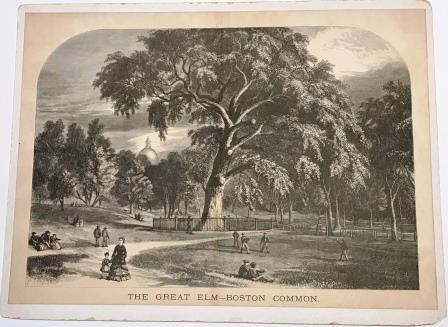
As we begin to move out of February and, hopefully, leave behind the worst of winter, I’d like to reflect back on a historic Boston storm that had a strong impact both on Boston’s landscape and its mythology. February 15, 1876 was a stormy day at the start of the United States’ centennial year. It was also the last day that one of Boston’s first ‘residents’ would stand in Boston Common. This resident was known as the “Great Elm” (and later, the “Old Elm”) and it was one of the most prominent signifiers of Boston’s place in history, a silent witness to history called upon in many early accounts of the city.

The tree had a fabled history among Bostonians. Nehemiah Adams describes the tree in alternately flowery language: “That tree is to antiquity with us what a pyramid is in Egypt. It is like the pillars of Hercules, bounding the unknown ages which preceded the arrival of the Pilgrims” (Boston Common, 1842) and more bizarre turns of phrase: “vegetable patriarch” (The Boston Common: Or, Rural Walks in Cities). Adams’ assessment of the tree’s ancientness is largely in keeping with other Bostonian’s views. Although it was a long held belief that the tree stood in Boston Common even before the Puritans arrived, it was only when the tree fell and its rings were counted that residents definitively concluded that the tree had existed since at least the 1630s (Boston Common in colonial and provincial days by Mary Farwell Ayer). 

The tree had witnessed a number of types of events over the years, from public hangings and duels during the early days of Boston to local women laundering clothing by the tree and Frog Pond at the end of the eighteenth century. In the nineteenth century, as Boston grew in size and the Common became more like a large public park, more common activities included people meeting at the Elm Tree or going skating on Frog Pond.


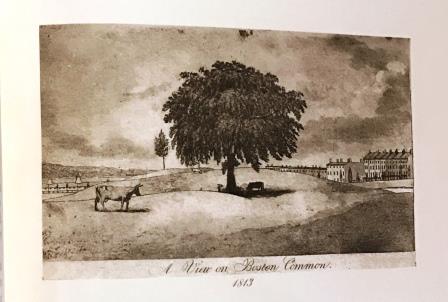
This nineteenth century print is one of many prints and artistic renderings that were produced of the tree and features Bostonians enjoying their time near the Great Elm, whether sitting under the tree, playing catch near it, or strolling by it. Although this particular print focuses on an idyllic depiction of the Common, it also reveals the age of the Great Elm, which is missing several branches and is fenced in by an iron gate in this depiction. The gate wasn’t installed until 1854, after a series of storms left the elm badly scarred. Over several hundred years, the tree sustained a number of injuries, including a large cavity that developed in the center of its trunk. When the tree finally did come down in 1876, struck by a strong gust of wind during a storm, Boston citizens rushed to the tree to claim branches and scraps of wood as souvenirs.


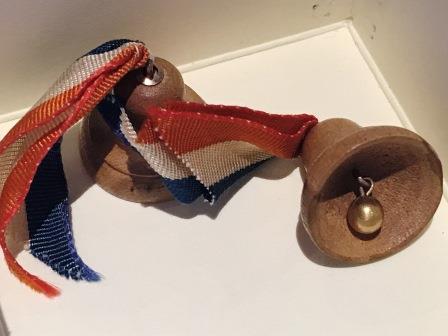
The tree was repurposed in a number of other ways by inventive residents, including creating veneered pictures of the tree made out of wood from the elm itself and growing a root of “The Old Elm” around a china dish cover. Part of the tree was also used to make a chair for the Boston Public Library (Boston Common: a diary of notable events, incidents, and neighboring occurrences by Samuel Barber). One of these keepsakes belongs to MHS’s own collection, a pair of “Old Elm earrings,” made by Benjamin F. Knowlton. The earrings are shaped like tiny liberty bells and are made out of elm wood, with tiny gold clappers, and red, white, and blue striped ribbon attached to the top of each earring.

From the days of Puritan society, when Boston Common was still a cow pasture, to the Revolution and into the nineteenth century, the Great Elm was a marker of time for Boston for many years. If you are interested in the Great Elm, or the history of Boston Common, please consider visiting the library to learn more! 

This Week @ MHS

By Dan Hinchen

The MHS is CLOSED on Monday, 20 February, for Presidents’ Day. 

Despite the holiday-shortened week, there is quite a bit of activity at the Society. Here’s is what we have the calendar for the final full week of February:

POSTPONED : “Harvest for War: Fruits, Nuts, Imperialism, and Gas Mask Manufacture in the United States During World War I,” originally scheduled for Tuesday, 21 February, is postponed to Tuesday, 9 May, 5:15PM. 

– Wednesday, 22 February to Thursday, 23 February : “Women in the Ear of the American Revolution” is a two-day teacher workshop open to K-12 educators. Participants will explore the daily lives of revolutionary women, including those who served as soldiers and secret agents, or followed the army as cooks and laundresses. The program fee includes a visit to the Museum of Fine Arts. Please email education@masshist.org or call 617-646-0557 for more information or to register.

– Wednesday, 22 February, 12:00PM : Stop by at lunchtime for a Brown Bag talk with Emily C. Burns of Auburn University. Her talk, “Constructing American Belatedness: The Archives of American Artists in Late Nineteenth-Century Paris” culls archival materials to understand how American culture collectively became defined through internatioanl mobility as belated and innocent. This talk is free and open to the public. 

– Wednesday, 22 February, 6:00PM : “MIT: History and Architecture,” is a public talk with Douglass Shand-Tucci, author of the recently published MIT: The Campus Guide. This talk focuses on the way MIT and Harvard, now universally ranked among the top five seats of higher learning in the world, reflected Boston 19th century Unitarian tradtion and framed its Brahmin Ascendancy. Registration is required for this program with a fee of $10 (no charge for MHS Fellows or Members). Pre-talk reception begins at 5:30PM followed by the speaking program at 6:00PM. 

– Thursday, 23 February, 5:30PM : Please join us for a conversation with the authors of two important new books in the history of sexuality. “Sexuality of History, History of Sexuality” is part of the History of Women and Gender seminar series.  This wide-ranging discussion, with Sue Lanser of Brandeis  University and Jim Downs of Connecticut College, will explore the relationship between lesbian and gay male histories, literary and historical methods, representation and political mobilization of people and communities. Jen Manion of Amherst College moderates the discussion. Seminars are free and open to the public; RSVP requiredSubscribe to receive advance copies of the seminar papers. Please note that there are no precirculated essays for this session. This program takes place at Radcliffe, Fay House, Sheerr Room, 10 Garden St. in Cambridge.

– Saturday, 25 February, 9:00AM : “Abraham Lincoln & Emancipation” is a teacher workshop open to K-12 educators. MHS staff and participants will use primary sources from the Society’s collection to discuss and debate Lincoln’s grounds for opposing slavery and his thoughts on colonization, abolition, and gradual emancipation. The group will be joined by Kevin M. Levin, author of Civil War Memory. Registration is required with a fee of $25. Please email education@masshist.org or call 617-646-0557 for more information or to register. This workshop was originally scheduled for Saturday, 11 February.

– Saturday, 25 February, 1:00PM : “Begin at the Beginning: Mapping New England – a visual story.” Join MHS librarian Peter Drummey in investigating the world of early New England maps: how they were created; what they included and what they omitted; the images their creators choose and the messages they conveyed. Were early maps designed to encourage emigrants, or aids to navigation? Did they chart colonial-Native American conflict or paint an idyllic garden scene? Find out how these non-textual artifacts communicated the world of 17th-century New England. Registration is required at no cost. Please RSVP 

NOTE: This meeting is a discussion, not a lecture. Come prepared to examine maps, raise questions, and make your points! No expertise required, just a willingness to engage with primary material, talk to fellow attendees, and enjoy yourself.

– Saturday, 25 February, 10:00AM-4:00PM : This is your last chance to view our current exhibition, Turning Points in American History, which ends on 2/25

There is no public tour this week.


Working with Google to Showcase MHS Content about U. S. Presidents

By Nancy Heywood, Digital Projects Coordinator

Selections from MHS’s two most important collections, the Adams Family Papers and the Coolidge Collection of Thomas Jefferson Manuscripts, are now part of the Google Arts & Culture website. This website is administered by the Google Cultural Institute, a non-profit initiative founded in 2011 that partners with cultural organizations to “bring the world’s cultural heritage online.” [Read more about the Google Cultural Institute here: https://www.google.com/culturalinstitute/about/partners/.]

When MHS was approached by a coordinator of the Google Cultural Institute in the late summer and asked to contribute content about U.S. Presidents for the American Democracy Project, MHS staff realized there were many benefits of having our collections showcased within the Google Arts & Culture web delivery system.  Highlights of the Society’s extraordinary Adams and Jefferson manuscript collections are now available to users who browse and search the content Google is hosting from about 1,200 significant museums, archives, and cultural organizations.

MHS’s main website has thousands of presentations of documents from our Adams and Jefferson materials, and the first challenge was to figure out what specifically to contribute to Google’s recent project.  The Google content management system features items as single digitized images and online exhibitions featuring those digital items.  Given limited production time to assemble the online content, we decided to focus our efforts on creating two online exhibitions–“The Private Jefferson” and “From Diplomats to Presidents: John Adams and John Quincy Adams”.

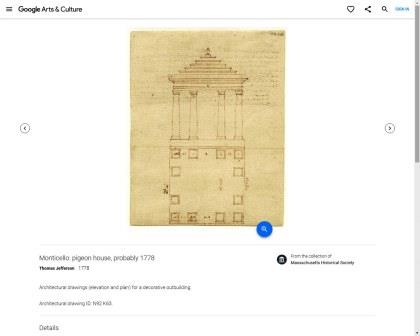
For “The Private Jefferson” online exhibition, Laura Wulf, Production Specialist, worked from the publication, The Private Jefferson: Perspectives from the Collections of the Massachusetts Historical Society, the companion to the recent MHS exhibition.  It features selected letters written by Jefferson, pages from manuscript volumes, architectural drawings and sketches, published documents, and engravings.

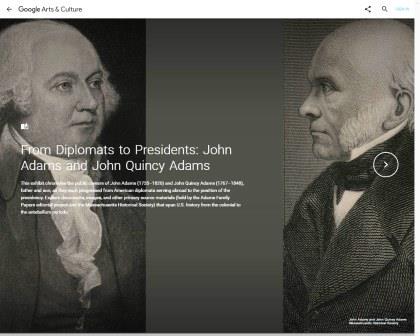
Neal Millikan, Digital Projects Editor, and Amanda Norton, Digital Projects Editor (with input from their colleagues within the Adams Papers department) crafted an informative narrative for the exhibition “From Diplomats to Presidents: John Adams and John Quincy Adams.” This exhibition presents key documents and quotations about the extensive careers in public service of John Adams and his son, John Quincy Adams.

The MHS digital team (Laura Wulf, Peter Steinberg, and I) assembled all the digital components (images and associated metadata), loaded them into the Google web delivery system, and used the exhibition editor tool to assemble the online exhibitions.

Please explore the exhibitions and MHS’s online content within the Google Arts & Culture website, and the entire Google American Democracy project.


“We…Intend to Make Things Lively”: Boston’s Black Voters in 1884

By Susan Martin, Collection Services

The MHS just acquired a fascinating document related to political activism by Boston’s black voters during the 1884 presidential election. This election, only the fourth presidential contest in which black (male) voters could take part, pitted Democrats Grover Cleveland and Thomas A. Hendricks against Republicans James G. Blaine and John A. Logan. Most African Americans supported the Republican Party, and “Blaine and Logan Clubs” had sprung up in many American cities, including Boston.


On 20 Sep. 1884, a committee consisting of three Boston men sent this letter to the Republican National Committee on behalf of the “colored voters of the 3d. Congressional district” of Massachusetts. They requested information on the candidates, particularly Democratic vice presidential nominee Hendricks. The letter reads, in part:

We hope you will be able to forward a good stock of Hendrick’s [sic] public record so that every colored man in the Commonwealth may know all about the Democratic candidate for the Vice-Presidency. […] We have formed a Blaine & Logan Club and intend to make things lively for Messrs. Cleveland & Hendricks on the 4th day of next November.

I was curious about this “opposition research” targeting Hendricks. Thomas Andrews Hendricks (1819-1885) of Indiana certainly had a substantial public record. By 1884, he’d served in multiple elected offices, including state congressman, U.S. representative, U.S. senator, and governor. He’d even run for vice president once before, on a ticket with Samuel Tilden in 1876, but they lost to Rutherford B. Hayes. So, what specific grievances did black voters have against Hendricks? To answer that question, I found two terrific resources in the MHS stacks, both printed in Boston in 1884.

The first is a book called The Life and Public Services of Grover Cleveland, by Frederick E.  Goodrich, which includes an appended biography of Hendricks. Goodrich was an enthusiastic Democrat, and his biography is unabashedly partisan. He describes the Democrats as the true heirs to the Founding Fathers and calls the Republicans “demoralized” and “thoroughly corrupt.” Hendricks himself sounds almost mythical: “His honesty was above suspicion, his integrity was never questioned, nor his motives impugned. He won the respect of all his colleagues and retained the confidence and support of his constituents.”

Goodrich wrote in generalities and didn’t have much to say about Hendricks’ specific votes related to slavery or African American civil rights. He did explain, in one passage, Hendricks’ support for the Fugitive Slave Act:

It has been objected to him lately, that he was in favor of the Fugitive Slave Law; but so was the majority of his party, which at that time recognized that slavery was a legal institution in the Southern States, and which upheld the right of the slave-owners to claim their property wherever they found it. It is too late in the day now to rake up the anti-slavery record of any man, because many of our foremost and most honored public men since the war were, prior to that event, defenders, or at least apologists of slavery.

The second resource I found at the MHS was a speech by W. R. Holloway delivered on 2 Aug. 1884 and published in pamphlet form as A Bad Record: Hendricks as a Public Man. William Robeson Holloway (1836-1911), a staunch Republican and brother-in-law of Gov. Oliver P. Morton, had held various political appointments in Indiana. He was a full-throated anti-Hendricks man and didn’t mince his words, characterizing Hendricks like this:

Shown to have been the Friend and Apologist of Slavery, a Copperhead of the worst type.—An Intense Negro Hater, as well as a Defender of Treason, a Constant Sympathizer with the Rebellion.—The Champion of Traitors, and always a Bogus Reformer, an Insincere Demagogue, and an Uncertain Leader.—Not a Redeeming Feature to be found in the Public Career of the Choice of the Democracy for Vice-President.

Hendricks did, in fact, oppose all three Reconstruction Amendments to the U.S. Constitution: the Thirteenth (abolishing slavery), Fourteenth (extending citizenship, due process, equal protection, etc.), and Fifteenth (granting suffrage to black men). In his speech, Holloway also described how the Democrat “sustained and defended the Dred-Scott decision,” “denounced the Emancipation Proclamation,” and opposed the military service of African Americans, arguing that black soldiers lacked the courage to serve alongside whites. He accused Hendricks of opportunism, hypocrisy, and cowardice. Here’s more:

He has been consistent in his opposition to the negroes, and while in the Senate, voted uniformly against the colored race, against emancipation in the District of Columbia, against their civil and political rights in that District, and against their right to ride on the street-cars in the city of Washington; opposed their employment as soldiers, and after they were enlisted and had gallantly perilled their lives on the field of battle, he voted on more than one occasion to deny them equal compensation with white soldiers in the same service.

It’s no wonder the “colored voters of the 3d. Congressional district” were determined to “make things lively”! Massachusetts’ 14 electoral votes went to the Republican nominee, James G. Blaine, but despite the party’s best efforts, Grover Cleveland won the election by a narrow margin. Thomas A. Hendricks died one year later on 25 Nov. 1885, and the vice presidency remained vacant for the rest of Cleveland’s term.

I hoped to find out more about the three men who sent the letter, A. P. Jones, W. D. Johnson, and Jas. H. Wolff, but could only definitively identify the third man. The remarkable story of James Harris Wolff (1847-1913) probably deserves a blog post of its own. He served in the Navy during the Civil War and became a prominent black attorney who argued civil rights cases for African Americans. In 1910, he was the first black person to deliver the official Fourth of July oration in Boston.


This Week @ MHS

By Dan Hinchen

Coming back after a couple of snow days, we have a quiet week ahead here at the Society. Please be sure to check our website and calendar in the coming weeks to be aware of weather closures. 

– Thursday, 16 February, 6:00PM : Of Arms and Artists: The American Revolution Through Painters’ Eyes contains the stories of five artists – Peale, Copley, Trumbull, West, and Stuart – who interacted continually with the nation’s Founders. Each story opens a fresh window on the Revolutionary era, making more human the figures we have long honored as our Founders, and deepening our understanding of the whirlwind out of hw hich the United STates emereged. Join us for a talk with Paul Staiti of Mount Holyoke College who authored the book. This talk is open to the public but registration is required with a fee of $10 (no charge for MHS Members or Fellows). A pre-talk reception begins at 5:30PM and the program starts at 6:00PM. 

– Saturday, 18 February, 10:00AM : The History and Collections of the Massachusetts Historical Society Tour is a 90-minute docent-led walk through our public rooms. The tour is free, open to the public, with no need for reservations. If you would like to bring a larger party (8 or more), please contact Curator of Art Anne Bentley at 617-646-0508 or abentley@masshist.org.

While you’re here you will also have the opportunity to view our current exhibition: Turning Points in American History.

“A Remarkable Deception”: The Cardiff Giant Hoax

By Shelby Wolfe, Reader Services

In the autumn of 1869 the peaceful valley of Onondaga, in central New York, was in commotion from one end to the other. Strange reports echoed from farm to farm. It was noised abroad that a great stone statue or petrified giant had been dug up near the little hamlet of Cardiff, almost at the southern extremity of the valley; and soon, despite the fact that the crops were not yet gathered and the elections not yet over, men, women, and children were hurrying from Syracuse and from the farm-houses along the valley to the scene of the great discovery.

So begins Andrew D. White in a 1902 article for The Century titled “The Cardiff Giant: The True Story of a Remarkable Deception.” Thus, he sets the scene for his bizarre – yet true – story about a very fake giant.


I came across White’s article in a scrapbook of clippings in our collections, illuminating the events and deceptions surrounding the once-famed Cardiff Giant. While the compiler of clippings in this scrapbook is unknown, this person had enough interest to collect published material and neatly title the scrapbook in black ink, “The Cardiff Giant.” On the first page, a note from the November 1902 meeting of the Massachusetts Historical Society recognizes “one of our distinguished Corresponding Members,” Andrew D. White, for his “minute description of the attempt to cheat the public.”  

On 16 October 1869, workers who were hired to dig a well on the property of William C. “Stub” Newell in Cardiff, New York, unearthed what became known as the Cardiff Giant. The bewildered well diggers were hired by Newell, who knew the figure had been deliberately planted almost a year earlier by his cousin, George Hull. While in Iowa in 1866, Hull was reportedly inspired to create a stone giant and pass it off as a petrified man after he argued with a Methodist revivalist, Rev. Mr. Turk, and wondered why so many believed the remarkable stories in the Bible about giants. Two years later, Hull hired men to quarry out an eleven-foot block of gypsum near Fort Dodge, Iowa, which he shipped by train to Chicago to be sculpted into the giant. The finished 3,000-pound figure was shipped again to Cardiff and buried to await its debut. Once it was uncovered, Newell set up a tent to display the nearly ten-foot-five colossus, and hundreds flocked to his Cardiff hamlet for a twenty-five-cent viewing of what many believed to be a petrified man (Newell raised the price to fifty cents after two days). Following the discovery, Hull sold the giant to David Hannum for $23,000, who shipped it to Syracuse and began a road tour toward New York City. Noting the public’s remarkable interest in the giant, P.T. Barnum offered to purchase it for $50,000. Though his offer was declined, Barnum covertly made an exact copy of the giant and charged visitors to view it.

While much of the public and even some professionals were fooled, others saw through the deceit, partially or fully. An article in the 3 November 1869 edition of the Worcester Daily Spy includes a testimony from Professor James Hall, “the state geologist of New York, a scholar of a good American reputation.” Hall states, “It is certainly a great curiosity, and, as it now presents itself, the most remarkable archaological [sic] discovery ever made in this country, and entirely unlike any other relics of a past age yet known to us.” While Hall did not believe it to be a petrified human, he thought it a unique object related to “the race or people of the past formerly inhabiting that part of the country.” Another article includes a letter dated 24 November 1869, in which Professor O. C. Marsh concludes, “Altogether, the work is well calculated to impose upon the general public; but I am surprised that any scientific observers should not have at once detected the unmistakable evidence against its antiquity.” He posits evidence for the deliberate and relatively recent burial of the figure, namely an analysis of the gypsum from which it was cut and the estimated erosion timeline that both support the “humbug” conclusion.


It struck me while reading George Hull’s obituary in the Boston Journal that the notice is hardly about Hull. Less of an obituary and more of a sensational article, the heading reads “Cardiff Giant” and within the article, “Hull Proud of It.” I presume it’s safe to say Hull wouldn’t have minded – the obituary notes, “Hull was very proud of the affair, and he never tired of talking about it.” According to the Boston Journal, Hull accumulated a fortune from his hoax but died in poverty. Whoever assembled this scrapbook of clippings also included an obituary next to Hull’s, printed just fifteen days later for “the last survivor of the famous ‘Cardiff Giant’ humbug,” sculptor John J. Sampson of Chicago.

The tale of the Cardiff Giant sparked the imaginations of authors Mark Twain and L. Frank Baum, and the giant even found his way into a Nancy Drew mystery. Today you can find him on display at the Farmers’ Museum in Cooperstown, New York.

If you would like to explore this topic further, visit the library to see what else you can uncover about the Cardiff Giant, its public reception and famed deception.