
Who Did John Adams Like?

By Gwen Fries, Adams Papers

Every time I write a blog post or teach a workshop and mention John Adams’s complicated relationship with Benjamin Franklin or mistrust of Alexander Hamilton, some member of the public will invariably scoff, “Who did John Adams like?”

I’m always taken aback by this attitude. “He liked lots of people!” I protest. In fact, the word that jumps to mind when I think of John Adams is “gregarious.” Adams loved to tell stories, crack jokes, and debate the topics of the day. He preferred his house bursting at the seams with children, grandchildren, and friends. Adams was a member of various dinner clubs and societies and well into old age welcomed curious citizens into his home for a friendly chat.

So how have we collectively developed an image of a scowling, curmudgeonly John Adams with a strong dislike of everyone besides Abigail? Probably because for many of us—myself included—our first introduction to John Adams was through a screaming Paul Giamatti in HBO’s John Adams or a sniping William Daniels in 1776. (And his reputation surely hasn’t been helped by the demonic “Welcome, folks, to the Adams Administration” voiceover in Hamilton that makes audience members feel they’ve left the sunshine days of President Washington behind and are advancing through the open gates of Hell.)

Adams undeniably spewed enough venom to inspire scriptwriters to cast him as the exasperated, irritated comic relief—the late Bob Dole called him the “eighteenth-century Don Rickles.” But imagine if the memory of you that is passed down to posterity consisted only of the words you used while venting to a trusted friend after a particularly stressful day (or even what you wrote in your diary). Adams is often remarkably generous in his descriptions of his contemporaries, so why are we only familiar with the insults? It may be because Adams’s gripes are funny, snappy, and eminently quotable. Posterity likely wouldn’t remember a lengthy diatribe against Pennsylvania’s John Dickinson, but we can forever associate him with his two-word title, the “piddling Genius.”(See also: Hamilton as the “bastard brat of a Scotch Pedler,” etc., etc.)

Detail of a handwritten letter from John Adams to Abigail Adams
John Adams to Abigail Adams, 1 March 1796

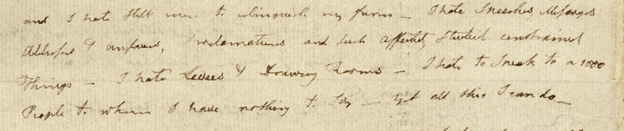
Another reason we tend to view John Adams as unsociable is that the people he liked best aren’t preserved in the pantheon of American political history. Adams cared for two things: his family’s peace and happiness and his country’s peace and happiness. He had, in effect, sacrificed the former for the latter, and thus jealously guarded the latter. Where we see serene and omniscient statesmen, Adams saw self-absorbed, blundering politicians undermining his life’s work. (I think most of us agree that a mistrust of politicians is probably wise. In his line of work, it’s remarkable Adams found so many people he did like.) While serving as Vice President, John wrote home to Abigail: “I hate Speeches, Messages Addresses & answers, Proclamations and such Affected, studied constrained Things— I hate Levees & Drawing Rooms— I hate to Speak to a 1000 People to whom I have nothing to Say.”

Adams’s idea of contentment was sitting at his fireside after a long day’s work on his farm, surrounded by family and lifelong friends, speaking freely. “Formalities and Ceremonies are an abomination in my sight. —I hate them,” a 34-year-old John Adams confided to his diary. He was not to change his mind. Though he did acquire true friends during his political career—Benjamin Rush comes to mind—most of Adams’s nearest and dearest were Quincy farmers, in-laws, and former law students.

Detail of John Adams's diary entry for 30 June 1770
John Adams’s diary entry for 30 June 1770

If John Adams were half the curmudgeon he’s made out to be, I wouldn’t delight in sitting down each day to read his letters. But he’s kind and affectionate, witty and wise, candid, (sometimes exasperating), generous, and supremely lovable. And so, I delight.

The Adams Papers editorial project at the Massachusetts Historical Society gratefully acknowledges the generous support of our sponsors. Major funding is provided by the National Endowment for the Humanities, the National Historical Publications and Records Commission, and the Packard Humanities Institute. The Florence Gould Foundation and a number of private donors also contribute critical support. All Adams Papers volumes are published by Harvard University Press.

“My dear Daughter”: John and the other Abigail Adams

By Gwen Fries, Adams Papers

The first extant letter from John Adams to his daughter was written on 19 Sept. 1774, when Nabby was nine years old. He opened the letter by praising the “Improvement in your hand Writing and in the faculties of the Mind” but quickly transitioned into talking about her brothers, filling the page with advice he wanted Nabby to convey to them.

We don’t have any evidence of how Nabby may have reacted to this snub—if she perceived it as such—but John Adams’s next extant letter provides some clarity. In it, Adams encourages his daughter to be “more attentive than ever to the instructions and examples of your mamma and your aunts. They I know will give you every assistance in forming your heart to goodness and your mind to useful knowledge, as well as to those other accomplishments which are peculiarly necessary and ornamental in your sex.”

Aha. Adams had suggestions of books to fill his sons’ time and of virtues to fill their heads. He was consciously raising lawyers and future statesmen to take over the governance of the nation he was trying to build. But when it came to a quiet nine-year-old girl, he was stumped. What was her future? To become a wife. What advice could he give her? Take after your mother.

He even seemed to have had trouble finding things to correct in her character. “I shall not lay down any rules for your behaviour in life,” he wrote on 2 Dec. 1778, “because I know the steadiness of your mind, your modesty and discretion.” John’s inability to think up advice for his daughter led to some painfully dry letters like this one from 1777 where he described attending a Scots’ Presbyterian Church service. (This may interest scholars of religion. It probably did not interest an eleven-year-old girl.)

Abigail Adams Smith, miniature portrait on porcelain tile by an unidentified artist, [18--]
Abigail Adams 2d, known to her family as “Nabby.”
On the rare occasions he saw an opportunity to correct Nabby, he overcompensated, like in this 26 Sept. 1782 letter in which he overreacts to Nabby asking for a small present. “Taste is to be conquered, like unruly appetites and passions, or the mind is undone,” he wrote. “There are more thorns sown in the path of human life by vanity, than by any other thing.”

His message was taken to heart. In her next letter to him, Nabby wrote, “I assure you my Dear Sir that I have suffered, not a little mortification, whenever I reflected that I have requested a favour of you that your heart and judgment did not readily assent to grant. Twas not that your refusal pained me, but the consciousness that there was an impropriety, in my soliciting whatever you should consider incompattiable to comply with. It has rendered me so througherly dissatisfied with my own oppinion and judgment, that I shall for the future take care to avoid the possibility of erring in a similar manner.”

Even John Adams knew he had overreacted, backpedaling with, “I know your disposition to be thoughtful and serene, and therefore I am not apprehensive of your erring much in this way” and closed the letter by assuring Nabby of his “inexpressible tenderness of heart” for her.

Ironically, it was his daughter, the person he seemed to find it hardest in all the world to advise, to whom he gave the best advice: “To be good, and to do good, is all We have to do.”

The Adams Papers editorial project at the Massachusetts Historical Society gratefully acknowledges the generous support of our sponsors. Major funding is provided by the National Endowment for the Humanities, the National Historical Publications and Records Commission, and the Packard Humanities Institute. The Florence Gould Foundation and a number of private donors also contribute critical support. All Adams Papers volumes are published by Harvard University Press.


Sympathy for the Devil: John Quincy Adams’s Brush with Aaron Burr

By Gwen Fries, Adams Papers

It was an open secret that the Adamses were no fans of Alexander Hamilton. Senator John Quincy Adams couldn’t even be prevailed upon to wear crape, join in a funeral procession, or “join in any outward demonstration of regret” after Hamilton’s untimely death. When chastised by his wife, JQA responded that he “had no respect” for the fallen statesman.

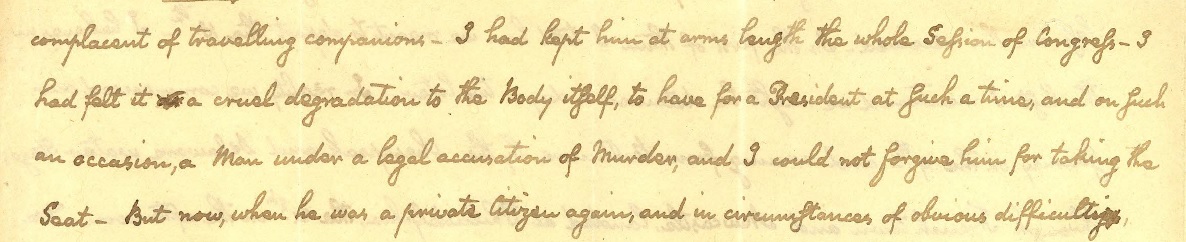
Nor did he much respect the man who had stood opposite Hamilton in the early hours of 11 July 1804, and his respect for Burr only plummeted further when Burr dared to return to his station as President of the Senate. Adams admitted he had kept Burr “at arms length the whole Session of Congress,” feeling it “a cruel degradation to the Body itself, to have for a President at such a time, and on such an occasion, a Man under a legal accusation of Murder.” Adams “could not forgive him for taking the Seat.”

Detail of letter from John Quincy Adams to Thomas Boylston Adams
 John Quincy Adams to Thomas Boylston Adams, 1 April 1805 (Adams Papers)

When the second session of the Eighth Congress came to a close on 3 March 1805, Burr gave a farewell address—“the last act of his political life,” as Adams thought—and John Quincy left the Senate Chamber for home, convinced he had seen the last of Burr.

On 19 March, John Quincy and Louisa Catherine boarded a ship in Baltimore, sweating in the unseasonably warm weather, two sick and fitful toddlers in their arms, ready to get the trip over with and reach their next destination of Philadelphia. (When they later arrived in Philadelphia, the Adamses’ old friend Dr. Benjamin Rush diagnosed the boys with chicken pox and whooping cough.) An overwhelmed Louisa Catherine recorded in her diary that “the Children were both quite unwell and of course very troublesome It was the first time that I had the entire charge of them.”

One can imagine the sinking of already low spirits when the Adamses got on board and were greeted by Aaron Burr. Having been much affected by Hamilton’s demise, Louisa confided to her diary that she “felt a sort of loathing for this Col Burr.”

Within a few hours, Louisa—and everyone else on board—had fallen under his spell. “He appeared to fascinate every one in the Boat down to the lowest Sailor and knew every bodies history by the time we left— He was politely attentive to me . . . At Table he assisted me to help the Children with so much ease and good nature that I was perfectly confounded.”

Detail of letter from John Quincy Adams to Thomas Boylston Adams
John Quincy Adams to Thomas Boylston Adams, 1 April 1805 (Adams Papers)

When relaying the event to his brother, John Quincy wrote, “Whether the original seducer of mankind, has embodied himself in the person of the little ex-vice, I am not competent to pronounce— This I will say; that I defy Man, Woman or Child, so to withstand the powers of his fascination, as to part from him after such a transitory association, without feelings of good-will towards him.”

After a particularly rough passage—so rough, in fact, that at one point Louisa rolled out of her high berth and onto the floor—the Pennsylvania soil was a sweet sight to the passengers. Taking pity on the sleep-deprived parents of fussy young children, Burr swooped in, taking little John Adams II in one arm, taking Louisa’s luggage in the other hand, and offering her his arm to disembark. John Quincy followed behind them, George Washington Adams in his arms, his jaw on the gangplank.

“It was all done with so little parade and with such entire good breeding that it made you forget that he was doing any thing out of the way,” Louisa recalled. “He talked and laughed all the way and we were quite intimate by the time we got to Philadelphia where he called to see us, and this the first and last occasion on which I ever saw this celebrated man.”

After two weeks’ rumination, John Quincy summed up the experience by writing, “I had not strength of mind enough to retain in their full inflexibility the resentments even of Virtue— I felt a degree of compassion for the Man, which was almost ready to turn to Respect— He was more than barely civil to me and my family— I could not help feeling for him in return more kindness, than I was willing to acknowledge to myself—infinitely more than I suffered myself to shew him; and perhaps more than is justly consistent with that character which on a cool and distant estimate I cannot help believing to be his.”

The Adams Papers editorial project at the Massachusetts Historical Society gratefully acknowledges the generous support of our sponsors. Major funding is provided by the National Endowment for the Humanities, the National Historical Publications and Records Commission, the Packard Humanities Institute, and the Amelia Peabody Charitable Fund. All Adams Papers volumes are published by Harvard University Press.

The Day the Vice President Showed His Strength

by Rhonda Barlow, Adams Papers Research Associate

John Adams famously described the vice presidency as “the most insignificant Office” ever devised. Less well known is why he said this or that there came a day when he revealed that the office actually mattered a great deal.

As vice president, Adams spent his days in the Senate, sitting in a chair, reading the proposed legislation, and listening to the senators’ debate. It was tiresome, boring work for a man of thought and action. “This Confinement will injure my health,” he wrote to his eldest son, John Quincy, in April 1790. After France became a republic and declared war on Great Britain, Americans, caught in the cross-fire, disagreed over the Washington administration’s official policy of neutrality. Writing to Abigail Adams on 19 Dec. 1793, John explained his role in foreign affairs as vice president:

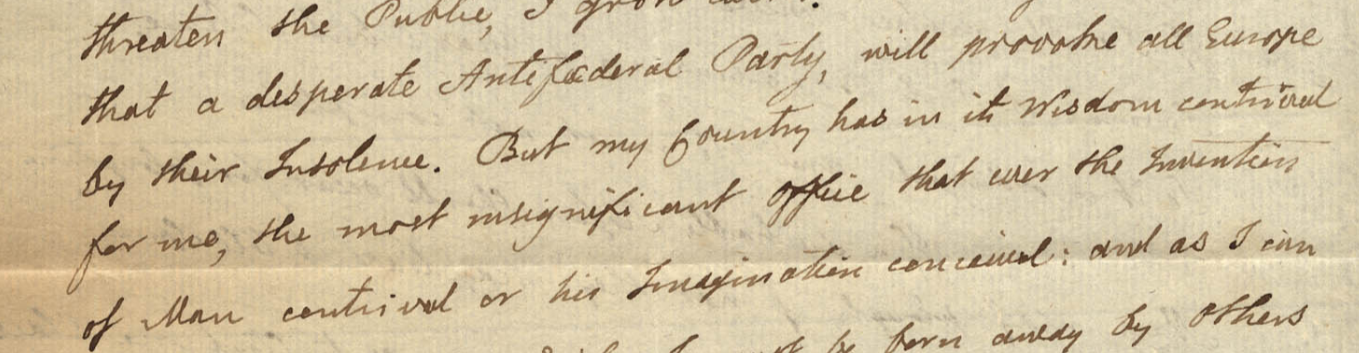
“I am very apprehensive that a desperate Antifœderal Party, will provoke all Europe by their Insolence. But my Country has in its Wisdom contrived for me, the most insignificant Office that ever the Invention of Man contrived or his Imagination conceived: and as I can do neither good nor Evil, I must be born away by Others and meet the common Fate.”

John Adams letter
John Adams letter to Abigail Adams, 19 December 1793

During his tenure as the first U.S. minister to the Court of St. James’s in the mid-1780s, Adams tried to negotiate a commercial treaty with Great Britain. But the former mother country, able to trade freely with the disunited States, had no need for a formal agreement. By early 1794, John Jay was about to undertake a special mission to finally negotiate a treaty with Britain, but Democratic-Republicans in Congress were still pushing anti-British legislation to restrict trade. John confided to Abigail on 3 April 1794, “The Times are so critical and Parties so nearly ballanced that I cannot in honour, nor consistently with my Duty abandon my Post. There are so many wild Projects and Motions and so many to support them, that I am become of more importance than Usual.” Twelve days later, he wrote, “The Senate will now be called upon to show their Independence, and perhaps your Friend to shew his Weakness or his Strength.”

John Adams letter
John Adams letter to Abigail Adams, 15 April 1794

A bill to prohibit British imports passed the House of Representatives by a vote of 59 to 34. In the Senate, the vote was as close as could be: 13 for and 13 against. It was up to the vice president to break the tie. On 28 April, John Adams blocked the bill, and cleared the way for Jay to sail to England and into history, successfully negotiating the 1794 Treaty of Amity, Commerce, and Navigation, commonly known as the Jay Treaty.

On 24 June 1795, John Adams once again sat in his chair in the Senate, and recorded the votes as the senators gave their advice and consent to the Jay Treaty by the required two-thirds majority. This new treaty not only improved relations with Great Britain, but demonstrated American independence from France. You can read more the Jay Treaty and about the ways John Adams shaped the vice presidency in the Adams Papers editorial project’s forthcoming volume 21 of The Papers of John Adams.

The Adams Papers editorial project at the Massachusetts Historical Society gratefully acknowledges the generous support of our sponsors. Major funding is provided by the National Endowment for the Humanities, the National Historical Publications and Records Commission, the Packard Humanities Institute, and the Amelia Peabody Charitable Fund. All Adams Papers volumes are published by Harvard University Press.

Marian “Clover” Hooper Adams, Dog Portraitist?

By Heather Rockwood, Communications Associate

Known to her friends and family as “Clover,” Marian Hooper Adams was born in Boston, 13 September 1843, to Robert W. Hooper, an eye doctor, and Ellen (Sturgis) Hooper, a poet and a Transcendentalist. Clover and her two older siblings were raised by her father after Ellen died of tuberculosis when Clover was only five.

Clover married historian and writer Henry Adams, great-grandson of President John Adams, in 1872. They moved to Washington in 1877, where Clover was known for her wit and celebrated salon. She took up photography in 1883 and her work as a portraitist and landscape photographer was admired within her social circle. Although asked to publish some of her photographs, she declined.

After seeing Clover’s amusing portrait of her dogs Possum, Marquis and Boojum in “Three Dogs at Tea in Garden” recently, I wondered if she had an affinity for taking photographs of dogs. And the answer is yes!

Three dogs seated on chairs at a table set for tea
The photograph that inspired this blog post: Three dogs at tea in garden, by Marian Hooper Adams, 1883-1884. This photograph features Possum, Marquis and Boojum.

Although her main subjects were mainly landscapes or portraits of her friends and family in various settings, dogs made it into these portraits ten times out of the one hundred and thirty seven photographs held in the MHS collection. In her two and a half year career as a photographer from 1883-1885, seven percent of her photographs contain dogs!

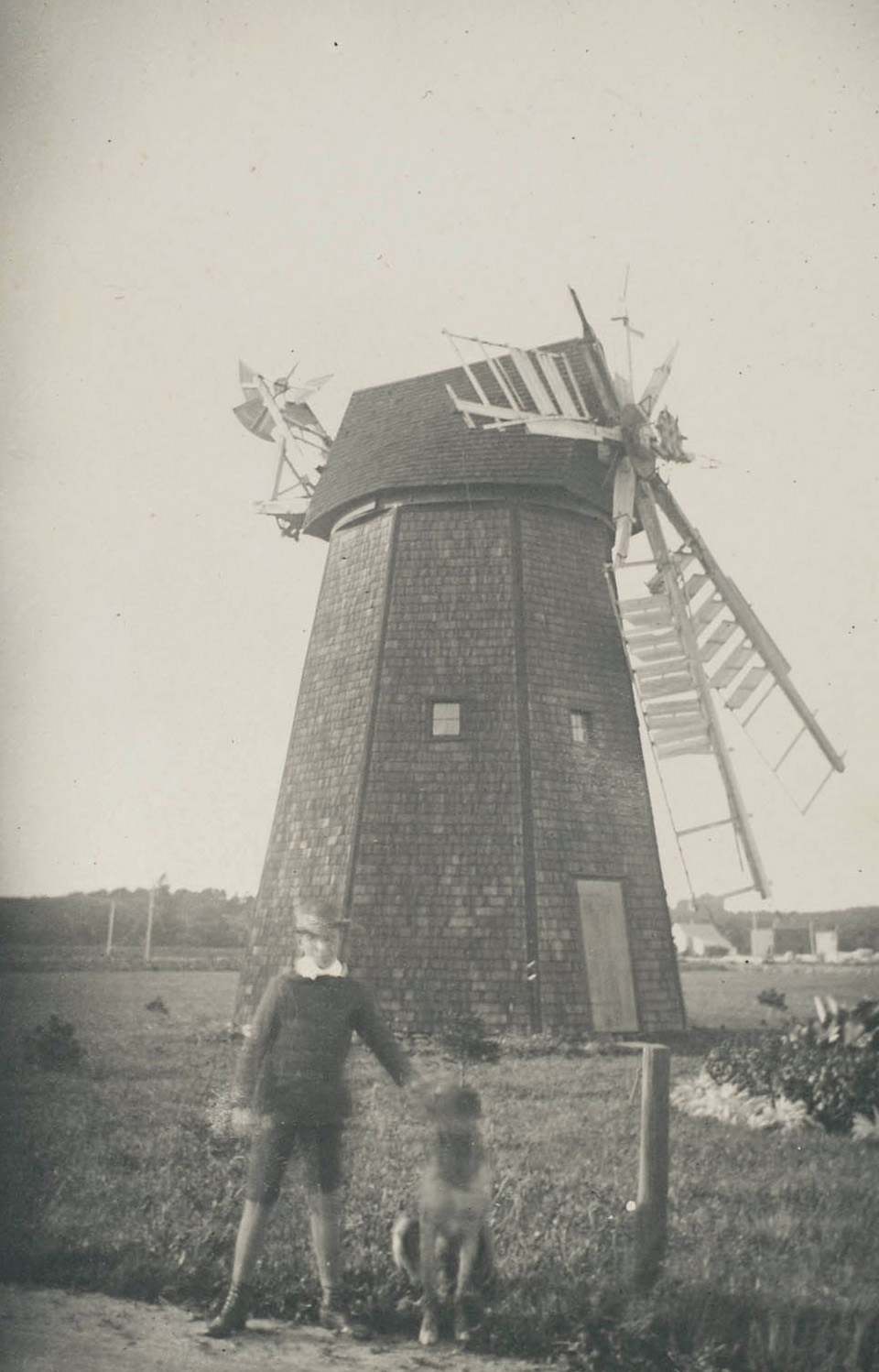
Her favorite dog to include in her portraits was Marquis, who appears in five of the ten portraits, although Boojum with three and Possum with two portraits are close runners up. What I find most fascinating about Clover’s dog portraits is their clarity. Portraiture in the 1880’s was becoming easier for the subject, as exposure, or sitting, time was down from minutes to seconds. But it could still have been up to 64 seconds depending on the time of day, year, and lens used on the camera. These long exposure times lead photographers to ask their subjects to sit very still or they must choose to take pictures while their subjects naturally repose, or rest. After viewing many of Clover’s portraits, it is clear she preferred mainly the latter and you can see why in this image of a young boy and dog in front of a windmill.

Photo of windmill with boy and dog
Windmill, boy and dog in foreground, at Falmouth, by Marian Hooper Adams, circa 1885

A blurred image shows the movement of the subject during the exposure time while a photograph was taken. And in this image where Clover took a photograph while Brooks Adams, her brother in law, was caring for a horse shows some very specific blurring.

Photo of a man, dog, and horse
Brooks Adams with horse and dog, by Marian Hooper Adams, 1883

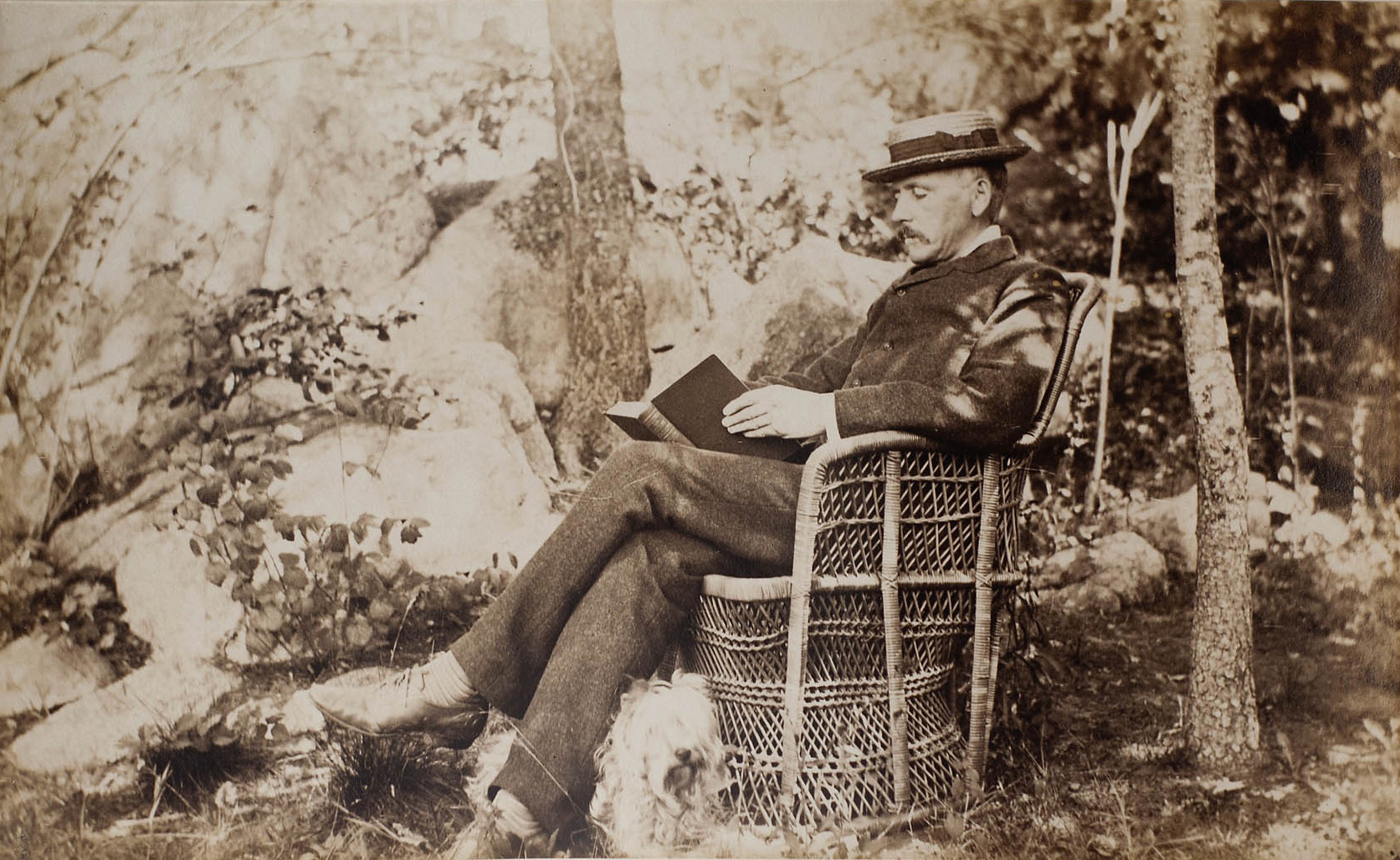
You can see that the dogs would need to be specially trained to stay still for up to 64 seconds, which Clover may have achieved. Or the dogs may be used to being in repose with their human companions. I especially enjoy the images that look as if Clover captured a moment between the human and dog where they are relaxing with each other.

Photo of a seated man with a dog
James Lowndes at Beverly Farms, seated outdoors in wicker chair, reading book, with dog at feet, by Marian Hooper Adams, 1883

This portrait features Boojum at the feet of James Lowndes, a friend of the Clover and Henry Adams.

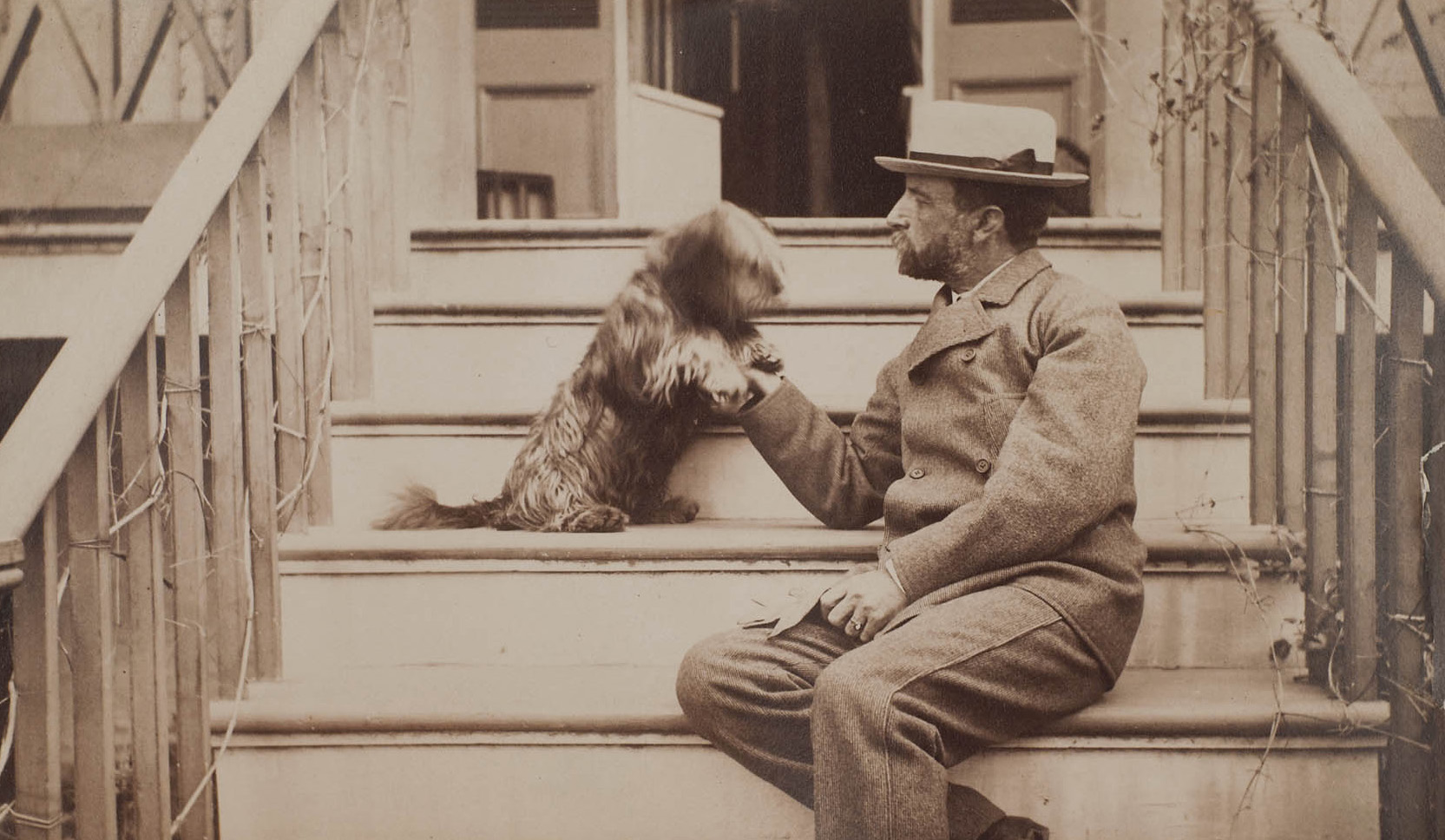
Photo of a man seated on steps with a dog
Henry Adams seated with dog on steps of piazza, by Marian Hooper Adams, 1883

Marquis playing with Henry Adams, Clover’s husband.

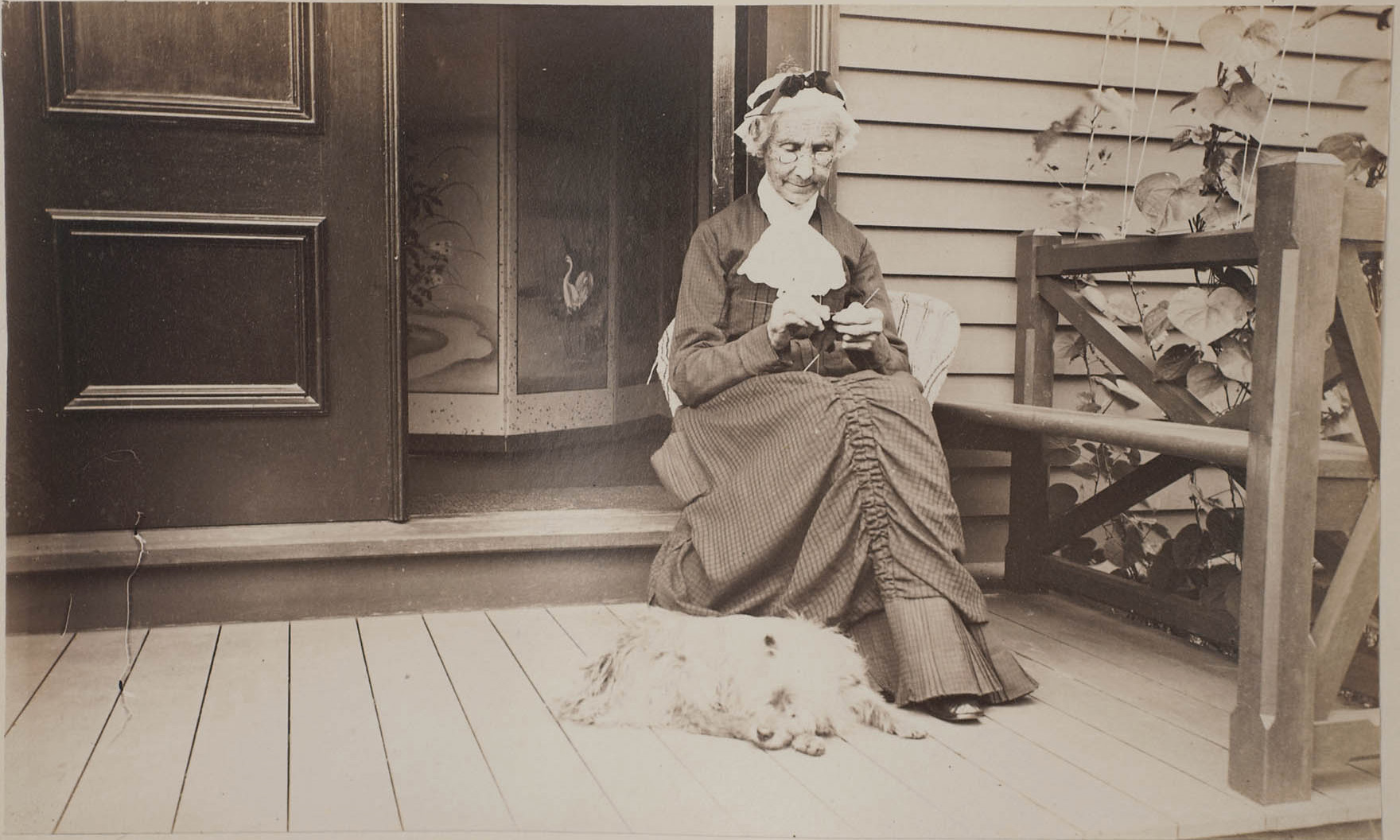
Photo of a woman seated next to a dog
Betsy Wilder seated on piazza, with dog at her feet, by Marian Hooper Adams, 1883

Dandy can be seen here relaxing while Betsy Wilder, beloved housekeeper from Clover’s youth, knits on a porch.

In the images which appear more staged, rather than at rest, you can see that the dogs are upright and either looking at the camera, or looking at their human companion.

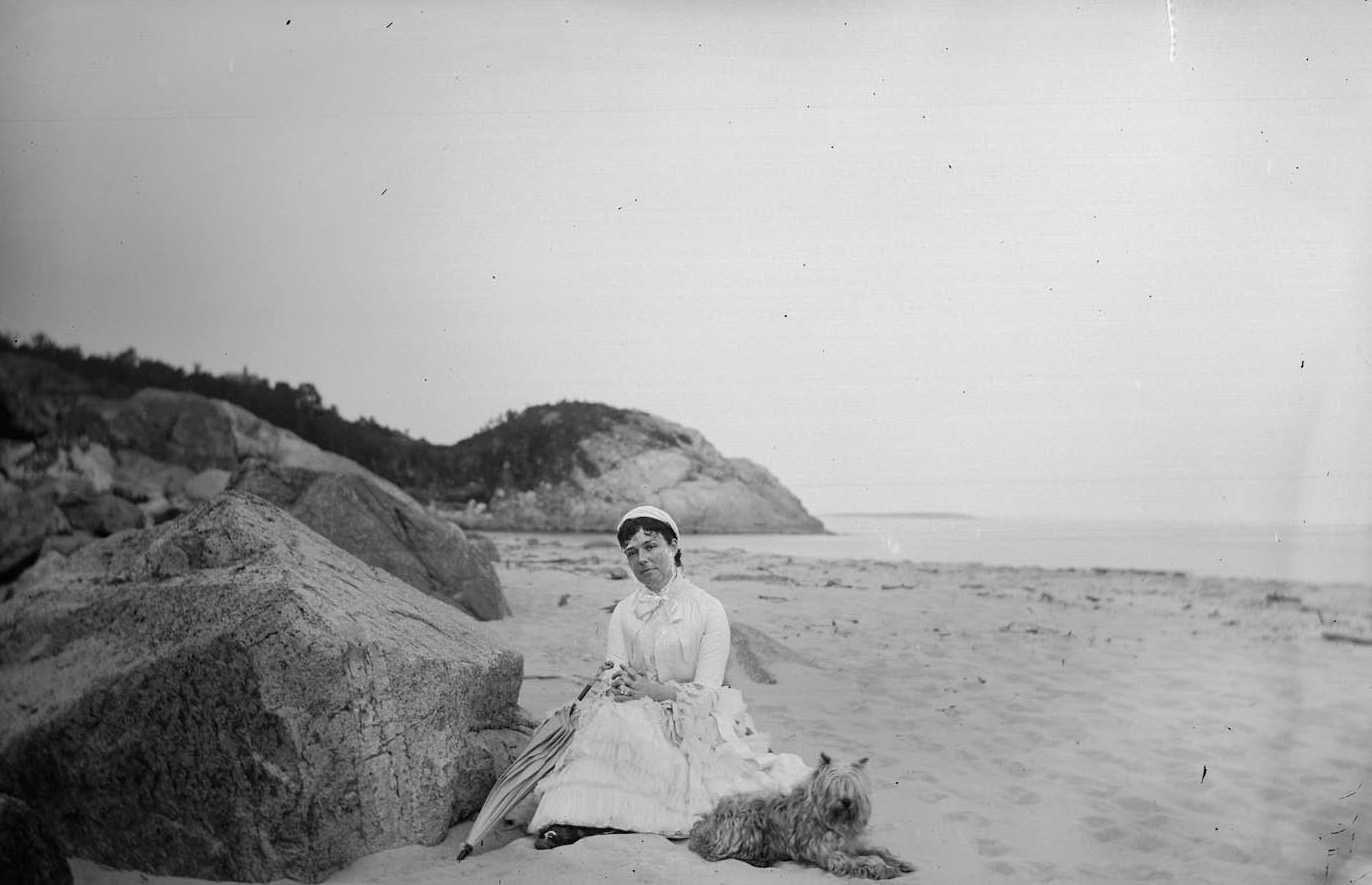
Photo of a woman seated at the beach with a dog
Mrs. Jim Scott and dog seated by rock at east end of Singing Beach, Manchester, glass plate negative by Marian Hooper Adams, 1883

This image is from a glass plate negative, displayed in positive as the printed portrait is much more difficult to see. The subject of this portrait, Boojum, is seen quite clearly at the feet of Mrs. Jim Scott, a neighbor who came along for a day at the beach.

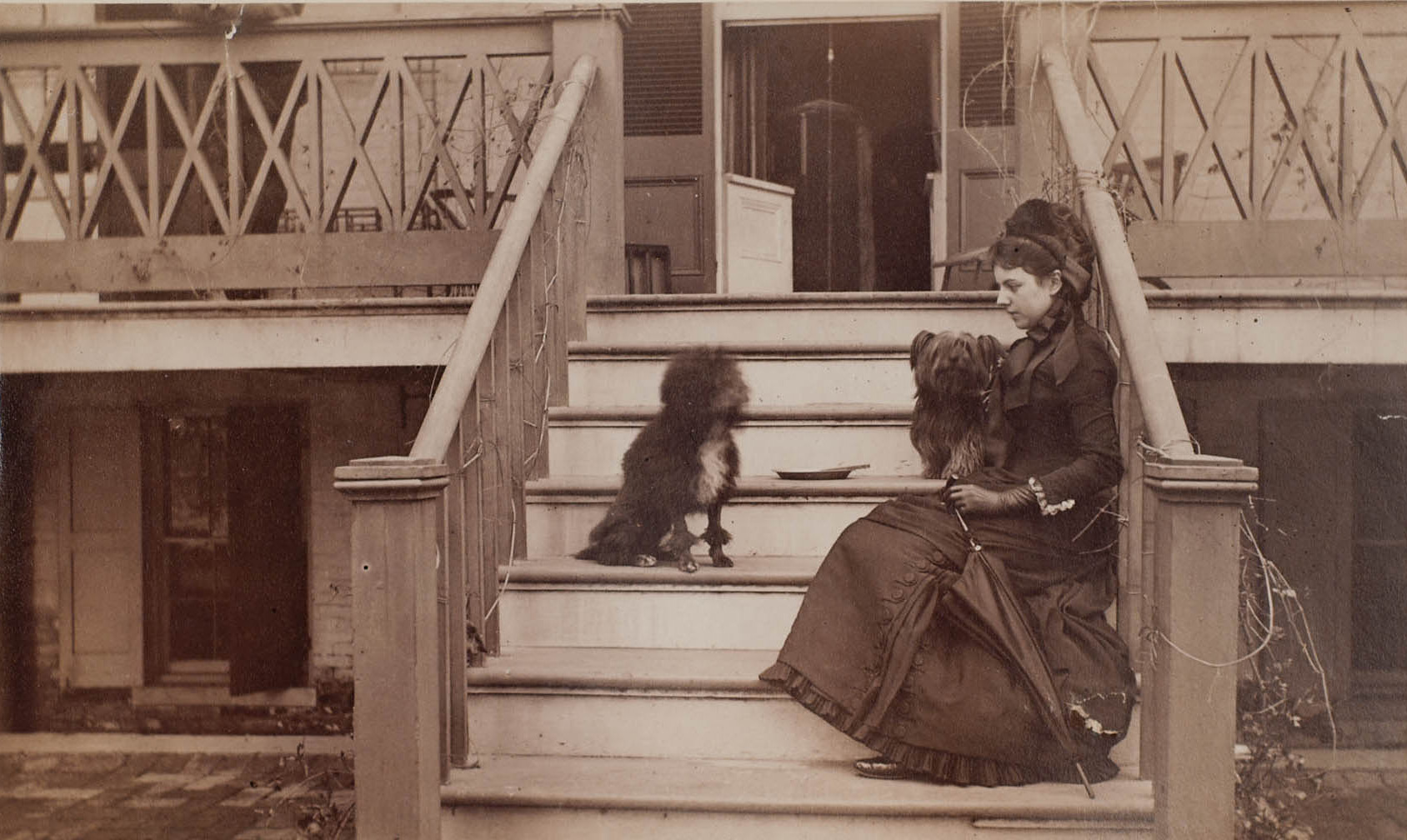
Photo of woman seated on steps with two dogs
Miss Langdon seated with two dogs on steps of piazza, by Marian Hooper Adams, 1883

Toto and Marquis are seen here comforting Miss Langdon, who is in mourning attire for her recently deceased grandmother, on the same porch steps which we saw Marquis playing with Henry.

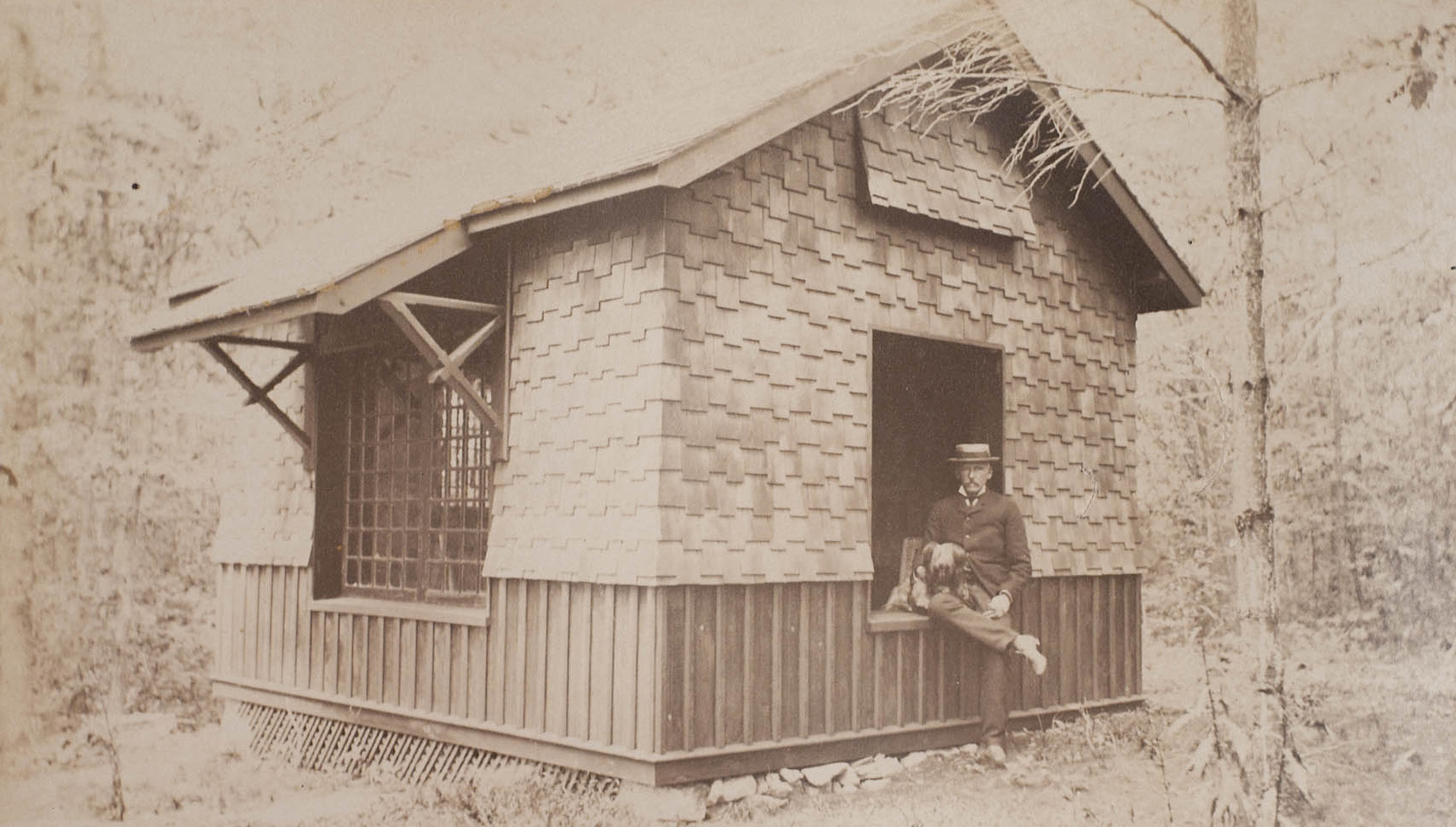
Photo of a man and dog in the window of a playhouse
James Lowndes and dog in window of playhouse, by Marian Hooper Adams, 1883

Marquis is seen here relaxing, perhaps after a brisk walk, with James Lowndes. This may have been on the same day as the other image with James Lowndes.

Natalie Dykstra writes in her biography Clover Adams: A Gilded and Heartbreaking Life, “If Clover could be playful and mocking in her pictures, as with her “dogs at tea” photograph, a send-up of social convention she occasionally found tedious, she could also evoke sadness or an intense feeling of loss.”  I do feel that although the subject of dogs can be whimsical, especially for photography in the 1880’s, that their human companions mostly evoke sadness.

Photo of two dogs seated at a table set for tea
Two dogs at tea in garden, by Marian Hooper Adams, 1883

The second and last in Clover’s “dogs at tea” series features Marquis and Possum. This one has a more natural setting and no white backdrop giving the image a feeling that the viewer happened upon this tea party that was already occurring.

To read more about Marion “Clover” Hooper Adams and her photography visit the MHS online Collection Guide, see the MHS Selected Letters and Photographs, or read The Beehive blog post about those pages and the biography by Natalie Dykstra.


Further Reading:

Letters Shed New Light on Henry Adams | Beehive (masshist.org)

Clover Adams’ Memorial: From a Husband Who Would No Longer Speak Her Name – Atlas Obscura

“My sense of duty leads me to support the administration”: John Quincy Adams as Senator and Professor, 1801–1809

By Neal Millikan, Series Editor for Digital Editions, The Adams Papers

Transcriptions of more than 500 pages of John Quincy Adams’s diary have just been added to the John Quincy Adams Digital Diary, a born-digital edition of the Adams Papers editorial project at the Massachusetts Historical Society. The new material spans the period September 1801 through July 1809 and chronicles Adams’s experiences as a senator in Washington, D.C., and a professor at Harvard.

John Quincy Adams was selected to be a member of the U.S. Senate in February 1803, elected to the position by a Massachusetts legislature controlled by the Federalist Party. Taking his seat in October, Adams charted an independent political course, voting on issues as he believed they related to the national good and not simply to Federalist interests. This was most obvious when he voted for the embargo in December 1807, which sought to punish France and Great Britain for their punitive trade restrictions by prohibiting U.S. vessels from trading with European nations.

By supporting the embargo, Adams in effect voted against the Federalist Party, whose New England contingent relied heavily on merchant shipping for their economic livelihood. He was also supporting the policy of President Thomas Jefferson, his father John Adams’s political adversary. Jefferson, who had defeated the senior Adams in the presidential election of 1800, was the leader of the opposition party, the Democratic-Republicans. After the embargo vote, John Quincy recorded his reasoning in his diary: “On most of the great national questions now under discussion, my sense of duty leads me to support the administration, and I find myself of course in opposition to the federalists in general.” He went on, however, to clarify that he had “no Communication with the President other than that in the regular order of business in Senate.” Indeed, Adams recognized that owing to his personal stances on the main issues of the day, “my political prospects are declining.”

As his political career floundered during this period, his personal finances also received a setback due to the 1803 failure of London bankers Bird, Savage, and Bird. While this failure negatively impacted John Quincy’s savings, he was more worried about his parents, John and Abigail Adams, for whom he had heavily invested with Bird, Savage, and Bird, the funds planned for their retirement. To help protect his mother and father from financial ruin, John Quincy sold his personal property and practiced extreme personal economy. He moved his family out of their Boston home and back in to the small house in Quincy, Massachusetts, where he had been born. He recounted these actions in his diary, noting that while “I have practiced all the economy I thought practicable” he found to have “needed still more.”

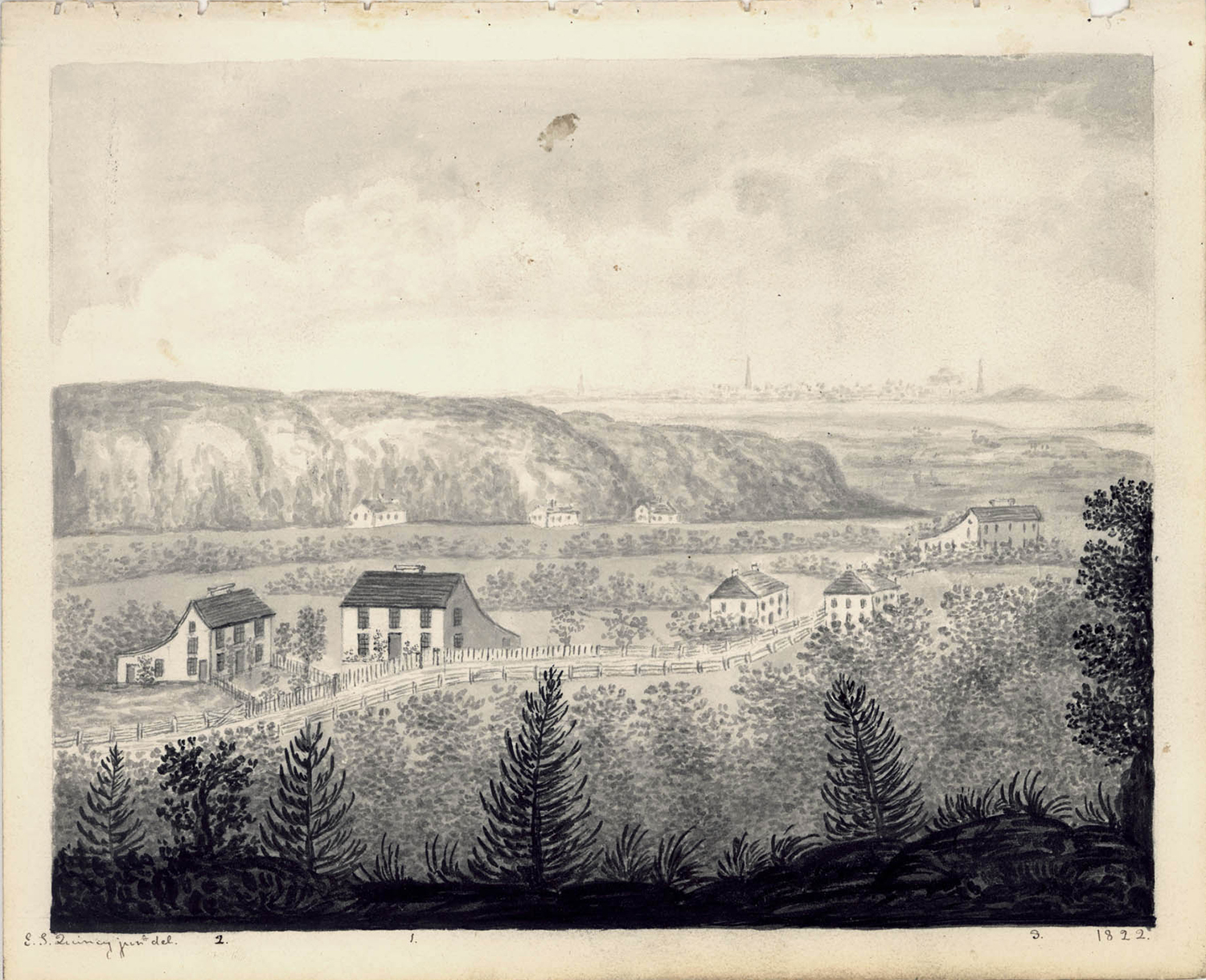
Drawing of John Adams and John Quincy Adams birthplaces by Eliza Susan Quincy
Birthplaces of John Adams and John Quincy Adams, watercolor drawing by Eliza Susan Quincy, 1822

There were, however, some bright spots for John Quincy Adams during these years. He and his wife, Louisa Catherine Adams, and eldest son, George Washington Adams, welcomed two additional children into their family: John Adams was born on 4 July 1803 and Charles Francis Adams on 18 August 1807. He also enjoyed his tenure as the Boylston Professor of Rhetoric and Oratory, a position to which he was elected by the Corporation of Harvard University on 24 June 1805. He spent significant time researching and writing thirty-six lectures, delivering the first one on his thirty-ninth birthday, 11 July 1806. After that lecture, he proudly recorded in his diary that it “was well received, and could I hope that the issue of the whole course would but bear a proportion to the effect of this introduction, I should be fully satisfied.” The lectures were published in 1810.

For more on his life in this period, read the headnote, or, navigate to the entries to begin reading his diary. With this release, transcriptions of forty years of John Quincy Adams’s diary, from 1789 to 1829, are now freely available on the MHS website. In addition, the side-by-side viewer tool allows users to access images of the over 5,700 diary manuscript pages that accompany these transcriptions.

The Adams Papers editorial project at the Massachusetts Historical Society gratefully acknowledges the generous support of our sponsors. Major funding for the John Quincy Adams Digital Diary was provided by the Amelia Peabody Charitable Fund, with additional contributions by Harvard University Press and a number of private donors. The Andrew W. Mellon Foundation in partnership with the National Historical Publications and Records Commission also support the project through funding for the Society’s Primary Source Cooperative.

Daily History: Transcribing JQA’s Diary

By Alyssa Machajewski, Adams Papers Intern

John Adams once suggested to his son, an 11-year-old John Quincy Adams, that he start a journal to record the events of his life. Displaying a level of discipline that must surely be genetic, John Quincy followed his father’s advice consistently for over 68 years. He kept multiple diaries, including a line-a-day version that consists of a single-line summary of each day.

Because of his busy schedule, John Quincy Adams would record this brief summary and then later write out the long-form entry using the line-a-day as reference. I can sympathize with how difficult it would be to keep up with, as I took up bullet journaling only last year (which has a similar organizational idea as JQA’s diary) and I find it exhausting.

Part of my internship experience with the Adams Papers editorial project is to help transcribe some of the 15,000+ pages of JQA’s diary. Luckily, JQA has exceptionally neat handwriting (as long as you can read cursive) and the work is really more like a puzzle that needs solving.

When I first started transcribing the diary, this puzzle was my main interest. I never expected to have anything in common with the journal content or the man behind it. I knew John Quincy Adams as a career politician, the son of a Founding Father, and a president. Surely, his daily life looked nothing like mine, but then I reached about halfway down the line-a-day diary entries for January 1795.

JQA diary
John Quincy Adams diary detail, January 1795

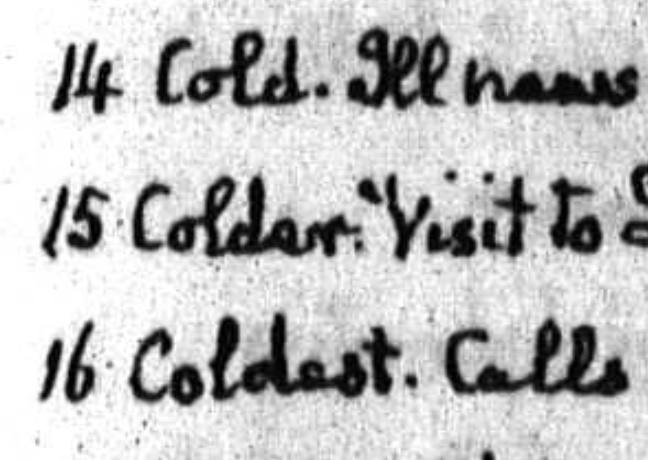
And I laughed; 227 years after writing it, John Quincy Adams made someone laugh. I transcribed this passage in February 2021, just as I and the rest of my home state of Texas were experiencing the coldest winter in living memory. That serendipity changed how I saw the person behind the lines of cursive. JQA became more than a distant historical figure. He was more human somehow—someone who complained about the cold.

We have our obvious differences. I am a recent college graduate and, at the time, he was the U.S. minister to the Netherlands. He lived through an invasion by the French, while I’m living through a global pandemic. However, there were parts of his life that were not difficult at all to relate to. JQA goes on walks (2 March 1795). He sometimes struggles with “Laborious and unsuccessful writing” otherwise known as writer’s block.

JQA diary
John Quincy Adams diary detail

He gets anxious when people don’t answer his letters. And, every two months or so, he buys books (I’m jealous of this frequency!) and will sometimes make a note of what he’s finished reading: “Read the private life of the Marechal de Richelieu; and Voltaire” (22 April 1795). Although we have vastly different bookshelves, I love that buying books is still worthy of a diary entry. “Attended the sale of books the whole day, purchased a considerable number. Walk in the Evening alone. Music at home.” I wonder if he’s ever slightly embarrassed that he has gone and bought more books when he knows perfectly well he has a stack of unread ones at home. Still, I can’t help but imagine him grinning as he walks down the streets of The Hague with his armful of books. It is exactly what I would do.

In the six-month span that I have transcribed so far, I can see the skills that led him to be known as a diplomatic president. He negotiated for the release of an acquaintance and French prisoner of war (14 July 1795). He also “disallowed” (i.e. kicked out) French soldiers from his house when they tried to forcibly quarter there (11 March 1795). It is the sort of thing the U.S. Constitution frowns upon and I would like to have been present for that conversation. His diary recorded the following:

The municipality this morning sent a couple of french soldiers to quarter in the house of Mr: Jehu where I am lodged. They have tried the experiment three or four times; and as often the french Commandant of the City upon my application has ordered them to allow the exemption to which the usage of Nations entitles me.

And of course he also noted important historical events, such as on 17 May 1795: “Weather beautiful. Morning and evening walks . . . The Treaty with France signed at 2. AM.”

Working through the diary now feels less like a puzzle and more like a story and a life unfolding. How lucky that we get the chance to see it. To start your own search, visit the John Quincy Adams Digital Diary!

Stories to Cheer our Spirits: Horses in the Adams Papers

By Kenna Hohmann, Adams Papers Intern

Diving into the vast collections of documents in the Adams Papers has been one of the best parts of my internship at the MHS. Over the past few months, I have endeavored to identify quotations and stories that allow for a greater understanding of and connection to the historical figures from our nation’s past. My research yielded both lighthearted moments—the Adamses’s comments on the seasons—and serious reflection—the family’s thoughts on education. A few had another theme in common— horses—a subject that because of person interest sparked my curiosity and prompted a deeper dive into the documents.

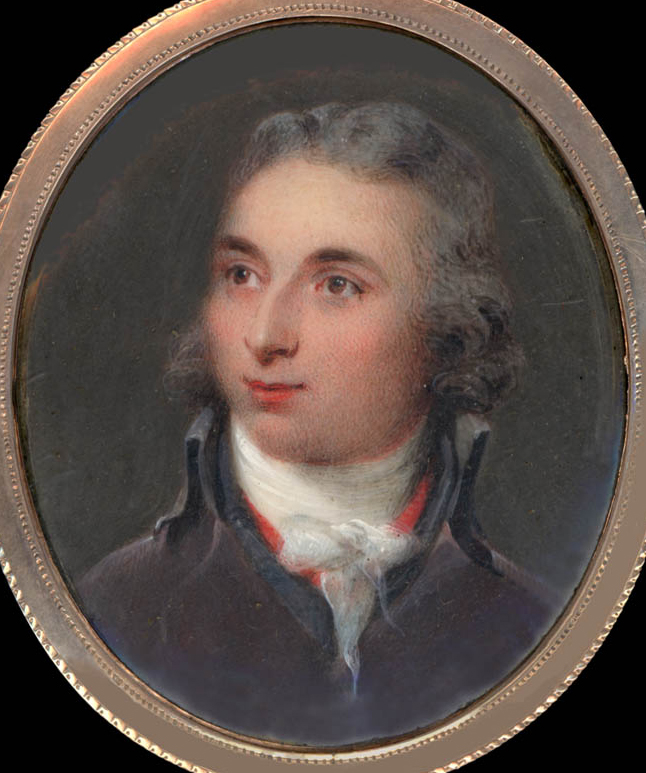
miniature portrait of Thomas Boylston Adams
Thomas Boylston Adams by Mr. Parker, 1795

The first story I found reflects the hardship that sometimes goes along with riding long distances. In the spring of 1794 Thomas Boylston Adams (1772–1832), the youngest son of John and Abigail Adams, spent five weeks traveling through Pennsylvania. Thomas Boylston was 21-years old at the time and trying his best to establish his legal career, in part by taking “a journey into the interior parts of this State upon a Circuit with the Supreme Court.” Writing to his mother in June, Thomas Boylston provided a detailed description of the country he traveled t, commenting to Abigail “The exercise of riding on Horseback so long a Journey was rather more severe than I have been accustomed to, but tho’ it took away some of my flesh, it contributed much to my health.” Thomas Boylston experienced the physical pain caused by long periods of riding but also the benefits of the trip to his health and wellbeing. As someone who has also ridden horses over long distances, I can appreciate how the soreness of riding could be overlooked due to the joy that comes from being in nature. Thomas Boylston Adams was entering a new period of his life. That excitement, along with the beautiful Pennsylvania spring and a good horse and long ride, was enough to lift his spirits.

In a twist on the theme, the second story I found came from John Adams in a February 1795 letter to Abigail Adams. Then vice president, John Adams had been in Philadelphia since the previous November, while Abigail remained in Quincy. John, along with most Americans, was eagerly awaiting the arrival of the Jay Treaty from Britain, although the vice president also feared the treaty might delay his return home. “Oh my Hobby Horse—and my little Horse! I want you both for my Health And Oh my I want you much more, for the delight of my heart and the cheering of my spirits—” John frequently referred to his farm as his “Hobby Horse” and when he wanted a break from the stress of politics he turned his thoughts toward home to lift his spirits. In this selection, his love for Abigail Adams and her importance to him is on full display.

John Adams to Abigail Adams, 1 Feb, 1795
Detail of letter from John Adams to Abigail Adams, 1 February 1795, Adams Papers

My personal interest in horses and subsequent search for related content yielded these two different but interesting anecdotes. The sweet words between John and Abigail Adams and the humorous yet earnest letter that Thomas Boylston Adams sent to his mother would not have come to my attention without my original interest in the theme of horses. Spending time with the expansive collection of the Adams Papers has been a highlight of my internship, and I would recommend that everyone take a bit of time to read a few letters! To get started, visit the Adams Papers Digital Edition.

Party Men and Congressional Pugilists: The Rise of Party Conflict during the Adams Administration

By Lauren Howard, Adams Papers Intern

“The Accounts We have of the Uneasy State of the Minds of our Countrymen: their innumerable Projects, and fluctuating Politicks are perhaps more distressing to Us, than they are to you who are on the spot… For my own Part I am too old and feeble, to fight— They must put me to death for my neutrality: for I will not be a Party Man.”

John Adams to Richard Cranch, 20 July 1787

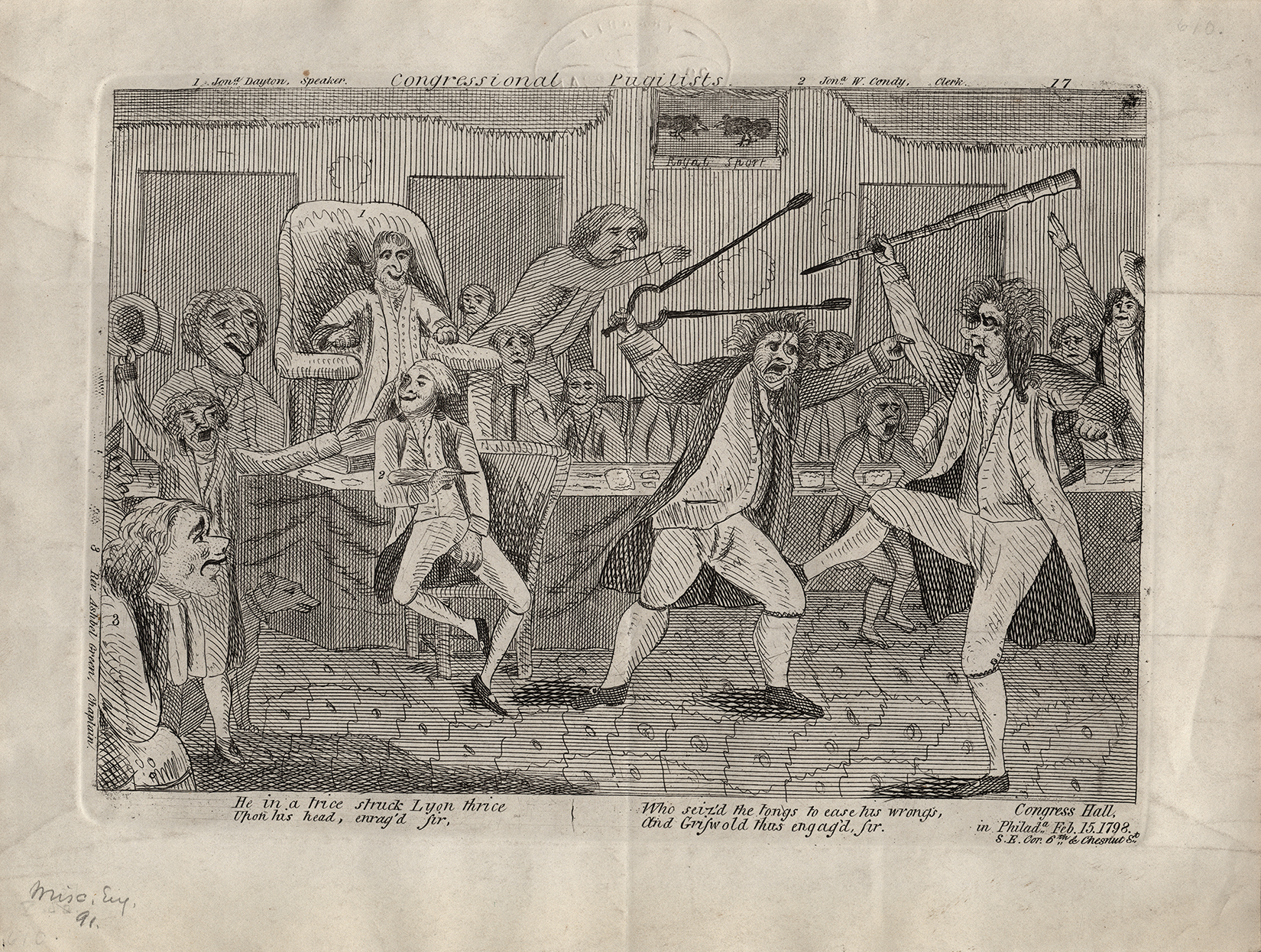
Cartoon drawing titled "Congressional Pugilists"
“Congressional Pugilists,” political cartoon of Matthew Lyon fighting with a federalist opponent on the floor of Congress early in 1798

Despite his disdain for party politics, John Adams’s administration began with the country already divided along party and regional lines. He narrowly won the presidency by three electoral votes, although he entered office with a distinct advantage—a Federalist majority in Congress. This majority allowed a bill to be introduced and quickly signed into law. For example, the Nonintercourse Act of 1799 was introduced in the Senate on 1 March 1799 and signed two days later; “An Act to Lay Additional Duties on Certain Articles Imported” was introduced in the House of Representatives on 8 May 1800, passed and transmitted to the Senate later that day, and signed by Adams on the 13th. Despite this Federalist majority, congressional records reveal that it was also a period of increasing partisan polarization and conflict. During my internship with the Adams Papers editorial project, I used the Adams Papers Digital Edition, Annals of Congress, and the House and Senate Journals to construct a legislative calendar of the important bills passed during the Adams administration. Bill by bill, my research revealed the gradual entrenchment of party divisions. “Rivalries have been irritated to madness,” Adams wrote to Abigail Adams in February 1799, and this madness even erupted in a physical altercation in the House.

One line from a letter by John Adams to Abigail Adams
Detail of letter from John Adams to Abigail Adams in February 1799

A prime instigator of this increased factionalism was the breakdown of diplomatic relations with France. In December 1797, Abigail Adams correctly foretold, “Should we be forced into a war, which God forbid, parties would again assume a face of violence.” After initially urging diplomatic restraint and voicing a dedication to “keep the Peace with their high Mightinesses at paris,” Adams called on Congress to create a navy to protect the coast and commerce of the United States. In the wake of the XYZ Affair, the  nation was consumed by war hysteria but found itself split over the French issue. Democratic-Republicans called for a de-escalation of tensions and a halt to war preparations, while Federalists passed numerous bills to prepare the country to fight. “An Act to Provide for an Additional Armament for the Further Protection of the Trade of the United States” and “An Act for the Establishment of the Department of the Navy” passed in the Senate by large majorities and little effectual resistance from Democratic-Republicans.

Members of the House also voted along party lines on related issues. The Sedition Act passed on 10 July 1798 by a vote of 44 to 41, with 21 abstentions. All of the yes votes came from Federalists, although three crossed party lines to oppose the bill. Later, the Sedition Act was used exclusively to arrest and imprison Democratic-Republicans.

The ongoing conflict with France reinforced the party lines drawn several years earlier with Washington’s Proclamation of Neutrality. As factionalism divided Congress, partisan conflict evolved beyond balloting and policymaking. On 15 February 1798, a brawl—complete with a walking stick and fireplace tongs—broke out on the House floor. On 30 January 1798 Federalist Roger Griswold insulted Matthew Lyon’s valor during the American Revolution, after Lyon declared himself a champion of the common man and accused Griswold of corruption. Lyon, a Democratic-Republican from Vermont, spat at Griswold and was charged with gross indecency by House Federalists. However, as an outraged Abigail Adams wrote, “Instead of considering what was due to the Honour of the House, as Legislatures and as gentlemen, they have sufferd narrow party views to operate.” With Federalists unable to secure enough votes to remove Lyon, Griswold took matters into his own hands and beat Lyon with his cane; Lyon defended himself with fireplace tongs. The men later apologized and retained their seats, but the incident provides valuable insight into party conflict during the Adams presidency. The fight was instigated by disagreements over Adams’s militaristic approach to Franco-American relations and debates over which party better served American interests. According to Abigail Adams, the affair also “created more warmth, more wrath more ill will, than the most momentous questions of National concern.” Thus, while Adams despised party politics, his administration further established party identities and fostered partisan conflict so intense that it erupted in legislative violence.

“The most memorable period of my life”: John Quincy Adams in Russia and Great Britain, 1809–1817

By Neal Millikan, Series Editor for Digital Editions

Transcriptions of more than 1,200 pages of John Quincy Adams’s diary have just been added to the John Quincy Adams Digital Diary, a born-digital edition of the Adams Papers editorial project at the Massachusetts Historical Society. The new material spans the period August 1809 through August 1817 and chronicle Adams’s experiences as a diplomat in Russia and Great Britain.

It was with a heavy heart that John Quincy Adams accepted the role of America’s first minister plenipotentiary to Russia. Taking the position would mean traveling with his wife, Louisa Catherine Adams, and his youngest son, Charles Francis Adams, but leaving behind his two eldest sons, George Washington Adams, then age eight, and John Adams, age six, to continue their education in America. Adams, a born diplomat, utilized his new post in St. Petersburg to keep abreast of the shifting European alliances during the Napoleonic Wars. He was on good terms with Emperor Alexander I, and the two men often ran into each other on their walks around the city. During their time in Russia, John Quincy and Louisa Catherine Adams lost their only daughter, also named Louisa Catherine, to dysentery shortly after her first birthday. He agonizingly recounted her illness in his diary, recording that “Her last moments were distressing to me and to her mother, beyond expression.”

St. Petersburg, Russia
View of St. Petersburg, Russia

When the United States declared war on Great Britain in 1812, owing to issues left unsettled after the Revolutionary War, including the impressment of American sailors, Adams watched from afar. Appointed to lead the peace commission, in April 1814 John Quincy traveled alone to Ghent, Belgium, to help negotiate a settlement with his fellow commissioners and their British counterparts. He noted in his diary: “I commenced my Journey, to contribute if possible to the restoration of Peace to my own Country.” After months of negotiation, a peace agreement was signed on Christmas Eve. As he recorded in his diary on several other occasions throughout his life, John Quincy declared this period in Ghent to be, “the most memorable period of my life.”

Adams next traveled to Paris in January 1815, where he was reacquainted with his wife and youngest son, and then on to Great Britain in May to assume his new role as U.S. minister at the Court of St. James’s. On the 25th, John Quincy had one of the most momentous reunions of his life when he, Louisa, and Charles, were reunited with George and John after almost six years apart. Adams marveled that George had “grown almost out of our knowledge” and noted that John was “yet small for his age.” According to John Quincy, Louisa was “so much overcome by the . . . agitation of meeting so unexpectedly her long absent children, that she was obliged to retire, and twice fainted.” These years in Great Britain were some of the happiest of John Quincy’s adult life; surrounded once again by his entire family, they lived in the aptly named “Little Boston” house in the London suburb of Ealing. Adams traveled into the British capital when necessary for diplomatic work and made many new acquaintances, including the philosopher and social reformer Jeremy Bentham.

John Quincy Adams received notice in April 1817 that President James Monroe had offered him the position of secretary of state. The family sailed for the United States on 15 May and arrived in New York on 6 August. Continuing on to Quincy, on the 18th John Quincy was reunited with “my dear and venerable father and mother,” John and Abigail Adams, recording his “inexpressible happiness” to find them both “in perfect health.”

For more on John Quincy Adams’s life during these years, read the headnote, or, navigate to the entries to begin reading his diary. The addition of material for the 1809–1817 period joins existing transcriptions of Adams’s diary for his early years as a lawyer and diplomat (1789–1801), as secretary of state (1817–1825), and as president (1825–1829), and brings the total number of transcriptions freely available on the MHS website to more than 5,000 pages.

The Adams Papers editorial project at the Massachusetts Historical Society gratefully acknowledges the generous support of our sponsors. Major funding for the John Quincy Adams Digital Diary was provided by the Amelia Peabody Charitable Fund, with additional contributions by Harvard University Press and a number of private donors. The Andrew W. Mellon Foundation in partnership with the National Historical Publications and Records Commission also support the project through funding for the Society’s Primary Source Cooperative.