This Week @ MHS

By Dan Hinchen

And here we are again for the weekly round-up of events to come. Keeping with the pattern established in previous weeks, we have two Brown Bag lunch talks on offer this week, as well as a free tour. 

First up, on Monday, 18 August, drop by the Society at noon for “Operating Outside of Empire: Trade and Citizenship in the Atlantic World, 1756-1812.” In this Brown Bag talk, Mark Dragoni of Syracuse University talks about his examination of merchants operating at the edge of empire and the competing discourses on trade, cosmopolitanism, and neutrality that statesmen, philosophers, and merchants mobilized. Specifically, this project looks at the participation of Samuel Cabot and John & Jonathan Amory in an often illicit, yet highly profitable transatlantic trade during the foundational period for modern citizenship and increasing state regulation. This talk is free and open to the public.

Then, on Friday, 22 August, come in again at noon for “Ten Years of Winter: The Cold Decade and Environmental Consciousness in the Early 19th Century.” Come listen as Sean Munger, University of Oregon, discusses his research which attempts to understand ohow people in the English-speaking world understood and evaluated anomolies in global weather ad climate, and what their reactions tell us about the state of scientifid thinking, environmental consciousness, and how their worlds – both global and local – were constructed. This Brown Bag talk is free and open to the public. 

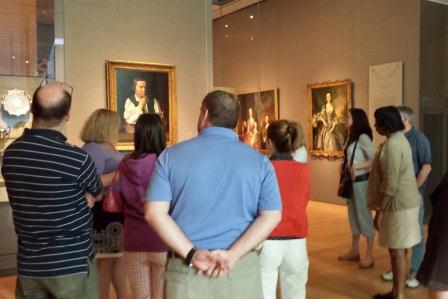
On Saturday, 23 August, stop by the Society for a free tour, The History and Collections of the MHS. This 90-minute docent-led tour explores all of the public spaces in the Society’s home at 1154 Boylston Street, touching on the art, architecture, history, and collections of the MHS. The tour begins at 10:00AM and is free and open to the public. No reservations necessary for individuals or small groups. For parties of eight or more, please contact the MHS in advance. For more information, please contact Curator of Art Anne Bentley at 617-646-0508 or abentley@masshist.org

Finally, remember to come by and see our current exhibition “Letters and Photographs from the Battle Country: Massachusetts Women in World War I.” Exhibit is on display Monday-Saturday, 10:00AM-4:00PM, free of charge. 

*Please note that the Society is closed 30 August – 1 September in observance of Labor Day.*
Indiana Limestone? At the MHS?

By Dan Hinchen

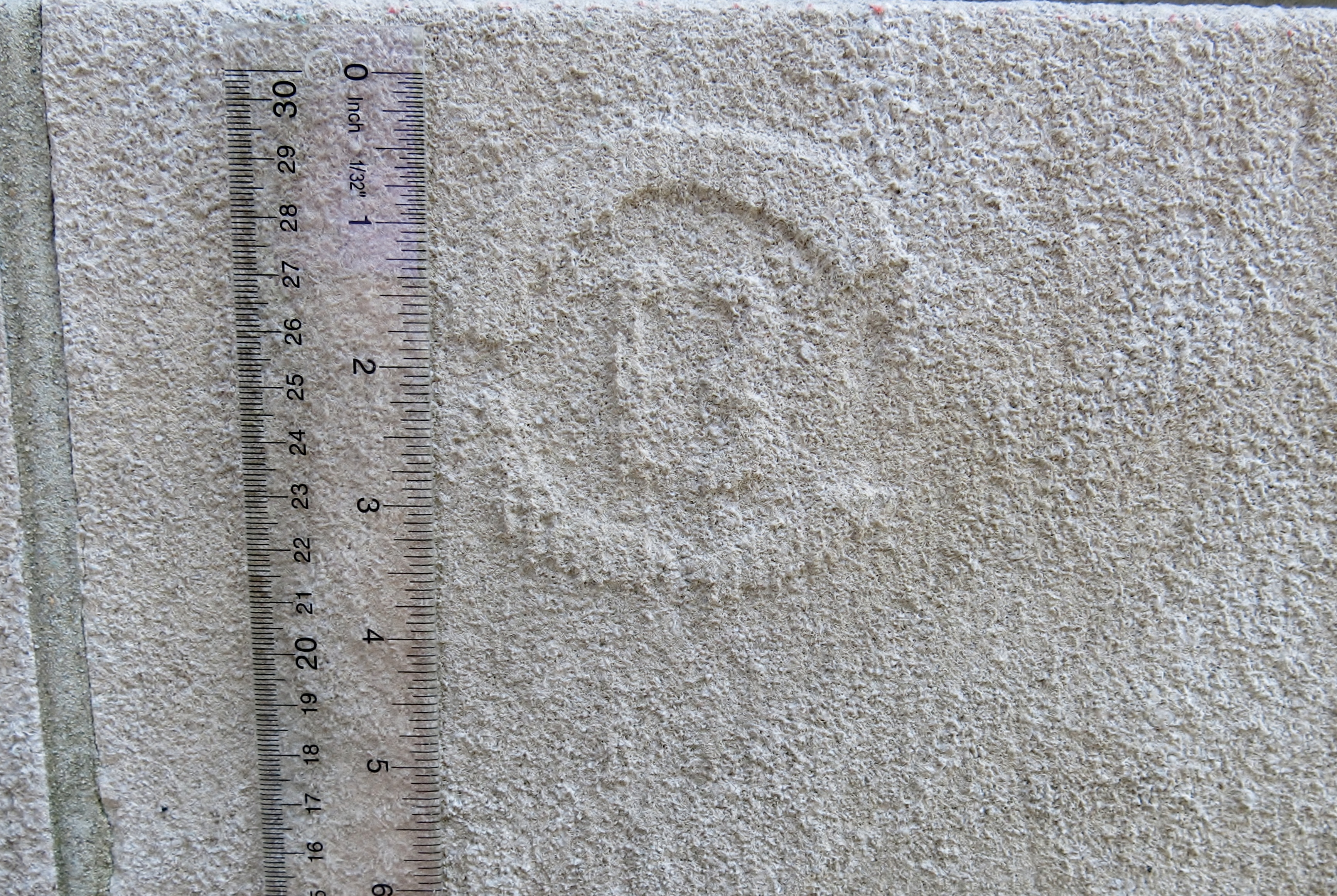
Some mornings, before researchers (and much of the staff) arrive at the MHS, I enjoy sitting out front with a cup of coffee and a book. It’s a good way to keep up on whatever I am reading and to cool down after my morning bicycle commute. A few weeks ago, as I approached my perch, I noticed a letter B located on one of the large stone blocks circling the base of the building. The letter is circled and is raised as if in bas relief. Even though I am now well into my third year of work at the MHS this little feature is something that I never noticed. Carve me intrigued! Sorry, that was a (bad) quarrying joke.

To find out more about this little letter, I first spoke with the MHS’ operations manager to see what he knew. As I learned, a mark such as this is sometimes used to indicate the quarry from which the stone was cut. Next, I went into the MHS’ institutional archives to see what records the Society holds regarding the construction of the building in the late 1890s. As I read through copies of contracts and building specifications, I came across a couple paragraphs about the foundation and stonework. I read mentions of Milton granite, Rockport granite, and Amherst stone. I assumed that the marked block in question must be one of these types of local stone. But in talking with our building manager again, I learned the block was limestone.

So, back to the records I went and, sure enough, what I missed on my first read-through was the statement “All stone-work so indicated on drawings to be of first quality Indiana limestone…all to be hand-tooled…” I took to the mighty Google machine to see what I could find about Indiana limestone quarries and was not disappointed to find several listed that are still operating. But the most potentially useful tidbit came from the Wikipedia entry on the stone which referred to it as Bedford limestone because it is primarily quarried in a section of Indiana that sits between the towns of Bloomington and Bedford.

Is that what the mysterious “B” stands for? I feel like I am almost at the answer but I still want confirmation. I called the Indiana Limestone Institute of America and the Lawrence County Museum of History to see if anyone could help me out. So far, I stumped the gentlemen I spoke with at each institution but I am hopeful that I will get an answer soon. Stay tuned to find out more! 


This Week @ MHS

By Dan Hinchen

There is rain on the horizon as we start this week at the MHS. Why not duck into the Society to get out of the rain and take part in some of our public programs?

On Wednesday of this week, 13 August, we have a Brown Bag lunch talk beginning at noon. This time around, Serena Zabin of Carleton College presents “Military Wives in Eighteenth-Century Boston.” When British troops came to Boston in 1768, hundreds of army wives and children came with them. At the time, Boston newspapers exclaimed in horror at the arrival of these army women, referring to them as the “dregs and refuse of all nations.” Yet tantalizing hints in the diaries of Massachusetts militia and provincial soldiers suggest that during the campaigns in 1745 to Louisburg and throughout the Seven Years War, women may have occasionally also accompanied Massachusetts troops. If so, some Boston women may themselves have once been military wives, a possibility that no historian has ever considered, and one that might explain some of the relationships that came to develop between British regulars and Boston civilians in the months preceding the Boston Massacre. This talk is free and open to the public.

And on Friday there is another Brown Bag talk, again at noon. Bring a lunch and listen to Brenton Grom of Case Western Reserve University as he discusses “The Death and Transfiguration of New England Psalmody, ca.1790-1860.” The robust culture of psalm- and hymn-singing that flourished in Revolutionary New England became subject to Europeanizing reforms after the turn of the nineteenth century. Introducing these reform efforts as instances of political and theological ideology operating within a larger discourse of refinement, this presentation focuses on their surprisingly variable reception as revealed in copybooks and marginalia. It furthermore considers Victorian values of home, sentiment, and historical memory as masks for the retention of outmoded musical styles in later years.

Also going on this week is the third in a series of two-day teacher workshops, this time taking place in Falmouth, Mass. on Wednesday and Thursday, 13-14 August. Learn more about “Old Towns/New Country: The First Years of a New Nation” on our website, including information about the final session which will take place in Framingham, Mass. on 26-27 September.

Finally, do not forget about our ongoing exhibition, “Letters and Photographs from the Battle Country: Massachusetts Women in World War I,” on view Monday-Saturday, 10:00AM-4:00PM. And come in for “The History and Collections of the MHS,” a free tour of the Society’s building on Saturday, 16 August. 


The MHS as Time Machine

By Susan Martin, Collection Services

In my work as a manuscript processor here at the MHS, I often come across the diaries or letters of a person I wish I could meet face to face. It’s rarely the well-known movers and shakers of history, just someone with a unique and interesting voice. I’ve introduced you to some of these people (Eliza Cheever Davis & Moses Hill) in previous posts, but my latest discovery is Jacob Newman Knapp (1773-1868), teacher and occasional preacher of Walpole, N.H. I wrote about Jacob before, but I hope you’ll indulge me if I quote from him again. Here he is in a letter to his son Francis on 21 May 1850 (from the Knapp family correspondence):

We are all well and active. When I say active I speak more particularly for others, than for myself. My days of activity have either gone by, or not yet arrived….Well, it is said that it takes a variety to constitute a world! There is certainly a good variety of characters in the world. Life is undoubtedly a serious trust and must be seriously accounted for; but there is so much of the ludicrous, of the absurd extravagant and incomprehensible in the human character, that I feel inclined to cry and to laugh at the same time. What a display, at different times, in the same person, of saint and sinner, of philosopher and fool, of man and monkey, a perpetual, practical antithesis, a combination in one person of the two sons of Leda, mortal and immortal by turns.

His wit, eloquence, and philosophical attitude endeared Jacob to me immediately. Not to mention his obvious affection for his family:

We [Jacob and his wife Louisa (Bellows) Knapp] have many topics of interest for conversation; one never tiring, never exhausted subject is our sons. We follow them every where, and when facts are unknown, we reason upon the probable and the improbable, the possible and the impossible, and at times free the imagination from its cage of logic, and let it fly at large, at liberty to light anywhere, and to sing its wildest notes. We have no dull hours. We have occasionally some silent hours, but no vacant ones, for they are crowded full of reminiscences or compendiums and abstracts of future developments.

Jacob lived to be almost 95 years old. He was born 7 Nov. 1773 and died 27 July 1868. Imagine, a man born a few weeks before the Boston Tea Party, old enough to remember events of the Revolutionary War (he was almost 10 when the Treaty of Paris was signed), who lived to see the end of the Civil War and the ratification of the 14th Amendment! No wonder his letters are full of so much wisdom. How fascinating he would be to talk to.

There’s only so much we can know about the people of the past from the writings they leave behind, but it’s hard not to feel that I have, in a way, “met” Jacob.

This Week @ MHS

By Dan Hinchen

Looking for some midday academic fulfilment this week? Then look no further. We have a couple of free lunchtime talks on the schedule this week at the Society, as well as a free tour and a free exhibition. Open to the public Monday – Saturday, 10:00AM-4:00PM, “Letters and Photographs from the Battle Country: Massachusetts Women in WWI” focuses on two of the hundreds of women from Massachusetts who went to France as members of the U.S. armed forces, the Red Cross, and other war relief organizations. This exhibit commemorates the centennial of the outbreak of World War I in 1914. 

On Monday, 4 August, join us for a Brown Bag lunch talk beginning at noon. “The Labor of Self-Making in New Engand Mill Women’s Poetry,” is presented by Robin Smith, University of North Carolina at Chapel Hill. Through her research into poems and prose pieces written by women mill workers for publication in literary magazines such as the Lowell Offering, Smith argues that writing poetry was an important means of humanizing potentially dehumanizing labor for mill women. The rhythms of poetry helped them to reclaim control of time and, in so doing, made space for fortifying their creative, coherent selves. This talk is free and open to the public. 

And on Wednesday, 6 August, there is another Brown Bag talk, also beginning at noon. This time, Frank Cirillo of the University of Virginia presents “‘The Day of Sainthood Has Passed’: American Abolitionists and the Golden Moment of the Civil War, 1861-1865.” With this project, Cirillo explores divisions among American abolitionists over whether or not to support the Lincoln Administration and the Union war effort during the Civil War. The choices that longtime reformers made in confronting the changed landscape of wartime America, and the series of schisms within the movement that ensued, helps to explain how the Union war achieved both so much and so little in terms of black social and political rights. Pack a lunch and please join us for the talk!

On Saturday, 9 August, come by at 10:00AM for a free tour. The History and Collections of the MHS is a 90 minute, docent-led tour that explores all of the public spaces in the Society’s Boylston St. home and touches on the history, collections, art, and architecture of the MHS. The tour is free and open to the public. No reservation is required for individuals or small groups. Parties of 8 or more should contact the MHS prior to attending a tour. For more information please contact Curator of Art Anne Bentley at 617-646-0508 or abentley@masshist.org.

What was it like to live in a town that had existed for years (if not a full century or more) before becoming part of a new nation in 1776? Designed for educators and local history enthusiasts, this workshop will explore some of the social, cultural, economic, and political concerns expressed in New England towns as the United States was attempting to form a new government in the 1780s and 1790s. We will discuss the truly participatory, well-informed conversations taking place in town halls and meeting places throughout the new colonies-turned-states. By turning an eye towards local politics and events we will rediscover the ways in which “ordinary people” contributed to America’s creation story. “Old Towns/New Country: The First Years of a New Nation” is a two-day teacher workshop that is open to the public. This week’s two-day session takes place in Searsport, Maine. Addition two-day workshops will be held in Falmouth, Massacuhsetts (13-14 August) and in Framingham, Massachusetts (26-27 September). To Register: Please complete this registration form and send it with your payment to: Kathleen Barker, Massachusetts Historical Society, 1154 Boylston Street, Boston, MA 02215


From the Magna Carta to Boston School Desegregation: An Educational Summer

By Kathleen Barker, Education Department

Summer is in full swing at the Society, and that means I’m surrounded by teachers and students (of all ages) who love history as much as I do. Our season began with a workshop for a group of educators visiting from Oxnard, California. After viewing artifacts from the era the American Revolution, the group debated the effectiveness of the boycotts of British goods that took place in Boston in the 1760s and 1770s. This program was a great example of the connections MHS staff members have made at workshops and conferences over the years. The group leader, Blake Thomas, was a participant in our 2010 Landmarks of American History and Culture Workshop (which was just funded again by the National Endowment for the Humanities for the summer of 2015!).  

July brought new partnerships and new friends to the MHS. July 10-11, MHS education staff co-hosted a workshop with the Museum of Fine Arts to celebrate their special exhibition Magna Carta: Cornerstone of Liberty. The exhibit features many documents from MHS collections, including two manuscript copies of the Declaration of Independence, originally written by John Adams and Thomas Jefferson, currency engraved by Paul Revere, and Elbridge Gerry’s annotated copy of the U.S. Constitution. Participants enjoyed viewing the exhibition and analyzing other documents from the MHS and artifacts and paintings from the MFA. As a final activity, participants had to create their own broadsides that offered commentary on the theme of rights and liberties in the pre-revolutionary era.
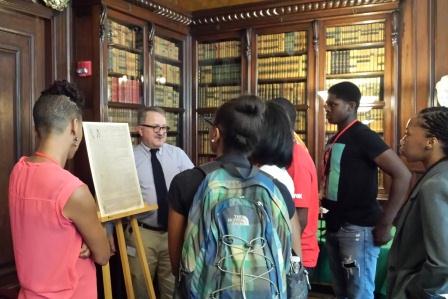
This month also featured a visit from MYTOWN students researching the American Revolution in the Boston area. MYTOWN is a great organization that engages students in the learning and teaching of their local history. These particular student viewed documents from the period pertaining to the Revolution in general (like the Declaration of Independence), as well as materials related specifically to the Dillaway Thomas House in Roxbury. They even blogged about their experience at the MHS! 
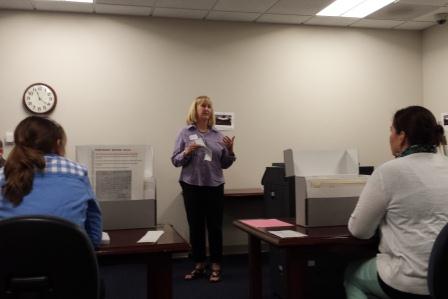
I spent the week of July 18 working with a fun group of educators participating in the Primarily Teaching program at the National Archives in Waltham. Together we researched Boston school desegregation, in particular the records pertaining to Morgan v. Hennigan, the case that prompted Boston Public Schools to adopt busing in order to reverse segregation in its schools and facilities. By the end of the week, I had worked with my counterpart at the Archives, Annie Davis, to develop a new workshop on the changing meanings of equality in education over the last two and a half centuries. (Look for it on our program schedule in 2015.)
August might be right around the corner, but summer isn’t over yet. There are still opportunities to attend an MHS workshop. Join us in Searsport, Maine, or, Falmouth, Massachusetts, for an upcoming workshop on the first years of the Early Republic. These “Old Towns/New Country” workshops introduce participants to local aspects of national stories such as the War of 1812, economic crises, political debates, and the flourishing of a distinctly American culture. We have a number of other programs for educators on the horizon for fall, including a two-day workshop on women and World War I, a program for students and teachers interested in National History Day,  and another two-day session on the history of Boston and the Sea. Keep an eye on our events calendar for more details!

This Week @ MHS

By Dan Hinchen

The July Brown Bag bonanza continues this week with two lunchtime talks. Also taking place this week is a two-day public workshop and a Saturday tour. 

Old Towns/New Country: The First Years of a New Nation” is a two-day teacher workshop held in Milford, New Hampshire and Pepperell, Massachusetts, in parternship with the Freedom’s Way National Heritage Area. Taking place on Wednesday and Thursday, 30-31 July, the workshop will look at the truly participatory, well-informed conversations taking place in twon halls and meeting places throughout the new colonies-turned-states. By turning an eye toward local politics and events, participants will rediscover the ways in which “ordinary people” contribute to American’s creation story. Registration is required for this workshop and there is a $25 charge to cover lunches for both days. To register, please complete this registration form and send it with your payment to: Kathleen Barker, Massachusetts Historical Society, 1154 Boylston Street, Boston, MA 02215. Additional two-day workshops will be held in Searsport, Maine, August 6-7; in Falmouth, Massachusetts, August 13-14; and in Framingham, Massachusetts, September 26-27.

Also taking place on Wednesday 30 July, is a Brown Bag lunch talk featuring Kristen Burton, University of Texas, Arlington, and her project titled “John Barleycorn vs. Sir Richard Rum: Alchohol, the Atlantic, and the Distilling of Colonial Identity, 1650-1800.” Focusing on the rise of commercial distilling, this project examines the shifting perceptions of spirituous liquors in the Atlantic World throughout the seventeenth and eighteenth centuries. Burton also explores the evolution of liquors from their use as a wholesome source of medicine to a pernicious, societal threat. This talk is open to the public free of charge and begins at noon. 

And on Friday, 1 August, is another Brown Bag lunch, this time presented by Rachel Walker, University of Maryland, and titled “Character Detectives: Female Physiognomists in the Early American Republic.” Looking at the fraught connection between femaly beauty, morality, and intelligence in the post-Enlightenment era, this project examines how cultural ideas concerning these traits became intertwined by studying the eighteenth and nineeteenth century “science” of physiognomy. A discipline rooted in the notion that an individual could discern a person’s moral and mental characteristics merely by examining his or her facial features, early Americans discussed male and female physiognomy in distinct ways and used discussions about female appearance to distinguish between the moral and intellectual capacities of men and women. This talk is open to the public free of charge and begins at noon. 

Finally, on Saturday, 2 August, join us for a tour of the Society’s public rooms. Led by an MHS staff member or docent, the tour touches on the history and collections of the MHS and lasts approximately 90 minutes. The tour is free and open to the public. No reservation is required for individuals or small groups. Parties of 8 or more should contact the MHS prior to attending a tour. For more information please contact Curator of Art Anne Bentley at 617-646-0508 or abentley@masshist.org.

As always, be sure to keep an eye on our events calendar to see what programs are on the horizon. And do not forget to come in and see our current exhibition “Letters and Photographs from the Battle Country: Massachusetts Women in WWI,” on display Monday-Saturday, 10:00AM-4:00PM, free of charge. 

Bragging Rights

By Andrea Cronin, Reader Services

The practice of attaching additional items (newspaper articles, photographs, etc.) to correspondence obviously is not a new custom. Attachments generally provide more detail about the subject matter discussed in the associated correspondence. However, I found an interesting letter in the S. Lothrop Thorndike papers in which the letter is meant for one individual and the attachments are intended for others.

The two articles enclosed with a letter from the Canton, China bound Samuel Lothrop Thorndike on 27 May 1852 tell fascinating stories about a wager on a ship race to Hong Kong and cyclonic gales encountered along the way in the Philippine Sea. The younger Thorndike clearly leaves mention of these events out of the letter, addressed to his father Albert Thorndike. He includes these grand adventure stories as attachments, intended for his college friends.

At 22 years of age, Samuel Lothrop Thorndike left Harvard College in the middle of his senior year to accompany fellow Harvard student William Sturgis Hooper on a voyage to China. These two young scholars obtained a faculty leave of absence to make the voyage, and traveled on the new ship Courser. Sturgis’s father, shipping merchant Samuel Hooper, dispatched the Courser from Boston to California then to China in January 1852.

The letter to Albert Thorndike contains little more than a greeting, a note that the son has not yet received mail, and reassurance of good health and love. Postscript directions from son to father request that the two enclosed attachments be given to young brother William “Bill” Thorndike, who will see that “the fellows in Cambridge” – Harvard classmates Joseph Hodges Choate and Peter Chardon Brooks – receive the articles.

The first newspaper article recounts a ship race from San Francisco to Hong Kong between the Courser and the Witchcraft. Seemingly unaware of the race, the clipper ship Invincible simply loses by nearly two weeks.

PASSAGES FROM SAN FRANCISCO TO CAN-
TON. – The ship Courser, Capt. Cole, of Boston,
sailed from San Francisco May 29 for Canton, where
she arrived July 11. The clipper ship Invincible,
Capt. Johnson, of New York, sailed from San Fran-
cisco May 16, and arrived at Canton July 11. The
clip ship Witchcraft, Capt. Rogers, of Salem,
sailed from San Francisco May 30, and arrived at
Canton July 19. We understand that bets were
made in San Francisco that the Witchcraft would
reach Hong Kong ten days before the Courser, but
the event proved that the C. which is not a clipper,
beat the Witchcraft full six days, and beat the In-
viscible thirteen days.

The second article briefly describes the cyclonic gales in the Philippine Sea that Thorndike and Hooper weathered during the Courser’s voyage.  

Very heavy cyclonic gales were experienced in the China
seas, from the 3d to the 7th of July. The Am ship Courser
encountered one on the 5th, in about lat 18 N, lon 128 E.
The Invincible on the 6th in lat 20 N, lon 119 E.

Thorndike does write to his father in reassurance, “I never was in better health and spirits in my life.” However, he does not mention the betting, race, or the gales. He essentially left all the fun and danger out of his letter to his father. But he dispatched the articles to his Harvard classmates as bragging rights.


“For your mutual Happiness and…dedicated to the Public”: The Marriage of John Quincy and Louisa Catherine Adams

By Amanda A. Mathews, Adams Papers

In the upcoming volume of Adams Family Correspondence we reach a pivotal moment in Adams family history—the marriage of Louisa Catherine Johnson to John Quincy Adams.

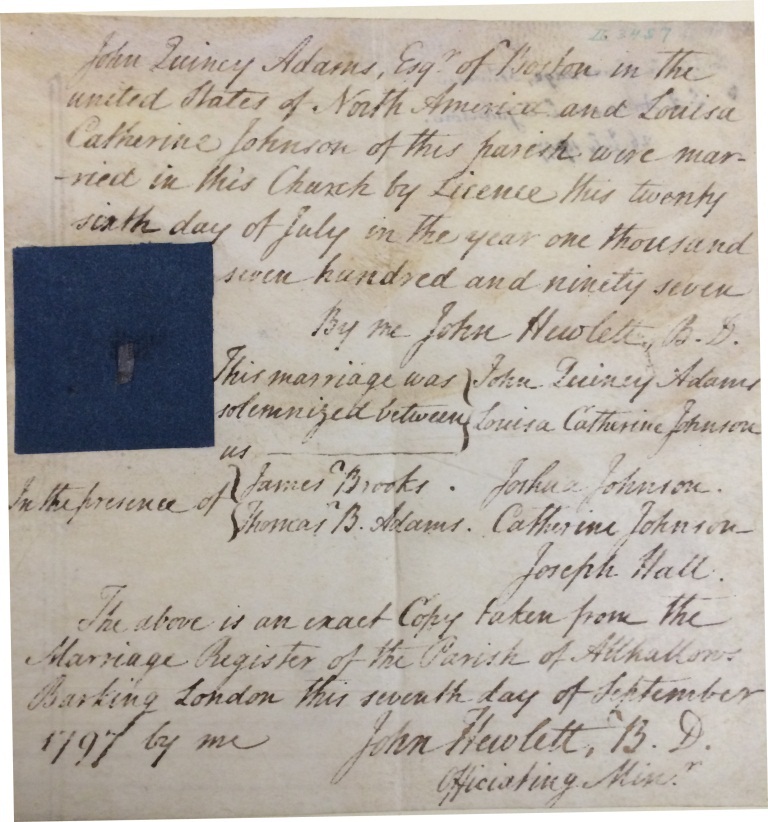
This partnership began quite simply on July 26, 1797. They were married before eleven o’clock in the morning at the Church of All Hallows, Barking, right by the Tower of London and immediately took a tour of country house near London, as JQA reported in his diary entry for the day. Louisa, who kept no diary at the time, wrote in her memoirs nearly thirty years later, and with the knowledge of what was coming quickly around the corner for the newlyweds—the embarrassment of her father’s financial failure—noted it simply, “On the Wednesday 26 of July 1797 I became a bride under as every body thought the happiest auspices—”

Two days after the wedding, the newlyweds sat down to compose a joint letter announcing their marriage to the distant John and Abigail Adams.

John Quincy opened the letter:

I have now the happiness of presenting to you another daughter…. My recommendation of her to your kindness and affection I know will be unnecessary. My sentiment of her merit, will not at this moment especially boast its impartiality, but if there be as I believe an inseparable chain of connection which binds together all the domestic virtues, I have the strongest pledge that she, who has in an amiable and respectable family, adorned the characters of a daughter and Sister, will prove an equal ornament to that of a wife.

Louisa, promising to always act worthily of their “esteem and tenderness,” concluded: “fulfillment of my duties either as wife or daughter, to be respected in these characters, and to meet the approbation of my Husband, and family, is the greatest wish of my heart— Stimulated by these motives (your affection the reward) will prove a sufficient incitement, never to sully the title of subscribing myself your, Dutiful Daughter.”

John Adams replied to the news of his eldest son’s marriage with his blessing: “I congratulate you and your Lady on this Event, which I hope will be for your mutual Happiness and…, for a long Course of years, dedicated to the Public— And may the Blessing of God Almighty be bestowed on this Marriage and all its Connections and Effects.” His blessing on this marriage, one that lasted over fifty years and combined the charm and sociability of Louisa to John Quincy’s dedicated and driven, if sometimes brusque demeanor, was more than fulfilled in the couple serving the public until John Quincy’s death in 1848.


**Image: JQA and LCA’s Marriage Certificate,  26 June 1797, Adams Family Papers.


This Week @ MHS

By Dan Hinchen

We are back again with the round-up of events in the week to come here at the Society. Like last week, this one is a bit top-heavy and dominated by Brown Bag lunch talks. And here is what is tap.
Starting with Monday, 21 July, there is a Brown Bag lunch talk presented by Brendan Gillis of Indiana University. “Cosmopolitan Parochialism: Magistrates and Imperial Revolution in New England, 1760-1800” investigates how shared assumptions about magisterial authority contributed to the construction of new jurisdictions incorporating non-English lands and peoples. In New England, this British model of local government proved so adaptable that it allowed justices of the peace to assert independence during a period of imperial crisis. This talk is free, open to the public, and begins at 12:00PM.

On Tuesday, 22 July, also at noon, is another Brown Bag lunch talk, this time presented by Jeffrey Egan, University of Connecticut. “Watershed Decisions: Arthur Shurcliff’s Vision of the Quabbin Reservoir in Massachusetts, 1922-1945” provides a brief historical overview of the creation of the Quabbin Reservoir in Massachusetts, a massive public-works project that led to the disincorporation of four rural towns in the western poriton of the Commonwealth and radically transformed 39 square miles of land during the 1930s and 1940s. It will then delve into the environmental wordlview and vision of the Quabbin project held by Arthur Shurcliff, the landscape architect employed by the Boston Metropolitan District Commission to reform the grounds surrounding this new, artificial lake. 

The third and final brown bag talk of the week will take place at noon on Wednesday, 23 July. This time, long-term research fellow Jonathan Grinspan, University of Virginia/Jeffersno Scholars Foundation, presents “The Virgin Vote: Young Americans in the Age of Popular Politics.” Young people fueled American democracy at its most popular. Between 1840 and 1900, children, youths and young adults turned out at rallies and elections, searching for identity, advancement, and fun. Many viewed the political system as a route to adulthood, during a period of major social instability. At the same time, politicians wooed first-time “virgin voters,” lobbied young women to influence the men in their lives, and recruited children as future partisans. Their interest helped bring about the highest voter turnouts in U.S. history. This project explores this fascinating and forgotten relationship between public politics and personal aspirations.

And on Saturday, 26 July, join us for a free tour of the Society’s building on Boylston Street in Boston’s Back Bay. “The History and Collections of the MHS” is a 90-minute, docent-led tour of the public spaces in the building. The tour touches on the art, architecture, history, and collections of the Historical Society. The tour is free and open to the public.  No reservation is required for individuals or small groups. Parties of 8 or more should contact the MHS prior to attending a tour. For more information please contact Curator of Art Anne Bentley at 617-646-0508 or abentley@masshist.org.

Remember to keep an eye on the Society’s online events calendar to see what is coming up in the near future and that our current exhibition, “Letters and Photographs from the Battle Country: Massachusetts Women in the First World War” is now on display. The gallery is open Monday-Saturday, 10:00AM – 4:00PM, free of charge.