
This Week @ MHS

By Dan Hinchen

Looking for some midday academic fulfilment this week? Then look no further. We have a couple of free lunchtime talks on the schedule this week at the Society, as well as a free tour and a free exhibition. Open to the public Monday – Saturday, 10:00AM-4:00PM, “Letters and Photographs from the Battle Country: Massachusetts Women in WWI” focuses on two of the hundreds of women from Massachusetts who went to France as members of the U.S. armed forces, the Red Cross, and other war relief organizations. This exhibit commemorates the centennial of the outbreak of World War I in 1914. 

On Monday, 4 August, join us for a Brown Bag lunch talk beginning at noon. “The Labor of Self-Making in New Engand Mill Women’s Poetry,” is presented by Robin Smith, University of North Carolina at Chapel Hill. Through her research into poems and prose pieces written by women mill workers for publication in literary magazines such as the Lowell Offering, Smith argues that writing poetry was an important means of humanizing potentially dehumanizing labor for mill women. The rhythms of poetry helped them to reclaim control of time and, in so doing, made space for fortifying their creative, coherent selves. This talk is free and open to the public. 

And on Wednesday, 6 August, there is another Brown Bag talk, also beginning at noon. This time, Frank Cirillo of the University of Virginia presents “‘The Day of Sainthood Has Passed’: American Abolitionists and the Golden Moment of the Civil War, 1861-1865.” With this project, Cirillo explores divisions among American abolitionists over whether or not to support the Lincoln Administration and the Union war effort during the Civil War. The choices that longtime reformers made in confronting the changed landscape of wartime America, and the series of schisms within the movement that ensued, helps to explain how the Union war achieved both so much and so little in terms of black social and political rights. Pack a lunch and please join us for the talk!

On Saturday, 9 August, come by at 10:00AM for a free tour. The History and Collections of the MHS is a 90 minute, docent-led tour that explores all of the public spaces in the Society’s Boylston St. home and touches on the history, collections, art, and architecture of the MHS. The tour is free and open to the public. No reservation is required for individuals or small groups. Parties of 8 or more should contact the MHS prior to attending a tour. For more information please contact Curator of Art Anne Bentley at 617-646-0508 or abentley@masshist.org.

What was it like to live in a town that had existed for years (if not a full century or more) before becoming part of a new nation in 1776? Designed for educators and local history enthusiasts, this workshop will explore some of the social, cultural, economic, and political concerns expressed in New England towns as the United States was attempting to form a new government in the 1780s and 1790s. We will discuss the truly participatory, well-informed conversations taking place in town halls and meeting places throughout the new colonies-turned-states. By turning an eye towards local politics and events we will rediscover the ways in which “ordinary people” contributed to America’s creation story. “Old Towns/New Country: The First Years of a New Nation” is a two-day teacher workshop that is open to the public. This week’s two-day session takes place in Searsport, Maine. Addition two-day workshops will be held in Falmouth, Massacuhsetts (13-14 August) and in Framingham, Massachusetts (26-27 September). To Register: Please complete this registration form and send it with your payment to: Kathleen Barker, Massachusetts Historical Society, 1154 Boylston Street, Boston, MA 02215
 

From the Magna Carta to Boston School Desegregation: An Educational Summer

By Kathleen Barker, Education Department

Summer is in full swing at the Society, and that means I’m surrounded by teachers and students (of all ages) who love history as much as I do. Our season began with a workshop for a group of educators visiting from Oxnard, California. After viewing artifacts from the era the American Revolution, the group debated the effectiveness of the boycotts of British goods that took place in Boston in the 1760s and 1770s. This program was a great example of the connections MHS staff members have made at workshops and conferences over the years. The group leader, Blake Thomas, was a participant in our 2010 Landmarks of American History and Culture Workshop (which was just funded again by the National Endowment for the Humanities for the summer of 2015!).  

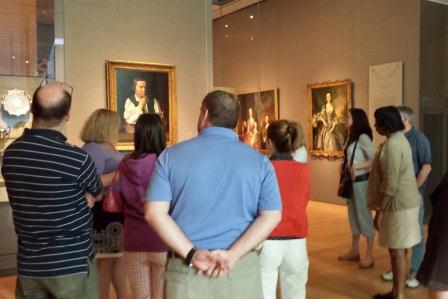
July brought new partnerships and new friends to the MHS. July 10-11, MHS education staff co-hosted a workshop with the Museum of Fine Arts to celebrate their special exhibition Magna Carta: Cornerstone of Liberty. The exhibit features many documents from MHS collections, including two manuscript copies of the Declaration of Independence, originally written by John Adams and Thomas Jefferson, currency engraved by Paul Revere, and Elbridge Gerry’s annotated copy of the U.S. Constitution. Participants enjoyed viewing the exhibition and analyzing other documents from the MHS and artifacts and paintings from the MFA. As a final activity, participants had to create their own broadsides that offered commentary on the theme of rights and liberties in the pre-revolutionary era.
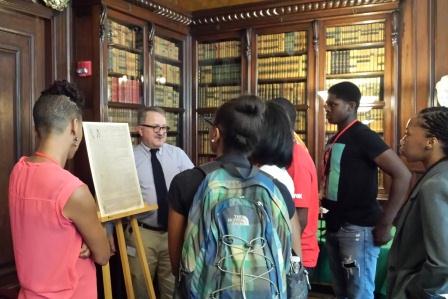
This month also featured a visit from MYTOWN students researching the American Revolution in the Boston area. MYTOWN is a great organization that engages students in the learning and teaching of their local history. These particular student viewed documents from the period pertaining to the Revolution in general (like the Declaration of Independence), as well as materials related specifically to the Dillaway Thomas House in Roxbury. They even blogged about their experience at the MHS! 
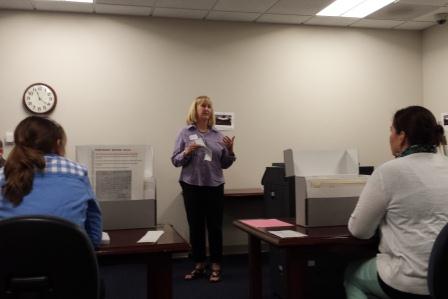
I spent the week of July 18 working with a fun group of educators participating in the Primarily Teaching program at the National Archives in Waltham. Together we researched Boston school desegregation, in particular the records pertaining to Morgan v. Hennigan, the case that prompted Boston Public Schools to adopt busing in order to reverse segregation in its schools and facilities. By the end of the week, I had worked with my counterpart at the Archives, Annie Davis, to develop a new workshop on the changing meanings of equality in education over the last two and a half centuries. (Look for it on our program schedule in 2015.)
August might be right around the corner, but summer isn’t over yet. There are still opportunities to attend an MHS workshop. Join us in Searsport, Maine, or, Falmouth, Massachusetts, for an upcoming workshop on the first years of the Early Republic. These “Old Towns/New Country” workshops introduce participants to local aspects of national stories such as the War of 1812, economic crises, political debates, and the flourishing of a distinctly American culture. We have a number of other programs for educators on the horizon for fall, including a two-day workshop on women and World War I, a program for students and teachers interested in National History Day,  and another two-day session on the history of Boston and the Sea. Keep an eye on our events calendar for more details!

This Week @ MHS

By Dan Hinchen

The July Brown Bag bonanza continues this week with two lunchtime talks. Also taking place this week is a two-day public workshop and a Saturday tour. 

Old Towns/New Country: The First Years of a New Nation” is a two-day teacher workshop held in Milford, New Hampshire and Pepperell, Massachusetts, in parternship with the Freedom’s Way National Heritage Area. Taking place on Wednesday and Thursday, 30-31 July, the workshop will look at the truly participatory, well-informed conversations taking place in twon halls and meeting places throughout the new colonies-turned-states. By turning an eye toward local politics and events, participants will rediscover the ways in which “ordinary people” contribute to American’s creation story. Registration is required for this workshop and there is a $25 charge to cover lunches for both days. To register, please complete this registration form and send it with your payment to: Kathleen Barker, Massachusetts Historical Society, 1154 Boylston Street, Boston, MA 02215. Additional two-day workshops will be held in Searsport, Maine, August 6-7; in Falmouth, Massachusetts, August 13-14; and in Framingham, Massachusetts, September 26-27.

Also taking place on Wednesday 30 July, is a Brown Bag lunch talk featuring Kristen Burton, University of Texas, Arlington, and her project titled “John Barleycorn vs. Sir Richard Rum: Alchohol, the Atlantic, and the Distilling of Colonial Identity, 1650-1800.” Focusing on the rise of commercial distilling, this project examines the shifting perceptions of spirituous liquors in the Atlantic World throughout the seventeenth and eighteenth centuries. Burton also explores the evolution of liquors from their use as a wholesome source of medicine to a pernicious, societal threat. This talk is open to the public free of charge and begins at noon. 

And on Friday, 1 August, is another Brown Bag lunch, this time presented by Rachel Walker, University of Maryland, and titled “Character Detectives: Female Physiognomists in the Early American Republic.” Looking at the fraught connection between femaly beauty, morality, and intelligence in the post-Enlightenment era, this project examines how cultural ideas concerning these traits became intertwined by studying the eighteenth and nineeteenth century “science” of physiognomy. A discipline rooted in the notion that an individual could discern a person’s moral and mental characteristics merely by examining his or her facial features, early Americans discussed male and female physiognomy in distinct ways and used discussions about female appearance to distinguish between the moral and intellectual capacities of men and women. This talk is open to the public free of charge and begins at noon. 

Finally, on Saturday, 2 August, join us for a tour of the Society’s public rooms. Led by an MHS staff member or docent, the tour touches on the history and collections of the MHS and lasts approximately 90 minutes. The tour is free and open to the public. No reservation is required for individuals or small groups. Parties of 8 or more should contact the MHS prior to attending a tour. For more information please contact Curator of Art Anne Bentley at 617-646-0508 or abentley@masshist.org.

As always, be sure to keep an eye on our events calendar to see what programs are on the horizon. And do not forget to come in and see our current exhibition “Letters and Photographs from the Battle Country: Massachusetts Women in WWI,” on display Monday-Saturday, 10:00AM-4:00PM, free of charge. 

Bragging Rights

By Andrea Cronin, Reader Services

The practice of attaching additional items (newspaper articles, photographs, etc.) to correspondence obviously is not a new custom. Attachments generally provide more detail about the subject matter discussed in the associated correspondence. However, I found an interesting letter in the S. Lothrop Thorndike papers in which the letter is meant for one individual and the attachments are intended for others.

The two articles enclosed with a letter from the Canton, China bound Samuel Lothrop Thorndike on 27 May 1852 tell fascinating stories about a wager on a ship race to Hong Kong and cyclonic gales encountered along the way in the Philippine Sea. The younger Thorndike clearly leaves mention of these events out of the letter, addressed to his father Albert Thorndike. He includes these grand adventure stories as attachments, intended for his college friends.

At 22 years of age, Samuel Lothrop Thorndike left Harvard College in the middle of his senior year to accompany fellow Harvard student William Sturgis Hooper on a voyage to China. These two young scholars obtained a faculty leave of absence to make the voyage, and traveled on the new ship Courser. Sturgis’s father, shipping merchant Samuel Hooper, dispatched the Courser from Boston to California then to China in January 1852.

The letter to Albert Thorndike contains little more than a greeting, a note that the son has not yet received mail, and reassurance of good health and love. Postscript directions from son to father request that the two enclosed attachments be given to young brother William “Bill” Thorndike, who will see that “the fellows in Cambridge” – Harvard classmates Joseph Hodges Choate and Peter Chardon Brooks – receive the articles.

The first newspaper article recounts a ship race from San Francisco to Hong Kong between the Courser and the Witchcraft. Seemingly unaware of the race, the clipper ship Invincible simply loses by nearly two weeks.

PASSAGES FROM SAN FRANCISCO TO CAN-
TON. – The ship Courser, Capt. Cole, of Boston,
sailed from San Francisco May 29 for Canton, where
she arrived July 11. The clipper ship Invincible,
Capt. Johnson, of New York, sailed from San Fran-
cisco May 16, and arrived at Canton July 11. The
clip ship Witchcraft, Capt. Rogers, of Salem,
sailed from San Francisco May 30, and arrived at
Canton July 19. We understand that bets were
made in San Francisco that the Witchcraft would
reach Hong Kong ten days before the Courser, but
the event proved that the C. which is not a clipper,
beat the Witchcraft full six days, and beat the In-
viscible thirteen days.

The second article briefly describes the cyclonic gales in the Philippine Sea that Thorndike and Hooper weathered during the Courser’s voyage.  

Very heavy cyclonic gales were experienced in the China
seas, from the 3d to the 7th of July. The Am ship Courser
encountered one on the 5th, in about lat 18 N, lon 128 E.
The Invincible on the 6th in lat 20 N, lon 119 E.

Thorndike does write to his father in reassurance, “I never was in better health and spirits in my life.” However, he does not mention the betting, race, or the gales. He essentially left all the fun and danger out of his letter to his father. But he dispatched the articles to his Harvard classmates as bragging rights.


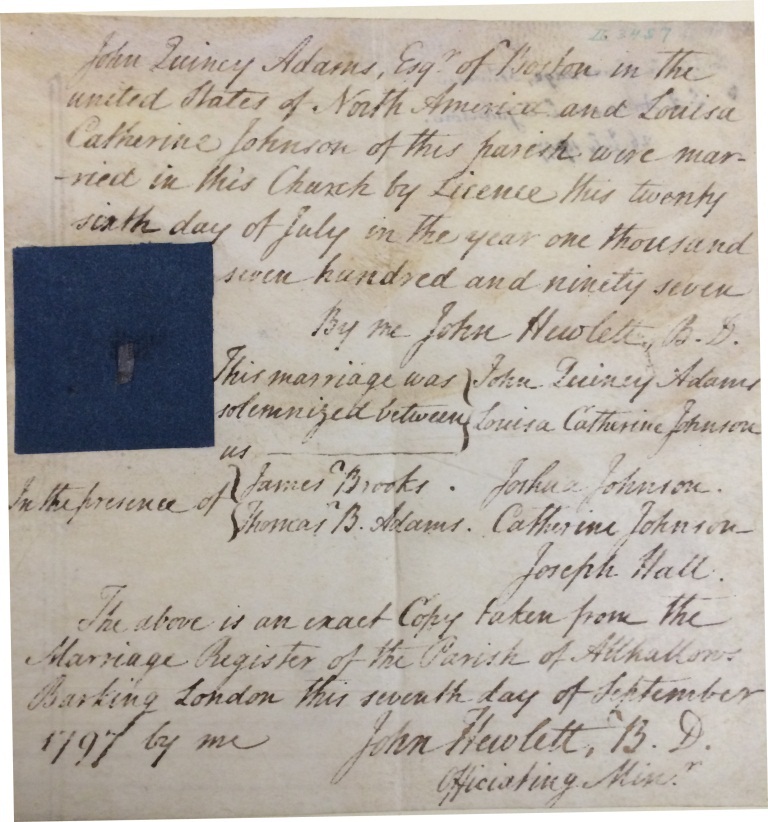
“For your mutual Happiness and…dedicated to the Public”: The Marriage of John Quincy and Louisa Catherine Adams

By Amanda A. Mathews, Adams Papers

In the upcoming volume of Adams Family Correspondence we reach a pivotal moment in Adams family history—the marriage of Louisa Catherine Johnson to John Quincy Adams.

This partnership began quite simply on July 26, 1797. They were married before eleven o’clock in the morning at the Church of All Hallows, Barking, right by the Tower of London and immediately took a tour of country house near London, as JQA reported in his diary entry for the day. Louisa, who kept no diary at the time, wrote in her memoirs nearly thirty years later, and with the knowledge of what was coming quickly around the corner for the newlyweds—the embarrassment of her father’s financial failure—noted it simply, “On the Wednesday 26 of July 1797 I became a bride under as every body thought the happiest auspices—”

Two days after the wedding, the newlyweds sat down to compose a joint letter announcing their marriage to the distant John and Abigail Adams.

John Quincy opened the letter:

I have now the happiness of presenting to you another daughter…. My recommendation of her to your kindness and affection I know will be unnecessary. My sentiment of her merit, will not at this moment especially boast its impartiality, but if there be as I believe an inseparable chain of connection which binds together all the domestic virtues, I have the strongest pledge that she, who has in an amiable and respectable family, adorned the characters of a daughter and Sister, will prove an equal ornament to that of a wife.

Louisa, promising to always act worthily of their “esteem and tenderness,” concluded: “fulfillment of my duties either as wife or daughter, to be respected in these characters, and to meet the approbation of my Husband, and family, is the greatest wish of my heart— Stimulated by these motives (your affection the reward) will prove a sufficient incitement, never to sully the title of subscribing myself your, Dutiful Daughter.”

John Adams replied to the news of his eldest son’s marriage with his blessing: “I congratulate you and your Lady on this Event, which I hope will be for your mutual Happiness and…, for a long Course of years, dedicated to the Public— And may the Blessing of God Almighty be bestowed on this Marriage and all its Connections and Effects.” His blessing on this marriage, one that lasted over fifty years and combined the charm and sociability of Louisa to John Quincy’s dedicated and driven, if sometimes brusque demeanor, was more than fulfilled in the couple serving the public until John Quincy’s death in 1848.


**Image: JQA and LCA’s Marriage Certificate,  26 June 1797, Adams Family Papers.


This Week @ MHS

By Dan Hinchen

We are back again with the round-up of events in the week to come here at the Society. Like last week, this one is a bit top-heavy and dominated by Brown Bag lunch talks. And here is what is tap.
Starting with Monday, 21 July, there is a Brown Bag lunch talk presented by Brendan Gillis of Indiana University. “Cosmopolitan Parochialism: Magistrates and Imperial Revolution in New England, 1760-1800” investigates how shared assumptions about magisterial authority contributed to the construction of new jurisdictions incorporating non-English lands and peoples. In New England, this British model of local government proved so adaptable that it allowed justices of the peace to assert independence during a period of imperial crisis. This talk is free, open to the public, and begins at 12:00PM.

On Tuesday, 22 July, also at noon, is another Brown Bag lunch talk, this time presented by Jeffrey Egan, University of Connecticut. “Watershed Decisions: Arthur Shurcliff’s Vision of the Quabbin Reservoir in Massachusetts, 1922-1945” provides a brief historical overview of the creation of the Quabbin Reservoir in Massachusetts, a massive public-works project that led to the disincorporation of four rural towns in the western poriton of the Commonwealth and radically transformed 39 square miles of land during the 1930s and 1940s. It will then delve into the environmental wordlview and vision of the Quabbin project held by Arthur Shurcliff, the landscape architect employed by the Boston Metropolitan District Commission to reform the grounds surrounding this new, artificial lake. 

The third and final brown bag talk of the week will take place at noon on Wednesday, 23 July. This time, long-term research fellow Jonathan Grinspan, University of Virginia/Jeffersno Scholars Foundation, presents “The Virgin Vote: Young Americans in the Age of Popular Politics.” Young people fueled American democracy at its most popular. Between 1840 and 1900, children, youths and young adults turned out at rallies and elections, searching for identity, advancement, and fun. Many viewed the political system as a route to adulthood, during a period of major social instability. At the same time, politicians wooed first-time “virgin voters,” lobbied young women to influence the men in their lives, and recruited children as future partisans. Their interest helped bring about the highest voter turnouts in U.S. history. This project explores this fascinating and forgotten relationship between public politics and personal aspirations.

And on Saturday, 26 July, join us for a free tour of the Society’s building on Boylston Street in Boston’s Back Bay. “The History and Collections of the MHS” is a 90-minute, docent-led tour of the public spaces in the building. The tour touches on the art, architecture, history, and collections of the Historical Society. The tour is free and open to the public.  No reservation is required for individuals or small groups. Parties of 8 or more should contact the MHS prior to attending a tour. For more information please contact Curator of Art Anne Bentley at 617-646-0508 or abentley@masshist.org.

Remember to keep an eye on the Society’s online events calendar to see what is coming up in the near future and that our current exhibition, “Letters and Photographs from the Battle Country: Massachusetts Women in the First World War” is now on display. The gallery is open Monday-Saturday, 10:00AM – 4:00PM, free of charge. 


Stephen Greenleaf Bulfinch Diary, Post 34

By Elaine Grublin

The following excerpt is from the diary of Stephen Greenleaf Bulfinch.

Sunday, July 24th, 1864


As to public affairs, – we appear to gain little near Richmond, – Sherman advances successfully in Georgia. Gold has been up to 270 or above it. The president calls for half a million more men, – for one year. The first abortive attempts at negotiation are symptoms which may be followed by something better. The awful sacrifices of the war go on meantime; & among the late losses is that of my friend Hall’s son, of Dorchester, assistant Henry Ware Hall, killed near Atlanta, Georgia. His father bears it heroically.

 Sunday, July 31st


This dreadful war continues its ravages, & the good & the brave fall on both sides. Maria writes me of the death of her cousin Cyprus, – my namesake & godson, – in battle near Marrietta, – fighting in the rebel cause; – & of the Christian firmness & submission with which he met death. ‘How long, O Lord!’

This Week @ MHS

By Dan Hinchen

This week’s events round-up is a bit top-heavy with four events in three days. Kicking things off on Monday, 14 July, is a Brown Bag lunch talk that begins at noon. Stop by with your lunch and listen as Jonathan Koefoed presents “Cautious Romantics: The Dana Family of Boston as the Interpretive Key to a Larger Discourse.” With this project, Koefoed hopes to provide a fuller picture of the way that European Romantic texts functioned in American intellectual, cultural, and religious history by highlighting a group of “Cautious Romantics” that emerged as an alternative and conservative Romantic religious tradition in America between 1800 and the late 19th century. The program focuses on how the Dana Family functions as a critical lens through which one can view the large Cautious Romantic discourse. This program is free and open to the public.

On Tuesday, 15 July, is another Brown Bag lunch talk, this time presented by Mark Thompson of the University of Groningen. “Land, Liberty, & Property: Surveyors and the Production of Empire in British North America” examines the land surveyor as a key figure in early America – instrumental in everything form makring colonial boundaries to measuring the smallest parcel of a farmer’s land. Adapting European methods to American conditions, surveyors drafted a “creole science” that served the demands of imperial authorities and common settlers alike. Together they transformed land into liberty, property, and territorial empire. This talk begins at noon and is free and open to the public. 

Also on Tuesday is a rare summer evening event. “‘What is Focus?’ Margaret Hall’s Battle Country” is an author talk featuring Margaret R. Higonnet, editor of the forthcoming MHS publication Letters and Photographs from the Battle Country: The World War I Memoir of Margaret Hall. Higonnet is Professor of English and Comparative Literature at the University of Connecticut, an affiliate at Harvard’s Center for European Studies, and has published extensively on gender and World War I. Providing comment during the talk are Susan Solomon and Suzanne Diefenbach. Solomon, of Boğaziçi University, Istanbul, will comment on her research into the life and photographs of Hall. Diefenbach, great niece of Margaret Hall, will share recollections of “Aunts” and life with her at Paradise Hill Farm in Hull, Massachusetts. This event is open to the public but registration is required at no cost. Register online or call the MHS reservations line at 617-646-0560. Pre-talk reception begins at 5:30PM and the talk begins at 6:00PM. 

The next day, Wednesday, 16 July, there is a third Brown Bag lunch talk. In this installment, Laurie Dickmeyer, University of California, presents “Americans in Chinese Treaty Ports: Trade and Diplomacy in Nineteenth-Century U.S. – China Relations.” With this project, Dickmeyer explores the changing texture and relationship of trade and diplomacy between American and Chinese traders and diplomats from 1784 to the 1860s. This talk will present an overview of the project but will focus on findings from traders’ records at the MHS. The talk is open to the public and begins at noon. 

And on Saturday, 19 July, is another free public tour. Beginning at 10:00AM, The History and Collections of the MHS is a 90-minute, docent-led tour of the Society’s historic building and touches on the art, architecture, history, and collections of the Society. The tour is free and open to the public and no reservations are required for individuals or small groups. Parties of 8 or more should contact the MHS prior to attending a tour. For more information please contact Curator of Art Anne Bentley at 617-646-0508 orabentley@masshist.org.

Finally, remember that our current exhibition is open to the public free of charge. “Letters and Photographs from the Battle Country: Massachusetts Women in the First World War” features photographs, letters, diaries, and memorabilia related to Margaret Hall and Eleanor (Nora) Saltonstall, Red Cross volunteers in France. This exhibit commemorates the centennial of the outbreak of World War I and celebrates the forthcoming MHS publication Letters and Photographs from the Battle Country: The World War I Memoir of Margaret Hall. The exhibit is open Monday-Saturday, 10:00AM-4:00PM until 24 January 2015. 

Margaret Hall’s WWI Memoir: The Book, the Talk, the Exhibition

By Jim Connolly, Publications

I’ve posted on the Beehive a few times about Margaret Hall, a Massachusetts woman who volunteered with the American Red Cross in France during World War I. So you may know (and if you didn’t, now you do!) that her memoir and selected photographs from her war experience will be published for the first time in the Society’s forthcoming book, Letters and Photographs from the Battle Country: The World War I Memoir of Margaret Hall. The MHS will publish the volume on 14 July 2014.

Come celebrate the release of Letters and Photographs from the Battle Country on Tuesday, 15 July 2014, when the volume’s editor, Margaret R. Higonnet, will give a talk titled “‘What is Focus?’ Margaret Hall’s Battle Country.” The program will run from 6:00 to 7:30 PM following a pre-talk reception at 5:30 PM. This event is free but requires an RSVP. Register online or call the MHS reservations line at 617-646-0560.

And while you’re in the Society’s 1154 Boylston Street building, you can take in our current exhibition, Letters and Photographs from the Battle Country: Massachusetts Women in the First World War. Until then, you can get your Margaret Hall fix from July’s Object of the Month.

Guest Post: Searching for the Federalist Party in Massachusetts

By Kyran Schnur, Hopkinton High School

I plan to be a professional historian, but I had this nagging worry that sifting through a bunch of historical documents could be a mind-numbing slog that would turn me off of the subject I love so much. Thanks to the Massachusetts Historical Society, I now know I’m in this for the long haul. I had so much fun looking through old letters, speeches, and newspaper publications. Every text seemed to be an appeal from the long-dead author, saying, “Hear me! Know my story!” It was a thrilling experience to hear the perspective of contemporaries and draw my own conclusions.

Once I was shown around the building and told how to navigate the collection, I felt right at home. There is such a welcoming atmosphere, and I really felt the satisfaction of learning from the material, rather than simply completing an assigned project. I could assign real value to my work, and I wasn’t treated like a child. I really enjoyed working on my own investigation, alongside like-minded people, in an environment in which I felt completely at ease. During my visits I was delighted to see other young people doing the same kind of thing. The staff always took me seriously, and was always ready to help if I had a question. Until now I had never used microfiche, but within two minutes the reference librarian had me set up and I knew all I needed to know to use it. I could even take pictures of the old documents and email them to myself so I could do work at home.

My project was an investigation of just what happened to the Federalist party after the Revolution of 1800, the first major turnover of power in our government’s history. Usually we are taught that this defeated party, woefully out of touch with public opinion, faded into obscurity quickly after being defeated by Thomas Jefferson, apparently the dashing savior of the republic. The sources I looked over showed a very different story of a party that raised its standard against what they saw as misgovernment and staged a strong, if brief, political comeback.

My most invaluable resource was a collection of the letters by the arch-Federalist Harrison Gray Otis in the aftermath of the disastrous Hartford Convention. I actually came upon it by accident while looking through a collection of Massachusetts letters for a specific speech. The letters form a plea by Otis to posterity, people like us, to not let the name of Massachusetts be blackened by the misrepresentation of its conduct by the rest of the country. After watching a rival get elected governor and listening to that man’s denouncement of his own state during the War of 1812, he laments:

Hereafter it will be too late to blot out the blot made by His Excellency upon the historic page, by alleging that his speech was intended merely to chime with the slang of the day. It will be answered … that the accused party in the Legislature quailed under the pungent rebuke from the chair, and that members of the Convention continued to be dumb as sheep before their shearer … will not the rising generations of this State burn with shame and indignation when it shall constantly be thrown in their teeth by the rising generations of other States, that their base blood has crept to them through ancestors who silently admitted themselves to be stigmatized as outlaws from the “American Family!”

It was the discovery of documents such as this that helped me to develop a real connection to the project, unearthing old misconceptions and hearing age-old voices as directly as I possibly could. The MHS archives gave me a wonderful opportunity to experience historical research first hand. Even now that my fellowship is over I intend to go back and continue my research. We are so lucky to have access to these documents in Massachusetts and this organization, and I hope other people will take advantage of them as I did.


**The MHS has awarded the John Winthrop Student Fellowship since 2013. This fellowship encourages high school students to make use of the nationally significant documents of the Society in a research project of their choosing.