Lovers’ Tiff in Turkey

By Andrea Cronin, Reader Services

Sometimes you come across the completely unexpected when searching the MHS collections. Initially I hoped to highlight the food of the season, and began a search for an interesting menu from any date in the month of November. If turkey had been on any of the menus, that would be the subject of today’s post. Not finding a satisfactory menu  and determined to have some sort of turkey in this post — be it fowl or country — I started searching for descriptions of Turkey. With a subject search for “Istanbul (Turkey) – Description and travel” a collection finally caught my eye. 

What I found was a letter, written in 1830, containing a beautiful yet brief description of Constantinople in the Henry K. Loring papers. However, the depiction of mosques, minarets, and palaces was not the most intriguing excerpt from this letter. A lovers’ tiff revealed in the very same letter entirely captivated my attention!

Captain Loring’s passenger ship arrived in Constantinople (now Istanbul) on 27 November 1830. As a sailor abroad, Loring often wrote to his sweetheart Sarah Hichborn in Boston from his various destinations, including the Greek Islands, Italy, and Turkey. During this stop in Constantinople, he wrote to Hichborn on 18 December 1830 responding to a situation that she addressed in a prior letter, which is not among this collection of correspondence. She seemingly accused him of intentionally impressing ladies other than herself while he was last in Boston. The captain addressed the issue with such ostentation I am uncertain whether his sentiments are flirtation or vainglory:

Dear Sarah, as you observe, distance, does not seperate minds. May ours, never be seperated. But be always, united according to your good Wishes, I cannot recollect, were I took Tea, excepting it was at your house, I do not remember, any ladies, that I could possibly, have impressed them, with any Particular regards for me. I suffer it was on account, of my beauty, Gentlemanly appearance &c. I think you aught to have gratified me, by telling me who they were, Now by way of retaliation I shall not tell you, how near I come, loosing my heart, at Constantinople. The Turkish and Armenian ladies, are certainly very beautifull.

Ooh, trouble! I would advise the captain that retaliation is not always the best course of action in matters of the heart.

Dear readers, if you are worried about their relationship, let me reassure you. Captain Loring and Sarah Hichborn married on 21 March 1833.


Adventures in Western Massachusetts

By Kathleen Barker, Education Department

What do Herman Melville, papermaking, and Shays’ Rebellion have in common? Perhaps you already knew that all three have a connection to Berkshire County in Massachusetts. On 15-16 November 2013, educators and history enthusiasts had the opportunity to immerse themselves in these topics as part of the Society’s recent series of workshops, “Old Towns/New Country: The First Years of the New Nation.” This program, offered in conjunction with the Berkshire Historical Society at Herman Melville’s Arrowhead, the Crane Museum of Papermaking, and the Pittsfield Athenaeum, offered participants a behind-the-scenes look at the fascinating history of the region.

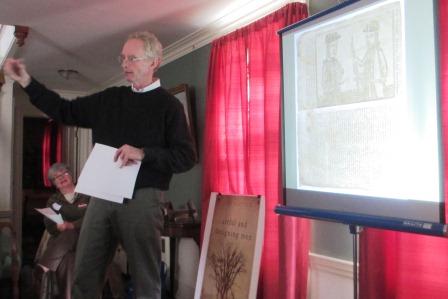
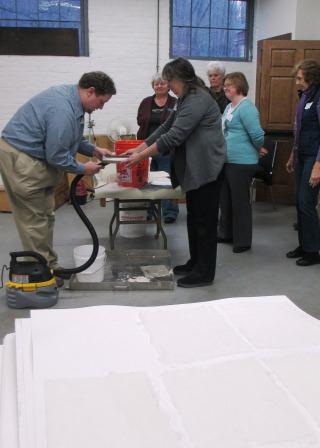
Friday’s highlights included a discussion of the events known as Shays’ Rebellion, tiptoeing through gravestones, and vacuuming water from paper pulp.  First, Gary Shattuck shared his research into the life of his ancestor, Job Shattuck, a participant in the uprising that closed several Massachusetts courts in 1786 and 1787. We discussed the complicated political, social, and economic conditions that led to the “rebellion,” as well as Shays’ and Shattuck’s legacies. Is it really accurate to call these court closings a rebellion? As Gary pointed out, men like Shattuck were not trying to overthrow the system of government, just regulate it. (Perhaps that’s why the title of Gary’s new book is Artful and Designing Men: The Trials of Job Shattuck and the Regulation of 1786-1787.)

Friday afternoon began with a conversation with Dean Eastman, a retired history teacher from Beverly High School and the co-creator (with Kevin McGrath) of the fantastic website, Primary Research: Local History, Closer to Home. Many of the primary-source-based projects featured on the site were collaborations between Dean’s students, historians, and local history organizations. Dean explained how one investigation into the designs carved into eighteenth- and nineteenth-century gravestones encouraged student research on topics including local artists, the religious culture of Massachusetts, and even the growth patterns of lichen. Dean is currently looking for history buffs to participate in a project that traces the men and women who served as apprentices in Essex County, Massachusetts. Visit primaryresearch.org to learn more. The day concluded with a visit to the Crane Museum of Papermaking in Dalton. Curator Peter Hopkins treated us to a hands-on introduction to the art of making fine paper. Did you know that Crane & Co. supplies the majority of the paper that will become United States currency? Although we didn’t get to make money, everyone did take a turn at making a sheet of paper.

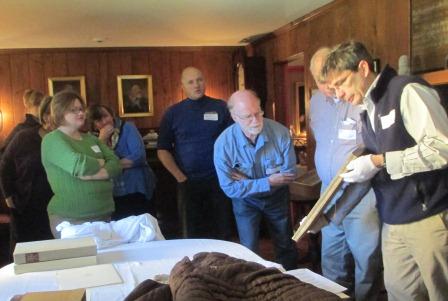
Saturday was devoted to exploring the physical structures and features of the landscape that make Berkshire country such a special place. Curator Will Garrison gave participants a look at some of the artifacts donated to the Berkshire Historical Society over the years. Although the Society is headquartered at Melville’s Pittsfield residence, Arrowhead, the organization’s collections include many intriguing artifacts that speak to the history of the region. Participants caught a glimpse of a nineteenth-century sampler, a cozy looking quilted skirt, a piece of the hull from the U.S.S. Constitution, and part of the press used by the residents of Cheshire, Massachusetts, to make a 1,200-pound wheel of cheese for President Thomas Jefferson in 1802. Our tour of Arrowhead concluded with a walk through his home with Betsy Sherman, Director of the Berkshire Historical Society. She talked about Melville’s longstanding connection to—and affinity for—the Berkshires, as well as the references to the people and places of the region that fill the pages of his writings. She saved the best part of the tour for last: a glimpse into Melville’s study and the stunning view of Mt. Greylock beyond his window. We ended the day in the local history room at the Pittsfield Athenaeum, where Kathleen Reilly treated us to a comprehensive overview of the library’s many resources. Like Dean, she also has a potential research project for anyone with time and interest to spare. Just ask her about the mystery of the twin paintings….

For information about upcoming public programs or workshops, please visit our web calendar or contact the Education Department.

The Real Gettysburg Address

By Peter Drummey, Librarian

On November 19, 1863, when Abraham Lincoln spoke to an immense crowd at the consecration of the Soldiers’ National Cemetery at Gettysburg, Edward Everett of Massachusetts, the greatest orator of the day, was the primary speaker.  In his diary, Everett omitted any reference to the president’s remarks except for his praise of Everett’s speech.  The next day, however, after they had returned to Washington together, Everett and Lincoln exchanged letters concerning their respective addresses:

I should be glad [Everett wrote to Lincoln], if I could flatter myself, that I came as near to the central idea of the occasion in two hours as you did in two minutes. 

Lincoln replied the same day:

In our respective parts yesterday, you could not have been excused to make  a short address, nor I a long one.  I am pleased to know that, in your judgment, the little I did say was not entirely a failure.

On Tuesday, 19 November, the Historical Society will mark the 150th anniversary of the Gettysburg Address by displaying this extraordinary exchange of letters—and other materials related to the respective roles of Lincoln and Everett that day at Gettysburg—from 10:00 AM until 4:00 PM.

 Come and help us decide what was the “real” Gettysburg Address.

This Week @ MHS

By Dan Hinchen

Hello, and welcome once again to our weekly forecast of programs here at the Society. This week, the first and only full week in November for us at the MHS, we have four public programs for you to come in and experience. In addition, don’t forget about our current public exhibition: “The Cabinetmaker & the Carver: Massachusetts Furniture from Private Collections.” This installation provides a rare public glimpse of privately held treasures from across the commonwealth and is part of the Four Centuries of Massachusetts Furniture collaboration taking place at institutions all over the state. Visit fourcenturies.org for more information. Our exhibit is open to the public six days per week, Monday-Saturday, 10:00AM-4:00PM, and will be available until 17 January 2014. 

On Tuesday, 19 November, join us at 12:00PM for an hour-long lunchtime public program. Murray Forbes discusses his work on the fascinating lives of Governor James and General John Sullivan in “The Sullivan Brothers.” The two brothers forged remarkable and versatile careers during the American Revolution and early republic, were honored in their own time and remained remembered and respected through the 19th century. How should we remember them today? This event is free and open to the public.

On Wednesday, 20 November, the Society hosts a double-header. First up, at 12:00PM, is a Brown Bag lunch talk featuring John Lauritz Larson of Purdue University. “On a Bender with Uncle Sam: Freedom, Resources, and the Lure of Progress in the Early Republic” asks how the American Revolution changed the colonial American economic culture patterns of natural resource exploitation. How did the “release of energy” produced by the new political order contribute to new definitions of public and private acquisitiveness, wealth, and progress. Brown Bag lunch talks are free and open to the public.

Then, also on Wednesday, is a public program associated with our current exhibition. Join us at 6:00PM for “Boston & Its Craft Community, 1650-1850.” J. Ritchie Garrison, Director of the Winterthur Program in American Material Culture, will explore Boston’s craft community with a focus on three themes: production as part of a regional network, inequalities that drove artisans’ decisions, and the city’s furniture-makers’ adaptations to a number of factors. To Register: Tickets are $10 per person (no charge for Fellows and Members). Please call 617-646-0560 or register online by clicking here. Pre-talk reception begins at 5:30PM.

And lastly, on Saturday, 23 November, the Society will host yet another public tour. Join us at 10:00AM for “The History and Collections of the MHS,” 90-minute docent-led tour which explores the public space in the Society’s home at 1154 Boylston Street, touching on the history, collections, art, and architecture of the MHS. The tour is free and open to the public. No reservation is required for individuals or small groups. Parties of 8 or more should contact the MHS prior to attending a tour. For more information please contact Curator of Art Anne Bentley at 617-646-0508 or abentley@masshist.org.

Please note that the MHS will be closed 28 November – 30 November for the Thanksgiving holiday. Normal hours resume on Monday, 2 December.


James Mease and American Sericulture

By Andrea Cronin, Reader Services

“We are striving to promote the Culture of Silk,” wrote Dr. James Mease of Philadelphia to Colonel Timothy Pickering of Salem on 13 November 1826. The wealthy physician dabbled in various interests outside of medicine including geology, agriculture, local history, and something called sericulture.

Sericulture, or silk farming, is the breeding of silkworms for the production of silk. In short, silkworms require white mulberry leaves or osage orange leaves to create liquid silk. These caterpillars then spin the liquid silk into cocoons, using the sticky protein sericin to glue each strand together. The cocoons are collected and boiled before the pupas develop and emerge as silk moths. The silk threads of the emptied cocoons disband as the sericin dissolves in hot water. This “raw silk” is then reeled and woven into the cloth. Sounds easy, right?

Silkworm breeding is exhaustively needy at best and disease-ridden at worst. An adult silk moth cannot eat, drink, or fly. The sole purpose of its existence is to mate (which it relies entirely on human intervention to achieve) and produce the next generation. At odds with the laborious milieu of sericulture, Dr. James Mease remarked in the 13 November 1826 letter:

[We] find that the there is no difficulty in breeding the worms – we have abundance of red or native mulberry trees and also the white sort. I imported an ounce of eggs from Genoa last spring and gave them to three persons, who had very great success with them. The Cocoons were twice the size of those produced from Egg previously here.

With mulberry trees aplenty, Dr. James Mease’s associates and other American silk farmers eagerly produced raw silk throughout the early 19th century.

Adams, King, and Jack McCoy

By Amanda A. Mathews, Adams Papers

In the forthcoming Papers of John Adams, Volume 17, Massachusetts representative to the Continental Congress and future minister to Great Britain, Rufus King, pens his first letter to the sitting minister to Great Britain, John Adams, in November 1785, describing himself as a “stranger.” While it was true that the two had not met, Adams had represented King’s father, the Tory-learning Richard King, a dozen years earlier.

In March 1766, a mob of self-described “Suns of liburty” broke into King’s home and store, terrifying his family, breaking windows and burning papers in his desk. Although threatening retaliation for legal action, King pursued a civil action against the group. When he did not find the awarded damages satisfactory, he appealed, and it was at this point that Adams joined as counsel.

This trial, Richard King v. John Stewart et al., is a poignant reminder that before Adams was a Founding Father, he was a talented attorney. This case, perhaps even more than the Boston Massacre trials, reveals that Adams neither allowed his personal political sympathies to cloud his legal judgment nor to determine which cases he would undertake. Moreover, Adams did not simply recite dry legal precedents, but tied the law to strong emotionally driven images to encourage the jury to connect with his client, as this Jack McCoy styled closing argument demonstrates:

Be pleased then to imagine yourselves each one for himself—in bed with his pregnant Wife, in the dead of Midnight, five Children also asleep, and all the servants. . . . The Doors and Windows all barrd, bolted and locked—all asleep, suspecting nothing, harbouring no Malice, Envy or Revenge in your own Bosoms nor dreaming of any in your Neighbours. . . .

All of a sudden, in an Instant, in a twinkling of an Eye, an armed Banditti of Felons, Thieves, Robbers, and Burglars, rush upon the House. Like Savages from the Wilderness, or like Legions from the Blackness of Darkness, they yell and Houl, they dash in all the Windows and enter. Enterd they Roar, they stamp, they Yell, they houl, they cutt break tear and burn all before them.

Do you see a tender and affectionate Husband, an amiable deserving Wife near her Time, 3 young Children, all in one Chamber, awakened all at once, ignorant what was the Cause, terrifyd, inquisitive to know it. The Husband attempting to run down stairs, his Wife, laying hold of his Arm, to stay him and sinking fainting dying away in his Arms. The Children crying and clinging round their Parents—father will they kill me—father save me! . . .

It’s of great Importance to the Community that sufficient that exemplary Damages should be given in such Cases. King might have kill’d em all. If a Man has Humanity enough, to refrain, he ought to be fully compensated.

One of the children home that night was then eleven-year-old Rufus King. Nearly two decades later, he had grown to reject his father’s loyalism, become a staunch patriot and later Federalist, and initiate a correspondence with John Adams that led to a friendship with two generations of the Adams family.

This Week @ MHS

By Dan Hinchen

We return from a long weekend with several programs ready for public consumption this week. Starting the week off, on Tuesday, 12 November, is “Making Land in Earthquake Country: Urban Development and Disaster in San Francisco.” In this Environmental History Seminar, Joanna Dyl of the University of South Florida looks at the earliest years of urban development in San Francisco during the late 1840s and early 1850s, characterized by an emphasis on filling in “water lots.” Dyl’s paper argues that ignorance does not fully explain San Franciscans’ apparent tendency to downplay or ignore the danger posed by the combination of made land and earthquakes. Comment provided by Conevery Bolton Valencius, University of Massachusetts – Boston.Be sure to RSVP for this program by emailing seminars@masshist.org or phoning 617-646-0568. Seminar begins at 5:15PM.

Friday, 15 November, is a busy day at the MHS with two public programs occurring on-site and one off. Taking place in Pittsfield, MA and beginning at 8:30AM is the first day of a two-day teacher workshop, continuing on Saturday, 16 November. “Old Towns/New Country: The First Years of a New Nation” explores how to use local resources to examine historical issues with a national focus, concentrating on the period just after the Revolution. The workshop is open to teachers, librarians, archivists, members of local historical societies, and all interested local history enthusiasts. Workshop faculty will include the MHS Department of Education and Public Programs, Gary Shattuck, author of Artful and Designing Men: The Trials of Job Shattuck and the Regulation of 1786-1787, MHS Teacher Fellow Dean Eastman, and the staff of the Berkshire Historical Society. The program will also include visits to the Berkshire Athenaeum and the Crane Museum of Papermaking. There is a $25 charge to cover lunches both days; program and material costs have been generously funded by the Richard Saltonstall Charitable Foundation. Educators can earn 15 PDPs and 1 Graduate Credit (for an additional fee) from Framingham State University. To Register: Please complete this registration form and send it with your payment to: Kathleen Barker, Massachusetts Historical Society, 1154 Boylston Street, Boston, MA 02215. For Additional Information: Contact the Education Department: 617-646-0557 or  education@masshist.org.

Also on Friday, beginning at 12:00PM, join us at the Society’s building at 1154 Boylston St. for a Brown Bag lunch talk. With “The Urban Archival Regime in Trans-national Perspective: Roxbury, Africville, Hogan’s Alley,” Karen Bridget Murray of Kennesaw State University and York University discusses variations in archival regimes, their relationship to the writing of Black urban history, and their implications for efforts to secure redress for past urban spatial injustices, such as school bussing in Boston, and the razing of African-Canadian communities in Vancouver and Halifax. Brown bag lunch talks are free and open to the public.

And at 2:00PM is a public program focused on our current exhibition: “Early Boston Furniture: Style, Constructions, Materials, & Use.” American furniture collectors John and Marie Vander Sande will discuss late 17th-century joined case pieces, early 18th-century cabinetwork, and pre-1730 chairs produced in Boston. The style, construction techniques, woods chosen, and motivation for the applied decoration, as well as the use of the pieces in the home, will be highlighted. This program is free and open to the public.

Last but certainly not least, on Saturday, 16 November, stop by at 10:00AM for The History and Collections of the MHS. This 90-minute, docent-led tour exposes visitors to all of the public space in the building at 1154 Boylston St., touching on the art, architecture, history, and collections of the Massachusetts Historical Society. The tour is free and open to the public. No reservation is required for individuals or small groups. Parties of 8 or more should contact the MHS prior to attending a tour. For more information please contact Curator of Art Anne Bentley at 617-646-0508 or abentley@masshist.org.


Stephen Greenleaf Bulfinch, Post 27

By Elaine Grublin

The following excerpt is from the diary of Stephen Greenleaf Bulfinch.

Sunday, Nov. 8th

Of military affairs, the rumor is now, – said to be confirmed to-day, – of the taking of Fort Sumter by our forces. We hear of late sad accounts of the treatment of Union prisoners by the rebels, – their suffering from want of food, etc. Their own destitution may partly extenuate this wrong. God grant the end be soon, & the victory of Union & freedom!

Sunday, November 15th

The rumor mentioned in my last entry [the recapturing of Fort Sumter] was not corroborated; but successive advantages give good hope for the cause of Union and Freedom. We lament meanwhile, for the sufferings of our brave men, prisoners in Richmond, said to be almost starved. A plot has been revealed through the British authorities, formed by refugees in Canada, for attacks on our lake cities etc.

Monday Nov. 23d 1863

Last week occurred the Dedication of the Battle Cemetery at Gettysburg. An oration by Mr. Everett, & some noble words from President Lincoln.

Sunday Nov. 28th

Of public events, I must name with solemn gratitude the victory granted to the union arms near Chattanooga & Lookout Mountain. Hope is again encouraged that the end of this awful strife is near.


Fur Trade in the Dorr Family Papers, Part II

By Andrea Cronin, Reader Services

“We desire you to embrace the first favourable Wind and weather and proceed to … any other ports places or Islands where you may think it likely to find seal plenty,” wrote the Boston fur merchants Ebenezer Dorr, Ebenezer Jr. Dorr, Joseph Dorr, and John Dorr to the captain of their snow  Pacific Trader, Samuel Edes, on 11 September 1799. The four-page letter details the responsibilities expected of Captain Samuel Edes during his voyage, including those expectations of the crew to capture and skin any available seal for profit.

The letter stipulates instructions on the preservation of seal hides.

…on your arrival at a suitable place for sealing you will immediately secure your vessel and set your people to work killing seal and preserving their hides either by drying or Pickling as the weather will permit, always remembering, that to have them well dried is our wish in Preference to Salting or Pickling.

This preference for dried hides over pickled ones benefited the merchants twofold. Dried pelts were more stable to transport aboard a sailing vessel because pickled ones were subject to putrefaction and other means of deterioration. Dried pelts additionally yielded higher profits than pickled pelts in Canton. If the process of pickling a seal skin seems curious, it may be interesting to know that pickling (preservation of perishables in brine or vinegar) is often part of the tanning process (the conversion of animal skin to leather by use of tannic acid or other chemicals) . The Dorr merchants informed the captain of their preservation preferences to achieve higher profit in market.


This Week @ MHS

By Dan Hinchen

It is a shortened week for us here at the Society with just a couple of public programs happening but, with the end of the Red Sox season, there are no excuses to miss out on any evening events.

First up, on Tuesday, 5 November, is an Early American History seminar presented by Elaine Crane of Fordham University, with Irene Q. Brown, University of Connecticut, providing comment. Beginning at 5:15PM, “The Poison Plot” looks at the marital failing of early 18th century Rhode Islanders Benedict Arnold and his wife, Mary, who in 1738 tried to poison her husband. The story offers new insights into a range of social fault lines that extended beyond their domestic circle: infidelity, illegitimacy, abuse of husbands, female dependency, criminal proceedings, and the role of the state as mediator. Seminars are free and open to the public, RSVP required. Subscribe to received advance copies of the seminar papers.

And on Wednesday, 6 November, come in at noon for a Brown Bag lunch talk given by MHS-NEH Long-term fellow, Nancy Shoemaker, University of Connecticut. Shoemaker will discuss research for her project “Pursuing Respectability in the Cannibal Isles: Americans in Nineteenth-Century Fiji,” which resurrects the history of the China Trade and the early nineteenth-century Pacific as key sites of American economic and political intervention. It explores the formation of an American sense of self through a study of several individuals, including a “beachcomber,” a sea captain’s wife, and a U.S. Consul.

The library of the MHS is closed on Thursday, 7 November, in preparation for the evening’s event, the fourth annual Cocktails with Clio. Named for the muse of history, this festive evening celebrates American history and the 222-year-old mission of the Society. The evening will feature a cocktail buffet at the Society’s building at 1154 Boylston St., followed by a conversation with political commentator, author, and MHS Overseer, Cokie Roberts, at the nearby Harvard Club. Ms. Roberts will discuss her approach to writing bestselling books about history and historical figures, her work as a political commentator, and how she has used the MHS collections in her research. RSVP required. Tickets are $250 per person. All net proceeds from the event will support the Society’s outreach efforts. For more information, please contact Carol Knauff at cknauff@masshist.org or 617-646-0554.

The MHS will be closed on Saturday, 9 November, and Monday, 11 November, in observance of the Veterans Day holiday. Normal hours will resume on Tuesday, 12 November.

Be sure to keep an eye on our events calendar to stay up-to-date with all of the goings-on here at the Society. And do not forget to come in to see our current exhibition, “The Cabinetmaker & the Carver: Boston Furniture from Private Collections,” on display six days per week, Monday-Saturday, 10:00AM-4:00PM. The exhibit is open to the public with a suggested donation of $5.