This Week @ MHS

By Elaine Grublin

Bouncing back from the November holidays, we have a very busy week ahead at the MHS.

Tuesday, 27 November at 6:00 PM, Waite Rawls, Museum of the Confederacy, presents The Confederacy in History, Myth, & Memory.  A pre-event reception begins at 5:30 PM. Reservations are requested for this free event. To RSVP call 617-646-0560 or click here.

Immediately following the program, current and prospective associate members (age 40 and under) are invited to adjorn to The Hawthorne in Kenmore Square to continue the conversation at our first historical happy hour from 8:00 PM to 9:00 PM.  A separate reservation is required for this event and can be made by calling 617-646-0560 or clicking here.

Friday, 30 November, we close out the month with our signature fundraising event.  Tickets are still available for Cocktails with ClioThe evening begins at 6:00 PM with an elegant cocktail buffet at the Society’s building, followed by a trip to the Harvard Club for dessert and a conversation with cultural critic, Harvard scholar, host of PBS series Finding Your Roots, and MHS Overseer Henry Louis Gates, Jr.  Tickets cost $200 per person. All net proceeds from the event will support the Society’s outreach efforts. For more information or to purchase tickets, please contact Carol Knauff at cknauff@masshist.org or 617-646-0554.
Please note that in order to transform our building for the event, the library and exhibition galleries will close at 2:00 PM on Friday, 30 November.

Credit Where Credit Is Due: Thank You from the MHS

By Emilie Haertsch

At this time of giving thanks, we at the Society reflect on all of those friends who have made our work possible. As part of the recent renovations to the building, we installed plaques to honor our supporters, both past and present, and we take the time now to thank them and all who have become part of our community at the MHS.

On January 24, 1791, the Rev. Jeremy Belknap convened a meeting with nine like-minded gentlemen with the goal of gathering and protecting the basic sources of American history. By the end of that meeting, and through their pledges of manuscripts, books, pamphlets, newspapers, and historical artifacts, the “Historical Society,” the nation’s first, was formed. A lot has changed since then. Today we have many more Members and a beautiful home at 1154 Boylston Street. But what hasn’t changed is our dedication to the Society’s original purpose of serving as a repository and a publisher, collecting, preserving, and disseminating resources for the study of American history. Through exhibitions, our library, lending to other institutions, online resources, publications, public programming, and film and television, the Society’s collections reach local, national, and international audiences.

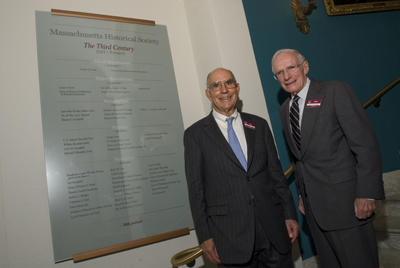
None of this work would be conceivable without the countless numbers of people who have supported the Society’s work intellectually, financially, and through the contribution of documents and objects. Our first recorded gift was $20 from Ebenezer Hazard in 1798, and many others followed, both financial and material. Due to many generous donations, we hold in our collections millions of letters and diary entries, as well as photographs, maps, broadsides, artifacts, works of art, prints, and early newspapers. As a sign of our gratitude and respect, the First Two Centuries plaque on the right wall  of the lobby honors the top 100 donors to the MHS through 1991. On the opposite wall, the Third Century plaque honors recent major donors and will be updated annually.

New Donor Plaque
Scholars, researchers, Board members, donors, Fellows, staff, and visitors – we couldn’t do it without you! Thank you, from the Massachusetts Historical Society.

Image: MHS Board Chair Charlie Ames and Trustee Bill Cotter pose in front of the new third century donor plaque. Photo by Laura Wulf.

Stephen Greenleaf Bulfinch Diary, Post 18

By Elaine Grublin

The following excerpt is from the diary of Stephen Greenleaf Bulfinch.

Saturday, Nov. 29th, 1862

The election in Massachusetts disappointed the party just named [the People’s party], & maintained the high patriotic position of the state. On the other hand, an opposition ticket has prevailed in New York, Ohio, and other states where it had hardly been anticipated. Among the reasons that account for this are dissatisfaction at the slow progress of the war, and the absence of many in the army who would have voted the Republican ticket. The election was soon followed by the removal of Gen. McClellan, – on the ground of slowness and disobedience of orders, – and the appointment of Gen. Burnside in his place. The country and the army acquiesce in these changes. Burnside, of whom I have a very high opinion from what I hear, has advanced & is encamped before Fredericksburg, Va. The rebel army under Lee is opposite him, & a large rebel force, under ‘Stonewall’ Jackson, is or was in the valley of the Shenandoah. An expedition has been preparing, & is now embarking under Gen. Banks, from Long Island; – destination unknown, – rumor points to Texas or Georgia; but many, of whom I am one, hope that it will cooperate with Burnside in Virginia, and Foster in N.C. against Richmond & its defenders. I have two young parishioners, – the Weymouths -, in the 42d Mass. in this expedition.

A Civil War Surgeon & Prisoner of War

By Susan Martin, Collection Services

The Joseph H. Hayward family papersis one of five collections on deposit at the MHS from the Mary M. B. Wakefield Charitable Trust. The collection contains over two centuries of correspondence, diaries, sketchbooks, and other personal papers of members of the Hayward family of Milton, Mass., including Civil War surgeon John McLean Hayward (1837-1886).

John McLean Hayward, or “Mac,” graduated from Harvard Medical School in 1858. His family had already produced a number of doctors, including his father Joshua Henshaw Hayward, his uncle George Hayward, and his grandfather Lemuel Hayward. While still in his twenties, Mac was commissioned surgeon of the 12th Regiment of Massachusetts Infantry, otherwise known as the “Webster Regiment” after its first commander Col. Fletcher Webster. Mac served with distinction at Bull Run, Antietam, and other battles.

Unfortunately, on 19 November 1862, he was captured by the Confederate Army at Warrenton, Va. The Hayward collection contains some fascinating documents related to this incident, including the certificate of his parole, signed by Capt. Robert Randolph of the Black Horse Troop, 4th Virginia Cavalry. On the reverse of this document is a note granting Hayward passage “from Confederate into Federal lines.”


Hayward’s capture was complicated by the fact that he served as a non-combatant. General Order No. 60, issued on 6 June 1862 by the U.S. War Department, stated in no uncertain terms that medical personnel were off-limits. Paragraph 4 of the order read: “The principle being recognized that medical officers should not be held as prisoners of war it is hereby directed that all medical officers so held by the United States shall be immediately and unconditionally discharged.” On 26 June, the Confederate States of America did the same with its General Order No. 45.

On 26 November 1862, Hayward forwarded his parole to the assistant adjutant general in Washington, enclosed in a letter describing the circumstances of his capture. He explained that he had been ill for some time. When the 12th Regiment had decamped from Warrenton, he stayed behind to recuperate and was captured when Confederate troops marched into town. He wrote, “On the 19th Gen. Steward [Jeb Stuart] arrived and demanded my parole. I at first refused to give it on the ground that I was a surgeon and could not be paroled, but Steward took the ground that as I was not in charge of any sick at Warrenton I should be treated like any other officer in the same circumstance and if I refused my parole I should go a prisoner to Richmond.”

Annotations on the back of Hayward’s letter show a series of referrals. In just three days, the letter made its way to the Commissary-General of Prisoners Col. William Hoffman, then to Lt. Col. William H. Ludlow at Fort Monroe, Agent for Exchange of Prisoners. In his referral to Ludlow, Hoffman wrote, “This case comes clearly under Order No. 60, June 6th par. 4 – and Dr. Hayward should be released.” Ludlow agreed, writing, “The parole given by Dr. Hayward is null and void.”

Hayward eventually returned to his regiment, but had to resign his commission in April 1863 due to poor health. After serving for a short time as post surgeon at the Long Island conscript camp in Boston Harbor, he opened a private practice in Boston. In an interesting postscript to his Civil War service, documents in the collection indicate that, on 26 March 1864, he exhibited an invention to the Suffolk District Medical Society – a “mule ambulance” of his own design. The society immediately approved his invention for submission to the War Department.

John McLean Hayward was clearly well-respected as a doctor and a military man. His friend Col. James L. Bates, speaking on behalf of the regiment in a letter to the surgeon general, described Hayward as “a gentleman whom we all love and esteem, and in whose skill in surgery and medicine we have an unbounded faith.”

To learn more about the Hayward family, please visit the MHS library.

Who’s Your Favorite Historian?

By Kathleen Barker, Education Department

Although it’s only early November, program planning for the winter and spring of 2013 is well under way here in the Education Department. The MHS will be offering an interesting mix of public programs in the coming months, including concerts, author talks, a walking tour, and even a dramatic reading! Even as we experiment with different program formats, however, we always remember to ask ourselves how we can shine a spotlight on the Society’s unique resources and assets. In addition to our amazing collections, the MHS also employs a phenomenal staff with connections to an engaging array of historians, public figures, artists, and others who make use of history in their work. How can we tap into this deep pool of historical enthusiasm? What is the best way to connect all of these fantastic people with our public program audiences?  We’ve come up with a few ideas, but we’d love to hear what YOU think.

One program we will pilot in 2013 is modeled after something we’ve tried at our annual fundraiser, “Cocktails with Clio.” At each of the past two events, the Society’s President has interviewed a prominent historian as part of the evening’s entertainment. We’d like to build on this format and develop an entire series of discussion-based programs that feature historians working on intriguing projects.

So … who is your favorite historian? Who would you like to converse with at the MHS? Along the same lines, we’re also on the lookout for non-historians who could comment on how history affects their work. Jurists, for example, could discuss how they use history to frame their responses to current court cases, while city planners could explain how they engage with the past while planning for the future. Are there other “opinion makers” you’d like to see at the MHS? Use the comment form below to let us know!

Of course, writers and artists use history in their work all the time, and we’re excited to offer several prominent examples of historically minded creations this spring. In February, for example, we will host author William Martin, who will share the experience of writing his latest book, The Lincoln Letter, a work of historical fiction that takes readers on a an adventure through Civil War Washington. In May, we will bring our collections to life in song and theater. Local playwright Rob Velella will join us for a dramatic reading that explores the friendship between Charles Sumner and Henry Wadsworth Longfellow. His performance is based on the letters, journals, and other documents created by both men. Later in the month, Berklee Professor of Music Education Peter Cokkinias brings his Boston Saxophone Quartet to MHS. The group will perform music from the era of the American Civil war and provide historical commentary on songs that our audience will be sure to recognize. Are you ready to sing along?

Now that you’re all excited about 2013, don’t forget that we have some nifty programs coming up in November and December. Be sure to visit our web calendar often for more information about programs on the horizon.

Terrorism No New Topic to Presidential Elections

By Emilie Haertsch, Publications

It’s Election Day, and there has been a lot of talk in the news lately about terrorism influencing the current and last two presidential elections. But although sometimes it feels like it’s a relatively new political issue, the fear of terrorism has been part of the American political discussion since our nation’s founding. During the presidential election of 1800, terrorism and its prevention were hot topics, and part of what cost Pres. John Adams his reelection.

During Adams’s presidency, America was involved in the Quasi-War with France from 1798 through 1800. France was a great ally to the United States during the American Revolution, but much changed in the intervening years. The United States made peace with Great Britain in 1783, and several years later the French monarchy collapsed. Revolutionary France declared war on Great Britain, and Great Britain joined a coalition of European monarchies that aimed at containing the French Revolution. The United States remained neutral in the conflict. In addition, the U.S. government refused to repay debts owed to France from the American Revolution, claiming that they were owed to the French monarchy, which no longer existed. Ignoring American neutrality, French privateers began seizing American merchant ships in the West Indies. This led to an undeclared war between the United States and France—the Quasi-War.

Pres. Adams and the Federalist Party supporters aligned with Great Britain. They viewed the French Revolution as mob rule and resented what they saw as foreign intervention in American domestic politics. They also feared the threat of possible invasion. Adams signed the Alien and Sedition Acts into law in 1798. The four laws targeted French immigrants and sympathizers to the French cause, but also foreigners in general and anyone who criticized the government. The Alien and Sedition Acts increased the residency requirement for citizenship from five to fourteen years and empowered the president to deport aliens “dangerous to the peace and safety of the United States” at will. No one ever was prosecuted or deported as a “dangerous” alien and the law expired in 1800, but it had a chilling effect on resident aliens. A separate law that allowed the president to restrain or remove enemy aliens in wartime was the only act that had wide support in congress (and still is in effect today), but was not used by Adams because the U.S. never formally declared war on France. The laws also limited the freedom of the press, a sentiment that Adams had strongly supported as author of the Massachusetts Constitution. The Sedition Act gave the government broad power to suppress public attacks on the government and its officials, and, as a practical matter, allowed the Federalists to prosecute their political opponents. The Sedition Act also had a fixed term and ended on the last day of Adams’s presidential term in March 1801.

When the Federalists attempted to use the Alien and Sedition Acts to silence their opposition, they met strong opposition from the Democratic-Republican Party, a party more closely aligned with the ideals of the French Revolution and under the leadership of Vice President Thomas Jefferson. Most newspapers of the day were partisan, and when Republican newspapers harshly criticized the Adams administration for its handling of French relations, fourteen authors and editors were tried under the new Sedition Act. Playwright and newspaperman James Burke, Vermont congressman Matthew Lyon, and newspapermen Thomas and Abijah Adams were among those indicted for seditious libel.

The 1800 presidential election was a bitter continuation of the previous presidential election. One of the Democratic Republicans’ chief criticisms of the Federalist Party was of its efforts to centralize and increase governmental power, illustrated by the passage of the Alien and Section Acts and the resulting infringement on individual rights. Republicans were not necessarily against prosecutions for seditious libel, but believed they should take place in state rather than federal courts.

The Republicans won the election of 1800 and, at least in part because of the unpopular acts, Adams became a one-term president. He was succeeded by Jefferson who, in his conciliatory first inaugural speech, said that “…every difference of opinion is not a difference of principle. We have called by different names, brethren of the same principle. WE ARE ALL REPUBLICANS; WE ARE ALL FEDERALISTS.” His administration too soon would be at war with foreign “terrorists,” in this case the Barbary pirates, who attacked and kidnapped American sailors in the Mediterranean.

During the recent presidential debates, Pres. Barack Obama and former Massachusetts governor Mitt Romney addressed their own positions on terrorism and homeland security. Although the threat may look slightly different now, with a greater focus on foreign terrorists rather than internal subversion, it’s nothing new to American politics. Just ask John Adams—and Thomas Jefferson. And don’t forget to vote!

The Past in the Present: Election Day

By Elaine Grublin

As evidenced in this 1798 cartoon, politcs in America have always been contentious. To mark Election Day the MHS offers a retrospective of items from our blog and across our website related to American electoral history. 

From the Beehive:

Terrorism No New Topic to Presidential Elections (6 November 2012)

“The Inveteracy of Party Spirit is however indeed allarming at present.”: Press and Partisanship in the Election of 1796 (31 October 2012)

Historian Ray Raphael on that Flummoxing Electoral College (28 September 2012)

Election Days Past (2 Nov 2010)

Our Newest Arrival: Abigail Adams on Election of 1800 (27 May 2010)


From Collections Online:

Leverett Saltonstall and the Election of 1876

The American Party (the Know-Nothing Party) comes to power in Massachusetts in 1855

The Gerry-Mander. A new species of Monster which appeared in Essex South District in Jan. 1812

GOP campaign mugs of Richard M. Nixon and Henry Cabot Lodge, Jr. (Just for fun.)


And with all the attention political ads have given to female voters in this year, it seemed appropriate to point back to Massachusetts Woman Suffrage Victory Parade : Instructions for Marchers


The image above is “Congressional Pugilists”, a political cartoon depicting Matthew Lyon fighting with a federalist opponent on the floor of Congress early in 1798.


This Week @ MHS

By Elaine Grublin

It is a relatively quiet week at the MHS, with only one public program being offered.  But it promises to be a great one.

If you are looking for something to do on your lunch hour on Wednesday, 7 November, come to 1154 Boylston Street at 12:00 PM for a brown-bag lunch presentation by MHS-NEH long-term fellow Matthew Dennis, University of Oregon. Dennis will present “American Relics and the Material Politics of Public Memory,” a project that assesses American relics that have emerged and persisted since the colonial period, placing them in a broader context, using their histories to analyze the means through which Americans have used them to express and authorize their public words by making those words (literally) concrete.

Please note that their is no building tour on Saturday as the MHS will be closed Saturday, 10 November and Monday, 12 November in observance of Veterans Day. 

Brown Bag Lunch Talk: “The Theology of Citizenship”

By Anna J. Cook, Reader Services

On Wednesday, October 31, Andrew W. Mellon research fellow Ben Park, a Ph.D. candidate at the University of Cambridge, England,  presented a brown bag lunch talk, “The Theology of Citizenship: Local Preachers and the Production of Nationalism in Early America.” Park’s dissertation explores the local production of national identities in the Early Republic, using South Carolina, Pennsylvania, and Massachusetts as comparative regional case studies. His current research focuses on the role of the clergy in imagining and disseminating notions of citizenship and national character. To introduce his topic, Park described the evolution of the Reverend Jeremy Belknap (1744-1798), a key figure in the founding of the Massachusetts Historical Society. Belknap spent his early career in New Hampshire where his sermons remained politically neutral throughout the Revolution and into the 1780s. Only when Belknap moved from New Hampshire to Boston in 1787, where he took up a post at the Federal Street Church, did his weekly sermons begin to more overtly combine religious notions of providentialism with exhortations to patriotic sensibility. He began to speak of God’s role in shaping the United States as a nation, condemned those he saw as religious and political fanatics, had harsh words to say about French “atheist” revolutionaries, and expressed trepidation at the growing role of mercantilism in American life. Park theorizes that Belknap’s change in geographic location brought him into a new “localized nationalism,” in which particular Boston-based notions of civic responsibility and national identity galvanized him into political speech. Previous historians have explored the effect of politics on religious identity and practice; Park wonders about the effect of religion on political identity and action.

Conversation following Park’s presentation explored the working definitions of “local,” “national,” and “citizenship,” and the relationship between these three concepts: What does it mean for citizens to articulate ideas of nationalism from their position in a particular locality? What happens when individuals from two different localities converse about their mutual citizenship in the newly federal America? To what extent can existing sources – such as sermons – open a window into how congregants understood themselves in relation to political powers? When sources are clustered in urban centers (Boston, Philadelphia, and Charleston) to what extent can arguments be made about the region as a whole? What interpersonal networks existed between urban and rural communities in each state? How does one get not only at local political ideas but also local political acts such as voting, pageantry, and revolts?

We look forward to following Ben’s work during over the course of his year-long residency here in Boston conducting his primary source research for the dissertation; and eventually we look forward to congratulating him upon a successful defense of his work and conferral of his Ph.D. Best wishes for a successful year of study and writing!

“The Inveteracy of Party Spirit is however indeed allarming at present.”: Press and Partisanship in the Election of 1796

By Amanda A. Mathews, Adams Papers

As another election season draws to a close, there is mounting concern over the state of American party politics with vitriolic and panic-stricken ads, headlines, and pleas for support dominating the media. We rush to declare an election “the nastiest ever” as we consume the negative ads and media distortions. Meanwhile, all sides assert, as Abigail Adams did to her son, John Quincy, in the late fall of 1796, “at no period has our National interest been in a more Dangerous, or difficult situation than the present.”

In the forthcoming Adams Family Correspondence, Volume 11, John Adams faces off with Thomas Jefferson in the nation’s first contested presidential election, following the retirement of George Washington in 1796. While this contest predates modern electioneering practices such as party conventions and stump speeches, much of it sounds familiar to the modern reader. Abigail complains, for instance, that Democratic-Republican newspaper editors falsely attack John for supporting “hereditary” government, and that “by such false and glaring absurdities do these misirable Beings endeavour to deceive and delude the people.”

Still, Abigail remained fearful of what might happen if the country made the wrong choice. “I feel anxious for the Fate of My Country,” Abigail wrote, “if the Administration should get into Hands who would depart from the System under which we have enjoyed so great a share of Peace prosperity and happiness, we should soon be involved in the wars and calamities which have deluged other Nations in Blood, we should Soon become a devided and a misirable people.”

Writing to his wife in December 1796, John Adams noted, “The Inveteracy of Party Spirit is however indeed allarming at present. There have been Manœuvres and Combinations in this Election that would Surprize you.” Adams, however, should not have been so surprised. In his own Defence of the Constitutions of Government of the United States of America (1787–1788), a work repeatedly held up as proof of his “undemocratic” principles, Adams noted the “natural and unchangeable inconvenience in all popular elections.” Candidates were likely to be of near equal merit, and voters of good faith would be nearly evenly divided. Therefore, elections would turn on which candidate “has the deepest purse, or the fewest scruples about using it” to win over those whose votes were for sale. So as we shake our heads at yet another political ad, we can take a bit of comfort that it is just another part of one of America’s oldest political traditions.