
Helen Keller in Boston

By Susan Martin, Collection Services

Those of us who process manuscript collections are always stumbling on interesting and unexpected finds. I was recently working with the MHS’s George E. Ellis papers to improve the arrangement and description of the collection, and one letter immediately caught my eye. It was written by 10-year-old Helen Keller.

Between 1888 and 1892, Keller was a student at Perkins School for the Blind in South Boston. (The school moved to Watertown, Mass. in 1912.) She found a happy home at Perkins, which she described in her 1902 autobiography The Story of My Life: “Until then I had been like a foreigner speaking through an interpreter. In the school where Laura Bridgman was taught I was in my own country.”

The subject of this letter, written to Dr. Ellis on 27 April 1891, is four-year-old Tommy Stringer, another Perkins student who was both blind and deaf. Stringer’s family was unable to support him, so he had been brought up from an almshouse in Pennsylvania to the Perkins kindergarten. Keller became his energetic advocate and wrote to friends and strangers alike, as well as newspapers, to solicit donations for his education. Ellis was one of the many who contributed. Keller wrote to him gratefully:

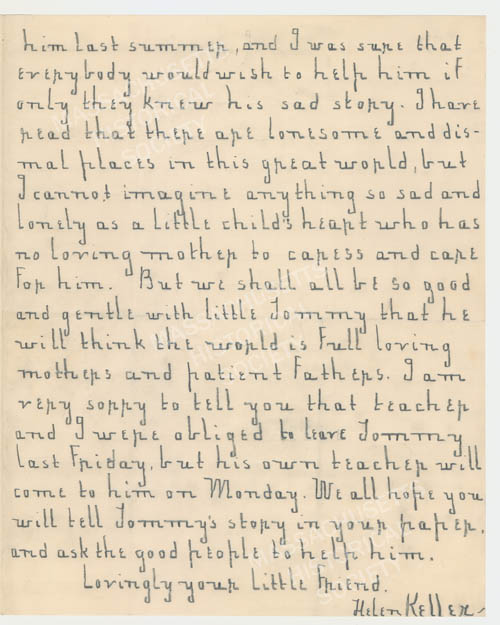
Mr [Phillips] Brooks once told me that love was the most beautiful thing in the world, and now I am sure it is, for nothing but love could brighten Tommy’s whole life. I think we ought to love those who are weak and helpless even more tenderly than we do others who are strong and beautiful….I have read that there are lonesome and dismal places in this great world, but I cannot imagine anything so sad and lonely as a little child’s heart who has no loving mother to caress and care for him. But we shall all be so good and gentle with little Tommy that he will think the world is full [of] loving mothers and patient fathers.

It just so happens that Ellis was the president of our very own MHS at the time, an historian, and a former minister of the Harvard Church in Charlestown, Mass. He corresponded with many notable people, but this letter, written in large, neat, blocky handwriting, stands out from the rest. It’s amazing to realize that it was written just four years after Keller met Annie Sullivan, at which time Keller could barely communicate at all, let alone read and write. (About a year later, she explained to the readers of the children’s magazine St. Nicholas how she wrote by placing a “grooved board” between the pages, probably some version of a noctograph.)

George E. Ellis died in 1894. In his will, he bequeathed $30,000, as well as his home and all its contents, to the MHS. Funds from the sale of his property were used to help build and relocate to our current home at 1154 Boylston Street. Our very own research room, Ellis Hall, is named after him. We hope to see you there sometime!

Thomas Stringer graduated from Perkins in 1913 and became a woodworker in Pennsylvania, dying in 1945.
This Week @ MHS

By Dan Hinchen

Even with a shortened week there is a plethora of public programs going on at the MHS. The Society is closed for business on Monday, 14 October, in observance of the Columbus Day holiday, however, the building will be open to visitors as part of the Fenway Cultural District’s Opening Our Doors event. This is the largest single day of free arts and cultural events in Boston and the MHS will have an open house from 10:00AM to 3:00PM.

On Wednesday, 16 October, the Society will host Charlene Mires of Rutgers University for an author talk. “Capital of the World: The Race to Host the United Nations” tells the story of an ambitious dream shared and pursued by Bostonians in 1945-1946: to serve as headquarters for the new United Nations and to become not only “the Hub” but also the Capital of the World. This illustrated talk will draw from Mires’ book to talk about the dramatic, surprising, and often comic story of civic boosterism awakened by the UN’s search for a home. Registration is required for this talk and tickets are $10 per person (no charge for Fellows and Members). Please call 617-646-0560 or register online by clicking here. There is a pre-talk reception beginning at 5:30PM and the talk will commence at 6:00PM.

That author talk is followed up by another the next day, Thursday 17 October. “Book of Ages: The Life and Opinions of Jane Franklin” is presented by Jill Lepore of Harvard University. Taking place at Boston Public Library, Copley Square, this talk will center on Lepore’s new book about the constant presence and influence that Jane Franklin had in the life of her brother, Benjamin Franklin. The author provides a revelatory portrait of the youngest Franklin daughter, herself a passionate reader, gifted writer, and shrewd political commentator, through the use of little-studied documents, objects, and recently-discovered portraits. The is event is free and open to the public. To reserve a spot, visit the Boston Public Library’s website for additional information and directions. Talk begins at 6:00PM.

On Friday, 18 October, at 2:00PM, stop by the Society for a free public program centered around the current exhibition: “The Call of Classicism: Boston Furniture from the Early 19th Century.” This exhibition spotlight by Irfan Ali, a collector of American furniture, examines Boston’s answer to the call of classicism in the early 19th century, a time of prosperity for the city, by looking at furniture made by craftsmen such as Thomas Seymour, Isaac Vose, and Archibald and Emmons. This program is free and open to the public.

As a reminder, our current exhibition, “The Cabinetmaker & the Carver: Boston Furniture from Private Collections,” is on view to the public six days per week, Monday – Saturday, 10:00AM – 4:00PM. Visit fourcenturies.org to learn about other similar exhibits done in conjunction with our own.

There is no tour this Saturday, 19 October.


Considering Collation: Decoding the Formula

By Dan Hinchen, Reader Services

In my last post I shared some of the lessons that I learned in July at Rare Book School at the University of Virginia. Now, as promised, I can explain what some of it means. If you remember, I provided a collation formula of a book from the print collection here at the MHS. Specifically, I gave a description of a book called “Pansebeia.” Published in the mid-17th century, this book purported to be a view of “all the world’s religions.” The formula that I gave read like this:

8°: A8 a8 B-I8 L-R8 T-2M8 2N4 3A8 3a4 3B-3F8 (K8 S8  3F8 missing; 2D6 missing, removed); [$4 (-3A2, 3a4) signed; missigning V4 as U4]; 345 leaves; [32] 1-544 [545-552]; 2[24] 1-78 [79] [misnumbering 68 as 63, 78 as 73, 206 as 106, 479 as 463, and 266 as 96].

So, what does this mean? Well, it might take a while to explain all of this, so let us start simply.

This opening piece of the formula designates the format of the book. This lets us know the relationship between sheets of paper on which the text is printed and the number of individual leaves created when the sheets are folded into gatherings.

In determining the format of a book it is not sufficient to simply count the number of leaves in a gathering. There must be some other physical evidence to base it on. This is where watermarks and chainlines come in handy. A watermark is a symbol created by the papermaker to show that the hand-made product is his. The marks always appear on the same part of the sheet since it was actually a part of the frame used to create the paper. So, when folding a sheet of paper a certain number of times, the watermark will always appear in the same orientation, whether it is in the center of the page in a folio, in the center of the gutter of a quarto, or in the top of the gutter for an octavo. The chainlines in the paper are created by wires used in the paper-making frame that are slightly thinner than the rest of the sheet and are clearly visible when backlit. These lines will either appear vertically or horizontally in a book depending on the folds of the paper. So, using these identifying marks and seeing how they are aligned, we can establish the format of the book.

Specifically, this symbol refers to an octavo format; it can also be written 8vo. This means that the printer, when impressing sheets of paper with the text for the work, laid eight pages of text on each side of a sheet of paper in a designated pattern. The sheet is then folded three times, each time it is folded on the long edge of the sheet. What results is a gathering of eight leaves and sixteen pages.

Stay tuned for my next blog when I provide a little bit of information relating to signatures.

And since we are nearing Halloween, I leave you with a bibliographic description of “The doctrine of devils,” another title from the MHS print collection. Can you decipher any of the formula?

8°: A4 B-O8; [$4 (-A3,4) signed; missigning I4 as I3]; 108 leaves; pp. [8] 1-205 [3].


A “Painless” Day at the MHS

By Kathleen Barker, Education Department

On Saturday, 5 October, the MHS hosted a fun-filled, hands-on workshop for teachers, students, librarians, and history enthusiasts. Nearly 20 participants braved the beautiful weather (and the Red Sox home game) to spend a day working with documents from the Society’s collections. Participants travelled far and wide to visit the MHS, and our guest list included students from Arlington; teachers from Bedford, Sharon, Rutland, Revere, and Fitchburg; and librarians and archivists in Boston, Methuen, and Wayland. Who could resist a workshop with a cheeky title like “Painless: A Survival Guide to the Dreaded History Project?”

Our goals for this one-day event included introducing visitors to the resources of the MHS, and encouraging those participants to think more creatively about the ways in which they present history to various audiences. To begin, we examined a range of historical documents from the era of the American Revolution through the Civil War, looking for connections to the theme of “rights and responsibilities.” As they perused letters, diaries, songs, petitions, and government records, participants were asked to collect evidence and draw conclusions about the past based on their understanding of the materials.  Our clever participants identified several themes and essential questions that could be used to anchor a history project. We discussed ideas such as natural rights; the role of government in creating and protecting rights; and the various ways that people fought to protect or change their rights in the eighteenth and nineteenth centuries.

Once our intrepid investigators had collected their evidence, it was time for them to decide how to present their findings. Robert Jones, co-coordinator of Massachusetts History Day discussed how the program works, and how History Day methods can be used to encourage the creation of imaginative and engaging history projects. Students in grades 6-12 can participate in History Day, and Bob explained the different sorts of projects that student can create. The group discussed the pros and cons of the traditional history paper, websites, exhibitions, documentaries, and performances. It was then up to all of our participants to create their own project – in 15 minutes or less! One group of participants decided to create a website in order to make use of the great visuals on the site, as well as the multimedia capabilities of the web. (We’d love to see a site featuring songs from the collections of the MHS!) Another very brave group decided to create a 10-minute performance depicting abolitionist activities in the 1840s and 1850s.

It’s safe to say that by the end of the afternoon, our participants had several new methods for tackling the “dreaded” history project, whether it’s an exhibit for the local historical society, or a paper for a high school history class. If you’d like to join us for an upcoming workshop, visit our web calendar or the Education page. For more information about Massachusetts History Day, or to learn about serving as a judge at a 2014 History Day competition, visit the MHD website for news and contact information. 


Volunteer, the America’s Cup victor—of 1887

By Peter Drummey, Librarian

The extraordinary come-from-behind victory of Oracle Team USA in the recent America’s Cup competition calls to mind a time when Boston was the center of American yacht racing design and development.  Between 1885 and 1887, the local team of Charles Jackson Paine (owner) and Edward Burgess (designer), first as part of a syndicate and then twice on their own, defended the Cup in three successive campaigns.  The triumph of their center-board sloop, Volunteer, over the British challenger, Thistle, in September 1887, was the cause of an enormous victory celebration that took place, on October 7, 1887, 126 years ago , at Faneuil Hall in Boston.  While photographs of elegant Volunteer evoke a romantic, now long-lost age of sail, she was, in her own day, as innovative as the wing-sailed catamarans that vie for the Cup today.  Designed and built in great secrecy with steel frames and plating, Volunteer could carry ballast lower in her hull than her wooden-hulled predecessors.

Although 19th–century Boston was increasingly divided along ethnic and political lines, in 1887 the entire city came together in a joyous outpouring of patriotism at a monumental reception for their local heroes. So many ardent supporters attended the event—which included the reading of a poem written for the occasion, “Bostonia Victrix”— that the program was interrupted at several points “to allow the assembled multitude to greet the guests of the evening with a hand-shake.”  Newspaper reporters estimated that 7,000 people queued up for the opportunity to personally thank “enterprising” Charles J. Paine and equally “inventive” Edward Burgess, the “guardians of the Cup.”    

This Week @ MHS

By Dan Hinchen

It is another busy week here at the MHS now that public program season is in full swing. On Friday, 4 October, our new exhibition opened to the public. Be sure to come in soon to see “The Cabinetmaker & the Carver: Boston Furniture from Private Collections,” on display six days per week, Monday-Saturday, 10:00AM – 4:00PM.

On Tuesday, 8 October, the Society presents its first Environmental History Seminar of the season. Starting at 5:15PM, John Lauritz Larson of Purdue University will present “From Wilderness Environments to Well-Ordered Plantations: The Gifts of God Perfected by Industry.” Comment provided by Joyce Chaplin, Harvard University. Be sure to RSVP for this program by emailing seminars@masshist.org or phoning 617-646-0568. Subscribe to received advance copies of the seminar papers.

Then, on Wednesday, 9 October, come by at noon for “An Empire of Fakes: Counterfeit Goods in Eighteenth-Century America.” This project by Catherine Cangany of the University of Notre Dame investigates the market, commodities, producers, suppliers, vendors, and consumers of spurious merchandise in early Anglo-America. The work reclaims forgotten commercial actors and networks and downplays the primacy of mercantilism to emphasize individualism. This individualism may have been the more important commercial doctrine, given that the underground economy constituted half of all economic transactions in this period. Brown Bag Lunch talks are free and open to the public.

And on Wednesday evening, join us at 6:00PM for “Behind the Scenes at the Museum: The Curator’s View of ‘Boston Furniture from Private Collections.'” This presentation will offer an opportunity to learn about and tour this loan exhibition of more than 40 rarely seen examples of Boston furniture from ca. 1690 to ca. 1900 with guest curator Gerald W.R. Ward, the Katherine Lane Weems Senior Curator of American Decorative Arts and Sculpture, Art of the Americas, at the Museum of Fine Arts, Boston. There will be a pre-talk reception at 5:30PM. Registration is required for this event. Tickets are $10 per person (no charge for Fellows and Members). Please call 617-646-0560 or register online.

On Thursday, 10 October, the MHS will sponsor another seminar, this time from the History of Women and Gender series. Beginning at 5:30PM and taking place at the Schlesinger Library at Harvard University, Kate Dossett of the University of Leeds presents “‘Qualified Women’: Women, Performance and Political Labor in the New Deal,” with comment provided by Susan Ware, General Editor of American National Biography. Seminars are free and open to the public; RSVP required. Subscribe to received advance copies of the seminar papers. To RSVP for this program, email seminars@masshist.org or phone 617-646-0568.

Finally, on Saturday, 12 October, visit the Society for The History and Collections of the MHS, a 90-minute docent-led tour that explores all of the public rooms in the building will touching on the art, architecture, history, and collections of the Society. The tour is free and open to the public. No reservation is required for individuals or small groups. Parties of 8 or more should contact the MHS prior to attending a tour. For more information please contact Curator of Art Anne Bentley at 617-646-0508 or abentley@masshist.org.


Chinese Hanzi Characters in 1801

By Andrea Cronin, Reader Services


On 30 July 1801 the snow Pacific Trader bound for Canton floundered in the Pacific Ocean when the vessel took on water in the midst of a violent two-day gale. The winds tore the sails and mangled the rigging so terribly that the ship and its small crew limped into safe harbor at Macao on 23 August 1801. Proprietors William and Sullivan Dorr in Canton received more than ten letters from Captain Samuel Edes aboard the Pacific Trade in the subsequent month while the ship sheltered and was repaired in Macao. These letters are contained in the Samuel Barrett Edes papers held at the MHS.

On 27 September 1801 Captain Edes writes to inform the Dorrs of the progress of ship repairs and the condition of the cargo. However, it is the verso page of the letter that truly captures my imagination. The verso functioned as the envelope, containing the address information of the intended recipient, Sullivan Dorr. Far more interesting than the address is the beautiful example of Chinese Hanzi characters composed on the verso.

I imagine that the Hanzi message reveals directions due to its location close to the address, just near the seal. However, a larger question looms in my mind. Who wrote this inscription? The small crew of the Pacific Trader hailed from Massachusetts, New York, Virginia, Ireland, St. Croix, Guadeloupe, and Bengal according to a crew list in the Samuel Barrett Edes papers. None of these men were native to China or surrounding countries that utilized Hanzi script. Although some crewmen may have learned the spoken language, the beautiful and careful script of the Hanzi suggests to me that a native writer composed the message.

Are you familiar with 19th century Chinese Hanzi script? Can you read this inscription? We would love to hear from you!

John Adams and the Bill of Rights

By Amanda A. Mathews, Adams Papers

On this day in 1789, President George Washington wrote a short letter to each state’s governor, enclosing a copy of twelve proposed amendments to the new United States Constitution for consideration, which Congress had passed on September 25 with the signatures of the Speaker of the House and the President of the Senate, Vice President John Adams. Of the twelve, ten received the necessary ratification and collectively became known as the Bill of Rights.

These amendments corresponded with many of the changes for which John Adams had expressed a desire when he first read the proposed Constitution. “A Declaration of Rights I wish to see with all my Heart,” he confided in early 1788, “though I am sensible of the Difficulty of framing one, in which all the States can agree.— a more compleat Seperation of the Executive from the Legislative too, would be more Safe for all. The Press, Conscience & Juries I wish better Secured.— But is it not better to accept this Plan and amend it hereafter?”

Adams certainly was “sensible of the Difficulty” of writing a constitution. A decade earlier, in the fall of 1779, he toiled over his draft of the Massachusetts constitution, drawing upon the other states’ constitutions as well as his own extensive study and consideration of law and government. Not only did he include protections for the press, religious belief, and juries, but reflecting the importance the Declaration of Rights held for Adams, he had placed it ahead of the frame of government itself.

While the proposed amendments did not repair all the defects that Adams perceived in the federal Constitution (he particularly opposed the limited presidential veto and the need for Senate approval of nominations), he understood that the Constitutional Convention’s achievements could not be diminished, even if the final product remained flawed. “A result of accommodation cannot be supposed to reach the ideas of perfection of any one,” Adams admitted in the conclusion of his Defence of the Constitutions of Government of the United States, “but the conception of such an idea, and the deliberate union of so great and various a people in such a plan, is, without all partiality or prejudice, if not the greatest exertion of human understanding, the greatest single effort of national deliberation that the world has ever seen.” The new Bill of Rights moved the nation another step toward a “more perfect union.”

This Week @ MHS

By Dan Hinchen

It is a busy week here at the Society with a variety of public programs for your enjoyment, so clear your calendar and check out ours!

Starting the week off on Tuesday, 1 October, is the first event of the season from our Early American History Seminar series. Join us as Karin A. Wulf of William and Mary College presents a “Town Hall Meeting with the New Director of the Omohundro Institute of Early American History and Culture.” This town hall meeting will provide an opportunity to discuss the present and future of the OIEAHC. Through conferences, fellowships, and publications including the William and Mary Quarterly, the institute fosters scholarship on colonial and early national American history as well as the Atlantic world. Wulf began her tenure on 1 July. Be sure to RSVP for this program by e-mailing seminars@masshist.org or phoning 617-646-0568. Program begins at 5:15PM.

On Wednesday, 2 October, come in at noon for a Brown Bag Lunch talk. This week, Marisa Benoit of Oxford University presents “New England Teares, for Old England’s Feares: Comparing Attitudes Toward Infertility in Early Modern England and Colonial New England.” Through analysis of a wide variety of sources from 1650 to 1750, this comparative study of attitudes toward infertility in colonial New England and early modern England examines two societies linked by cultural and religious norms but facing different challenges. These challenges are explored by analyzing infertility’s representation in popular, religious, and medical literature and personal writings from both societies. Analysis of these representations of infertility provides a different angle through which to view the links between “Old” and New England, a relationship often described through reproductive language, while highlighting the connections between the sources themselves. The topic provides the opportunity to untangle the web of emerging anatomical discoveries, social ideas about gender relations, the family, and the importance of children, and religious ideas about generation that characterized attitudes toward reproduction in the early modern period. This event if free and open to the public. Pack a lunch and come on by!

Thursday, 3 October, will see the preliminary unveiling of the Society’s newest exhibition. MHS Fellows and Members are invited to a special preview and reception for “The Cabinetmaker & the Carver,” beginning at 6:00PM. This exhibit provides visitors with an opportunity to view nearly 50 examples of rarely seen furniture borrowed from distinguished private collections in the greater Boston area. Ranging in date from the late-17th century to about 1900, these privately held treasures, generously lent by their owners, provide a look at the trajectory of cabinetmaking in the Hub.Tickets are $25 (no charge for MHS Fund Giving Circle members) and RSVP is required. To register by phone or e-mail, call 617-646-0552 or e-mail bwillett@masshist.org.

This exhibit opens to the public on Friday, 4 October, and will be on display Monday through Saturday, 10:00AM to 4:00PM, until 17 January 2014. The furniture pieces are supplemented with documents, portraits, and other material from the Society’s collections that help place them in historical context.

Coinciding with the public opening of the exhibition, also on Friday, 4 October, is “New Thoughts on Old Things: Four centuries of Furnishing the Northeast.” This day-long symposium, co-sponsored by the Museum of Fine Arts, Boston, the Colonial Society of Massachusetts, and the MHS, is devoted to new scholarly research on the design, production, and circulation of furnishings in New England. The program will feature keynote speaker Glenn Adamson, Head of Research at the Victoria and Albert Museum in London, along with a select group of emerging scholars. Taking place at the Museum of Fine Arts and beginning at 10:00AM, the symposium is free with admission to the museum. Advanced ticketing is recommended. For information, please contact Lauren Spengler at lspengler@mfa.org.

The Society’s exhibition and the public symposium are presented as part of Four Centuries of Massachusetts Furniture, a collaborative project of the MHS and ten other institutions that features exhibitions, lectures, demonstrations, and publications to celebrate the Bay State’s legacy of furniture-making. Visit fourcenturies.org to learn more.

Finally, on Saturday, 6 October, the MHS, in collaboration with the National Archives at Boston and Massachusetts History Day, will present “Painless: A Survival Guide to the ‘Dreaded’ History Project.” This free workshop for teachers, students, librarians, and archivists explores how to approach primary source research in special libraries and archives through a range of historical documents including letters, diaries, songs, petitions, and government records. The workshop will take place at the National Archives in Waltham and begins at 9:00AM. For more information, or to register, please contact Kathleen Barker at the Massachusetts Historical Society: eduation@masshist.org or 617-646-0557.


Attention researchers: The library of the MHS will close at 3:30PM on Thursday, 3 October.


“[Otters] Are Your Principall Object”: Fur Trade in the Dorr Family Papers, Part I

By Andrea Cronin, Reader Services

“…perhaps you will find that you are to far up the Country for otters,” Boston merchant Ebenezer Dorr advises his son Ebenezer Dorr, Jr. who served as the supercargo onboard the schooner Amelia in a 10 December 1787 letter contained in the Dorr Family Papers. The elder Dorr continues, “if so one of you can scower the Seashore for them, they are your principall object, we are now making our first shipment on the new plan & making preparation for the second, the third expect you will proceed with if business turns out as I expect.”

The fur trade between the United States and China boomed in the late 18th century after the gates of Canton’s markets opened to United States merchant shipping in 1784. The Dorr family invested heavily in the fur trade expeditions of the schooner Amelia (1787), the sloop Lucretia (1792), and the snow Pacific Trader (1799-1801). In this letter Ebenezer Dorr instructs his son to collect otter pelts from the Pacific Northwest for trade in Canton where such furs commanded substantial returns. The Chinese merchants sought American furs, paying premium prices for luxurious otter pelts. The crew of the schooner Amelia engaged in sealing and trapping in the Pacific Northwest in efforts to bolster their wares before continuing passage to Canton.

The market of pelts employed not only the efforts of Chinese and American merchants, but Russians too. While otter fur exacted better prices, other furs sold in this market included seal, beaver, buffalo, wild cat, and even raccoon. In the very same letter the elder Dorr writes to his son that he should seek out, “rackoon if blackhaired & well furr’d … & wild cat they being furrs fashionable in Russia.” Those savvy Dorrs in Boston understood the unique demands of the participating powers in the fur trade and aimed to capitalize on their fur trading endeavors in the Pacific Northwest and Canton.